
Reports
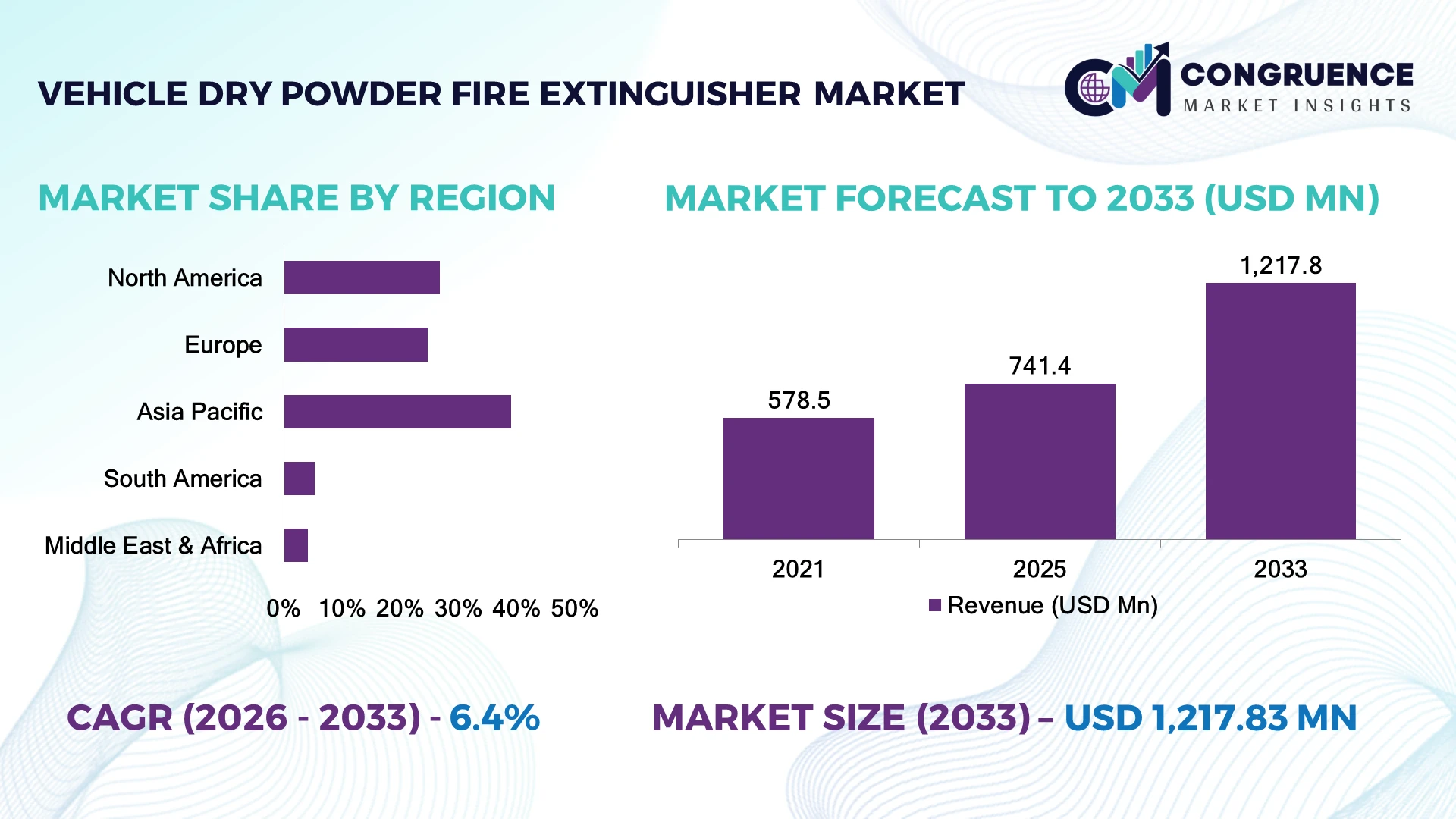
The Global Vehicle Dry Powder Fire Extinguisher Market was valued at USD 741.4 Million in 2025 and is anticipated to reach a value of USD 1,217.8 Million by 2033 expanding at a CAGR of 6.4% between 2026 and 2033. Growth is being driven by stricter vehicle fire safety regulations, rising commercial vehicle production, electric vehicle safety requirements, and mandatory onboard fire protection standards across transportation fleets.
China dominates the global Vehicle Dry Powder Fire Extinguisher market with an estimated 34% manufacturing share, supported by its extensive automotive production base, expanding electric vehicle industry, and large-scale fire safety equipment manufacturing ecosystem. Compared with Germany, which focuses on premium automotive safety systems, China supplies over 2.8 million commercial vehicle fire extinguishers annually while more than 62% of domestic manufacturers have upgraded automated filling and testing lines. Heightened geopolitical emphasis on supply-chain resilience since Red Sea shipping disruptions has further accelerated localized component sourcing and production investments.
Manufacturers strengthening certified production capacity, lightweight extinguisher technologies, and OEM partnerships are best positioned to capture long-term vehicle safety opportunities.
Market Size & Growth: USD 741.4 million (2025) to USD 1,217.8 million (2033) at 6.4% CAGR, supported by expanding vehicle safety regulations.
Top Growth Drivers: Commercial vehicle production (+31%), EV adoption (+27%), fleet safety compliance (+22%).
Short-Term Forecast: By 2028, lightweight extinguisher adoption increases 24% while maintenance costs decline 15%.
Emerging Technologies: Smart pressure indicators, corrosion-resistant cylinders, and IoT inspection systems improve operational reliability.
Regional Leaders: Asia-Pacific, Europe, and North America lead demand through automotive production and fleet modernization.
Consumer/End-User Trends: Nearly 64% of commercial fleet operators prioritize certified compact extinguishers with extended service intervals.
Pilot/Case Example: A 2026 fleet upgrade reduced inspection time by 21% using digitally monitored extinguishers.
Competitive Landscape: Top manufacturers collectively hold approximately 47% market share through OEM contracts and certified product portfolios.
Regulatory & ESG Impact: Enhanced fire safety regulations improved compliance rates by nearly 19% across commercial transport fleets.
Investment & Funding: More than USD 620 million supports automated manufacturing, testing facilities, and regional production expansion.
Innovation & Future Outlook: Smart diagnostics, lightweight alloys, and predictive maintenance continue reshaping vehicle fire protection.
Vehicle Dry Powder Fire Extinguisher demand is expanding across passenger vehicles, buses, trucks, mining equipment, and electric commercial fleets. Lightweight composite cylinders, digital pressure monitoring, and longer service intervals are becoming important product differentiators. Around 29% of newly introduced commercial vehicle safety products now integrate smart inspection features, while localized manufacturing strategies continue improving supply resilience and supporting the industry's transition toward advanced vehicle fire safety solutions.
Vehicle Dry Powder Fire Extinguishers have become strategically important as governments strengthen transportation safety regulations and vehicle manufacturers integrate higher fire protection standards across conventional and electric platforms. Fleet operators increasingly prioritize certified suppression systems that reduce operational risk, improve regulatory compliance, and enhance passenger safety. Localized manufacturing and supply-chain diversification are also reshaping procurement strategies following recent global logistics disruptions.
Modern lightweight aluminium-alloy and composite-cylinder extinguishers reduce installed weight by approximately 18% while improving corrosion resistance by nearly 30% compared with conventional steel-cylinder designs. China leads high-volume manufacturing through large automotive supply chains, whereas Germany emphasizes premium engineering, certification quality, and integration into advanced commercial vehicles. Over the next two to three years, digital inspection technologies and compact extinguisher designs are expected to become standard procurement criteria for fleet operators.
Commercial bus operators, logistics fleets, and mining vehicle manufacturers are expanding deployment of certified dry powder extinguishers supported by automated production, OEM partnerships, and digital maintenance systems. Manufacturers continue investing in smart pressure monitoring, lightweight materials, and enhanced testing capabilities to strengthen competitive positioning. Companies capable of combining regulatory compliance, durable engineering, and intelligent maintenance solutions will achieve stronger operational advantages in the evolving vehicle fire safety ecosystem.
Tighter vehicle fire safety regulations and expanding commercial fleet operations are accelerating adoption of dry powder fire extinguishers across passenger vehicles, trucks, buses, and off-highway equipment. Approximately 68% of newly procured commercial fleets now specify certified onboard extinguishers, while nearly 32% of fleet operators have upgraded fire safety equipment during scheduled vehicle replacement cycles. India's expanding freight transportation network and stricter commercial vehicle inspections are increasing certified product demand. This regulatory shift improves OEM integration rates and replacement sales simultaneously. Manufacturers are responding by expanding automated production facilities, developing lightweight extinguisher designs, and strengthening long-term partnerships with vehicle manufacturers and fleet operators. Competitive advantage increasingly depends on certification capability and OEM-approved product portfolios rather than standalone aftermarket sales.
Volatility in steel, aluminium, monoammonium phosphate, and nitrogen supply continues constraining production economics for vehicle dry powder fire extinguishers. Raw materials account for approximately 56% of manufacturing costs, while cylinder-grade steel prices have fluctuated by nearly 18% across recent procurement cycles. European manufacturers also face higher certification and testing expenses that increase production lead times. These structural cost pressures reduce pricing flexibility and compress supplier margins, particularly within price-sensitive commercial fleet markets. Companies are mitigating risks by localizing component sourcing, negotiating long-term procurement contracts, investing in automated manufacturing, and adopting alternative lightweight materials. Operational resilience increasingly depends on diversified supplier networks rather than reliance on single-country procurement strategies.
Digital inspection technologies and connected fleet maintenance platforms are creating significant opportunities beyond conventional fire suppression products. Nearly 36% of fleet operators are evaluating extinguishers equipped with digital pressure monitoring and predictive maintenance capabilities, while automated inspection systems reduce servicing time by approximately 28%. Japan is encouraging intelligent commercial vehicle safety technologies through broader transport modernization initiatives. Manufacturers are investing in IoT-enabled monitoring devices, QR-based maintenance tracking, and strategic collaborations with fleet management software providers. A non-obvious opportunity lies in converting regulatory compliance from a maintenance cost into a data-driven asset management function that improves fleet uptime and reduces unnecessary extinguisher replacement cycles.
Meeting diverse certification requirements across international automotive markets remains a major execution challenge for manufacturers seeking global expansion. Approximately 41% of exporters modify products to satisfy country-specific fire safety standards, increasing engineering costs by nearly 19% and extending certification timelines by approximately 23%. Vehicle electrification introduces additional testing requirements for extinguisher compatibility with high-voltage vehicle architectures. These evolving technical standards complicate product standardization and production planning. Manufacturers must strengthen testing infrastructure, invest in internationally recognized certification capabilities, and collaborate with automotive OEMs during product development. Long-term competitiveness will depend on delivering globally compliant products without increasing manufacturing complexity or extending commercialization timelines.
Lightweight Cylinder Adoption Accelerates: Manufacturers are replacing conventional steel cylinders with aluminium and composite alternatives, reducing extinguisher weight by approximately 18% while improving corrosion resistance by nearly 30%. Commercial fleet operators increasingly prioritize lighter safety equipment to improve vehicle efficiency, prompting suppliers to expand automated lightweight production capacity.
Digital Maintenance Gains Momentum: QR-enabled inspection systems and digital maintenance records now support approximately 34% of newly deployed commercial fleet extinguishers, reducing inspection time by nearly 26%. Increasing regulatory documentation requirements are encouraging manufacturers to integrate smart identification technologies and partner with fleet management software providers for streamlined compliance.
OEM Supply Contracts Expand: Vehicle manufacturers increasingly source certified extinguishers directly through long-term supplier agreements, with OEM procurement volumes increasing by approximately 21% and standardized installation rates exceeding 65% in new commercial vehicles. Companies are strengthening manufacturing automation and regional production facilities to secure high-volume automotive contracts amid evolving supply-chain localization strategies.
Higher Performance Dry Powders: Advanced monoammonium phosphate formulations improve extinguishing efficiency by approximately 17% while extending service intervals by nearly 20%. A less obvious market shift is the growing emphasis on lifecycle maintenance costs rather than purchase price alone. Manufacturers are investing in enhanced filling technologies, precision quality testing, and performance-certified product portfolios to strengthen long-term fleet relationships.
ABC dry powder fire extinguishers account for approximately 61% of the global Vehicle Dry Powder Fire Extinguisher market owing to their ability to suppress Class A, B, and C fires, making them the preferred choice for passenger cars, commercial vehicles, and fleet operators. Their broad fire suppression capability, competitive cost, and compliance with international automotive safety standards support widespread OEM and aftermarket adoption. BC dry powder extinguishers continue serving specialized applications involving flammable liquids and fuel systems but represent a comparatively mature segment with slower replacement cycles.
Compact ABC dry powder extinguishers are also the fastest-growing type as electric commercial vehicles, logistics fleets, and public transport operators increasingly prioritize multi-hazard protection within limited cabin space. Lightweight cylinder designs improve installation flexibility by approximately 21%, while automated manufacturing has reduced production defects by nearly 17%. Manufacturers are investing in higher-performance extinguishing agents, corrosion-resistant cylinders, and OEM partnerships to strengthen product portfolios. Investment priorities are steadily shifting toward compact, certified, and maintenance-efficient fire suppression solutions that satisfy increasingly stringent automotive safety requirements.
According to a 2026 enterprise fleet safety assessment by the National Fire Protection Association (NFPA), multi-purpose ABC dry powder extinguishers remain the preferred onboard fire protection solution for commercial road transport because of their broad extinguishing capability and regulatory acceptance.
Commercial vehicles represent the largest application segment with approximately 48% market share due to mandatory onboard fire safety regulations, higher vehicle utilization rates, and expanding logistics networks. Trucks, buses, mining vehicles, and hazardous goods carriers require certified fire extinguishers as standard safety equipment, creating sustained replacement demand throughout operational lifecycles. Passenger vehicles remain a stable market supported by safety awareness and national regulatory requirements, while emergency response and specialty vehicles increasingly specify premium certified suppression systems.
Electric vehicles represent the fastest-growing application as manufacturers strengthen fire safety systems around lithium-ion battery protection and high-voltage architectures. Fire safety equipment integration has increased by nearly 29% in newly launched commercial EV platforms, while demand for lightweight extinguishers has risen by approximately 24% among fleet operators seeking weight optimization. Companies are expanding OEM integration programmes, enhancing product certification, and introducing compact designs compatible with modern vehicle interiors. Demand is shifting toward application-specific fire protection that combines operational efficiency with evolving automotive safety standards.
A 2025 commercial transportation safety survey conducted by the International Road Transport Union (IRU) indicated that fleet operators increasingly prioritize certified onboard fire suppression equipment as part of preventive vehicle safety and risk management programmes.
Commercial fleet operators account for approximately 52% of total market demand due to large vehicle populations, regulatory inspection requirements, and scheduled maintenance programmes. Logistics companies, passenger transport providers, construction contractors, and mining operators replace extinguishers periodically to maintain operational compliance and minimize safety risks. Original Equipment Manufacturers (OEMs) remain a significant purchasing group by integrating certified extinguishers during vehicle assembly, while individual vehicle owners primarily contribute through the aftermarket replacement segment.
OEMs represent the fastest-growing end-user category as vehicle manufacturers increasingly standardize onboard fire protection across conventional and electric vehicle platforms. Factory-installed extinguisher integration has expanded by approximately 27%, while procurement through long-term supplier agreements has increased by nearly 22%. Manufacturers are responding through customized product designs, co-development partnerships, and automated supply programmes aligned with automotive production schedules. Competitive positioning increasingly depends on certification quality, production reliability, and the ability to support global vehicle manufacturing operations.
A 2026 automotive supplier procurement study published by the International Organization of Motor Vehicle Manufacturers (OICA) highlighted that vehicle manufacturers are increasingly incorporating certified fire safety equipment during factory assembly to improve regulatory compliance, operational consistency, and occupant protection.
Asia-Pacific accounted for the largest market share at 39.1% in 2025 however, Middle East & Africa is expected to register the fastest growth, expanding at a CAGR of 7.3% between 2026 and 2033.
Fleet Safety Compliance Strengthens OEM Integration
North America represents approximately 26.8% of the global Vehicle Dry Powder Fire Extinguisher market, supported by mature automotive manufacturing, stringent commercial vehicle safety regulations, and high fleet replacement rates. Commercial transport, school buses, mining vehicles, and emergency response fleets continue driving demand for certified onboard fire protection systems. More than 63% of heavy-duty fleet procurement programmes now specify factory-approved dry powder extinguishers as standard equipment. Vehicle manufacturers are expanding supplier partnerships to integrate lightweight, corrosion-resistant extinguishers into production lines, while automated inspection and digital maintenance tracking are improving fleet compliance and reducing service downtime across large transportation operators.
United States Market Outlook: The United States dominates the regional market through its extensive commercial trucking industry, strong OEM production base, and comprehensive vehicle safety compliance framework. Fleet operators increasingly standardize certified fire extinguishers across logistics and public transportation assets, with nearly 69% of newly procured heavy commercial vehicles incorporating factory-installed fire suppression equipment. Investments in connected fleet management platforms are also encouraging adoption of digitally traceable inspection and maintenance solutions.
Regulatory Standardization Drives Premium Safety Solutions
Europe remains a technologically advanced market where vehicle fire protection is closely aligned with stringent product certification, sustainability objectives, and commercial transport safety regulations. The region accounts for approximately 24.7% of global demand, supported by established automotive manufacturing and high replacement rates in commercial fleets. Manufacturers increasingly deploy lightweight aluminium cylinders and recyclable components while expanding automated quality testing. Standardized compliance requirements encourage suppliers to deliver high-performance extinguishers with extended service intervals, improving operational efficiency for fleet operators across multiple transport sectors.
Germany Market Outlook: Germany leads the European market through its globally recognised automotive manufacturing ecosystem and advanced commercial vehicle production capabilities. Premium OEMs increasingly integrate compact certified extinguishers during vehicle assembly, while commercial fleet operators prioritize products offering lower maintenance requirements. More than 61% of commercial vehicle manufacturers have increased sourcing of lightweight fire safety equipment to improve efficiency and support evolving vehicle design standards.
Manufacturing Scale Accelerates Global Supply Leadership
Asia-Pacific leads the global Vehicle Dry Powder Fire Extinguisher market with approximately 39.1% share, supported by high automotive production volumes, competitive manufacturing costs, and expanding commercial transportation networks. China, India, Japan, and South Korea continue strengthening regional production capacity through automated manufacturing and localized supply chains. Nearly 58% of global vehicle dry powder extinguisher production is concentrated within Asia-Pacific, enabling efficient exports and competitive pricing. Manufacturers are investing in automated filling systems, precision testing facilities, and OEM supply agreements to strengthen production efficiency and international competitiveness.
China Market Outlook: China remains the world's largest manufacturing hub for vehicle fire safety equipment, supported by its extensive automotive supply chain and expanding electric vehicle industry. Domestic manufacturers continue increasing production automation while strengthening exports to emerging automotive markets. More than 65% of large production facilities now operate automated cylinder filling and testing systems, improving manufacturing consistency and supporting high-volume OEM supply contracts.
Commercial Transport Modernization Supports Demand
South America continues experiencing stable demand as governments strengthen vehicle inspection programmes and commercial fleet operators modernize transportation assets. Brazil, Argentina, and Chile remain key markets where logistics expansion and mining activities sustain replacement demand for certified dry powder extinguishers. Approximately 46% of fleet safety upgrades now include replacement of onboard fire protection equipment as part of scheduled vehicle maintenance. Manufacturers are strengthening distributor partnerships and regional warehousing while balancing infrastructure constraints and certification differences across national markets.
Brazil Market Outlook: Brazil represents the largest regional market owing to its sizeable commercial transport industry, growing agricultural logistics sector, and domestic automotive manufacturing capacity. Fleet operators increasingly adopt standardized fire safety equipment across long-haul trucks and passenger buses to improve operational compliance. Nearly 54% of commercial fleet procurement programmes now specify certified extinguishers meeting updated national transport safety requirements.
Infrastructure Expansion Fuels Safety Investments
The Middle East & Africa market is benefiting from expanding transport infrastructure, fleet modernization, and stricter industrial safety standards across logistics, construction, mining, and public transportation sectors. Government-backed investment in road transport and urban mobility projects is increasing demand for certified onboard fire protection systems. Approximately 37% of new commercial fleet acquisitions across major Gulf economies include upgraded fire safety equipment specifications. Manufacturers are expanding regional distribution networks, strengthening local partnerships, and increasing inventory availability to improve delivery efficiency and regulatory compliance.
United Arab Emirates Market Outlook: The United Arab Emirates leads regional adoption through continuous investment in transport infrastructure, commercial vehicle fleets, and advanced logistics operations. Fleet operators serving aviation, ports, oil and gas, and public transportation increasingly specify internationally certified vehicle fire extinguishers. More than half of newly registered commercial fleet projects incorporate enhanced fire safety equipment, reflecting the country's emphasis on operational resilience, regulatory compliance, and high-standard transportation infrastructure.
Global fire protection manufacturers such as Amerex, Kidde, Minimax, Ceasefire, and Safex compete with regional certified extinguisher producers, while OEM-approved suppliers challenge cost-focused aftermarket manufacturers for long-term vehicle contracts. The top five companies collectively account for approximately 46% of global market share. Competition centres on certification, product durability, manufacturing efficiency, and OEM integration rather than price alone. Automated production improves manufacturing consistency by nearly 19%, lightweight cylinder designs reduce installed weight by approximately 18%, and localized sourcing lowers delivery lead times by around 23%. Leading manufacturers are expanding production facilities, securing automotive OEM partnerships, introducing corrosion-resistant designs, and strengthening regional distribution networks. The competitive landscape is shifting toward integrated supply-chain control and certified product differentiation as regulatory requirements tighten. Stringent international certification, testing infrastructure, and established OEM relationships remain significant entry barriers. Winning requires certified quality, manufacturing scale, dependable supply chains, rapid customization, and long-term automotive partnerships.
Amerex Corporation
Kidde
Minimax GmbH
Ceasefire Industries
Safex Fire Services Ltd.
Buckeye Fire Equipment
Badger Fire Protection
NAFFCO
Kanex Fire
Fire Shield
Strike First Corporation
Firechief Global
Gielle Industries
Advanced monoammonium phosphate formulations, lightweight aluminium cylinders, and corrosion-resistant coatings represent the core technologies shaping vehicle dry powder fire extinguishers. Modern automated filling and pressure-testing systems improve production consistency by approximately 18%, while nearly 64% of newly manufactured commercial vehicle extinguishers now incorporate high-durability powder formulations and enhanced anti-corrosion finishes. These technologies extend operational reliability and reduce maintenance requirements for fleet operators operating in demanding environments.
Emerging innovations include composite cylinders, digital pressure indicators, QR-enabled maintenance tracking, and IoT-supported inspection platforms. Compared with conventional steel-cylinder products, lightweight composite designs reduce installed weight by approximately 22% while improving corrosion resistance by nearly 30%. Large commercial fleet operators and automotive OEMs benefit most from these technologies through lower maintenance costs, simplified inspections, and improved regulatory compliance. Manufacturers are integrating automated traceability and predictive maintenance features to differentiate premium product portfolios.
Between 2026 and 2028, intelligent inspection systems, automated compliance reporting, and advanced extinguishing powder formulations will become key competitive differentiators. Digital lifecycle management is expected to support more than 40% of commercial fleet maintenance programmes, strengthening asset visibility and reducing service interruptions. Manufacturers investing in smart product identification, automated production, and globally certified testing capabilities will strengthen OEM relationships, improve export competitiveness, and secure higher-value fleet contracts as vehicle safety standards continue evolving.
January 2024 Amerex announced a strategic partnership with a leading automotive manufacturer to integrate fixed fire suppression systems into commercial vehicle platforms, strengthening OEM safety integration across fleet vehicles.
November 2025 Amerex achieved full FM 5970 compliance for its vehicle fire suppression systems after completing more than 200 fire flow and component evaluations, strengthening heavy-duty mobile equipment protection and expanding certified product flexibility. Source: Amerex Fire Systems
May 2025 AFEX Systems expanded technical capability by conducting its Global Distributor Training School, strengthening installer expertise and improving deployment quality for vehicle dry chemical fire suppression systems across international distribution channels
October 2025 AFEX Systems marked ten years of distribution partnership with Fluitek in Chile, reinforcing regional market coverage for heavy-vehicle fire suppression solutions and improving customer support across mining and industrial transport sectors. Source: AFEX Systems corporate announcement
This report provides a comprehensive assessment of the global Vehicle Dry Powder Fire Extinguisher market across product types, vehicle applications, end-user groups, and major geographic regions. It evaluates demand across ABC and BC dry powder extinguishers, passenger vehicles, commercial vehicles, emergency fleets, OEMs, fleet operators, and aftermarket channels. The study also examines deployment trends, regulatory compliance requirements, manufacturing capabilities, and competitive positioning across mature and emerging automotive markets.
The report further analyses lightweight cylinder technologies, advanced dry chemical formulations, automated manufacturing, digital inspection systems, and evolving certification standards influencing market development between 2026 and 2033. More than 60% of commercial vehicle procurement programmes now prioritize certified onboard fire protection as a standard safety requirement. Strategic insights support investment planning, manufacturing expansion, supplier evaluation, product portfolio optimization, competitive benchmarking, and regional growth strategies by identifying high-potential application areas, technology adoption trends, and evolving procurement priorities across the global automotive fire safety ecosystem.
| Report Attribute/Metric | Report Details |
|---|---|
|
Market Revenue in 2025 |
USD 741.4 Million |
|
Market Revenue in 2033 |
USD 1,217.8 Million |
|
CAGR (2026 - 2033) |
6.4% |
|
Base Year |
2025 |
|
Forecast Period |
2026 - 2033 |
|
Historic Period |
2021 - 2025 |
|
Segments Covered |
By Type
By Application
By End-User
|
|
Key Report Deliverable |
Revenue Forecast, Growth Trends, Market Dynamics, Segmental Overview, Regional and Country-wise Analysis, Competition Landscape |
|
Region Covered |
North America, Europe, Asia-Pacific, South America, Middle East, Africa |
|
Key Players Analyzed |
Amerex Corporation, Kidde, Minimax GmbH, Ceasefire Industries, Safex Fire Services Ltd., Buckeye Fire Equipment, Badger Fire Protection, NAFFCO, Kanex Fire, Fire Shield, Strike First Corporation, Firechief Global, Gielle Industries |
|
Customization & Pricing |
Available on Request (10% Customization is Free) |




