
Reports
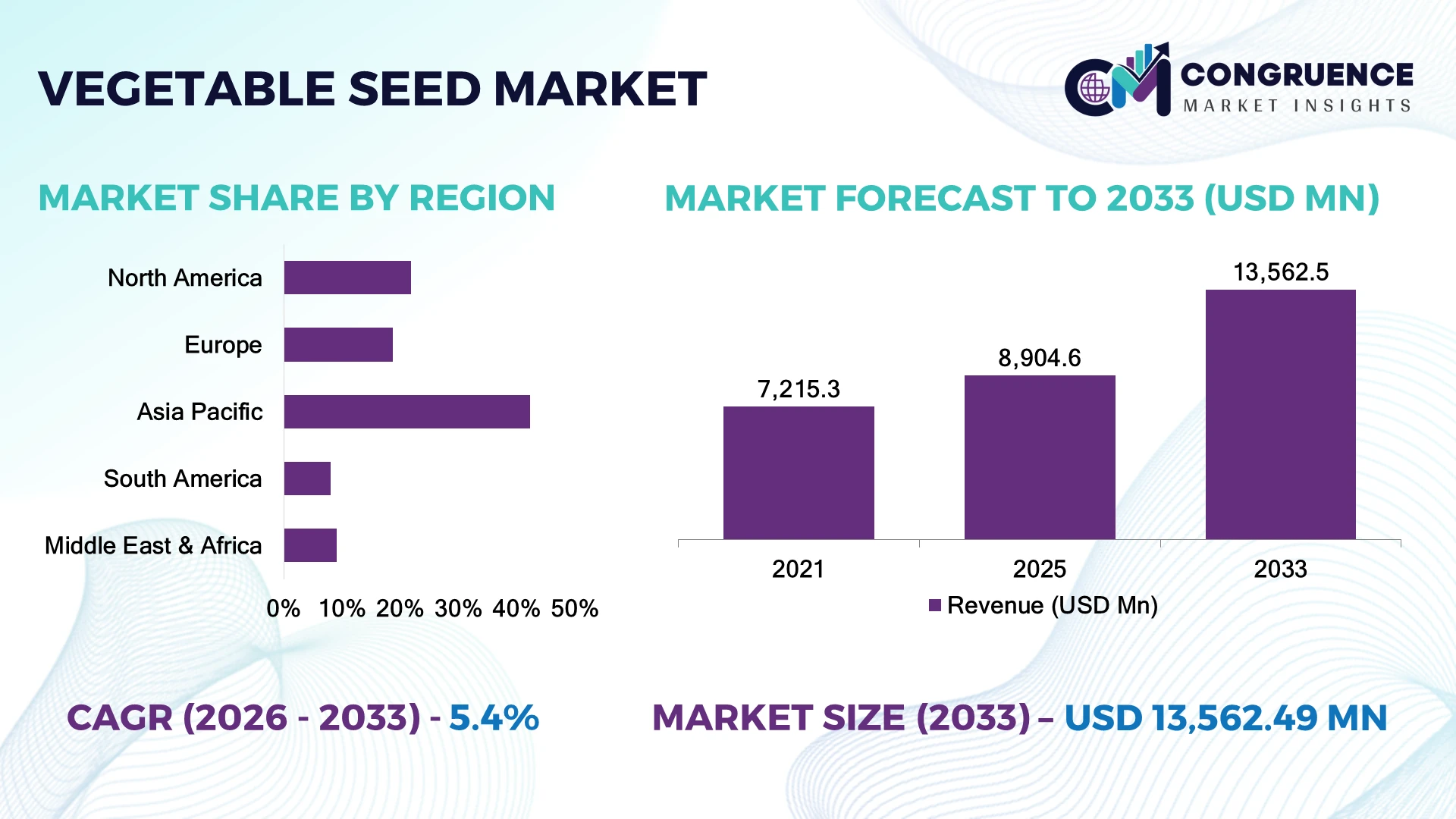
The Global Vegetable Seed Market was valued at USD 8,904.6 Million in 2025 and is anticipated to reach a value of USD 13,562.5 Million by 2033 expanding at a CAGR of 5.4% between 2026 and 2033. Growth is being driven by hybrid seed adoption, protected cultivation, climate-resilient breeding, precision agriculture, and rising investment in disease-resistant vegetable varieties.
China remains the dominant vegetable seed production and consumption hub, supported by extensive vegetable acreage, seed-processing infrastructure, and intensive hybrid cultivation. China accounts for roughly 30% of global vegetable production, while India contributes about 15%, creating a substantial commercial base for seed suppliers. Protected cultivation and hybrid adoption are expanding particularly quickly in India, China, and Southeast Asia, while geopolitical supply-chain diversification is encouraging multinational seed companies to strengthen regional breeding and production networks.
Strategically, seed companies with localized breeding, climate-resilient genetics, and dependable regional multiplication capacity are best positioned to capture premium vegetable seed demand.
Market Size & Growth: USD 8,904.6 million in 2025 is projected to reach USD 13,562.5 million by 2033 at 5.4% CAGR, driven by hybridization and climate-resilient seed technology.
Top Growth Drivers: Hybrid seeds contribute roughly 38%, protected cultivation 24%, and disease-resistant varieties 19% to incremental demand momentum.
Short-Term Forecast: By 2028, precision breeding and digital seed selection can reduce variety-screening cycles by 15–25% while improving field-selection efficiency.
Emerging Technologies: CRISPR-assisted breeding, genomic selection, AI-enabled trait discovery, automated phenotyping, and seed-treatment technologies are reshaping product development.
Regional Leaders: Asia-Pacific could exceed USD 7.0 billion by 2033, Europe USD 2.4 billion, and North America USD 2.1 billion, with protected cultivation accelerating adoption.
Consumer/End-User Trends: Hybrid vegetable varieties account for more than 50% adoption in several intensive commercial-production systems, particularly for tomato, cucumber, pepper, and cabbage.
Pilot/Case Example: By 2026, automated phenotyping programs are targeting 20–30% faster trait evaluation, accelerating disease-resistance and heat-tolerance breeding pipelines.
Competitive Landscape: Syngenta leads premium commercial genetics, competing closely with Bayer, BASF, KWS, Limagrain, Rijk Zwaan, Sakata Seed, and Takii across hybrid and specialty varieties.
Regulatory & ESG Impact: Climate-resilient and disease-resistant varieties can reduce crop-protection requirements by approximately 10–20% in suitable production systems.
Investment & Funding: Global seed companies continue directing hundreds of millions of dollars toward breeding platforms, protected-cultivation genetics, biological treatments, and regional seed-production infrastructure.
Innovation & Future Outlook: The competitive focus is shifting toward gene-edited traits, heat tolerance, water efficiency, biological seed treatments, and locally adapted genetics as climate volatility intensifies.
The Vegetable Seed Market is expanding across tomato, onion, pepper, cucumber, cabbage, carrot, and leafy-vegetable production, with hybrid and disease-resistant varieties gaining priority. Hybrid seeds represent more than half of commercial adoption in several intensive production systems. AI-assisted breeding, genomic selection, biological seed treatments, and precision phenotyping are accelerating product development, while seed companies diversify multiplication networks amid global logistics and geopolitical disruptions.
Vegetable seeds are becoming a strategic agricultural input because genetic performance increasingly determines yield stability, disease resistance, resource efficiency, and farmer economics. Competition is shifting from basic varietal availability toward proprietary traits, localized genetics, and faster breeding cycles. In 2026, supply-chain resilience is also becoming critical as seed companies diversify production and processing across Asia, Europe, Africa, and the Americas rather than relying on concentrated multiplication networks.
Technology is widening the performance gap. Genomic selection and automated phenotyping can shorten breeding evaluation cycles by roughly 15–25% compared with conventional field-heavy screening, while precision seed treatment improves uniformity and early-stage crop establishment. Asia-Pacific remains the largest commercial production base, whereas Europe and North America emphasize premium genetics, protected cultivation, sustainability, and high-value specialty vegetables.
Over the next 2–3 years, commercial breeders will prioritize heat tolerance, water-use efficiency, disease resistance, and shorter maturity periods. A practical example is protected tomato and cucumber production, where growers increasingly combine hybrid genetics with controlled irrigation, fertigation, and environmental monitoring. Leading companies are therefore increasing localized breeding partnerships, expanding regional seed multiplication, and acquiring complementary genetics. Competitive advantage will increasingly depend on owning differentiated traits while maintaining reliable, climate-resilient seed supply.
Hybrid vegetable seed adoption is accelerating as commercial growers prioritize uniformity, disease resistance, and marketable yield. Hybrid varieties already represent more than 50% of commercial adoption in several intensive vegetable systems, while protected cultivation can improve water-use efficiency by 20–30%. India’s protected tomato and cucumber production is increasingly shifting toward high-performance hybrids, while Chinese growers emphasize short-duration and disease-tolerant varieties. Seed companies are responding by expanding localized breeding programs, genomic selection platforms, and regional multiplication partnerships. The non-obvious advantage is faster crop-cycle standardization: uniform hybrids simplify harvesting and grading, reducing labor-intensive sorting requirements by approximately 10–15%. Companies controlling proprietary genetics therefore capture value beyond seed sales through stronger grower retention and premium positioning.
Vegetable seed production remains exposed to labor, irrigation, processing, and specialized pollination costs, particularly for hybrid varieties. Manual field operations can represent 25–35% of multiplication costs in labor-intensive production systems, while climate variability can increase field-production losses by 10–20% during adverse seasons. India, Thailand, China, and selected African production zones face periodic disruptions from water availability, extreme temperatures, and logistics constraints. Companies are responding through multi-country seed multiplication, contract-growing agreements, controlled environments, and strategic inventory buffers. A less visible pressure is quality deterioration from extended storage or repeated handling, which can increase rejection rates by 5–10%. Greater localization of processing and tighter seed-lot traceability are therefore becoming margin-protection strategies rather than simple supply-chain improvements.
Climate-resilient genetics create significant opportunities in heat-stressed and water-constrained vegetable production. Heat-tolerant, drought-resilient, and disease-resistant varieties can reduce crop losses by approximately 15–25% under suitable conditions, while precision breeding can shorten trait-screening cycles by 15–25%. India, Mexico, Brazil, and parts of Southeast Asia offer particularly attractive deployment environments because protected cultivation and irrigation modernization are expanding simultaneously. Companies are increasing investment in genomic selection, automated phenotyping, gene-editing research, and partnerships with growers to validate localized traits. An underdeveloped opportunity lies in region-specific seed portfolios: varieties optimized for narrow climatic and soil conditions can command 10–20% higher value than broadly marketed genetics because they directly address production-risk economics.
Vegetable breeding increasingly requires simultaneous optimization of yield, flavor, shelf life, disease resistance, heat tolerance, and transport durability, making trait stacking technically complex. Advanced breeding programs can involve 5–10 major trait-selection parameters per commercial variety, while field-validation requirements can extend development workflows across multiple growing environments. India and Brazil face additional pressure from fragmented farm structures, creating inconsistent trial conditions and slower commercial feedback. Companies must integrate genomic databases, automated phenotyping, controlled-environment trials, and grower networks to improve selection accuracy. The strategic challenge is not simply developing superior genetics but proving consistent performance across production systems. Companies that reduce multi-location validation time by 15–20% gain a meaningful launch advantage while lowering the risk of expensive variety failures.
AI Accelerates Trait Selection: AI-assisted phenotyping and genomic analytics are increasingly screening thousands of plant characteristics simultaneously, reducing selected breeding workflows by 15–25%. Companies are integrating machine vision with field datasets to identify disease, maturity, and stress-response traits faster, while labor-intensive visual scoring declines.
Protected Cultivation Changes Genetics: Greenhouse and net-house production is expanding in India, China, Mexico, and Turkey, with controlled environments improving water-use efficiency by roughly 20–30%. Seed developers are consequently prioritizing compact growth, uniform fruiting, and temperature tolerance rather than optimizing solely for open-field conditions.
Seed Treatment Becomes More Biological: Biological coatings, microbial inoculants, and precision priming are gaining adoption as growers seek stronger emergence with reduced chemical dependency. Advanced treatment systems can improve early establishment by approximately 10–15%, encouraging seed companies to bundle genetics with biological inputs and technical agronomy services.
Supply Networks Become More Distributed: Geopolitical disruptions and climate-related production volatility are pushing multinational breeders to diversify seed multiplication across multiple countries. Regional production redundancy can reduce selected supply interruptions by 15–20%, while companies increasingly maintain parallel processing, storage, and quality-testing capabilities closer to major commercial growing markets.
Hybrid Seeds Strengthen Commercial Dominance
Hybrid vegetable seeds account for approximately 58–62% of the global market, supported by superior uniformity, disease resistance, yield consistency, and suitability for commercial production. Their stronger performance in tomato, cucumber, pepper, cabbage, and brassica cultivation makes them particularly attractive to intensive growers. Open-pollinated seeds retain roughly 30–34% share because of lower upfront cost, seed-saving potential, and relevance among smallholders. Genetically modified vegetable seeds remain a niche category at below 5%, constrained by regulatory approval and consumer acceptance. Hybrid adoption is particularly strong in China, India, Mexico, and Turkey, where commercial growers increasingly combine improved genetics with protected cultivation.
The fastest-growing shift is toward specialty hybrids incorporating heat tolerance, disease resistance, longer shelf life, and water-efficiency traits. Premium trait packages can command 10–20% higher seed pricing, encouraging breeders to increase R&D allocation toward localized genetics. Companies are expanding regional breeding stations, partnering with growers for multi-location trials, and acquiring proprietary germplasm to strengthen differentiated portfolios.
The International Seed Federation reported in 2025 that hybridization and advanced breeding remain central to commercial vegetable seed innovation, with disease resistance, climate adaptation, and productivity among leading breeding priorities.
Fruit and Fruiting Vegetables Anchor Seed Demand
Fruit and fruiting vegetables represent approximately 42–45% of global vegetable seed demand, led by tomato, pepper, cucumber, eggplant, and related crops requiring intensive varietal selection. Their dominance reflects high commercial value per hectare, frequent hybrid use, and strong demand from fresh-produce and protected-cultivation systems. Leafy vegetables contribute roughly 20–23%, while root and bulb vegetables account for around 18–21%. Brassicas and other specialty vegetables maintain smaller but strategically important positions.
Protected cultivation is accelerating demand for premium fruiting-vegetable genetics, making this the fastest-growing application segment. Greenhouse tomato and cucumber growers increasingly prioritize compact architecture, uniform maturity, extended shelf life, and resistance to multiple pathogens. Advanced varieties can improve marketable yield by approximately 10–20% under optimized conditions. Seed companies are responding through greenhouse-specific breeding, precision phenotyping, and partnerships with commercial growers in India, China, Mexico, Spain, and Turkey. The business opportunity is shifting toward application-specific genetics rather than one-size-fits-all varieties.
FAO's recent agricultural assessments continue to identify vegetables as high-value crops where improved varieties, protected cultivation, efficient irrigation, and better production practices materially influence productivity and resource efficiency.
Commercial Growers Drive Premium Seed Adoption
Commercial growers account for approximately 55–60% of global vegetable seed demand because large-scale farms, greenhouse operators, and organized horticultural enterprises purchase hybrid varieties repeatedly and prioritize predictable yield and uniformity. Smallholder farmers represent roughly 35–40%, retaining strong demand for affordable open-pollinated and locally adapted varieties. Institutional and specialized growers comprise the remaining share but increasingly influence premium breeding requirements through contract farming and controlled-environment production.
Commercial greenhouse operators are the fastest-growing end-user group, particularly in China, India, Mexico, Spain, and Turkey. Their seed expenditure per hectare can be 15–25% higher than conventional open-field production because genetic performance directly affects crop cycles, grading, and contract fulfillment. Companies are responding with customized variety portfolios, agronomic support, demonstration farms, and direct partnerships with large growers. Smallholder-focused suppliers are emphasizing smaller pack sizes, localized varieties, and distributor networks. The competitive shift favors companies capable of serving both high-volume commercial accounts and fragmented growers without compromising seed quality or technical support.
The International Seed Federation's 2025 industry priorities emphasize farmer access to improved genetics, locally adapted varieties, and technologies that strengthen productivity and resilience across commercial and smallholder production systems.
Asia-Pacific accounted for the largest market share at 42.3% in 2025 however, Middle East & Africa is expected to register the fastest growth, expanding at a CAGR of 6.2% between 2026 and 2033.

Precision breeding shifts competition toward proprietary genetics
North America accounted for approximately 21.8% of the global vegetable seed market in 2025, supported by commercial farming, greenhouse production, advanced breeding infrastructure, and strong demand for premium hybrid varieties. The United States represents the dominant market, with California, Florida, and Arizona serving as major vegetable production centers. Hybrid adoption exceeds 60% across several commercially important vegetable categories, particularly tomatoes, peppers, and cucurbits. Breeders are integrating genomic selection, automated phenotyping, and disease-resistance screening to shorten variety development cycles by approximately 15–25%. Controlled-environment agriculture is also strengthening demand for compact, uniform varieties engineered for specific production systems. Seed companies are expanding proprietary breeding programs and partnering directly with greenhouse operators to accelerate field validation. Supply-chain localization is gaining importance as companies seek greater control over seed multiplication, processing, and inventory availability.
United States Market Outlook: The United States remains North America's principal vegetable seed market because of its large-scale commercial farms, sophisticated greenhouse operations, and established seed distribution infrastructure. California alone accounts for a substantial share of U.S. vegetable production, creating concentrated demand for high-performance genetics. Commercial growers increasingly prioritize varieties with resistance to soil-borne pathogens, heat tolerance, and extended shelf life. Premium hybrid varieties can command 15–25% higher seed pricing where improved yield consistency and reduced crop losses justify the additional input cost. Companies are strengthening grower trials and regional breeding programs to improve local adaptation.
Sustainability requirements reshape premium seed portfolios
Europe represented approximately 18.7% of the global vegetable seed market in 2025, supported by intensive horticulture, protected cultivation, high-value fresh produce, and sophisticated seed-processing infrastructure. Spain, Italy, France, the Netherlands, and Germany are key production and technology centers. European growers increasingly prioritize disease resistance, water efficiency, biological compatibility, and reduced chemical dependence. Protected cultivation accounts for a particularly important demand channel in the Netherlands and Spain, where controlled environments require highly uniform varieties. Advanced breeding and digital phenotyping can reduce selected screening requirements by 15–20%. Seed companies are responding with climate-adapted genetics, biological seed treatments, and partnerships with greenhouse operators. Regulatory emphasis on sustainability is also shifting R&D toward varieties that maintain productivity under lower-input production systems.
Netherlands Market Outlook: The Netherlands is strategically important because its greenhouse horticulture ecosystem combines advanced seed genetics, controlled-environment infrastructure, automation, and global vegetable technology expertise. High-value tomato, cucumber, and pepper production creates strong demand for varieties optimized for greenhouse conditions rather than conventional open fields. Commercial growers increasingly use sensor-controlled climate and fertigation systems alongside specialized genetics, improving resource-use efficiency by approximately 20–30% in optimized facilities. Seed companies benefit from close collaboration with greenhouse operators, allowing rapid testing of new traits and accelerated commercialization of premium varieties.
Production scale accelerates hybrid and localized genetics
Asia-Pacific held approximately 42.3% of the global vegetable seed market in 2025, supported by China's massive vegetable production base, India's expanding horticulture sector, and sophisticated seed industries in Japan and South Korea. China remains the largest regional demand center, while India is rapidly increasing commercial hybrid adoption. Hybrid varieties account for more than 55% of commercial seed usage in several intensive production systems. Protected cultivation, drip irrigation, fertigation, and digital crop monitoring are increasing demand for varieties designed around specific growing environments. Seed companies are expanding breeding stations and multiplication partnerships in China, India, Thailand, and Southeast Asia. Localized breeding is particularly important because temperature, disease pressure, and cropping cycles vary significantly between production zones.
China Market Outlook: China represents the region's largest vegetable production and seed consumption base, supported by extensive commercial cultivation and sophisticated seed-processing infrastructure. Intensive production clusters in Shandong, Guangdong, Jiangsu, and Yunnan generate substantial demand for high-yield hybrid vegetables. Breeders increasingly prioritize disease resistance, compact plant architecture, and shorter maturity periods suited to intensive cropping. Hybrid adoption above 60% in several commercial vegetable categories is encouraging seed suppliers to expand proprietary genetics, local trial networks, and contract multiplication capacity. China also remains an important seed-production base for multinational companies serving Asian markets.
Commercial horticulture drives premium hybrid adoption
South America accounted for approximately 8.1% of global vegetable seed demand in 2025, with Brazil representing the dominant commercial market. Tomatoes, onions, peppers, brassicas, and leafy vegetables generate significant demand from commercial farms and organized horticultural producers. Hybrid adoption is strongest in higher-value crops, where improved uniformity and disease resistance directly influence marketable yield. Brazil's protected-cultivation footprint is expanding around major agricultural and urban consumption centers, supporting demand for specialized genetics. Premium varieties can deliver approximately 10–20% higher marketable output under optimized production conditions. Companies are strengthening local distribution, demonstration plots, and agronomic partnerships to address fragmented farm structures and variable production conditions. Currency volatility and imported-input exposure remain important operational considerations for seed suppliers.
Brazil Market Outlook: Brazil is the region's key vegetable seed market because of its large agricultural economy, extensive commercial farming network, and year-round vegetable production potential across diverse climates. São Paulo, Minas Gerais, Paraná, and other established horticultural areas support concentrated demand for hybrid tomato, onion, pepper, and brassica varieties. Growers increasingly prioritize genetics with resistance to tropical diseases and heat stress. Seed companies are expanding local trials and distributor partnerships to improve varietal adaptation, while premium hybrids increasingly command 10–15% pricing advantages where they deliver stronger uniformity and harvest consistency.
Controlled-environment agriculture strengthens seed demand
Middle East & Africa represented approximately 9.1% of global vegetable seed demand in 2025, with Saudi Arabia, the United Arab Emirates, Turkey, Egypt, Morocco, and South Africa representing important commercial markets. Water scarcity and harsh climatic conditions are accelerating protected cultivation, hydroponics, precision irrigation, and climate-adapted seed adoption. Greenhouse operators increasingly require varieties optimized for high temperatures, salinity, shorter growing cycles, and controlled environments. Premium hybrid varieties can generate 15–25% higher commercial value when combined with optimized irrigation and protected production. Gulf countries are investing in large-scale controlled-environment agriculture, while North African producers remain important export-oriented vegetable suppliers. Seed companies are responding through localized trials, climate-resilient breeding, technical partnerships, and regional distribution infrastructure.
Saudi Arabia Market Outlook: Saudi Arabia is emerging as a strategically important market because food-security programs are accelerating greenhouse horticulture, precision irrigation, and domestic vegetable production. Controlled-environment farms increasingly rely on hybrid varieties selected for heat tolerance, compact growth, and water efficiency. Advanced greenhouse systems can reduce water consumption by more than 50% compared with conventional open-field production for selected crops, increasing the value of genetics optimized for controlled environments. Seed companies are strengthening partnerships with greenhouse developers and agricultural technology providers to develop varieties suited to high-temperature and water-constrained production conditions.
Syngenta, Bayer, BASF | Nunhems, Limagrain, and Rijk Zwaan compete as global breeding leaders, while Sakata, Enza Zaden, East-West Seed, and regional specialists compete through crop-specific genetics and local distribution. The top five players hold an estimated 35% combined share. Competition centers on proprietary traits, breeding speed, quality, localization, and supply reliability: advanced breeding can shorten selection cycles 15–25%, premium hybrids command 10–20% higher pricing, and localized multiplication can reduce supply disruptions 15–20%. Global leaders are expanding breeding stations, acquiring regional germplasm, and building seed-health infrastructure; regional specialists counter with locally adapted varieties and faster grower feedback. The competitive shift is toward climate-resilient genetics, digital phenotyping, controlled-environment varieties, and supply-chain control. Entry barriers remain high because germplasm libraries, regulatory approvals, multi-location trials, and breeder expertise require sustained investment. Winning requires differentiated genetics, rapid commercialization, local adaptation, and dependable seed availability.
Syngenta Group
Bayer
BASF
Limagrain
Rijk Zwaan
Enza Zaden
Sakata Seed Corporation
Takii & Co.
East-West Seed
Groupe Vilmorin & Cie
HM.CLAUSE
Namdhari Seeds
Maharashtra Hybrid Seeds Company (Mahyco)
VNR Seeds
Genomic selection, automated phenotyping, doubled-haploid breeding, and marker-assisted selection are moving commercial breeding beyond conventional field screening. Advanced platforms can shorten selected breeding cycles by 15–25% while improving trait-selection accuracy. Adoption is strongest among multinational breeders with extensive germplasm libraries, where digital datasets increasingly connect greenhouse trials, disease screening, and field performance. This improves launch speed and reduces costly late-stage variety failures.
AI-enabled image analysis and controlled-environment phenotyping are becoming important for evaluating thousands of plants against disease, maturity, plant architecture, and stress-response traits. Compared with manual scoring, automated phenotyping can improve evaluation throughput by roughly 20–30%. Bayer, Syngenta, and Rijk Zwaan are positioned to benefit from integrating breeding data with greenhouse infrastructure and grower feedback. Seed-health diagnostics are also becoming more sophisticated, supporting earlier pathogen detection and reducing quality-control risks by approximately 10–15%.
From 2026–2028, gene editing, predictive breeding, digital trial management, and climate-controlled breeding environments will increasingly converge. Gene-edited and precision-bred traits can accelerate development of heat tolerance, disease resistance, and resource efficiency, while localized datasets improve regional adaptation. Companies combining proprietary germplasm with AI, automation, and controlled-environment testing gain a measurable commercialization advantage. The competitive priority is shifting from simply discovering superior genetics to converting biological data into commercially validated varieties faster and more reliably.
May 2025 Syngenta Vegetable Seeds opened a $9 million Seed Health Lab in Enkhuizen, Netherlands, adding advanced testing capacity to its global quality network. The facility strengthens pathogen screening and seed-quality assurance, supporting reliable international production and distribution. Source: syngentavegetables.com
June 2025 Enza Zaden opened a 2-hectare R&D expansion in Enkhuizen, including a high-tech cucumber breeding greenhouse and sustainable energy center. The investment expands breeding capacity, supports specialized variety development, and strengthens long-term operational infrastructure for commercial seed innovation. Source: enzazaden.com
July 2025 DENSO acquired Axia Vegetable Seeds, a Dutch tomato-breeding company serving greenhouse growers globally. The transaction expands DENSO’s AgriTech presence and combines industrial technology with specialized genetics, strengthening data-driven cultivation and controlled-environment vegetable production capabilities. Source: syngentagroupventures.com
July 2025 Sakata Seed acquired Agritu Sementes in Brazil for 63 million Brazilian real, strengthening its onion-seed business. The transaction adds local breeding, production, and distribution capabilities in Santa Catarina, expanding Sakata’s portfolio and supporting South American market penetration. Source: sakataseed.co.jp
The Vegetable Seed Market Report covers hybrid, open-pollinated, and specialty or advanced seed types across fruiting vegetables, leafy vegetables, root and bulb vegetables, brassicas, and other commercial crops. Application analysis includes open-field cultivation, protected cultivation, greenhouse production, processing, and specialty horticulture, while end-user coverage spans commercial growers, smallholders, greenhouse operators, and institutional producers. The study evaluates hybrid adoption exceeding 50% in several intensive commercial systems and assesses emerging climate-resilient genetics.
Regional analysis covers North America, Europe, Asia-Pacific, South America, and Middle East & Africa, with country-level assessment of production, breeding, distribution, and technology adoption. Key technologies include genomic selection, AI-assisted phenotyping, gene editing, biological seed treatment, automated seed health testing, and controlled-environment breeding. The report supports investment planning, regional expansion, portfolio prioritization, partnership strategy, competitive benchmarking, and technology decisions through 2026–2033.
| Report Attribute/Metric | Report Details |
|---|---|
Market Revenue in 2025 | USD 8904.6 Million |
Market Revenue in 2033 | USD 13562.4859872374 Million |
CAGR (2026 - 2033) | 5.4% |
Base Year | 2025 |
Forecast Period | 2026 - 2033 |
Historic Period | 2021 - 2025 |
Segments Covered | By Type
By Application
By End-User
|
Key Report Deliverable | Revenue Forecast, Growth Trends, Market Dynamics, Segmental Overview, Regional and Country-wise Analysis, Competition Landscape |
Region Covered | North America, Europe, Asia-Pacific, South America, Middle East, Africa |
Key Players Analyzed | Syngenta Group, Bayer, BASF, Limagrain, Rijk Zwaan, Enza Zaden, Sakata Seed Corporation, Takii & Co., East-West Seed, Groupe Vilmorin & Cie, HM.CLAUSE, Namdhari Seeds, Maharashtra Hybrid Seeds Company (Mahyco), VNR Seeds |
Customization & Pricing | Available on Request (10% Customization is Free) |




