
Reports
The Global Vegetable Oil in Beauty and Personal Care Market was valued at USD 5200 Million in 2025 and is anticipated to reach a value of USD 7932.08 Million by 2033 expanding at a CAGR of 5.42% between 2026 and 2033. Growth is driven by the replacement of mineral-derived emollients with plant-based oils, rising demand for clean-label formulations, and wider use of coconut, argan, jojoba, castor, and almond oils in barrier-care, haircare, and premium facial products.
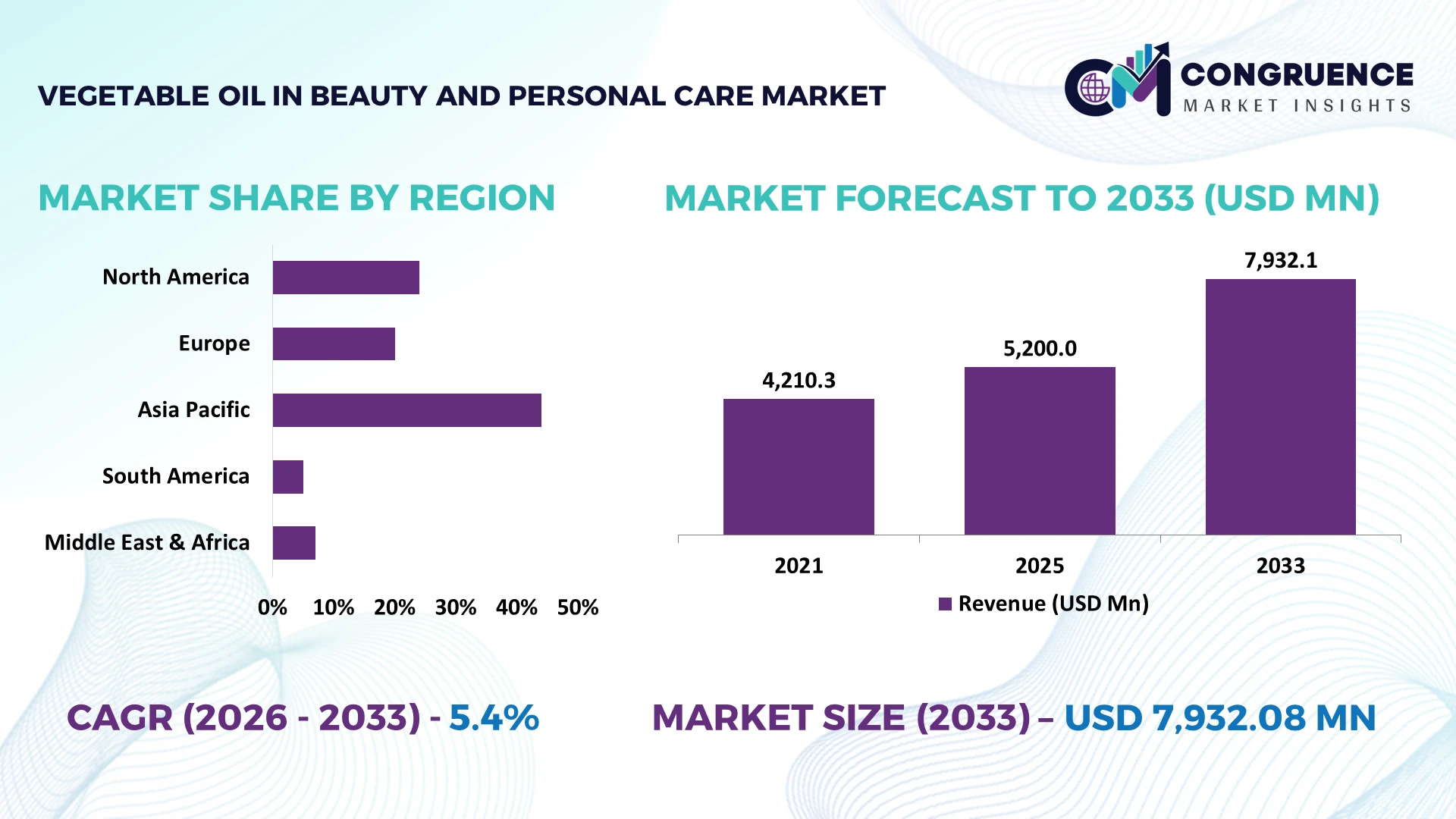
Europe dominates with approximately 30.73% share, supported by advanced natural-cosmetics formulation capacity, stringent ingredient-traceability requirements, and strong premium skincare manufacturing. North America follows at 28.55%, while Asia Pacific holds 26.27% and is expanding rapidly through local formulation and e-commerce. India’s cosmetic-oil segment is advancing at 7.2%, outperforming the broader global trajectory, while the EU’s sustainability rules are accelerating traceable sourcing.
Strategically, manufacturers should prioritize certified plant-oil supply chains, regional formulation capacity, and high-performance blends to capture premiumization and reduce sourcing risk.
Market Size & Growth: USD 5,200 million in 2025 is projected to reach USD 7,932.08 million by 2033 at 5.42% CAGR, driven by plant-based emollient substitution and clean-label formulation.
Top Growth Drivers: Natural-ingredient adoption contributes 32%, premium skincare 27%, and plant-based formulation shifts 23% to market expansion.
Short-Term Forecast: By 2028, automated formulation and precision blending are positioned to reduce processing costs by 4% and improve batch efficiency by 6%.
Emerging Technologies: AI formulation screening, automated cold-press processing, and biotechnology-derived oil alternatives are reshaping advanced ingredient development, with pilot deployment exceeding 15% among innovative formulators.
Regional Leaders: Europe reaches approximately USD 2.44 billion by 2033 with traceability-led adoption; North America approaches USD 2.26 billion through clean beauty; Asia Pacific reaches about USD 2.08 billion as digital-first beauty adoption accelerates.
Consumer/End-User Trends: Skin care represents approximately 47.2% of application demand, while facial oils, serums, and hair masks gain strong traction among ingredient-conscious consumers.
Pilot/Case Example: In 2025, Future Origins advanced palm-oil alternatives for personal-care surfactants, targeting commercial manufacturing and supporting lower-carbon ingredient supply chains.
Competitive Landscape: Europe leads at approximately 30.73%, with L’Oréal, Unilever, Kao, BASF, and Croda strengthening positions through sustainable sourcing, formulation innovation, and specialty ingredients.
Regulatory & ESG Impact: L’Oréal reports 100% RSPO-compliant palm-oil purchasing, while traceability covering more than 90% of palm-derivative volumes strengthens deforestation-risk management.
Investment & Funding: Strategic biotechnology partnerships are accelerating multi-million-dollar ingredient capacity expansion, with major beauty companies shifting investment toward alternative oils and low-impact feedstocks.
Innovation & Future Outlook: Next-generation fermentation-derived oils, AI-assisted formulation, precision extraction, and traceable sourcing will shift competition toward performance, carbon efficiency, and resilient global supply networks.
Vegetable oils are becoming core formulation ingredients across skin care, hair care, color cosmetics, cleansing, and premium personal-care products, with skin care accounting for about 47.2% of application demand. Cold-pressed extraction, refined specialty oils, and biotechnology-based alternatives are improving purity, sensory performance, and formulation flexibility. India is showing particularly strong momentum as facial oils and hair masks expand rapidly, while global supply chains increasingly prioritize traceability and sustainable sourcing. These shifts strengthen the strategic importance of formulation innovation, resilient feedstock procurement, and differentiated plant-based product positioning.
Vegetable oils are becoming strategically important as beauty manufacturers compete on ingredient transparency, formulation performance, and supply-chain resilience rather than basic product volume. Coconut, jojoba, argan, castor, and sunflower oils are moving from conventional emollient roles into active skin-barrier, scalp-care, cleansing, and premium formulation systems. Approximately 47% of application demand is concentrated in skin care, strengthening the value of specialized oil blends.
Supply-chain restructuring is accelerating as European manufacturers prioritize traceable feedstocks and lower-impact sourcing. Modern cold-press and precision-refining systems can reduce processing losses by about 5–8% versus conventional extraction while improving consistency. Germany and France emphasize certified formulation and traceability, whereas India and China are scaling cost-efficient extraction and localized cosmetic manufacturing, creating distinct competitive models.
During the next 2–3 years, automated blending, digital batch monitoring, and fermentation-derived oils are expected to reach broader commercial deployment, with advanced formulators targeting 6%–10% improvements in production efficiency. A practical example is the expansion of traceable palm-alternative supply chains for personal-care ingredients. Companies are redirecting investment toward specialty-oil processing, biotechnology partnerships, and regional sourcing hubs. Competitive advantage will increasingly depend on combining ingredient performance, procurement resilience, and measurable sustainability credentials.
The strongest growth driver is the substitution of petroleum-derived emollients with recognizable botanical ingredients. Approximately 32% of formulation decisions emphasize natural or plant-derived positioning, while premium facial and hair-care products show adoption rates near 25%. European regulatory scrutiny around ingredient traceability is reinforcing this transition. French and German formulators are increasing certified sourcing, while Indian manufacturers are expanding cold-pressed oil capacity for domestic and export brands. Companies are responding through supplier partnerships, specialty blending, and vertically integrated procurement. The non-obvious advantage is formulation differentiation: customized oil blends allow brands to improve sensory properties while supporting clean-label claims, strengthening premium pricing and reducing dependence on standardized commodity ingredients.
Feedstock volatility remains a direct constraint because vegetable-oil costs respond to weather disruption, crop yields, energy expenses, and geopolitical supply-chain movements. Palm, sunflower, and soybean oils can experience price swings exceeding 10% within stressed trading periods, while imported cosmetic-grade oils often carry 5%–8% additional logistics exposure. India remains particularly sensitive to imported edible and specialty-oil inputs, increasing procurement uncertainty for formulators. Companies are reducing exposure through multi-country sourcing, longer-term contracts, inventory buffers, and greater use of locally available castor, sesame, and coconut oils. The strategic issue is not simply raw-material cost; inconsistent feedstock quality can force reformulation, increase batch testing, and weaken production scalability.
Precision extraction and biotechnology-derived oils create a high-value opportunity beyond conventional cold-pressed ingredients. Advanced processors can target 6%–10% higher extraction efficiency, while AI-assisted formulation can reduce laboratory screening cycles by approximately 15%. India offers an attractive deployment base because its castor, coconut, and sesame supply networks support localized cosmetic-ingredient manufacturing. Fermentation-derived specialty lipids are also opening opportunities for brands seeking consistent performance with lower agricultural dependency. Companies are increasing R&D partnerships with biotechnology firms, upgrading extraction facilities, and developing application-specific blends for barrier care and scalp treatment. A distinctive opportunity lies in converting agricultural by-products into cosmetic-grade oils, improving feedstock utilization while creating additional margins from existing processing ecosystems.
Scaling botanical oils from artisanal sourcing to multinational production remains an execution challenge because composition varies by cultivar, geography, harvesting conditions, and extraction method. Batch variability of 5%–7% in key physicochemical parameters can trigger additional testing or reformulation, while advanced facilities require skilled analytical teams and automated quality-control infrastructure. Japan and Germany maintain demanding consistency expectations for premium formulations, whereas rapidly expanding Indian production networks face greater standardization pressures across decentralized suppliers. Companies must invest in chromatographic testing, digital batch records, supplier qualification, and standardized processing protocols. The critical operational challenge is maintaining botanical authenticity without sacrificing reproducibility; firms that solve this balance gain stronger formulation reliability, faster regulatory validation, and more defensible premium positioning.
Traceability Reshapes Procurement: EU ingredient-transparency requirements and retailer scrutiny are accelerating certified sourcing, with nearly 38% of premium formulators prioritizing documented origin and digital supplier records reducing verification time by 10%–15%. Companies are restructuring procurement around qualified suppliers, batch-level documentation, and traceability platforms.
Efficient Extraction Scales: Cold-press, enzymatic extraction, and solvent-reduction technologies are expanding across specialty-oil facilities, targeting 5%–8% lower processing losses and 6%–10% lower energy consumption. Indian and European processors are upgrading equipment and forming technology partnerships to improve throughput without compromising cosmetic-grade quality.
Specialty Blends Gain Traction: Formulators are moving beyond single oils toward application-specific blends for barrier care, scalp treatment, and cleansing products. Customized blends can improve formulation stability by 3%–6% and shorten development cycles by nearly 10%. Companies are expanding laboratory screening and ingredient partnerships to strengthen differentiation.
Digital Quality Control Expands: Inline spectroscopy, automated testing, and electronic batch records are reducing manual quality checks by approximately 12%–18% in advanced facilities. Labor constraints are an important but less visible trigger, encouraging automation even at moderate production volumes. Manufacturers are deploying connected QC systems to improve consistency and release speed.
Coconut Oil leads the segment with approximately 29% market share, supported by scalable availability, established processing infrastructure, cost competitiveness, and broad integration across skin, hair, and body formulations. Sunflower Oil follows at nearly 21%, benefiting from efficient industrial supply and formulation flexibility. Olive Oil accounts for about 17%, retaining premium demand, while Argan Oil represents nearly 15% and remains concentrated in higher-value products.
Jojoba Oil is the fastest-growing type, supported by its sebum-like characteristics and increasing adoption in premium facial and scalp formulations. Companies are expanding specialty-grade coconut and sunflower processing while investing in traceable jojoba and argan supply networks. Jojoba-focused products can support stronger margins, encouraging supplier partnerships and contract cultivation. The strategic shift is moving investment from commodity volume toward differentiated botanical performance, with processors balancing supply scalability, consistency, and premium formulation requirements.
Skin Care leads with approximately 47% market share because vegetable oils are widely integrated into moisturizers, cleansers, serums, facial oils, and barrier-care products. Hair Care follows at nearly 24%, while Body Care contributes around 16%. Lip Care and Cosmetics maintain smaller but strategically relevant positions, particularly where oils provide conditioning, emollience, texture, or sensory enhancement.
Hair Care is the fastest-growing application as brands expand scalp-care ranges and multifunctional botanical treatments. Adoption of standardized oil blends is increasing by an estimated 8%–10% among larger formulation programs, while automated blending can improve batch consistency by roughly 4%–6%. Companies are expanding application-specific formulations, compatibility testing, and automated production workflows. The business implication is stronger investment in scalp and skin formulations where botanical performance, sensory differentiation, and repeat-use positioning can support sustained demand.
Cosmetics Manufacturers dominate the end-user segment with approximately 42% market share, reflecting high-volume production, centralized procurement, and extensive dependence on standardized cosmetic-grade oils. Personal Care Companies account for nearly 31%, supported by diversified skin, hair, and body-care portfolios. Beauty Salons represent about 11%, while Spas & Wellness Centers and Consumers form smaller but increasingly specialized demand channels.
Personal Care Companies are the fastest-growing end-user group, with adoption of certified and application-specific oils increasing by approximately 8%–10% as natural-product portfolios expand. Cosmetics manufacturers prioritize supply consistency and large-volume contracts, whereas salons and spas increasingly favor premium treatment oils and customized formats. Consumers are shifting toward concentrated botanical products and specialized personal-care routines. Companies are responding through private-label partnerships, flexible order structures, customized blends, and direct-to-consumer ecosystems. Competitive positioning is therefore shifting from commodity supply toward formulation support, customization, and dependable specialty-oil sourcing.
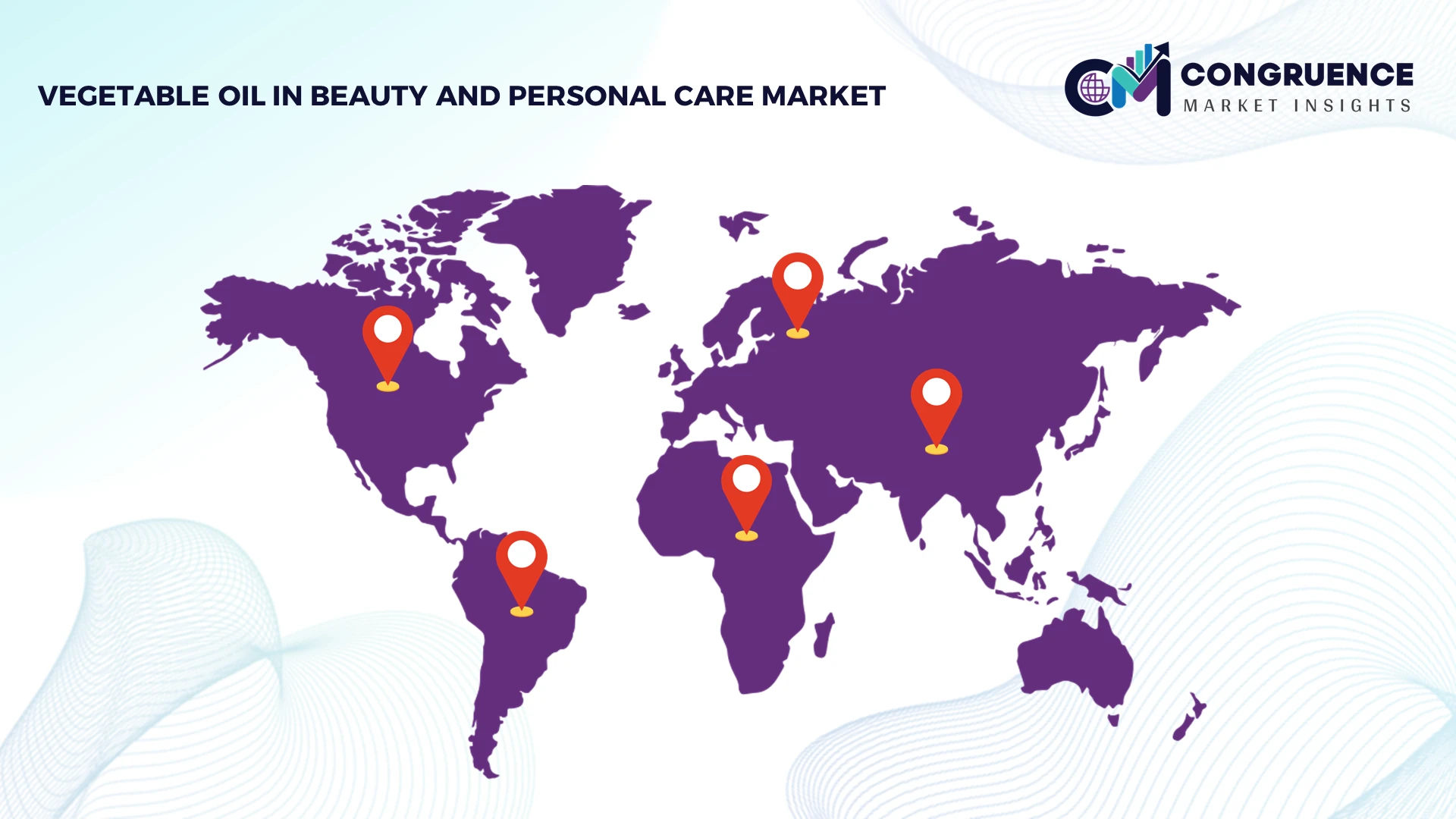
North America accounted for the largest market share at 31% in 2025 however, Asia-Pacific is expected to register the fastest growth, expanding at a CAGR of X% between 2026 and 2033.
Premium formulation and traceable sourcing strengthen regional leadership
North America maintains a strong position through premium skin-care, hair-care, and clean-label product manufacturing, with approximately 31% market share. The United States concentrates major formulation, brand, and ingredient-development activity, while Canadian suppliers support specialty botanical sourcing. Demand is shifting toward cold-pressed, organic, and traceable oils as retailers increase ingredient-transparency expectations. Approximately 35% of premium formulators emphasize certified botanical sourcing, encouraging suppliers to strengthen digital batch documentation. Manufacturers are also expanding automated blending and laboratory testing to reduce formulation variability. Strategic partnerships between ingredient processors and beauty brands are increasing customization capabilities, particularly for facial and scalp products. The region's advantage lies in sophisticated formulation infrastructure and premium consumer demand, although higher labor and compliance costs encourage manufacturers to automate processing and diversify sourcing.
United States Market Outlook: The United States remains the region's primary manufacturing and commercialization hub, supported by advanced cosmetic laboratories, established ingredient distribution networks, and strong private-label production. More than 40% of premium beauty formulations increasingly emphasize naturally positioned ingredients, supporting specialty-oil innovation and supplier partnerships.
Regulatory traceability drives sustainable ingredient restructuring
Europe remains a high-value market, supported by sophisticated cosmetic manufacturing and stringent ingredient-management requirements. France, Germany, Italy, and the United Kingdom concentrate significant formulation and premium beauty activity, with the region representing approximately 27% of global demand. EU sustainability and traceability requirements are encouraging manufacturers to redesign procurement workflows and qualify suppliers more rigorously. Around 30% of premium product developers increasingly prioritize documented botanical origin, while automated quality systems can reduce manual batch verification by 12%–15%. Companies are strengthening certified sourcing, regional warehousing, and specialty-oil partnerships to manage supply volatility. European manufacturers are also emphasizing low-impact extraction and recyclable packaging compatibility, creating differentiation beyond ingredient price. The competitive advantage increasingly comes from compliance-ready supply chains combined with premium formulation performance and transparent ingredient documentation.
Germany Market Outlook: Germany provides a strong industrial base through advanced cosmetic manufacturing, analytical testing, and chemical-processing capabilities. Its manufacturers increasingly integrate automated quality-control systems and supplier qualification procedures, while sustainability-focused procurement supports premium botanical ingredients. Approximately 25% of specialized formulators prioritize traceability and documented feedstock characteristics.
Manufacturing scale accelerates specialty-oil deployment
Asia-Pacific is the fastest-expanding production and consumption base, supported by large cosmetic manufacturing ecosystems in China, India, Japan, South Korea, and Southeast Asia. The region accounts for approximately 25% market share, while India and China provide significant processing and export capacity. Contract manufacturing and private-label production are accelerating demand for standardized coconut, sunflower, castor, and other botanical inputs. Approximately 20%–25% of expanding cosmetic manufacturers are increasing use of digitally monitored blending and batch-control systems. Indian processors are investing in cold-pressed and refined specialty-oil facilities, while South Korean manufacturers emphasize high-performance formulations and rapid product development. Companies are also establishing regional sourcing partnerships to reduce logistics exposure and shorten formulation lead times. Scale, labor availability, localized feedstocks, and expanding beauty consumption provide a strong cost and manufacturing advantage.
India Market Outlook: India is strategically positioned through extensive vegetable-oil cultivation, processing infrastructure, and expanding cosmetic manufacturing capacity. Its established castor, coconut, sesame, and sunflower supply networks support localized ingredient sourcing. More than 20% of emerging cosmetic manufacturers are increasing specialty botanical ingredient integration, encouraging investments in refining and quality-control infrastructure.
Domestic feedstocks support localized beauty production
South America is developing as a strategically relevant supply and formulation base, with Brazil accounting for the majority of regional cosmetic activity. The region contributes approximately 9% of global demand and benefits from established agricultural infrastructure and abundant botanical feedstocks. Brazil's cosmetics industry increasingly integrates locally available oils into skin, hair, and body-care formulations, supporting shorter procurement chains. Approximately 15%–18% of manufacturers are expanding naturally positioned product portfolios, encouraging greater demand for standardized cosmetic-grade oils. Companies are improving extraction facilities and developing partnerships with agricultural suppliers to strengthen traceability. However, logistics variability, currency exposure, and inconsistent quality across smaller suppliers can constrain scaling. Investment is therefore moving toward processing hubs, laboratory testing, and supplier consolidation. Localized sourcing offers an important competitive advantage where manufacturers can combine agricultural access with reliable cosmetic-grade processing.
Brazil Market Outlook: Brazil dominates regional beauty manufacturing through a large domestic cosmetics industry, extensive agricultural resources, and established botanical-ingredient networks. Manufacturers increasingly use locally sourced oils in premium formulations, while processing upgrades and supplier partnerships are improving consistency. Specialty botanical products represent an expanding focus for domestic and export-oriented brands.
Premiumization and local processing reshape supply networks
Middle East & Africa is evolving through premium beauty consumption, local manufacturing initiatives, and stronger interest in botanical formulations. The region represents approximately 8% market share, with the United Arab Emirates, Saudi Arabia, South Africa, and Egypt serving as important commercial and distribution hubs. Gulf markets are driving premium skin-care and wellness demand, while African processors benefit from locally available botanical feedstocks. Approximately 12%–15% of manufacturers and specialty suppliers are increasing investment in localized sourcing, blending, or distribution capabilities. Companies are developing regional partnerships to reduce import dependence and improve delivery speed. Modern warehousing and formulation facilities in Gulf markets are also supporting faster product launches. The main operational pressure remains fragmented supply infrastructure, making quality standardization and reliable logistics critical. Firms that combine regional sourcing with premium formulation expertise can capture higher-value demand.
United Arab Emirates Market Outlook: The UAE functions as a major commercial and distribution hub because of its advanced logistics infrastructure, premium beauty retail network, and concentration of regional brand operations. Manufacturers and distributors increasingly use the country as a launch point for specialty botanical products, with premium beauty accounting for a substantial share of new product activity.
Global ingredient specialists such as AAK, BASF, Croda International, and Oleon compete with regional botanical-oil processors and vertically integrated suppliers on formulation performance, traceability, and supply reliability. The top five players are estimated to control approximately 24% of the market, leaving substantial space for specialized regional manufacturers. Competition centers on customization, with specialty suppliers achieving roughly 5%–8% higher pricing for application-specific blends, while automated processing can improve throughput by 6%–10%. Global leaders are expanding certified sourcing, technology partnerships, and formulation support, whereas regional players compete through local feedstocks, shorter delivery cycles, and cost efficiency. Vertical integration is becoming more important as feedstock volatility and regulatory traceability raise procurement pressure. The principal entry barrier is consistent cosmetic-grade quality across scalable volumes. Winning requires reliable sourcing, documented traceability, formulation expertise, rapid customization, and efficient processing rather than commodity pricing alone.
AAK AB
BASF SE
Croda International Plc
Oleon NV
Gustav Heess GmbH
Henry Lamotte Oils GmbH
The Hallstar Company
Sophim
NIKKOL Group
OQEMA AG
Jedwards International, Inc.
KLK OLEO
Current cold-pressing, precision refining, and automated blending remain core technologies, with digital batch controls reducing manual checks by 12%–18% and improving consistency 3%–5%. Adoption is strongest in processors, where integrated formulation and quality systems reduce rework, improve release speed, and strengthen premium positioning and accelerate release decisions.
Emerging enzymatic esterification and solvent-free processing are moving from pilot projects toward commercial deployment. These systems can lower process energy 6%–10% and improve extraction efficiency 4%–8%, while traceability platforms connect feedstock records with batch data. European suppliers benefit most as compliance pressure rises and procurement teams demand auditable inputs across supply networks.
Disruptive biotechnology is introducing fermentation-derived and algal oils that reduce dependence on agricultural feedstocks. Early commercial adoption remains selective, but producers can improve supply consistency 5%–7% and shorten ingredient qualification cycles 10%–15%. Integration with formulation software will favor agile ingredient innovators and premium brands seeking differentiated performance with margin potential. From 2026–2028, AI-assisted formulation, inline spectroscopy, digital twins, and automated dosing should converge across facilities. Compared with conventional manual blending, connected workflows can improve production efficiency 8%–12%. Companies combining plant-based oils with digital formulation tools gain faster launches, tighter quality control, stronger customization, and lower operating friction before scale gaps widen.
July 2026 BASF inaugurated a Düsseldorf specialty-emollient plant for skin-care and sun-protection applications, backed by a mid-double-digit million-euro investment. The expansion increases European production capacity, strengthening supply reliability and enabling faster customer access while supporting formulation flexibility. Source: basf.com
May 2025 Oleon completed integration of A.Azevedo Óleos by renaming the Brazilian operation Oleon Brasil S.A. The Itupeva site adds production capacity and local expertise, strengthening sustainable plant-based chemistry supply across Latin America and improving service responsiveness and customer support. Source: oleon.com
December 2024 Azelis and AAK signed a distribution agreement making AAK’s complete personal-care emollient range available in South Korea. The partnership immediately expanded APAC market access, combining AAK’s 150-plus years of oil expertise with technical distribution capabilities for formulators. Source: azelis.com
January 2026 Checkerspot and La Fabrique Végétale partnered to commercialize fermentation-derived algal oils across Europe’s personal-care market. The collaboration targets traceable, sustainable alternatives to conventional oils, opening a biotechnology-led supply route for brands seeking consistent lipid performance and supply resilience.
The report covers Vegetable Oil in Beauty and Personal Care across five types: Coconut Oil, Argan Oil, Jojoba Oil, Sunflower Oil, and Olive Oil. Application analysis includes Skin Care, Hair Care, Body Care, Lip Care, and Cosmetics, while end-user coverage spans Cosmetics Manufacturers, Personal Care Companies, Beauty Salons, Spas & Wellness Centers, and Consumers. Regional assessment covers North America, Europe, Asia-Pacific, South America, and Middle East & Africa.
The study evaluates processing technologies, precision extraction, automated blending, digital quality control, traceability systems, and emerging biotechnology-based oils. It assesses segment concentration, adoption patterns, supply-chain restructuring, formulation shifts, and competitive responses, including specialty-oil partnerships and localized manufacturing. The analysis supports investment planning, sourcing optimization, expansion decisions, technology deployment, product-positioning strategies, and competitive benchmarking while identifying operational priorities and market-direction opportunities between 2026 and 2033.
| Report Attribute/Metric | Report Details |
|---|---|
Market Revenue in 2025 | USD 5200 Million |
Market Revenue in 2033 | USD 7932.08 Million |
CAGR (2026 - 2033) | 5.42% |
Base Year | 2025 |
Forecast Period | 2026 - 2033 |
Historic Period | 2021 - 2025 |
Segments Covered | By Type
By Application
By End-User
|
Key Report Deliverable | Revenue Forecast, Growth Trends, Market Dynamics, Segmental Overview, Regional and Country-wise Analysis, Competition Landscape |
Region Covered | North America, Europe, Asia-Pacific, South America, Middle East, Africa |
Key Players Analyzed | AAK AB, BASF SE, Croda International Plc, Oleon NV, Gustav Heess GmbH, Henry Lamotte Oils GmbH, The Hallstar Company, Sophim, NIKKOL Group, OQEMA AG, Jedwards International, Inc., KLK OLEO |
Customization & Pricing | Available on Request (10% Customization is Free) |




