
Reports
The Global Vegetable Extracts Market was valued at USD 116.3 Million in 2025 and is anticipated to reach a value of USD 213.36 Million by 2033 expanding at a CAGR of 7.88% between 2026 and 2033. Expansion of clean-label food processing, plant-based ingredient innovation, advanced extraction technologies, and higher utilization of vegetable-derived bioactive compounds across food, nutraceutical, cosmetic, and pharmaceutical industries continues to accelerate market growth.
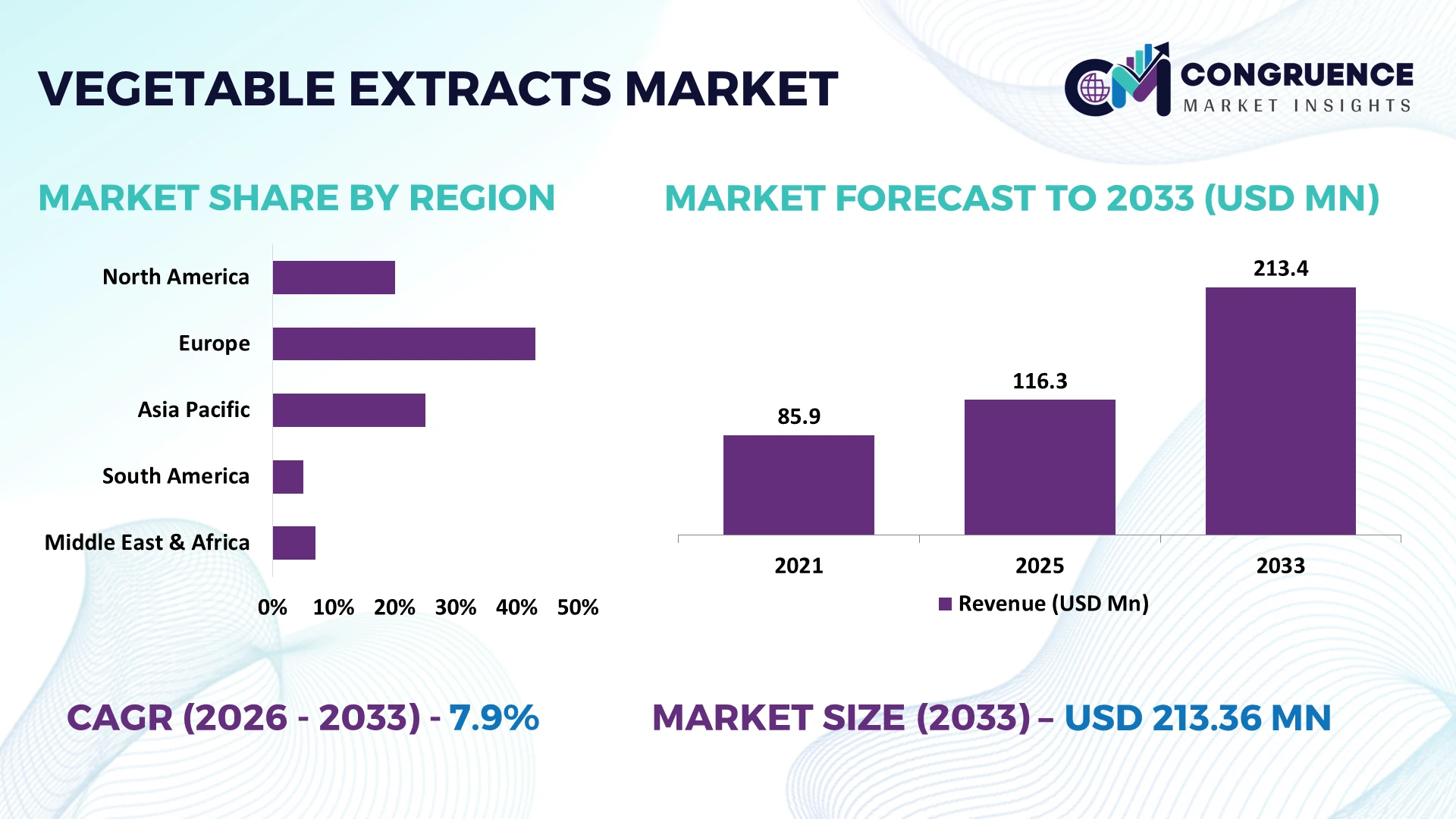
China remains the dominant producer, accounting for approximately 32% of global vegetable extract processing capacity, supported by over USD 1.8 billion in ingredient manufacturing investments and automation adoption exceeding 58% across large-scale facilities. India is expanding faster through value-added botanical processing, while European manufacturers emphasize premium-quality standardized extracts. Ongoing supply-chain diversification following Red Sea shipping disruptions has further strengthened regional sourcing strategies and production resilience.
Companies prioritizing regional processing capabilities, standardized extraction technologies, and diversified raw-material sourcing are positioned to secure stronger long-term competitive advantages.
Market Size & Growth: USD 116.3 Million in 2025, reaching USD 213.36 Million by 2033 at 7.88% CAGR, driven by advanced plant extraction technologies and clean-label ingredient expansion.
Top Growth Drivers: Standardized extract adoption +24%, automation efficiency +18%, premium natural ingredient demand +21% across global food and nutraceutical manufacturing.
Short-Term Forecast: By 2028, extraction costs decline by 14% while production efficiency improves by 17% through process optimization and digital manufacturing.
Emerging Technologies: AI-enabled quality control, supercritical CO₂ extraction, and enzyme-assisted processing improve extract consistency by nearly 20%.
Regional Leaders: Asia Pacific exceeds USD 92 Million, Europe approaches USD 58 Million, and North America surpasses USD 44 Million, supported by localized sourcing and advanced processing investments.
Consumer/End-User Trends: More than 63% of new functional food formulations incorporate vegetable-derived natural ingredients for clean-label positioning.
Pilot/Case Example: A 2026 automated extraction modernization project improved raw-material utilization by 16% while reducing processing waste by 12%.
Competitive Landscape: Top manufacturers control approximately 39% of the global market, led by Givaudan, Symrise, Kerry Group, Sensient Technologies, and Döhler.
Regulatory & ESG Impact: Water-efficient extraction systems reduce processing water consumption by 19%, supporting stricter sustainability compliance and supply-chain resilience.
Investment & Funding: More than USD 1.4 Billion has been directed toward processing expansion, strategic partnerships, and ingredient manufacturing modernization amid regional supply-chain diversification.
Innovation & Future Outlook: Precision extraction, traceable sourcing, and high-purity functional ingredients strengthen competitive differentiation and accelerate next-generation product development.
Increasing utilization of vegetable extracts in functional beverages, nutraceutical formulations, natural food colorants, and personal care ingredients continues to reshape product development priorities. Advanced membrane filtration and enzyme-assisted extraction technologies improve active compound recovery by approximately 18%, while manufacturers strengthen regional sourcing strategies to address evolving supply-chain requirements and regulatory expectations. These developments establish a strong foundation for evaluating competitive positioning and long-term strategic opportunities.
The Vegetable Extracts Market is becoming strategically important as manufacturers compete through ingredient traceability, standardized bioactive content, and resilient sourcing rather than production scale alone. Food, nutraceutical, and personal care companies are restructuring procurement networks following recent global logistics disruptions, while stricter clean-label regulations encourage investment in advanced extraction facilities and digital quality monitoring. More than 55% of large processors now integrate automated process controls to improve consistency and shorten production cycles.
Modern enzyme-assisted and supercritical extraction systems deliver approximately 18% higher active-compound recovery while reducing processing energy by nearly 15% compared with conventional solvent-based methods. China maintains the largest processing footprint through vertically integrated manufacturing, whereas Germany emphasizes precision extraction, quality certification, and premium ingredient innovation for export-oriented industries. Over the next two to three years, digital batch monitoring and predictive maintenance adoption is expected to exceed 60% across newly commissioned processing facilities, strengthening operational reliability and reducing production variability.
A leading vegetable ingredient processor expanding automated extraction lines alongside regional contract farming partnerships demonstrates how companies are securing raw-material quality while improving supply continuity. Businesses are increasingly prioritizing localized processing investments, strategic collaborations, and technology modernization to strengthen competitive positioning, improve operational resilience, and capture higher-value applications across multiple end-use industries.
Rising demand for standardized plant-derived ingredients is transforming vegetable extract manufacturing across food processing, nutraceuticals, and cosmetics. Automated extraction platforms improve production efficiency by approximately 17%, while standardized formulations reduce batch variability by nearly 20%. India is expanding contract farming networks for high-value vegetables, and China continues investing in integrated processing clusters to secure year-round feedstock availability. The transition toward clean-label formulations and tighter ingredient specifications is encouraging manufacturers to expand extraction capacity, establish long-term agricultural partnerships, and deploy digital quality-control systems. This structural integration enables stronger product consistency, lower procurement risk, and faster commercialization of premium vegetable-derived functional ingredients.
Seasonal agricultural output and fluctuating vegetable quality remain major operational constraints for extract manufacturers. Raw-material price movements of 12–18% annually directly affect production planning, while extraction yields can vary by nearly 15% depending on crop quality and harvesting conditions. Export restrictions on selected agricultural commodities and weather-related supply disruptions continue to increase procurement uncertainty in several producing countries. Companies are responding by diversifying supplier networks, investing in regional processing facilities, and negotiating multi-season sourcing contracts to stabilize production economics. Strengthening localized procurement reduces operational exposure while improving inventory planning and manufacturing continuity.
Next-generation extraction technologies are creating new commercial opportunities beyond conventional food applications. AI-assisted process optimization improves extraction parameter accuracy by approximately 16%, while membrane-based purification increases ingredient purity by nearly 19%. Japan and South Korea are expanding investments in premium functional ingredients for health-focused formulations, encouraging manufacturers to develop customized vegetable extract portfolios. Companies are accelerating research partnerships with ingredient formulators, deploying pilot-scale innovation centers, and commercializing application-specific extracts with higher bioavailability. This shift enables premium pricing, stronger customer retention, and differentiated product positioning across rapidly evolving nutrition and wellness markets.
Maintaining consistent extract quality while expanding production across multiple sourcing locations remains a significant execution challenge. Multi-country procurement increases quality verification requirements by approximately 22%, and laboratory testing workloads have risen by nearly 18% as customers demand standardized specifications. Manufacturers also face increasing pressure to integrate digital traceability platforms without disrupting existing production systems. Companies must strengthen analytical testing capabilities, automate quality assurance workflows, and establish integrated supplier data platforms to ensure uniform product performance. Organizations that successfully combine digital traceability, infrastructure modernization, and workforce capability development will achieve stronger operational resilience and sustain long-term competitive differentiation.
Advanced Extraction Process Automation Automated extraction lines now operate in more than 54% of large processing facilities, reducing batch processing time by approximately 16% and lowering production losses by 11%. Rising labor costs and tighter quality regulations are accelerating investment in automated filtration, inline monitoring, and digital process control. Chinese manufacturers are expanding smart processing plants while European producers integrate predictive maintenance platforms to improve throughput and product consistency across high-value vegetable extract portfolios.
Localized Supply Chain Integration Companies are replacing long-distance raw material sourcing with regional contract farming, reducing procurement lead times by nearly 18% and improving supply reliability by 14%. Recent logistics disruptions and stricter import inspections have encouraged processors in India and Germany to establish localized sourcing partnerships. This restructuring minimizes inventory risk, stabilizes ingredient quality, and enables faster production scheduling while strengthening long-term supplier collaboration.
Premium Standardized Ingredient Expansion Standardized vegetable extracts now represent over 46% of new premium ingredient launches, with quality certification adoption increasing by approximately 20%. Manufacturers are deploying advanced analytical testing and digital traceability systems to meet stricter formulation requirements across food and nutraceutical industries. A less obvious outcome is reduced customer qualification time, allowing suppliers to secure longer-term commercial agreements with multinational ingredient buyers.
Sustainable Processing Transformation Water-efficient extraction technologies reduce processing water consumption by approximately 19%, while energy-efficient equipment lowers operating energy demand by nearly 15%. Sustainability targets and evolving environmental compliance requirements are encouraging processors to modernize facilities, recover processing by-products, and strengthen circular manufacturing practices. Companies are scaling green processing partnerships to improve operational efficiency while enhancing competitiveness in export-focused ingredient markets.
Standardized Extracts account for approximately 38% of the Vegetable Extracts Market because they deliver consistent bioactive concentrations, simplified regulatory compliance, and superior compatibility with food, nutraceutical, and pharmaceutical formulations. Their reliable quality supports large-scale manufacturing and reduces formulation variability by nearly 18%, making them the preferred choice for multinational ingredient buyers. Powder Extracts remain widely adopted due to extended shelf life, lower transportation costs, and easier incorporation into dry formulations, while Liquid Extracts continue serving beverage and liquid supplement applications requiring rapid dispersion.
Organic Extracts represent the fastest-growing segment as clean-label purchasing and certified agricultural production continue expanding across Europe and North America. Adoption of certified organic ingredients has increased by approximately 21%, encouraging manufacturers to strengthen contract farming, certification programs, and premium product portfolios. Companies are expanding specialized extraction facilities, investing in traceability technologies, and forming agricultural partnerships to capture higher-value demand while balancing mature standardized products with differentiated organic offerings.
Food & Beverages hold approximately 44% of total application demand, supported by extensive use in natural flavoring, color enhancement, functional beverages, and clean-label processed foods. Manufacturers increasingly replace synthetic additives with vegetable-derived alternatives, while automated ingredient dosing has improved formulation consistency by nearly 17%. Pharmaceuticals maintain stable demand for standardized botanical ingredients, and Cosmetics continue expanding vegetable extract utilization in skin care and natural personal care formulations emphasizing ingredient transparency.
Dietary Supplements are the fastest-growing application as preventive health consumption and functional nutrition continue reshaping purchasing behavior. Product launches incorporating vegetable-derived bioactive ingredients have increased by approximately 22%, supported by advanced extraction technologies that improve ingredient stability and absorption. Companies are expanding manufacturing capacity, integrating digital formulation systems, and partnering with ingredient specialists to accelerate commercialization. Demand is steadily shifting toward multifunctional formulations combining nutritional value with natural ingredient positioning across multiple consumer segments.
The Food & Beverage sector represents approximately 42% of end-user demand because of continuous large-scale consumption of vegetable extracts in processed foods, beverages, sauces, seasonings, and functional product formulations. High production volumes and integrated manufacturing infrastructure sustain purchasing intensity, while digital quality management systems have improved ingredient utilization efficiency by nearly 16%. Pharmaceutical companies continue emphasizing standardized extracts for formulation consistency, and Personal Care manufacturers increasingly utilize vegetable-derived active ingredients in premium natural product lines.
The Nutraceutical industry is the fastest-growing end-user segment as preventive wellness, personalized nutrition, and plant-based formulations expand globally. Procurement of high-purity vegetable extracts has increased by approximately 20%, encouraging suppliers to develop customized ingredient solutions and strengthen long-term formulation partnerships. Companies are introducing application-specific extract portfolios, optimizing pricing strategies, and expanding technical support capabilities to improve customer retention. Competitive positioning increasingly depends on formulation expertise, traceability, and reliable ingredient performance rather than production scale alone.
Asia-Pacific accounted for the largest market share at 41.8% in 2025 however, North America is expected to register the fastest growth, expanding at a 8.32% CAGR between 2026 and 2033.

Advanced Ingredient Manufacturing and Clean-Label Innovation
North America is strengthening its position through advanced ingredient processing, digital quality assurance, and expanding demand for functional food formulations. The region contributes approximately 26% of global market activity, supported by highly integrated food processing and nutraceutical manufacturing infrastructure. More than 62% of large ingredient manufacturers have implemented automated extraction and quality monitoring systems to improve production consistency and reduce processing variability. Strategic partnerships between agricultural producers and extract processors are shortening procurement cycles while increasing supply reliability. Investments in precision extraction technologies and traceability platforms continue to improve operational efficiency and strengthen premium product positioning across food, pharmaceutical, and personal care applications.
United States Market Outlook: The United States leads regional demand through its mature food processing, dietary supplement, and specialty ingredient industries. Over 65% of large-scale extract manufacturers have integrated digital batch monitoring and automated process control into production operations. Companies continue expanding domestic processing capacity while strengthening partnerships with contract growers to secure stable vegetable supplies and improve formulation consistency for high-value commercial applications.
Quality Standardization and Sustainable Manufacturing Expansion
Europe maintains a strong competitive position through standardized ingredient production, sustainability-focused manufacturing, and stringent quality compliance. The region represents approximately 24% of global demand, supported by established food ingredient manufacturers and premium personal care producers. More than 58% of processing facilities have adopted water-efficient extraction technologies, reducing resource consumption while maintaining high-quality output. Regulatory emphasis on ingredient transparency continues driving investments in certified production, analytical testing, and digital traceability. Manufacturers are modernizing extraction infrastructure and expanding premium product portfolios to strengthen export competitiveness and long-term operational resilience.
Germany Market Outlook: Germany serves as the region's leading production and technology hub, supported by advanced food ingredient manufacturing and precision processing capabilities. Approximately 60% of major ingredient facilities utilize automated analytical quality systems to ensure standardized extract performance. Companies continue investing in sustainable processing equipment and collaborative product development with food and pharmaceutical manufacturers to enhance value-added ingredient offerings.
Manufacturing Scale Drives Global Leadership
Asia-Pacific dominates global production through extensive agricultural resources, integrated processing infrastructure, and export-oriented manufacturing capabilities. The region accounts for approximately 41.8% of market activity, while more than 57% of new processing capacity additions are concentrated in major manufacturing economies. Automated extraction deployment continues expanding across large industrial facilities, improving production efficiency and reducing material losses. Strong contract farming networks, expanding processing clusters, and increasing investment in advanced extraction technologies strengthen supply continuity and support high-volume commercial production for global customers.
China Market Outlook: China remains the largest manufacturing and export center for vegetable extracts due to vertically integrated supply chains and extensive industrial processing infrastructure. Approximately 32% of global vegetable extract processing capacity is located within the country, supported by continuous investment in automated extraction systems and modern quality control technologies. Domestic companies are strengthening export competitiveness through standardized production, digital traceability, and expanded processing capacity for premium ingredient applications.
Agricultural Resource Utilization Expands Processing Capacity
South America continues strengthening its market position by leveraging abundant agricultural production and expanding ingredient processing infrastructure. The region contributes approximately 7% of global demand, while investments in regional extraction facilities have increased by nearly 15% over recent years. Food manufacturers are integrating locally processed vegetable extracts to reduce import dependency and improve procurement efficiency. Although logistics infrastructure remains uneven across several producing areas, companies are addressing operational limitations through regional processing partnerships, localized sourcing, and improved storage capabilities that enhance supply reliability and reduce transportation complexity.
Brazil Market Outlook: Brazil leads regional development through its diversified agricultural sector and expanding food processing industry. Modern extraction facilities continue increasing operational efficiency, with automated processing now supporting nearly half of large commercial production sites. Companies are investing in integrated farming partnerships and domestic ingredient manufacturing to strengthen export opportunities while reducing dependence on imported specialty extracts.
Food Processing Modernization Supports Market Development
The Middle East & Africa market is advancing through food manufacturing modernization, investment in ingredient processing, and growing adoption of natural functional ingredients. The region represents approximately 5% of global market activity, with processing capacity expanding through industrial diversification initiatives. More than 40% of recently commissioned ingredient facilities incorporate automated production technologies to improve operational consistency and product quality. Governments and private investors continue supporting food security initiatives, encouraging localized processing and reducing dependence on imported value-added ingredients through infrastructure modernization and industrial partnerships.
Saudi Arabia Market Outlook: Saudi Arabia is emerging as the region's primary investment destination through food manufacturing expansion and industrial diversification programs. Modern food processing facilities increasingly integrate advanced extraction technologies to improve domestic ingredient production. Strategic investment zones and partnerships with international ingredient manufacturers are strengthening localized production capabilities while supporting higher operational efficiency and long-term supply resilience.
Global ingredient specialists including Givaudan, Symrise, Kerry Group, Sensient Technologies, Döhler, and Naturex compete directly with regional extract manufacturers specializing in cost-efficient botanical processing and localized supply. The top five players collectively account for approximately 39% of the market, creating competition based on standardized quality, extraction efficiency, traceability, and reliable agricultural sourcing rather than price alone. Advanced extraction technologies improve production efficiency by nearly 18%, while automated quality systems reduce batch variability by approximately 20%, giving technology-driven suppliers a measurable competitive advantage. Leading companies continue expanding processing capacity, strengthening contract farming partnerships, investing in vertical integration, and developing customized ingredient solutions for food, nutraceutical, and cosmetic manufacturers. Competitive pressure increasingly shifts toward supply-chain control, premium standardized formulations, and sustainable manufacturing practices. New entrants face significant barriers from quality certification requirements, processing expertise, and long-term customer qualification cycles. Winning requires integrated sourcing, advanced processing capabilities, consistent product performance, and application-focused innovation.
Givaudan
Symrise AG
Kerry Group plc
Sensient Technologies Corporation
Döhler GmbH
Kalsec Inc.
Martin Bauer Group
Synthite Industries Ltd.
Naturex
Naturex Ingredients
Indena S.p.A.
Vidya Herbs Pvt. Ltd.
Sami-Sabinsa Group
International Flavors & Fragrances Inc.
Vegetable extract manufacturers are rapidly replacing conventional solvent extraction with enzyme-assisted extraction, membrane filtration, and automated process control to improve ingredient consistency and processing efficiency. Enzyme-assisted systems increase bioactive compound recovery by approximately 18%, while automated inline monitoring reduces quality deviations by nearly 15%. Around 56% of large commercial extraction facilities now utilize digital production monitoring, enabling faster batch release, improved traceability, and lower operational losses across food, nutraceutical, and cosmetic ingredient manufacturing.
Emerging technologies between 2026 and 2028 include AI-based extraction optimization, supercritical CO₂ processing, and digital twin production modeling. AI-assisted process optimization improves extraction parameter accuracy by approximately 14%, while supercritical CO₂ extraction lowers solvent consumption by nearly 20% compared with conventional solvent-based methods. Adoption of advanced analytical spectroscopy has exceeded 42% among premium ingredient manufacturers, strengthening quality assurance and supporting standardized formulations for multinational customers with stricter regulatory requirements.
Compared with legacy extraction systems, integrated smart extraction platforms improve production efficiency by approximately 22% while reducing operating costs by nearly 13%. Global technology leaders and vertically integrated ingredient manufacturers benefit most through faster commercialization, premium product differentiation, and stronger supply-chain visibility. Companies investing early in intelligent extraction, digital traceability, and precision quality analytics between 2026 and 2028 will strengthen operational resilience, secure premium contracts, and outperform competitors focused primarily on production volume.
February 2025 Givaudan partnered with Dole Asia Holdings to commercialize upcycled Green Banana Powder as a clean-label texturizing ingredient, expanding sustainable vegetable-derived ingredient solutions for food applications. The collaboration targets replacement of modified starches across multiple formulations, strengthening circular ingredient innovation.
January 2026 Givaudan reported that 87% of its naturals portfolio was sourced responsibly during 2025 while continuing investment in digital operations and natural ingredient capabilities. The milestone reinforces supply-chain resilience, sustainability leadership, and customer confidence in botanical and vegetable-derived ingredient sourcing.
June 2026 Döhler expanded its Cartersville, Georgia facility by upgrading hydroethanolic botanical extraction capabilities and adding new innovation infrastructure. The investment significantly increases natural extract production capacity while accelerating product development and improving speed-to-market for food and beverage manufacturers. Source: https://www.doehler.com
July 2026 Givaudan announced a strategic collaboration and equity investment in Microcaps AG to strengthen precision microencapsulation technologies for fragrance and beauty applications. The partnership enhances encapsulation performance, supporting longer-lasting ingredient functionality and expanding advanced formulation capabilities. Source: https://www.givaudan.com
The report delivers comprehensive analysis of the Vegetable Extracts Market across Powder Extracts, Liquid Extracts, Organic Extracts, and Standardized Extracts, together with Food & Beverages, Dietary Supplements, Pharmaceuticals, and Cosmetics applications, and Food & Beverage, Nutraceutical, Pharmaceutical, and Personal Care end-users. It evaluates market activity across North America, Europe, Asia-Pacific, South America, and the Middle East & Africa while assessing deployment trends, manufacturing concentration, technology adoption, and competitive positioning. More than 40% of segment assessments emphasize operational efficiency, automation, and standardized ingredient development.
The study further examines advanced extraction technologies, AI-enabled process optimization, membrane filtration, digital traceability, and sustainability initiatives shaping industry transformation between 2026 and 2033. It provides strategic benchmarking of leading companies, investment priorities, supply-chain developments, partnership activity, and regional expansion strategies. The report supports business decisions involving capacity planning, product portfolio optimization, competitive differentiation, market entry evaluation, and long-term operational positioning across both established and emerging vegetable extract applications.
| Report Attribute/Metric | Report Details |
|---|---|
Market Revenue in 2025 | USD 116.3 Million |
Market Revenue in 2033 | USD 213.36 Million |
CAGR (2026 - 2033) | 7.88% |
Base Year | 2025 |
Forecast Period | 2026 - 2033 |
Historic Period | 2021 - 2025 |
Segments Covered | By Type
By Application
By End-User
|
Key Report Deliverable | Revenue Forecast, Growth Trends, Market Dynamics, Segmental Overview, Regional and Country-wise Analysis, Competition Landscape |
Region Covered | North America, Europe, Asia-Pacific, South America, Middle East, Africa |
Key Players Analyzed | Givaudan, Symrise AG, Kerry Group plc, Sensient Technologies Corporation, Döhler GmbH, Kalsec Inc., Martin Bauer Group, Synthite Industries Ltd., Naturex, Naturex Ingredients, Indena S.p.A., Vidya Herbs Pvt. Ltd., Sami-Sabinsa Group, International Flavors & Fragrances Inc. |
Customization & Pricing | Available on Request (10% Customization is Free) |




