
Reports
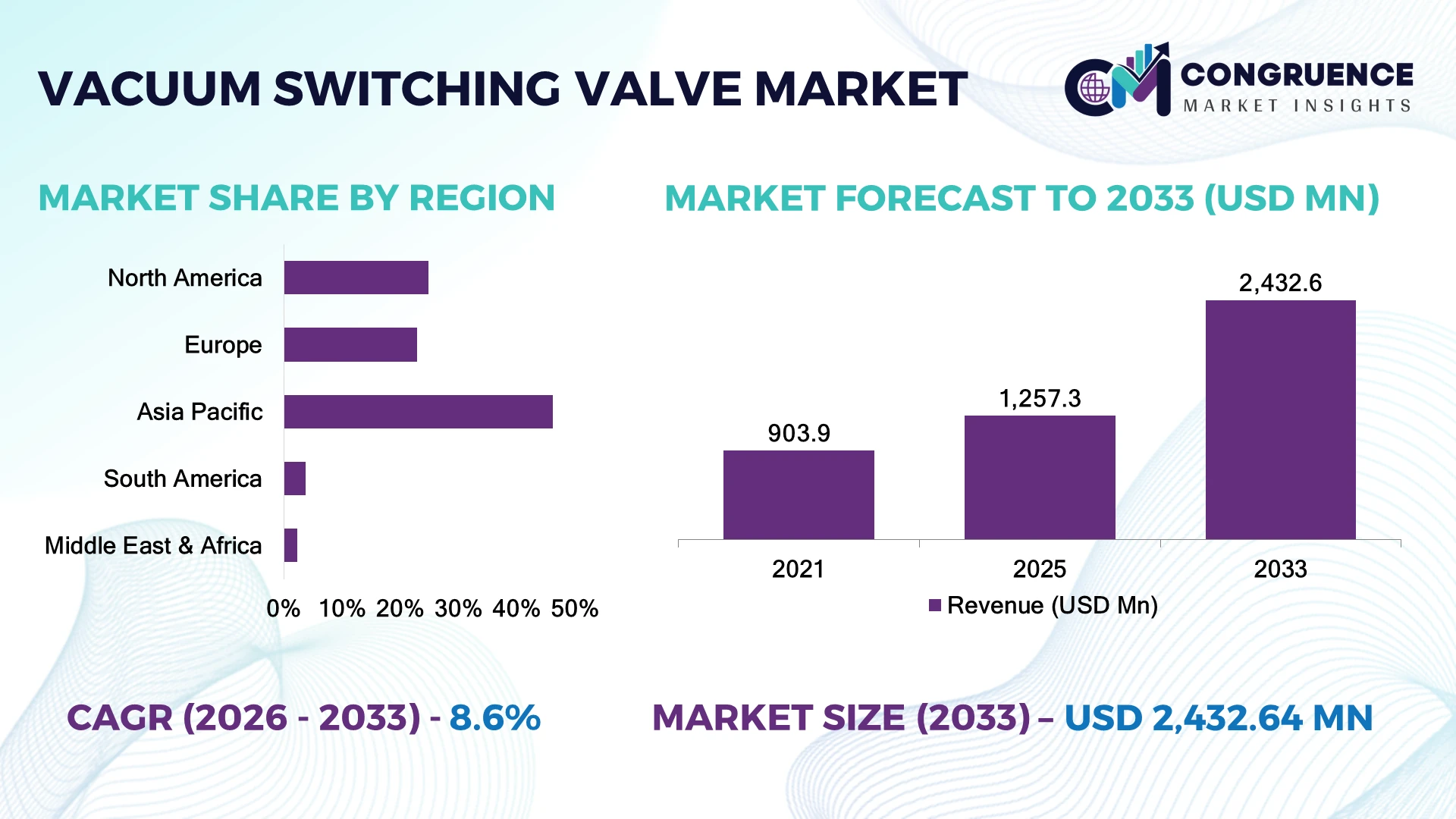
The Global Vacuum Switching Valve Market was valued at USD 1,257.3 Million in 2025 and is anticipated to reach a value of USD 2,432.6 Million by 2033 expanding at a CAGR of 8.6% between 2026 and 2033. Growth is driven by expansion of semiconductor fabrication, high-vacuum industrial processing, and precision automation across electronics, healthcare, and advanced manufacturing.
Japan accounts for approximately 34% of global high-precision vacuum switching valve production, supported by sustained investments in semiconductor equipment, vacuum engineering, and advanced automation. Nearly 68% of domestic manufacturers have integrated digitally controlled valve systems into production platforms, compared with approximately 52% in South Korea. Continuing technology localization following global semiconductor supply-chain realignments has accelerated investment in precision vacuum component manufacturing and cleanroom production capacity.
Companies investing in precision engineering, localized manufacturing, and smart valve technologies are strengthening long-term competitiveness across high-value industrial automation markets.
Market Size & Growth: USD 1,257.3 Million in 2025, reaching USD 2,432.6 Million by 2033 at 8.6% CAGR, supported by semiconductor expansion and precision vacuum automation.
Top Growth Drivers: Semiconductor manufacturing 37%, industrial automation 31%, pharmaceutical processing 26%.
Short-Term Forecast: By 2028, valve response time improves 18% while maintenance downtime declines 21%.
Emerging Technologies: AI diagnostics, smart actuator integration, and predictive maintenance platforms improve operational reliability.
Regional Leaders: Asia-Pacific exceeds USD 1.0 Billion, North America surpasses USD 620 Million, Europe approaches USD 510 Million through semiconductor and industrial automation investments.
Consumer/End-User Trends: Approximately 61% of semiconductor equipment manufacturers prioritize digitally controlled vacuum valve systems.
Pilot/Case Example: A 2026 semiconductor automation project reduced process interruptions by 24% through intelligent valve monitoring.
Competitive Landscape: Leading suppliers collectively control nearly 47% market share, led by VAT Group, MKS Instruments, CKD, SMC Corporation, and Parker Hannifin.
Regulatory & ESG Impact: Energy-efficient vacuum systems lower equipment power consumption by approximately 16%.
Investment & Funding: More than USD 2.1 Billion supports cleanroom expansion, automation, and precision manufacturing worldwide.
Innovation & Future Outlook: Digital vacuum platforms and high-speed switching technologies are redefining industrial process control.
Vacuum switching valves are becoming increasingly critical across semiconductor fabrication, analytical instrumentation, medical equipment, and advanced coating systems where precise pressure regulation directly influences manufacturing quality. Approximately 42% of newly installed vacuum processing systems incorporate intelligent valve monitoring and predictive diagnostics. Ongoing semiconductor localization initiatives and clean manufacturing investments continue accelerating technology upgrades, setting the stage for deeper strategic transformation.
Vacuum switching valves have become strategically important as manufacturers pursue higher process precision, cleaner production environments, and automated equipment across semiconductor fabrication, life sciences, industrial coating, and advanced electronics. Expansion of domestic semiconductor manufacturing and supply-chain restructuring are increasing demand for locally produced high-performance vacuum components. Organizations capable of delivering precision-engineered valves with digital monitoring capabilities are strengthening their competitive position in mission-critical manufacturing environments.
Modern electronically controlled vacuum switching valves improve response accuracy by approximately 26% while reducing maintenance interventions by nearly 19% compared with conventional pneumatic valve systems. Japan continues leading high-precision valve engineering and semiconductor equipment manufacturing, while the United States emphasizes automation software integration and advanced process control. During the next two to three years, approximately 58% of newly commissioned semiconductor process tools are expected to incorporate intelligent vacuum valve diagnostics and predictive maintenance capabilities.
Equipment manufacturers are expanding strategic partnerships with semiconductor OEMs and industrial automation providers to develop customized vacuum flow control solutions for next-generation fabrication facilities. Investment priorities increasingly focus on digital diagnostics, contamination-resistant materials, and localized precision manufacturing. Companies combining engineering accuracy, automation integration, and responsive service capabilities will secure sustainable competitive advantage as vacuum switching valves become increasingly central to advanced manufacturing efficiency and operational resilience.
Global semiconductor fabrication expansion is reshaping demand for high-performance vacuum switching valves capable of maintaining ultra-clean process environments and precise pressure control. Approximately 41% of new wafer fabrication equipment incorporates digitally controlled vacuum valve assemblies, while automated vacuum systems improve process consistency by nearly 24%. The United States and Japan continue expanding domestic semiconductor manufacturing following strategic technology localization initiatives, increasing procurement of precision vacuum components. This investment cycle strengthens demand for contamination-resistant valves with faster switching performance. Manufacturers are responding through localized production, strategic partnerships with semiconductor equipment OEMs, and advanced material innovation. A critical competitive advantage now depends on delivering highly reliable vacuum components that support uninterrupted high-volume chip production.
Production of vacuum switching valves remains constrained by dependence on specialized alloys, high-purity sealing materials, and precision machining capabilities. Approximately 27% of manufacturing lead time is linked to sourcing critical vacuum-grade components, while imported precision materials account for nearly 22% of production costs. Germany and Japan continue facing procurement challenges for niche machining components during periods of semiconductor equipment demand fluctuations. These structural constraints reduce production flexibility and increase inventory carrying costs for manufacturers. Companies are mitigating operational exposure through supplier diversification, regional manufacturing expansion, long-term procurement agreements, and increased investment in localized precision machining to strengthen supply continuity and manufacturing resilience.
Integration of intelligent diagnostics with vacuum switching valves is creating new opportunities across semiconductor fabrication, pharmaceutical manufacturing, and advanced laboratory automation. Approximately 35% of newly specified vacuum systems now include predictive monitoring capabilities, while AI-assisted diagnostics reduce unexpected maintenance events by nearly 21%. South Korea is accelerating investment in smart semiconductor production lines that require digitally connected vacuum control infrastructure. Manufacturers are expanding software partnerships, embedded sensor development, and cloud-based equipment monitoring to deliver higher-value solutions beyond mechanical valve performance. An emerging opportunity lies in predictive maintenance services that improve equipment utilization while reducing lifecycle operating costs for industrial customers.
Integrating vacuum switching valves into digitally connected manufacturing environments requires precise synchronization with process controllers, robotics, and factory automation platforms. Approximately 29% of equipment integration projects experience extended commissioning due to software compatibility and calibration requirements, while cybersecurity validation adds nearly 16% to digital deployment timelines. Semiconductor manufacturers increasingly require standardized communication protocols and real-time diagnostic capability across production equipment. Companies must strengthen software interoperability, engineering support, cybersecurity architecture, and collaborative technology partnerships to ensure reliable large-scale deployment. Long-term competitiveness will increasingly depend on combining precision hardware with intelligent digital integration rather than component performance alone.
Digital Valve Intelligence Expansion: Approximately 46% of newly installed vacuum switching valves now incorporate embedded diagnostics and digital communication interfaces, reducing maintenance interventions by nearly 19%. Semiconductor equipment suppliers are integrating remote condition monitoring into production workflows, while manufacturers expand software partnerships to improve equipment availability amid increasingly automated fabrication environments.
Ultra-Clean Material Engineering: Around 38% of new product developments utilize advanced low-particle sealing materials and corrosion-resistant alloys to minimize process contamination. Growing semiconductor node complexity and stricter cleanroom standards are encouraging manufacturers to redesign valve architectures, strengthening process stability while extending service intervals across precision vacuum systems.
Localized Production Networks: Nearly 33% of precision valve manufacturers are expanding regional production and component sourcing to reduce logistics risk and shorten customer delivery cycles. Continuing semiconductor supply-chain restructuring has accelerated investment in domestic machining capabilities, enabling faster customization and stronger resilience against international procurement disruptions.
Compact Modular Valve Designs: Approximately 43% of next-generation vacuum systems now specify modular valve platforms that simplify maintenance and reduce equipment footprint by nearly 18%. Equipment manufacturers are standardizing interchangeable valve assemblies, allowing faster production upgrades, lower inventory complexity, and improved operational flexibility for high-throughput industrial processing facilities.
Electromagnetic vacuum switching valves account for approximately 48% of the global market, driven by their rapid switching response, high reliability, and seamless integration with automated semiconductor, analytical, and industrial vacuum systems. Their compatibility with digitally controlled manufacturing platforms and low maintenance requirements support broad adoption across high-cycle applications. Pneumatic vacuum switching valves remain well established in industrial processing because of their operational simplicity and cost efficiency, while manual vacuum switching valves continue serving laboratory and low-volume process environments where automation is less critical.
Electropneumatic vacuum switching valves represent the fastest-growing segment, with adoption increasing by approximately 29% as manufacturers seek greater control precision and flexible automation. Around 54% of newly installed semiconductor vacuum systems now incorporate electronically controlled valve architectures that improve process repeatability and diagnostics. Manufacturers are investing in intelligent actuation technologies, compact valve platforms, and collaborative development with equipment OEMs to strengthen product differentiation. Investment priorities are steadily shifting toward digitally integrated switching solutions capable of supporting advanced manufacturing environments.
According to a 2026 semiconductor equipment industry assessment, digitally controlled vacuum valve technologies continue replacing conventional mechanical switching systems to improve process consistency, contamination control, and equipment uptime in advanced fabrication facilities.
Semiconductor manufacturing represents approximately 46% of global vacuum switching valve demand, supported by expanding wafer fabrication capacity, advanced lithography, and increasingly stringent cleanroom requirements. Precision vacuum control is essential for deposition, etching, and inspection processes where contamination directly affects production yield. Industrial vacuum processing remains a mature application across coating, metallurgy, and material handling, while analytical instrumentation and medical equipment continue expanding adoption because of rising precision and reliability requirements.
Pharmaceutical manufacturing is the fastest-growing application as sterile production environments and automated processing systems increasingly depend on precise vacuum regulation. Adoption within this segment has expanded by approximately 27%, while intelligent vacuum systems improve process stability by nearly 18%. Around 49% of newly commissioned pharmaceutical production facilities are deploying digitally monitored vacuum control systems. Manufacturers are responding through modular valve platforms, predictive maintenance capabilities, and tighter automation integration, positioning precision vacuum control as a critical operational asset beyond semiconductor manufacturing.
A 2025 enterprise survey across advanced manufacturing facilities found that precision vacuum control ranked among the highest operational priorities for improving production consistency, equipment reliability, and contamination management.
Semiconductor equipment manufacturers account for approximately 44% of global vacuum switching valve procurement due to continuous investment in advanced wafer fabrication tools, process automation, and contamination-free manufacturing. These organizations require highly reliable switching valves capable of supporting high-cycle operations with minimal performance variation. Industrial automation equipment manufacturers remain another significant customer group, while research laboratories and analytical instrument producers continue demanding compact, precision-engineered vacuum components for specialized applications.
Pharmaceutical equipment manufacturers represent the fastest-growing end-user segment, with procurement increasing by approximately 26% as sterile manufacturing, biotechnology expansion, and automated process validation accelerate. Approximately 47% of equipment suppliers now prioritize customized vacuum valve configurations tailored to regulated production environments. Companies are strengthening strategic partnerships, application-specific engineering, and localized technical support while expanding modular product portfolios to address increasingly diverse customer requirements. Future competitive advantage will increasingly depend on customized performance, digital compatibility, and lifecycle service capabilities.
A 2026 industrial automation study found that equipment manufacturers increasingly specify intelligent vacuum switching valves with integrated diagnostics to enhance process reliability, reduce maintenance requirements, and support fully automated production environments.
Asia-Pacific accounted for the largest market share at 46.2% in 2025 however, North America is expected to register the fastest growth, expanding at a CAGR of 9.1% between 2026 and 2033.

Advanced Semiconductor Investments Drive Precision Vacuum Infrastructure
North America accounts for approximately 24.8% of the global vacuum switching valve market, supported by semiconductor fabrication expansion, advanced life sciences manufacturing, and industrial automation. Precision vacuum technologies are increasingly deployed across wafer fabrication, analytical laboratories, and aerospace manufacturing where contamination control remains critical. Nearly 57% of newly commissioned semiconductor production equipment in the region incorporates digitally controlled vacuum valve systems with predictive diagnostics. Equipment manufacturers continue expanding localized engineering capabilities and strategic partnerships to improve supply resilience and shorten product qualification timelines. Growing investment in cleanroom infrastructure and intelligent manufacturing platforms is reinforcing the region's leadership in high-value vacuum process equipment.
United States Market Outlook: The United States dominates regional demand through large-scale semiconductor manufacturing investments, advanced research laboratories, and strong industrial automation capabilities. Domestic equipment manufacturers continue prioritizing precision vacuum technologies for next-generation wafer fabrication and pharmaceutical processing. Approximately 64% of North America's advanced semiconductor process equipment installations are concentrated in the United States, strengthening domestic demand for high-performance vacuum switching valves and localized engineering support.
Precision Engineering Strengthens Industrial Competitiveness
Europe represents approximately 22.9% of global market demand, supported by advanced precision engineering, pharmaceutical manufacturing, and high-value industrial automation. Vacuum switching valves are increasingly integrated into semiconductor research facilities, analytical instruments, and vacuum coating systems requiring exceptional reliability and process stability. Around 46% of industrial automation projects involving precision vacuum applications now incorporate digitally monitored valve technologies. Manufacturers continue investing in sustainable production methods, advanced machining capabilities, and collaborative engineering programs to strengthen long-term competitiveness.
Germany Market Outlook: Germany leads the European market through its strong semiconductor equipment ecosystem, industrial automation expertise, and precision manufacturing infrastructure. Domestic companies continue integrating advanced vacuum control systems into production machinery, laboratory equipment, and industrial process platforms. Approximately 53% of Germany's newly developed precision vacuum systems utilize intelligent valve technologies that enhance operational consistency and equipment efficiency across high-value manufacturing sectors.
Manufacturing Scale Powers Global Supply Leadership
Asia-Pacific contributes approximately 46.2% of the global market, driven by semiconductor manufacturing, electronics production, and precision industrial equipment development. Japan, China, South Korea, and Taiwan continue expanding fabrication facilities requiring contamination-free vacuum control solutions. Nearly 66% of regional vacuum switching valve production supports semiconductor and electronics manufacturing applications, while automated production technologies continue improving manufacturing consistency and delivery performance. Companies are strengthening localized supply chains, expanding machining capacity, and increasing investment in digitally integrated valve technologies to support next-generation manufacturing infrastructure.
Japan Market Outlook: Japan remains the region's technology leader through advanced vacuum engineering, precision machining, and semiconductor equipment manufacturing. Domestic producers continue developing high-speed, contamination-resistant vacuum switching valves for wafer fabrication and analytical systems. Approximately 61% of Japan's advanced vacuum valve manufacturing capacity supports semiconductor process equipment, reinforcing the country's position as a global center for precision vacuum technology innovation.
Industrial Modernization Expands Vacuum Technology Adoption
South America accounts for approximately 3.8% of the global market, supported by expanding pharmaceutical manufacturing, industrial processing, and laboratory modernization initiatives. Adoption of vacuum switching valves is increasing across analytical equipment, food processing, and industrial coating applications where reliable vacuum control improves operational consistency. Approximately 25% of newly modernized industrial production facilities are incorporating automated vacuum control systems. Companies are strengthening regional distribution partnerships and localized technical support while managing infrastructure limitations and longer equipment procurement cycles.
Brazil Market Outlook: Brazil represents the region's largest market owing to its diversified industrial manufacturing base, pharmaceutical production, and growing laboratory infrastructure. Domestic industries continue modernizing production facilities with advanced vacuum equipment to improve efficiency and regulatory compliance. Approximately 44% of South America's demand for precision vacuum process equipment originates from Brazil, supported by expanding industrial automation and manufacturing investments.
Industrial Diversification Supports Precision Equipment Deployment
The Middle East & Africa represents approximately 2.3% of global market demand, driven by industrial diversification, pharmaceutical manufacturing, and investment in research infrastructure. Vacuum switching valves are increasingly adopted across laboratory systems, specialty manufacturing, and advanced industrial processing requiring reliable vacuum control. Approximately 23% of newly established precision manufacturing facilities in the region integrate automated vacuum process equipment. Companies are expanding engineering partnerships, regional service capabilities, and application-specific support to strengthen long-term market development.
United Arab Emirates Market Outlook: The United Arab Emirates leads regional adoption through sustained investment in advanced manufacturing, pharmaceutical production, and scientific research infrastructure. Industrial facilities continue deploying precision vacuum technologies to improve production quality and equipment reliability. Approximately 36% of advanced laboratory and precision industrial equipment installations across the Gulf region are concentrated in the UAE, reinforcing its position as a strategic hub for high-value industrial technologies.
Global technology leaders including VAT Group, MKS Instruments, Parker Hannifin, SMC Corporation, and CKD compete directly in high-end semiconductor and analytical vacuum applications, while regional manufacturers challenge through cost optimization and faster customization. The top five companies collectively account for approximately 49% of global market share. Competition centers on switching precision, contamination control, lifecycle reliability, and localized supply, with intelligent valve systems improving process stability by nearly 23%, automated manufacturing reducing lead times by approximately 18%, and predictive diagnostics lowering service interventions by 20%. Companies are expanding production in Asia, strengthening semiconductor OEM partnerships, integrating digital monitoring software, and increasing vertical control over precision machining and sealing technologies. Competitive momentum is shifting toward smart vacuum platforms and localized manufacturing resilience rather than standalone hardware performance. High qualification requirements, precision manufacturing expertise, and cleanroom certification remain key entry barriers. Winning requires superior engineering accuracy, digital integration, rapid customization, and resilient global supply execution.
VAT Group AG
MKS Instruments, Inc.
Parker Hannifin Corporation
SMC Corporation
CKD Corporation
Nor-Cal Products, Inc.
ULVAC, Inc.
Pfeiffer Vacuum+Fab Solutions AG
Edwards Vacuum
VDL ETG
Kurt J. Lesker Company
Fujikin Incorporated
GEMÜ Group
Burkert Fluid Control Systems
Advanced vacuum switching valves increasingly combine electromagnetic actuation, high-purity sealing materials, embedded sensors, and digital communication protocols to support semiconductor, pharmaceutical, and analytical processing. Intelligent valve control improves switching precision by approximately 24% while reducing unplanned maintenance by nearly 19%. Around 63% of newly installed semiconductor vacuum platforms now integrate digitally monitored valve assemblies, enabling predictive diagnostics, contamination control, and automated process optimization. Equipment manufacturers benefit through higher equipment availability, lower operating costs, and faster qualification for advanced manufacturing environments.
Emerging technologies include AI-enabled predictive maintenance, edge-based condition monitoring, compact modular valve architectures, and corrosion-resistant surface coatings. Compared with conventional pneumatic switching systems, digitally controlled electromagnetic valves deliver approximately 27% faster response and improve process repeatability by nearly 21%. Semiconductor equipment OEMs, precision instrument manufacturers, and pharmaceutical automation providers gain competitive advantage through tighter process control, lower particle generation, and enhanced operational consistency.
Between 2026 and 2028, digital twins, cloud-connected vacuum diagnostics, and self-calibrating valve platforms will redefine equipment reliability. Approximately 69% of newly developed high-end vacuum systems are expected to incorporate intelligent diagnostic capabilities. Organizations investing early in software-enabled vacuum control, advanced materials, and predictive service ecosystems will strengthen customer retention, reduce lifecycle costs, and establish durable competitive differentiation across precision manufacturing industries.
March 2024 VAT Group introduced its Safety Compressed Air Accumulator solution to maintain pneumatic vacuum valve operation during compressed-air failures, improving process continuity for semiconductor manufacturing and reducing unexpected production interruptions. Source: VAT
May 2025 VAT Group outlined its 2025–2029 strategic roadmap during its Capital Markets Day, reinforcing technology leadership in semiconductor vacuum solutions and targeting continued capacity expansion to support accelerating wafer fabrication investment. Source: WebDisclosure
June 2026 VAT Group announced that its climate targets were validated by the Science Based Targets initiative (SBTi), strengthening sustainability commitments while supporting lower-emission manufacturing across its global vacuum valve operations. Source: VAT
July 2026 VAT Group reported record semiconductor demand, with valve segment orders increasing 43% sequentially, prompting further production capacity expansion and supply-chain scaling to shorten lead times and strengthen customer fulfillment. Source: Webdisclosure
The Vacuum Switching Valve Market Report provides comprehensive analysis across electromagnetic, pneumatic, electropneumatic, and manual vacuum switching valves, covering applications in semiconductor manufacturing, pharmaceutical production, industrial vacuum processing, analytical instrumentation, and medical equipment. The assessment evaluates procurement trends across semiconductor equipment OEMs, industrial automation manufacturers, pharmaceutical equipment suppliers, research laboratories, and precision engineering companies. Regional coverage includes North America, Europe, Asia-Pacific, South America, and the Middle East & Africa, with semiconductor manufacturing accounting for approximately 46% of total application demand.
The report further examines intelligent vacuum diagnostics, AI-enabled monitoring, advanced sealing technologies, modular valve architectures, and digital process integration influencing industry competitiveness between 2026 and 2033. Strategic insights include technology adoption patterns, localization strategies, supply-chain resilience, competitive benchmarking, and emerging high-value applications. The analysis supports investment planning, product development, manufacturing expansion, partnership evaluation, and long-term competitive positioning across precision vacuum technology markets.
| Report Attribute/Metric | Report Details |
|---|---|
|
Market Revenue in 2025 |
USD 1,257.3 Million |
|
Market Revenue in 2033 |
USD 2,432.6 Million |
|
CAGR (2026 - 2033) |
8.6% |
|
Base Year |
2025 |
|
Forecast Period |
2026 - 2033 |
|
Historic Period |
2021 - 2025 |
|
Segments Covered |
By Type
By Application
By End-User
|
|
Key Report Deliverable |
Revenue Forecast, Growth Trends, Market Dynamics, Segmental Overview, Regional and Country-wise Analysis, Competition Landscape |
|
Region Covered |
North America, Europe, Asia-Pacific, South America, Middle East, Africa |
|
Key Players Analyzed |
VAT Group AG, MKS Instruments, Inc., Parker Hannifin Corporation, SMC Corporation, CKD Corporation, Nor-Cal Products, Inc., ULVAC, Inc., Pfeiffer Vacuum+Fab Solutions AG, Edwards Vacuum, VDL ETG, Kurt J. Lesker Company, Fujikin Incorporated, GEMÜ Group, Burkert Fluid Control Systems |
|
Customization & Pricing |
Available on Request (10% Customization is Free) |




