
Reports
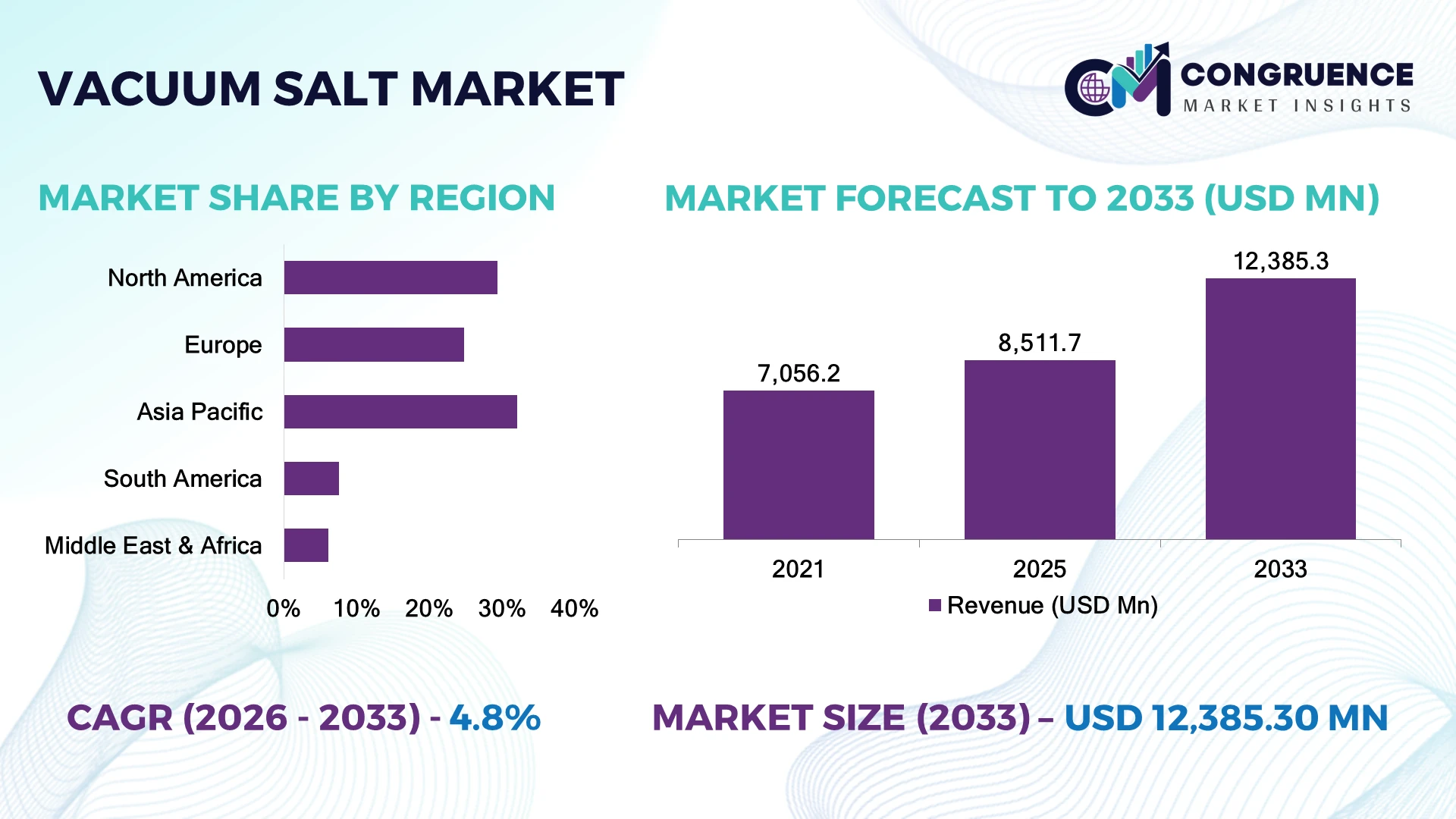
The Global Vacuum Salt Market was valued at USD 8,511.7 Million in 2025 and is anticipated to reach a value of USD 12,385.3 Million by 2033 expanding at a CAGR of 4.8% between 2026 and 2033. Growth is being driven by rising pharmaceutical-grade salt consumption, chlor-alkali processing, food-grade purity requirements, and industrial buyers shifting toward consistent particle size and low-impurity salt.
India represents a leading production and consumption base, supported by chlor-alkali, food processing, pharmaceuticals, and chemical manufacturing, with industrial applications estimated to account for more than 55% of vacuum salt demand. China combines large chemical-processing capacity with expanding purification infrastructure, while Germany emphasizes high-purity industrial applications and automated processing. Geopolitical supply-chain realignment since the Russia–Ukraine conflict has increased emphasis on diversified mineral and chemical inputs.
Strategic priority should center on high-purity grades, energy-efficient crystallization, and geographically diversified production capacity.
Market Size & Growth: USD 8.51 billion in 2025 to USD 12.39 billion by 2033 at 4.8% CAGR, supported by pharmaceutical and chlor-alkali demand.
Top Growth Drivers: Chlor-alkali 28%, food processing 22%, pharmaceuticals 17%.
Short-Term Forecast: By 2028, automated crystallization can reduce processing losses by 8–12% and improve energy efficiency by 10–15%.
Emerging Technologies: Multi-effect evaporation, mechanical vapor recompression, automated crystallizer control, and online purity monitoring are improving production consistency.
Regional Leaders: Asia-Pacific contributes about 43%, Europe 25%, and North America 18%, with Asia-Pacific maintaining the strongest industrial-scale deployment.
Consumer/End-User Trends: Industrial users represent approximately 55% of consumption, prioritizing consistent purity and particle-size specifications.
Pilot/Case Example: 2025 high-purity crystallization upgrades demonstrated approximately 12% lower energy intensity through improved evaporation and heat-recovery integration.
Competitive Landscape: Leading producers collectively control an estimated 30–35% of organized supply, competing through purity, scale, logistics, and long-term contracts.
Regulatory & ESG Impact: Cleaner crystallization and heat-recovery systems can reduce thermal energy consumption by 10–20%, strengthening compliance and operating economics.
Investment & Funding: More than USD 500 million in capacity and process-modernization investments is being directed toward salt purification, crystallization, and downstream chemical infrastructure.
Innovation & Future Outlook: 2026–2028 priorities center on low-energy crystallization, digital process control, higher-purity grades, and integrated production-to-distribution networks.
Vacuum salt is gaining importance across chlor-alkali processing, food manufacturing, pharmaceuticals, water treatment, animal nutrition, and specialty chemicals. High-purity grades increasingly command attention where impurity control affects downstream process stability, with industrial applications representing roughly 55% of demand. Manufacturers are upgrading crystallizers, evaporation systems, and automated quality controls to maintain uniform particle size and moisture specifications. Supply-chain diversification is also becoming more important as chemical producers reassess sourcing routes and inventory buffers, creating stronger demand for reliable regional production capacity.
Vacuum salt is becoming strategically important because purity, consistency, and supply reliability directly influence downstream chemical and pharmaceutical processing. Chlor-alkali producers, pharmaceutical manufacturers, and food processors increasingly require controlled sodium chloride specifications rather than commodity-grade material. This shift is strengthening investment in purification, crystallization, packaging, and automated quality-control infrastructure.
Technology is reshaping production economics. Modern multi-effect evaporation and heat-recovery systems can lower thermal energy requirements by approximately 10–20% compared with older single-stage configurations, while automated crystallizer controls improve particle-size consistency by roughly 8–12%. India and China emphasize high-volume industrial production, whereas Germany and other European manufacturing hubs place greater emphasis on purity, process efficiency, and environmental performance.
Over the next 2–3 years, producers will increasingly integrate online density monitoring, automated crystallization, mechanical vapor recompression, and predictive maintenance. A practical deployment model involves linking vacuum evaporation directly with downstream chemical plants to reduce transportation, handling, and contamination exposure. Companies are responding through capacity expansion, long-term industrial contracts, energy-efficiency retrofits, and localized distribution networks. Competitive advantage will therefore depend on delivering high-purity vacuum salt with stable specifications, lower energy intensity, and dependable regional supply rather than competing solely on commodity pricing.
Pharmaceutical-grade and chlor-alkali applications are strengthening vacuum salt demand, with industrial processing representing roughly 55% of consumption and high-purity grades expanding about 7–9% annually in key manufacturing clusters. India’s pharmaceutical and chemical industries increasingly specify controlled impurity profiles, while China continues expanding chlor-alkali capacity. Modern crystallization and evaporation systems can improve salt recovery by 5–10%, reducing losses and improving batch consistency. Companies are responding with higher-purity product lines, crystallizer upgrades, and supply agreements with chemical manufacturers. The non-obvious advantage is closer integration between salt production and downstream chemical facilities, which reduces contamination exposure and logistics costs while creating more predictable offtake volumes.
Vacuum crystallization remains energy-intensive, with thermal processing potentially accounting for 20–30% of production costs at less-efficient facilities. Electricity and steam price volatility can therefore compress margins, particularly where plants lack heat-recovery infrastructure. Imported equipment, specialty membranes, and maintenance components can add another 8–12% to operating expenditure when supply chains tighten. European producers face additional pressure from energy-cost and environmental requirements, while Indian facilities remain sensitive to logistics and industrial-power economics. Companies are reducing exposure through multi-effect evaporation, mechanical vapor recompression, renewable electricity procurement, and localized equipment sourcing. The strategic pressure point is not raw salt availability but converting brine into consistently high-purity product without allowing energy intensity to undermine cost competitiveness.
Energy-efficient crystallization creates a significant opportunity as producers target 10–20% lower thermal consumption through heat recovery, mechanical vapor recompression, and optimized evaporation cycles. Automated density and moisture monitoring can improve specification compliance by 8–12%, particularly in pharmaceutical and specialty-chemical grades. India offers an attractive expansion pathway because pharmaceutical manufacturing and chlor-alkali production increasingly require reliable high-purity inputs. Companies are investing in digitally controlled crystallizers, integrated heat-recovery systems, and modular purification capacity. A less obvious opportunity lies in co-locating vacuum salt units with chemical plants, enabling shared steam, utilities, storage, and logistics. This model can lower delivered costs while creating stronger long-term industrial contracts.
Maintaining uniform crystal size, moisture, and impurity levels across continuous vacuum systems remains an execution challenge, particularly when feed-brine composition changes. Variations of 5–10% in feed characteristics can disrupt crystallization conditions and increase off-specification output. Skilled operators are also required to manage evaporation, vacuum pressure, temperature, and centrifugation simultaneously. In China and India, rapid capacity additions increase the importance of standardized process control, while European plants face tighter environmental-performance requirements. Companies must deploy advanced sensors, predictive process control, operator training, and laboratory automation to stabilize production. The key long-term risk is not capacity availability but maintaining pharmaceutical- and specialty-grade consistency as facilities scale throughput and diversify feedstock sources.
Automated Crystallization Controls: Producers are deploying inline density, temperature, conductivity, and moisture sensors, with automated control systems improving batch consistency by approximately 8–12% and reducing manual intervention by 15–20%. Indian and European plants are increasingly integrating these controls with centralized production monitoring, helping operators respond faster to feed-brine variation and reduce off-specification output.
Heat-Recovery Systems Scaling: Rising industrial energy costs are accelerating adoption of multi-effect evaporation and mechanical vapor recompression. Modern installations can reduce thermal energy consumption by 10–20%, while heat recovery improves steam utilization by roughly 15%. Producers are prioritizing retrofits at energy-intensive facilities rather than relying exclusively on new capacity, improving operating economics without major footprint expansion.
High-Purity Grades Expanding: Pharmaceutical and specialty-chemical buyers are increasing procurement of tightly specified vacuum salt, with high-purity applications gaining an estimated 7–9% in annual volume across selected industrial clusters. Producers are responding with dedicated purification stages, stricter laboratory controls, and segregated packaging. This shift is making contamination prevention and traceability commercially more important than basic production volume.
Supply Networks Becoming Local: Geopolitical disruption and freight volatility are encouraging chemical manufacturers to shorten input-sourcing routes and strengthen regional inventories. Industrial buyers are targeting 10–15% reductions in supply exposure through dual sourcing, local warehousing, and longer-term contracts. Producers are responding by expanding distribution hubs near chlor-alkali and pharmaceutical clusters, making proximity an increasingly important competitive differentiator.
Vacuum-Evaporated Salt Leads on Purity and Process Control
Vacuum-evaporated salt is estimated to account for approximately 58% of the global vacuum salt market, supported by consistent crystal size, low insoluble content, and tighter purity specifications required by pharmaceutical, chemical, and food processors. Its controlled evaporation process delivers more uniform quality than solar salt, particularly where contamination tolerance is low. Industrial-grade vacuum salt represents the mature volume base, while high-purity and pharmaceutical-grade variants are expanding faster, with demand growth running roughly 4–6 percentage points above standard grades. Producers are therefore prioritizing crystallizer upgrades, automated quality monitoring, and higher-capacity evaporation systems.
High-purity vacuum salt is emerging as the strategic growth segment, capturing increasing procurement attention from specialty chemicals and pharmaceutical manufacturers. Standard food-grade grades remain commercially important, but premium grades improve supplier margins and customer retention. Producers are responding through specification-based product portfolios, dedicated purification lines, and long-term supply contracts, shifting investment toward higher-value output rather than undifferentiated tonnage.
The U.S. Geological Survey's 2025 salt industry reporting continued to identify vacuum-pan salt as an established industrial production route, reinforcing the importance of controlled evaporation for high-specification salt applications.
Chemical Processing Remains the Core Consumption Engine
Chemical processing is estimated to represent about 42% of global vacuum salt consumption, making it the leading application because sodium chloride is a critical feedstock for chlor-alkali production, chlorine derivatives, and other inorganic chemicals. Demand concentration is strongest where plants require predictable purity and continuous bulk supply. Water treatment follows as a substantial application, while food processing and pharmaceutical use command smaller but higher-value volumes. Chemical demand remains mature, whereas pharmaceutical and specialty chemical applications are expanding approximately 5–7% faster as purity requirements tighten.
Water treatment is the fastest-growing application segment as desalination, industrial wastewater treatment, and municipal purification projects increase salt requirements for regeneration and process chemistry. Producers are adapting through regional warehouses, bulk handling systems, and contract-based supply. The strategic shift is toward application-specific grades, allowing suppliers to protect margins while chemical manufacturers prioritize uninterrupted feedstock availability and pharmaceutical buyers demand tighter impurity controls.
The International Desalination Association reported continued expansion of desalination capacity globally through 2025, strengthening the industrial ecosystem supporting salt-intensive water-treatment processes and regeneration applications.
Chemical Producers Dominate High-Volume Procurement
Chemical manufacturers are estimated to account for approximately 45% of global vacuum salt demand, reflecting large-scale consumption in chlor-alkali and downstream chemical operations. Their purchasing decisions emphasize purity consistency, delivered cost, logistics reliability, and uninterrupted availability rather than premium packaging. Food and beverage companies form another established buyer group, while pharmaceutical manufacturers represent the fastest-growing high-value segment, with demand expanding roughly 6–8% faster than conventional industrial procurement as tighter raw-material specifications become embedded in production controls.
Water-treatment operators and pharmaceutical companies are increasingly influencing product differentiation because their procurement models reward certification, traceability, and consistent chemical performance. Pharmaceutical buyers typically accept higher unit costs for tighter specifications, while large chemical producers negotiate aggressively through volume contracts. Suppliers are responding with dedicated quality-control systems, customized grades, regional distribution agreements, and integrated logistics. The competitive priority is shifting from simply producing salt at scale toward matching purity, documentation, delivery reliability, and application-specific performance.
The U.S. Food and Drug Administration's continued emphasis on pharmaceutical manufacturing quality systems reinforces the commercial importance of controlled raw-material specifications, documentation, and traceability for high-purity salt used in regulated production environments.
Asia Pacific accounted for the largest market share at 32.1% in 2025 moreover, Asia-Pacific is also expected to register the fastest growth, expanding at a CAGR of 5.6% between 2026 and 2033.

Industrial Purity Standards Reshape Procurement
North America maintains a strong vacuum salt position through concentrated chlor-alkali, chemical processing, food manufacturing, and water-treatment consumption. The region represented approximately 29.4% of global demand in 2025, with the United States accounting for the majority of regional industrial volume. Automated brine purification and mechanical vapor recompression are improving crystallization consistency while reducing energy intensity by an estimated 8–12% at upgraded facilities. Chemical producers increasingly favor domestic supply contracts to limit exposure to freight disruptions and imported salt-price volatility. Producers are responding with higher-purity grades, automated packaging, and strategically positioned bulk-storage capacity. The operational advantage increasingly rests on dependable year-round delivery rather than production volume alone, particularly for chlor-alkali plants requiring continuous feedstock availability.
United States Market Outlook: The United States leads North American vacuum salt consumption because of its extensive chemical manufacturing base, food-processing capacity, and established industrial salt infrastructure. Chlor-alkali facilities represent a major demand center, while pharmaceutical and specialty chemical production is increasing demand for tighter impurity specifications. Domestic producers are strengthening regional distribution networks and upgrading evaporation assets, with automated handling systems improving throughput and reducing labor-intensive loading requirements by roughly 10%.
Energy Efficiency Drives Production Modernization
Europe's vacuum salt market is shaped by mature chemical manufacturing, food processing, pharmaceutical production, and stringent energy-efficiency requirements. Germany, France, the Netherlands, and the United Kingdom remain important consumption and processing hubs, while producers increasingly prioritize low-energy crystallization and heat-recovery systems. Modern evaporation equipment can reduce thermal energy requirements by approximately 8–15% compared with older configurations, strengthening the economics of plant modernization. Energy-price volatility has accelerated investment in process optimization, heat integration, and automated quality control. European buyers also place greater emphasis on traceability and consistent impurity profiles, shifting procurement toward suppliers capable of supplying application-specific grades rather than commodity volumes.
Germany Market Outlook: Germany represents a strategically important European market because of its dense chemical manufacturing ecosystem and sophisticated industrial processing infrastructure. Vacuum salt is closely linked with chlor-alkali operations, specialty chemicals, food processing, and water-treatment applications. Chemical producers increasingly require consistent purity and uninterrupted bulk deliveries. Automated crystallization and energy-recovery upgrades are strengthening plant productivity, while digitally monitored production systems are reducing process variability and supporting tighter quality specifications.
Capacity Expansion Meets Chemical Manufacturing Scale
Asia-Pacific is the fastest-expanding vacuum salt market, supported by large chemical-processing clusters, pharmaceutical manufacturing, food production, and expanding water-treatment infrastructure. China, India, Japan, and South Korea collectively account for a substantial portion of regional industrial consumption, while China provides the strongest manufacturing scale. Newer evaporation and crystallization systems can improve production efficiency by roughly 10–15% compared with less-automated installations. Chemical producers are increasingly integrating salt procurement with broader supply-chain planning to stabilize chlor-alkali feedstock availability. Producers are responding through capacity expansion, automated crystallizers, bulk logistics, and higher-purity grades. India's expanding pharmaceutical and chemical manufacturing base is creating an additional premium-grade demand channel alongside China's high-volume industrial requirements.
China Market Outlook: China remains the region's most strategically significant vacuum salt market because of its extensive chlor-alkali, chemical, food-processing, and industrial manufacturing base. Large integrated chemical clusters support continuous bulk consumption and favor suppliers with dependable logistics and consistent purity. Industrial producers are increasingly adopting automated evaporation controls, with modernized systems delivering approximately 10% higher process efficiency in suitable installations. Domestic manufacturing scale also supports faster equipment deployment and localized supply-chain development.
Chemical Processing Concentrates Regional Demand
South America's vacuum salt consumption is concentrated around Brazil and Argentina, where chemical manufacturing, food processing, water treatment, and pharmaceutical production create the strongest industrial demand. Brazil represents the principal regional market, supported by its larger manufacturing base and extensive industrial distribution infrastructure. Vacuum processing is gaining importance where buyers require tighter purity and moisture control than conventional salt production provides. Modernized facilities can reduce processing losses by approximately 5–10% through improved crystallization and automated material handling. Import exposure remains relevant for specialized grades, encouraging producers and distributors to strengthen domestic inventory and long-term procurement arrangements. The key opportunity lies in replacing inconsistent supply with application-specific grades for chemical and pharmaceutical customers.
Brazil Market Outlook: Brazil holds the strongest commercial position in South America because of its diversified chemical, food, pharmaceutical, and water-treatment industries. Industrial customers increasingly prioritize consistent salt specifications and dependable bulk delivery, particularly where production interruptions affect downstream processing. Regional distributors are expanding storage capacity and strengthening contracted supply arrangements. Modern material-handling systems can reduce loading and handling losses by approximately 5%, improving delivered-cost economics for high-volume industrial buyers.
Industrial Diversification Accelerates Premium Salt Demand
Middle East & Africa demand is increasingly tied to chemical diversification, desalination, food processing, and industrial water treatment. Gulf countries are developing stronger downstream chemical and manufacturing capabilities, while South Africa remains an important industrial processing market. Desalination infrastructure creates an additional salt-intensive ecosystem, particularly around large coastal industrial complexes. New processing installations increasingly combine automated crystallization with heat-recovery systems, reducing energy consumption by roughly 8–12% compared with older equipment. Producers and distributors are responding through localized storage, regional partnerships, and higher-purity product portfolios. The strategic shift is from commodity salt distribution toward reliable industrial-grade supply integrated with chemical and water-treatment procurement networks.
Saudi Arabia Market Outlook: Saudi Arabia represents the region's strongest strategic market because of its expanding chemical-processing base, desalination infrastructure, and industrial diversification programs. Large industrial clusters create concentrated demand for consistent salt inputs, while water-intensive operations reinforce bulk procurement requirements. New industrial projects increasingly incorporate automated material handling and energy-efficient processing. Modernized systems can lower processing energy requirements by around 10%, strengthening the business case for local production and reducing dependence on long-distance supply.
K+S, Cargill, Tata Chemicals, Compass Minerals, and INEOS compete as integrated salt producers, with regional specialists such as Dominion Salt and Cheetham Salt defending local contracts. The top five players hold about 53.6% collectively, indicating meaningful concentration without eliminating regional competition. Price influences roughly 30% of purchasing decisions, while purity and consistency affect about 25%; logistics reliability contributes another 20%. K+S and Cargill emphasize scale and distribution, Tata Chemicals is expanding vertically integrated production, while INEOS and regional suppliers compete through industrial contracts and application-specific grades. The competitive shift is toward supply security, energy efficiency, and higher-purity grades rather than commodity volume alone. High capital requirements, brine access, evaporation infrastructure, environmental compliance, and established customer qualification create substantial entry barriers. Winning requires dependable feedstock, efficient crystallization, regional logistics, application-grade customization, and long-term contracts that protect both cost competitiveness and delivery continuity, especially where chemical and pharmaceutical customers demand validated specifications.
K+S Aktiengesellschaft
Cargill, Incorporated
Tata Chemicals Limited
Compass Minerals International, Inc.
INEOS Group Limited
Qemetica
AkzoNobel N.V.
Dominion Salt Limited
Cheetham Salt Group
Nirma Limited
WA Salt Group
Zoutman NV
Südwestdeutsche Salzwerke AG
Infosa
Modern vacuum-salt plants are shifting from conventional multi-effect evaporation toward mechanical vapor recompression (MVR), heat recovery, automated crystallization, and digital process control. MVR systems can reduce thermal-energy requirements by roughly 20–35%, while crystallizers improve crystal consistency by 5–10%. Adoption is strongest in newer chemical and high-purity facilities, where automated controls manage temperature, density, scaling, and moisture parameters continuously.
The clearest gap is between legacy evaporation and integrated MVR systems: optimized installations can deliver 15–30% lower energy consumption and 5–12% higher usable output. Inline sensors, predictive maintenance, and automated quality monitoring reduce process variability by about 10%. Large producers benefit first as utilization spreads capital costs, while pharmaceutical and food-grade suppliers gain from tighter specification control and traceability.
During 2026–2028, competitive focus will move toward digitally integrated crystallization, energy-recovery loops, and intelligent cleaning systems. Closed-loop controls can reduce manual intervention by 20–25%, while modular automation accelerates capacity upgrades. Companies combining MVR with waste-energy recovery, real-time quality analytics, and predictive maintenance will secure lower operating costs, stronger purity performance, and resilient production. The priority is no longer adding evaporator capacity across high-volume and specification-sensitive production environments alone; it is converting energy, data, and process stability into higher-value salt output.
November 2024 Qemetica Salz announced 2025 price adjustments after rising energy, labor, and logistics costs, while expanding storage and safety stocks for 25-kg packaging. The move protected delivery reliability and supported sustainable production economics for Western European customers. Source: qemetica.com (Qemetica)
July 2025 GHCL disclosed a 1.7-lakh-tonne vacuum salt capacity project using surplus energy at its facility. The integration targets margin products while reducing incremental energy requirements and strengthening vertical integration and improves portfolio resilience across salt and chemicals. Source: bseindia.com (AceSphere Announcements)
February 2026 Tata Chemicals approved ₹515 crore for a 210,000-tonne-per-year iodised vacuum salt facility in Tamil Nadu. The greenfield plant diversifies production beyond Gujarat, strengthens southern supply coverage, and expands domestic capacity further through a 36-month implementation program. Source: tatachemicals.com (Tata Chemicals)
2025 K+S reported approximately 9 million tonnes of annual salt and brine capacity across Europe, alongside vacuum-salt operations in Germany and the Netherlands. Its integrated extraction and processing model reduces import dependence and supports resilient regional supply chains. Source: kpluss.com (K+S Aktiengesellschaft)
The Vacuum Salt Market Report covers the industry across product types, purity grades, particle formats, applications, end-users, and distribution channels. Analysis spans food-grade, industrial-grade, and pharmaceutical-grade vacuum salt, with applications including chemical processing, food processing, water treatment, pharmaceuticals, de-icing, and other specialized uses. Regional coverage includes North America, Europe, Asia-Pacific, South America, and the Middle East & Africa, with country-level assessment of major production and consumption hubs.
The report evaluates production technologies, crystallization systems, energy-efficiency initiatives, supply-chain structures, application-specific specifications, and competitive positioning. It assesses segment shares, adoption patterns, production capacity, and deployment concentration to identify investment priorities and expansion opportunities. Strategic analysis supports supplier selection, capacity planning, geographic diversification, partnership evaluation, product positioning, and competitive response planning through 2026–2033, with particular attention to high-purity grades, energy-efficient production, and emerging industrial applications.
| Report Attribute/Metric | Report Details |
|---|---|
|
Market Revenue in 2025 |
USD 8,511.7 Million |
|
Market Revenue in 2033 |
USD 12,385.3 Million |
|
CAGR (2026 - 2033) |
4.8% |
|
Base Year |
2025 |
|
Forecast Period |
2026 - 2033 |
|
Historic Period |
2021 - 2025 |
|
Segments Covered |
By Type
By Application
By End-User
|
|
Key Report Deliverable |
Revenue Forecast, Growth Trends, Market Dynamics, Segmental Overview, Regional and Country-wise Analysis, Competition Landscape |
|
Region Covered |
North America, Europe, Asia-Pacific, South America, Middle East, Africa |
|
Key Players Analyzed |
K+S Aktiengesellschaft, Cargill, Incorporated, Tata Chemicals Limited, Compass Minerals International, Inc., INEOS Group Limited, Qemetica, AkzoNobel N.V., Dominion Salt Limited, Cheetham Salt Group, Nirma Limited, WA Salt Group, Zoutman NV, Südwestdeutsche Salzwerke AG, Infosa |
|
Customization & Pricing |
Available on Request (10% Customization is Free) |




