
Reports
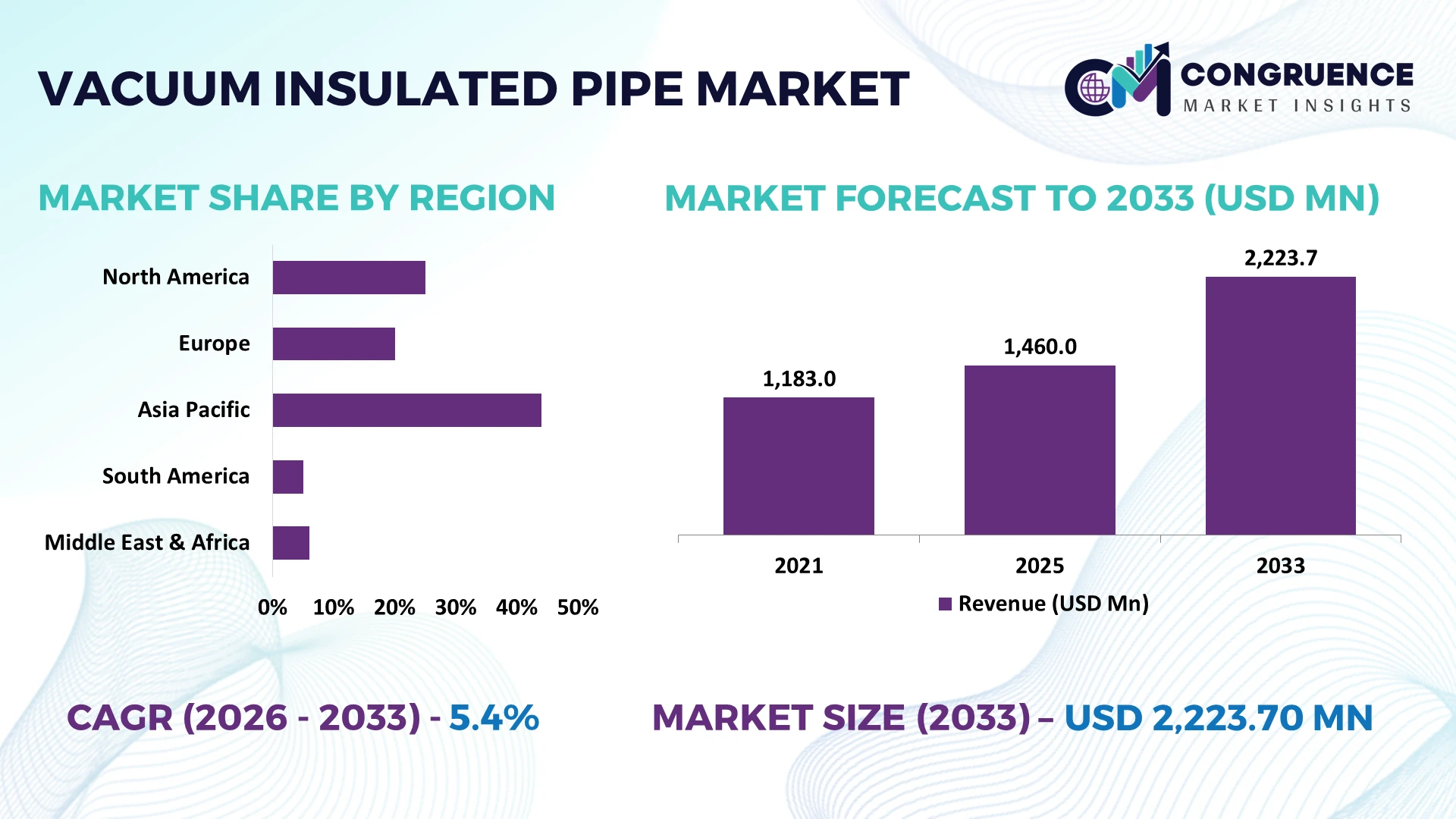
The Global Vacuum Insulated Pipe Market was valued at USD 1460 Million in 2025 and is anticipated to reach a value of USD 2223.7 Million by 2033 expanding at a CAGR of 5.4% between 2026 and 2033. Growth is driven by LNG liquefaction capacity expansion, liquid hydrogen infrastructure development, and cryogenic distribution networks serving semiconductor manufacturing, industrial gases, and aerospace applications.
The United States represents a strategically important market for advanced vacuum insulated piping systems, supported by large-scale LNG export infrastructure and industrial gas investments. U.S. LNG export capacity is projected to exceed 16 billion cubic feet per day in 2026, while China's LNG import infrastructure and industrial hydrogen investments strengthen Asian procurement activity. Vacuum insulated pipe systems support cryogenic fluid transfer at temperatures approaching −196°C for liquid nitrogen and −253°C for liquid hydrogen, making thermal performance, installation reliability, and lifecycle operating costs central purchasing criteria.
Strategically, manufacturers should prioritize LNG infrastructure and hydrogen-ready piping, targeting projects handling cryogenic fluids between −162°C and −253°C while strengthening regional fabrication and installation capabilities.
Market Size & Growth: USD 1,460 million in 2025, reaching USD 2,223.7 million by 2033 at 5.4% CAGR, supported by LNG infrastructure expansion and advanced cryogenic transfer systems.
Top Growth Drivers: U.S. LNG exports increased 23% during H1 2026; vacuum insulation delivers over 90% lower thermal conductance than conventional foam insulation, strengthening energy efficiency.
Short-Term Forecast: By 2027, U.S. LNG exports are forecast to increase 9%, supporting cryogenic infrastructure procurement and insulated pipeline installations.
Emerging Technologies: Three innovations dominate product development: multilayer insulation, automated vacuum monitoring, and hydrogen-compatible stainless steel piping.
Regional Leaders: Illustrative 2033 allocations are Asia-Pacific USD 845 million, North America USD 667 million, and Europe USD 445 million, reflecting LNG, industrial gas, and hydrogen infrastructure adoption, respectively.
Consumer/End-User Trends: Industrial buyers prioritize thermal efficiency exceeding 10 times conventional foam-insulated piping performance for critical cryogenic operations.
Pilot/Case Example: Chart Industries' Tacoma LNG bunkering installation demonstrates zero-venting design capability through large-bore vacuum insulated piping and secondary containment.
Competitive Landscape: Chart Industries is a prominent supplier alongside Cryofab, Acme Cryogenics, Demaco, and Cryotherm; independently verified company market shares remain unavailable.
Regulatory & ESG Impact: Vacuum insulated systems provide over 90% lower thermal conductance than foam alternatives, supporting boil-off management and energy conservation objectives.
Investment & Funding: Five U.S. LNG export projects are scheduled to start or expand operations through 2027, creating equipment procurement opportunities.
Innovation & Future Outlook: Next-generation systems target −253°C hydrogen handling, integrated vacuum diagnostics, and modular cryogenic distribution infrastructure.
The Global Vacuum Insulated Pipe Market serves critical cryogenic applications across LNG terminals, semiconductor fabrication, aerospace propulsion, pharmaceutical processing, and industrial gas distribution. Advanced vacuum jacketed piping delivers more than 10 times the thermal efficiency of conventional foam-insulated systems, improving temperature stability and reducing heat ingress. Manufacturers are introducing modular transfer assemblies, precision-engineered bayonet connections, and automated vacuum integrity monitoring to strengthen installation reliability. Expansion of hydrogen liquefaction infrastructure and regional LNG supply networks is accelerating demand for customized cryogenic transfer solutions. These developments establish thermal performance, material compatibility, and localized manufacturing capabilities as strategic competitive priorities.
Vacuum insulated piping is becoming strategically important as LNG exporters, industrial gas producers, and hydrogen infrastructure developers prioritize thermal efficiency, cryogenic safety, and reliable fluid transfer. The infrastructure shift toward modular liquefaction terminals and distributed industrial gas networks is changing procurement strategies. Vacuum jacketed systems maintain liquid nitrogen near −196°C and liquid hydrogen near −253°C, making insulation integrity essential for operational continuity. Manufacturers are increasingly integrating piping fabrication, vacuum testing, and installation engineering into comprehensive supply contracts.
Compared with conventional foam-insulated piping, advanced multilayer vacuum insulation can reduce thermal conductance by more than 90% under comparable design conditions. The United States emphasizes large LNG export installations, while China is expanding cryogenic infrastructure serving semiconductor manufacturing and industrial gases. Germany prioritizes hydrogen infrastructure compatibility and industrial decarbonization. These differences influence material specifications, project engineering, and supplier qualification requirements.
During 2026–2028, procurement priorities will increasingly favor prefabricated piping modules, monitored vacuum integrity, and standardized cryogenic connections. LNG loading facilities provide practical deployment examples where vacuum insulated transfer lines minimize heat ingress and manage boil-off. Suppliers are strengthening partnerships with engineering contractors and cryogenic equipment manufacturers to secure integrated project packages. Competitive advantage increasingly depends on verified thermal performance, installation efficiency, and dependable lifecycle service capabilities.
Expanding LNG export capacity is increasing demand for vacuum insulated transfer lines, loading systems, and cryogenic distribution assemblies. U.S. LNG exports increased approximately 23% during the first half of 2026, reflecting stronger utilization of newly commissioned infrastructure. Advanced vacuum insulation can reduce thermal conductance by more than 90% compared with conventional foam insulation under comparable conditions, while LNG storage and transfer systems operate near −162°C. These requirements make thermal stability critical for reducing boil-off and protecting equipment efficiency. Manufacturers are expanding prefabrication capabilities, strengthening EPC contractor partnerships, and developing large-diameter vacuum jacketed piping assemblies. Suppliers offering factory-tested modules gain procurement advantages through reduced field fabrication requirements and more predictable installation quality.
Vacuum insulated piping requires precision welding, double-wall construction, vacuum sealing, and specialized cryogenic materials, creating higher manufacturing complexity than conventional insulated systems. Stainless steel alloys commonly contain approximately 18% chromium and 8% nickel in 304-grade compositions, exposing fabrication costs to alloy market volatility. Thermal contraction also creates engineering constraints: austenitic stainless steel can contract approximately 0.3% when cooled from ambient temperature to liquid nitrogen temperatures. These factors increase material qualification, expansion-joint engineering, and installation requirements. In India, dependence on specialized vacuum components and cryogenic fabrication expertise can complicate domestic procurement. Manufacturers are responding through localized fabrication, standardized pipe assemblies, alternative material qualification, and longer-term alloy purchasing agreements to stabilize production economics.
Liquid hydrogen infrastructure presents opportunities for next-generation vacuum insulated piping, particularly in liquefaction, aerospace fueling, and industrial distribution. Hydrogen liquefies near −253°C, approximately 57°C colder than liquid nitrogen, requiring advanced multilayer insulation and exceptionally low heat ingress. Conventional liquid hydrogen storage can experience boil-off losses exceeding 1% daily, depending on vessel configuration and operating conditions. Germany's hydrogen infrastructure initiatives and Japan's liquid hydrogen supply-chain demonstrations are encouraging specialized cryogenic equipment development. Manufacturers are investing in vacuum monitoring sensors, modular pipe assemblies, and hydrogen-compatible components. Integrating predictive diagnostics with thermal management creates opportunities for service contracts, while improved insulation performance strengthens competitiveness in high-value hydrogen transfer applications.
Maintaining vacuum integrity across extensive cryogenic piping networks remains a significant engineering challenge, particularly during thermal cycling, equipment vibration, and repeated maintenance. Liquid nitrogen systems operate near −196°C, while liquid hydrogen applications require approximately −253°C, imposing severe thermal contraction and sealing requirements. Austenitic stainless steel contracts approximately 0.3% between ambient and liquid nitrogen temperatures, making expansion compensation essential. Hydrogen's molecular characteristics further complicate leak prevention and connection integrity. Japan's hydrogen demonstration infrastructure highlights the importance of coordinated equipment qualification and operational safety. Manufacturers must strengthen automated welding, helium leak testing, vacuum diagnostics, and technician certification. Competitive differentiation increasingly depends on documented reliability, standardized commissioning procedures, and consistent performance across complex cryogenic installations.
Modular Fabrication Reshapes Project Execution: Cryogenic equipment suppliers are shifting toward factory-assembled piping modules to reduce installation complexity and site welding requirements. LNG transfer systems operating near −162°C require precise alignment, vacuum integrity, and reliable thermal contraction management. Austenitic stainless steel contracts approximately 0.3% between ambient and liquid nitrogen temperatures. Manufacturers are standardizing prefabricated sections, incorporating expansion compensation, and coordinating factory acceptance testing with engineering contractors. This approach reduces construction interfaces and improves installation predictability for complex terminals.
Digital Quality Assurance Gains Importance: Automated orbital welding, helium leak detection, and digital inspection records are strengthening cryogenic piping quality control. Liquid nitrogen applications operate near −196°C, while liquid hydrogen equipment encounters temperatures approaching −253°C. These conditions expose weld defects and sealing weaknesses that conventional ambient testing can overlook. Suppliers are integrating weld traceability, vacuum verification, and serialized component documentation into manufacturing workflows. The resulting quality records simplify customer qualification, reduce inspection uncertainty, and support consistent production across multiple fabrication facilities.
Semiconductor Manufacturing Tightens Purity Requirements: Advanced semiconductor fabrication increasingly requires controlled nitrogen distribution and contamination-resistant cryogenic equipment. High-purity nitrogen specifications commonly reach 99.999%, while specialized applications require 99.9999% purity. South Korean and Taiwanese fabrication facilities emphasize contamination control, automated gas handling, and uninterrupted utility delivery. Vacuum insulated piping suppliers are responding with electropolished stainless steel surfaces, cleanroom-compatible connections, and improved fabrication cleanliness. These specifications favor manufacturers capable of combining cryogenic thermal performance with documented material purity and contamination control.
Cryogenic Maintenance Becomes More Predictive: Operators are replacing exclusively calendar-based inspections with condition-based monitoring of vacuum pressure, thermal performance, and connection integrity. Systems handling liquid oxygen near −183°C and liquid nitrogen near −196°C require continuous attention to insulation condition. Even localized vacuum deterioration increases heat ingress and operational losses. Equipment manufacturers are integrating pressure transducers, temperature sensors, and remote diagnostic interfaces into maintenance programs. This transition supports earlier fault identification, planned maintenance windows, and stronger lifecycle service differentiation.
Rigid Vacuum Insulated Pipes Maintain Infrastructure Leadership
Rigid Vacuum Insulated Pipes represent the leading product category, supported by their suitability for permanent cryogenic installations, structural stability, and compatibility with large industrial distribution networks. Their estimated market share of 40–45% reflects an indicative segmentation assumption rather than independently verified industry data. These systems are preferred for LNG terminals, industrial gas production facilities, and fixed cryogenic processing equipment. Stainless steel construction, multilayer insulation, and factory-tested vacuum jackets support consistent thermal performance. Manufacturers are prioritizing standardized pipe diameters, modular fabrication, and improved connection reliability to strengthen project competitiveness.
Flexible Vacuum Insulated Pipes represent a potentially faster-expanding category, particularly where installation geometry and equipment movement require adaptable connections. Vacuum-Jacketed Transfer Lines remain important for integrated cryogenic distribution, while Vacuum-Insulated Cryogenic Hoses support loading, unloading, and mobile equipment interfaces. Liquid nitrogen transfer near −196°C and liquid hydrogen transfer near −253°C create distinct engineering requirements across these products. Suppliers are developing improved flexible assemblies, enhanced sealing systems, and application-specific connection technologies. Investment priorities increasingly distinguish high-volume permanent infrastructure from specialized transfer equipment requiring frequent operational movement.
LNG Transportation and Distribution Leads Demand
LNG Transportation and Distribution represents the leading application category, supported by large-scale liquefaction infrastructure, loading terminals, storage facilities, and associated cryogenic transfer operations. An indicative market allocation of 35–40% reflects an analytical estimate rather than a verified industry share. LNG handling near −162°C requires controlled heat ingress, reliable insulation, and stable transfer performance. U.S. LNG exports increased 23% during the first half of 2026, highlighting the operational scale supporting cryogenic equipment procurement. Manufacturers are developing integrated vacuum jacketed transfer assemblies and standardized terminal connections to improve installation efficiency and maintenance accessibility.
Liquid Hydrogen Transfer represents an emerging high-growth application as hydrogen liquefaction and specialized distribution technologies advance. Operating temperatures near −253°C create demanding insulation and material compatibility requirements. Industrial Gas Transfer and Cryogenic Fluid Handling maintain established applications across oxygen, nitrogen, and argon distribution. Food and Beverage Processing uses cryogenic systems for freezing and temperature control, while Medical and Pharmaceutical Applications require dependable low-temperature handling. Suppliers are differentiating products through application-specific insulation, cleanliness standards, connection design, and documented thermal performance.
Oil and Gas Companies Anchor Procurement
Oil and Gas Companies represent the dominant end-user category, reflecting their involvement in LNG liquefaction, storage, terminal loading, and associated cryogenic infrastructure. An estimated 35–40% market allocation is an indicative analytical assumption, not a verified supplier-reported share. LNG processing temperatures near −162°C require insulation reliability across interconnected transfer systems. Procurement decisions emphasize thermal performance, installation compatibility, equipment certification, and maintenance accessibility. Manufacturers are strengthening relationships with LNG engineering contractors and developing factory-tested piping modules to address large infrastructure projects.
Aerospace and Research Institutions represent a potentially faster-growing specialized buyer category, supported by liquid hydrogen propulsion research and advanced cryogenic testing. Hydrogen transfer near −253°C creates stringent material compatibility and insulation requirements. Industrial Gas Producers remain established purchasers of nitrogen, oxygen, and argon distribution equipment. Chemical and Petrochemical Companies require dependable cryogenic process integration, while Healthcare and Pharmaceutical Facilities prioritize controlled fluid handling and operational continuity. Food and Beverage Manufacturers emphasize equipment reliability and hygienic integration. Suppliers are increasingly tailoring insulation specifications, connection geometries, and technical service packages to distinct operating environments and procurement requirements.
Asia-Pacific accounted for the largest estimated market share at 38% in 2025 however, Asia-Pacific is expected to register the fastest growth, expanding at a CAGR of 6.3% between 2026 and 2033.
LNG Export Infrastructure Strengthens Cryogenic Equipment Procurement
North America accounted for an estimated 30% of the global vacuum insulated pipe market in 2025, supported by LNG export terminals, industrial gas processing, aerospace propulsion, and specialized cryogenic manufacturing. The United States dominates regional procurement through large-scale liquefaction facilities along the Gulf Coast, where vacuum jacketed transfer systems support loading, storage, and low-temperature fluid distribution. Canada's LNG infrastructure development adds demand for cryogenic connections, modular transfer lines, and specialized installation services. LNG Canada commenced production in 2025, introducing an initial export capacity of approximately 14 million tonnes annually. Manufacturers are strengthening relationships with engineering contractors, expanding prefabrication capabilities, and improving factory acceptance testing. Regional competitive advantages include established cryogenic engineering expertise, specialized welding capabilities, and integrated equipment maintenance services. Suppliers offering standardized assemblies and dependable field support are positioned favorably for infrastructure procurement.
United States Market Outlook: The United States benefits from an established industrial gas manufacturing ecosystem, advanced aerospace research facilities, and extensive cryogenic equipment engineering capabilities. NASA's Space Launch System uses approximately 2.76 million liters of liquid hydrogen and liquid oxygen combined, demonstrating the scale of specialized cryogenic fluid handling requirements. Domestic suppliers increasingly emphasize high-integrity connections, thermal performance verification, and localized fabrication to serve aerospace, semiconductor, and industrial gas customers.
Hydrogen Infrastructure Modernization Reshapes Equipment Specifications
Europe represented an estimated 20% of the global vacuum insulated pipe market in 2025, supported by industrial gas networks, LNG import infrastructure, scientific research, and hydrogen technology development. Germany, France, Italy, and the Netherlands provide established manufacturing and engineering capabilities for advanced cryogenic systems. European procurement increasingly emphasizes material traceability, equipment certification, thermal efficiency, and integration with existing industrial infrastructure. The European Union's Alternative Fuels Infrastructure Regulation establishes hydrogen refueling infrastructure requirements along the TEN-T core network by 2030, supporting broader hydrogen equipment standardization. However, compressed hydrogen refueling and liquid hydrogen transfer require different piping technologies. Suppliers are responding through hydrogen-compatible product development, modular fabrication, and partnerships with specialized engineering companies. Regional differentiation increasingly depends on certification expertise, customized cryogenic assemblies, and reliable integration with industrial facilities undergoing energy infrastructure modernization.
Germany Market Outlook: Germany combines industrial gas production, chemical manufacturing, advanced engineering, and hydrogen infrastructure investment. Its national hydrogen strategy targets at least 10 GW of domestic electrolysis capacity by 2030. Although electrolysis capacity does not directly translate into liquid hydrogen piping demand, associated liquefaction, storage, and distribution projects create specialized equipment opportunities. German manufacturers prioritize precision welding, certified materials, and integrated thermal management solutions.
Industrial Manufacturing Scale Accelerates Cryogenic Infrastructure Deployment
Asia-Pacific held an estimated 38% share of the global vacuum insulated pipe market in 2025, reflecting substantial LNG infrastructure, industrial gas production, semiconductor manufacturing, and cryogenic equipment deployment. China, Japan, South Korea, and India represent strategically important procurement centers with differing technical requirements. China emphasizes industrial gas distribution and LNG receiving infrastructure, while Japan advances specialized liquid hydrogen handling technologies. South Korea's semiconductor and advanced manufacturing industries require high-purity cryogenic utility systems. China's LNG import capacity exceeds 100 million tonnes annually, supporting extensive terminal and associated equipment infrastructure. Manufacturers are strengthening regional fabrication capabilities, expanding industrial partnerships, and developing standardized cryogenic piping configurations. Competitive positioning increasingly depends on manufacturing scale, application-specific engineering, and shorter equipment delivery schedules. Suppliers combining localized production with verified insulation performance gain advantages in large industrial procurement programs.
China Market Outlook: China benefits from extensive industrial gas consumption, semiconductor manufacturing investment, and domestic cryogenic equipment production. The country's 2024 LNG imports reached approximately 76.7 million tonnes, demonstrating the operating scale of its LNG infrastructure. Domestic manufacturers are expanding fabrication and engineering capabilities, while international suppliers compete through advanced vacuum insulation, specialized connections, and high-purity transfer technologies.
LNG Import Diversification Supports Specialized Cryogenic Installations
South America represented an estimated 5% of the global vacuum insulated pipe market in 2025, with procurement concentrated in LNG infrastructure, industrial gas processing, petrochemical operations, and specialized cold-chain manufacturing. Brazil, Argentina, and Chile represent important markets with different infrastructure requirements. Brazil's LNG import terminals support gas supply flexibility, while Argentina's energy infrastructure development creates opportunities for specialized cryogenic transfer equipment. Industrial gas producers require reliable vacuum insulated piping for nitrogen, oxygen, and argon distribution. Argentina's Vaca Muerta formation accounts for a substantial proportion of national unconventional gas production, strengthening the long-term case for associated gas infrastructure. However, specialized fabrication availability, imported components, and project financing remain procurement constraints. Manufacturers are responding through local engineering partnerships, modular equipment supply, and maintenance support agreements to improve project execution reliability.
Brazil Market Outlook: Brazil combines LNG receiving infrastructure, offshore energy operations, industrial gas consumption, and food processing applications. The country operates several floating LNG regasification facilities, supporting flexible natural gas imports and associated cryogenic handling requirements. Equipment suppliers prioritize corrosion-resistant materials, modular connections, and service availability. Domestic partnerships help international manufacturers address installation logistics, technical certification, and maintenance requirements across geographically dispersed industrial facilities.
Gas Liquefaction Megaprojects Transform Equipment Supply Chains
Middle East & Africa accounted for an estimated 7% of the global vacuum insulated pipe market in 2025, supported by LNG liquefaction projects, industrial gas processing, petrochemical facilities, and emerging hydrogen infrastructure. Qatar represents a major procurement center through its North Field LNG expansion program, while the United Arab Emirates is developing additional liquefaction and industrial energy infrastructure. QatarEnergy's North Field expansion is designed to increase national LNG production capacity from 77 million tonnes annually to 142 million tonnes by 2030. This creates substantial associated demand for cryogenic equipment, transfer assemblies, and specialized engineering services, although not all project piping requires vacuum insulation. Suppliers are strengthening EPC partnerships, establishing regional service capabilities, and prioritizing equipment qualification. Competitive differentiation increasingly depends on large-project execution, documented thermal performance, and dependable technical support under demanding industrial conditions.
Qatar Market Outlook: Qatar's LNG expansion establishes a significant industrial procurement opportunity for cryogenic equipment manufacturers. The North Field East development includes four LNG trains, each designed for approximately 8 million tonnes of annual production. Suppliers serving these projects must meet demanding fabrication, inspection, and operational reliability requirements. Strategic opportunities concentrate on specialized transfer assemblies, vacuum integrity testing, and long-term equipment servicing.
The global vacuum insulated pipe market features competition between integrated cryogenic equipment suppliers, specialized piping manufacturers, and regional fabrication specialists. Chart Industries, Cryofab, Technifab, Demaco, and Cryotherm compete through engineering capabilities, thermal performance, customization, and project execution. The leading five suppliers collectively represent an indicative 40–50% market share, although independently verified concentration data remains unavailable. Advanced multilayer vacuum insulation can reduce thermal conductance by over 90% compared with conventional foam insulation under comparable conditions. Austenitic stainless steel contracts approximately 0.3% at liquid nitrogen temperatures, reinforcing the importance of precision engineering. Manufacturers are expanding modular fabrication, automated welding, and integrated vacuum testing capabilities. Specialized suppliers differentiate through hydrogen-compatible assemblies, flexible transfer systems, and application-specific connections. Vertical integration and engineering partnerships increasingly determine procurement competitiveness. High qualification costs, specialized fabrication expertise, and stringent leak-testing requirements restrict market entry. Winning requires dependable thermal performance, localized service capabilities, and consistent delivery across complex industrial projects.
Chart Industries, Inc.
Cryofab, Inc.
Demaco Holland B.V.
Cryotherm GmbH & Co. KG
Technifab Products, Inc.
PHPK Technologies
CryoWorks, Inc.
Vacuum Barrier Corporation
INOX India Limited
Thames Cryogenics Ltd.
BRUGG Pipes
Cryogas Equipment Private Limited
Ability Engineering Technology, Inc.
BUTTING CryoTech GmbH
Multilayer vacuum insulation, double-wall stainless steel construction, and precision welding dominate current cryogenic piping technology. Compared with conventional foam-insulated systems, optimized vacuum insulation can reduce thermal conductance by over 90% under comparable operating conditions. Automated orbital welding improves joint consistency, while helium leak testing verifies vacuum integrity before installation. These technologies are established across LNG terminals, industrial gas facilities, and aerospace fueling infrastructure. Manufacturers benefit through lower heat ingress, improved operational reliability, and reduced maintenance exposure during continuous cryogenic transfer operations.
Emerging technologies include digital vacuum monitoring, advanced getter materials, and modular cryogenic transfer assemblies. Integrated pressure sensors enable condition-based maintenance, while getter systems capture residual gases and preserve insulation performance. Multilayer insulation effectiveness depends on vacuum quality, reflective layer spacing, and thermal bridge control. Suppliers combining automated fabrication with digital inspection records strengthen traceability and equipment qualification. Specialized manufacturers gain advantages through faster commissioning, customized connections, and dependable lifecycle service capabilities.
Disruptive developments focus on hydrogen-compatible piping, embedded diagnostics, and digitally integrated thermal management. Liquid hydrogen systems operate near −253°C, demanding exceptional sealing integrity and material compatibility. Between 2026 and 2028, suppliers prioritizing monitored vacuum jackets, standardized modules, and predictive maintenance will strengthen competitiveness. Their strategic advantage lies in verified insulation performance, reduced installation uncertainty, and reliable operation across increasingly complex cryogenic infrastructure.
November 2024: INOX India secured a Bahamas LNG terminal contract involving 10 vacuum insulated storage tanks totaling 15,000 cubic meters. The project strengthens integrated cryogenic infrastructure capabilities and supports reliable LNG distribution for maritime power generation. Source: inoxcva.com
July 2025: Baker Hughes announced its acquisition agreement with Chart Industries, valuing the transaction at USD 13.6 billion. The consolidation combines complementary energy technologies and cryogenic equipment capabilities, strengthening integrated project delivery, aftermarket services, and global industrial customer access. Source: investors.bakerhughes.com
November 2024: Crane Company completed its acquisition of Technifab Products, adding vacuum insulated piping and cryogenic valve capabilities. This followed its May acquisition of CryoWorks, strengthening the company's integrated product portfolio and expanding its position in specialized cryogenic infrastructure. Source: investors.craneco.com
February 2026: Germany's aerospace research agency DLR initiated procurement for liquid hydrogen distribution infrastructure at Lampoldshausen, specifying approximately 110 meters of vacuum insulated piping. The project supports four testing positions and strengthens specialized cryogenic engineering opportunities for qualified suppliers. Source: vergabehero.eu
The Vacuum Insulated Pipe Market Report examines industry performance, technology adoption, competitive positioning, and infrastructure development between 2026 and 2033. Segmentation covers four product types, six applications, and six end-user categories, including rigid and flexible vacuum insulated pipes, cryogenic transfer lines, LNG distribution, industrial gases, liquid hydrogen, healthcare, and aerospace. Regional analysis evaluates North America, Europe, Asia-Pacific, South America, and Middle East & Africa, emphasizing industrial deployment, manufacturing capabilities, and procurement requirements.
Technology coverage includes multilayer vacuum insulation, automated welding, vacuum integrity monitoring, and hydrogen-compatible materials. The analysis examines cryogenic operations from approximately −162°C for LNG to −253°C for liquid hydrogen. Competitive assessment addresses supplier specialization, fabrication localization, engineering partnerships, and installation capabilities, supporting investment prioritization, geographic expansion, product differentiation, and long-term infrastructure planning.
| Report Attribute/Metric | Report Details |
|---|---|
Market Revenue in 2025 | USD 1460 Million |
Market Revenue in 2033 | USD 2223.7 Million |
CAGR (2026 - 2033) | 5.4% |
Base Year | 2025 |
Forecast Period | 2026 - 2033 |
Historic Period | 2021 - 2025 |
Segments Covered | By Type
By Application
By End-User
|
Key Report Deliverable | Revenue Forecast, Growth Trends, Market Dynamics, Segmental Overview, Regional and Country-wise Analysis, Competition Landscape |
Region Covered | North America, Europe, Asia-Pacific, South America, Middle East, Africa |
Key Players Analyzed | Chart Industries, Inc., Cryofab, Inc., Demaco Holland B.V., Cryotherm GmbH & Co. KG, Technifab Products, Inc., PHPK Technologies, CryoWorks, Inc., Vacuum Barrier Corporation, INOX India Limited, Thames Cryogenics Ltd., BRUGG Pipes, Cryogas Equipment Private Limited, Ability Engineering Technology, Inc., BUTTING CryoTech GmbH |
Customization & Pricing | Available on Request (10% Customization is Free) |




