
Reports
The Global Vacuum Dispersing Emulsifier Market was valued at USD 101.0 Million in 2025 and is anticipated to reach a value of USD 126.0 Million by 2033 expanding at a CAGR of 2.8% between 2026 and 2033. The market is accelerating due to rising adoption of high-shear vacuum emulsification systems across pharmaceuticals, cosmetics, specialty chemicals, and food processing industries where precision mixing, contamination control, and batch consistency have become operational priorities. Increasing deployment of automated PLC-integrated emulsifiers has improved processing efficiency by over 22% while reducing material wastage by nearly 18% in large-scale manufacturing environments. Between 2024 and 2026, global supply chain restructuring and stricter GMP compliance standards across Europe, China, and the U.S. forced manufacturers to upgrade legacy mixing infrastructure with energy-efficient vacuum dispersing platforms capable of handling multi-viscosity formulations.
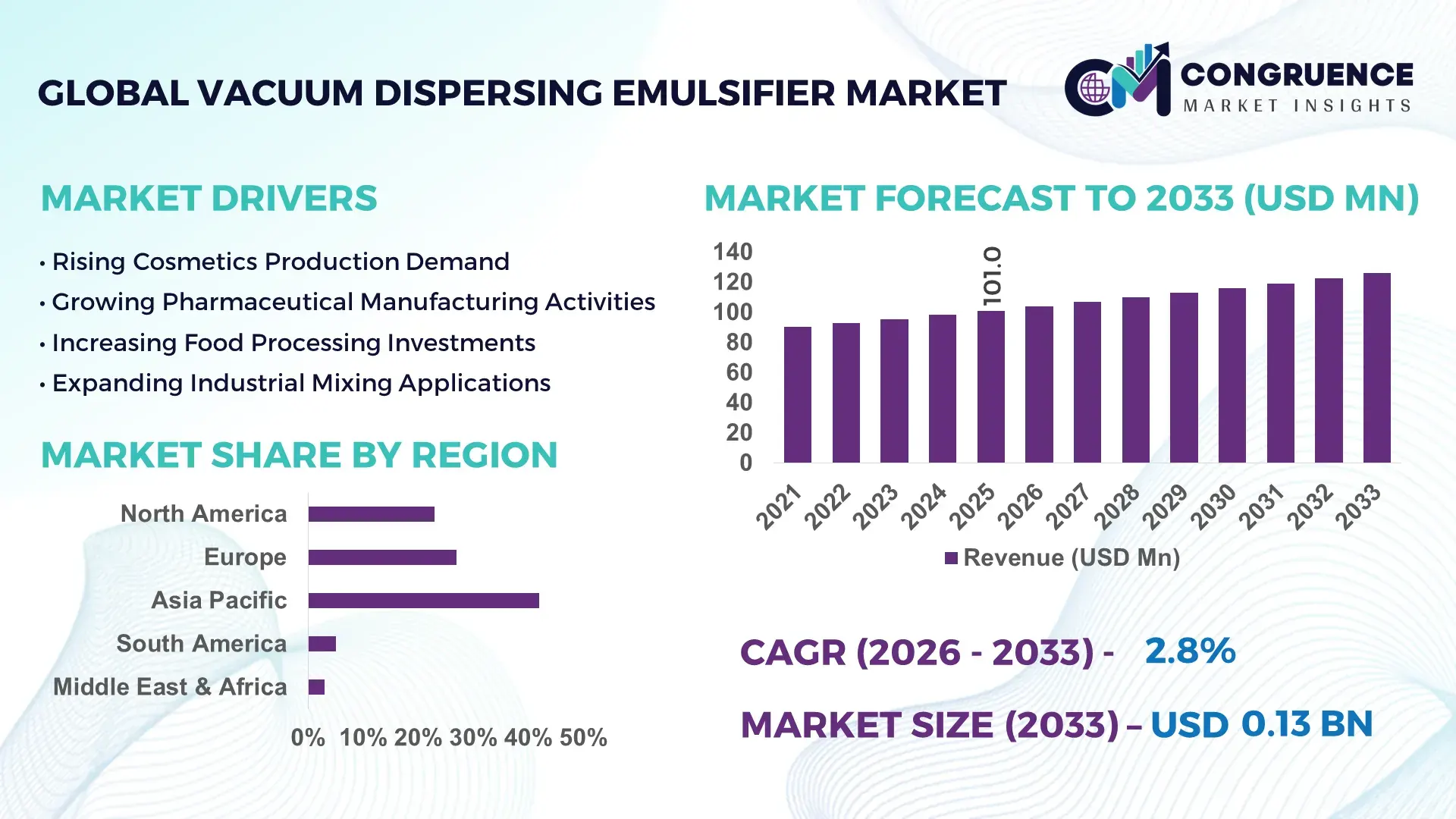
China dominates the global Vacuum Dispersing Emulsifier Market with nearly 34% production share, supported by more than 2,000 industrial cosmetic and pharmaceutical processing facilities and aggressive manufacturing expansion in Jiangsu and Guangdong provinces. The country increased advanced emulsifier equipment exports by 19% in 2025, while localized automation integration reduced production cycle time by approximately 27% compared to conventional systems. Germany remains a technology leader in precision vacuum mixing controls, whereas the U.S. leads in pharmaceutical-grade adoption intensity and high-value processing applications.
As global manufacturers prioritize contamination-free processing, energy optimization, and faster batch scalability, competitive advantage is increasingly shifting toward companies capable of delivering automated, high-capacity, digitally monitored emulsification systems with strong compliance alignment.
Market Size & Growth: USD 101.0 million in 2025 reaching USD 126.0 million by 2033, driven by automated pharmaceutical and cosmetic processing expansion.
Top Growth Drivers: Automation integration improved processing efficiency by 22%, energy optimization by 18%, and contamination reduction by 31%.
Short-Term Forecast: By 2028, advanced vacuum systems are projected to reduce production downtime by 24% across high-volume manufacturing lines.
Emerging Technologies: AI-enabled viscosity control, PLC automation, and smart high-shear dispersion systems are reshaping industrial mixing precision.
Regional Leaders: Asia-Pacific holds 42% demand concentration, Europe leads precision-engineering adoption, while North America dominates pharmaceutical-grade integration.
Consumer/End-User Trends: Nearly 47% of cosmetic manufacturers shifted toward fully enclosed vacuum processing to improve product consistency and compliance.
Pilot/Case Example: In 2025, a German pharmaceutical facility improved batch uniformity by 29% after deploying automated vacuum dispersing systems.
Competitive Landscape: Top five manufacturers control approximately 38% market share, led by Ross, Ginhong, IKA, Silverson, and Yekeey.
Regulatory & ESG Impact: Energy-efficient emulsifiers lowered industrial power consumption by nearly 16% under stricter European compliance mandates.
Investment & Funding: Industrial automation partnerships and plant modernization projects exceeded USD 280 million between 2024 and 2025 globally.
Innovation & Future Outlook: Smart modular emulsifiers with remote monitoring and predictive maintenance are redefining scalable high-throughput production.
Pharmaceutical applications contribute nearly 36% of global Vacuum Dispersing Emulsifier Market demand, followed by cosmetics and personal care with approximately 31%, reflecting strong dependence on contamination-free, high-viscosity processing systems. Recent innovations in AI-based viscosity monitoring and automated batch optimization improved production consistency by over 25% in advanced manufacturing facilities. Asia-Pacific continues dominating equipment deployment due to localized production expansion, while Europe prioritizes energy-efficient systems aligned with stricter industrial sustainability standards. Simultaneously, supply chain diversification and component localization strategies are reshaping procurement models, pushing manufacturers toward digitally integrated and modular emulsification platforms capable of supporting faster industrial scaling and precision-driven production strategies.
The Vacuum Dispersing Emulsifier Market is rapidly transforming into a strategic industrial infrastructure segment as manufacturers across pharmaceuticals, cosmetics, food processing, and specialty chemicals intensify investments in contamination-free, high-efficiency production systems. Precision emulsification is no longer treated as a secondary processing function; it has become a critical operational differentiator directly linked to product quality consistency, regulatory compliance, production scalability, and energy optimization. Global manufacturers are accelerating modernization programs as labor shortages, rising quality-control costs, and tightening GMP standards continue reshaping industrial processing economics.
A major structural shift is emerging from global supply chain decentralization and regional manufacturing localization initiatives, particularly across Asia-Pacific and Europe. Automated vacuum dispersing systems integrated with AI-enabled process controls improve production efficiency by nearly 26% while reducing operational waste by approximately 19% compared to legacy open-mixing systems. Europe leads in compliance-driven innovation and closed-loop processing adoption, while Asia-Pacific leads in production volume and equipment deployment with nearly 42% global demand concentration driven by pharmaceutical and cosmetics manufacturing expansion.
Over the next three years, advanced smart emulsification systems are projected to reduce batch processing downtime by over 24% while increasing formulation consistency by nearly 30% across high-throughput industrial facilities. ESG positioning is also becoming a competitive advantage, as energy-efficient vacuum systems lower industrial power consumption by approximately 16% and significantly reduce contamination-related material losses. In 2025, a South Korean cosmetics manufacturer improved production throughput by 21% after integrating automated vacuum homogenization systems with real-time viscosity monitoring.
Industrial equipment suppliers are increasingly shifting capital allocation toward modular, digitally connected emulsification platforms capable of predictive maintenance and remote diagnostics. Strategic partnerships between automation providers and processing equipment manufacturers are accelerating, particularly in pharmaceutical-grade production environments where operational precision directly influences regulatory approvals and export competitiveness. Companies capable of optimizing processing speed, energy efficiency, and compliance integration simultaneously are positioning themselves to dominate the next phase of industrial manufacturing transformation.
The Vacuum Dispersing Emulsifier Market is being reshaped by accelerating industrial automation, stricter contamination-control standards, and rising demand for high-viscosity precision processing across pharmaceuticals, cosmetics, chemicals, and food manufacturing sectors. Industrial producers are increasingly replacing conventional open-mixing systems with closed vacuum dispersing platforms capable of improving batch consistency, reducing oxidation risks, and optimizing material utilization. More than 48% of large-scale cosmetic and pharmaceutical manufacturers have already integrated automated emulsification technologies into core production lines to improve operational reliability and compliance performance. The market is also experiencing structural transformation due to energy-efficiency mandates, labor cost escalation, and growing demand for digitally monitored manufacturing systems. Asia-Pacific continues dominating production scale and equipment deployment, while Europe leads in regulatory-driven technology upgrades focused on sustainable processing and reduced industrial waste. Simultaneously, manufacturers are prioritizing modular system architectures, predictive maintenance capabilities, and AI-assisted viscosity controls to improve throughput efficiency and shorten production cycles. These trends are redefining procurement strategies, competitive positioning, and long-term industrial processing investments across global manufacturing ecosystems.
Industrial automation is becoming the primary force accelerating Vacuum Dispersing Emulsifier Market expansion as manufacturers prioritize precision, contamination control, and faster batch scalability. Automated vacuum emulsification systems improved processing efficiency by approximately 22% while reducing manual intervention errors by nearly 31% across pharmaceutical and cosmetic production environments. Rising global demand for high-stability formulations, particularly in biologics, premium skincare, and specialty chemicals, is forcing companies to modernize conventional mixing infrastructure with digitally integrated systems capable of real-time process optimization. The 2024–2026 global supply chain restructuring wave further accelerated localized production investments, especially across China, India, Germany, and the United States. Manufacturers responded by increasing smart manufacturing investments and expanding automated processing capacities to reduce operational bottlenecks and dependency on imported intermediates. Nearly 44% of newly installed industrial mixing systems in advanced pharmaceutical facilities now include PLC-controlled vacuum dispersing capabilities. Major companies are aggressively expanding modular equipment portfolios, forming automation partnerships, and integrating AI-assisted monitoring systems to capture higher-value industrial clients. This shift is redefining competitive positioning as operational precision, compliance readiness, and throughput optimization become essential procurement criteria across industrial processing sectors.
Despite accelerating industrial adoption, high capital expenditure and technical integration complexity continue constraining Vacuum Dispersing Emulsifier Market scalability, particularly among mid-sized manufacturers. Advanced automated systems typically increase upfront equipment investment by nearly 28% compared to conventional mixing units, while customized pharmaceutical-grade installations can raise deployment costs by over 35% due to validation and compliance requirements. These cost pressures are limiting adoption across price-sensitive manufacturing environments in emerging economies. The market also faces structural dependency on specialized stainless-steel components, vacuum pumps, precision seals, and electronic control systems, creating procurement volatility during periods of global supply disruption. Between 2024 and 2025, industrial equipment lead times increased by approximately 17% in several European and Asian manufacturing hubs due to component shortages and logistics delays. In addition, infrastructure limitations and insufficient technical expertise continue slowing implementation in smaller production facilities. To mitigate these risks, manufacturers are diversifying supplier networks, increasing regional sourcing agreements, and developing modular systems requiring lower installation complexity. Several equipment providers are also introducing hybrid semi-automated models aimed at reducing capital barriers while maintaining core process optimization benefits. The ability to balance cost efficiency with high-performance automation is becoming a defining competitive challenge across the industry.
The strongest growth opportunity in the Vacuum Dispersing Emulsifier Market is emerging from the convergence of smart manufacturing, localized industrial expansion, and demand for high-efficiency precision processing. AI-assisted emulsification platforms capable of predictive viscosity control improved batch consistency by nearly 27% while reducing processing waste by approximately 18% in advanced pharmaceutical and cosmetic applications. These operational gains are accelerating demand for digitally connected vacuum dispersing systems across both developed and emerging industrial markets. India, Southeast Asia, and parts of Latin America are becoming high-priority expansion zones as domestic pharmaceutical and personal care manufacturing capacities rapidly increase. More than 39% of newly commissioned cosmetic processing plants in Asia-Pacific during 2025 incorporated automated vacuum dispersing systems to support export-grade quality standards and scalable production models. Simultaneously, modular emulsification technologies are creating new demand pockets among mid-sized manufacturers previously constrained by infrastructure limitations. Leading companies are aggressively expanding R&D investments into energy-efficient high-shear technologies, remote monitoring capabilities, and customizable multi-product processing systems. Strategic ecosystem building between automation providers, industrial software firms, and process equipment manufacturers is accelerating. The market opportunity is increasingly shifting beyond hardware sales toward integrated smart-processing solutions capable of delivering measurable productivity, compliance, and sustainability advantages.
The Vacuum Dispersing Emulsifier Market faces growing execution challenges linked to scalability pressures, regulatory complexity, and operational standardization across multi-industry deployments. High-performance vacuum systems require precise calibration, skilled technical oversight, and continuous maintenance, increasing operational dependency on specialized engineering talent. Nearly 29% of industrial operators reported production inefficiencies linked to improper system integration or inconsistent process parameter management during 2025 implementation cycles. Stricter global GMP and industrial sustainability regulations are also forcing manufacturers to redesign production architectures while maintaining cost competitiveness. In Europe, compliance-driven processing upgrades increased operational transition costs by approximately 14%, particularly for manufacturers transitioning from legacy open-mixing systems. Simultaneously, energy-intensive production environments and rising industrial electricity costs continue pressuring long-term profitability across high-volume processing facilities. Companies must also address interoperability challenges between legacy production systems and next-generation AI-enabled emulsification technologies. Several industrial operators are responding through strategic automation partnerships, workforce training investments, and predictive maintenance integration aimed at reducing unplanned downtime and operational inconsistency. Long-term competitiveness will depend on how effectively companies optimize scalability, digital integration, regulatory compliance, and operational resilience simultaneously within increasingly complex manufacturing ecosystems.
31% Increase in Automated Vacuum Processing Deployment Across Pharmaceutical Facilities Industrial manufacturers are rapidly replacing manual and semi-automatic mixing systems with PLC-integrated vacuum dispersing emulsifiers to improve formulation consistency and contamination control. More than 46% of newly installed pharmaceutical processing lines in 2025 incorporated automated viscosity monitoring and closed-loop processing functions. This shift is reducing batch rejection rates by nearly 18% while optimizing production speed. Equipment suppliers are expanding smart-control partnerships and increasing modular system production to meet accelerating compliance-driven demand.
24% Reduction in Production Downtime Through Predictive Maintenance Integration Predictive diagnostics and sensor-enabled monitoring systems are reshaping operational management across high-throughput manufacturing plants. Industrial operators implementing AI-assisted maintenance platforms reduced unplanned downtime by approximately 24% and lowered maintenance-related shutdown costs by nearly 16%. Rising labor shortages and stricter manufacturing timelines are forcing companies to restructure maintenance workflows around remote monitoring capabilities. Several equipment manufacturers are embedding cloud-connected analytics directly into next-generation emulsification platforms.
19% Expansion in Localized Manufacturing and Regional Supply Chain Realignment Supply chain disruptions between 2024 and 2025 accelerated regional equipment sourcing strategies, particularly across Asia-Pacific and Europe. Nearly 41% of manufacturers increased local procurement of vacuum dispersing components to reduce delivery volatility and import dependency. Chinese and Indian industrial equipment producers expanded domestic production capacity by over 20%, enabling faster deployment cycles and lower logistics costs. This regionalization trend is redefining supplier relationships and procurement priorities across industrial processing sectors.
27% Growth in Energy-Efficient High-Shear Emulsification System Adoption Energy optimization has become a critical operational priority as industrial electricity costs continue rising globally. Advanced high-shear vacuum emulsifiers reduced power consumption by approximately 15% while improving dispersion efficiency by nearly 27% in cosmetic and specialty chemical applications. Companies are increasingly redesigning processing architectures around low-energy systems to align with stricter European sustainability mandates and enterprise ESG targets. This shift is also accelerating investment into multi-functional modular equipment capable of handling diverse formulation requirements within smaller production footprints.
The Vacuum Dispersing Emulsifier Market is segmented by type, application, and end-user, with demand concentration heavily influenced by processing precision, contamination-control requirements, and industrial automation intensity. Fully automatic systems account for nearly 48% of total market demand due to their scalability and operational efficiency advantages in pharmaceutical and cosmetic manufacturing environments. Semi-automatic platforms continue holding strong adoption among mid-sized industrial processors prioritizing lower deployment costs and flexible production capabilities. Application demand remains concentrated within pharmaceuticals and cosmetics, collectively contributing approximately 67% of global equipment utilization due to rising demand for high-viscosity formulations and sterile processing environments. Meanwhile, food processing and specialty chemicals are increasingly adopting advanced vacuum dispersing systems to improve batch consistency and reduce material loss. End-user demand is shifting toward large-scale industrial manufacturers investing aggressively in digitalized processing infrastructure, although contract manufacturing organizations and regional processing facilities are rapidly expanding adoption to strengthen production scalability and compliance alignment. These segmentation shifts are redefining investment priorities, product innovation strategies, and competitive positioning across the industrial processing ecosystem.
Fully Automatic Vacuum Dispersing Emulsifiers dominate the market with approximately 48% share due to their superior integration capabilities, precision control systems, and scalability advantages across pharmaceutical and cosmetic production environments. These systems significantly reduce human intervention, improve batch consistency by nearly 30%, and optimize processing efficiency for high-volume manufacturing operations. Large industrial producers increasingly prioritize fully automated platforms because they support real-time monitoring, predictive maintenance, and contamination-free processing requirements aligned with evolving GMP standards. Semi-Automatic Vacuum Dispersing Emulsifiers are emerging as the fastest-expanding segment, recording adoption growth exceeding 21% across mid-sized manufacturing facilities. Their growth is driven by lower capital requirements, flexible deployment capabilities, and rising demand from regional cosmetics and specialty chemical manufacturers transitioning from manual operations. Compared to fully automatic systems, semi-automatic solutions provide a more balanced cost-performance model for manufacturers seeking gradual automation upgrades without extensive infrastructure restructuring. Manual and customized emulsification systems collectively account for nearly 24% market share, maintaining relevance within niche production applications, pilot-scale operations, and low-volume specialty processing environments. Equipment manufacturers are increasingly expanding modular product portfolios and introducing hybrid automation capabilities to capture evolving industrial demand patterns. Investment momentum is clearly shifting toward scalable automated systems capable of supporting precision manufacturing, faster throughput, and digitalized industrial operations.
Pharmaceutical manufacturing leads the Vacuum Dispersing Emulsifier Market with nearly 36% demand concentration due to stringent contamination-control requirements, high-viscosity formulation processing, and rising biologics production expansion. Pharmaceutical producers increasingly rely on advanced vacuum dispersing systems to improve formulation uniformity, reduce oxidation exposure, and maintain GMP-compliant production standards. Automated systems improved sterile batch consistency by approximately 26%, making them essential for large-scale drug manufacturing and precision formulation environments. Cosmetics and personal care applications represent the fastest-growing segment, expanding adoption by more than 24% as premium skincare, dermatological formulations, and high-performance beauty products gain global traction. Compared to mature pharmaceutical usage, cosmetics manufacturers prioritize processing flexibility, shorter product development cycles, and multi-viscosity compatibility to support rapidly changing consumer demand patterns. High-shear vacuum emulsification systems are increasingly deployed to improve texture uniformity, ingredient stability, and product shelf-life performance. Food processing, specialty chemicals, and industrial materials collectively contribute around 33% of total market utilization, particularly in emulsified sauces, industrial coatings, and specialty additives. Companies are responding by expanding customized equipment offerings, improving automation integration, and developing energy-efficient processing architectures tailored to application-specific production requirements. Demand is steadily shifting toward multifunctional emulsification systems capable of handling complex formulations while supporting operational scalability and regulatory compliance.
Large-scale industrial manufacturers account for approximately 52% of total Vacuum Dispersing Emulsifier Market demand due to their dependence on high-throughput production, strict quality-control requirements, and continuous operational efficiency optimization. Pharmaceutical conglomerates, multinational cosmetic brands, and specialty chemical producers are aggressively investing in automated vacuum processing systems to improve production consistency, reduce contamination exposure, and support large-volume manufacturing scalability. Advanced digital integration has improved operational throughput by nearly 23% across enterprise-level production environments. Contract manufacturing organizations (CMOs) are emerging as the fastest-growing end-user segment, recording adoption growth exceeding 26% as outsourcing strategies accelerate across pharmaceuticals and personal care industries. Compared to established multinational manufacturers, CMOs prioritize flexible, multi-product capable emulsification systems that support rapid production shifts and shorter client delivery timelines. This demand transition is reshaping procurement preferences toward modular and customizable processing architectures. Small and mid-sized regional manufacturers collectively contribute nearly 29% of market demand, particularly across emerging economies where localized production expansion is accelerating. Equipment providers are increasingly targeting these buyers through flexible financing models, semi-automated product lines, and strategic technical partnerships. Future demand is steadily shifting toward digitally connected, energy-efficient systems capable of balancing scalability, compliance readiness, and operational affordability within increasingly competitive industrial environments.
Asia-Pacific accounted for the largest market share at 42% in 2025 however, North America is expected to register the fastest growth, expanding at a CAGR of 3.4% between 2026 and 2033.

Asia-Pacific continues dominating global production and equipment deployment due to expanding pharmaceutical, cosmetics, and specialty chemical manufacturing infrastructure across China, India, South Korea, and Japan. Europe holds approximately 27% market share, driven by precision engineering, sustainability-focused industrial upgrades, and strict GMP compliance requirements. North America contributes nearly 23% of global demand while leading in high-value pharmaceutical-grade processing adoption and smart manufacturing integration. Meanwhile, South America and the Middle East & Africa collectively represent 8% share, supported by localized industrial expansion and infrastructure modernization initiatives. Ongoing supply chain regionalization and industrial automation investments are forcing global manufacturers to prioritize localized production partnerships, modular system deployment, and digitally integrated processing expansion strategies.
North America represents approximately 23% of the global Vacuum Dispersing Emulsifier Market, driven by strong pharmaceutical manufacturing intensity, advanced cosmetic production infrastructure, and rapid smart-factory integration. The United States dominates regional demand due to rising deployment of contamination-free processing systems and automated high-shear mixing technologies across biologics and premium personal care production. Nearly 54% of newly installed industrial emulsification systems in the region include AI-enabled monitoring and predictive maintenance capabilities. Rising FDA compliance pressure and supply chain localization strategies are accelerating modernization investments across processing facilities. Several manufacturers expanded production automation capacity by over 18% during 2025 to optimize throughput efficiency and reduce operational downtime. Enterprises increasingly prioritize digitally connected, high-efficiency emulsification systems that improve compliance readiness, scalability, and production precision, positioning North America as a high-value strategic investment region.
Europe accounts for nearly 27% of the global Vacuum Dispersing Emulsifier Market, supported by strong pharmaceutical engineering capabilities and advanced cosmetic manufacturing infrastructure across Germany, France, Italy, and the United Kingdom. Strict EU industrial sustainability regulations and GMP compliance standards are accelerating demand for energy-efficient closed-loop emulsification systems capable of reducing material waste and operational emissions. More than 48% of industrial processing upgrades completed in 2025 focused on low-energy automated mixing technologies aligned with ESG targets. Regional manufacturers are increasingly integrating high-shear precision systems with digital monitoring functions to improve batch consistency and traceability. Germany leads regional equipment innovation, while France and Italy remain strong premium cosmetics production hubs. Enterprises across Europe continue prioritizing compliance-driven automation investments, forcing suppliers to innovate around energy optimization, operational transparency, and sustainable processing performance.
Asia-Pacific leads the global Vacuum Dispersing Emulsifier Market with approximately 42% demand concentration and the highest industrial production scale globally. China, India, Japan, and South Korea dominate regional manufacturing due to strong pharmaceutical exports, expanding cosmetics production, and lower industrial operating costs. Nearly 46% of newly commissioned cosmetic and pharmaceutical processing plants in 2025 integrated automated vacuum dispersing systems to improve production scalability and export-grade quality consistency. China alone contributes over 34% of global equipment manufacturing capacity, supported by aggressive industrial automation expansion and localized supply chain advantages. Regional enterprises prioritize cost-efficient, high-throughput processing systems capable of supporting rapid production cycles and multi-product flexibility. Equipment manufacturers are expanding regional production partnerships and localized assembly operations, positioning Asia-Pacific as the critical global hub for industrial scale, manufacturing speed, and long-term processing infrastructure expansion.
South America contributes approximately 5% of the global Vacuum Dispersing Emulsifier Market, with Brazil and Argentina leading regional demand due to expanding pharmaceutical production and growing personal care manufacturing activities. Regional manufacturers are increasingly investing in semi-automated and modular emulsification systems to improve production quality while managing capital constraints. Nearly 33% of newly deployed systems during 2025 focused on mid-scale cosmetic and food-processing applications. However, infrastructure limitations, import dependency, and currency volatility continue constraining large-scale automation deployment across several industrial sectors. Enterprises remain highly price-sensitive and prioritize flexible equipment configurations capable of supporting multiple formulation requirements. Equipment suppliers are responding through localized distribution partnerships and lower-cost automation models, making South America an attractive but execution-sensitive market where operational adaptability and cost efficiency determine long-term competitive success.
The Middle East & Africa account for approximately 3% of the global Vacuum Dispersing Emulsifier Market, supported by rising industrial diversification initiatives, expanding pharmaceutical processing infrastructure, and growing food manufacturing investments across the UAE, Saudi Arabia, and South Africa. Governments and private enterprises are accelerating industrial modernization programs focused on localized production and reduced import dependency. Nearly 29% of newly established pharmaceutical and cosmetic facilities in key Gulf economies integrated advanced vacuum emulsification systems during 2025 to improve processing efficiency and compliance readiness. Infrastructure expansion and strategic industrial partnerships are driving increased adoption of digitally monitored high-shear processing technologies. Regional enterprises increasingly prioritize durable, scalable systems capable of operating efficiently in high-temperature industrial environments. The region is emerging as a strategic long-term opportunity as manufacturing localization and infrastructure transformation continue accelerating.
China – 34% Market share: driven by massive pharmaceutical and cosmetics manufacturing capacity, localized industrial automation expansion, and strong equipment export infrastructure.
United States – 19% Market share: supported by advanced pharmaceutical-grade processing demand, rapid smart manufacturing adoption, and high investment in automated industrial production systems.
The Vacuum Dispersing Emulsifier Market is characterized by intense competition between global high-shear mixing leaders such as Silverson Machines, IKA Works, Ross Mixers, Ginhong, and Yekeey, alongside aggressive regional manufacturers competing on pricing and localized customization. Global technology-focused players dominate pharmaceutical and premium cosmetics processing, while Chinese and regional OEMs increasingly capture cost-sensitive industrial demand through faster delivery cycles and lower manufacturing costs.
The top five companies collectively control approximately 38% of the global market, with competition centered around automation capability, processing precision, energy efficiency, and scale-up flexibility. Advanced high-shear systems reduced processing time by nearly 90%, while AI-enabled viscosity monitoring improved operational consistency by approximately 26% in pharmaceutical applications. Regional manufacturers are leveraging localized supply chains to cut equipment lead times by nearly 18%, intensifying pressure on traditional global suppliers.
Competition is increasingly shifting toward modular automation platforms, predictive maintenance integration, and vertically integrated manufacturing ecosystems. Strategic partnerships between industrial automation firms and processing equipment suppliers are accelerating, particularly in GMP-compliant pharmaceutical environments. High engineering complexity, regulatory validation requirements, and after-sales technical support remain critical entry barriers. Winning in this market now requires precision automation, scalable customization, rapid deployment capability, and strong compliance-driven processing performance.
IKA Works GmbH & Co. KG
Charles Ross & Son Company
Ginhong Industrial Mixers
Yekeey Intelligent Equipment
SPX FLOW
Lee Industries
Admix Inc.
EKATO Holding GmbH
INOXPA S.A.
Bematek Systems
NETZSCH Group
Primix Corporation
FrymaKoruma
The Vacuum Dispersing Emulsifier Market is rapidly transitioning toward AI-enabled, digitally monitored, and high-shear precision processing technologies designed to optimize industrial throughput and formulation consistency. Automated PLC-integrated emulsification systems are now deployed in nearly 46% of newly commissioned pharmaceutical and cosmetics production facilities, driven by the need for contamination-free processing and reduced operational dependency on manual calibration. Real-time viscosity monitoring and predictive maintenance functions improved batch consistency by approximately 27% while lowering unplanned downtime by nearly 24%.
Advanced rotor-stator high-shear mixing technology continues dominating industrial adoption due to its ability to achieve finer droplet dispersion and faster emulsification cycles. Compared to legacy open-mixing systems, modern vacuum emulsifiers reduce processing time by up to 90% while improving product homogeneity by nearly 30%. Manufacturers focusing on biologics, dermatological products, and specialty chemicals are increasingly prioritizing closed-loop systems capable of supporting sterile, multi-viscosity production environments.
Emerging modular emulsification platforms integrated with cloud analytics and remote diagnostics are reshaping industrial scalability strategies. Approximately 39% of large-scale manufacturers have already integrated smart monitoring functions into production workflows to optimize maintenance scheduling and process traceability. Companies investing early in digitalized high-shear processing technologies are gaining measurable advantages in regulatory compliance, production flexibility, and energy optimization.
Between 2026 and 2028, the market is expected to witness accelerated deployment of autonomous process optimization systems, energy-efficient vacuum chambers, and adaptive AI-driven mixing controls capable of dynamically adjusting processing parameters in real time. Equipment suppliers capable of combining automation intelligence, operational efficiency, and compliance-ready architecture will dominate next-generation industrial processing expansion.
March 2025 – Silverson Machines expanded deployment of high-shear mixing solutions for cosmetic formulation processing through its collaboration with Beauty Science Labs, improving scale-up consistency and reducing formulation processing time by nearly 30%. The partnership strengthened Silverson’s position in premium cosmetics manufacturing automation. [Cosmetic Processing Alliance] Source: www.silverson.com
May 2025 – IKA Works GmbH & Co. KG introduced upgraded bottom-entry homogenizer and dispersing systems designed for faster dissolution and high-shear emulsification performance, reducing industrial processing time significantly compared to conventional agitation methods. The launch strengthened IKA’s advanced pharmaceutical and specialty chemical processing portfolio. [High-Shear Upgrade]
October 2025 – Silverson Machines showcased next-generation pilot-scale and laboratory emulsification systems at SCS Formulate 2025, enabling scalable batch processing up to 50 liters with enhanced precision forecasting capabilities. The deployment reinforced growing demand for flexible cosmetic R&D processing infrastructure. [Pilot-Scale Expansion]
November 2024 – Silverson Machines expanded promotion of ultra-efficient in-line high-shear mixers capable of reducing mixing times by up to 90% across food and pharmaceutical applications. The operational efficiency gains accelerated adoption among manufacturers seeking faster throughput and lower production bottlenecks. [Efficiency Optimization Drive]
The Vacuum Dispersing Emulsifier Market Report delivers comprehensive analysis across equipment types, industrial applications, end-user groups, regional demand centers, and emerging processing technologies shaping next-generation industrial manufacturing. The study evaluates fully automatic, semi-automatic, and customized emulsification systems across pharmaceutical, cosmetics, food processing, specialty chemical, and industrial material applications. It further analyzes demand behavior among large-scale manufacturers, contract manufacturing organizations, and regional production facilities across North America, Europe, Asia-Pacific, South America, and the Middle East & Africa.
The report provides deep analytical coverage of more than 12 major industry participants, alongside detailed segmentation intelligence, technology benchmarking, operational efficiency trends, and regional production dynamics. Approximately 48% of market demand concentration within fully automated systems and nearly 67% combined application share across pharmaceuticals and cosmetics are examined through execution-level operational insights and strategic competitive analysis. The report also evaluates AI-enabled viscosity monitoring, predictive maintenance integration, modular high-shear processing platforms, and energy-efficient vacuum technologies reshaping industrial processing infrastructure.
Additionally, the report delivers forward-looking strategic assessment covering 2026–2033 industrial transformation pathways, localized manufacturing shifts, automation penetration trends, and smart processing adoption patterns. Decision-makers benefit from actionable intelligence supporting investment prioritization, capacity expansion, supply chain localization, technology adoption, and long-term competitive positioning across rapidly evolving industrial manufacturing ecosystems.
| Report Attribute / Metric | Details |
|---|---|
| Market Revenue (2025) | USD 101.0 Million |
| Market Revenue (2033) | USD 126.0 Million |
| CAGR (2026–2033) | 2.8% |
| Base Year | 2025 |
| Forecast Period | 2026–2033 |
| Historic Period | 2021–2025 |
| Segments Covered |
By Type
By Application
By End-User Insights
|
| Key Report Deliverables | Revenue Forecast; Market Trends; Growth Drivers & Restraints; Technology Insights; Segmentation Analysis; Regional Insights; Competitive Landscape; Regulatory & ESG Overview; Recent Developments |
| Regions Covered | North America; Europe; Asia-Pacific; South America; Middle East & Africa |
| Key Players Analyzed | Silverson Machines; IKA Works GmbH & Co. KG; Charles Ross & Son Company; Ginhong Industrial Mixers; Yekeey Intelligent Equipment; SPX FLOW; Lee Industries; Admix Inc.; EKATO Holding GmbH; INOXPA S.A.; Bematek Systems; NETZSCH Group; Primix Corporation; FrymaKoruma |
| Customization & Pricing | Available on Request (10% Customization Free) |




