
Reports
The Global Vacuum Coating Machines Market was valued at USD 628.0 Million in 2025 and is anticipated to reach a value of USD 1,120.0 Million by 2033 expanding at a CAGR of 7.5% between 2026 and 2033. Growth is driven by increasing semiconductor fabrication investments, advanced display manufacturing, and the adoption of magnetron sputtering and precision thin-film deposition technologies across electronics and automotive production.
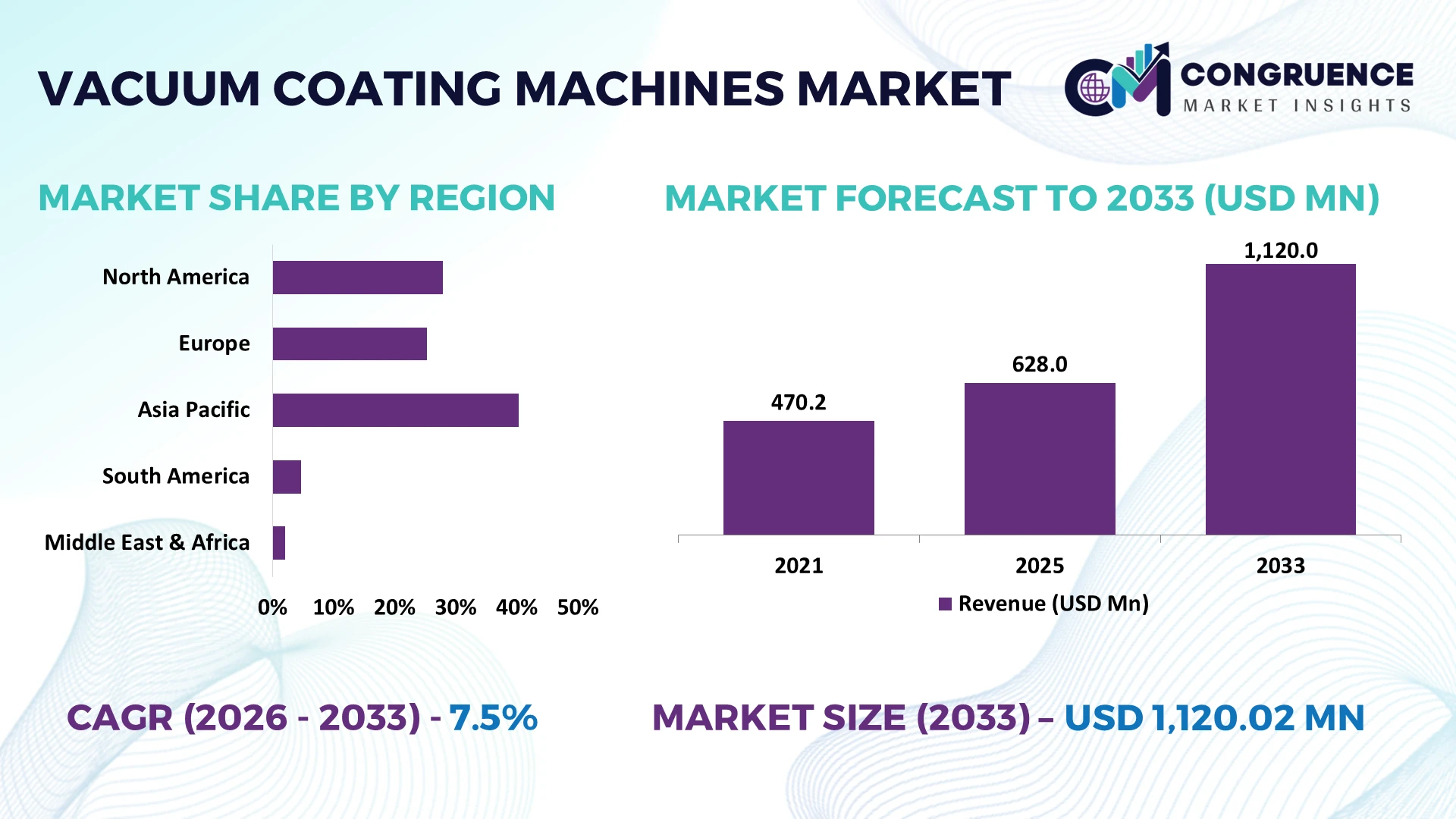
China represents a dominant manufacturing hub, supported by substantial investments in semiconductor fabrication, OLED displays, solar panels, and consumer electronics. The country accounts for approximately 21.2% of the global PVD coating machine segment, reinforcing its position in advanced deposition equipment manufacturing. Japan and South Korea strengthen regional competitiveness through precision optics, semiconductor equipment, and display technologies. Asia Pacific accounted for approximately 49.5% of the broader market's 2025 valuation, highlighting its manufacturing concentration.
Manufacturers should prioritize Asia Pacific expansion, automated deposition platforms, and localized equipment servicing to strengthen competitiveness and capture high-value industrial opportunities.
Market Size & Growth: The global market stands at USD 628.0 million in 2025 and targets USD 1,120.0 million by 2033, with a 7.5% CAGR, supported by semiconductor miniaturization and advanced display production.
Top Growth Drivers: Semiconductor manufacturing contributes a 40% application benchmark, advanced display production drives approximately 30% of specialized coating requirements, and automotive applications account for approximately 17% of selected PVD equipment demand.
Short-Term Forecast: By 2028, manufacturers are expected to prioritize automated production lines, targeting 10% reductions in process-related downtime through predictive maintenance and improved chamber utilization.
Emerging Technologies: AI-enabled process monitoring, magnetron sputtering, and atomic-layer deposition integration are strengthening coating uniformity, production repeatability, and advanced material compatibility.
Regional Leaders: Asia Pacific leads with approximately USD 311 million in estimated 2025 market value, while North America and Europe represent important investment centres, particularly for semiconductor fabrication and precision optical coating.
Consumer/End-User Trends: Semiconductor and microelectronics applications represent approximately 40.1% of selected PVD equipment demand, reflecting increasing adoption of precision thin-film deposition in advanced electronic components.
Pilot/Case Example: A 2018 optical-component manufacturing equipment project demonstrated the commercial advantage of customized PVD systems, with the selected supplier's proposal priced approximately 10–15% below competing quotations.
Competitive Landscape: Applied Materials maintains a strong position in advanced deposition equipment, competing with ULVAC, Bühler Leybold Optics, VON ARDENNE, and SINGULUS TECHNOLOGIES across specialized coating applications.
Regulatory & ESG Impact: Environmental compliance and low-emission manufacturing are encouraging the adoption of vacuum-based coating processes, which reduce dependence on conventional solvent-intensive surface treatments.
Investment & Funding: Semiconductor capacity expansion and manufacturing localization are directing equipment investments toward Asia Pacific, while international partnerships strengthen technology access and regional service capabilities.
Innovation & Future Outlook: Next-generation inline coating, intelligent chamber control, and hybrid deposition technologies are reshaping equipment procurement, shifting competition toward process precision, automation, and lifecycle efficiency.
The Global Vacuum Coating Machines Market is witnessing increasing demand from semiconductor fabrication, automotive components, architectural glass, precision optics, and renewable energy manufacturing. Magnetron sputtering and automated multi-chamber systems are improving coating consistency, while advanced substrate processing supports increasingly complex product designs. Approximately 40% of selected PVD equipment demand originates from semiconductor and microelectronics applications. Supply-chain localization and semiconductor export controls are also influencing equipment procurement and regional manufacturing strategies.
Vacuum coating machines are becoming strategically important as manufacturers compete on surface performance, production precision, and advanced material integration. Their applications across semiconductor fabrication, automotive electronics, optical components, and energy technologies position them as essential industrial manufacturing assets. Semiconductor supply-chain restructuring and government-backed domestic manufacturing initiatives are further accelerating investments in specialized deposition equipment, particularly across Asia and North America.
Technology differentiation is increasingly determining equipment purchasing decisions. Advanced magnetron sputtering and automated cluster systems offer improved film uniformity, repeatability, and process control compared with conventional coating configurations. Integrated automation reduces manual intervention, while predictive maintenance improves equipment availability. For manufacturers, these capabilities strengthen production economics and support increasingly demanding semiconductor and optical applications.
Regional investment strategies are also diverging. China, Japan, and South Korea prioritize high-volume electronics and display manufacturing, whereas North America emphasizes semiconductor fabrication and advanced materials. Over the next two to three years, manufacturers will increasingly prioritize localized servicing, automated chamber management, and shorter equipment commissioning cycles. For example, a customized PVD installation in Italy completed installation, commissioning, and operator training within 80 days in 2026. Equipment suppliers are consequently strengthening regional partnerships and application engineering capabilities. Ultimately, competitive positioning will depend on technological differentiation, reliable equipment performance, and the ability to deliver integrated coating solutions across evolving industrial applications.
Increasing semiconductor miniaturization and demand for high-performance electronic components are accelerating the adoption of advanced vacuum coating machines. Semiconductor and microelectronics applications account for approximately 40% of selected PVD equipment demand, while Asia-based semiconductor manufacturers continue expanding fabrication capacity. The transition toward smaller device geometries, multilayer structures, and precision thin-film deposition is increasing requirements for atomic-level coating control. South Korea's semiconductor investment expansion and China's domestic equipment localization initiatives are reinforcing this shift. Manufacturers are responding through investments in magnetron sputtering, automated cluster systems, and advanced process-control technologies. The strategic advantage increasingly lies in achieving consistent nanoscale deposition across high-volume production cycles rather than simply increasing equipment capacity.
High acquisition costs and specialized infrastructure requirements constrain the adoption of vacuum coating machines among small and medium-sized manufacturers. Advanced PVD and CVD installations require substantial capital expenditure, while installation, maintenance, and cleanroom integration can add approximately 15–25% to initial project costs. Dependence on specialized vacuum pumps, precision valves, sensors, and imported electronic components further exposes manufacturers to supply-chain volatility. Japan and Germany remain important sources of specialized vacuum technology, creating procurement dependencies for several developing manufacturing markets. These constraints extend equipment payback periods and limit deployment flexibility. Manufacturers are addressing the pressure through modular equipment designs, long-term component procurement agreements, localized servicing, and refurbished system offerings.
Intelligent deposition platforms and hybrid coating technologies present significant opportunities for equipment manufacturers. AI-assisted process monitoring can improve production consistency, while automated chamber control supports approximately 10–20% reductions in selected process-related downtime through improved fault detection and maintenance scheduling. India's semiconductor manufacturing incentives and expanding electronics production ecosystem are creating additional opportunities for localized equipment supply and technical partnerships. Furthermore, atomic layer deposition and advanced magnetron sputtering are supporting increasingly complex thin-film applications. Manufacturers investing approximately 8–12% of their equipment development budgets in automation and process innovation can strengthen product differentiation. A particularly attractive opportunity lies in retrofitting existing coating installations with digital monitoring systems rather than replacing entire production lines.
Maintaining consistent coating performance across complex manufacturing environments remains a major execution challenge. Approximately 20–30% of specialized equipment commissioning schedules can be affected by integration, calibration, and process-validation requirements in complex installations. Advanced vacuum coating systems require coordination among vacuum engineering, plasma control, substrate handling, and production software, increasing technical dependencies. Germany and Japan face growing requirements for specialized equipment engineers as manufacturing systems become more automated and interconnected. Cybersecurity vulnerabilities in digitally integrated production environments further complicate long-term deployment. Equipment manufacturers must strengthen workforce training, establish application engineering centres, and improve interoperability between deposition platforms and factory execution systems. Long-term competitiveness will depend on repeatable process integration rather than equipment specifications alone.
Dry milling machines are estimated to represent the leading type, accounting for approximately 52.8% of the global market in 2025. Their dominance reflects efficient zirconia processing, reduced coolant requirements, simplified maintenance, and compatibility with standardized crown and bridge production. Wet milling remains strategically important for glass ceramics, lithium disilicate, and other materials requiring coolant-assisted machining, representing an estimated 34.6% share. Wet and dry milling systems account for the remaining 12.6% and are gaining attention among laboratories seeking greater material flexibility through a single equipment platform.
The fastest-growing adoption shift is toward combined wet and dry capabilities, particularly among larger laboratories managing diversified restoration portfolios. Approximately 18–22% of new equipment evaluations increasingly prioritize multi-material processing flexibility. Manufacturers are responding with integrated cooling systems, automated material settings, and interchangeable machining configurations. Dry systems retain cost and throughput advantages, whereas combined platforms strengthen long-term purchasing value by reducing dependence on separate machines.
Crowns and bridges represent the leading application, accounting for an estimated 43.0% of global dental milling machine demand in 2025. Their dominance reflects recurring restorative procedures, standardized digital design workflows, and extensive use of zirconia and ceramic materials. Implantology is the fastest-growing application, supported by increasing use of digitally planned implant restorations, customized abutments, and full-arch prosthetics. Dentures maintain an established demand base through conventional and digitally fabricated removable prosthetics, while orthodontics and other specialized applications contribute additional equipment utilization. These applications collectively encourage manufacturers to improve machining precision and material compatibility.
The application mix is gradually shifting toward complex implant-supported restorations, which require advanced toolpaths and greater machining flexibility. Implantology represents an estimated 22.0% share, while dentures account for approximately 18.0%; orthodontics and other applications contribute 7.0% and 10.0%, respectively. Manufacturers are strengthening five-axis compatibility, application-specific CAM software, and validated material libraries. The business opportunity lies in serving both high-volume conventional restoration production and specialized, higher-complexity dental procedures.
Dental laboratories represent the dominant end-user segment, accounting for approximately 72.2% of global dental milling machine demand in 2025. Their leadership reflects centralized restoration manufacturing, specialized technicians, continuous equipment utilization, and the ability to process multiple materials and restoration categories. Dental clinics represent an estimated 18.0% share and are the fastest-growing end-user group as multi-location practices increasingly adopt chairside milling for faster restorative treatment. Hospitals account for approximately 6.0%, while academic and research institutions and other users collectively represent 3.8%. Their requirements are more specialized, emphasizing clinical training, research applications, and institutional dental production.
The purchasing landscape is shifting toward decentralized production as clinics integrate scanners, design software, and compact milling equipment. Laboratory buyers prioritize throughput, machine uptime, and material flexibility, whereas clinics emphasize simplified operation, installation support, and reduced treatment turnaround. Approximately 80% of surveyed dental technicians reported CAD/CAM usage, reinforcing the established digital infrastructure supporting laboratory demand. Manufacturers are responding through compact equipment portfolios, bundled software, financing arrangements, and technician-training partnerships. Future competitive positioning increasingly depends on serving centralized laboratories and expanding chairside installations through scalable, integrated solutions.
Asia-Pacific accounted for the largest market share at 40.3% in 2025 however, North America is expected to register the fastest growth at a CAGR 27.8% between 2026 and 2033.

North America accounted for approximately 27.8% of the global vacuum coating machines market in 2025, making it the second-largest regional market. The United States drives demand through semiconductor fabrication, aerospace, medical devices, automotive components, and specialty optics manufacturing. Buyers increasingly prioritize high-uniformity PVD and CVD systems, automated process controls, and equipment capable of supporting complex multilayer coatings. Semiconductor capacity expansion is strengthening the regional investment pipeline. Micron announced plans for up to USD 200 billion in U.S. semiconductor manufacturing and research and development, supporting future demand for advanced fabrication equipment and related vacuum-processing technologies. Equipment suppliers are responding with integrated process monitoring, improved uptime, and localized technical support. The region's established industrial base favors premium systems where coating precision and production reliability justify higher capital expenditure.
United States Market Outlook: The United States represents the principal country market in North America, supported by its semiconductor, aerospace, defense, and advanced electronics industries. Micron's planned investment of up to USD 200 billion across U.S. manufacturing and R&D activities highlights the scale of domestic semiconductor expansion. This investment pipeline supports demand for precision deposition, thin-film processing, and advanced vacuum systems. A strong network of research institutions, equipment suppliers, and industrial customers further reinforces the country's position in high-value coating applications.
Europe accounted for approximately 25.2% of the global vacuum coating machines market in 2025. Germany, France, the United Kingdom, Italy, and the Netherlands support regional demand through automotive manufacturing, optical components, industrial machinery, specialty glass, and semiconductor production. European buyers place strong emphasis on coating consistency, energy efficiency, process traceability, and compliance with environmental and industrial standards. Demand is increasingly directed toward automated PVD and CVD systems that improve material utilization and production reliability. Semiconductor localization is creating additional opportunities for advanced deposition equipment. Germany's Dresden semiconductor investment received approval for up to EUR 5 billion in state aid, strengthening the region's fabrication capacity and associated equipment ecosystem. Suppliers are focusing on customized production lines, retrofit solutions, and service capabilities to support complex industrial installations.
Germany Market Outlook: Germany is the leading country market in Europe because of its automotive, optical, machinery, and semiconductor manufacturing base. The country's precision-engineering ecosystem supports demand for vacuum coating systems used in vehicle components, architectural glass, industrial tools, and advanced electronics. The Dresden semiconductor investment, backed by up to EUR 5 billion in state aid, adds momentum to domestic semiconductor capacity and creates opportunities for suppliers of advanced deposition and vacuum-processing equipment.
Asia-Pacific held approximately 40.3% of the global vacuum coating machines market in 2025, making it the largest regional market. China, Japan, South Korea, Taiwan, and India drive demand through semiconductor fabrication, consumer electronics, display panels, photovoltaic manufacturing, automotive production, and industrial glass processing. The region benefits from concentrated manufacturing clusters, established component supply chains, and high-volume production facilities. Equipment procurement increasingly favors inline coating platforms, automated material handling, and high-throughput deposition systems. China recorded approximately 484.3 billion integrated circuits in 2025, reflecting the scale of its electronics manufacturing ecosystem. Regional suppliers are also expanding domestic equipment capabilities, strengthening local sourcing and service responsiveness. These conditions support demand across both premium semiconductor applications and cost-sensitive industrial coating installations.
China Market Outlook: China is the most strategically significant country market in Asia-Pacific, combining large-scale electronics production with a growing domestic vacuum equipment supply base. Its semiconductor, display, photovoltaic, automotive, and consumer electronics industries require coating systems for conductive, optical, protective, and functional thin films. Integrated-circuit output reached approximately 484.3 billion units in 2025, reinforcing the scale of its electronics manufacturing base. Domestic equipment development and localized technical support also improve procurement flexibility for industrial buyers.
South America represented approximately 4.7% of the global vacuum coating machines market in 2025, with Brazil serving as the principal regional demand center. Automotive components, packaging, glass processing, consumer goods, and industrial surface treatment are important application areas. Manufacturers are adopting vacuum coating technologies to improve corrosion resistance, optical properties, surface durability, and decorative finishes. Brazil's automotive supplier ecosystem provides opportunities for batch and inline coating systems, while Argentina, Chile, and Colombia contribute smaller pockets of demand. However, dependence on imported machinery, currency volatility, and limited local technical-service coverage can extend procurement and commissioning cycles. Suppliers are therefore emphasizing distributor partnerships, spare-parts availability, and service support. The strongest opportunities are concentrated among manufacturers modernizing existing facilities rather than across broad-based new industrial deployment.
Brazil Market Outlook: Brazil is the leading country market in South America, supported by its automotive manufacturing base, packaging industry, and established industrial supply chain. The country produced approximately 2.64 million motor vehicles in 2025, supporting demand for vacuum-coated automotive lighting, reflective components, decorative trim, and precision parts. Local manufacturers and component suppliers offer opportunities for equipment providers, particularly those able to deliver reliable maintenance, process customization, and technical support.
The Middle East & Africa accounted for approximately 2.1% of the global vacuum coating machines market in 2025. Demand is concentrated in selected Gulf economies, South Africa, and North African manufacturing centers, with applications spanning architectural glass, packaging, automotive components, solar manufacturing, and industrial surface treatment. Regional investment programs are encouraging local production and reducing reliance on imported finished goods. Saudi Arabia's photovoltaic manufacturing partnerships are creating opportunities for vacuum deposition and related thin-film processing equipment. Planned domestic photovoltaic cell and module production capacity of 10 GW annually illustrates the scale of the manufacturing pipeline. However, the market remains dependent on imported machinery, specialist installation expertise, and regional service networks. Suppliers with local partnerships, training capabilities, and dependable maintenance support are better positioned to secure industrial projects.
Saudi Arabia Market Outlook: Saudi Arabia is the region's strategically significant market, supported by industrial diversification and renewable-energy localization under Vision 2030. Partnerships involving the Public Investment Fund, JinkoSolar, and Vision Industries are intended to establish domestic photovoltaic cell and module production capacity of 10 GW annually. These facilities create potential demand for vacuum deposition and other precision coating technologies. Investment in construction materials, architectural glass, and advanced manufacturing may further broaden equipment demand as industrial projects progress.
The vacuum coating machines market pits semiconductor deposition leaders Applied Materials and ULVAC against industrial system specialists VON ARDENNE, Bühler Leybold Optics, and Oerlikon Balzers. Applied Materials and ULVAC compete on integrated wafer-processing platforms, while VON ARDENNE and Bühler target large-area, optical, glass, and roll-to-roll lines; Oerlikon competes through PVD expertise and application-specific systems. The top five suppliers are estimated to account for approximately 35% of sales; this is an analyst estimate because companies do not disclose comparable market-share figures. Competition centers on throughput, film uniformity, uptime, automation, and lifecycle service. Semiconductor buyers may accept 10–15% higher equipment prices for validated yield and process control, while industrial buyers emphasize operating cost and customization. Players expand through service hubs, customer co-development, and modular platforms. The shift toward integrated deposition, etch, and data analytics raises engineering and qualification barriers. Winning requires proven process performance, dependable supply, support, and competitive total ownership cost.
Applied Materials, Inc.
ULVAC, Inc.
VON ARDENNE GmbH
Bühler Leybold Optics
Oerlikon Balzers
Canon ANELVA Corporation
SHINCRON Co., Ltd.
Denton Vacuum
Angstrom Engineering Inc.
KDF Electronic & Vacuum Services
Semicore Equipment, Inc.
Satisloh AG
Vacuum coating technology is shifting toward connected, multi-chamber platforms combining physical vapor deposition (PVD), chemical vapor deposition (CVD), atomic layer deposition (ALD), and process control. PVD remains deployed for optical films, decorative finishes, architectural glass, and tool coatings; CVD and ALD are established in semiconductor manufacturing where conformality and thickness control matter. Integrated transfer chambers reduce atmospheric exposure and handling. As an indicative engineering target, automation can cut cycle-related losses by 2–4%, depending on the baseline process.
Emerging systems use plasma-enhanced processes, ion-beam assistance, magnetron sputtering, and film monitoring. Compared with manual recipe adjustment, closed-loop monitoring can target 1–3% tighter film-thickness variation, while optimized pumping can reduce energy use per batch by 2–5%. These are targets, not universal market averages. Adoption is strongest in semiconductor fabs, precision optics, and glass and solar production, where repeatability affects yield.
The competitive advantage is moving toward suppliers integrating equipment, recipes, metrology, software, and lifecycle service. Applied Materials and ULVAC benefit in semiconductor platforms; VON ARDENNE and Bühler Leybold Optics are positioned in large-area and optical coating. During 2026–2028, demand should favor modular systems, predictive maintenance, and lower-waste processes. Buyers delaying upgrades risk higher rework, energy intensity, and qualification costs as coating tolerances tighten.
The report evaluates the vacuum coating machines market across equipment types, including physical vapor deposition, chemical vapor deposition, magnetron sputtering, evaporation, and atomic layer deposition platforms. Application coverage includes semiconductor and electronics manufacturing, optical components, architectural and automotive glass, solar cells, batteries, medical devices, packaging, and industrial tools. End-user analysis considers semiconductor fabs, automotive and electronics manufacturers, glass and optics producers, component makers, contract coating service providers, and research institutions. The study assesses batch, inline, and roll-to-roll configurations, alongside emerging requirements for multilayer films and flexible substrates.
Regional coverage spans North America, Europe, Asia-Pacific, South America, and the Middle East & Africa, with country-level assessment of manufacturing clusters and investment activity. Technology and competitive analysis examines automation, process monitoring, service models, supply-chain resilience, and equipment customization to support investment planning, expansion decisions, supplier benchmarking, and strategic positioning through 2033.
| Report Attribute / Metric | Details |
|---|---|
| Market Revenue (2025) | USD 628.0 Million |
| Market Revenue (2033) | USD 1,120.0 Million |
| CAGR (2026–2033) | 7.5% |
| Base Year | 2025 |
| Forecast Period | 2026–2033 |
| Historic Period | 2021–2025 |
| Segments Covered |
By Type
By Application
By End-User
|
| Key Deliverables | Revenue Forecast; Market Trends; Growth Drivers & Restraints; Technology Insights; Segmentation Analysis; Regional Insights; Competitive Landscape; Regulatory & ESG Overview; Recent Developments |
| Regions Covered | North America; Europe; Asia-Pacific; South America; Middle East & Africa |
| Companies Profiled | Applied Materials, Inc.; ULVAC, Inc.; VON ARDENNE GmbH; Bühler Leybold Optics; Oerlikon Balzers; Canon ANELVA Corporation; SHINCRON Co., Ltd.; Denton Vacuum; Angstrom Engineering Inc.; KDF Electronic & Vacuum Services; Semicore Equipment, Inc.; Satisloh AG |
| Customization & Pricing | Available on Request (10% Customization Free) |




