
Reports
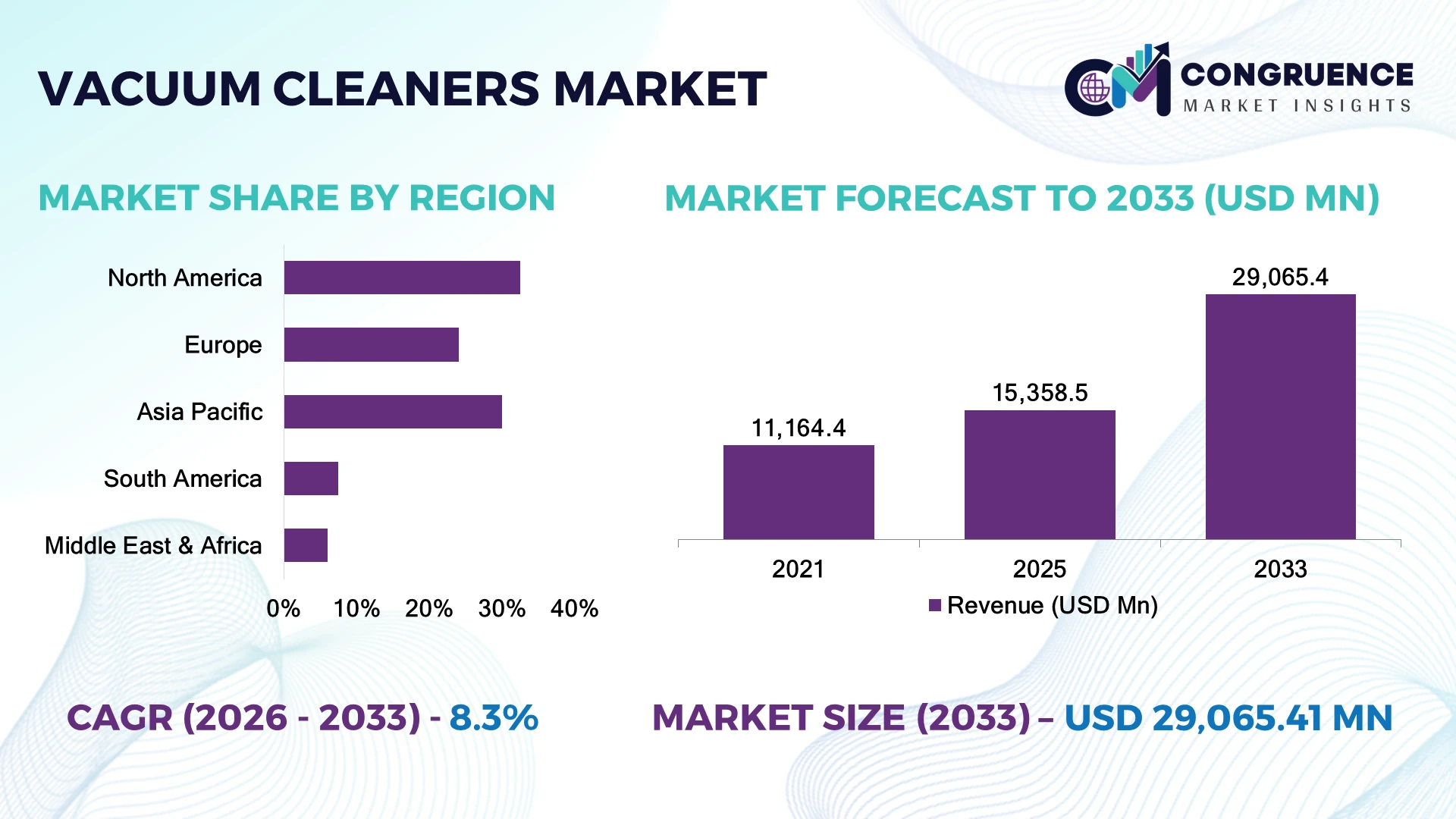
The Global Vacuum Cleaners Market was valued at USD 15,358.5 Million in 2025 and is anticipated to reach a value of USD 29,065.4 Million by 2033 expanding at a CAGR of 8.3% between 2026 and 2033. Growth is driven by robot-vacuum adoption, cordless battery performance, automated floor mapping, and demand for labor-saving cleaning across residential and commercial environments.
China dominates manufacturing through its extensive appliance, battery, motor, and electronics supply chains, while the United States represents a major premium-consumer market. Chinese factories benefit from integrated component sourcing and large-scale contract manufacturing; U.S. demand favors connected robots, cordless stick models, and advanced filtration. Battery efficiency, navigation accuracy, and smart-home integration increasingly differentiate products. Trade-policy uncertainty and changing sourcing strategies are encouraging manufacturers to diversify assembly locations and qualify alternative component suppliers.
Manufacturers should combine cost-efficient production with differentiated navigation, battery performance, and service capabilities while strengthening supply-chain resilience.
Market Size & Growth: The market is projected to increase from USD 15,358.5 million in 2025 to USD 29,065.4 million by 2033, with robot navigation and cordless convenience reshaping product demand.
Top Growth Drivers: Robot-vacuum adoption, cordless product development, and demand for automated cleaning are key growth drivers; precise global driver shares are not consistently reported.
Short-Term Forecast: By 2028, manufacturers are prioritizing longer battery runtime, improved obstacle detection, and easier maintenance; efficiency gains depend on product design and real-world floor conditions.
Emerging Technologies: AI-assisted obstacle recognition, LiDAR mapping, self-emptying docks, and connected-device controls are advancing cleaning autonomy and reducing user intervention.
Regional Leaders: Asia-Pacific leads manufacturing, North America supports premium cordless and robotic products, and Europe emphasizes energy efficiency, repairability, and product durability.
Consumer/End-User Trends: Buyers increasingly compare runtime, suction performance, filtration, noise, and automated maintenance rather than relying on wattage alone.
Pilot/Case Example: Robotic systems combining mapping with scheduled cleaning reduce routine manual intervention; actual time savings vary with home layout, floor coverage, and dock automation.
Competitive Landscape: Dyson, SharkNinja, Roborock, Ecovacs, and iRobot compete through premium engineering, price-value positioning, navigation technology, and automated maintenance features.
Regulatory & ESG Impact: Energy-efficiency requirements, battery recycling obligations, and repairability expectations are increasing the importance of durable designs and component-level compliance.
Investment & Funding: Product development focuses on battery systems, compact motors, navigation sensors, software updates, and automated docks, while manufacturers reassess sourcing and assembly footprints.
Innovation & Future Outlook: The market is shifting toward connected, low-intervention cleaning systems, with competitive advantage increasingly determined by dependable autonomy, service support, and total ownership cost.
Residential cleaning remains the core demand area, while offices, hospitality, and other commercial facilities require dependable performance across larger floor areas. Cordless platforms improve mobility, and robotic models combine mapping, scheduled operation, and increasingly automated dust disposal. Premium buyers prioritize obstacle avoidance and maintenance convenience, while value-oriented households focus on suction, battery life, and replacement-part availability. As connected-home ecosystems expand, manufacturers must deliver reliable software and practical cleaning performance alongside hardware improvements, setting up a competitive shift from standalone appliances toward integrated cleaning solutions.
The vacuum cleaners market is becoming strategically important as cleaning appliances evolve from basic household equipment into connected, software-enabled devices. Manufacturers compete through suction performance, battery endurance, filtration, navigation, and the degree of human intervention required. Robot-vacuum suppliers are differentiating through room mapping and obstacle recognition, while cordless-stick brands focus on portability and motor efficiency. Component sourcing, software support, and product reliability increasingly influence brand loyalty and after-sales costs.
Technology choices create measurable trade-offs. Brushless motors and optimized airflow can improve energy conversion and cleaning performance compared with less efficient motor designs, while LiDAR-based mapping can provide more structured navigation than random-path systems. Actual performance depends on floor type, debris, layout, and device configuration, so manufacturers must validate claims under comparable testing conditions. China remains central to production, whereas North America and Europe are important markets for premium features, connected functionality, and product-lifecycle expectations.
During 2026–2028, investment priorities include longer-lasting batteries, improved edge cleaning, obstacle recognition, self-emptying docks, and repairable components. For commercial buyers, fleet standardization and replaceable parts can reduce service complexity across multiple sites. For residential customers, dependable mapping and easier maintenance strengthen the case for robotic products. Companies that align hardware performance with software reliability, service coverage, and competitive ownership costs will be better positioned than brands relying on feature counts alone.
Demand for automated cleaning is strengthening as consumers seek reduced manual effort and flexible cleaning schedules. Robot vacuums combine mapping, programmable routines, and automated docking, while cordless stick models address quick-cleaning needs without cable restrictions. Premium devices increasingly incorporate LiDAR, obstacle detection, and app-based controls, shifting competition toward reliable real-world navigation. Manufacturers are responding through software upgrades, improved battery management, and integrated dock systems. The strategic driver is not automation alone: products that clean effectively around furniture, thresholds, and mixed flooring deliver more usable autonomy. Brands that validate navigation and suction performance across realistic household conditions can justify differentiation more effectively than competitors relying on specifications alone.
Battery packs, sensors, compact motors, and automated docking systems raise production costs, particularly for feature-rich robotic cleaners. Premium models can face price resistance in markets where conventional canister and upright products remain affordable and familiar. Battery degradation also creates replacement costs and affects long-term ownership economics. Manufacturers must balance runtime, suction, weight, and retail price without compromising reliability. Diversified component sourcing and shared battery platforms can reduce procurement exposure, while modular designs simplify servicing. The operational pressure is strongest when advanced features increase the bill of materials without producing a visible cleaning benefit. Suppliers that prioritize high-use features and maintain serviceable designs can protect value positioning across premium and mid-range categories.
Advanced navigation creates opportunities to improve cleaning coverage and reduce repeated passes. LiDAR mapping, camera-based recognition, room zoning, and obstacle detection enable more structured operation than random-path navigation, particularly in homes with mixed flooring and complex layouts. Self-emptying docks and mop-washing stations further reduce routine user intervention. Manufacturers can expand these capabilities through software updates, sensor partnerships, and tiered product platforms rather than developing every feature from scratch. Commercial applications also offer opportunities for autonomous cleaning in predictable indoor environments. The strongest proposition combines measurable cleaning coverage with low maintenance burden; feature-rich systems that remain difficult to troubleshoot risk weakening customer satisfaction and repeat purchases.
Maintaining dependable performance across rugs, hard floors, thresholds, cables, pet waste, and changing room layouts remains a major engineering challenge. Sensors can misclassify objects, brushes can tangle, and dust or moisture can reduce component performance. Connected models also require sustained software support, cybersecurity maintenance, and compatibility with evolving smart-home platforms. Manufacturers must validate navigation, suction, battery endurance, and dock reliability across diverse use conditions rather than optimizing for demonstration environments. Modular sensors, field-data analysis, and structured firmware testing can reduce recurring faults. Long-term competitiveness depends on consistent cleaning outcomes and repairability, because autonomy loses commercial value when frequent intervention, connectivity failures, or costly repairs undermine convenience.
Robotic Cleaning Becomes More Autonomous: Robot vacuums increasingly combine room mapping, obstacle recognition, scheduled cleaning, and automated docking. LiDAR and camera-based navigation help reduce unnecessary movement compared with random-path systems, although gains depend on floor layout and sensor quality. Manufacturers are adding software features and dock automation to reduce user intervention, while prioritizing obstacle handling and maintenance access as practical differentiators.
Cordless Platforms Improve Usability: Compact motors, battery-management electronics, and improved airflow designs are helping cordless cleaners balance suction with runtime. Product teams are refining removable batteries, charging systems, and lightweight construction to improve convenience. Competition is shifting from headline power ratings toward sustained pickup performance and runtime under load, encouraging manufacturers to invest in motor efficiency and battery durability.
Automated Docks Expand Maintenance Functions: Self-emptying stations and integrated mop washing reduce routine handling for compatible robot cleaners. Some systems also automate water management and drying, creating a more complete cleaning workflow. These features increase product complexity and price, so manufacturers are differentiating premium tiers while improving dock reliability, consumable availability, and ease of cleaning to control ownership friction.
Repairability and Lifecycle Costs Gain Attention: Battery replacement, filter availability, brush servicing, and software support increasingly affect product value. Regulatory pressure around electronic waste and product durability reinforces the importance of serviceable components. Manufacturers are responding with replaceable parts, clearer maintenance schedules, and extended software support, while retailers compare total ownership costs alongside suction performance and convenience.
Canister vacuum cleaners represent the leading product type, accounting for an estimated 25.7% of global market revenue in 2025. Their position reflects versatile floor coverage, established manufacturing and servicing networks, and suitability for hard floors, carpets, stairs, and upholstery. Upright models remain important in carpet-intensive households and professional settings, while stick and handheld formats appeal to consumers prioritizing lightweight handling and rapid cleaning. Wet-and-dry and drum vacuum cleaners serve specialized spill-recovery, workshop, and heavy-debris requirements. These established formats retain commercial relevance because buyers value predictable performance, familiar maintenance, and competitive acquisition costs.
Robotic vacuum cleaners are among the fastest-evolving types as mapping, obstacle recognition, app controls, and automated docking reduce routine user intervention. Premium models increasingly combine vacuuming with mop management, creating opportunities for higher-value product platforms. Manufacturers are investing in navigation software, battery optimization, sensor integration, and replacement-part availability; a 1–3% improvement in cleaning-path efficiency is a practical engineering target, not a universal market result. Competition is shifting from suction specifications alone toward reliable autonomy and lower maintenance effort. Companies that match automation features to real household conditions can differentiate products, while conventional models remain essential for deep cleaning and cost-sensitive buyers.
Residential cleaning is the leading application, accounting for approximately 47.1% of global vacuum cleaner market revenue in 2025. Household demand is supported by routine floor maintenance, carpet and upholstery cleaning, pet-hair removal, and interest in improved indoor cleanliness. Canister and upright models remain practical for regular whole-home cleaning, while cordless and robotic formats target convenience, compact storage, and reduced manual effort. Commercial applications span offices, hospitality properties, retail spaces, healthcare facilities, and transport environments, where cleaning frequency, filtration, equipment durability, and serviceability influence purchasing decisions. Industrial applications address workshops and production areas requiring wet-and-dry recovery or collection of heavier debris.
Commercial cleaning is the fastest-growing major application category, supported by professional hygiene requirements and the need to manage large floor areas with consistent cleaning schedules. Commercial buyers increasingly evaluate equipment utilization, downtime, maintenance costs, and labor productivity rather than purchase price alone. Manufacturers are expanding professional cordless, backpack, wet-and-dry, and robotic offerings to serve different operating environments. A 5–10% reduction in cleaning time is a potential operational target when equipment selection and workflow are optimized, not a universal verified outcome. Suppliers that combine durable construction, replaceable components, and application-specific filtration can strengthen adoption among commercial operators while residential brands continue to compete through convenience and user experience.
Residential consumers represent the largest end-user group, consistent with the residential application’s estimated 47.1% share of global vacuum cleaner revenue in 2025. Household purchasing decisions depend on cleaning performance, ease of handling, storage space, filtration, noise, and replacement-part availability. Upright and canister models remain relevant for established cleaning routines, while stick and robotic products attract buyers seeking portability or automation. Commercial cleaning service providers represent a strategically important buyer group because they operate equipment intensively across multiple customer sites. Hospitality, healthcare, retail, and office operators also procure machines to maintain facility standards, while industrial users require robust equipment for workshops, production floors, and debris recovery.
Professional cleaning providers are an important growth-oriented end-user group as facility operators seek reliable equipment, predictable maintenance, and better labor utilization. Compared with household buyers, these organizations place greater weight on uptime, service contracts, consumable availability, and cost per cleaning shift. Manufacturers are responding with commercial-grade motors, larger-capacity collection systems, ergonomic designs, and service partnerships. A 5–10% reduction in equipment downtime is a reasonable operational improvement target where maintenance processes are inefficient, but results depend on usage intensity and service quality. Residential brands compete through product design and retail reach, whereas professional suppliers gain advantage through durability, fleet standardization, and responsive technical support.
North America accounted for the largest market share at approximately 32.5% in 2025 however, Asia-Pacific is expected to register the fastest growth, expanding at a CAGR of approximately 9.6% between 2026 and 2033.

Premium Cordless Platforms and Robotic Automation Reshape Competition
North America benefits from strong household appliance spending, established retail distribution, and high adoption of cordless and robotic vacuum cleaners. The United States is the region’s principal demand center, supported by premium home-care brands, e-commerce penetration, and replacement purchases. Buyers increasingly evaluate battery runtime, filtration, pet-hair pickup, navigation reliability, and automated dust disposal rather than suction specifications alone. Commercial demand comes from hospitality, healthcare, offices, and professional cleaning services, where durability and maintenance costs influence procurement. Manufacturers are strengthening direct-to-consumer channels, expanding connected product portfolios, and improving service support. Competition increasingly favors brands that combine dependable cleaning performance with accessible replacement parts and software support, particularly as feature-rich robotic models raise expectations for convenience and lower user intervention.
United States Market Outlook: The United States leads regional demand through its large household appliance market, broad retail infrastructure, and strong premium-product presence. Dyson, SharkNinja, and iRobot compete with Asian robotic-vacuum specialists on product performance, convenience, and pricing. The country’s extensive e-commerce ecosystem supports rapid product comparison and launches, while subscription-style consumables and replacement filters create recurring aftermarket opportunities. Manufacturers that pair differentiated hardware with reliable warranty service and readily available parts are positioned to strengthen retention beyond the initial purchase.
Energy Efficiency and Product Longevity Influence Purchasing
Europe’s vacuum cleaner market is shaped by established household-appliance demand, sustainability expectations, and attention to product durability. Germany, the United Kingdom, France, and Italy are important national markets, supported by mature retail networks and demand for both conventional and robotic models. Buyers increasingly assess energy use, noise, filtration, repairability, and replacement-part availability alongside cleaning performance. EU ecodesign and energy-labelling rules influence product development and disclosure for applicable appliance categories, while broader circular-economy priorities strengthen interest in longer product life and serviceable components. Manufacturers are responding with improved motor efficiency, replaceable parts, and clearer maintenance support, balancing premium features against compliance costs and price-sensitive consumer segments.
Germany Market Outlook: Germany is strategically important because of its established appliance sector, engineering expertise, and demanding quality expectations. Consumers and commercial buyers evaluate durability, filtration, noise, and long-term serviceability, encouraging manufacturers to compete on lifecycle performance rather than headline specifications alone. Germany’s strong retail and specialist distribution networks support both premium and mid-range products. Suppliers that provide dependable after-sales service, accessible spare parts, and efficient motor systems can improve brand credibility and compete effectively in a market where product reliability remains central to purchasing decisions.
Manufacturing Scale and Smart-Cleaning Innovation Reinforce Regional Leadership
Asia-Pacific combines large-scale appliance manufacturing with rising demand for cordless and robotic cleaning products. China anchors production through its motor, battery, sensor, electronics, and contract-manufacturing networks, while Japan and South Korea contribute established appliance engineering and smart-home technologies. India offers expanding demand as urban households gain access to modern retail and e-commerce. Chinese brands are also strengthening international positions through navigation innovation, automated docks, and competitive pricing. This combination of manufacturing depth and product development allows suppliers to serve both value-conscious buyers and premium markets. Companies are investing in localization, software capabilities, and regional distribution to manage trade exposure and capture demand across diverse income levels.
China Market Outlook: China is the region’s strategic manufacturing and export hub, with established supply chains for brushless motors, lithium-ion batteries, navigation sensors, and electronic controls. Companies including Roborock, Ecovacs, and Dreame compete through rapid product launches and increasingly sophisticated robotic features. In the first quarter of 2025, global shipments of robotic vacuum cleaners reached approximately 5.1 million units, reflecting continued expansion of the category in which Chinese brands are prominent. Manufacturers that combine component integration with reliable software and international service networks are positioned to sustain competitiveness.
Affordable Models and Local Distribution Shape Market Access
South America’s vacuum cleaner demand is concentrated in Brazil, with Argentina, Chile, and Colombia providing additional opportunities. Buyers remain sensitive to purchase price, financing availability, repair costs, and access to replacement filters and accessories. Standard cylinder models retain relevance, while stick and robotic products attract consumers seeking convenience and modern home-care features. Local assembly and established appliance distribution help brands manage import exposure and reach price-conscious households. Brazil’s domestic-appliance industry benefits from a broad manufacturing base, but currency fluctuations and borrowing costs can affect purchasing decisions. Suppliers that maintain affordable product tiers, local service support, and reliable parts availability are better positioned to convert interest in premium features into sustained sales.
Brazil Market Outlook: Brazil is the region’s principal vacuum cleaner market, supported by a large consumer base, established appliance retailers, and local manufacturing. In 2025, Britânia held approximately 29% of national vacuum cleaner retail volume, while Electrolux held around 28%, demonstrating the influence of established brands. These players compete through broad product ranges, retail relationships, and pricing suited to different household budgets. Stick and robotic products offer opportunities for portfolio expansion, but success depends on balancing feature upgrades with affordability, warranty support, and dependable replacement-part supply.
Hospitality Expansion and Premium Housing Support Equipment Demand
The Middle East and Africa market is shaped by urban housing, hospitality investment, commercial property development, and modern retail expansion. The United Arab Emirates and Saudi Arabia are important demand centers for premium household appliances and professional cleaning equipment, while South Africa provides an established retail and distribution base. Hotels, offices, malls, and serviced residences require durable machines, reliable filtration, and predictable maintenance. Saudi Arabia’s hospitality pipeline is creating additional procurement opportunities as new properties move toward opening and operational readiness. Most vacuum cleaners are imported, making distributor coverage, spare-parts availability, and delivery reliability important competitive factors. Suppliers that develop local service partnerships and tiered product offerings can address both premium projects and cost-conscious households.
Saudi Arabia Market Outlook: Saudi Arabia’s hospitality expansion supports demand for residential-grade, commercial, and professional cleaning equipment. Knight Frank reported that the country had approximately 167,500 hotel rooms at the end of the first quarter of 2025, with around 99,500 additional rooms under construction or in planning for delivery by 2030. New hotels require equipment procurement, maintenance arrangements, and replacement planning, creating opportunities for suppliers serving contract-cleaning companies and facility operators. Manufacturers that work with local distributors and hospitality procurement partners can strengthen access to these projects while offering durable equipment and responsive service support.
Dyson and SharkNinja compete in premium and mid-priced cordless appliances, while Ecovacs, Roborock, and Dreame challenge them through robotic navigation, automated docks, and rapid feature launches. These five brands are estimated to hold 54.5% of the household vacuum cleaner market. Western incumbents lean on brand trust, filtration, and retail reach; Chinese technology-led players compete on feature velocity and value. Robotic cleaning shipments reached 24.12 million units in 2025, rising 17.1%, intensifying pressure on conventional formats. Competition increasingly hinges on obstacle recognition, battery runtime, serviceability, and connected-home integration. A 30% suction increase for Dyson’s V8 Cyclone shows how incumbents refresh established platforms, while ECOVACS’ BSH partnership targets built-in cleaning systems. Suppliers compete through sourcing scale and product cycles; 1–3% gains in production yield or warranty-cost reduction can protect margins. Sensor integration, software support, and service networks raise entry barriers. Winning requires proven cleaning results, autonomy, competitive pricing, and dependable after-sales support.
Navigation technology is reshaping robotic cleaners: LiDAR mapping, cameras, and AI-based obstacle recognition enable room zoning and route planning, unlike random-path systems. Global smart-vacuum shipments reached 24.12 million units in 2025, up 17.1%, signaling that automated cleaning is moving beyond a niche. Coverage gains vary by floor plan, lighting, and obstacle density, so manufacturers must validate performance in realistic homes.
Battery and motor advances determine cordless usability. Dyson’s V8 Cyclone, launched in 2026, claims 30% more suction power than its predecessor and up to 60 minutes of runtime. Brushless motors, improved airflow, and battery-management software help balance pickup, weight, and runtime; a 1–2% improvement in usable runtime or energy efficiency is a practical engineering target, not a universal outcome. Replaceable batteries and filters also improve serviceability and lifecycle value.
Automated docks are expanding from dust collection to mop washing, drying, and water management. ECOVACS’ 2025 BSH partnership for an integrated built-in vacuum-and-mop robot signals a shift toward appliance integration. Through 2026–2028, innovators benefit from reliable autonomy and service ecosystems, while value brands compete by selectively adopting sensors. Companies should prioritize cleaning reliability, software maintenance, and repairable components over feature counts alone. These priorities matter across layouts.
June 2026: Dyson launched the V8 Cyclone cordless vacuum, reporting 30% more suction power than its predecessor and up to 60 minutes of runtime. The upgrade refreshes a platform for households seeking pickup without moving to flagship pricing. Source: prnewswire.com
September 2025: ECOVACS and BSH Home Appliances announced a development partnership for integrated floor cleaning, showcasing a built-in vacuum-and-mop robot concealed behind kitchen cabinetry. The concept extends robotic cleaning into fitted kitchens and creates a new appliance-integration channel. Source: ecovacs.com
November 2025: SharkNinja introduced the EveryMess 3-in-1 cleaner for wet spills, dry debris, and deep stains. Combining three cleaning functions in one device targets consumers seeking fewer appliances and gives the brand a differentiated position in portable equipment. Source: ir.sharkninja.com
March 2026: IDC reported 32.72 million global home-cleaning robot shipments in 2025, up 20.1% year over year; smart-vacuum shipments reached 24.12 million, up 17.1%. The figures confirm expanding scale for automated floor care across smart-home cleaning product categories. Source: idc.com
The Vacuum Cleaners Market Report examines canister, upright, stick, handheld, robotic, wet-and-dry, and specialized vacuum systems across residential, commercial, and industrial applications. End-user analysis covers households, professional cleaning providers, hospitality businesses, healthcare facilities, offices, and industrial operators. Regional coverage includes North America, Europe, Asia-Pacific, South America, and the Middle East and Africa, with country-level assessment of manufacturing capabilities, product adoption, distribution, and competitive conditions.
The report evaluates cordless battery systems, brushless motors, AI-assisted navigation, LiDAR mapping, automated docking, filtration, and connected-device integration. Competitive analysis profiles 12 major manufacturers and examines pricing, innovation, serviceability, and sourcing strategies. The findings support product portfolio decisions, investment prioritization, regional expansion, and competitor benchmarking. Forecast-period analysis through 2033 considers the commercial implications of robotic adoption, evolving consumer preferences, regulatory requirements, and demand for durable, serviceable cleaning equipment.
| Report Attribute/Metric | Report Details |
|---|---|
|
Market Revenue in 2025 |
USD 15,358.5 Million |
|
Market Revenue in 2033 |
USD 29,065.4 Million |
|
CAGR (2026 - 2033) |
8.3% |
|
Base Year |
2025 |
|
Forecast Period |
2026 - 2033 |
|
Historic Period |
2021 - 2025 |
|
Segments Covered |
By Type
By Application
By End-User
|
|
Key Report Deliverable |
Revenue Forecast, Growth Trends, Market Dynamics, Segmental Overview, Regional and Country-wise Analysis, Competition Landscape |
|
Region Covered |
North America, Europe, Asia-Pacific, South America, Middle East, Africa |
|
Key Players Analyzed |
Dyson Limited, SharkNinja, Inc., ECOVACS Robotics, Roborock Technology Co., Ltd., Dreame Technology, BISSELL Homecare, Inc., Miele & Cie. KG, Electrolux AB, Samsung Electronics Co., Ltd., LG Electronics Inc., Panasonic Holdings Corporation, Alfred Kärcher SE & Co. KG |
|
Customization & Pricing |
Available on Request (10% Customization is Free) |




