
Reports
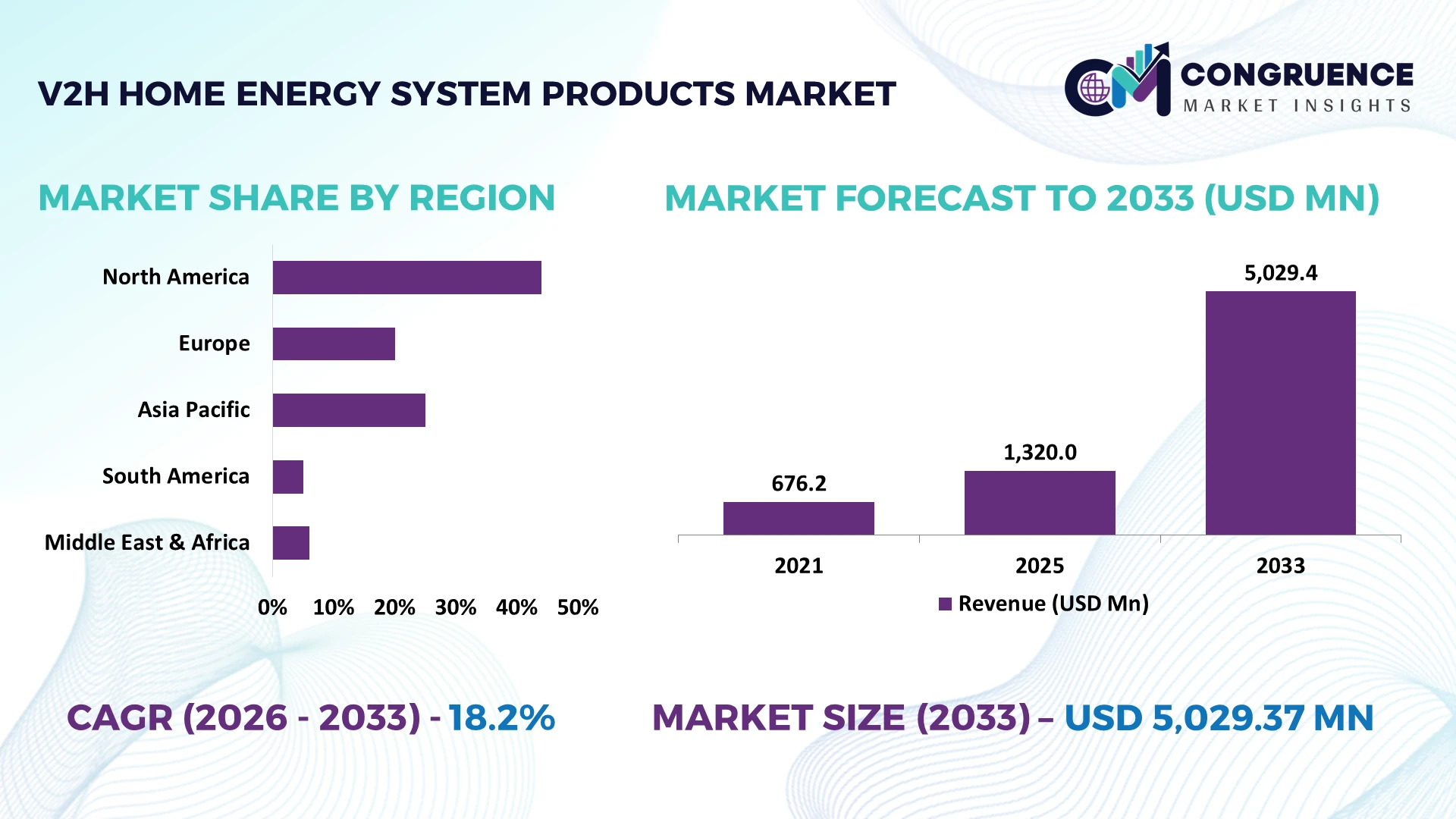
The Global V2H Home Energy System Products Market was valued at USD 1320 Million in 2025 and is anticipated to reach a value of USD 5029.37 Million by 2033 expanding at a CAGR of 18.2% between 2026 and 2033. Growth is driven by bidirectional EV charging adoption, residential solar integration, electricity tariff optimization, and backup power requirements during grid outages.
The United States represents a strategic center for V2H home energy system commercialization, supported by electric vehicle manufacturing, residential solar installations, and advanced home energy management technology. Electric vehicles represented approximately 8% of new vehicle sales in 2025, compared with more than 50% in China. Ford's F 150 Lightning supports up to 9.6 kW of exportable power, while California's SB 59 establishes a regulatory framework for bidirectional charging capabilities. Investments in residential electrification and utility modernization strengthen product integration opportunities.
Strategically, suppliers should prioritize integrated 7 to 11 kW bidirectional charging platforms, utility interoperability, and residential backup solutions to capture higher value installation opportunities.
Market Size & Growth: USD 1,320 million in 2025, reaching USD 5,029.37 million by 2033 at 18.2% CAGR, driven by residential bidirectional charging commercialization.
Top Growth Drivers: EV charging penetration, residential solar adoption, and grid outage protection support V2H demand; GM's bidirectional charger delivers 67% higher charging power than its 11.5 kW reference charger.
Short Term Forecast: By 2028, integrated V2H platforms target 10% to 15% installation cost reductions through standardized electrical components and simplified commissioning.
Emerging Technologies: Three innovations dominate product development: AI energy management, silicon carbide power electronics, and automated vehicle charging communication.
Regional Leaders: Indicative 2033 allocations place North America at USD 2,011.75 million, Asia Pacific at USD 1,760.28 million, and Europe at USD 1,006 million, reflecting backup power, bidirectional EV adoption, and solar integration.
Consumer / End User Trends: Homeowners increasingly evaluate 10.6 to 35.4 kWh storage configurations alongside EV batteries for backup flexibility.
Pilot / Case Example: In 2024, GM Energy commercialized its V2H system supporting up to 9.6 kW household backup discharge.
Competitive Landscape: General Motors, Ford, Nissan, Wallbox, and dcbel compete across vehicle integration, bidirectional chargers, and residential energy controls.
Regulatory & ESG Impact: California's SB 59 advances bidirectional charging readiness, with regulatory implementation affecting future vehicle model years.
Investment & Funding: GM's USD 35 billion planned electric and autonomous vehicle investment program through 2025 established a broader electrification platform supporting energy services.
Innovation & Future Outlook: Advanced 19.2 kW bidirectional charging and intelligent load management strengthen residential energy independence and flexible electricity consumption.
The V2H Home Energy System Products Market is shifting toward integrated residential energy platforms combining electric vehicles, solar generation, bidirectional inverters, and intelligent household load controls. General Motors' PowerShift charger supports 19.2 kW charging and 9.6 kW household discharge when paired with compatible equipment, demonstrating the commercial transition from conventional EV charging toward distributed backup power. California's evolving bidirectional charging framework is influencing product compatibility and installation planning. Meanwhile, automated energy management and smart electrical panels are becoming important differentiators, establishing the foundation for strategic competition in residential energy infrastructure.
Vehicle to Home (V2H) energy systems are transforming electric vehicles into residential energy assets, creating strategic opportunities for automakers, charging equipment manufacturers, and electricity providers. Bidirectional charging enables households to use vehicle batteries during outages and expensive electricity periods, reducing dependence on dedicated stationary storage. California's SB 59 establishes a regulatory pathway for bidirectional charging capability requirements, accelerating product development and electrical infrastructure modernization. Manufacturers are consequently integrating vehicle controls, residential power electronics, and intelligent energy management into unified platforms.
The United States emphasizes residential backup power, Japan benefits from established CHAdeMO bidirectional charging infrastructure, and Germany prioritizes solar integration and dynamic electricity tariffs. GM's PowerShift charger supports 19.2 kW charging, approximately 67% greater power than an 11.5 kW conventional charger, while compatible systems deliver 9.6 kW household backup output. Between 2026 and 2028, suppliers are prioritizing automated installation, communication interoperability, and predictive household energy optimization.
GM Energy's residential ecosystem demonstrates practical integration between compatible electric vehicles, bidirectional chargers, and home power management equipment. Ford, Nissan, and specialist charger manufacturers are strengthening hardware partnerships and installation networks. Competitive advantage increasingly depends on system compatibility, installation economics, and dependable backup performance rather than charging hardware alone.
Increasing residential electricity resilience requirements are accelerating V2H system commercialization, particularly in markets experiencing grid interruptions and expanding electric vehicle ownership. In the United States, electric vehicles represented approximately 8% of new light vehicle sales in 2025, creating a growing installed base for future bidirectional charging applications. GM's PowerShift charger provides up to 19.2 kW charging capacity, while compatible vehicle systems support 9.6 kW household backup discharge. California's bidirectional charging legislation strengthens the incentive for automakers to develop compatible vehicle platforms. General Motors and Ford are expanding integrated charging ecosystems through equipment partnerships and certified installation networks. The strategic advantage lies in converting existing vehicle battery capacity into residential backup capability without requiring an equivalent dedicated storage installation.
V2H commercialization faces structural constraints from specialized inverter requirements, electrical panel upgrades, and limited vehicle compatibility. Conventional residential Level 2 chargers commonly operate at approximately 90% to 95% conversion efficiency, while bidirectional energy transfer introduces additional conversion stages that increase electricity losses. A complete charge and discharge cycle operating at 90% efficiency in each direction returns approximately 81% of the original electrical energy. United States installations also require compatible transfer equipment, utility compliant electrical protection, and qualified electricians, increasing deployment complexity. Proprietary vehicle communication protocols restrict equipment interchangeability and reduce consumer purchasing flexibility. Manufacturers are addressing these constraints through integrated hardware packages, certified installer partnerships, and standardized charging interfaces. Lower installation complexity remains essential for reaching households beyond premium electric vehicle ownership.
Advanced V2H platforms create opportunities to monetize residential energy flexibility through dynamic electricity pricing, solar self consumption, and coordinated household load management. A household facing a 30% peak electricity price premium can improve energy purchasing economics by shifting compatible consumption into lower tariff periods, subject to conversion losses. Bidirectional systems operating at approximately 81% round trip efficiency require sufficient tariff differences to offset energy losses and battery degradation. Japan's established bidirectional charging ecosystem provides a foundation for expanding intelligent residential energy services. Manufacturers are integrating predictive software, smart electrical panels, and automated energy scheduling to support emerging aggregation models. The strategic opportunity extends beyond backup electricity toward recurring energy management services, where software optimization and utility partnerships become important competitive differentiators.
Long term V2H deployment requires reliable coordination between vehicle batteries, residential electrical systems, and utility infrastructure. Bidirectional chargers supporting 19.2 kW power transfer impose substantial electrical demands, requiring appropriate service capacity, protection equipment, and grid connection management. Systems targeting 99.9% operational availability must also maintain dependable communication between vehicles, inverters, and home energy controllers. A 1% communication failure rate across 1,000 daily control events would create approximately 10 unsuccessful interactions, illustrating the importance of robust software validation. Germany's expanding smart meter infrastructure increases expectations for secure digital energy integration. Manufacturers must invest in cybersecurity testing, interoperability certification, remote diagnostics, and standardized communication protocols. Competitive success depends on maintaining reliable household backup operation while coordinating increasingly complex electricity market and grid requirements.
Integrated Residential Energy Hardware Platforms: Automakers are consolidating bidirectional chargers, transfer switches, and household controllers into coordinated product packages. GM Energy's PowerShift charger supports 19.2 kW charging, while compatible vehicles provide up to 9.6 kW household backup output. Ford and General Motors are expanding certified installation networks, reducing component selection complexity and improving commissioning consistency for residential electrical contractors.
Advanced Semiconductor Power Conversion Adoption: Manufacturers are integrating silicon carbide switching devices into residential power conversion equipment to improve thermal performance and switching efficiency. Advanced inverter designs target conversion efficiencies exceeding 95%, compared with approximately 90% for less efficient configurations. Charging equipment suppliers are refining semiconductor packaging, cooling architectures, and inverter controls to reduce electrical losses and improve equipment reliability during sustained household power transfer.
Standardized Vehicle Communication Protocol Development: Automotive suppliers are advancing ISO 15118 communication capabilities and SAE J3400 connector compatibility to improve charging ecosystem interoperability. Bidirectional charging equipment commonly targets 7.2 kW to 19.2 kW power ratings, requiring coordinated vehicle authorization and electrical protection. Manufacturers are updating firmware, certification procedures, and communication controllers to reduce integration barriers between vehicle platforms and residential charging equipment.
Residential Electrical Panel Modernization Accelerates: Smart electrical panels are becoming important components of integrated V2H installations, particularly in American homes requiring selective circuit backup. Typical residential electrical services operate at 100 A or 200 A, while bidirectional charging equipment can impose substantial additional loads. Equipment manufacturers are developing automated load prioritization and circuit monitoring capabilities, helping installers accommodate vehicle energy systems without unnecessary electrical infrastructure replacement.
Bidirectional EV Chargers represent an estimated 38% of the global V2H Home Energy System Products Market, reflecting their essential role in transferring electricity between compatible electric vehicles and residential electrical systems. Their market position benefits from increasing vehicle electrification, integrated charging packages, and growing demand for household backup capabilities. Commercial products supporting 11.5 kW to 19.2 kW charging demonstrate the importance of power capacity and electrical compatibility in purchasing decisions. Manufacturers including Wallbox and General Motors are developing integrated charging equipment and installation partnerships to improve residential deployment.
Home Energy Management Systems represent the fastest growing product category as homeowners seek automated coordination between vehicle batteries, household loads, and electricity tariffs. Power Conversion Systems remain essential for managing bidirectional electricity flow, while Smart Metering Devices provide consumption visibility and electrical monitoring. Energy Storage Units complement vehicle batteries where additional backup capacity is required. Suppliers are prioritizing interoperable controllers, modular equipment, and simplified installation procedures. Competitive differentiation increasingly depends on system integration and dependable energy management rather than charger specifications alone.
Home Backup Power accounts for an estimated 42% of V2H system applications, supported by demand for household electricity continuity during utility outages. Compatible electric vehicles equipped with bidirectional power systems can provide approximately 9.6 kW of household backup output, depending on vehicle specifications and installation configuration. This capability strengthens the commercial appeal of integrated charging and transfer equipment, particularly in American markets experiencing weather related electricity interruptions. Manufacturers are developing coordinated vehicle charging, electrical isolation, and household load management solutions to improve backup reliability.
Solar Energy Integration represents the fastest growing application as residential photovoltaic owners seek greater control over electricity consumption and stored energy availability. Peak Load Management enables households to reduce electricity demand during expensive operating periods, while Electricity Bill Optimization emphasizes automated charging schedules and tariff responsiveness. Grid Support remains an emerging application requiring utility coordination and compatible power export controls. Companies are investing in intelligent controllers, monitoring platforms, and integrated installation services. Demand is increasingly concentrated in applications combining electricity resilience with measurable household energy management benefits.
Residential Homeowners represent an estimated 58% of V2H Home Energy System Products Market demand, supported by direct investment in electric vehicle charging infrastructure and household backup power. Purchasing decisions emphasize vehicle compatibility, installation requirements, equipment reliability, and electricity continuity. Residential charging equipment commonly operates between 7.2 kW and 19.2 kW, creating different electrical infrastructure requirements across household configurations. Manufacturers are targeting homeowners through bundled charging packages, certified installation networks, and integrated energy monitoring applications to simplify purchasing and ownership.
Smart Home Developers represent the fastest growing end user category as integrated residential energy systems become part of connected housing infrastructure. Residential Builders increasingly evaluate electrical readiness during construction, reducing the complexity of future charging equipment installation. Utility Providers participate through electricity demand management programs, technical integration, and residential energy service partnerships. Suppliers are strengthening relationships with property developers, electrical contractors, and utility technology providers. Competitive investment is shifting toward standardized installation packages and digital service platforms that reduce customer acquisition complexity and support scalable residential deployment.
North America accounted for the largest market share at an estimated 40% in 2025 however, Asia Pacific is expected to register the fastest growth, expanding at a CAGR of approximately 21.5% between 2026 and 2033.
Residential Backup Electrification and Integrated Charging Ecosystems
North America represents an estimated 40% of the global V2H Home Energy System Products Market, supported by residential backup power requirements, electric vehicle adoption, and integrated charging equipment commercialization. The United States dominates regional deployment through automotive manufacturers introducing compatible bidirectional charging platforms. General Motors' PowerShift charger delivers up to 19.2 kW charging capacity, while Ford's residential backup ecosystem supports compatible electric vehicles and household electrical integration. California's SB 59 establishes a regulatory framework for bidirectional charging capabilities, strengthening future equipment compatibility requirements. Canadian residential electrification initiatives provide additional opportunities for smart charging and distributed energy management. Manufacturers are expanding certified installation networks, developing integrated electrical protection systems, and improving communication compatibility. Regional competitive positioning increasingly depends on reliable backup performance, installation accessibility, and coordinated vehicle and household energy controls.
United States Market Outlook: The United States maintains a strong competitive position through automotive technology development, residential electrical equipment manufacturing, and established utility infrastructure. General Motors and Ford have commercialized vehicle energy systems supporting household backup applications. The Ford F 150 Lightning supports up to 9.6 kW of exportable power through compatible equipment. California's electricity reliability concerns and expanding residential solar installations reinforce demand for integrated vehicle charging and backup systems, encouraging partnerships between automakers, electrical contractors, and energy technology providers.
Solar Electrification and Intelligent Residential Energy Integration
Europe holds an estimated 20% share of the global V2H Home Energy System Products Market, supported by residential solar adoption, advanced charging infrastructure, and electricity market modernization. Germany, the Netherlands, and the United Kingdom represent important centers for intelligent residential energy technology development. European automakers are integrating bidirectional charging capabilities into selected electric vehicle platforms, while charging equipment manufacturers are advancing compatibility with ISO 15118 communication standards. Residential photovoltaic systems increasingly support coordinated electricity consumption and battery charging, creating opportunities for integrated home energy controllers. Germany's dynamic electricity tariff framework strengthens the commercial relevance of automated charging schedules and household electricity monitoring. Manufacturers are expanding partnerships with solar installers, utility technology providers, and residential energy software developers. Competitive differentiation increasingly emphasizes interoperability, installation efficiency, and coordinated operation across vehicle batteries, solar equipment, and household electrical systems.
Germany Market Outlook: Germany benefits from established automotive engineering, residential photovoltaic adoption, and advanced electrical equipment manufacturing. Volkswagen and BMW are developing bidirectional charging capabilities across selected vehicle platforms, supporting integration with residential energy infrastructure. Germany installed approximately 16.2 GW of solar photovoltaic capacity during 2024, demonstrating substantial distributed generation activity. The country's smart meter rollout and dynamic electricity pricing requirements strengthen opportunities for automated home energy management and compatible bidirectional charging equipment.
Automotive Manufacturing Scale and Bidirectional Charging Innovation
Asia Pacific represents an estimated 35% of the global V2H Home Energy System Products Market, supported by China's electric vehicle manufacturing scale, Japan's established bidirectional charging ecosystem, and South Korea's advanced power electronics industry. China provides extensive manufacturing capabilities for charging equipment, automotive batteries, and intelligent electrical components. Japan maintains an established vehicle energy integration ecosystem through CHAdeMO compatible charging infrastructure and residential backup applications. Nissan has supported vehicle power export capabilities through compatible electric vehicle platforms and charging equipment. China's electric car sales exceeded 11 million units during 2024, strengthening the potential installed base for future V2H adoption. Manufacturers are developing integrated charging platforms, advanced inverter controls, and standardized residential electrical interfaces. Regional competition increasingly reflects manufacturing efficiency, domestic technology integration, and the ability to commercialize compatible systems across different vehicle architectures.
China Market Outlook: China possesses substantial advantages in electric vehicle production, charging equipment manufacturing, and residential energy technology supply chains. BYD and other domestic automotive manufacturers are developing vehicle power export capabilities, although V2H compatibility varies across vehicle models. Electric cars represented more than 40% of China's new car sales during 2024, demonstrating the scale of its electrification ecosystem. Domestic power electronics manufacturers benefit from established semiconductor sourcing, automated assembly capabilities, and extensive distribution networks supporting future residential bidirectional charging commercialization.
Distributed Solar Adoption and Residential Energy Resilience
South America accounts for an estimated 3% of the global V2H Home Energy System Products Market, with Brazil and Chile representing important emerging opportunities. Residential solar installations and electricity reliability requirements create potential demand for vehicle integrated backup systems. Brazil's distributed generation market provides an established foundation for household energy management technologies, while Chile's renewable electricity infrastructure supports interest in flexible energy systems. V2H deployment remains constrained by limited compatible electric vehicle availability, specialized inverter requirements, and uneven residential electrical infrastructure. Charging equipment suppliers are evaluating partnerships with solar installers, automotive distributors, and electrical contractors to improve market access. Regional procurement is concentrated in higher value residential applications where backup power reliability and existing photovoltaic installations support the economic case for bidirectional charging equipment.
Brazil Market Outlook: Brazil represents the strongest potential residential V2H market in South America through its expanding distributed solar infrastructure and established automotive industry. The country surpassed 50 GW of installed solar photovoltaic capacity in early 2025, including centralized and distributed installations. Residential solar adoption creates opportunities for integrated charging systems that coordinate vehicle batteries with household electricity consumption. Local electrical equipment manufacturers and automotive distributors provide potential channels for compatible charging hardware, installation services, and residential energy management platforms.
Smart Infrastructure Investment and Residential Energy Modernization
The Middle East and Africa represent an estimated 2% of the global V2H Home Energy System Products Market, supported by smart infrastructure development, residential electrification, and distributed energy technology adoption. The United Arab Emirates and Saudi Arabia are investing in electric mobility infrastructure and intelligent building systems, creating opportunities for advanced residential charging products. South Africa presents a distinct market opportunity through household backup power requirements and growing interest in distributed electricity solutions. Regional deployment remains limited by compatible vehicle availability, residential charging infrastructure, and specialized electrical installation requirements. Equipment manufacturers are pursuing partnerships with property developers, automotive distributors, and energy technology integrators. Commercial opportunities are strongest in premium residential developments and properties combining electric vehicle charging with solar generation and intelligent electrical management.
United Arab Emirates Market Outlook: The United Arab Emirates benefits from smart city investment, advanced residential construction, and expanding electric vehicle charging infrastructure. Dubai's clean energy strategy targets 75% clean energy generation capacity by 2050, encouraging investment in integrated electricity technologies. Premium residential developments provide opportunities to incorporate bidirectional charging readiness during construction. Automotive distributors, property developers, and electrical technology suppliers are positioned to collaborate on residential energy platforms integrating vehicle charging, solar equipment, and automated household power management.
The global V2H Home Energy System Products Market features competition between automotive manufacturers, charging equipment specialists, and residential energy technology providers. General Motors and Ford leverage vehicle integration, while Wallbox, dcbel, and Enphase Energy compete through power electronics, interoperability, and energy management capabilities. The five leading suppliers represent an estimated 55% of market activity. Competition emphasizes charging efficiency, installation economics, vehicle compatibility, and software integration. Advanced power conversion platforms target efficiencies exceeding 95%, while integrated installation architectures pursue cost reductions of 10% to 15%. Automakers are expanding certified installation networks, while equipment specialists strengthen partnerships with utilities and electrical contractors. Competitive positioning is shifting from standalone charging hardware toward integrated residential energy ecosystems. Proprietary vehicle communication, electrical certification, and installation complexity remain significant entry barriers. Success requires dependable vehicle compatibility, scalable installer networks, and intelligent household energy management capabilities that deliver measurable operational benefits.
General Motors Company
Ford Motor Company
Nissan Motor Co., Ltd.
Wallbox N.V.
dcbel Inc.
Enphase Energy, Inc.
SolarEdge Technologies, Inc.
Tesla, Inc.
Volkswagen AG
BMW AG
Hyundai Motor Company
Kia Corporation
Mitsubishi Motors Corporation
Schneider Electric SE
Current V2H technology integrates bidirectional chargers, residential inverters, transfer switches, and vehicle communication controllers. GM Energy's PowerShift charger supports 19.2 kW charging, approximately 67% greater capacity than conventional 11.5 kW equipment. Advanced silicon carbide converters achieve efficiency above 95% under specified operating conditions, reducing electricity losses during power conversion. Manufacturers integrating electrical protection and automated load management gain installation advantages while supporting dependable household backup operations.
Emerging technologies emphasize ISO 15118 communication, intelligent energy management, and predictive charging optimization. Automated controllers coordinate vehicle batteries, household consumption, and solar generation through continuous monitoring. Advanced systems target 10% to 15% reductions in commissioning time through standardized configuration workflows. Smart metering integration improves electricity consumption visibility, while modular power electronics simplify equipment servicing. Automakers and charging specialists benefit from scalable software architectures and reduced customization requirements across residential installations.
Disruptive developments include virtual power plant connectivity, adaptive inverter controls, and vehicle battery health optimization. During 2026 to 2028, manufacturers are prioritizing secure communication, automated fault detection, and intelligent household energy orchestration. Platforms targeting 99.9% controller availability strengthen operational reliability. Competitive differentiation increasingly depends on verified interoperability, predictable installation costs, and the ability to coordinate residential electricity assets without compromising vehicle mobility requirements.
October 2024: General Motors expanded GM Energy's residential portfolio with PowerBank storage systems offering 10.6 kWh and 17.7 kWh capacities. Nationwide availability strengthened integration between bidirectional EV charging, stationary storage, and solar equipment, improving household backup flexibility. Source: gm.com
October 2025: Wallbox completed six Quasar 2 residential installations in Menifee, California, partnering with Kia America and the University of California, Irvine. The deployment demonstrated household power delivery from compatible Kia EV9 batteries, advancing practical V2H commercialization. Source: electrek.co
February 2026: Massachusetts Clean Energy Center announced participants in its V2X demonstration program, selecting 55 bidirectional charging systems across residential, municipal, and school transportation applications. The initiative supports deployment testing, grid reliability assessment, and practical commercialization of vehicle energy integration. Source: masscec.com
August 2026: Pacific Gas and Electric expanded its bidirectional charging program, incorporating dcbel and Wallbox equipment alongside additional vehicle platforms. Eligible homeowners gained access to incentives reaching $4,500, reducing installation barriers and supporting residential energy flexibility. Source: pv-magazine-usa.com
The V2H Home Energy System Products Market Report evaluates Bidirectional EV Chargers, Home Energy Management Systems, Power Conversion Systems, Smart Metering Devices, and Energy Storage Units. Application coverage includes Home Backup Power, Peak Load Management, Solar Energy Integration, Electricity Bill Optimization, and Grid Support. End user analysis examines Residential Homeowners, Smart Home Developers, Residential Builders, and Utility Providers. Geographic coverage spans North America, Europe, Asia Pacific, South America, and the Middle East and Africa, assessing infrastructure readiness and deployment concentration.
Technology analysis examines bidirectional power electronics, intelligent charging communication, automated energy management, and residential electrical integration. Competitive assessment covers 14 influential manufacturers and technology providers, emphasizing product compatibility, installation economics, and commercialization partnerships. The 2026 to 2033 outlook supports investment prioritization, geographic expansion, supplier evaluation, and strategic positioning across emerging residential energy applications.
| Report Attribute/Metric | Report Details |
|---|---|
Market Revenue in 2025 | USD 1320 Million |
Market Revenue in 2033 | USD 5029.37 Million |
CAGR (2026 - 2033) | 18.2% |
Base Year | 2025 |
Forecast Period | 2026 - 2033 |
Historic Period | 2021 - 2025 |
Segments Covered | By Type
By Application
By End-User
|
Key Report Deliverable | Revenue Forecast, Growth Trends, Market Dynamics, Segmental Overview, Regional and Country-wise Analysis, Competition Landscape |
Region Covered | North America, Europe, Asia-Pacific, South America, Middle East, Africa |
Key Players Analyzed | General Motors Company, Ford Motor Company, Nissan Motor Co., Ltd., Wallbox N.V., dcbel Inc., Enphase Energy, Inc., SolarEdge Technologies, Inc., Tesla, Inc., Volkswagen AG, BMW AG, Hyundai Motor Company, Kia Corporation, Mitsubishi Motors Corporation, Schneider Electric SE |
Customization & Pricing | Available on Request (10% Customization is Free) |




