
Reports
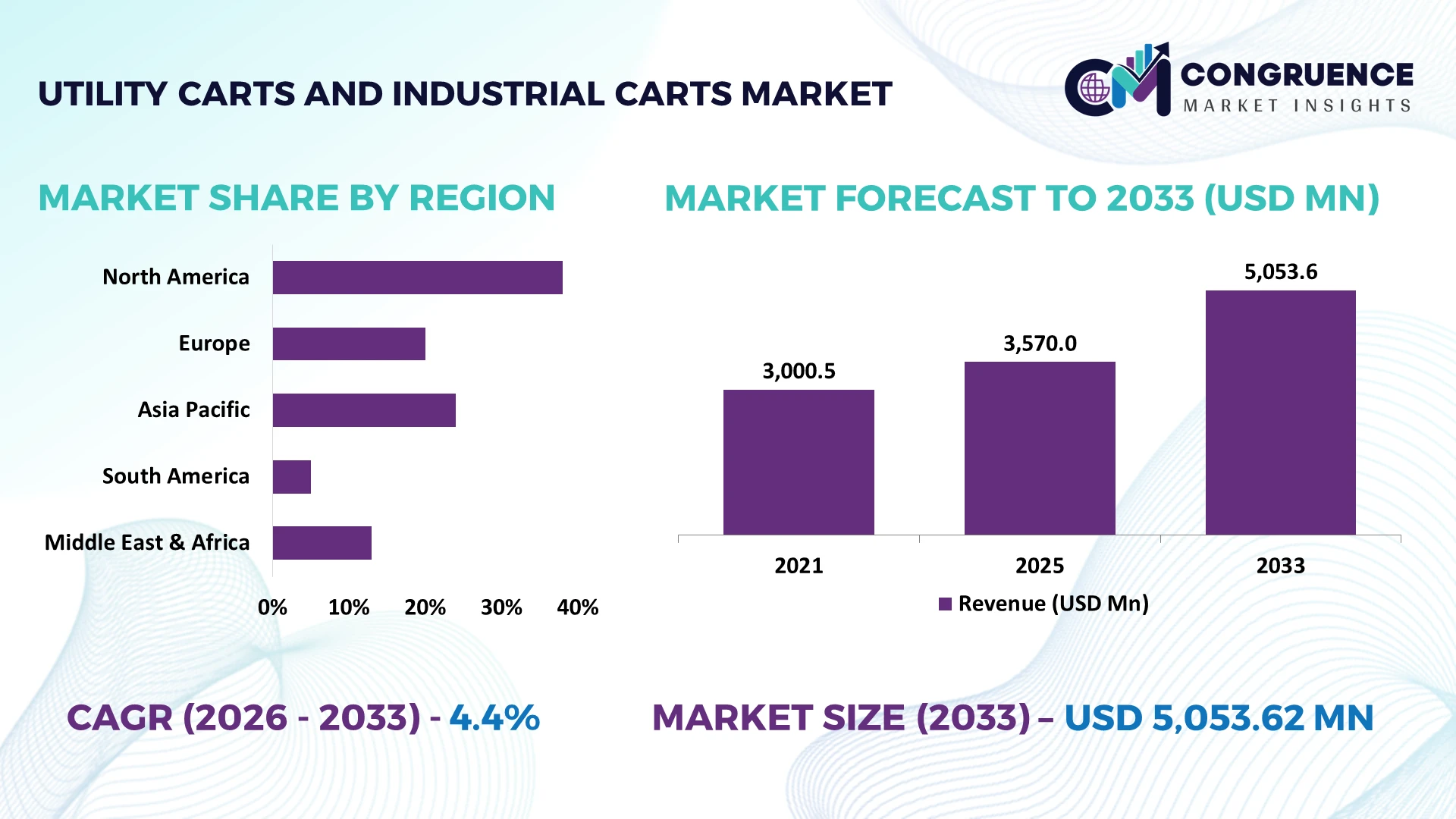
The Global Utility Carts and Industrial Carts Market was valued at USD 3570 Million in 2025 and is anticipated to reach a value of USD 5053.62 Million by 2033 expanding at a CAGR of 4.44% between 2026 and 2033. Warehouse automation, e-commerce fulfillment expansion, lean manufacturing, ergonomic material handling, and replacement of labor-intensive internal transport systems are accelerating demand for advanced utility and industrial carts.
The United States remains a dominant country market, supported by more than 20,000 warehouse and distribution facilities and over 600,000 manufacturing establishments. Around 72% of U.S. distribution centers use industrial carts, while smart-cart adoption increased approximately 22% during 2023–2025. U.S. manufacturing reshoring and North American supply-chain localization strengthen demand, while China benefits from a larger manufacturing and export-production ecosystem.
For suppliers, the strongest positioning lies in high-capacity, ergonomic and automation-compatible carts designed for U.S. logistics and manufacturing operations while expanding cost-efficient production and distribution capabilities across Asia-Pacific.
Market Size & Growth: USD 3,570 million in 2025 is projected to reach USD 5,053.62 million by 2033 at 4.44% CAGR, driven by warehouse automation and manufacturing material-flow optimization.
Top Growth Drivers: Approximately 68% of warehouses prioritize material-handling efficiency, 61% of industrial facilities target labor-productivity improvement, and 57% of newer cart installations incorporate ergonomic designs.
Short-Term Forecast: By 2028, connected and automation-compatible carts will gain importance as advanced warehouse orchestration demonstrates 10% reductions in robotic travel time in large-scale fulfillment operations.
Emerging Technologies: RFID/IoT tracking, AI-directed material routing and autonomous mobile robotics are reshaping cart design; smart tracking deployment has increased approximately 36% across digitally modernizing warehouse environments.
Regional Leaders: Asia-Pacific represents approximately 38% of industry participation, North America 31%, and Europe 24%, supported respectively by manufacturing scale, warehouse automation and ergonomic workplace modernization.
Consumer/End-User Trends: More than 65% of logistics centers integrate carts into picking and inventory movement, while industrial models represent approximately 63% of demand because of higher load-bearing requirements.
Pilot/Case Example: In 2025, Amazon surpassed 1 million deployed robots; its DeepFleet AI improved robotic travel efficiency by 10%, highlighting the direction of automated internal material movement.
Competitive Landscape: Leading suppliers include Rubbermaid Commercial Products, FlexQube, Magline, Hamilton Caster and Toyota Material Handling, with platform carts alone representing approximately 30% of the broader industrial-cart product mix.
Regulatory & ESG Impact: Ergonomic handling is becoming a stronger procurement criterion, with approximately 61% of companies prioritizing ergonomic cart designs and advanced configurations targeting workplace-injury reductions approaching 18%.
Investment & Expansion: Capital allocation is shifting toward automated warehouses and fulfillment infrastructure rather than standalone carts; Amazon's robotic fleet now spans more than 300 facilities, creating demand for automation-compatible material-handling ecosystems.
Innovation & Future Outlook: Lightweight aluminum, reinforced polymers, modular platforms and connected tracking will define advanced carts; approximately 46% of newer installations already incorporate lightweight materials and 29% feature smart tracking capabilities.
Utility Carts and Industrial Carts Market demand is concentrating across warehouses, manufacturing plants, healthcare facilities and high-throughput distribution centers. Smart tracking adoption has increased approximately 36%, alongside growing use of RFID, IoT monitoring, lightweight materials and automation-compatible platforms. Manufacturing reshoring and supply-chain localization are strengthening requirements for flexible internal logistics, positioning intelligent, ergonomic carts as strategic material-handling assets.
Utility carts and industrial carts are becoming strategic infrastructure for factories, warehouses, hospitals, and fulfillment centers as operators redesign internal material flow around automation and labor productivity. The shift from labor-intensive movement toward digitally coordinated intralogistics is particularly visible in the United States, where manufacturing reshoring and distribution-network modernization are increasing requirements for ergonomic, modular, automation-compatible equipment. Cart procurement is consequently moving from basic hardware replacement toward integrated workflow optimization.
Connected carts equipped with RFID, sensors, electronic identification, and fleet-management interfaces provide substantially better asset visibility than untracked legacy carts; automated material-movement systems can reduce repetitive transport activity by more than 20% in suitable workflows. China retains an advantage in manufacturing scale and cost-efficient production, while U.S. facilities emphasize automation integration and Europe maintains stronger ergonomic and workplace-safety requirements.
Amazon's deployment of more than 1 million robots demonstrates how quickly internal logistics is becoming software-directed. Through 2026–2028, manufacturers will increasingly develop carts compatible with autonomous mobile robots, standardized towing systems, and digital tracking. Suppliers are investing in modular platforms, lightweight materials, customization, and automation partnerships. Competitive advantage will increasingly depend on treating carts as connected intralogistics assets rather than standalone transport equipment.
Warehouse automation is fundamentally increasing the operational value of industrial carts as facilities integrate manual transport equipment with robotics, conveyor networks, and digitally managed workflows. More than 70% of warehouses still depend on human-operated material movement for at least part of their workflow, while automation can reduce repetitive travel by over 20% in suitable processes and improve picking productivity by 15%–30%. In the United States, reshoring and fulfillment-network modernization are accelerating investment in flexible intralogistics rather than fixed infrastructure alone. This favors modular carts that can operate manually, within tugger trains, or alongside autonomous mobile robots. Manufacturers are responding with ergonomic handles, configurable shelving, standardized couplings, and sensor-ready platforms. Strategically, interoperability is becoming more valuable than maximum load capacity alone because customers increasingly require equipment that survives successive automation upgrades.
Steel, aluminum, casters, polymers, and fabricated components expose cart manufacturers to procurement volatility, while highly customized configurations limit production standardization. Raw materials can represent more than 50% of manufacturing cost for metal-intensive material-handling equipment, and aluminum remains roughly 65% lighter than steel by density but generally carries a higher material cost. U.S. tariff changes and continuing trade-policy uncertainty surrounding imported steel and aluminum have reinforced sourcing complexity for fabricators dependent on international supply chains. Smaller manufacturers consequently face greater difficulty maintaining margins when customers demand customized load capacities, dimensions, wheels, and accessories at standardized-equipment prices. Suppliers are reducing exposure through localized fabrication, dual sourcing, modular component architectures, and longer-term procurement agreements. The critical competitive issue is SKU complexity: excessive customization can erode the manufacturing efficiency that higher order volumes would otherwise provide.
The strongest value-creation opportunity lies in transforming conventional carts into identifiable, trackable, automation-compatible intralogistics assets. RFID can provide near-instant identification without line-of-sight scanning, while connected sensors enable location monitoring, utilization analysis, preventive maintenance, and inventory association. Automated material handling can deliver 20%–30% productivity improvements in appropriately redesigned workflows, creating opportunities beyond simple cart replacement. U.S. fulfillment centers are particularly attractive for AMR-compatible carts, while India's expanding electronics, automotive, pharmaceutical, and organized warehousing infrastructure creates an emerging market for modular material-handling systems. Through 2026–2028, standardized docking, digital fleet identification, smart casters, and autonomous towing will move further into commercial deployment. Manufacturers are directing R&D toward modular platforms and robotics partnerships. The non-obvious opportunity is utilization monetization: tracking allows operators to reduce excess cart fleets instead of simply purchasing additional units.
Long-term competitiveness depends on integrating carts with increasingly heterogeneous automation ecosystems without compromising safety, maneuverability, or operational consistency. A facility can contain manual carts, tugger trains, conveyors, forklifts, and AMRs from multiple vendors, while autonomous systems require highly repeatable docking geometry and predictable load behavior. Even centimeter-level positioning variation can disrupt automated coupling or transfer processes, and payload changes of 20%–30% can materially alter braking, turning, and towing characteristics. The United States illustrates the scale challenge: Amazon has deployed more than 1 million robots, demonstrating that future material-handling equipment must function within increasingly software-orchestrated environments. Manufacturers therefore need standardized interfaces, validated caster performance, digital identification, cybersecurity-conscious tracking systems, and robotics partnerships. The strategic challenge is no longer producing durable carts; it is ensuring that thousands of physical assets behave consistently inside automated workflows.
Lightweight Materials Reshape Product Design: Lightweight construction is moving into mainstream cart specifications, with 46% of new installations incorporating lightweight materials and aluminum representing roughly 32% of newly introduced products. Ergonomic handles have expanded across approximately 48% of commercial models. Manufacturers are redesigning frames, caster assemblies, and modular decks to reduce push force while retaining industrial load ratings, lowering operator strain and improving maneuverability.
Asset Visibility Moves Into Workflows: Cart fleets are increasingly managed as trackable operational assets rather than anonymous equipment. Smart tracking appears in approximately 29% of newer installations, while about 18% of large logistics operators use RFID-enabled carts. With warehouse management system usage reaching 87% in a 2025 operations survey, suppliers are integrating tags, identification points, and fleet-monitoring capabilities that reduce search time and expose underutilized cart inventories.
Picking Workflows Become Less Manual: Warehouse picking practices are changing alongside cart configurations. Paper-based picking declined to 40% in 2025 from 44% in 2024 and 56% in 2023, while batch picking increased to 48% from 44%. Cart manufacturers are consequently supporting tote segmentation, pick-to-light compatibility, configurable shelving, and multi-order workflows, allowing operators to increase picks per trip without replacing entire material-handling fleets.
Modular Equipment Gains Procurement Priority: Supply-chain uncertainty is pushing buyers toward configurable equipment and dependable suppliers; nearly 80% of companies in a 2025 warehouse study had adjusted sourcing strategies. Meanwhile, 22% of recent cart introductions emphasized modular configurations and 34% focused on high-capacity designs. Manufacturers are standardizing frames while offering interchangeable shelves, handles, wheels, and attachments, reducing SKU complexity and shortening configuration cycles.
Platform Carts lead the provided type segmentation with approximately 30% share, supported by open-deck versatility, straightforward fabrication, and compatibility with boxes, totes, machinery components, and irregular loads. Industrial configurations commonly support 500–2,000 kg, making the format scalable across manufacturing and warehouse environments. Utility Carts remain important for lighter commercial and institutional workflows, particularly where maneuverability, shelving, hygiene, and corrosion resistance outweigh maximum payload requirements.
Material Handling Carts are the fastest-expanding strategic category as factories and distribution centers redesign internal flows around lean replenishment and automation. Service Carts retain established demand in maintenance, hospitality, healthcare, and technical operations, while Tow Carts gain relevance in milk-run logistics where multiple loads move simultaneously between storage and production areas. Manufacturers are prioritizing modular decks, reinforced casters, ergonomic controls, powered assistance, and tow-compatible interfaces. Investment is therefore shifting from single-purpose designs toward configurable cart platforms capable of serving multiple workflows and automation stages.
Material Transport represents the leading application, estimated at approximately 35% of demand across the specified categories because carts remain fundamental to work-in-process movement, line feeding, inventory transfer, and bulk movement. Warehouse Picking is increasingly technology-assisted as operators combine multi-level carts with barcode, voice, and pick-to-light workflows. In 2025, single-order picking remained prevalent at 65%, while batch picking reached 48%, highlighting continued dependence on mobile load-carrying equipment alongside digital execution systems.
Order Fulfillment is the fastest-changing application as e-commerce facilities compress picking, consolidation, and dispatch cycles. Paper-based picking declined from 56% in 2023 to 40% in 2025, creating stronger requirements for carts configured around totes, scanners, displays, and multi-order handling. Maintenance Operations favor compartmentalized service carts that keep tools and replacement components point-of-use, while Food Service prioritizes washable polymers, stainless surfaces, maneuverability, and shelf organization. Suppliers are expanding configurable cart families and automation-compatible designs as purchasing shifts toward workflow-specific productivity rather than basic transportation capacity.
Manufacturing Plants lead the specified end-user categories with approximately 35% share, reflecting continuous requirements for work-in-process movement, line-side replenishment, tooling transport, component staging, and lean material delivery. More than 80% of manufacturing plants use wheeled carts for internal transportation, supporting high equipment density across automotive, machinery, electronics, and fabricated-products facilities. Warehouses form the next major buyer base, with approximately 72% of large facilities using industrial carts for inventory transportation and fulfillment support.
Warehouses represent the fastest-evolving buyer group as robotics and software reshape material flow. Hospitals remain strategically important for enclosed, hygienic, corrosion-resistant Utility Carts used for supplies and clinical logistics, while Hotels emphasize service, housekeeping, and food-handling configurations. Retail Stores increasingly use compact carts for replenishment and backroom-to-floor movement. Suppliers are segmenting portfolios by payload, hygiene, maneuverability, shelving, and automation compatibility rather than offering universal designs, enabling stronger pricing differentiation and customer-specific product ecosystems.
Asia-Pacific accounted for the largest market share at 41% in 2025 however, Asia-Pacific is expected to register the fastest growth, expanding at a CAGR of approximately 5.0% between 2026 and 2033.

Automation-Ready Warehousing Reshapes Procurement
North America represents approximately 29%–31% of global Utility Carts and Industrial Carts demand, anchored by dense warehousing, manufacturing, healthcare, retail, and fulfillment infrastructure. Around 72% of U.S. distribution centers deploy industrial carts for inventory movement and order fulfillment, while approximately 68% of logistics operators use carts for routine material transfer. Automation is changing specifications toward modular frames, tracking capability, ergonomic controls, and interfaces compatible with robotic workflows. The United States operates more than 20,000 warehouse and distribution facilities, creating a large replacement and upgrade base. Manufacturers increasingly differentiate through high-capacity platforms, corrosion-resistant materials, configurable shelving, and specialized caster systems. The operational shift is from purchasing isolated carts toward managing standardized mobile fleets capable of functioning across picking, staging, replenishment, and automated intralogistics workflows.
United States Market Outlook: The United States remains North America's strategic center because more than 600,000 manufacturing establishments create broad material-handling requirements. Approximately 76% of manufacturing plants use heavy-duty carts exceeding 300-kg capacities, while smart-cart adoption increased roughly 22% during 2023–2025. Suppliers offering automation compatibility, ergonomic engineering, and rapid customization hold the strongest positioning.
Ergonomics Drives Industrial Fleet Modernization
Europe contributes approximately 22%–24% of global demand, with Germany, France, Italy, and the United Kingdom collectively representing about 64% of regional consumption. Manufacturing generates approximately 38% of European requirements, while logistics contributes close to 31%, establishing industrial facilities and distribution infrastructure as core deployment environments. Procurement increasingly favors ergonomic handles, low-resistance casters, corrosion-resistant construction, lightweight materials, and modular configurations as employers strengthen workplace-safety and productivity programs. Advanced ergonomic features appear in approximately 57% of newly launched products, illustrating the shift from basic transport equipment toward operator-centered designs. European manufacturers are also increasing recycled-material content and repairable modular architectures, supporting circular-economy objectives. This combination of industrial modernization and stringent workplace practices favors suppliers capable of demonstrating lifecycle durability, ergonomic performance, and component standardization.
Germany Market Outlook: Germany accounts for approximately 24% of European market demand, supported by automotive, machinery, chemicals, pharmaceuticals, and sophisticated logistics operations. Its manufacturing-intensive economy favors heavy-duty carts, tugger systems, work-in-process platforms, and lean line-feeding equipment. Suppliers increasingly align products with automated factories where standardized docking, predictable caster performance, and modular load handling provide measurable operational advantages.
Manufacturing Scale Accelerates Cart Deployment
Asia-Pacific leads the global Utility Carts and Industrial Carts market with approximately 41% share, reflecting unmatched manufacturing scale, expanding logistics infrastructure, and rapid warehouse development. China represents nearly 46% of regional demand, India approximately 18%, and Japan around 12%, while Southeast Asian economies collectively contribute roughly 14%. Industrial users are progressively shifting from basic fabricated carts toward ergonomic, lightweight, high-capacity, and automation-compatible platforms as factories increase throughput and standardize internal logistics. Manufacturing expansion in electronics, automotive, machinery, batteries, and consumer products creates particularly intensive work-in-process movement requirements. Suppliers are expanding localized manufacturing and distribution while introducing modular products suited to multiple payload classes. Asia-Pacific's strategic advantage is therefore two-sided: it combines the industry's largest consumption base with a highly competitive fabrication and component supply ecosystem.
China Market Outlook: China accounts for approximately 46% of Asia-Pacific demand, supported by the world's largest manufacturing ecosystem and extensive e-commerce logistics infrastructure. Automotive, electronics, machinery, appliance, and battery factories create high-volume requirements for line-side, platform, tow, and material-handling carts. Automation investment increasingly favors equipment that integrates with AMRs, tugger trains, and digitally coordinated production systems.
Industrial Logistics Concentrates Around Brazil
South American demand is concentrated around Brazil's manufacturing, food processing, automotive, mining-support, retail, and logistics ecosystems, with Argentina and other industrial centers providing secondary deployment. Warehouse modernization is increasing requirements for platform carts, utility carts, picking equipment, and heavy-load configurations as operators replace fragmented manual handling practices with standardized fleets. E-commerce fulfillment and organized retail are particularly important because high-frequency replenishment favors maneuverable carts rather than fixed material-transfer infrastructure. However, imported components, exchange-rate movements, uneven automation penetration, and infrastructure disparities constrain rapid standardization. Suppliers are responding through local fabrication, distributor partnerships, simpler modular architectures, and repairable caster-and-frame designs. The region therefore favors products balancing acquisition cost with durability rather than highly specialized automation hardware, particularly among medium-sized industrial and logistics customers.
Brazil Market Outlook: Brazil provides South America's strongest addressable base through automotive manufacturing, agribusiness processing, consumer-goods production, hospitals, retail distribution, and logistics. With manufacturing contributing roughly 12% of national economic output, internal material movement remains operationally significant. Localized assembly, replaceable components, high-load durability, and broad distributor coverage provide suppliers with stronger positioning than import-dependent premium-only strategies.
Logistics Infrastructure Expands Equipment Demand
Middle East & Africa accounts for approximately 8% of global Utility Carts and Industrial Carts demand, with Gulf Cooperation Council economies generating nearly 58% of regional consumption. Large logistics parks, airports, hospitals, hotels, food-service operations, construction programs, and industrial diversification projects are broadening cart deployment beyond conventional warehouses. Warehousing investment has expanded approximately 11%, while demand for heavy-duty steel carts has increased about 14%, reflecting continued infrastructure and industrial development. Healthcare and institutional applications represent approximately 18% of regional cart requirements. Procurement increasingly emphasizes corrosion resistance, high-temperature durability, maneuverability, and low-maintenance caster systems. Suppliers are strengthening distributor relationships and application-specific portfolios because fragmented service infrastructure makes product reliability and replacement-part availability critical purchasing considerations.
Saudi Arabia Market Outlook: Saudi Arabia offers the strongest strategic momentum through Vision 2030 logistics, manufacturing, tourism, healthcare, and industrial infrastructure development. The Kingdom's National Industrial Development and Logistics Program targets major expansion across logistics and manufacturing capacity, strengthening requirements for warehouse, service, platform, and material-handling carts. Local distribution partnerships and durable application-specific configurations remain decisive supplier advantages.
Wesco Industrial Products, Rubbermaid Commercial Products, National Cart, Little Giant, FlexQube and Metro compete across overlapping industrial, warehouse and institutional applications, while specialists target customized tugger, healthcare and heavy-duty workflows. The top five organized suppliers account for approximately 46% of identified competitive share, leaving substantial space for regional manufacturers. Competition increasingly centers on customization, ergonomics, distribution reach and automation readiness: about 57% of new installations incorporate ergonomic features, 46% use lightweight materials and 29% integrate smart tracking. Rubbermaid and Metro leverage broad commercial channels, while Wesco and Little Giant emphasize industrial durability; FlexQube differentiates through modular and automated material handling. Suppliers are expanding configurable platforms, strengthening distributors and integrating digital capabilities rather than competing solely on fabrication cost. Low-cost regional production intensifies pricing pressure, while certification, load validation, caster engineering and dependable replacement parts create entry barriers. Winning requires standardized modularity, application-specific engineering, rapid fulfillment and credible integration with increasingly automated intralogistics environments.
Rubbermaid Commercial Products
Wesco Industrial Products
National Cart Co.
Little Giant
FlexQube
Metro
Magline
Vestil Manufacturing
Hamilton Caster
Durham Manufacturing
Seville Classics
Luxor
RWM Casters
Jtec Industries
Current cart technology is shifting from welded, fixed-purpose frames toward modular aluminum or steel platforms, ergonomic caster systems, powered-assist drives, and RFID-enabled fleet identification. Aluminum has roughly 65% lower density than steel, reducing structural mass where equivalent engineering permits, while optimized casters and powered assistance can cut operator push effort by 20–40% depending on load and floor conditions. Adoption is commercial across manufacturing, healthcare, retail, and warehousing, improving maneuverability, asset utilization, and workplace ergonomics.
Emerging systems combine carts with autonomous mobile robots, tugger trains, IoT tags, electronic locks, and warehouse-management interfaces. Compared with manually routed cart movement, digitally orchestrated transport can reduce nonproductive travel by about 10–20% in structured workflows and improve fleet utilization by 15–25% through dispatching and location visibility. Modular load carriers also let operators change shelves, fixtures, and docking interfaces without replacing the platform, lowering reconfiguration cost and supporting faster line changes.
Disruptive development centers on autonomous coupling, machine-readable load carriers, predictive maintenance, and standardized robot-cart interfaces. From 2026–2028, deployment will move from pilots toward mixed human-robot fleets, especially in automotive, electronics, and fulfillment facilities. Suppliers combining mechanical durability with interoperable automation will outperform commodity fabricators because customers value lifecycle flexibility, labor savings, and upgrade-ready intralogistics assets.
January 2026 Magline launched its next-generation Gemini Convertible Hand Truck, increasing two-wheel capacity from 500 to 600 pounds and four-wheel capacity to 1,100 pounds, strengthening ergonomic route-delivery performance and reducing equipment limitations for higher-load applications across commercial operations. Source: magliner.com
June 2025 FlexQube secured a USD 0.9 million U.S. automotive order for tugger-train material transport systems, its largest North American order of this type, accelerating adoption of cart-based intralogistics within vehicle manufacturing operations and supporting internal material flows. Source: nasdaq.com
June 2024 National Cart opened a larger Olyphant, Pennsylvania facility, bringing combined U.S. manufacturing and distribution space above 460,000 square feet across three locations, improving East Coast fulfillment capacity and shortening logistics response for industrial customers and retailers. Source: nationalcart.com
January 2025 Vestil introduced CART-330-SS stainless-steel scissor carts with 330-pound capacity, expanding corrosion-resistant ergonomic handling options for sanitary and washdown environments and strengthening product coverage across food-processing, pharmaceutical, medical, laboratory, and cleanroom applications requiring frequent industrial sanitation processes. Source: vestil.com
The report evaluates Utility Carts and Industrial Carts across Platform Carts, Utility Carts, Service Carts, Material Handling Carts, and Tow Carts, with application coverage spanning Material Transport, Warehouse Picking, Order Fulfillment, Maintenance Operations, and Food Service. End-user analysis includes Manufacturing Plants, Warehouses, Hospitals, Hotels, and Retail Stores, while regional assessment covers North America, Europe, Asia-Pacific, South America, and Middle East & Africa.
Technology coverage includes modular frames, ergonomic caster systems, powered assistance, RFID/IoT identification, tugger integration, and autonomous mobile robot compatibility. The study also examines deployment shifts toward lightweight materials, configurable load carriers, automation-ready fleets, and specialized sanitary or high-capacity designs. By combining segment positioning, adoption patterns, competitive activity, and regional operating conditions, the report supports investment planning, product expansion, partnership strategy, and competitive positioning through 2026–2033, including emerging opportunities in connected intralogistics and mixed human-robot material flow.
| Report Attribute/Metric | Report Details |
|---|---|
Market Revenue in 2025 | USD 3570 Million |
Market Revenue in 2033 | USD 5053.62 Million |
CAGR (2026 - 2033) | 4.44% |
Base Year | 2025 |
Forecast Period | 2026 - 2033 |
Historic Period | 2021 - 2025 |
Segments Covered | By Type
By Application
By End-User
|
Key Report Deliverable | Revenue Forecast, Growth Trends, Market Dynamics, Segmental Overview, Regional and Country-wise Analysis, Competition Landscape |
Region Covered | North America, Europe, Asia-Pacific, South America, Middle East, Africa |
Key Players Analyzed | Rubbermaid Commercial Products, Wesco Industrial Products, National Cart Co., Little Giant, FlexQube, Metro, Magline, Vestil Manufacturing, Hamilton Caster, Durham Manufacturing, Seville Classics, Luxor, RWM Casters, Jtec Industries |
Customization & Pricing | Available on Request (10% Customization is Free) |




