
Reports
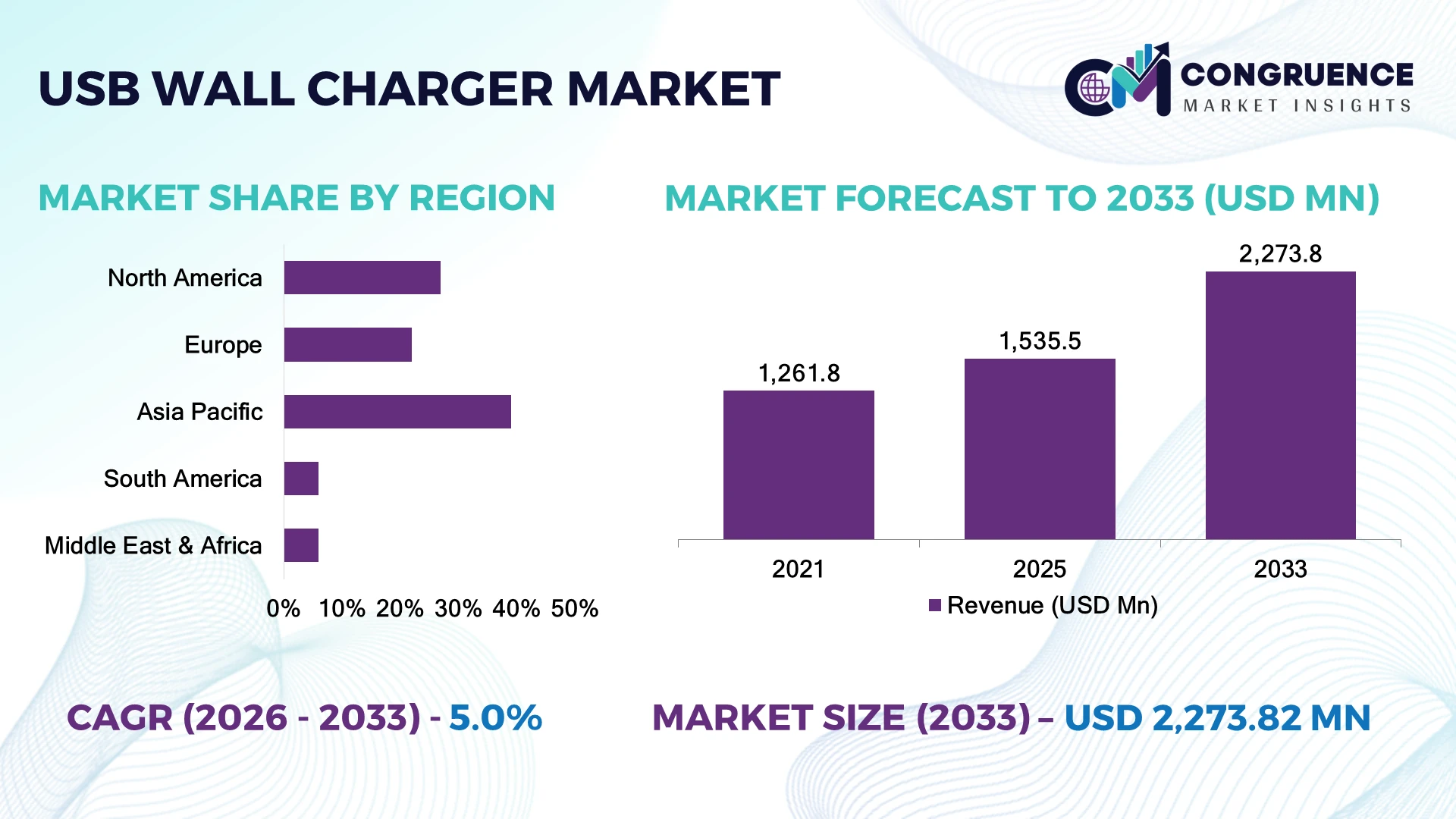
The Global USB Wall Charger Market was valued at USD 1,535.5 Million in 2025 and is anticipated to reach a value of USD 2,273.8 Million by 2033 expanding at a CAGR of 5.03% between 2026 and 2033. Growth is driven by the transition from conventional silicon adapters to compact GaN chargers, rising USB-C Power Delivery adoption, and the removal of bundled chargers from smartphones and laptops.
China remains the dominant manufacturing hub, supported by high-volume electronics production and a mature component ecosystem, while India is emerging as a high-growth consumption and assembly market; GaN chargers already represent 8–12% of Indian unit demand, while multi-port models account for 30–35%. The EU's common-charger framework covers major portable devices and laptops from April 2026, accelerating USB-C standardization.
Strategically, manufacturers should prioritize GaN, USB-C PD, multi-port architectures, and localized supply chains to capture premium accessory demand while meeting evolving interoperability requirements.
Market Size & Growth: The market stands at USD 1,535.5 Million in 2025 and is projected to reach USD 2,273.8 Million by 2033, supported by GaN adoption and USB-C standardization.
Top Growth Drivers: GaN adoption 18–25% annually; multi-port demand 12–16%; aftermarket demand 55–65% in India.
Short-Term Forecast: By 2028, GaN penetration is positioned to expand from 8–12% toward the mid-teens as component costs decline and power density improves.
Emerging Technologies: USB-C PD 3.1, GaN semiconductors, and adaptive power management are shifting chargers toward compact 100W–240W architectures.
Regional Leaders: Asia-Pacific leads manufacturing scale; Europe is driven by USB-C compliance; North America prioritizes high-wattage multi-device charging and GaN upgrades.
Consumer/End-User Trends: Smartphone and tablet charging represents approximately 65–70% of demand, while multi-port products capture 30–35% of Indian unit volume.
Pilot/Case Example: 2026 EU laptop USB-C implementation extends common-charger requirements across another major device category, strengthening interoperability and charger unbundling.
Competitive Landscape: An estimated 25–30% of India's sub-₹500 charger units face counterfeit pressure, intensifying competition among Anker, Belkin, UGREEN, Baseus, and Xiaomi.
Regulatory & ESG Impact: EU charger rules target approximately 980 tonnes of annual electronic-waste reduction through charger unbundling and common charging.
Investment & Funding: More than 400 million external power supplies are sold annually in the EU, reinforcing investment in efficient, interoperable charger platforms.
Innovation & Future Outlook: USB PD now supports up to 240W, accelerating single-charger architectures spanning smartphones, tablets, and laptops.
USB wall charger demand is concentrating around USB-C PD, GaN miniaturization, and multi-device charging, with 60%+ PD penetration targeted in India's organized market by 2030. The shift away from bundled adapters and tighter certification requirements is reshaping replacement demand, procurement channels, and product portfolios, creating a stronger strategic role for efficient, interoperable charging platforms.
USB wall chargers are becoming strategically important because charging has shifted from a bundled smartphone accessory into a standalone, multi-device power platform. Device unbundling, USB-C standardization, and higher-wattage laptops are increasing the value of chargers that support several products simultaneously. In India, aftermarket and replacement purchases already represent an estimated 55–65% of unit demand, creating a recurring upgrade channel.
Technology differentiation is also widening. GaN architectures deliver higher power density in smaller enclosures than conventional silicon designs, enabling 65W–100W compact chargers without the bulk of legacy adapters. USB PD has advanced to 240W, expanding charger applicability beyond smartphones into laptops and productivity equipment.
Regional strategies are diverging: China emphasizes manufacturing scale, India combines fast consumer adoption with local assembly, while Europe is being reshaped by regulatory standardization. Through 2028, companies are expected to prioritize GaN R&D, localized assembly, semiconductor sourcing, and retail partnerships. The strongest competitive position will come from combining power efficiency, interoperability, certification readiness, and compact design.
The shift toward GaN-based architectures is accelerating premium charger adoption as consumers prioritize compact, high-output devices. In India, GaN models already represent 8–12% of unit volume, while premium multi-port products account for 30–35%. GaN-based chargers are expanding at approximately 18–25% annually as second-generation components improve power density and thermal performance. The transition from bulky silicon adapters to 65W–100W compact designs enables one charger to replace multiple legacy units. Manufacturers are responding with expanded GaN portfolios, multi-port configurations, and USB-C PD integration. The non-obvious advantage is SKU consolidation: a single high-output charger can address smartphone, tablet, and laptop requirements, improving inventory efficiency and increasing premium accessory attachment rates.
Supply dependence and certification requirements constrain charger scalability, particularly for smaller brands. India's charger ecosystem remains approximately 75–85% import-dependent, while BIS-related compliance can increase costs for smaller importers by 8–12% and extend lead times by 4–8 weeks. Low-cost counterfeit products also represent an estimated 25–30% of sub-₹500 unit sales, creating pricing pressure for compliant manufacturers. These conditions compress margins, complicate inventory planning, and increase the cost of maintaining broad product assortments. Companies are reducing exposure through supplier diversification, longer component contracts, domestic assembly, and tighter channel controls. The strategic pressure point is not component availability alone; it is the ability to combine low landed cost with certification, thermal safety, and consistent power-delivery performance.
The expansion of USB-C PD creates an opportunity to reposition wall chargers as universal power hubs rather than single-device accessories. India's USB-C PD-compatible products are projected to exceed 60% of charger-market revenue by 2030, compared with roughly 40% in 2025, while multi-port demand is advancing at 12–16% annually. USB PD's 240W capability creates additional applications for laptops, monitors, gaming devices, and professional equipment. Companies can capture this opportunity through GaN R&D, 100W+ product expansion, hospitality partnerships, and enterprise charging programs. A less obvious opportunity lies in managed workspaces and hotels, where standardized multi-port chargers can reduce device-specific infrastructure and simplify replacement procurement.
Long-term competitiveness increasingly depends on consistent interoperability across different devices, cables, power levels, and regional standards. USB-C products must manage power negotiation, thermal protection, surge resistance, and cable limitations, while EU requirements increasingly formalize these parameters. From December 2028, applicable EU ecodesign rules require covered external power supplies to meet common-charger, efficiency, interoperability, and surge-resistance requirements. Companies therefore face higher engineering and validation requirements as product portfolios expand from 20W smartphone chargers toward 100W–240W platforms. Manufacturers must invest in firmware validation, thermal engineering, automated testing, and supplier qualification. The critical challenge is maintaining consistent charging performance across fragmented device ecosystems without sacrificing compactness, production yield, or cost competitiveness.
Multi-Port Configurations Accelerate: Two-port, three-port, and four-port chargers are gaining traction as users consolidate devices, with multi-port products representing about 30–35% of Indian shipments and expanding 12–16% annually. Manufacturers are increasing high-density SKUs and USB-C PD combinations, reducing outlet dependency and improving charging convenience across households and shared workspaces.
GaN Manufacturing Scales Quickly: GaN-based chargers account for roughly 8–12% of unit demand in India, while adoption is advancing 18–25% annually as compact 65W–100W designs replace bulkier silicon adapters. Component integration is shortening product footprints by around 30–40%, prompting brands to expand premium portfolios and strengthen semiconductor sourcing amid electronics supply-chain restructuring.
USB-C Compliance Reshapes Portfolios: EU common-charger rules covering laptops from April 2026 are accelerating USB-C standardization, while USB-C PD adoption is expanding across higher-powered devices. The European Commission estimates that more than 400 million external power supplies are sold annually in the EU, pushing manufacturers toward detachable-cable architectures, clearer power markings, and interoperable designs.
Commercial Charging Becomes Denser: Offices, hotels, airports, and co-working facilities are moving toward standardized multi-port charging, with commercial and hospitality deployments growing faster than traditional household replacement demand. Procurement teams increasingly favor 65W+ configurations and shared charging points, while manufacturers are developing bulk-packaged, safety-certified products and partnerships that simplify multi-location deployment and replenishment.
The 1 Port segment remains the leading type, accounting for approximately 50–55% of unit shipments in comparable 2025 market conditions because of its low acquisition cost, straightforward power delivery, and broad replacement demand. However, its share is declining by around 2–3 percentage points annually as consumers consolidate smartphone, tablet, wearable, and laptop charging. Two-port and three-port configurations are increasingly favored where users need simultaneous charging without additional wall adapters. Four-port chargers and other configurations retain strategic relevance in travel, hospitality, and shared workspaces, where charging density matters more than entry price.
The fastest-growing type is the 2 Ports configuration, supported by 12–16% annual expansion in multi-port demand and stronger adoption of USB-C PD. Manufacturers are shifting investment toward compact dual-port GaN architectures, dynamic power allocation, and 65W+ output. The commercial implication is clear: brands can replace several low-value single-port SKUs with fewer premium multi-device products, improving inventory productivity while increasing average selling potential.
The Individual application represents the leading demand category, contributing approximately 60–65% of market consumption as smartphones, tablets, laptops, and wearables create continuous personal charging requirements. Smartphone and tablet charging alone represents roughly 65–70% of comparable unit demand, maintaining strong replacement activity. Commercial applications are gaining ground as offices, hospitality venues, airports, and co-working facilities standardize charging access. Other applications remain relevant for specialized environments where chargers support equipment outside conventional personal-device workflows.
Commercial is the fastest-growing application, driven by higher device density and operational requirements for reliable shared charging. Demand for laptop-compatible USB-C PD chargers is increasing as remote and hybrid work expands, while 45W+ configurations are becoming more common. Companies are responding with bulk procurement programs, multi-port product lines, and standardized charging specifications across facilities. The strategic shift is from individual accessory replacement toward infrastructure-style deployment, allowing commercial buyers to reduce charger duplication and simplify maintenance across multiple locations.
Individual end-users represent the dominant purchasing group, accounting for approximately 50–55% of demand in comparable 2025 market conditions. Residential consumption remains structurally strong because consumers purchase replacement adapters, faster chargers, and additional units as device portfolios expand. Commercial buyers account for roughly 12–15%, while other institutional and reseller-oriented demand contributes additional volume. Residential purchasing emphasizes price, compactness, compatibility, and charging speed, whereas commercial procurement prioritizes durability, certification, standardized specifications, and multi-unit availability.
Commercial end-users are the fastest-growing group as hotels, offices, co-working facilities, airports, and retail environments increase charging availability. Hospitality and workspace deployments are growing at approximately 10–15% annually in high-adoption markets, compared with more mature residential replacement cycles. Manufacturers are targeting this segment through bulk pricing, customized port configurations, enterprise partnerships, and higher-output USB-C PD products. The strategic implication is that commercial procurement is becoming less fragmented: standardized charger fleets can reduce maintenance complexity and support consistent user experiences across multiple facilities.
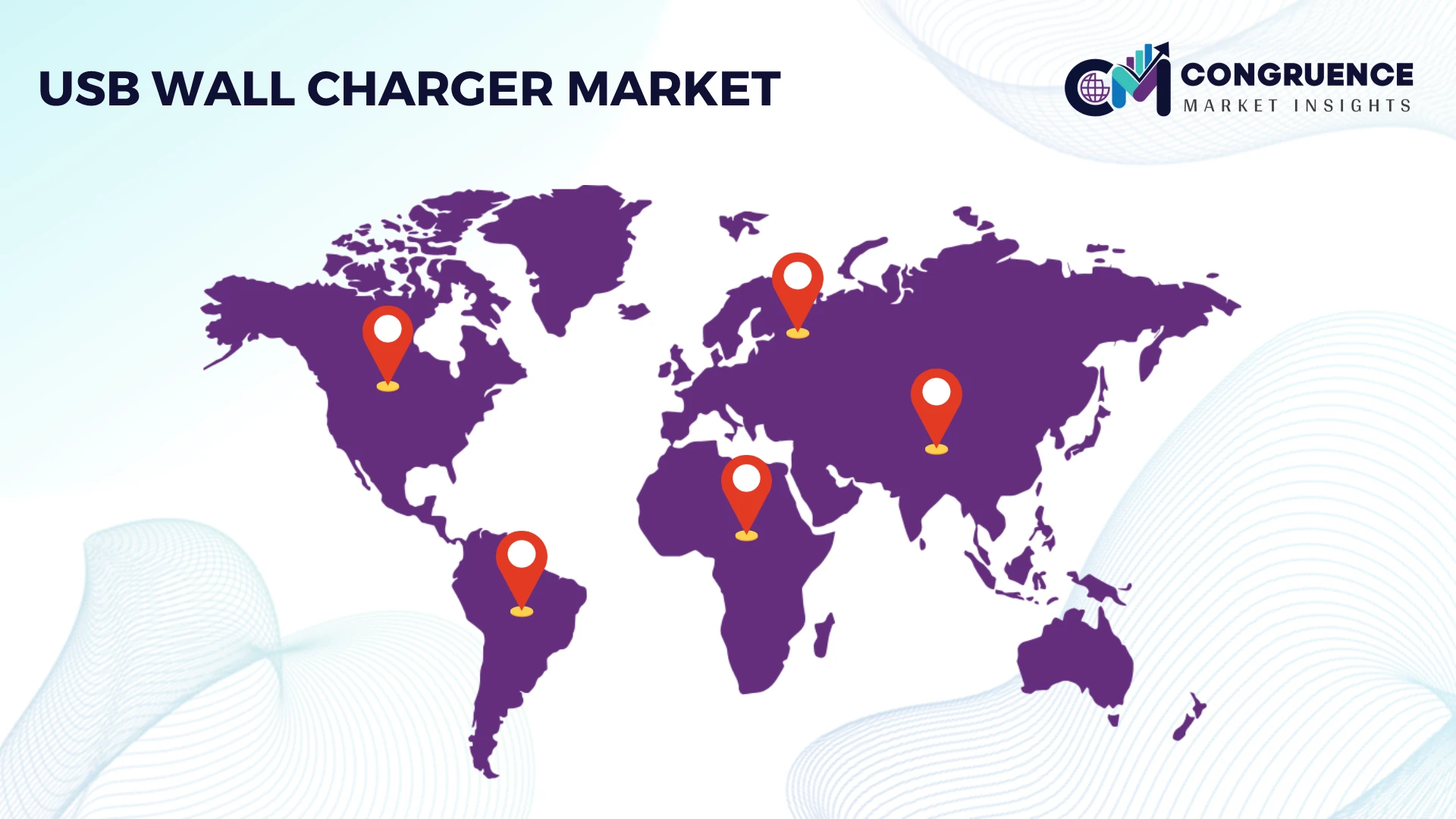
Asia-Pacific accounted for the largest market share at 39.0% in 2025 however, South America is expected to register the fastest growth, expanding at a CAGR of 6.2% between 2026 and 2033.
North America represents approximately 27% of global USB wall charger demand, supported by high smartphone penetration, laptop ownership, and strong replacement activity. The United States concentrates most regional demand, particularly for 65W–140W USB-C PD and multi-port GaN products. Premium chargers are increasingly replacing basic single-port adapters as consumers consolidate charging for multiple devices. Retail and e-commerce channels account for an estimated 70% of consumer purchases, reinforcing rapid product refresh cycles. Manufacturers are expanding 100W+ portfolios, partnering with device brands, and strengthening direct-to-consumer distribution. The region's strategic advantage lies in premiumization rather than manufacturing scale, with higher-output architectures supporting stronger unit economics and enterprise charging deployments.
United States Market Outlook: The United States remains North America's principal demand center, driven by extensive laptop, smartphone, gaming, and home-office device ownership. USB-C PD chargers above 65W are gaining traction as consumers replace multiple adapters with universal charging platforms. Enterprise workplaces and hospitality operators are also standardizing multi-port charging, creating procurement opportunities for durable, certified products with centralized replenishment.
Europe contributes approximately 22% of global USB wall charger demand, with Germany, the United Kingdom, France, and Italy forming major consumption centers. The market is being reshaped by the EU common-charger framework, which applies USB-C requirements to a broad range of portable electronics and to laptops from April 2026. Charger unbundling is also reducing redundant adapter purchases while increasing demand for interoperable aftermarket products. More than 400 million external power supplies are sold annually across the EU, creating a substantial replacement and efficiency-upgrade base. Manufacturers are redesigning portfolios around detachable USB-C cables, higher-efficiency power conversion, clearer power ratings, and compliant packaging. The regulatory transition is shifting competition from basic compatibility toward efficiency, interoperability, and documented performance.
Germany Market Outlook: Germany is strategically important because of its large electronics-consumer base, industrial purchasing power, and strong emphasis on energy efficiency. The country's established retail and enterprise distribution networks support premium USB-C PD adoption, while EU ecodesign requirements encourage manufacturers to prioritize efficient power conversion and standardized product architectures. This positions Germany as a strong market for compliant 65W–240W charger platforms.
Asia-Pacific commands approximately 39% of global USB wall charger demand and remains the principal manufacturing and supply-chain hub. China provides extensive semiconductor, power-management, PCB, connector, and assembly capacity, while India is strengthening downstream electronics production. India's electronics production reached approximately ₹11.3 lakh crore in 2024–25, while mobile-phone production increased 28-fold over the previous decade. This expanding device ecosystem directly strengthens the addressable charger base. Manufacturers are diversifying assembly locations, increasing GaN production, and building regional supplier networks to reduce logistics exposure. The region's strategic advantage is the combination of manufacturing depth, enormous device volumes, and rapidly expanding premium-charging adoption.
China Market Outlook: China remains the most strategically significant country for charger manufacturing because of its integrated electronics supply chain and concentration of component suppliers. Its ecosystem supports rapid transition from conventional silicon designs to GaN power stages, compact PCB layouts, and multi-port architectures. High-volume ODM and OEM capabilities allow brands to launch multiple power ratings quickly while maintaining competitive manufacturing costs.
South America accounts for approximately 6% of global USB wall charger demand, with Brazil representing the largest individual market and Argentina, Chile, and Colombia providing important secondary demand centers. Smartphone replacement, expanding e-commerce, and increasing use of laptops and tablets are strengthening demand for USB-C products. Multi-port chargers are gaining relevance as households manage several connected devices, while price sensitivity keeps entry-level single-port products important. Import dependence and currency fluctuations continue to influence landed costs and distributor inventories. Manufacturers are responding through localized distributor partnerships, broader mid-range portfolios, and region-specific packaging and certification strategies. The strongest opportunity is in Brazil, where scale allows suppliers to combine high-volume consumer products with premium 65W+ charging platforms.
Brazil Market Outlook: Brazil is the region's largest strategic market because of its population scale, extensive smartphone base, and developed consumer-electronics distribution network. E-commerce expansion is increasing access to branded USB-C and GaN chargers, while retailers increasingly favor standardized multi-port products. Suppliers with reliable local distribution, competitive warranty structures, and broad power-rating portfolios are positioned to capture replacement demand more efficiently.
Middle East & Africa contributes approximately 6% of global USB wall charger demand, with the United Arab Emirates, Saudi Arabia, South Africa, and Turkey serving as important commercial and distribution centers. High smartphone penetration in Gulf markets, expanding tourism infrastructure, and modernization of hotels, airports, offices, and retail facilities are increasing demand for reliable multi-port charging. Premium 65W+ products are gaining traction among business travelers and enterprise users, while price-sensitive African markets continue to favor basic single-port configurations. Suppliers are responding through distributor partnerships, hospitality-focused bulk packages, and localized inventory hubs. The region's non-obvious advantage is the concentration of high-value commercial infrastructure in Gulf economies, where standardized charging installations can support premium product positioning and recurring procurement.
United Arab Emirates Market Outlook: The UAE is the region's most strategically significant commercial market, supported by advanced retail infrastructure, high international visitor volumes, and strong adoption of premium consumer electronics. Hotels, airports, offices, and co-working facilities create concentrated demand for multi-port and USB-C PD charging systems. Suppliers can leverage centralized procurement and hospitality partnerships to deploy standardized charger fleets across multiple properties.
The USB wall charger market pits global charging leaders Anker, Belkin, UGREEN, Baseus, and Xiaomi against regional OEMs and private-label cost leaders. Premium brands compete through GaN, USB-C PD, thermal management, and multi-port engineering, while regional suppliers compete through pricing and supply-chain speed. The top five players collectively account for an estimated 30–35% of organized global branded sales, leaving substantial fragmentation. Technology-led products command 20–30% higher prices than conventional silicon chargers, while GaN architectures can reduce enclosure size by roughly 30–40%. Companies are expanding high-wattage portfolios, forming retail partnerships, integrating power-management components, and shifting assembly closer to major demand centers. The competitive shift is moving from basic wattage and price toward intelligent power allocation, sustainability, certification, and ecosystem compatibility. Entry barriers include semiconductor qualification, safety certification, tooling, retail access, and brand trust. Winners will combine compact high-efficiency hardware, dependable supply, rapid product refreshes, and strong channel execution consistently across markets.
Anker Innovations
Belkin International
UGREEN
Baseus
Xiaomi Corporation
Samsung Electronics
Koninklijke Philips
Panasonic Holdings
Lenovo
Aukey
ZAGG
Momax
Gallium nitride (GaN) is the key shift, replacing conventional silicon in chargers. GaN architectures support 65W–240W designs in smaller enclosures, with product footprints often 30–40% smaller than comparable legacy adapters. Adoption is strongest in multi-port products, improving thermal control, portability, and SKU efficiency for brands such as Anker, UGREEN, and Baseus.
USB-C Power Delivery 3.1 and intelligent power allocation are moving chargers from fixed-output accessories toward adaptive power platforms. Dynamic distribution enables simultaneous charging across laptops, tablets, and smartphones, while smart monitoring improves thermal and load management by roughly 5–10% in optimized designs. The technology favors companies with strong firmware and ecosystem integration capabilities. By 2028, 100W+ multi-device chargers will replace several lower-power adapters in professional and household workflows.
Emerging designs combine GaN, programmable power supplies, silicon-carbide components in higher-power architectures, smart displays, and active thermal sensing. These features improve charging visibility and operational reliability while supporting higher power density. Anker’s 140W and 250W platforms illustrate the premium direction, while UGREEN’s 500W architecture pushes desktop charging. Companies acting through 2026–2028 should prioritize power-management integration, interoperability testing, thermal engineering, and localized component qualification. The competitive advantage will shift toward intelligent, charging ecosystems rather than wattage alone.
June 2025 UGREEN launched the 500W Nexode 6-Port GaN charger, delivering simultaneous charging through five USB-C and one USB-A port. The capacity consolidates multiple adapters for professional workstations and gaming setups, strengthening UGREEN’s high-power charging position. Source: ugreen.com
January 2025 Belkin introduced 45W, 65W, 70W, and 100W charging products using 85–90% post-consumer recycled materials. The portfolio shift reduces virgin-plastic dependence and strengthens sustainable positioning as premium charging products expand across consumer channels and retailers globally. Source: belkin.com
August 2025 Anker highlighted GaN charging as a major technology transition, emphasizing compact architectures, thermal management, and improved power conversion versus silicon. Its 2025 portfolio increasingly combines high-output multi-port designs with intelligent controls, strengthening premium differentiation for consumers. Source: anker.com
January 2025 Baseus unveiled new charging innovations at CES, including products built around advanced charging architectures and retractable designs. The company also announced a Bose partnership, expanding ecosystem collaboration while reinforcing charging as a core growth category. Source: baseus.com
The report covers the global USB Wall Charger Market across 1 Port, 2 Ports, 3 Ports, and 4 Ports and Other configurations, with analysis by Individual, Commercial, and other applications and Individual, Commercial, and other end-user groups. It evaluates charging architectures, USB-C Power Delivery, GaN, multi-port power allocation, thermal management, and high-wattage platforms.
Geographic coverage spans North America, Europe, Asia-Pacific, South America, and Middle East & Africa, with country-level emphasis on the United States, Germany, China, India, Brazil, and the United Arab Emirates. The study tracks adoption patterns, manufacturing concentration, distribution structures, regulatory shifts, enterprise deployments, and emerging commercial charging use cases. It supports investment planning, portfolio expansion, supplier diversification, competitive positioning, and technology prioritization through 2033, with particular attention to the 2026–2028 transition toward universal USB-C and higher-density charging.
| Report Attribute / Metric | Details |
|---|---|
| Market Revenue (2025) | USD 1,535.5 Million |
| Market Revenue (2033) | USD 2,273.8 Million |
| CAGR (2026–2033) | 5.03% |
| Base Year | 2025 |
| Forecast Period | 2026–2033 |
| Historic Period | 2021–2025 |
| Segments Covered |
By Type
By Application
By End-User
|
| Key Deliverables | Revenue Forecast; Market Trends; Growth Drivers & Restraints; Technology Insights; Segmentation Analysis; Regional Insights; Competitive Landscape; Regulatory & ESG Overview; Recent Developments |
| Regions Covered | North America; Europe; Asia-Pacific; South America; Middle East & Africa |
| Companies Profiled | Anker Innovations; Belkin International; UGREEN; Baseus; Xiaomi Corporation; Samsung Electronics; Koninklijke Philips; Panasonic Holdings; Lenovo; Aukey; ZAGG; Momax |
| Customization & Pricing | Available on Request (10% Customization Free) |




