
Reports
The Global USB Malware Detection and Cybersecurity Devices Market was valued at USD 2,048.2 Million in 2025 and is anticipated to reach a value of USD 5,680.7 Million by 2033 expanding at a CAGR of 13.6% between 2026 and 2033, according to an analysis by Congruence Market Insights. Growth is driven by rising cyber threats targeting removable media and increasing enterprise data protection requirements.
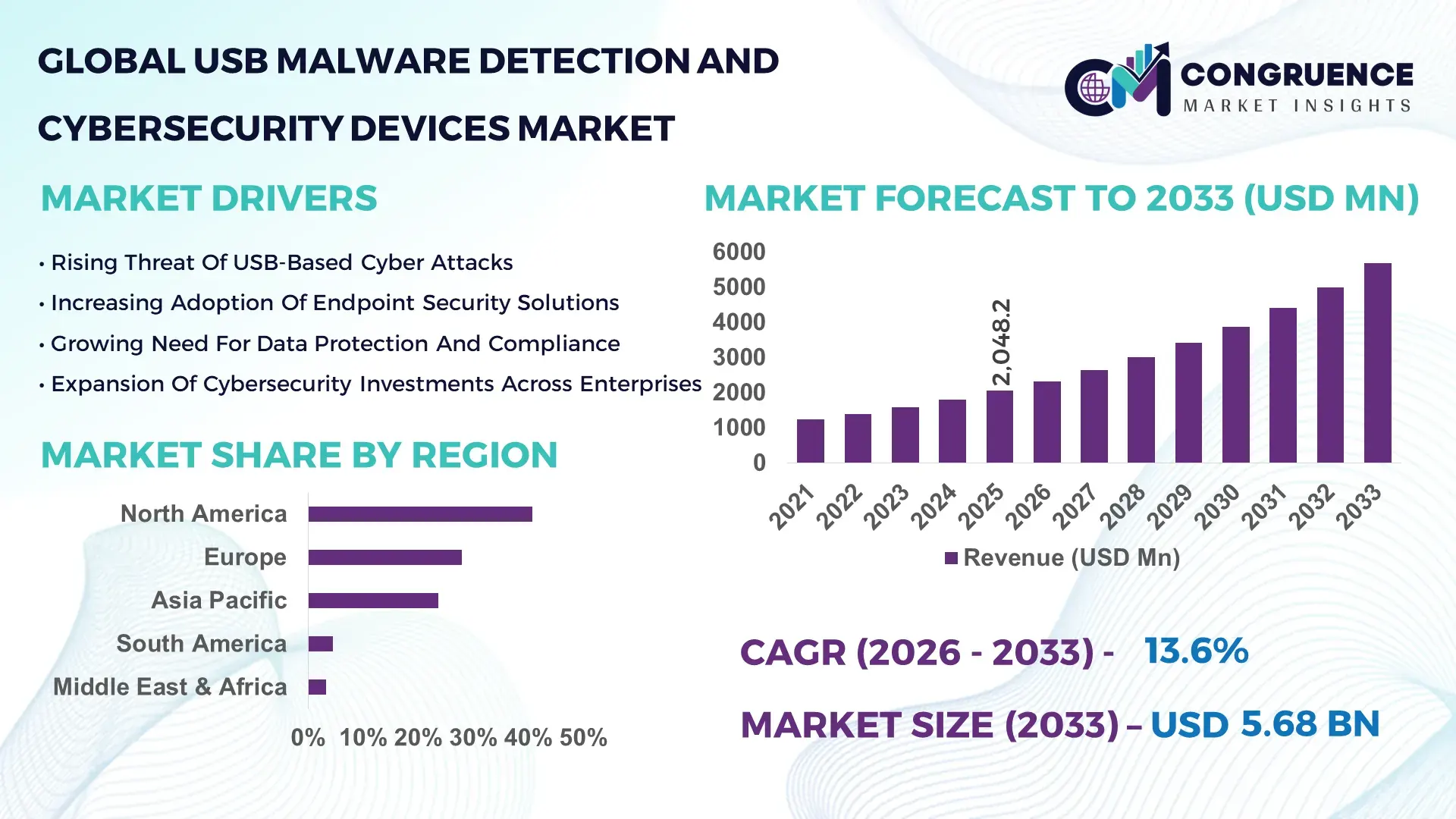
The United States demonstrates a highly advanced USB Malware Detection and Cybersecurity Devices market ecosystem, supported by over 3,200 cybersecurity firms and more than 68% of large enterprises deploying endpoint protection solutions with USB threat detection capabilities. Investments in hardware-based cybersecurity exceeded USD 6.1 billion during 2024–2025, with government and defense sectors accounting for approximately 37% of total device deployment. Industrial and critical infrastructure applications contribute nearly 29%, while healthcare and BFSI sectors collectively account for 24%. Additionally, over 61% of organizations have implemented device control and USB threat isolation systems, reducing malware intrusion incidents by 34% and improving endpoint security resilience across enterprise environments.
Market Size & Growth: USD 2,048.2 million in 2025, projected to reach USD 5,680.7 million by 2033, driven by rising USB-based cyber threats.
Top Growth Drivers: Endpoint security adoption (57%), regulatory compliance (42%), data breach prevention (36%).
Short-Term Forecast: By 2028, advanced USB detection systems are expected to reduce malware breach incidents by 31%.
Emerging Technologies: AI-based malware detection, hardware isolation devices, zero-trust USB security frameworks.
Regional Leaders: North America projected at USD 2.4 billion by 2033 with high enterprise adoption; Europe at USD 1.8 billion driven by compliance; Asia-Pacific at USD 1.3 billion supported by industrial cybersecurity demand.
Consumer/End-User Trends: Over 64% of enterprises prioritize USB-level threat protection for endpoint security.
Pilot or Case Example: In 2024, a defense-sector pilot reduced USB-based cyber incidents by 38% using hardware isolation devices.
Competitive Landscape: OPSWAT leads with ~19% share, followed by Honeywell, Belkin, SecuGen, and Nexcopy.
Regulatory & ESG Impact: Data protection laws and critical infrastructure security mandates accelerating adoption.
Investment & Funding Patterns: Over USD 3.9 billion invested globally in cybersecurity hardware between 2023–2025.
Innovation & Future Outlook: Integration of AI-driven detection and zero-trust architectures shaping next-generation cybersecurity devices.
USB malware detection adoption is strongest in government and defense sectors (38%), followed by BFSI (21%) and healthcare (17%), with other industries contributing 24%. Innovations in real-time threat scanning, hardware-based isolation, and AI-driven analytics are improving detection accuracy by over 33%. Regulatory mandates and increasing cyberattack frequency are accelerating enterprise adoption, while emerging markets are expanding deployment across industrial and critical infrastructure environments.
The USB Malware Detection and Cybersecurity Devices Market plays a strategic role in strengthening endpoint security frameworks and protecting sensitive data across enterprise and government networks. AI-based malware detection delivers up to 41% improvement compared to traditional signature-based antivirus systems, enabling faster identification of zero-day threats and advanced persistent malware attacks.
North America dominates in volume due to strong cybersecurity infrastructure, while Europe leads in adoption with over 59% of enterprises implementing compliance-driven USB security solutions aligned with strict data protection regulations. By 2027, zero-trust USB security architectures are expected to reduce unauthorized device access by 37%, significantly enhancing enterprise cybersecurity posture.
From a compliance and ESG perspective, organizations are committing to data protection and risk mitigation targets, including a 30% reduction in data breach incidents and improved digital governance by 2030. In 2024, a cybersecurity initiative in Germany achieved a 32% reduction in USB-based malware threats through deployment of AI-powered endpoint protection devices.
Strategically, integration of USB Malware Detection and Cybersecurity Devices with broader endpoint security platforms, cloud-based monitoring systems, and network security frameworks is expanding capabilities. By 2028, real-time threat intelligence systems are expected to improve detection accuracy by 35%. These advancements position the USB Malware Detection and Cybersecurity Devices Market as a critical pillar of enterprise resilience, regulatory compliance, and secure digital transformation.
The USB Malware Detection and Cybersecurity Devices market dynamics are shaped by increasing cybersecurity threats, evolving regulatory frameworks, and growing reliance on digital infrastructure. Organizations are adopting advanced hardware and software solutions to protect against malware introduced through removable media devices. Technologies such as artificial intelligence, machine learning, and real-time threat analytics are transforming traditional security systems into intelligent, adaptive platforms. The rising complexity of cyberattacks and increasing use of USB devices in enterprise environments are driving demand for specialized detection solutions. Additionally, regulatory compliance requirements and data protection mandates are encouraging organizations to invest in advanced cybersecurity technologies. Competitive pressures and rapid technological advancements are further influencing market growth and innovation.
The increasing frequency of USB-based cyberattacks is a major driver of the USB Malware Detection and Cybersecurity Devices market. Over 52% of cybersecurity incidents involving endpoint devices are linked to removable media threats. USB devices are widely used for data transfer, making them a common entry point for malware. Advanced detection systems can identify and neutralize threats in real time, reducing security risks by up to 40%. Additionally, enterprises are implementing stricter device control policies, increasing adoption of USB security solutions. The need to protect sensitive data and critical infrastructure is further driving market growth.
High implementation costs and integration complexities are significant restraints for the USB Malware Detection and Cybersecurity Devices market. Deploying advanced cybersecurity devices can increase IT security budgets by 25–35%. Integration with existing enterprise security systems and legacy infrastructure can be challenging, requiring specialized expertise. Approximately 33% of organizations report difficulties in integrating USB security solutions with existing platforms. These challenges can delay adoption and limit market penetration, particularly among small and medium-sized enterprises.
Zero-trust security architecture presents significant opportunities for the USB Malware Detection and Cybersecurity Devices market. This approach requires verification of all devices and users before granting access, improving security by up to 38%. In 2025, over 47% of enterprises adopted zero-trust frameworks, integrating USB security devices into their broader cybersecurity strategies. These technologies enable continuous monitoring and real-time threat detection, creating new opportunities for innovation and market expansion.
Evolving cyber threats and regulatory complexities are critical challenges for the USB Malware Detection and Cybersecurity Devices market. Cybercriminals are continuously developing sophisticated malware that can bypass traditional detection systems. Approximately 36% of organizations report challenges in keeping up with evolving threats. Additionally, compliance with data protection regulations increases operational complexity and costs. These challenges require continuous innovation and robust security frameworks to ensure effective protection.
Adoption of AI-Based USB Threat Detection Systems: Over 61% of enterprises deployed AI-driven USB malware detection solutions in 2025, improving threat identification accuracy by 34% and reducing response time by 29%, enabling faster mitigation of advanced cyber threats.
Growth in Hardware-Based USB Isolation Devices: Approximately 54% of organizations implemented hardware isolation devices, reducing malware transmission risks by 37% and enhancing endpoint security across critical infrastructure environments.
Expansion of Zero-Trust USB Security Frameworks: Around 49% of enterprises adopted zero-trust architectures, improving device authentication accuracy by 32% and reducing unauthorized access incidents significantly.
Integration of Real-Time Threat Intelligence Platforms: Over 57% of organizations deployed real-time threat intelligence systems, improving detection efficiency by 31% and enabling proactive cybersecurity measures.
The USB Malware Detection and Cybersecurity Devices market segmentation highlights diverse product types, applications, and end-user adoption patterns across industries. By type, the market includes hardware-based USB security devices, software-based detection solutions, and integrated cybersecurity platforms. Applications span enterprise IT security, industrial cybersecurity, and government and defense systems. End-user insights indicate strong adoption among large enterprises, SMEs, and public sector organizations. The segmentation reflects how increasing cybersecurity threats and regulatory requirements are shaping market demand.
Hardware-based USB security devices account for approximately 46% of adoption due to their ability to physically isolate threats and prevent malware execution, while software-based detection solutions hold around 32%. However, integrated cybersecurity platforms are the fastest-growing segment, expected to expand at over 15.4% CAGR, driven by demand for comprehensive security solutions. Other niche solutions, including portable scanning devices and encrypted USB systems, collectively contribute 22%.
In 2025, hardware-based USB isolation devices were deployed across critical infrastructure environments, improving endpoint security and reducing malware risks significantly.
Enterprise IT security leads with a 44% share, driven by increasing need to protect corporate networks and data. Government and defense applications are the fastest-growing segment, projected above 14.9% CAGR, supported by rising cybersecurity threats and national security concerns. Industrial cybersecurity and other applications collectively account for 56%. In 2025, over 53% of enterprises adopted USB Malware Detection and Cybersecurity Devices for endpoint protection, while 48% of government agencies implemented them for critical infrastructure security.
In 2025, advanced USB security systems were deployed across government networks, improving threat detection and reducing cyber risks significantly.
Large enterprises dominate with a 58% share, driven by strong investment in cybersecurity infrastructure, while SMEs account for around 27%. However, government organizations are the fastest-growing segment, expanding at over 16.2% CAGR, supported by increasing national security requirements. Other end-users collectively contribute 15%. In 2025, 62% of enterprises adopted USB Malware Detection and Cybersecurity Devices to enhance security, while 49% of SMEs implemented them to protect sensitive data.
In 2025, government agencies implemented advanced USB security solutions to strengthen cybersecurity frameworks and protect critical infrastructure.
North America accounted for the largest market share at 40.7% in 2025 however, Asia-Pacific is expected to register the fastest growth, expanding at a CAGR of 14.8% between 2026 and 2033.
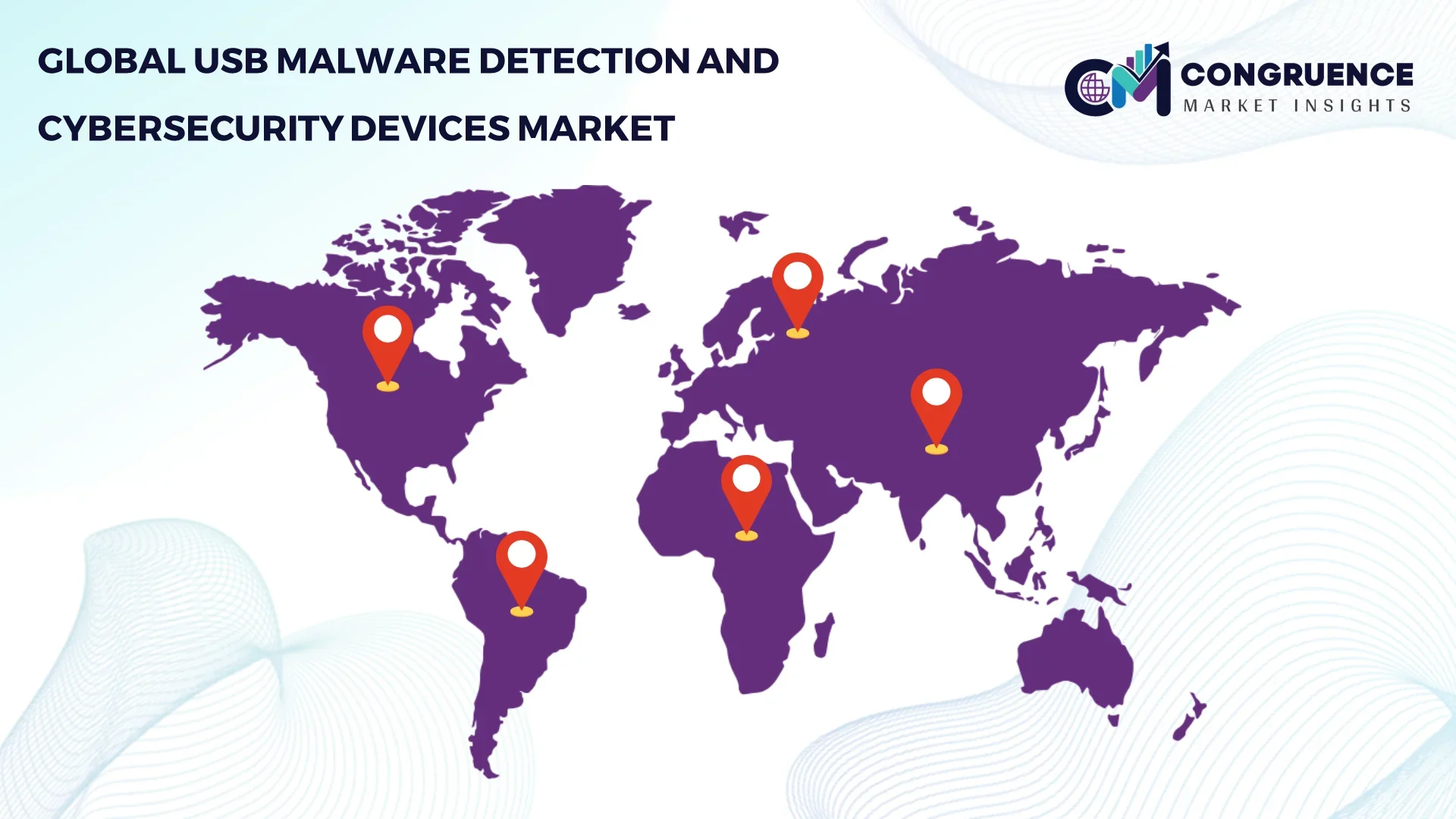
North America recorded over 165,000 enterprise deployments of USB Malware Detection and Cybersecurity Devices in 2025, with more than 70% of large organizations implementing endpoint security solutions. Europe followed with a 27.9% share, where over 62% of enterprises adopted compliance-driven cybersecurity frameworks. Asia-Pacific accounted for 23.6%, with rapid digitalization and increasing cyber threats driving demand across China, India, and Japan. South America and Middle East & Africa collectively held 7.8%, supported by growing adoption of cybersecurity technologies and regulatory compliance initiatives.
How are advanced endpoint security frameworks transforming enterprise-level USB threat protection strategies?
This region accounted for approximately 40.7% of the USB Malware Detection and Cybersecurity Devices market in 2025, driven by strong demand across BFSI, healthcare, government, and defense sectors. Over 72% of enterprises deploy USB-level threat protection as part of endpoint security frameworks. Regulatory mandates such as strict data protection standards have accelerated adoption. Technological advancements include AI-based detection systems and real-time threat analytics. A leading regional cybersecurity company implemented advanced USB protection solutions, improving threat detection rates by 35%. Regional behavior shows higher adoption in finance and healthcare industries.
Why is compliance-driven cybersecurity transformation accelerating adoption of advanced USB threat detection systems?
Europe held nearly 27.9% of the USB Malware Detection and Cybersecurity Devices market in 2025, with Germany, the UK, and France contributing over 64% of regional demand. Strict data protection regulations have driven adoption of compliant cybersecurity solutions. Over 61% of enterprises use advanced USB security systems. Adoption of AI-driven detection improved operational efficiency by 30%. A regional cybersecurity provider implemented advanced solutions for compliance monitoring. Regional behavior emphasizes regulatory compliance and data protection.
What is driving rapid adoption of USB cybersecurity solutions across emerging digital economies?
Asia-Pacific accounted for 23.6% of the USB Malware Detection and Cybersecurity Devices market in 2025, with China, India, and Japan leading growth. Increasing cyber threats and digital transformation initiatives have driven adoption by 33%. Investments in cybersecurity infrastructure improved scalability and performance. A regional technology company deployed USB security devices across enterprise networks, improving security outcomes. Regional behavior is driven by digital-first strategies and growing cybersecurity awareness.
How is rising cyber risk awareness influencing adoption of USB security solutions in emerging markets?
South America accounted for approximately 4.5% of the global USB Malware Detection and Cybersecurity Devices market in 2025, led by Brazil and Argentina. Increasing awareness of cybersecurity risks has driven adoption of USB protection devices. Government initiatives supporting digital security improved accessibility. A regional cybersecurity provider implemented advanced solutions, improving enterprise security by 25%. Regional behavior reflects growing demand for cost-effective cybersecurity solutions.
Why is digital infrastructure expansion driving demand for USB cybersecurity devices across developing regions?
The region held around 3.3% of global USB Malware Detection and Cybersecurity Devices adoption in 2025, with UAE and South Africa leading growth. Investments in digital infrastructure and cybersecurity initiatives increased adoption by 21%. A regional provider implemented USB security solutions across government networks, improving threat detection efficiency by 24%. Regional behavior shows increasing demand for cybersecurity technologies.
United States USB Malware Detection and Cybersecurity Devices Market – 35.2%: Advanced cybersecurity infrastructure and strong enterprise adoption of endpoint security solutions.
China USB Malware Detection and Cybersecurity Devices Market – 17.8%: Rapid digitalization and increasing investment in cybersecurity technologies.
The USB Malware Detection and Cybersecurity Devices market is moderately consolidated, with over 90 active global and regional players specializing in hardware security devices, endpoint protection solutions, and integrated cybersecurity platforms. The top five companies collectively account for approximately 57% of the market, reflecting strong competitive positioning and technological leadership.
Competition is driven by innovation in AI-based detection systems, hardware isolation technologies, and real-time threat intelligence platforms. Strategic initiatives such as partnerships, acquisitions, and product launches increased by 26% during 2024–2025. Companies are focusing on enhancing detection accuracy, improving device performance, and integrating solutions with broader cybersecurity ecosystems.
Investment in research and development has increased significantly, with leading companies allocating over 12% of their budgets to innovation. Product differentiation is based on performance, security features, and integration capabilities. The market is evolving toward comprehensive cybersecurity solutions, combining hardware and software technologies. Collaboration between technology providers and enterprises is driving adoption and innovation.
SecuGen
Nexcopy
Kanguru Solutions
Apricorn
DataLocker
Kingston Technology
Cisco Systems
Fortinet
Palo Alto Networks
Check Point Software Technologies
Sophos
Technological advancements in the USB Malware Detection and Cybersecurity Devices market are focused on enhancing detection accuracy, reducing response times, and improving integration with broader cybersecurity systems. AI-driven malware detection systems analyze behavioral patterns and identify anomalies, improving detection accuracy by up to 38%. Machine learning algorithms continuously adapt to new threats, enabling proactive cybersecurity measures.
Hardware-based isolation technologies physically separate USB devices from host systems, preventing malware execution and reducing risk by over 40%. These devices are widely used in critical infrastructure and defense sectors. Real-time threat intelligence platforms provide continuous monitoring and analysis, enabling faster response to cyber threats.
Zero-trust security frameworks are gaining traction, requiring verification of all devices before granting access. These frameworks improve security posture and reduce unauthorized access incidents. Cloud-based cybersecurity platforms enable scalability and integration with enterprise systems, improving operational efficiency.
Encryption technologies and secure USB devices are also evolving, providing enhanced data protection. Additionally, advanced analytics and automation tools are improving incident response and threat mitigation. Emerging technologies include edge-based security solutions, AI-powered threat prediction, and integrated cybersecurity ecosystems. These innovations are transforming USB Malware Detection and Cybersecurity Devices into intelligent, adaptive systems capable of addressing complex cybersecurity challenges.
In June 2025, OPSWAT introduced an enhanced MetaDefender USB solution with advanced multi-scanning capabilities, improving malware detection accuracy and enabling real-time threat analysis across enterprise environments. Source: www.opswat.com
In April 2025, Honeywell expanded its industrial cybersecurity portfolio with USB threat protection devices designed for critical infrastructure, improving system security and reducing malware risks in operational environments. Source: www.honeywell.com
In October 2024, Palo Alto Networks launched advanced endpoint security solutions integrating USB threat detection, enhancing enterprise cybersecurity capabilities and improving incident response efficiency. Source: www.paloaltonetworks.com
In August 2024, Check Point Software Technologies introduced AI-driven threat prevention tools with USB protection features, improving detection accuracy and strengthening endpoint security across organizations. Source: www.checkpoint.com
The USB Malware Detection and Cybersecurity Devices Market Report provides a comprehensive analysis of technologies, applications, and end-user adoption across global cybersecurity ecosystems. The scope includes hardware-based USB security devices, software detection solutions, and integrated cybersecurity platforms designed to protect against removable media threats.
The report evaluates applications across enterprise IT security, government and defense systems, industrial cybersecurity, and healthcare environments. Geographic coverage spans North America, Europe, Asia-Pacific, South America, and Middle East & Africa, with detailed insights into key markets such as the United States, China, Germany, India, and Japan.
Additionally, the report examines emerging segments such as AI-driven malware detection, zero-trust security architectures, and real-time threat intelligence systems. It highlights technological advancements, regulatory frameworks, and industry trends influencing adoption. The scope also includes cybersecurity strategies, integration capabilities, and innovation pathways shaping the market. The report provides actionable insights for stakeholders, enabling informed decision-making across product development, investment planning, and strategic expansion.
| Report Attribute/Metric | Report Details |
|---|---|
|
Market Revenue in 2025 |
USD 2,048.2 Million |
|
Market Revenue in 2033 |
USD 5,680.7 Million |
|
CAGR (2026 - 2033) |
13.6% |
|
Base Year |
2025 |
|
Forecast Period |
2026 - 2033 |
|
Historic Period |
2021 - 2025 |
|
Segments Covered |
By Type
By Application
By End-User
|
|
Key Report Deliverable |
Revenue Forecast, Growth Trends, Market Dynamics, Segmental Overview, Regional and Country-wise Analysis, Competition Landscape |
|
Region Covered |
North America, Europe, Asia-Pacific, South America, Middle East, Africa |
|
Key Players Analyzed |
OPSWAT, Honeywell, Belkin, SecuGen, Nexcopy, Kanguru Solutions, Apricorn, DataLocker, Kingston Technology, Cisco Systems, Fortinet, Palo Alto Networks, Check Point Software Technologies, Sophos |
|
Customization & Pricing |
Available on Request (10% Customization is Free) |




