
Reports
The Global Urea Formaldehyde Market was valued at USD 10,614.6 Million in 2025 and is anticipated to reach a value of USD 13,551.1 Million by 2033 expanding at a CAGR of 3.1% between 2026 and 2033. Growth is driven by demand for urea formaldehyde adhesives in medium-density fibreboard (MDF), particleboard, plywood, and cost-sensitive furniture manufacturing.
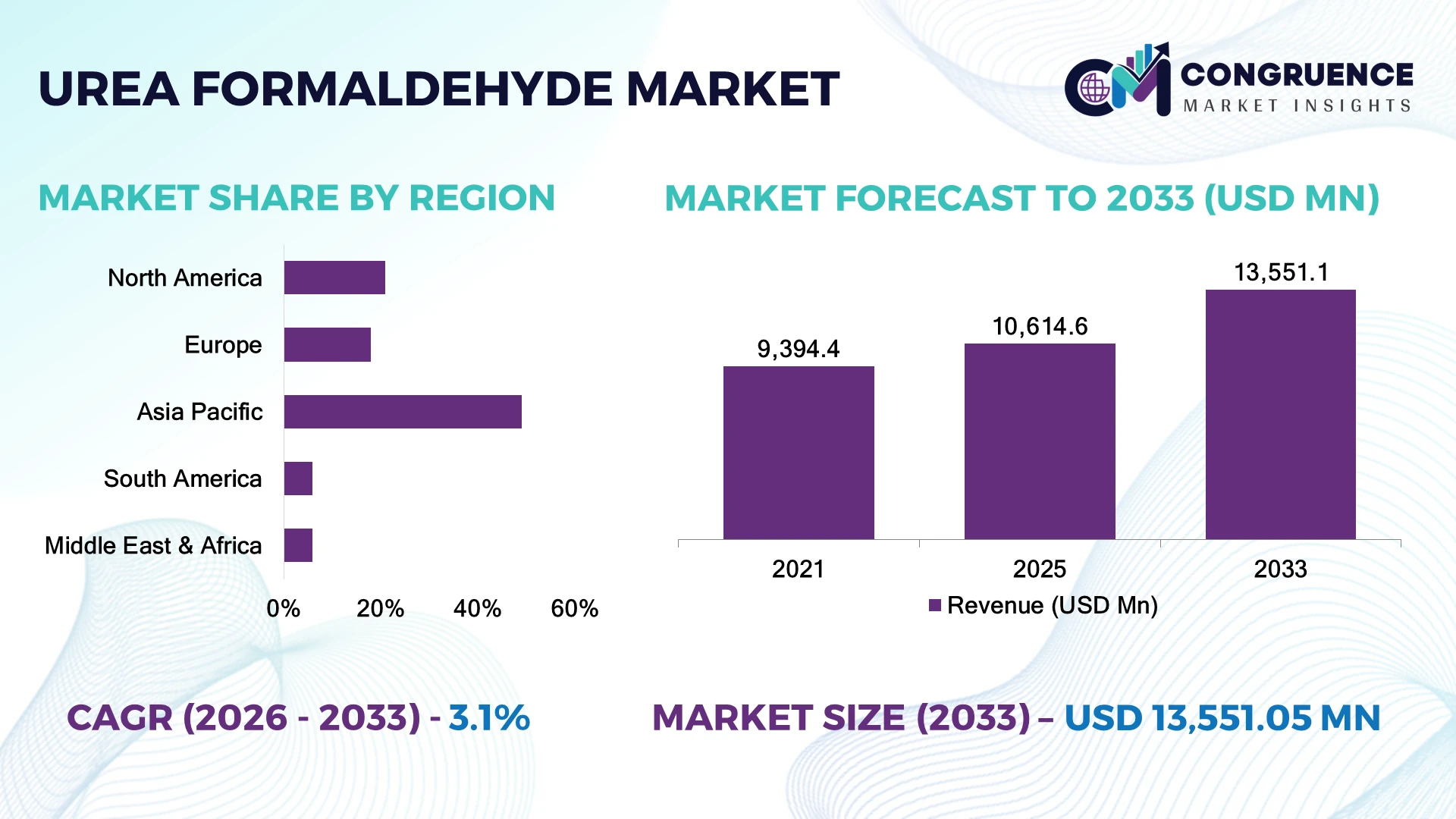
China remains a central production and consumption hub because its extensive engineered-wood, furniture, and construction-material industries sustain large-scale resin requirements. Asia-Pacific is estimated to account for approximately 50–58% of global demand, depending on market definition, compared with Europe's smaller but compliance-intensive market. China's manufacturing scale supports cost-efficient resin production, while European formaldehyde-emission requirements increase the importance of low-emission formulations. For suppliers, the strategic priority is to balance high-volume production economics with emission performance and customer-specific resin specifications.
Market Size & Growth: The market is valued at USD 10,614.6 million in 2025 and is projected to reach USD 13,551.1 million by 2033, with the supplied forecast indicating a 3.1% CAGR. Engineered-wood production remains a core demand driver.
Top Growth Drivers: MDF, particleboard, and furniture manufacturing underpin resin demand. Their individual percentage contributions require validation against the finalized market model.
Short-Term Forecast: By 2028, resin producers should prioritize measurable reductions in reject rates, curing time, and adhesive consumption rather than assume uniform industry-wide efficiency gains.
Emerging Technologies: Low-emission formulations, optimized formaldehyde-to-urea ratios, and process-control systems are important improvement areas for resin manufacturers serving regulated panel producers.
Regional Leaders: Asia-Pacific leads on manufacturing scale, Europe emphasizes emissions compliance, and North America serves established panel, furniture, and industrial markets. Regional market values require a consistent market definition.
Consumer/End-User Trends: Panel manufacturers increasingly assess bond strength, curing performance, formaldehyde emissions, and resin cost per unit of finished board rather than purchase price alone.
Pilot/Case Example: In 2025, a proposed ₹25.76 crore synthetic-organic-chemicals facility in Gujarat included formaldehyde-based resins, illustrating downstream interest in integrating resin supply. This is a project-specific indicator, not a verified market-wide performance benchmark.
Competitive Landscape: Hexion, BASF, Bakelite Synthetics, Acron, and regional resin producers compete through formulation capability, feedstock access, technical service, and proximity to wood-panel plants. A verified combined leader share is not established here.
Regulatory & ESG Impact: The EU's E1 classification uses a formaldehyde-emission threshold of 0.1 ppm under the specified 28-day chamber test, increasing the importance of compliant panel and resin systems.
Investment & Funding: Investment is directed toward resin capacity, downstream integration, and formulation upgrades. The ₹25.76 crore Gujarat proposal is a project-specific indicator, not a measure of total market investment.
Innovation & Future Outlook: The competitive shift is toward lower-emission resin chemistry, more consistent curing, and application-specific formulations that preserve bond performance while meeting customer and regulatory requirements.
The urea formaldehyde market remains closely linked to engineered-wood production, particularly MDF, particleboard, and plywood used in furniture and interior construction. Manufacturers are improving resin formulations and process controls to maintain bonding performance while reducing formaldehyde emissions. As emission requirements tighten and customers scrutinize product quality, suppliers with reliable technical support and consistent batch performance gain an advantage over producers competing only on price. This shifts purchasing decisions toward verified performance and compliance.
Urea formaldehyde remains strategically important because it combines cost-effective bonding with established compatibility across MDF, particleboard, plywood, and furniture manufacturing. Resin producers are increasingly judged on the performance of the finished panel, including bond strength, curing consistency, moisture response, and formaldehyde emissions. This makes formulation expertise and customer qualification as important as production scale.
The market is also being reshaped by differences in regional manufacturing and compliance requirements. China and India benefit from large downstream manufacturing ecosystems, while European customers place stronger emphasis on emissions performance and product documentation. Conventional formulations remain commercially relevant, but optimized resin chemistry, controlled dosing, and improved curing conditions can reduce rework and material losses when validated against existing processes. There is no universal efficiency improvement: results depend on the resin formulation, panel type, production line, and operating conditions.
Over the next two to three years, manufacturers should prioritize application testing, closer collaboration with panel producers, and investment in quality-control systems. A practical deployment pathway is to qualify lower-emission formulations on selected production lines before scaling across plants. Producers that combine competitive feedstock economics with consistent technical performance and regulatory readiness will be better positioned to retain customers and expand into specification-sensitive markets.
Demand for MDF, particleboard, plywood, and furniture panels remains a core driver because urea formaldehyde offers economical bonding and established compatibility with high-volume production. Asia-Pacific is estimated to represent approximately 50–58% of global demand, although the precise share depends on whether market estimates include resin intermediates and related formulations. Panel manufacturers prioritize resin systems that maintain bond strength without slowing pressing cycles. The operational effect is direct: inconsistent curing or adhesive performance increases rejects and disrupts production schedules. Producers are responding through formulation optimization, technical support at customer facilities, and closer coordination with board manufacturers. The non-obvious advantage lies in reducing resin consumption per unit of acceptable panel output, not simply increasing resin volume sold.
Formaldehyde emissions remain a structural restraint because resin performance must be balanced against indoor-air-quality requirements and customer specifications. The EU's E1 classification includes a threshold of 0.1 ppm under the specified 28-day chamber test, while other markets apply their own testing and product requirements. These differences increase qualification complexity for exporters supplying multiple destinations. Reformulating resin can affect curing speed, moisture resistance, bond strength, and production cost, so a lower-emission specification cannot be adopted without technical validation. Panel manufacturers face additional testing and documentation requirements, while resin producers must maintain consistent batches and support customer audits. Suppliers are reducing exposure through market-specific formulations, tighter process controls, and early collaboration with downstream customers.
Low-emission resin systems create an opportunity for suppliers that can meet tighter customer specifications without compromising panel performance or increasing manufacturing complexity. European requirements and international furniture supply chains encourage panel producers to request documented emission results and consistent product quality. Manufacturers can pursue differentiated formulations, optimized urea-to-formaldehyde ratios, and process adjustments that improve resin efficiency. Performance must be demonstrated through validated emission tests, bond-strength measurements, and production-line trials rather than formulation claims alone. A practical opportunity lies in helping smaller panel manufacturers upgrade compliance without replacing their entire production infrastructure. Resin suppliers that provide technical assistance, application-specific grades, and repeatable test results can secure stronger customer relationships and reduce the risk of competing exclusively on price.
Scaling improved urea formaldehyde formulations across different panel plants is challenging because wood species, moisture content, pressing temperatures, line speeds, and adhesive application rates vary. A resin that performs well in a controlled trial may require adjustment under commercial operating conditions. Even small process deviations can affect curing, internal bond strength, panel rejects, and emissions results. Manufacturers therefore need repeatable quality-control procedures and application support that extend beyond resin delivery. The challenge is particularly significant for suppliers serving customers across multiple countries with different equipment and product specifications. Companies should invest in technical service, standardized testing, and production-trial protocols. Competitive advantage depends on demonstrating consistent results at customer scale, not merely introducing a new formulation.
Low-Emission Formulation Upgrades: Resin suppliers are refining formulations to help panel producers meet stricter emissions requirements while preserving bond strength and press performance. The EU E1 classification sets a 0.1 ppm threshold under its specified 28-day chamber test. Qualification increasingly depends on measured emissions, repeatable batches, and documented production conditions. Suppliers are expanding technical testing and customer-specific formulation work rather than relying on broad low-emission claims.
Resin Efficiency Over Purchase Price: Panel manufacturers are assessing adhesive consumption per unit of acceptable board, reject rates, and press-cycle stability. A small reduction in resin dosage is commercially useful only when bond strength and product quality remain within specification. Producers are responding with dosing optimization, process monitoring, and joint trials with panel plants. This shifts competition from price per tonne toward total adhesive cost and consistent finished-panel performance.
Closer Downstream Supply Integration: Resin producers and engineered-wood manufacturers are strengthening supply coordination to reduce delivery uncertainty and match formulations to local production conditions. Regional manufacturing concentration, particularly in Asia, supports shorter delivery routes and technical collaboration. Integrated sourcing can reduce inventory and formulation mismatch, although benefits depend on plant location and procurement structure. Suppliers are prioritizing customer proximity, predictable feedstock access, and responsive application support.
Process Control and Quality Traceability: Manufacturers are improving control of resin preparation, storage, dosing, and curing parameters to limit batch variation and production disruption. Automated monitoring can improve consistency, but performance gains must be verified against plant-level baselines rather than assumed across the industry. Resin suppliers are increasingly expected to provide technical data, repeatable specifications, and troubleshooting support. This trend favors companies that combine chemical formulation expertise with practical production-line knowledge.
Liquid Resin Dominance Reflects Continuous Panel Manufacturing Requirements
Liquid urea formaldehyde resin is estimated to represent approximately 60% of the type segment, supported by direct compatibility with industrial adhesive application systems, straightforward dosing, and continuous MDF and particleboard production. Its handling characteristics help large panel manufacturers maintain consistent adhesive distribution and production throughput. Powder resin serves more specialized requirements, including molding compounds and applications where storage stability and transportation convenience influence procurement. Liquid resin remains the mature volume leader, while powder formulations offer opportunities in specialized industrial applications and markets where ready-to-use liquid supply is less practical.
Powder resin is a potential faster-growing niche, although its growth advantage requires validation against segment-level sales data. A directional estimate places liquid resin at 55–65% of type demand, with powder products accounting for much of the remainder. Suppliers are prioritizing formulation consistency, improved packaging, application support, and customer-specific grades. The strategic implication is to protect liquid-resin scale advantages while selectively expanding powder capabilities where logistics, product form, or specialized performance creates a defensible margin advantage.
Particleboard Bonding Anchors High-Volume Resin Consumption
Particleboard is estimated to account for approximately 42% of urea formaldehyde application demand, reflecting its extensive use in economical furniture, cabinetry, shelving, and interior panels. The resin's competitive cost, fast curing, and established compatibility with high-throughput pressing make it suitable for large production runs. MDF represents another major application, benefiting from the need for uniform bonding, smooth surfaces, and reliable machining performance. Plywood adhesives, decorative laminates, coatings, and molding compounds broaden the application base, although their resin requirements and processing conditions differ.
MDF is a plausible faster-growing application as manufacturers target consistent surface quality and precision-engineered interior products; however, a verified growth ranking requires application-level market data. Particleboard's estimated share of 38–45% highlights its established demand concentration, while other applications provide diversification opportunities. Producers are improving resin formulations, dosing precision, and curing consistency to reduce rejects and maintain bond strength. Investment priorities should therefore favour high-volume panel customers while developing specialized grades for applications where performance specifications and emissions compliance increasingly influence supplier selection.
Furniture Manufacturing Leads Through Engineered-Wood Consumption
The furniture industry is estimated to represent approximately 42% of urea formaldehyde end-user demand, driven by its consumption of particleboard and MDF in cabinets, wardrobes, shelving, desks, and other interior products. Building and construction is another substantial customer group, using resin-bonded panels in interior fit-outs and related applications. Electrical and electronics manufacturers, transportation suppliers, agriculture-related applications, and other industrial users contribute smaller but more specialized demand streams. Furniture producers prioritize consistent bonding, short press cycles, and competitive adhesive cost per finished panel, whereas specialized buyers place greater emphasis on formulation requirements and component performance.
Building and construction is a potential faster-growing end-user segment where engineered panels gain use in interior systems and modular fit-outs, although its relative growth requires confirmation from end-user sales data. Furniture's indicative 38–45% share reflects its concentration in high-volume panel consumption. Resin suppliers are responding through technical collaboration with panel manufacturers, differentiated low-emission grades, and supply arrangements aligned with production schedules. The strategic opportunity is to defend large furniture accounts while developing construction-related and specialized industrial customers that value application support, documented performance, and dependable supply.
Asia-Pacific accounted for the largest market share at an estimated 49% in 2025; however, Asia-Pacific is expected to register the fastest growth, expanding at an estimated CAGR of 3.8% between 2026 and 2033.

Emissions Compliance Reshapes Established Resin Supply Chains
North America represents an established urea formaldehyde market, supported by particleboard and MDF production, furniture manufacturing, construction materials, and industrial wood products. The United States is the principal regional demand centre, with Canada contributing through forestry, panel production, and cross-border supply chains. An indicative regional share of approximately 20–22% reflects the region's substantial downstream manufacturing base, although the precise proportion depends on market scope. Procurement increasingly balances resin cost and curing performance against workplace exposure, product emissions, and customer specifications. In January 2025, the US Environmental Protection Agency finalized its formaldehyde risk evaluation under the Toxic Substances Control Act, increasing the significance of chemical-risk management for manufacturers. Resin suppliers are consequently prioritizing formulation consistency, customer technical support, and compliance documentation alongside dependable supply. For producers, retaining panel customers increasingly requires reliable performance and regulatory readiness rather than price competition alone.
United States Market Outlook: The United States benefits from a large engineered-wood market, established chemical manufacturing, and extensive furniture and building-material supply chains. Its demand is shaped by panel production, cabinetry, residential interiors, and industrial wood applications. The country's formaldehyde risk evaluation has placed greater attention on exposure management and manufacturing conditions, strengthening the commercial value of reliable product stewardship. Suppliers that provide application-specific resin grades, technical documentation, and consistent batch quality can better serve customers managing compliance alongside production efficiency. Domestic supply reliability and regional distribution also help reduce procurement disruption.
Regulatory Compliance Accelerates Resin Specification Changes
Europe's urea formaldehyde market is supported by furniture, MDF, particleboard, cabinetry, and interior construction, with Germany, Poland, Italy, and France serving important manufacturing centres. The region's estimated share is approximately 16–19%, reflecting established panel production alongside stringent product and chemical requirements. The EU's formaldehyde restriction under REACH, with new limits for articles and mixtures applying from August 2026, increases the importance of emission testing and product qualification. Resin suppliers must preserve bond strength and press performance while supporting customers' compliance obligations. This creates a structural advantage for manufacturers with strong formulation expertise, testing capability, and traceable quality systems. Investment priorities increasingly favour lower-emission grades and technical collaboration with panel producers rather than undifferentiated volume expansion.
Germany Market Outlook: Germany is strategically important because of its established furniture, cabinetry, industrial wood-processing, and chemical manufacturing base. Its manufacturers require resin systems that deliver consistent curing, reliable bonding, and compliance with customer specifications across different panel applications. As European formaldehyde requirements tighten in 2026, panel and resin suppliers must coordinate testing, documentation, and production adjustments before products reach the market. Germany's engineering capabilities and established industrial supply networks support the adoption of optimized formulations and quality-control processes. Suppliers able to combine technical validation with dependable delivery are better placed to retain customers.
Engineered-Wood Manufacturing Scale Sustains Regional Leadership
Asia-Pacific is the dominant regional market for urea formaldehyde, driven by high-volume panel manufacturing, furniture production, construction interiors, and extensive chemical supply chains. China is the largest national demand centre, while India, Japan, Indonesia, Vietnam, and South Korea contribute through different combinations of panel production and downstream manufacturing. The region's indicative share is approximately 49%, supported by its concentration of engineered-wood capacity. China accounted for 45% of global wood-based panel production in 2024, highlighting the scale of the industrial base connected to adhesive consumption. Regional producers compete through feedstock access, production scale, customer proximity, and application support. Investment is therefore concentrated on dependable resin supply, efficient manufacturing, and formulations that satisfy evolving customer requirements without undermining cost competitiveness.
China Market Outlook: China offers the strongest country-level position through its large panel manufacturing ecosystem, furniture supply chains, and established chemical industry. Its 45% share of global wood-based panel production in 2024 demonstrates the scale of downstream manufacturing that supports resin consumption. Producers benefit from local customer concentration and the ability to coordinate resin supply with high-volume panel operations. Competition is intense, however, and manufacturers must manage pricing pressure while maintaining consistent quality. Suppliers that improve process efficiency, provide tailored formulations, and strengthen technical relationships with panel producers are best positioned to protect volume and customer retention.
Domestic Forestry and Panel Production Support Regional Demand
South America's urea formaldehyde market is anchored by Brazil's wood-panel, furniture, construction-material, and forestry industries. Argentina, Chile, and other markets contribute through furniture manufacturing, panel conversion, and industrial applications, but demand remains concentrated in a smaller number of production centres. The region's indicative market contribution is approximately 5–7%, reflecting a meaningful wood-processing base but a smaller downstream market than Asia-Pacific. Brazil produced approximately 3.5 million cubic metres of plywood in 2024, demonstrating the scale of its engineered-wood industry, although plywood production does not directly equate to urea formaldehyde consumption. Resin suppliers benefit from proximity to panel manufacturers and local forestry resources, while currency volatility, financing conditions, and uneven industrial demand complicate capacity planning. Reliable domestic distribution and customer-specific formulations remain important competitive advantages.
Brazil Market Outlook: Brazil is the region's most strategically significant market because of its forestry resources, established panel manufacturers, furniture industry, and wood-product export base. The country's 3.5 million cubic metres of plywood production in 2024 illustrates its substantial processing capacity, although resin requirements vary by panel type and adhesive chemistry. Suppliers can strengthen their position through dependable feedstock sourcing, local technical service, and formulations tailored to panel-production conditions. Export-oriented manufacturers also need consistent quality and documentation to serve international customers. Capacity investment should follow verified customer demand and plant utilization rather than forestry output alone.
Industrial Diversification Creates Selective Resin Demand Opportunities
The Middle East and Africa market is smaller and more unevenly developed than the major wood-panel manufacturing regions. Demand is concentrated in furniture production, construction interiors, joinery, and industrial wood processing, with Saudi Arabia, the United Arab Emirates, Türkiye, Egypt, and South Africa offering different market opportunities. An indicative regional contribution of approximately 4–7% reflects the limited scale of local panel production in several markets and dependence on imported wood products and chemical inputs. Saudi Arabia's Vision 2030 programme includes an identified furniture-manufacturing opportunity involving seven or more large-scale plants to address a stated domestic supply gap of 11.6 million units annually. Such industrial localization initiatives can support downstream demand, but actual resin consumption depends on the materials and manufacturing processes selected. Suppliers should prioritize qualified customers, distribution partnerships, and dependable import or local supply arrangements.
Saudi Arabia Market Outlook: Saudi Arabia is a strategically relevant market because investment in housing, hospitality, commercial interiors, and local furniture manufacturing is creating opportunities to expand domestic production. A proposed programme covering seven or more large-scale furniture plants highlights the policy emphasis on import substitution and manufacturing localization. For urea formaldehyde suppliers, the opportunity depends on whether these facilities use MDF, particleboard, or other resin-bonded materials in their product mix. Local distributors, technical support, and reliable supply planning can help manufacturers qualify suitable resin systems. Suppliers should assess actual plant commissioning, procurement specifications, and material choices before committing to dedicated capacity.
Global resin producers Hexion and BASF compete with integrated specialists Bakelite Synthetics, Metadynea, and regional suppliers such as ARCL Organics and Asta Chemicals. The top five players are estimated to hold about 40% of the global market. Leaders compete through formulation expertise, technical service, and customer qualification; regional firms counter with localized supply and price flexibility. Competition centres on delivered resin cost, curing consistency, emissions performance, feedstock security, and tailored grades. A 5–10% improvement in resin use or reject rates can change a panel mill’s unit economics, so buyers increasingly evaluate cost per acceptable board rather than price per tonne. Hexion’s acquisition of AI specialist Smartech introduced SmartMDI, which the company says can generate savings exceeding 15% per mill. Integrated producers also seek control of formaldehyde and urea inputs, while smaller suppliers face compliance and technical-service barriers. Winning requires dependable local supply, validated low-emission formulations, and measurable customer-line productivity gains.
Urea formaldehyde production is shifting from formulation expertise toward data-assisted resin application, tighter process control, and lower-emission chemistry. Conventional fixed recipes remain, but AI-supported systems can adjust application to changing wood and board conditions. Hexion says its SmartMDI system can reduce raw-material costs by more than 15% per mill through dynamic chemistry control and improved surface coverage. Results depend on the production line and baseline process.
Digital quality monitoring is an emerging layer. Hexion and Smartech introduced SmartQuality to provide board-quality insights, with the company reporting potential line-speed improvement of up to 3%. Compared with manual sampling and delayed adjustments, continuous monitoring helps operators detect quality drift sooner and balance throughput against board specifications. Adoption is concentrated among advanced panel mills; large producers with sufficient process data are best positioned to benefit.
Between 2026 and 2028, competitive advantage will depend on linking resin chemistry with mill-level data, emissions control, and traceable quality outcomes. Low-emission formulations and optimized urea-to-formaldehyde ratios must preserve curing speed and bond strength. Producers should pilot digital dosing or quality systems on one line, benchmark resin consumption, rejects, and throughput, then scale only after validation. The priority is measurable productivity, lower material loss, and compliance-ready panel quality.
January 2025 — The US Environmental Protection Agency finalized its formaldehyde risk evaluation under TSCA, finding unreasonable risks to workers and consumers under specified conditions of use. The determination intensifies compliance planning for resin and composite-wood supply chains. Source: EPA
December 2024 — Hexion acquired Smartech, adding AI-driven autonomous manufacturing capabilities for wood processing. Its SmartMDI system uses dynamic chemistry control and improved surface coverage; Hexion reports potential raw-material savings exceeding 15% per mill, strengthening its digital-service differentiation. Source: Hexion
November 2025 — An environmental-clearance filing documented a proposed synthetic-resin facility in West Bengal with 12,000 tonnes per year of UF, MF, and PF resin capacity. The project indicates planned local resin supply expansion. Source: West Bengal Pollution Control Board
February 2025 — Metafrax Chemicals commissioned a big-bag urea loading unit after commissioning in December 2024. The system enables shipment by road and rail as well as specialist rail wagons, broadening access for local customers lacking bulk-unloading infrastructure. Source: metafrax.ru
The report assesses the global urea formaldehyde market across liquid and powder or solid forms, covering particleboard, medium-density fibreboard, plywood, wood adhesives, coatings, and molding compounds. End-user analysis includes furniture and interior manufacturing, building and construction, transportation, electrical and electronics, and other industrial applications. Regional coverage spans North America, Europe, Asia-Pacific, South America, and the Middle East and Africa, with country-level focus on production concentration, panel manufacturing, supply availability, and regulatory requirements.
Technology and competitive analysis covers resin formulation, optimized urea-to-formaldehyde ratios, low-emission grades, process monitoring, AI-assisted resin application, and quality-control integration. The report compares global chemical groups with regional suppliers on feedstock access, customization, technical service, and supply-chain positioning. It also examines specialty panels and compliance-sensitive applications. These insights support investment screening, market entry, capacity planning, supplier selection, and competitive strategy through 2026–2033.
| Report Attribute/Metric | Report Details |
|---|---|
|
Market Revenue in 2025 |
USD 10,614.6 Million |
|
Market Revenue in 2033 |
USD 13,551.1 Million |
|
CAGR (2026 - 2033) |
3.1% |
|
Base Year |
2025 |
|
Forecast Period |
2026 - 2033 |
|
Historic Period |
2021 - 2025 |
|
Segments Covered |
By Type
By Application
By End-User
|
|
Key Report Deliverable |
Revenue Forecast, Growth Trends, Market Dynamics, Segmental Overview, Regional and Country-wise Analysis, Competition Landscape |
|
Region Covered |
North America, Europe, Asia-Pacific, South America, Middle East, Africa |
|
Key Players Analyzed |
Hexion Inc., BASF SE, Bakelite Synthetics, Acron Group, ARCL Organics Ltd., Asta Chemicals, Capital Resin Corporation, Dynea AS, Georgia-Pacific Chemicals, Hexza Corporation Berhad, Advachem SA, Sadepan Chimica, Ercros S.A., Foremark Performance Chemicals |
|
Customization & Pricing |
Available on Request (10% Customization is Free) |




