
Reports
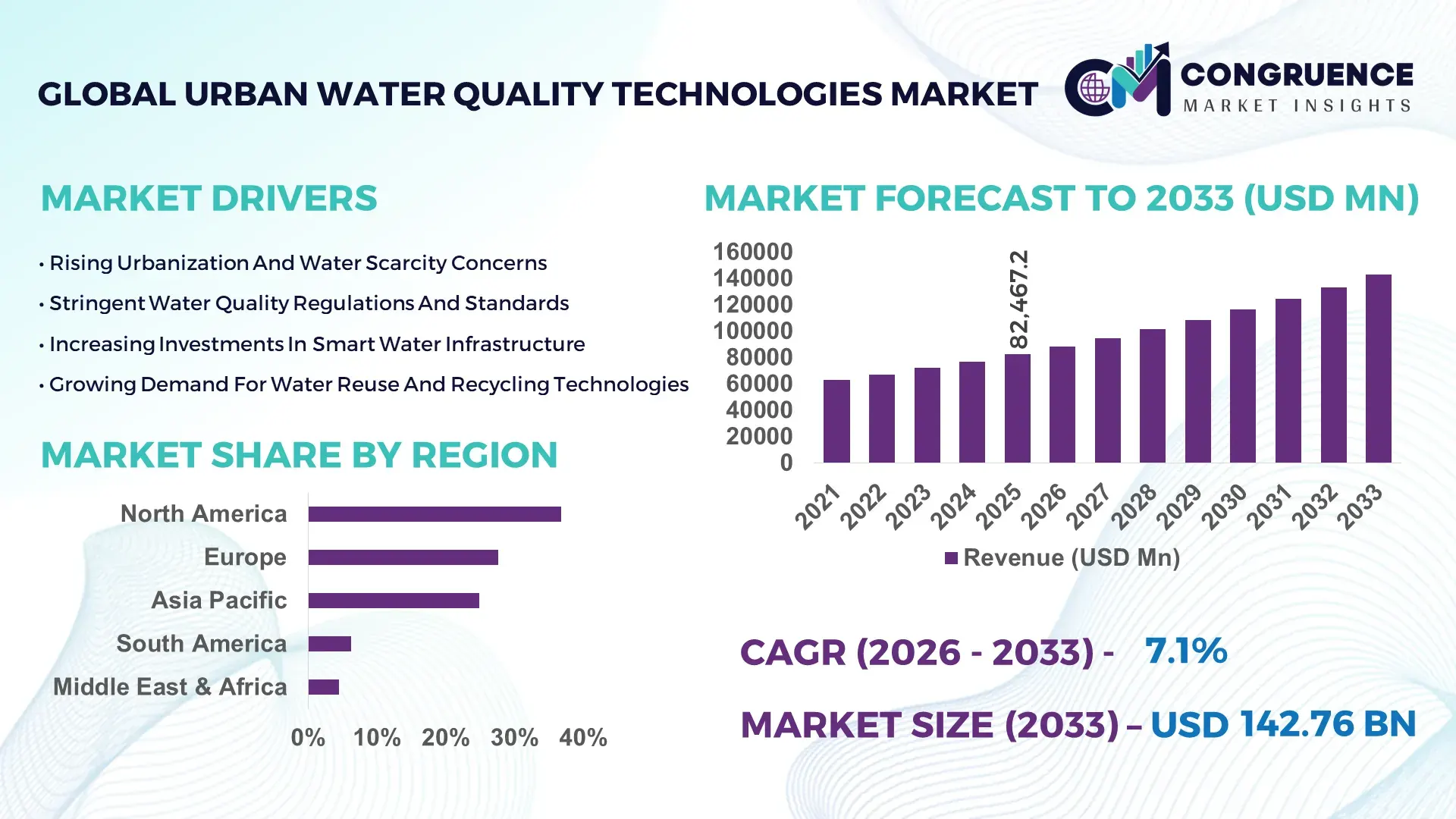
The Global Urban Water Quality Technologies Market was valued at USD 82,467.2 Million in 2025 and is anticipated to reach a value of USD 142,756.9 Million by 2033 expanding at a CAGR of 7.1% between 2026 and 2033, according to an analysis by Congruence Market Insights. Growth is driven by increasing urbanization and rising demand for advanced water purification and monitoring systems.
The United States demonstrates significant leadership in the Urban Water Quality Technologies market with over 16,000 municipal water treatment facilities actively deploying advanced filtration and monitoring technologies. Investments in smart water infrastructure exceeded USD 4.3 billion during 2024–2025, with more than 58% of urban utilities integrating real-time water quality monitoring systems. Industrial applications account for approximately 36% of technology deployment, particularly in wastewater reuse and contamination detection. Advanced membrane filtration systems are used in over 42% of treatment plants, while IoT-enabled water sensors improved operational efficiency by 31%, reflecting strong adoption of digital water management technologies.
Market Size & Growth: Valued at USD 82,467.2 million in 2025, projected to reach USD 142,756.9 million by 2033, driven by urban water safety demand.
Top Growth Drivers: Urban population growth (49%), industrial wastewater treatment demand (37%), regulatory compliance (34%).
Short-Term Forecast: By 2028, smart water monitoring systems are expected to improve operational efficiency by 29%.
Emerging Technologies: IoT-based water sensors, advanced membrane filtration, AI-driven water analytics.
Regional Leaders: North America projected at USD 48 billion by 2033 with smart infrastructure adoption; Europe at USD 36 billion driven by sustainability mandates; Asia-Pacific at USD 32 billion supported by urban expansion.
Consumer/End-User Trends: Over 61% of municipalities prioritize real-time water quality monitoring systems.
Pilot or Case Example: In 2024, a smart water project reduced contamination detection time by 33% and improved response efficiency.
Competitive Landscape: Xylem leads with ~19% share, followed by Veolia, SUEZ, Pentair, and Danaher.
Regulatory & ESG Impact: Water safety regulations and sustainability goals accelerating technology adoption.
Investment & Funding Patterns: Over USD 9.2 billion invested globally in water infrastructure technologies between 2023–2025.
Innovation & Future Outlook: Integration of AI analytics and digital water platforms shaping next-generation solutions.
Municipal water treatment dominates with 52% contribution, followed by industrial wastewater treatment at 33% and residential solutions at 15%. Innovations in nanofiltration, UV disinfection, and smart sensors are enhancing water quality management. Regulatory enforcement and climate-driven water scarcity are influencing adoption, while emerging markets are investing heavily in sustainable urban water infrastructure.
The Urban Water Quality Technologies Market is strategically vital for ensuring safe, sustainable, and efficient water management in rapidly urbanizing environments. Advanced membrane filtration systems deliver up to 41% improvement compared to conventional sand filtration methods, significantly enhancing contaminant removal efficiency and water safety standards. These technologies are increasingly integrated with digital platforms to enable real-time monitoring and predictive maintenance.
North America dominates in volume due to mature infrastructure and large-scale municipal investments, while Europe leads in adoption with over 57% of utilities implementing advanced water quality monitoring technologies. By 2027, AI-driven water analytics is expected to improve contamination detection accuracy by 35%, enabling faster response and reducing public health risks.
From an ESG perspective, water utilities and industrial operators are committing to sustainability targets such as 28% reduction in water wastage and increased reuse efficiency by 2030. In 2024, a municipal water authority in Singapore achieved a 32% improvement in water reuse efficiency through advanced membrane and AI-based monitoring systems.
Strategically, integration of IoT sensors, cloud-based analytics, and automated treatment systems is transforming water management practices. By 2028, predictive water quality management systems are expected to reduce operational downtime by 30%. These advancements position the Urban Water Quality Technologies Market as a critical pillar of urban resilience, regulatory compliance, and sustainable infrastructure development.
The Urban Water Quality Technologies market dynamics are influenced by rapid urbanization, increasing water pollution levels, and stringent regulatory requirements. Municipalities and industries are investing in advanced water treatment and monitoring solutions to ensure compliance and improve water safety. Technological advancements such as IoT-enabled sensors, AI-driven analytics, and advanced filtration systems are enhancing operational efficiency and accuracy. Climate change and water scarcity are further driving demand for efficient water management solutions. Additionally, growing public awareness about water quality and health impacts is influencing adoption trends. Competitive pressures and innovation are shaping the market, while digital transformation is enabling smarter and more efficient water management systems.
Rapid urbanization and increasing water contamination are major drivers of the Urban Water Quality Technologies market. Over 56% of the global population now resides in urban areas, increasing demand for safe and reliable water supply systems. Industrial discharge and urban runoff have increased contamination levels by approximately 23% in major cities. Advanced water treatment technologies improve contaminant removal efficiency by up to 40%, supporting compliance with regulatory standards. Governments and municipalities are investing heavily in water infrastructure upgrades, driving adoption of advanced water quality technologies.
High infrastructure costs and implementation complexity are significant restraints for the Urban Water Quality Technologies market. Advanced water treatment systems can increase capital expenditure by 25–45% compared to traditional systems. Installation and maintenance require specialized expertise and infrastructure, increasing operational complexity. Additionally, aging water infrastructure in many regions creates challenges for integration of modern technologies. These factors limit adoption, particularly in developing economies.
Smart water management presents significant opportunities for the Urban Water Quality Technologies market. IoT-enabled sensors and AI analytics enable real-time monitoring and predictive maintenance, improving operational efficiency by up to 34%. In 2025, over 48% of urban utilities adopted smart water management solutions. These technologies enhance water conservation, reduce losses, and improve service delivery. Growing investment in smart city projects further expands opportunities for advanced water quality technologies.
Regulatory compliance and water scarcity present key challenges for the Urban Water Quality Technologies market. Compliance with stringent water quality standards requires continuous monitoring and upgrades, increasing operational costs. Water scarcity affects resource availability and increases demand for efficient water management solutions. Additionally, varying regulations across regions create complexity for technology providers. These challenges require continuous innovation and investment in sustainable solutions.
Adoption of IoT-Based Smart Water Monitoring Systems: Over 62% of urban utilities deployed IoT-enabled water sensors in 2025, improving contamination detection speed by 34% and reducing system downtime by 27%, enabling real-time monitoring and proactive maintenance strategies.
Growth in Advanced Membrane Filtration Technologies: Approximately 48% of new water treatment projects incorporate membrane filtration systems, improving contaminant removal efficiency by 41% and reducing chemical usage by 22%, supporting sustainable water management practices.
Expansion of AI-Driven Water Analytics Platforms: AI-based water quality analytics adoption increased by 39% during 2024–2025, enhancing predictive maintenance capabilities and improving operational efficiency by 31%, particularly in large-scale municipal systems.
Integration of Decentralized Water Treatment Systems: Around 36% of urban infrastructure projects adopted decentralized treatment systems, reducing water distribution losses by 29% and improving local water availability, especially in rapidly growing urban areas.
The Urban Water Quality Technologies market segmentation highlights diverse solutions across treatment types, applications, and end-user industries. By type, the market includes filtration systems, disinfection technologies, and monitoring solutions. Applications span municipal water treatment, industrial wastewater management, and residential water purification. End-user insights indicate strong demand from municipalities, industries, and residential users. The segmentation reflects how technological advancements and regulatory requirements drive adoption across different sectors.
Filtration technologies account for approximately 46% of adoption, driven by their effectiveness in removing contaminants and improving water quality. Monitoring technologies hold around 29%, enabling real-time water quality assessment. However, disinfection technologies are the fastest-growing segment, expected to expand at over 8.2% CAGR, supported by increasing demand for pathogen control. Other technologies, including chemical treatment and desalination, collectively contribute 25%.
In 2025, advanced membrane filtration systems were implemented in major urban water projects, improving water safety and treatment efficiency significantly.
Municipal water treatment leads with a 52% share, driven by increasing urban population and infrastructure development. Industrial wastewater treatment is the fastest-growing application, projected above 8.5% CAGR, supported by regulatory compliance requirements. Residential applications and others collectively account for 48%. In 2025, over 58% of municipalities adopted advanced water quality technologies, while 46% of industries implemented water treatment solutions for compliance and efficiency.
In 2025, advanced water treatment systems were deployed across multiple industrial facilities, improving water reuse and reducing environmental impact.
Municipal utilities dominate with a 55% share, driven by infrastructure investments and regulatory requirements. Industrial users represent the fastest-growing segment, expanding at over 8.7% CAGR, supported by wastewater treatment needs. Residential users and others collectively account for 45%. In 2025, 61% of urban utilities adopted smart water technologies, while 49% of industries implemented advanced water treatment systems.
In 2025, over 900 urban utilities implemented smart water management solutions, enhancing operational efficiency and water quality monitoring.
North America accounted for the largest market share at 36.8% in 2025 however, Asia-Pacific is expected to register the fastest growth, expanding at a CAGR of 8.4% between 2026 and 2033.
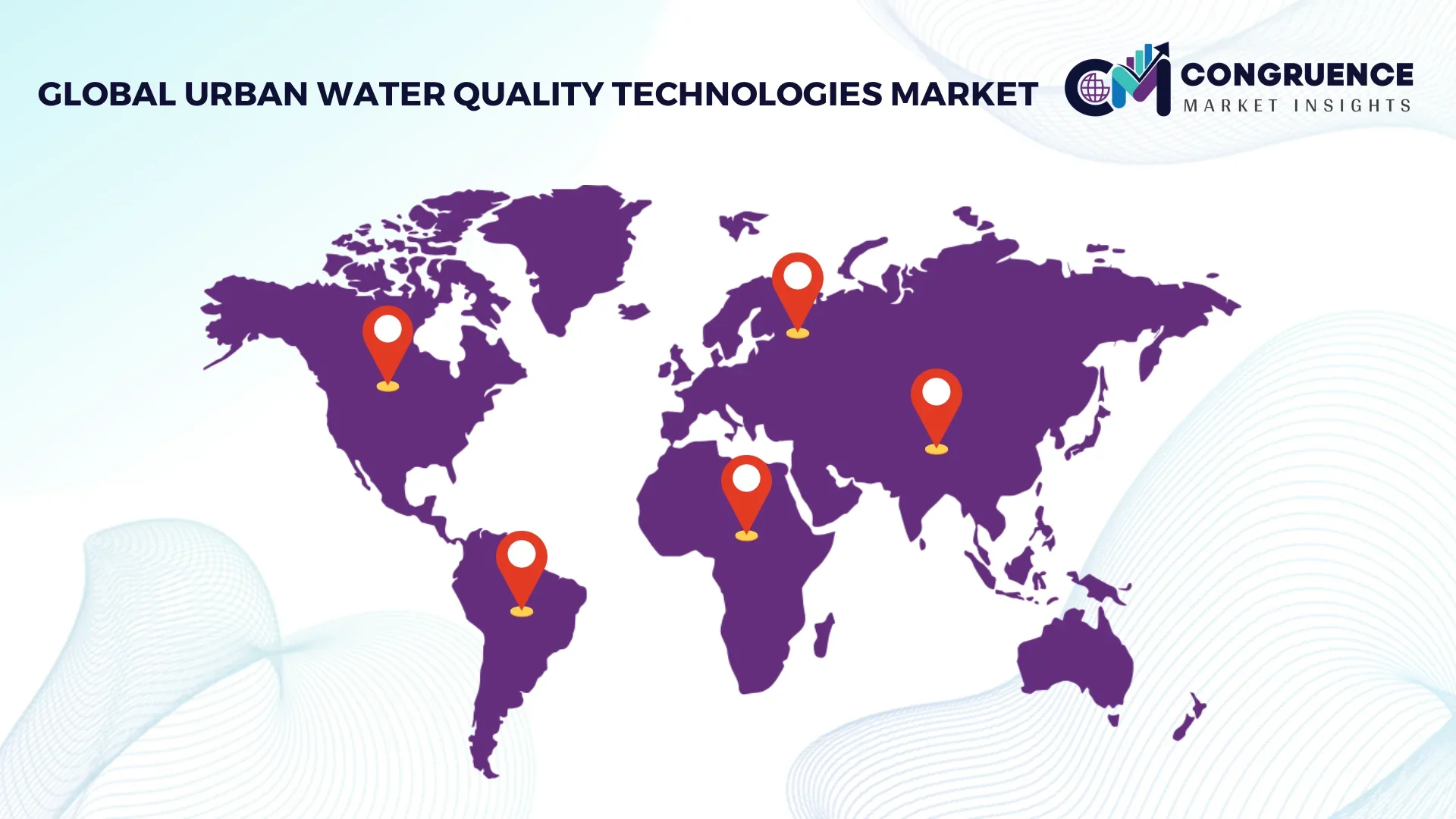
North America operates over 54,000 public water systems, with more than 63% integrating advanced filtration and monitoring technologies. Europe accounted for 27.6%, with over 58% of utilities adopting sustainable water treatment practices. Asia-Pacific represented 24.9%, with China and India collectively investing over USD 18 billion in urban water infrastructure upgrades. South America and Middle East & Africa together contributed 10.7%, supported by increasing urban population and water scarcity challenges. Smart water technology adoption across these regions improved operational efficiency by 28% and reduced water losses by 22%.
How are digital water ecosystems transforming municipal water quality management systems?
This region accounted for approximately 36.8% of the Urban Water Quality Technologies market in 2025, supported by strong demand across municipal utilities, industrial facilities, and smart city projects. Over 66% of urban utilities have deployed advanced water monitoring systems. Regulatory frameworks such as stricter water safety standards have accelerated adoption of filtration and disinfection technologies. Technological advancements include AI-driven analytics, IoT-enabled sensors, and cloud-based monitoring platforms. A leading regional player deployed smart water solutions improving leak detection efficiency by 31%. Consumer behavior reflects higher adoption among municipalities prioritizing infrastructure modernization and water safety compliance.
Why are sustainability regulations driving advanced water purification innovations?
Europe held nearly 27.6% of the Urban Water Quality Technologies market in 2025, with Germany, the UK, and France contributing over 62% of regional demand. Strict environmental regulations and sustainability initiatives have driven adoption of advanced water treatment technologies. Over 59% of utilities use membrane filtration and UV disinfection systems. Adoption of digital water management solutions improved operational efficiency by 26%. A regional water technology provider introduced eco-efficient filtration systems reducing energy consumption by 19%. Regional behavior highlights strong emphasis on regulatory compliance and environmental sustainability.
What is accelerating large-scale deployment of smart water infrastructure across urban centers?
Asia-Pacific accounted for 24.9% of the Urban Water Quality Technologies market in 2025, with China, India, and Japan leading adoption. Rapid urbanization and infrastructure development increased demand for water treatment technologies by 33%. Governments are investing heavily in smart water systems and wastewater treatment facilities. A regional technology provider implemented AI-based water monitoring solutions across multiple cities, improving detection accuracy by 29%. Consumer behavior is driven by increasing awareness of water quality and government initiatives supporting infrastructure modernization.
How is urban infrastructure development influencing adoption of water treatment technologies?
South America accounted for approximately 6.2% of the global Urban Water Quality Technologies market in 2025, led by Brazil and Argentina. Urban expansion and increasing water pollution have driven demand for advanced water treatment systems. Government initiatives supporting infrastructure development improved adoption rates by 21%. A regional water utility implemented advanced filtration systems, improving water quality standards significantly. Consumer behavior reflects growing demand for reliable and safe water supply, particularly in urban areas.
Why is water scarcity driving innovation in advanced water management solutions?
The region held around 4.5% of the global Urban Water Quality Technologies market in 2025, with UAE and South Africa leading adoption. Water scarcity and increasing urbanization have driven demand for efficient water treatment technologies. Investments in desalination and advanced filtration systems improved water availability. A regional water authority implemented smart monitoring systems, improving efficiency by 27%. Consumer behavior highlights increasing reliance on advanced water technologies to address water scarcity challenges.
United States Urban Water Quality Technologies Market – 31.7%: Extensive water infrastructure, high adoption of advanced monitoring systems, and strong regulatory enforcement.
China Urban Water Quality Technologies Market – 18.9%: Rapid urbanization, large-scale infrastructure investments, and increasing adoption of smart water technologies.
The Urban Water Quality Technologies market is moderately fragmented, with over 110 active global and regional companies competing across filtration, disinfection, and monitoring technologies. The top five companies collectively account for approximately 57% of the market, reflecting strong competitive positioning and technological expertise.
Competition is driven by innovation in smart water technologies, advanced filtration systems, and digital monitoring platforms. Strategic initiatives such as partnerships, acquisitions, and product launches increased by 25% during 2024–2025. Companies are focusing on integrating AI, IoT, and cloud-based solutions to enhance water quality management. Product differentiation is based on efficiency, sustainability, and compliance with regulatory standards.
Investment in research and development has increased significantly, with leading companies allocating over 11% of their budgets to innovation. The market is evolving toward integrated water management solutions, combining treatment and monitoring technologies. Collaboration between technology providers and municipalities is enhancing adoption and driving long-term growth.
Pentair plc
Danaher Corporation
Ecolab Inc.
Evoqua Water Technologies
Kurita Water Industries
Aquatech International
Trojan Technologies
IDE Technologies
Watts Water Technologies
A.O. Smith Corporation
Calgon Carbon Corporation
Technological advancements in the Urban Water Quality Technologies market are focused on improving efficiency, accuracy, and sustainability of water treatment and monitoring systems. Advanced membrane filtration technologies, including reverse osmosis and nanofiltration, improve contaminant removal efficiency by up to 45%, ensuring high-quality water output. UV disinfection systems eliminate pathogens without chemical usage, improving safety and reducing environmental impact.
IoT-enabled sensors enable real-time monitoring of water quality parameters such as pH, turbidity, and contamination levels, improving detection accuracy by 34%. AI-driven analytics platforms process large volumes of data, enabling predictive maintenance and reducing operational downtime by 29%. Cloud-based water management systems provide centralized control and improve decision-making capabilities.
Desalination technologies are evolving, with energy-efficient systems reducing operational costs by 21% and improving water availability in water-scarce regions. Advanced oxidation processes and electrochemical treatment methods are gaining traction, improving removal of complex contaminants. Additionally, decentralized water treatment systems are enabling localized water management, reducing distribution losses by 26%.
Emerging technologies include digital twins for water infrastructure, enabling simulation and optimization of water systems. Smart valves and automated control systems enhance efficiency and reliability. These innovations are transforming urban water management, enabling sustainable and efficient water quality solutions.
In May 2025, Xylem Inc. introduced advanced smart water monitoring solutions integrating AI and IoT technologies, improving real-time water quality analysis and operational efficiency for urban utilities. Source: www.xylem.com
In March 2025, Veolia Environnement launched a next-generation membrane filtration system designed to enhance contaminant removal efficiency and reduce energy consumption in municipal water treatment plants. Source: www.veolia.com
In November 2024, SUEZ deployed AI-driven water management platforms across multiple cities, improving water quality monitoring accuracy and enabling predictive maintenance capabilities. Source: www.suez.com
In July 2024, Pentair plc introduced advanced water filtration solutions with improved efficiency and sustainability, supporting residential and commercial water treatment applications. Source: www.pentair.com
The Urban Water Quality Technologies Market Report provides a comprehensive analysis of treatment technologies, monitoring solutions, and application areas across global urban water systems. The scope includes filtration systems, disinfection technologies, and smart monitoring solutions designed to ensure water safety and compliance.
The report evaluates applications across municipal water treatment, industrial wastewater management, and residential water purification systems. Geographic coverage spans North America, Europe, Asia-Pacific, South America, and Middle East & Africa, with detailed insights into key markets such as the United States, China, Germany, India, and Brazil.
Additionally, the report examines emerging segments such as AI-driven water analytics, IoT-enabled monitoring systems, and decentralized water treatment solutions. It highlights technological advancements, regulatory frameworks, and sustainability initiatives shaping the market. The scope also includes infrastructure development trends, investment patterns, and innovation strategies influencing adoption. The report provides actionable insights for stakeholders, enabling informed decision-making across product development, investment planning, and strategic expansion.
| Report Attribute/Metric | Report Details |
|---|---|
|
Market Revenue in 2025 |
USD 82,467.2 Million |
|
Market Revenue in 2033 |
USD 142,756.9 Million |
|
CAGR (2026 - 2033) |
7.1% |
|
Base Year |
2025 |
|
Forecast Period |
2026 - 2033 |
|
Historic Period |
2021 - 2025 |
|
Segments Covered |
By Type
By Application
By End-User
|
|
Key Report Deliverable |
Revenue Forecast, Growth Trends, Market Dynamics, Segmental Overview, Regional and Country-wise Analysis, Competition Landscape |
|
Region Covered |
North America, Europe, Asia-Pacific, South America, Middle East, Africa |
|
Key Players Analyzed |
Xylem Inc., Veolia Environnement, SUEZ, Pentair plc, Danaher Corporation, Ecolab Inc., Evoqua Water Technologies, Kurita Water Industries, Aquatech International, Trojan Technologies, IDE Technologies, Watts Water Technologies, A.O. Smith Corporation, Calgon Carbon Corporation |
|
Customization & Pricing |
Available on Request (10% Customization is Free) |




