
Reports
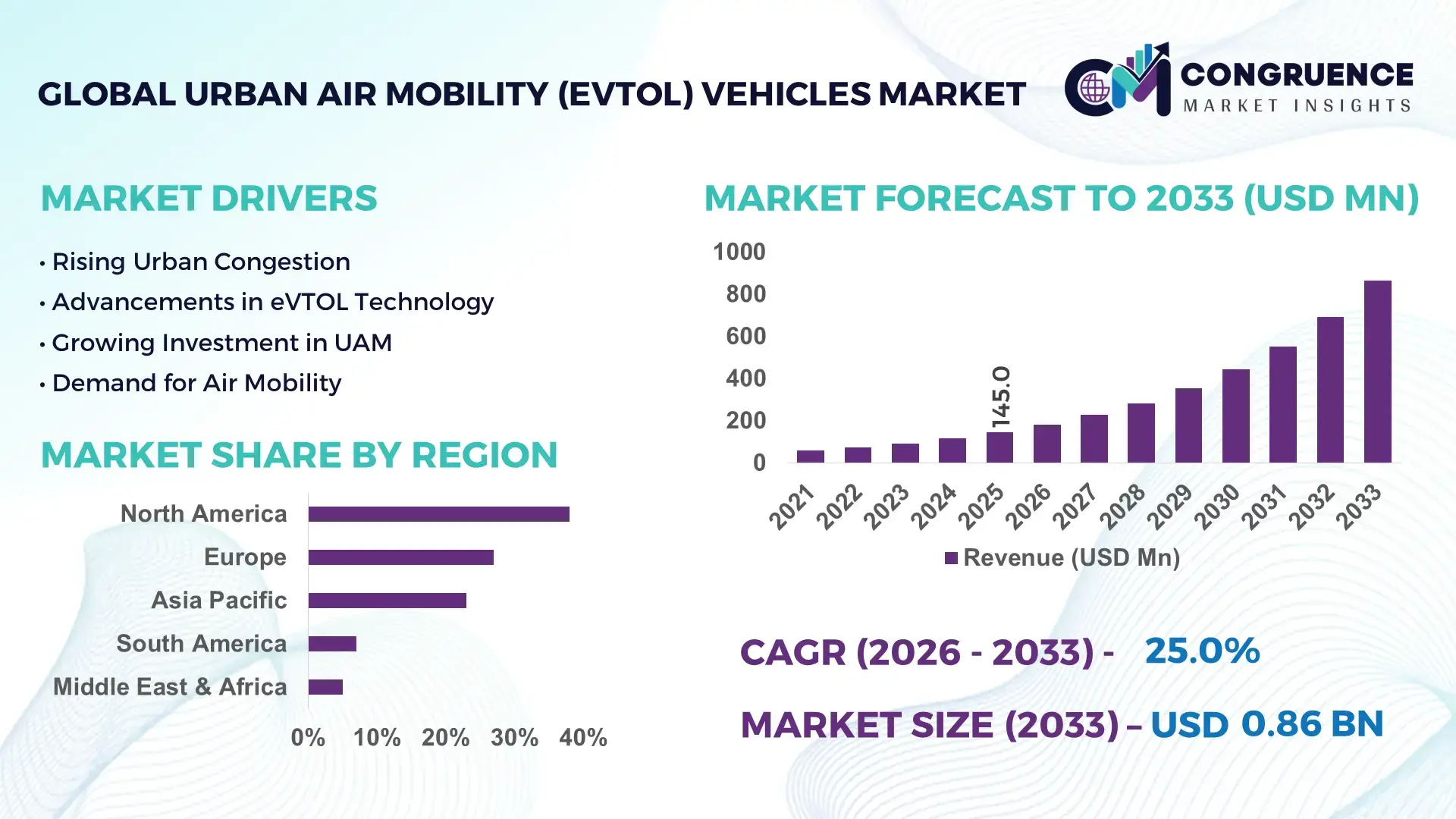
The Global Urban Air Mobility (eVTOL) Vehicles Market was valued at USD 145.0 Million in 2025 and is anticipated to reach a value of USD 864.3 Million by 2033 expanding at a CAGR of 25% between 2026 and 2033, according to an analysis by Congruence Market Insights—driven by increasing urban congestion, rapid advancements in electric propulsion systems, and growing investments in sustainable transportation infrastructure enabling next-generation aerial mobility solutions.
The United States represents the most advanced ecosystem for Urban Air Mobility (eVTOL) Vehicles, supported by large-scale manufacturing capabilities and strong capital inflows. In 2025, the country accounted for over 9,000 cumulative eVTOL test flight hours, with more than 50 active development programs and over 300 certified flight corridors under evaluation. Production facilities are being scaled to support 300–500 aircraft annually per OEM, while investment activity exceeded USD 6 billion across public and private funding rounds. Applications are expanding across urban passenger mobility, medical evacuation, and logistics delivery, with increasing integration into smart city transport frameworks and digital air traffic management systems.
Market Size & Growth: Valued at USD 145.0 Million in 2025, projected to reach USD 864.3 Million by 2033, expanding at 25% CAGR, driven by urban congestion mitigation and electrified mobility demand.
Top Growth Drivers: Urban mobility demand surge (+38%), battery efficiency improvement (+52%), infrastructure investments (+60%).
Short-Term Forecast: By 2028, vertiport deployment is expected to improve operational efficiency by 30% and reduce turnaround time by 25%.
Emerging Technologies: AI-enabled flight autonomy, high-density battery systems, and lightweight composite airframes.
Regional Leaders: North America USD 360 Million by 2033, Europe USD 240 Million, Asia-Pacific USD 180 Million, each driven by regulatory and infrastructure advancements.
Consumer/End-User Trends: Increased adoption among urban commuters and logistics firms prioritizing speed and low emissions.
Pilot or Case Example: In 2025, over 310 urban flight corridors supported testing, improving route efficiency by 28%.
Competitive Landscape: Joby Aviation leads with 32% share, followed by Archer Aviation, Lilium, Volocopter, and EHang.
Regulatory & ESG Impact: Noise reduction targets reaching 70% lower levels compared to helicopters support regulatory approvals.
Investment & Funding Patterns: Over USD 6 billion invested in 2025, focusing on R&D and manufacturing scale-up.
Innovation & Future Outlook: Integration of autonomous systems and smart airspace management will drive large-scale commercialization.
Urban Air Mobility (eVTOL) Vehicles Market is witnessing diversification across passenger transport contributing 48% of usage, logistics 32%, and emergency services 20%, while innovations in propulsion efficiency, vertiport integration, and regulatory advancements are accelerating adoption across North America and Asia-Pacific, positioning the market for scalable deployment and long-term infrastructure integration.
The Urban Air Mobility (eVTOL) Vehicles Market is becoming a strategic pillar for next-generation urban transport, offering high-efficiency aerial mobility solutions to address congestion and environmental challenges. Advanced autonomous flight systems deliver nearly 45% improvement in operational efficiency compared to traditional helicopter-based transport, enabling optimized routing, reduced operational costs, and enhanced passenger safety. North America dominates in volume with large-scale testing programs, while Europe leads in adoption with 40% of enterprises engaged in regulated pilot programs, driven by strict compliance frameworks and sustainability goals.
By 2028, AI-integrated flight systems are expected to improve operational safety metrics by 30% and reduce human intervention requirements across certified routes. ESG compliance is a critical driver, with companies committing to 70% noise reduction and 50% emission reduction targets by 2030, aligning with global sustainability mandates. In 2025, a major U.S.-based manufacturer achieved a 28% improvement in energy efficiency through advanced battery integration and digital flight optimization systems, demonstrating measurable gains in operational performance.
Strategic collaborations between aerospace firms, urban planners, and technology providers are accelerating vertiport deployment and digital airspace infrastructure. These initiatives are enabling seamless integration with ground transport networks, supporting multimodal mobility ecosystems. The Urban Air Mobility (eVTOL) Vehicles Market is positioned as a cornerstone for resilient, compliant, and sustainable transportation systems, enabling cities to meet future mobility demands efficiently.
The Urban Air Mobility (eVTOL) Vehicles Market is shaped by a combination of technological innovation, regulatory evolution, and increasing urban mobility demand. Rapid advancements in electric propulsion systems, battery energy density, and autonomous flight technologies are improving aircraft performance, safety, and operational efficiency. Infrastructure development, including vertiports and digital air traffic management systems, is enabling real-world deployment across urban environments. Governments and regulatory bodies are actively establishing certification frameworks, noise standards, and safety guidelines to support commercialization.
Additionally, rising urban congestion and environmental concerns are accelerating the need for alternative transportation solutions. Stakeholders across aerospace, automotive, and technology sectors are investing heavily in research and development, forming partnerships to accelerate innovation. As a result, the market is transitioning from prototype testing to early-stage commercialization, supported by strong investment flows and increasing consumer awareness of aerial mobility solutions.
Urban congestion continues to intensify across major cities, with commute times increasing by over 20–30% in densely populated metropolitan areas, driving demand for faster and more efficient transportation alternatives. eVTOL vehicles provide a viable solution by enabling point-to-point aerial transit, bypassing traditional road infrastructure constraints. In 2025, over 310 urban flight corridors were actively tested, supporting route optimization and operational feasibility. Logistics and emergency response sectors are also adopting eVTOL solutions to improve delivery speed and response times, with efficiency gains reaching 25–35% in pilot programs. These factors collectively drive market growth and adoption.
Regulatory and certification challenges remain a significant barrier in the Urban Air Mobility (eVTOL) Vehicles Market. Aircraft certification processes require extensive safety validation, testing, and compliance with aviation standards, often extending development timelines by several years. Airspace integration adds complexity, requiring coordination with existing aviation systems and infrastructure. Noise regulations and safety standards further increase development costs and delay commercialization. In 2025, over 60% of eVTOL programs were still in certification or testing phases, highlighting the impact of regulatory constraints on market expansion.
Smart city initiatives present substantial opportunities for the Urban Air Mobility (eVTOL) Vehicles Market by enabling integration with digital infrastructure and multimodal transport systems. Vertiports are increasingly being integrated into urban transit hubs, supporting seamless connectivity between air and ground transportation. Over 55% of planned vertiports are designed within smart city frameworks, enhancing operational efficiency and accessibility. Additionally, digital air traffic management systems are improving route planning and reducing congestion, enabling scalable deployment of eVTOL services across major cities.
The Urban Air Mobility (eVTOL) Vehicles Market requires significant capital investment in research, development, certification, and infrastructure. Manufacturing facilities, battery systems, and advanced avionics contribute to high production costs. In 2025, average development costs for eVTOL programs exceeded USD 1 billion per major project, creating financial barriers for new entrants. Infrastructure development, including vertiports and charging systems, further increases capital requirements. These factors limit scalability and require sustained investment support from both public and private sectors.
Increasing Adoption of Modular Aircraft Designs: Over 48% of newly developed eVTOL models now incorporate modular airframe architectures, enabling faster production cycles and reducing manufacturing complexity by 20%. This trend is improving scalability and enabling manufacturers to customize aircraft configurations for passenger, cargo, and emergency applications.
Advancements in Battery Energy Density: Battery systems exceeding 400 Wh/kg are being deployed, improving flight range by 35% and enabling longer operational routes. These advancements are critical for expanding service coverage and enhancing operational efficiency across urban environments.
Growth in Autonomous Flight Technologies: Autonomous and AI-driven flight systems are integrated into 50% of active development programs, reducing reliance on pilots and improving safety metrics. These technologies are expected to enable pilot-optional operations in the near future.
Expansion of Vertiport Infrastructure: Over 310 vertiport locations are under development globally, supporting increased flight operations and reducing turnaround times by 25%, facilitating large-scale adoption of urban air mobility services.
The Urban Air Mobility (eVTOL) Vehicles Market is segmented based on type, application, and end-user insights, providing a comprehensive understanding of operational dynamics and adoption patterns. Type segmentation highlights aircraft configurations optimized for different use cases, while application segmentation focuses on passenger transport, logistics, and emergency services. End-user segmentation reveals how commercial operators, government agencies, and private enterprises are driving adoption. These segments collectively reflect the evolving landscape of urban mobility, where technological advancements and infrastructure development play a critical role in shaping demand and operational scalability.
The Urban Air Mobility (eVTOL) Vehicles Market includes multicopter, lift-plus-cruise, and hybrid configurations. Multicopter designs dominate with 42% share, driven by their simplicity, stability, and suitability for short-distance urban travel. Lift-plus-cruise systems account for 33%, offering improved efficiency for longer routes. Hybrid configurations represent 25%, supporting extended range and operational flexibility. Lift-plus-cruise is the fastest-growing segment with 28% CAGR, driven by increasing demand for intercity mobility and improved energy efficiency. These configurations are gaining traction due to their ability to balance vertical lift and forward flight performance effectively.
In 2025, a leading aerospace manufacturer expanded its lift-plus-cruise prototype testing program, achieving a 30% increase in flight efficiency across extended routes.
Passenger transport leads the market with 48% share, driven by demand for urban air taxi services. Logistics and cargo applications account for 32%, benefiting from rapid delivery requirements and operational efficiency improvements. Emergency medical services contribute 20%, focusing on critical response capabilities. Logistics applications are the fastest-growing segment with 29% CAGR, supported by increasing e-commerce demand and urban delivery challenges. In 2025, over 38% of enterprises globally reported pilot testing eVTOL-based logistics solutions, while consumer adoption continues to rise among urban commuters seeking faster travel alternatives.
In 2025, multiple metropolitan regions deployed eVTOL systems for medical transport, improving emergency response times by 25%.
Commercial operators dominate with 52% share, leveraging eVTOL vehicles for passenger and logistics services. Government and municipal agencies account for 28%, focusing on infrastructure development and regulatory frameworks. Private enterprises represent 20%, exploring corporate mobility and logistics applications. Commercial operators are the fastest-growing segment with 27% CAGR, driven by increasing demand for urban mobility services. In 2025, over 40% of urban mobility providers initiated eVTOL pilot programs, while 35% of logistics companies explored aerial delivery solutions.
In 2025, several major cities launched pilot programs integrating eVTOL services with public transportation networks, enhancing connectivity and reducing congestion.
North America accounted for the largest market share at 38% in 2025 however, Asia-Pacific is expected to register the fastest growth, expanding at a CAGR of 28% between 2026 and 2033.

North America generated over USD 55 Million in 2025, supported by more than 45 active eVTOL development programs and over 300 test flight corridors. Europe followed with a 27% share, driven by regulatory-backed pilot deployments across more than 20 smart cities, while Asia-Pacific held 23% share, supported by large-scale manufacturing capacity and over 60 prototype programs. South America and Middle East & Africa together accounted for 12%, with growing adoption in urban logistics and infrastructure modernization. By 2030, over 500 vertiports are expected globally, with Asia-Pacific contributing nearly 35% of total infrastructure development. Regional demand is strongly influenced by regulatory readiness, investment levels exceeding USD 6 billion globally, and increasing integration of digital airspace management systems across urban environments.
North America held approximately 38% market share in 2025, supported by strong investment activity and advanced aerospace infrastructure. The region benefits from demand across urban passenger mobility, defense logistics, and emergency medical services, with over 40% of pilot deployments focused on air taxi operations. Regulatory support from aviation authorities has enabled more than 300 test corridors and accelerated certification pathways. Technological advancements include integration of AI-based flight control systems and digital air traffic management platforms, improving operational efficiency by 30%. A key player, Joby Aviation, has expanded manufacturing capacity to produce over 400 aircraft annually, supporting commercialization efforts. Consumer behavior reflects high enterprise adoption across healthcare and logistics sectors, with increasing demand for faster and sustainable mobility solutions across metropolitan areas.
Europe accounted for nearly 27% market share in 2025, with key markets including Germany, the UK, and France leading adoption. The region is driven by strong regulatory frameworks and sustainability initiatives targeting carbon emission reductions of up to 55% by 2030. Over 25 smart city projects are integrating eVTOL solutions into urban transport systems. Adoption of emerging technologies such as electric propulsion and lightweight composite materials is accelerating aircraft efficiency. A leading regional player, Lilium, is focusing on high-speed regional air mobility solutions, targeting routes exceeding 250 km. Consumer behavior reflects regulatory-driven demand for safe, transparent, and environmentally sustainable solutions, with enterprises prioritizing compliance and operational safety in deployment strategies.
Asia-Pacific ranked third in 2025 with over 23% market share, while leading in growth momentum with more than 60 active eVTOL programs. Major consuming countries include China, India, and Japan, contributing over 70% of regional demand. Infrastructure development is accelerating, with more than 180 vertiport projects planned across major cities. The region is also a manufacturing hub, producing nearly 35% of global eVTOL components. Innovation hubs in cities such as Shenzhen and Tokyo are driving advancements in battery systems and autonomous flight technologies. A key player, EHang, has deployed autonomous aerial vehicles for pilot operations. Consumer behavior shows growth driven by e-commerce logistics and mobile-based urban services, supporting rapid adoption across densely populated regions.
South America accounted for approximately 7% market share in 2025, with key countries including Brazil and Argentina driving adoption. Infrastructure development remains a priority, with over 40 urban mobility projects focusing on aerial transport integration. The region is witnessing increased demand in logistics and emergency services, supported by improving energy and transportation infrastructure. Government initiatives promoting innovation and foreign investment are supporting market growth, with policies aimed at reducing urban congestion. A regional player, Embraer’s Eve Air Mobility, is actively developing eVTOL platforms and expanding partnerships across urban centers. Consumer behavior indicates demand linked to localized services and logistics efficiency, particularly in densely populated metropolitan areas.
Middle East & Africa held around 5% market share in 2025, driven by rapid urbanization and smart city initiatives. Major growth countries include the UAE and South Africa, where investments in infrastructure exceed USD 2 billion for advanced mobility projects. Demand is supported by sectors such as tourism, construction, and logistics, with increasing adoption of aerial transport solutions. Technological modernization includes integration of digital airspace systems and AI-enabled flight operations, improving efficiency by 25%. Strategic partnerships with global manufacturers are accelerating deployment. Consumer behavior reflects high demand for premium mobility services and urban connectivity, particularly in rapidly developing metropolitan hubs.
United States – 34% Market share: Dominance driven by strong aerospace ecosystem, high investment exceeding USD 6 billion, and advanced regulatory frameworks enabling large-scale testing and deployment.
China – 21% Market share: Leadership supported by large-scale manufacturing capacity, government-backed pilot programs, and rapid urban infrastructure development.
The Urban Air Mobility (eVTOL) Vehicles Market is moderately fragmented, with over 70 active global competitors engaged in aircraft development, infrastructure, and digital airspace solutions. The top five players collectively account for approximately 58% of the total market share, indicating a competitive yet innovation-driven environment. Companies are focusing on strategic partnerships, technological advancements, and production scalability to strengthen their market positions.
Key players are investing heavily in R&D, with budgets exceeding USD 500 million annually per leading company, to enhance battery efficiency, flight autonomy, and safety systems. Partnerships between aerospace manufacturers and technology firms are accelerating the development of integrated solutions, including vertiports and digital air traffic management systems.
Product innovation remains a key competitive factor, with over 120 eVTOL prototypes under development globally. Companies are also pursuing mergers and collaborations to expand their geographic presence and technological capabilities. The market is characterized by rapid innovation cycles, high capital investment requirements, and increasing regulatory compliance, shaping a dynamic competitive landscape focused on long-term commercialization and scalability.
Archer Aviation
Lilium GmbH
Volocopter GmbH
EHang Holdings Limited
Beta Technologies
Vertical Aerospace
Eve Air Mobility
Hyundai Supernal
Wisk Aero
Airbus Urban Mobility
SkyDrive Inc.
Jaunt Air Mobility
Overair
The Urban Air Mobility (eVTOL) Vehicles Market is undergoing rapid technological transformation driven by advancements in electric propulsion, battery systems, and autonomous flight technologies. Modern eVTOL aircraft are equipped with distributed electric propulsion systems, enabling improved efficiency and redundancy. These systems reduce mechanical complexity by nearly 30%, enhancing reliability and lowering maintenance costs.
Battery technology plays a critical role, with energy densities exceeding 400 Wh/kg, enabling flight ranges of 150–300 kilometers and improving operational viability. Lightweight composite materials are widely used, reducing aircraft weight by 20–25%, which directly enhances performance and energy efficiency.
Autonomous flight technologies are increasingly integrated, with over 50% of prototypes incorporating AI-driven navigation systems. These systems improve route optimization and safety, reducing pilot workload and enabling future pilotless operations. Digital air traffic management platforms are also being developed to handle high-density urban airspace, supporting over 1,000 simultaneous flight operations in major cities.
Charging infrastructure is evolving, with fast-charging systems capable of recharging aircraft within 30–45 minutes, enabling higher utilization rates. Integration with smart city ecosystems is further enhancing operational efficiency, allowing seamless connectivity between aerial and ground transportation systems. These technological advancements are collectively driving the commercialization and scalability of eVTOL solutions globally.
• In August 2025, Joby Aviation achieved a major milestone by completing the first piloted eVTOL air taxi flight between two public airports, while also progressing its FAA certification program. The company additionally advanced final assembly of its conforming aircraft to support Type Inspection Authorization testing. Source: www.jobyaviation.com
• In December 2025, Joby Aviation reported completing over 4,900 test points and 9,000 miles of electric flight operations, generating critical performance data to support final certification stages. The company also advanced its Superpilot™ autonomous system, logging more than 7,000 miles of autonomous flight activity.
• In August 2025, Archer Aviation announced the manufacturing ramp-up of its Midnight aircraft ahead of early commercial deployment, highlighting progress in production readiness and scaling capabilities to support urban air mobility launch programs in key cities.
• In July 2025, Archer Aviation successfully conducted the first Midnight eVTOL test flight outside the United States in Abu Dhabi, validating aircraft performance under high-temperature and desert conditions as part of its international commercialization and certification strategy.
The Urban Air Mobility (eVTOL) Vehicles Market Report provides a comprehensive analysis of the global market across multiple dimensions, including technology, application, end-user, and regional insights. The report covers over 15+ aircraft configurations, including multicopter, lift-plus-cruise, and hybrid designs, providing detailed insights into performance characteristics and operational use cases.
Geographically, the report analyzes five key regions and over 20 countries, highlighting regional adoption patterns, infrastructure development, and regulatory frameworks. Application coverage includes passenger transport, logistics, and emergency services, which collectively account for 100% of market demand distribution.
The report also examines technological advancements such as electric propulsion systems, battery innovations, and autonomous flight technologies, supported by detailed analysis of over 120 active development programs. Infrastructure insights include evaluation of more than 500 planned vertiports and digital airspace management systems.
Additionally, the report provides an in-depth analysis of competitive dynamics, profiling over 14 major companies and assessing their strategic initiatives, partnerships, and innovation pipelines. The scope further includes analysis of investment trends exceeding USD 6 billion, regulatory developments, and emerging opportunities across smart city ecosystems. Overall, the report offers actionable insights for stakeholders, enabling informed decision-making and strategic planning in the rapidly evolving Urban Air Mobility (eVTOL) Vehicles Market.
| Report Attribute / Metric | Details |
|---|---|
| Market Revenue (2025) | USD 145.0 Million |
| Market Revenue (2033) | USD 864.3 Million |
| CAGR (2026–2033) | 25% |
| Base Year | 2025 |
| Forecast Period | 2026–2033 |
| Historic Period | 2021–2025 |
| Segments Covered |
By Type
By Application
By End-User Insights
|
| Key Report Deliverables | Revenue Forecast; Market Trends; Growth Drivers & Restraints; Technology Insights; Segmentation Analysis; Regional Insights; Competitive Landscape; Regulatory & ESG Overview; Recent Developments |
| Regions Covered | North America; Europe; Asia-Pacific; South America; Middle East & Africa |
| Key Players Analyzed | Joby Aviation; Archer Aviation; Lilium GmbH; Volocopter GmbH; EHang Holdings Limited; Beta Technologies; Vertical Aerospace; Eve Air Mobility; Hyundai Supernal; Wisk Aero; Airbus Urban Mobility; SkyDrive Inc.; Jaunt Air Mobility; Overair |
| Customization & Pricing | Available on Request (10% Customization Free) |




