
Reports
The Global Unsalted Tomato Sauce Market was valued at USD 530.5 Million in 2025 and is anticipated to reach a value of USD 884.6 Million by 2033 expanding at a CAGR of 6.6% between 2026 and 2033. Rising adoption of low-sodium diets, stricter food labeling regulations, and expanding clean-label processed food manufacturing are accelerating demand for unsalted tomato sauce across retail and foodservice channels.
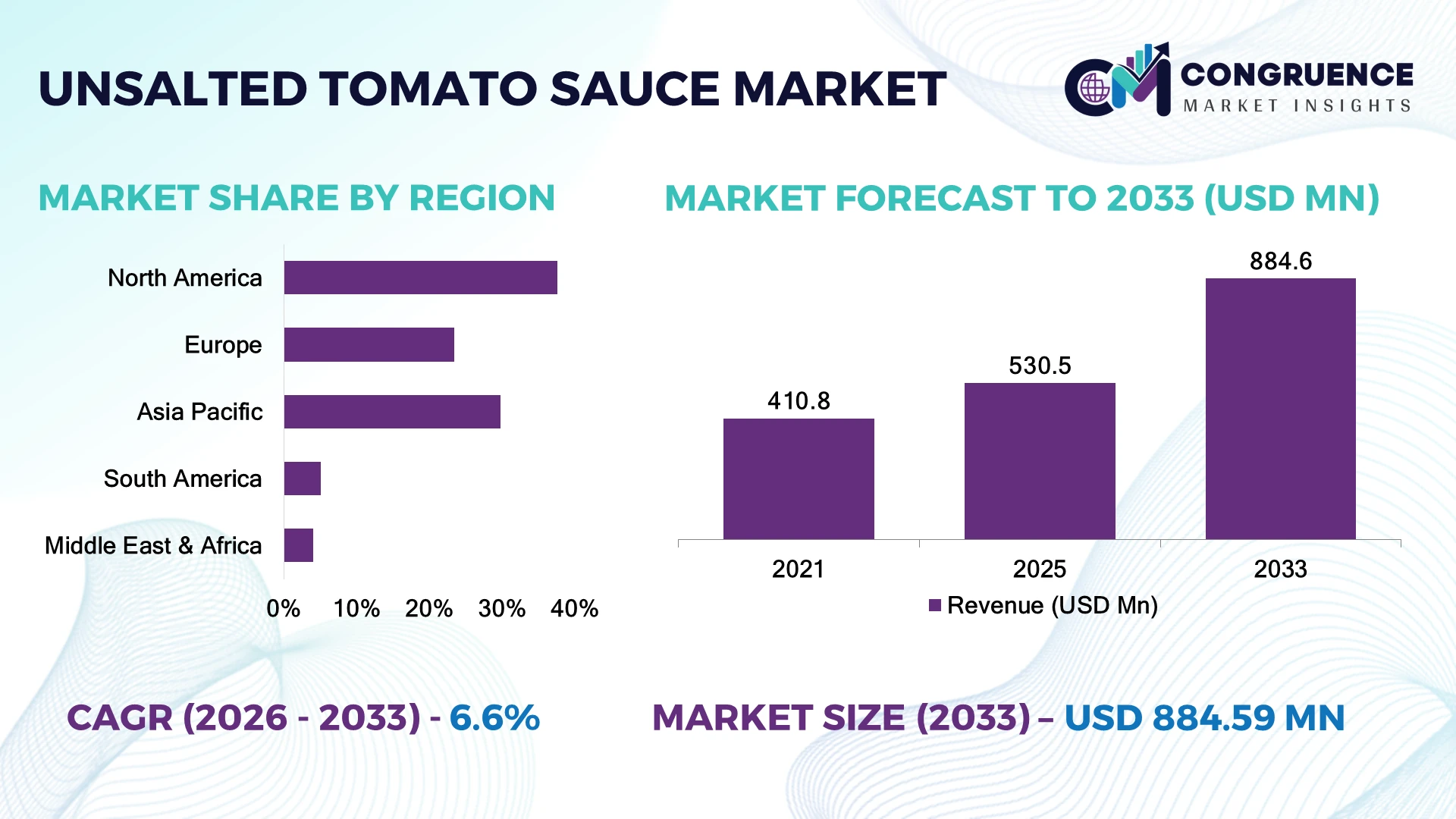
The United States leads the market with approximately 31% global consumption share, supported by advanced food processing infrastructure, widespread clean-label adoption, and strong retail penetration of reduced-sodium products. More than 58% of newly launched premium pasta sauce variants now include low-sodium or no-added-salt positioning, compared with nearly 42% in Italy, where traditional formulations remain dominant. Continued geopolitical disruptions affecting Mediterranean tomato exports have further encouraged diversified sourcing and domestic processing investments. This strengthens long-term opportunities for manufacturers focused on premium health-oriented formulations, resilient supply chains, and value-added product differentiation.
Market Size & Growth: USD 530.5 Million in 2025 to USD 884.6 Million by 2033 at 6.6% CAGR, supported by clean-label food innovation.
Top Growth Drivers: Low-sodium diets (+34%), clean-label demand (+29%), premium convenience foods (+26%).
Short-Term Forecast: By 2028, automated processing is expected to reduce production waste by 14%.
Emerging Technologies: AI quality inspection, aseptic packaging, and enzyme-assisted processing improve product consistency.
Regional Leaders: North America, Europe, and Asia-Pacific lead adoption through retail expansion and healthier packaged foods.
Consumer Trends: Nearly 47% of health-conscious shoppers actively prefer reduced-sodium packaged foods.
Pilot Case Example: A 2026 processing upgrade improved filling efficiency by 16% while reducing ingredient losses.
Competitive Landscape: Top suppliers collectively control about 41% share through premium formulations and retail partnerships.
Regulatory & ESG Impact: Sodium-reduction initiatives increased compliant product launches by approximately 22%.
Investment & Funding: More than USD 420 Million supports processing modernization and sustainable packaging projects.
Innovation & Future Outlook: Functional ingredients, recyclable packaging, and precision manufacturing strengthen premium product positioning.
The Unsalted Tomato Sauce Market is expanding across retail, foodservice, and private-label channels through clean-label formulations, high-pressure processing, and recyclable packaging innovations. Approximately 39% of premium launches now emphasize reduced-sodium nutrition alongside organic ingredients. Ongoing agricultural diversification and resilient tomato sourcing strategies are strengthening production continuity while supporting the industry's next phase of strategic market evolution.
The unsalted tomato sauce market has become strategically important as food manufacturers respond to tightening nutritional regulations, retailer clean-label standards, and changing consumer preferences for healthier packaged foods. Sodium reduction has shifted from product reformulation to a competitive differentiator, prompting investments in ingredient optimization, advanced processing, and premium branding. Companies capable of balancing nutrition with authentic taste are strengthening long-term retail positioning.
Modern aseptic processing and precision thermal control improve nutrient retention by approximately 18% compared with conventional processing while reducing product waste by nearly 12%. North America leads premium reduced-sodium product commercialization, whereas Italy and Spain continue leveraging established tomato processing ecosystems to scale exports of value-added formulations. During the next two to three years, more than 45% of new premium tomato sauce introductions are expected to feature clean-label positioning combined with sodium reduction and sustainable packaging.
Manufacturers are expanding direct partnerships with contract growers, investing in automated processing facilities, and introducing recyclable packaging formats to stabilize raw material quality and improve production efficiency. For example, integrated sourcing agreements enable processors to secure consistent tomato solids while minimizing seasonal supply disruptions. Companies combining resilient agricultural sourcing, formulation expertise, and advanced manufacturing will strengthen competitive positioning as health-driven purchasing increasingly shapes packaged food markets.
Rising consumer preference for reduced-sodium packaged foods is transforming product development strategies across the food industry. Nearly 48% of health-conscious grocery shoppers actively compare sodium content before purchasing processed foods, while clean-label formulations influence over 41% of premium sauce launches. The United States and Canada continue strengthening front-of-pack nutrition initiatives, encouraging manufacturers to reformulate without compromising flavor. This regulatory and consumer shift has increased investment in ingredient optimization, aseptic processing, and natural flavor enhancement technologies. In response, producers are expanding tomato sourcing partnerships, upgrading automated processing facilities, and launching premium wellness-oriented product lines. A notable strategic advantage now comes from manufacturers capable of delivering sodium reduction without sacrificing shelf stability or sensory quality, improving retailer acceptance and long-term brand differentiation.
Weather-related crop variability and fluctuating processing tomato availability continue creating structural pressure across the unsalted tomato sauce market. Raw tomato procurement costs fluctuate by 15–22% between harvest cycles, while transportation and packaging expenses account for nearly 28% of production costs in several processing hubs. Southern Europe has experienced periodic harvest disruptions caused by prolonged drought conditions, increasing procurement uncertainty for processors. These constraints compress operating margins, complicate production planning, and reduce pricing flexibility for premium low-sodium products. Companies are responding through diversified sourcing across multiple countries, long-term farming contracts, localized processing investments, and improved inventory management. Businesses with integrated agricultural procurement systems gain stronger operational resilience while reducing exposure to seasonal supply disruptions.
Growing interest in preventive nutrition creates significant opportunities for unsalted tomato sauce enriched with functional ingredients, organic tomatoes, and antioxidant-focused formulations. Approximately 37% of premium packaged food buyers actively seek products carrying both clean-label and nutritional benefit claims, while value-added formulations improve repeat purchase rates by nearly 18%. Japan and South Korea are accelerating healthier packaged food innovation through nutrition-focused product development and advanced food processing technologies. Manufacturers are investing in precision blending systems, recyclable packaging, and partnerships with specialty ingredient suppliers to develop differentiated offerings. An emerging strategic opportunity lies in combining sodium reduction with added dietary benefits, allowing brands to command premium positioning while expanding into institutional foodservice and healthcare nutrition channels.
Replicating the flavor profile and preservation performance of conventional tomato sauce remains one of the industry's most demanding execution challenges. Consumer testing indicates that nearly 33% of buyers perceive noticeable taste differences in low-sodium formulations, while reformulation projects can increase development timelines by approximately 20%. Food manufacturers must balance acidity, sweetness, texture, and microbial stability without relying on traditional salt levels. This complexity affects production consistency, retail acceptance, and product scalability across multiple markets. Companies are increasing investment in sensory science, natural flavor enhancement technologies, predictive quality analytics, and collaborative ingredient development to overcome formulation barriers. Success increasingly depends on integrating food science expertise with manufacturing precision rather than competing solely on pricing.
Clean-Label Product Expansion Premium unsalted tomato sauces account for nearly 36% of new healthier sauce launches, while clean-label claims increased approximately 24% during the past two years. Retailers are expanding dedicated wellness shelves, prompting manufacturers to accelerate reformulation programs and strengthen partnerships with certified tomato growers for consistent ingredient quality.
Automation Improves Processing Efficiency Smart production systems and AI-assisted quality inspection have reduced product waste by nearly 15% while increasing packaging line efficiency by approximately 18%. Italian processing facilities are investing in automated sorting and digital monitoring to address labor shortages and improve batch consistency across premium sauce production.
Sustainable Packaging Adoption Recyclable packaging formats now represent nearly 32% of premium product introductions, while lightweight containers reduce logistics-related emissions by approximately 12%. Companies are redesigning packaging portfolios and integrating environmentally optimized filling technologies as retailer sustainability requirements become increasingly stringent across developed consumer markets.
Health-Focused Retail Innovation Functional ingredient combinations and nutrition-centered merchandising have increased premium shelf penetration by nearly 21%, with reduced-sodium products achieving approximately 17% higher repeat purchase rates than conventional reformulations. Manufacturers are strengthening retailer collaborations, expanding private-label production, and deploying consumer analytics to optimize assortment planning and accelerate premium category growth.
Conventional unsalted tomato sauce accounts for approximately 68% of the market due to broad retail availability, competitive pricing, and compatibility with mainstream packaged food manufacturing. Large-scale processors continue favoring conventional products because of reliable tomato supply, standardized processing, and lower production costs. Organic unsalted tomato sauce is the fastest-growing segment as consumers increasingly prioritize pesticide-free ingredients and certified clean-label products. Demand for organic variants has strengthened particularly in the United States, Germany, and Japan, where premium grocery penetration continues to expand. Manufacturers are increasing investments in certified organic sourcing, recyclable packaging, and premium branding to strengthen market positioning.
Conventional products remain dominant across foodservice and private-label channels, while organic formulations are expanding rapidly through specialty retail and e-commerce platforms. Approximately 43% of premium product launches now emphasize organic or natural ingredient positioning, encouraging companies to broaden certified cultivation partnerships and diversify sourcing strategies. This transition is shifting investment toward value-added formulations with stronger consumer loyalty and higher retail margins.
According to findings published by the Organic Trade Association during 2025, consumer demand for certified organic packaged foods continued expanding across North America, reinforcing investment in organic tomato processing and premium clean-label product development.
Retail sales represent approximately 59% of total demand, supported by growing household preference for healthier pantry staples, clean-label products, and convenient cooking ingredients. Supermarkets, hypermarkets, and online grocery platforms continue expanding shelf space for reduced-sodium food products, strengthening category visibility. Foodservice is the fastest-growing application as restaurants, healthcare institutions, and corporate catering providers increasingly reformulate menus to satisfy nutritional guidelines and customer wellness expectations. Rising institutional demand is encouraging manufacturers to develop larger packaging formats and customized product specifications.
Retail remains the core revenue-generating application because of frequent household purchases and premium product diversification, while industrial food processing maintains stable demand for ready meals, soups, and sauces. Nearly 39% of manufacturers have expanded dedicated low-sodium product portfolios during the past two years, supported by automated packaging, retailer collaborations, and integrated distribution strategies. Companies are strengthening omnichannel availability to capture expanding demand across consumer and commercial applications.
According to a 2026 enterprise survey by the International Food Information Council, nutrition-focused purchasing remains a primary driver for packaged food selection, encouraging retailers and foodservice operators to expand reduced-sodium product offerings.
Households account for approximately 56% of total consumption, supported by increasing home cooking, preventive nutrition awareness, and growing demand for low-sodium pantry essentials. This segment benefits from strong supermarket penetration, expanding private-label offerings, and convenient packaging formats. The foodservice sector is the fastest-growing end-user group as hospitals, schools, restaurants, and corporate cafeterias adopt healthier ingredient standards. Demand from food manufacturers also remains significant for use in soups, frozen meals, and prepared foods, while institutional buyers increasingly prioritize nutritional compliance.
Manufacturers are responding through differentiated pack sizes, premium organic formulations, private-label partnerships, and targeted pricing strategies. Approximately 35% of premium product launches now focus specifically on health-conscious household buyers, while institutional procurement contracts increasingly specify reduced-sodium formulations. These shifts encourage suppliers to strengthen production flexibility, distribution capabilities, and customized product portfolios to serve evolving purchasing requirements across diverse end-user segments.
According to a 2025 consumer behavior assessment released by the International Food Information Council, households continue increasing purchases of lower-sodium packaged foods, with nutrition remaining one of the strongest purchase drivers across grocery categories.
North America accounted for the largest market share at 37.6% in 2025 however, Asia-Pacific is expected to register the fastest growth, expanding at a CAGR of 7.5% between 2026 and 2033.
Health-focused retail innovation strengthens regional leadership
North America maintains its leading position through advanced food processing infrastructure, strong supermarket penetration, and growing consumer preference for reduced-sodium packaged foods. The region contributes nearly 38% of global premium low-sodium tomato product consumption, supported by extensive private-label expansion and highly automated manufacturing facilities. More than 46% of newly introduced premium tomato sauces emphasize clean-label or reduced-sodium claims. Food manufacturers continue investing in aseptic filling technologies, recyclable packaging, and direct partnerships with domestic tomato growers to strengthen supply resilience. Retailers are simultaneously expanding wellness-focused shelf categories, accelerating product visibility and consumer adoption. Continuous investment in production efficiency and nutrition-driven product innovation reinforces North America's competitive position across both retail and institutional foodservice channels.
United States Market Outlook: The United States remains the region's largest market because of its extensive tomato processing industry, advanced retail infrastructure, and high consumer awareness of nutrition-focused products. California contributes the majority of domestic processing tomatoes, supporting year-round manufacturing capacity and supply stability. More than 58% of premium sauce launches emphasize low-sodium or clean-label positioning, encouraging processors to expand automated production, sustainable packaging investments, and long-term grower partnerships.
Premium Mediterranean processing supports value-added production
Europe benefits from its established tomato cultivation ecosystem, advanced food manufacturing expertise, and increasing demand for healthier packaged foods. Italy, Spain, and Portugal continue supplying high-quality processing tomatoes while manufacturers expand premium unsalted product portfolios for both domestic consumption and exports. Approximately 34% of premium sauce introductions across the region now feature reduced-sodium positioning. Investments in precision processing, sustainable packaging, and energy-efficient manufacturing are improving production consistency while supporting stricter nutritional standards. European processors increasingly differentiate products through organic certification and premium ingredient sourcing.
Italy Market Outlook: Italy remains Europe's strategic production hub due to its integrated tomato cultivation, processing infrastructure, and globally recognized food manufacturing capabilities. Modern processing facilities continue adopting automated quality inspection and precision filling technologies to enhance efficiency. Strong export orientation and premium product innovation enable Italian manufacturers to expand healthier sauce portfolios while maintaining consistent quality and operational competitiveness.
Urbanization and premium nutrition accelerate adoption
Asia-Pacific is experiencing rapid expansion as urbanization, rising disposable income, and healthier dietary preferences reshape packaged food demand. Japan, China, South Korea, and Australia are strengthening premium food manufacturing while modern retail channels increase the availability of reduced-sodium products. Nearly 31% of new premium sauce launches now emphasize clean-label ingredients and nutritional differentiation. Investments in automated processing, cold-chain logistics, and regional manufacturing capacity are improving product availability and reducing distribution costs. International brands are expanding local production partnerships to strengthen market responsiveness.
China Market Outlook: China represents the region's largest opportunity through expanding processed food consumption, large-scale tomato cultivation, and continuous investment in modern food manufacturing. Advanced processing facilities and growing supermarket penetration support premium product expansion. Manufacturers are strengthening domestic sourcing networks, investing in digital production systems, and introducing healthier packaged food portfolios tailored to evolving urban consumer preferences.
Agricultural strength supports processing expansion
South America benefits from abundant tomato cultivation, expanding food processing capacity, and rising consumer awareness of healthier packaged foods. Brazil, Argentina, and Chile continue investing in processing modernization to improve productivity and product quality. Approximately 27% of regional processors have upgraded production equipment to enhance operational efficiency and packaging flexibility. Although logistics infrastructure varies across markets, manufacturers increasingly localize sourcing and strengthen distribution partnerships to improve supply reliability. Premium reduced-sodium products are gradually expanding through modern retail and foodservice channels.
Brazil Market Outlook: Brazil leads the regional market through its substantial agricultural production, expanding packaged food industry, and growing retail modernization. Domestic processors continue investing in automated packaging, ingredient traceability, and local tomato procurement to strengthen supply stability. Increasing health awareness among urban consumers is encouraging manufacturers to broaden premium low-sodium product offerings while improving nationwide distribution efficiency.
Modern retail investment drives healthier food adoption
The Middle East & Africa market is expanding through supermarket development, food processing investments, and rising demand for healthier packaged products. Gulf countries are increasing food manufacturing capabilities while strengthening import diversification strategies to enhance supply security. Approximately 24% of premium packaged food introductions now include reduced-sodium positioning across organized retail channels. Investments in modern packaging facilities, cold-chain logistics, and regional distribution centers are improving product availability and operational efficiency. International food companies are expanding partnerships with regional distributors to strengthen market penetration.
Saudi Arabia Market Outlook: Saudi Arabia leads regional demand through expanding food manufacturing capacity, strong retail infrastructure, and government support for domestic food production. Modern processing investments and growing health-conscious consumer behavior are encouraging manufacturers to introduce premium clean-label tomato products. Continued expansion of organized retail networks and local packaging operations strengthens long-term opportunities for value-added unsalted tomato sauce manufacturers.
Global packaged food leaders compete directly with premium clean-label specialists, while private-label manufacturers challenge established brands through pricing and retailer exclusivity. Companies such as Kraft Heinz, Del Monte Foods, Mutti, Kagome, and Conagra collectively account for approximately 44% of the market, competing on ingredient quality, sourcing transparency, processing efficiency, and shelf differentiation. Premium producers command 12–18% higher average selling prices through organic ingredients and authentic tomato varieties, whereas retailer-owned brands compete with prices typically 10–15% below branded products. Manufacturers increasingly pursue grower partnerships, vertical integration, recyclable packaging, and automated processing to stabilize supply and improve margins. Competition is shifting toward control of agricultural supply chains and clean-label product innovation rather than promotional pricing alone. High-quality tomato sourcing, certification compliance, and retailer shelf access remain the principal barriers for new entrants. Sustainable procurement, superior formulation, and resilient production capabilities now define long-term competitive success against established market leaders.
Kraft Heinz Company
Del Monte Foods
Conagra Brands
Campbell Soup Company
Mutti S.p.A.
Kagome Co., Ltd.
Mizkan Holdings Co., Ltd.
The Morning Star Company
Red Gold LLC
Stanislaus Food Products
Neil Jones Food Company
Pastene Corporation
Advanced aseptic processing, AI-enabled quality inspection, and optical sorting systems are transforming unsalted tomato sauce production by improving consistency and minimizing ingredient loss. AI-assisted visual inspection reduces quality defects by approximately 20%, while automated optical sorting improves raw material utilization by nearly 15%. Around 48% of newly commissioned premium processing facilities now incorporate digital monitoring platforms that optimize processing parameters and strengthen traceability, enabling manufacturers to achieve higher product consistency with lower operational waste.
Emerging technologies include high-pressure processing, enzyme-assisted flavor optimization, and intelligent packaging that extends freshness without increasing sodium content. Compared with conventional thermal processing, high-pressure processing preserves up to 18% more natural nutrients and flavor compounds while reducing heat-related quality degradation by approximately 12%. Premium brands and integrated processors benefit most because these technologies strengthen product differentiation, clean-label positioning, and retailer acceptance. Digital twins and predictive maintenance further reduce unexpected production downtime by nearly 16%.
Between 2026 and 2028, automation, AI-driven process optimization, and precision ingredient formulation will reshape competitive positioning. Adoption of connected manufacturing systems is expected to exceed 55% among large processors, enabling faster product development, stronger supply-chain visibility, and improved inventory planning. Companies investing early in intelligent processing, sustainable packaging, and advanced quality analytics will achieve stronger operational resilience, lower production costs, and faster response to evolving nutrition-focused consumer demand.
June 2024 Mutti announced industrial investments of €100 million while reporting 18% turnover growth, strengthening processing capacity, agricultural sourcing, and premium tomato product manufacturing. The expansion enhances long-term supply resilience and production efficiency. Source: Mutti
November 2024 Mutti allocated €7 million in incentives to its agricultural supply chain following a challenging harvest season, reinforcing grower partnerships and improving raw material stability despite climate-related production pressures. Source: Mutti
May 2025 Mutti reported a 13% increase in revenue and launched Mutti Poland, expanding its international commercial footprint while increasing exports to 59% of total turnover, strengthening distribution across European markets. Source: Tomato News
July 2025 Kagome introduced the seasonal "Kagome Tomato Juice Premium" made from 100% Japanese tomatoes, reinforcing its no-added-salt product portfolio and domestic raw material strategy through limited-volume production. Source: Kagome Integrated Report and company announcement. (Kagome)
This report provides comprehensive analysis of the global unsalted tomato sauce market across product types, applications, end-users, and major geographic regions between 2026 and 2033. It evaluates conventional and organic product segments, retail and foodservice applications, household and institutional demand, and adoption patterns across North America, Europe, Asia-Pacific, South America, and the Middle East & Africa. The study also examines technological developments, packaging innovation, supply-chain optimization, and clean-label product differentiation influencing purchasing decisions.
The report assesses competitive positioning of leading manufacturers, covering market participation, operational expansion, product innovation, and strategic partnerships. It highlights key quantitative indicators including segment share, premium product adoption, distribution channel trends, and manufacturing deployment patterns. The analysis supports investment prioritization, capacity planning, geographic expansion, portfolio optimization, competitive benchmarking, and long-term business strategy by identifying emerging opportunities, operational challenges, and evolving consumer preferences shaping the global unsalted tomato sauce industry.
| Report Attribute/Metric | Report Details |
|---|---|
|
Market Revenue in 2025 |
USD 530.5 Million |
|
Market Revenue in 2033 |
USD 884.6 Million |
|
CAGR (2026 - 2033) |
6.6% |
|
Base Year |
2025 |
|
Forecast Period |
2026 - 2033 |
|
Historic Period |
2021 - 2025 |
|
Segments Covered |
By Type
By Application
By End-User
|
|
Key Report Deliverable |
Revenue Forecast, Growth Trends, Market Dynamics, Segmental Overview, Regional and Country-wise Analysis, Competition Landscape |
|
Region Covered |
North America, Europe, Asia-Pacific, South America, Middle East, Africa |
|
Key Players Analyzed |
Kraft Heinz Company, Del Monte Foods, Conagra Brands, Campbell Soup Company, Mutti S.p.A., Kagome Co., Ltd., Mizkan Holdings Co., Ltd., The Morning Star Company, Red Gold LLC, Stanislaus Food Products, Neil Jones Food Company, Pastene Corporation |
|
Customization & Pricing |
Available on Request (10% Customization is Free) |




