
Reports
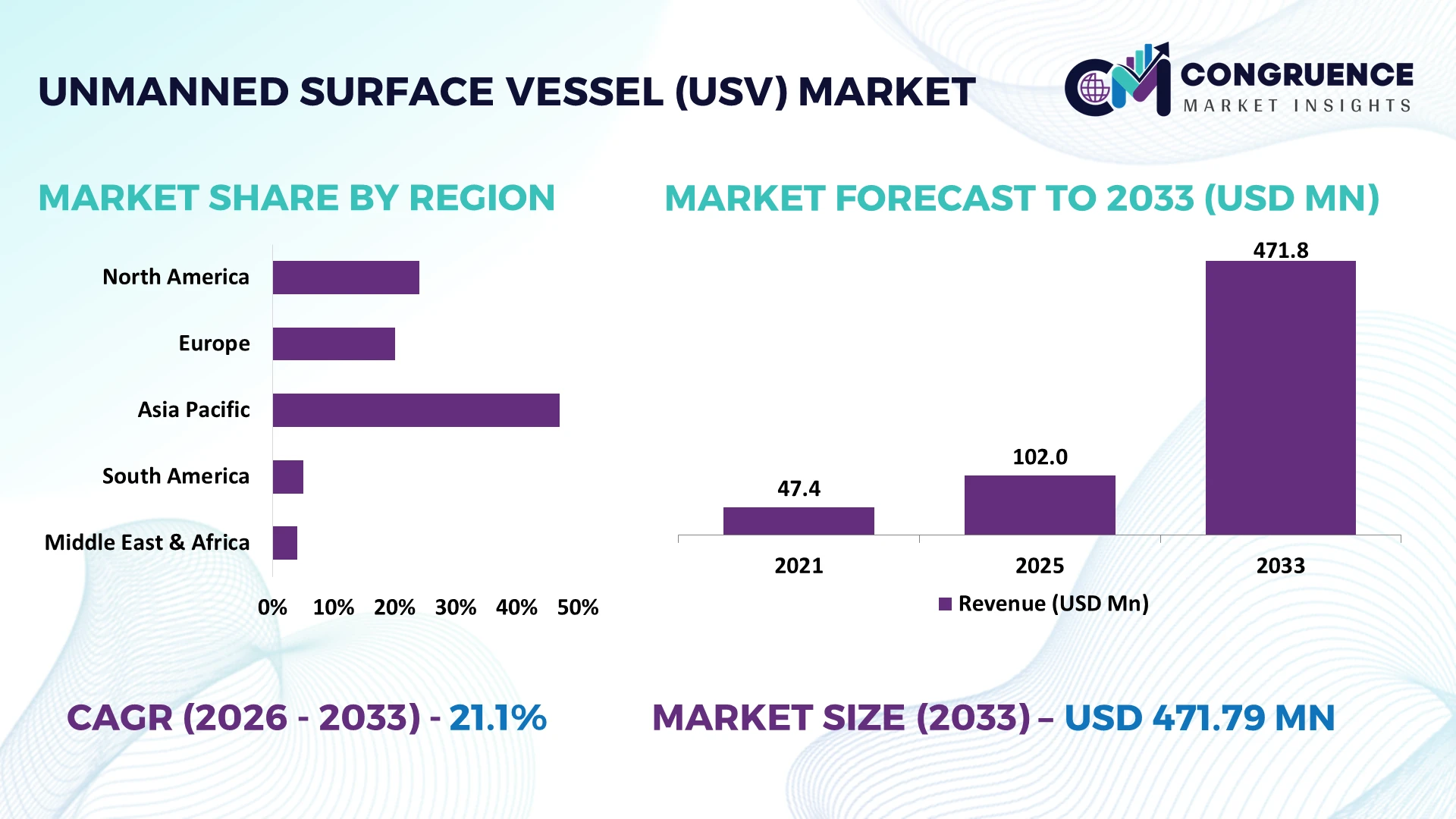
The Global Unmanned Surface Vessel (USV) Market was valued at USD 102 Million in 2025 and is anticipated to reach a value of USD 471.79 Million by 2033 expanding at a CAGR of 21.1% between 2026 and 2033. Growth is being accelerated by rising naval modernization programs, offshore energy inspection automation, maritime surveillance expansion, and AI-enabled autonomous navigation integrated into next-generation surface platforms.
The United States leads the global Unmanned Surface Vessel (USV) Market with approximately 34% of worldwide deployment activity, supported by sustained defense modernization, maritime security initiatives, and autonomous naval testing. More than 55% of advanced USV programs are linked to defense and offshore applications, while Japan strengthens commercial marine autonomy through port digitalization and coastal monitoring. Heightened maritime security following continued Indo-Pacific geopolitical developments has further accelerated procurement, giving the United States a clear technological advantage over other leading markets through larger autonomous fleet demonstrations and higher operational readiness.
Organizations investing in AI-enabled autonomy, scalable fleet management, and mission-specific USV platforms are positioned to secure long-term competitive advantages across defense and commercial maritime operations.
Market Size & Growth: USD 102 Million in 2025, projected to reach USD 471.79 Million by 2033 at a 21.1% CAGR, driven by AI-powered maritime autonomy and defense modernization.
Top Growth Drivers: Autonomous navigation adoption (+32%), naval modernization budgets (+24%), and offshore energy inspection automation (+19%) continue accelerating global market expansion.
Short-Term Forecast: By 2028, autonomous mission efficiency improves by nearly 28% while inspection and surveillance operating costs decline approximately 22%.
Emerging Technologies: AI navigation, edge computing, digital twins, and advanced sensor fusion increase autonomous mission accuracy by over 30%.
Regional Leaders: North America approaches USD 165 Million, Asia-Pacific exceeds USD 138 Million, and Europe reaches nearly USD 108 Million, supported by expanding naval and offshore deployments.
Consumer/End-User Trends: More than 60% of new procurement focuses on multi-mission USVs for defense, offshore energy, environmental monitoring, and port security.
Pilot/Case Example: During 2026 autonomous maritime trials, AI-enabled mission planning reduced operator workload by approximately 35% while extending continuous patrol duration.
Competitive Landscape: Leading manufacturers collectively account for roughly 46% market share, with L3Harris Technologies, Saildrone, Ocean Aero, Elbit Systems, and Textron Systems maintaining strong positions.
Regulatory & ESG Impact: Autonomous environmental monitoring improves marine inspection productivity by nearly 27% while supporting stricter emissions and maritime compliance initiatives.
Investment & Funding: More than USD 2 billion in public and private investments support autonomous vessel development, strategic defense partnerships, and manufacturing expansion amid regional supply chain diversification.
Innovation & Future Outlook: Swarm-enabled operations, modular payloads, and hybrid-electric propulsion strengthen next-generation maritime capabilities while expanding commercial and defense deployment strategies.
The Unmanned Surface Vessel (USV) Market is advancing through stronger demand from naval surveillance, offshore energy inspection, hydrographic mapping, and critical infrastructure monitoring. AI-based mission autonomy, enhanced sensor integration, and modular payload architectures are improving operational flexibility, with autonomous mission completion rates increasing by approximately 30%. Expanding maritime security requirements and resilient regional supply-chain strategies continue reinforcing long-term deployment plans, setting the stage for broader strategic investment and competitive positioning.
The Unmanned Surface Vessel (USV) Market has become strategically important as governments, offshore operators, and maritime security agencies prioritize autonomous operations to improve mission endurance, reduce personnel exposure, and strengthen maritime domain awareness. Infrastructure modernization across naval fleets and ports, combined with digital maritime ecosystems, is reshaping procurement priorities. Growing localization of critical marine electronics and sensor supply chains is also reducing dependency on imported components while improving delivery reliability for advanced autonomous platforms.
AI-enabled autonomous navigation and sensor fusion systems now deliver nearly 35% higher mission efficiency than conventional remotely operated patrol vessels while reducing operator workload by approximately 30%. The United States maintains leadership through large-scale defense deployments and autonomous fleet experimentation, whereas Norway advances commercial offshore inspection and renewable energy support with specialized USV fleets. Over the next two to three years, autonomous mission deployment is expected to expand by more than 25%, supported by improved communication networks, modular payload integration, and expanding maritime digital infrastructure.
A practical example is the deployment of autonomous USVs for offshore wind farm inspection, where continuous remote operations reduce maintenance planning time and improve asset availability. Companies are strengthening technology partnerships, investing in modular platforms, and expanding software-driven autonomous capabilities to secure stronger competitive positioning as maritime operations become increasingly data-centric and mission autonomous.
Defense modernization and autonomous maritime surveillance remain the strongest structural driver for the Unmanned Surface Vessel (USV) Market. More than 58% of newly announced naval modernization programs include autonomous or remotely operated maritime systems, while AI-enabled navigation improves patrol efficiency by around 32% and reduces operational manpower requirements by nearly 28%. The United States continues expanding autonomous maritime testing in response to evolving Indo-Pacific security requirements, encouraging faster procurement cycles and higher interoperability standards. Companies are responding through strategic technology partnerships, increased investment in modular mission payloads, and expanded manufacturing capabilities. A notable strategic shift is the integration of multi-mission software architectures, allowing a single platform to perform surveillance, mine countermeasures, and environmental monitoring with lower lifecycle costs.
Complex integration requirements and certification procedures continue limiting broader deployment of advanced USVs. Approximately 42% of project implementation costs are associated with integrating sensors, communication networks, and autonomous control software, while specialized maritime components experience procurement lead times extending by nearly 20% during supply-chain disruptions. Japan and several European maritime authorities maintain rigorous operational certification requirements that increase deployment timelines for commercial operators. These structural limitations directly affect production scalability, project profitability, and fleet expansion schedules. Companies are reducing exposure through localized component sourcing, long-term semiconductor supply agreements, standardized software interfaces, and greater use of modular electronic architectures that simplify upgrades while lowering integration risk across multiple vessel classes.
Commercial maritime automation presents a significant opportunity beyond traditional defense applications. Autonomous inspection, offshore renewable energy support, hydrographic surveying, and environmental monitoring are expected to represent more than 40% of new deployment activity within the next few years. AI-assisted mission planning reduces inspection cycles by approximately 30%, while digital twin integration improves predictive maintenance accuracy by nearly 25%. South Korea is accelerating smart-port infrastructure and autonomous maritime initiatives, creating favorable conditions for commercial fleet deployment. Companies are expanding research collaborations with marine technology firms, developing open-platform software ecosystems, and investing in modular payload solutions that enable rapid customization across energy, logistics, and coastal security applications, creating differentiated long-term service revenues rather than relying solely on hardware sales.
Scaling autonomous fleets while maintaining cybersecurity and operational consistency remains a critical long-term challenge. Around 48% of maritime operators identify cyber resilience as a primary investment priority, while autonomous communication networks increase data traffic by nearly 35%, requiring stronger encryption and resilient command architectures. The United Kingdom and the United States are strengthening maritime cybersecurity frameworks as autonomous naval and commercial operations become more interconnected. Without secure interoperability, fleet expansion risks operational disruption and reduced mission reliability. Companies must invest in secure software architectures, encrypted satellite communications, AI-enabled threat detection, and workforce development while strengthening partnerships with cybersecurity specialists to ensure reliable autonomous operations across increasingly complex maritime environments.
AI-Driven Mission Autonomy Expands Autonomous mission control is becoming the operational standard, with AI-assisted navigation improving route optimization by nearly 33% and reducing manual intervention by approximately 28%. The transition toward edge computing enables real-time onboard decision-making even in communication-constrained environments. Following heightened maritime security requirements in the Indo-Pacific, defense contractors are accelerating software-centric vessel development through technology partnerships, enabling faster deployment cycles and lower lifecycle operating costs while improving fleet availability.
Modular Payload Integration Accelerates More than 52% of newly introduced USV platforms now support modular payload architectures, allowing rapid configuration for surveillance, hydrographic mapping, mine countermeasures, or environmental monitoring. Standardized interfaces shorten mission preparation by roughly 24% while reducing upgrade expenses by nearly 18%. Manufacturers are restructuring product portfolios around interchangeable mission modules, enabling customers to maximize vessel utilization without expanding fleet size, creating a significant operational advantage in multi-mission maritime environments.
Commercial Offshore Operations Diversify Offshore wind farms, subsea inspection, and maritime infrastructure maintenance are driving broader commercial deployment. Around 37% of new commercial procurement emphasizes autonomous inspection capabilities that reduce offshore inspection time by nearly 30%. Labor shortages across offshore industries are encouraging operators to automate repetitive marine tasks. Companies are expanding service partnerships with offshore energy providers while integrating predictive maintenance software into autonomous surface operations to improve long-term asset performance.
Secure Connectivity Becomes Priority Satellite-enabled communications, encrypted control systems, and resilient maritime networking are receiving increased investment as autonomous fleets expand. Secure data transmission reliability has improved by approximately 26%, while advanced cyber monitoring reduces operational disruptions by nearly 20%. The United States and Japan continue strengthening maritime digital infrastructure, encouraging suppliers to integrate cybersecurity directly into vessel architecture rather than treating it as an aftermarket enhancement, improving fleet resilience and mission continuity.
Surface Combat USVs remain the dominant segment, accounting for approximately 44% of total deployments due to their extensive use in naval surveillance, intelligence gathering, force protection, and mine countermeasure missions. Their ability to integrate advanced radar, electro-optical sensors, electronic warfare payloads, and autonomous navigation systems provides superior operational flexibility compared with conventional patrol assets. Defense agencies continue prioritizing scalable autonomous fleets, while manufacturers expand modular combat platforms supporting multiple mission profiles. Survey & Research platforms represent the fastest-growing segment as governments and commercial operators increase investments in hydrographic mapping, seabed analysis, and offshore infrastructure planning.
Inspection Class USVs continue strengthening their position through offshore asset monitoring, pipeline inspection, and renewable energy maintenance, where autonomous operations reduce inspection frequency and operational costs by nearly 27%. Work Class vessels remain strategically important for towing, logistics support, and specialized industrial operations despite lower deployment volumes. Approximately 48% of newly developed platforms now feature modular payload integration, allowing companies to address multiple mission requirements using standardized hull designs. Manufacturers are increasing R&D spending, forming defense technology partnerships, and expanding autonomous software capabilities to capture higher-value mission applications.
Defense & Security remains the leading application, representing approximately 49% of operational deployments as naval modernization, maritime border protection, and persistent surveillance remain national priorities. Multi-mission autonomous vessels improve maritime situational awareness while reducing personnel exposure during extended patrols. Hydrographic Survey is the fastest-growing application as governments accelerate digital seabed mapping and offshore infrastructure planning. AI-assisted mapping workflows improve survey productivity by nearly 31%, while autonomous navigation reduces field deployment requirements by approximately 24%.
Offshore Oil & Gas continues adopting USVs for subsea inspection, platform monitoring, and pipeline surveillance, improving operational continuity in remote offshore environments. Environmental Monitoring is expanding steadily through autonomous water-quality assessment and marine ecosystem observation, while Search & Rescue operations increasingly utilize rapid-response autonomous platforms equipped with thermal imaging and long-endurance communication systems. Nearly 41% of recent commercial deployments emphasize multi-purpose operational capability. Companies are strengthening software integration, autonomous fleet management, and mission-specific payload development to address evolving operational requirements across commercial and government sectors.
Naval Forces represent the largest end-user group, accounting for approximately 52% of global USV deployments due to continuous investment in autonomous maritime surveillance, mine countermeasures, intelligence collection, and force protection. Fleet modernization strategies increasingly prioritize unmanned platforms capable of persistent operations with lower personnel requirements. Coast Guards represent the fastest-growing buyer segment as maritime border security, illegal fishing enforcement, and coastal surveillance become more technology-driven. Autonomous patrol operations improve monitoring coverage by nearly 30%, while AI-supported navigation enhances mission efficiency by approximately 25%.
Oil & Gas Companies continue expanding autonomous inspection activities to improve offshore asset reliability and reduce maintenance interruptions. Research Institutions remain important adopters for oceanographic exploration, environmental studies, and marine robotics development, while Commercial Marine Operators increasingly deploy USVs for port security, infrastructure inspection, and autonomous logistics support. Around 46% of manufacturers now offer configurable platforms tailored to different end-user missions. Companies are strengthening lifecycle service agreements, software subscription models, and strategic partnerships to improve customer retention and address increasingly specialized operational requirements.
North America accounted for the largest market share at 38% in 2025 however, Asia-Pacific is expected to register the fastest growth, expanding at a 23.8% between 2026 and 2033.
Defense-Led Autonomous Fleet Expansion
North America maintains the strongest position in the Unmanned Surface Vessel (USV) Market through advanced defense procurement, mature autonomous navigation capabilities, and extensive maritime testing infrastructure. The region contributes approximately 38% of global deployments, supported by naval modernization, offshore energy monitoring, and maritime border security initiatives. More than 57% of newly deployed autonomous maritime platforms are integrated with AI-enabled navigation and multi-sensor payloads, improving operational endurance and mission flexibility. Strategic collaboration between defense contractors, software developers, and marine technology firms continues accelerating platform standardization. Investments in autonomous maritime command systems and secure communications have improved mission readiness while reducing manual intervention during extended operations.
United States Market Outlook: The United States remains the regional technology leader due to strong naval procurement programs, autonomous vessel testing, and advanced defense research infrastructure. More than 60% of North American autonomous maritime trials are conducted in the country, supported by integrated defense innovation programs and expanding partnerships between government agencies and private marine technology developers. Companies continue investing in modular mission systems, AI-based autonomy, and resilient communication architectures to strengthen long-duration maritime operations.
Maritime Digitalization Strengthens Commercial Adoption
Europe continues expanding autonomous maritime operations through naval modernization, offshore renewable energy projects, and digital marine infrastructure. The region represents approximately 28% of global deployment activity, with strong demand for hydrographic surveying, offshore inspection, and environmental monitoring. Around 46% of new commercial maritime projects now evaluate autonomous surface systems for recurring inspection missions, reducing operational downtime and improving data collection efficiency. Regulatory support for maritime digitalization and increasing collaboration between naval organizations and research institutions continue strengthening deployment across commercial and defense sectors.
Norway Market Outlook: Norway leads regional commercial adoption through extensive offshore energy operations, advanced marine engineering expertise, and autonomous vessel innovation. Nearly 35% of offshore inspection programs increasingly utilize autonomous marine technologies to improve operational efficiency and reduce offshore personnel exposure. Local technology companies continue expanding partnerships with offshore energy operators while strengthening autonomous navigation, marine robotics, and digital inspection capabilities.
Manufacturing Scale Accelerates Deployment
Asia-Pacific is emerging as the fastest-expanding regional market due to strong shipbuilding capacity, growing naval modernization, and increasing investment in smart-port infrastructure. The region accounts for approximately 24% of global deployment activity while recording some of the highest autonomous vessel procurement rates. More than 40% of newly commissioned smart-port initiatives incorporate autonomous marine technologies for surveillance, inspection, and logistics support. Governments continue strengthening domestic manufacturing capabilities while marine technology enterprises expand AI-enabled navigation and autonomous fleet management solutions across commercial and defense applications.
Japan Market Outlook: Japan maintains a leading regional position through advanced marine automation, digital port infrastructure, and precision manufacturing capabilities. Autonomous vessel deployment has increased by approximately 29% across commercial maritime programs supporting coastal monitoring, port inspection, and marine data acquisition. Japanese enterprises continue investing in autonomous control systems, sensor integration, and robotics partnerships to improve maritime productivity while strengthening export competitiveness in advanced marine technologies.
Offshore Energy Drives Demand
South America is gradually expanding USV deployment through offshore oil and gas operations, coastal surveillance, and marine resource monitoring. The region contributes nearly 6% of global deployment activity, with Brazil leading commercial adoption across offshore infrastructure. Autonomous inspection programs reduce offshore survey durations by approximately 24%, supporting improved maintenance planning and lower vessel utilization costs. Infrastructure limitations and uneven digital maritime readiness continue affecting deployment speed, yet targeted investment in offshore automation and marine monitoring programs is steadily improving operational capability.
Brazil Market Outlook: Brazil represents the region's largest operational market due to its extensive offshore energy infrastructure and growing investment in marine digitalization. Offshore operators increasingly integrate autonomous inspection platforms into subsea asset management, improving inspection efficiency by nearly 27%. Domestic partnerships between marine engineering firms and offshore technology providers continue strengthening localized deployment capabilities while supporting long-term autonomous offshore operations.
Infrastructure Investment Expands Maritime Automation
The Middle East & Africa region is strengthening its position through maritime infrastructure modernization, offshore energy security, and coastal surveillance initiatives. The region contributes approximately 4% of global deployment activity, with autonomous maritime systems increasingly supporting critical energy infrastructure and port security. More than 30% of recently announced maritime modernization initiatives include autonomous monitoring capabilities, improving operational visibility and response efficiency. Strategic investment in smart ports, secure communications, and integrated maritime command systems continues expanding commercial and government deployment opportunities.
United Arab Emirates Market Outlook: The United Arab Emirates leads regional adoption through smart-port development, maritime digitalization, and strong investment in autonomous marine technologies. Port modernization initiatives increasingly incorporate autonomous monitoring systems, improving operational efficiency by approximately 22%. Local enterprises continue collaborating with international technology developers to expand autonomous vessel integration across port security, offshore monitoring, and coastal infrastructure management.
The market is led by Saildrone, L3Harris Technologies, Elbit Systems, Ocean Aero, and Textron Systems, competing against specialized autonomous marine developers and regional defense integrators. The top five players collectively control approximately 47% of the market, creating a technology-driven competitive structure rather than a price-led environment. Competition centers on autonomous navigation performance, mission endurance, modular payload capability, and secure communications, with AI-enabled mission efficiency improving nearly 30% and lifecycle operating costs reduced by about 22% compared with legacy platforms. Companies are expanding through defense partnerships, software integration, manufacturing localization, and vertical integration of sensors, navigation, and command systems. The competitive landscape is shifting toward software-defined autonomous platforms, where digital capabilities increasingly outweigh hull design alone. High certification requirements, cybersecurity compliance, and autonomous system validation remain significant entry barriers. Winning requires scalable autonomy, rapid mission customization, resilient supply chains, and continuous software innovation supported by long-term government and commercial partnerships.
Saildrone
L3Harris Technologies
Elbit Systems
Ocean Aero
Textron Systems
Maritime Robotics
SeaRobotics Corporation
ASV Global
Exail
ECA Group
Kongsberg Maritime
Liquid Robotics
Teledyne Marine
MARTAC (Maritime Tactical Systems)
Artificial intelligence, multi-sensor fusion, and autonomous navigation remain the core technologies shaping the Unmanned Surface Vessel (USV) Market. AI-enabled route planning improves mission efficiency by approximately 32%, while advanced sensor fusion enhances target detection accuracy by nearly 27%. Around 58% of newly deployed USVs now integrate edge computing for real-time onboard decision-making, reducing communication dependency during extended operations. These technologies enable defense agencies and offshore operators to improve surveillance continuity, minimize crew exposure, and optimize long-endurance maritime missions while lowering operating costs through greater autonomy.
Emerging technologies between 2026 and 2028 include digital twins, hybrid-electric propulsion, satellite-enabled resilient communications, and modular payload architectures. Hybrid propulsion lowers fuel consumption by roughly 18%, while digital twin-based predictive maintenance reduces unplanned downtime by approximately 24%. Nearly 46% of new platform developments emphasize modular mission systems that rapidly switch between hydrographic surveying, environmental monitoring, and maritime security applications. Companies investing in software-defined vessel architectures gain faster deployment capability and stronger lifecycle competitiveness through scalable mission customization.
Disruptive autonomy platforms outperform legacy remotely operated vessels by nearly 35% in mission endurance and improve operational responsiveness by approximately 30%. Autonomous swarm coordination, AI-assisted command systems, and secure cyber-resilient communications increasingly differentiate market leaders. Defense contractors, offshore energy operators, and advanced marine technology developers that accelerate autonomous software integration between 2026 and 2028 will secure stronger operational resilience, faster mission execution, and sustainable competitive positioning.
March 2024 Saildrone unveiled its new 20-meter Surveyor-class USV, optimized for autonomous deep-water mapping and maritime security missions. The platform measures 20 meters (65 feet), strengthening long-endurance operational capability for naval customers and offshore missions.
January 2026 Saildrone and Lockheed Martin announced integration of the Surveyor USV with the JAGM launcher, supported by Lockheed Martin's $50 million investment. The partnership expands combat-ready autonomous maritime capabilities and accelerates deployment for hybrid naval fleets. Source: lockheedmartin.com
May 2026 Saildrone launched its 2026 hurricane research mission with 10 autonomous USVs collecting real-time ocean and atmospheric data for NOAA. The deployment strengthens persistent environmental monitoring while improving forecasting capabilities for critical maritime operations. Source: saildrone.com
January 2026 The U.S. Navy confirmed expansion of operational unmanned surface forces, increasing its inventory from 4 to hundreds of small USVs during 2025 while establishing dedicated unmanned warfare units. The move significantly accelerates operational deployment and fleet integration. Source: militarytimes.com
This report provides comprehensive strategic analysis of the Unmanned Surface Vessel (USV) Market across Surface Combat, Survey & Research, Work Class, and Inspection Class platforms, covering Defense & Security, Hydrographic Survey, Offshore Oil & Gas, Environmental Monitoring, and Search & Rescue applications. It evaluates demand across Naval Forces, Coast Guards, Oil & Gas Companies, Research Institutions, and Commercial Marine Operators while assessing deployment patterns, technology adoption, and competitive positioning. More than 45% of recent platform development emphasizes modular mission architectures and AI-enabled autonomy.
The study delivers detailed regional assessments across North America, Europe, Asia-Pacific, South America, and the Middle East & Africa, highlighting industrial deployment trends, manufacturing capabilities, and enterprise strategies. It examines autonomous navigation, edge computing, hybrid propulsion, digital twins, secure communications, and sensor integration alongside company benchmarking, partnership activity, and investment priorities. The report supports expansion planning, procurement decisions, competitive intelligence, and long-term strategic positioning across evolving maritime autonomy ecosystems between 2026 and 2033.
| Report Attribute/Metric | Report Details |
|---|---|
Market Revenue in 2025 | USD 102 Million |
Market Revenue in 2033 | USD 471.79 Million |
CAGR (2026 - 2033) | 21.1% |
Base Year | 2025 |
Forecast Period | 2026 - 2033 |
Historic Period | 2021 - 2025 |
Segments Covered | By Type
By Application
By End-User
|
Key Report Deliverable | Revenue Forecast, Growth Trends, Market Dynamics, Segmental Overview, Regional and Country-wise Analysis, Competition Landscape |
Region Covered | North America, Europe, Asia-Pacific, South America, Middle East, Africa |
Key Players Analyzed | Saildrone, L3Harris Technologies, Elbit Systems, Ocean Aero, Textron Systems, Maritime Robotics, SeaRobotics Corporation, ASV Global, Exail, ECA Group, Kongsberg Maritime, Liquid Robotics, Teledyne Marine, MARTAC (Maritime Tactical Systems) |
Customization & Pricing | Available on Request (10% Customization is Free) |




