
Reports
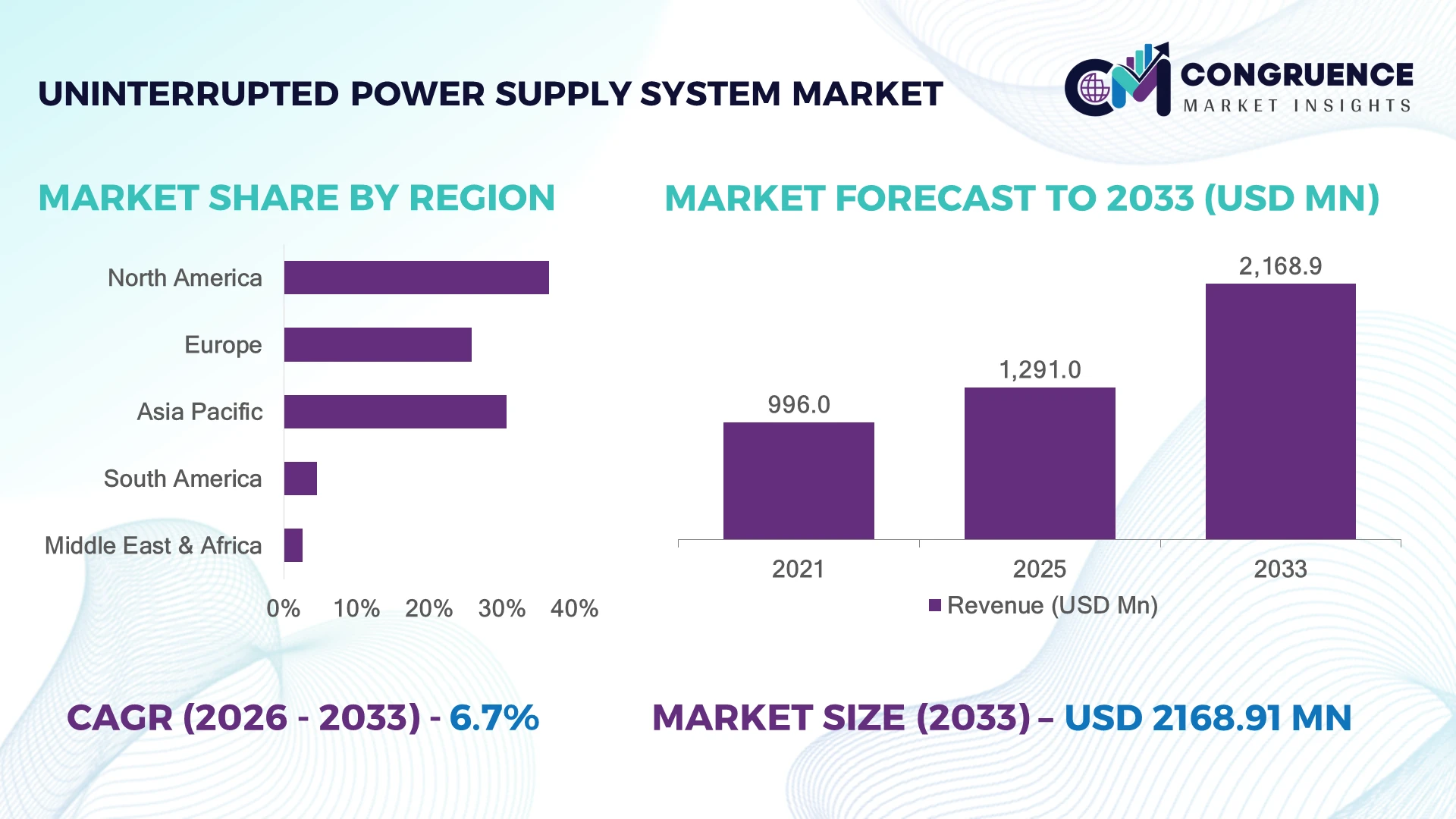
The Global Uninterrupted Power Supply System Market was valued at USD 1,291.0 Million in 2025 and is anticipated to reach a value of USD 2,168.9 Million by 2033 expanding at a CAGR of 6.7% between 2026 and 2033. Rising hyperscale data center expansion, grid instability, and continuous digital infrastructure modernization are accelerating deployment of advanced uninterrupted power supply systems across critical industrial and commercial operations.
The United States leads the global market followed by China accounting for approximately 31% of global UPS manufacturing capacity, supported by large-scale electronics production, over USD 18 billion in annual data center investments, and rapid industrial automation adoption. Compared with Germany's high-efficiency industrial installations, China delivers substantially higher production volumes while serving telecom, healthcare, and manufacturing sectors, with lithium-ion UPS adoption exceeding 42% in newly commissioned enterprise facilities.
Organizations prioritizing resilient power infrastructure and localized supply strategies are strengthening long-term operational continuity while improving competitive readiness across critical industries.
Market Size & Growth: Valued at USD 1,291.0 Million in 2025 and projected to reach USD 2,168.9 Million by 2033 at a CAGR of 6.7%, supported by expanding digital infrastructure and mission-critical power protection.
Top Growth Drivers: Data center expansion (+34%), industrial automation (+28%), and healthcare infrastructure upgrades (+22%) continue to strengthen global deployment.
Short-Term Forecast: By 2028, intelligent UPS monitoring is expected to improve maintenance efficiency by nearly 25% while reducing unplanned downtime.
Emerging Technologies: AI-based predictive maintenance, lithium-ion battery integration, and cloud-enabled remote monitoring are transforming advanced UPS platforms.
Regional Leaders: Asia Pacific approaches USD 870 Million, North America exceeds USD 520 Million, and Europe reaches nearly USD 430 Million, driven by manufacturing, cloud infrastructure, and industrial modernization.
Consumer/End-User Trends: More than 57% of enterprise facilities prioritize intelligent UPS systems with remote diagnostics and energy optimization capabilities.
Pilot/Case Example: In 2024, a hyperscale data center modernization project improved backup power availability by 30% through modular UPS deployment.
Competitive Landscape: Schneider Electric holds approximately 17% global market share alongside Eaton, Vertiv, ABB, and Huawei Digital Power.
Regulatory & ESG Impact: High-efficiency power standards reduce electricity losses by nearly 18%, supporting sustainable infrastructure modernization initiatives.
Investment & Funding: More than USD 5 billion has been committed globally toward resilient digital infrastructure, strategic partnerships, and manufacturing expansion.
Innovation & Future Outlook: Modular architectures, AI-enabled energy management, and scalable battery technologies are strengthening next-generation resilient power ecosystems.
Increasing demand from hyperscale data centers, hospitals, semiconductor manufacturing, and smart industrial facilities continues to reshape the Uninterrupted Power Supply System Market. Product innovation increasingly focuses on modular lithium-ion systems, AI-enabled diagnostics, and cloud-based energy monitoring, improving operational reliability. Nearly 45% of new enterprise installations now prioritize intelligent UPS platforms, while supply-chain localization and resilient infrastructure planning continue influencing procurement and deployment strategies worldwide, setting the stage for broader strategic transformation.
Reliable uninterrupted power infrastructure has become a strategic requirement as enterprises expand digital operations, automate manufacturing, and modernize mission-critical facilities. Increasing investment in resilient electrical infrastructure, grid modernization, and distributed computing is reshaping competitive priorities across healthcare, telecommunications, finance, and industrial production. Organizations are also restructuring supply chains to strengthen component availability and reduce operational risks.
Modern lithium-ion UPS systems typically occupy up to 40% less floor space and deliver nearly 30% longer service life than conventional valve-regulated lead-acid alternatives, lowering maintenance requirements while improving operational continuity. Asia Pacific leads large-scale manufacturing and deployment, whereas North America maintains leadership in intelligent software integration, edge computing applications, and high-density data center installations. During the next two to three years, remote monitoring adoption is expected to exceed 60% across newly deployed enterprise-grade UPS systems.
Leading suppliers are expanding localized manufacturing, investing in battery innovation, and forming technology partnerships to support faster deployment across industrial and digital infrastructure projects. Large healthcare campuses and hyperscale data centers increasingly deploy modular UPS architectures that simplify capacity expansion while minimizing service interruptions. Companies achieving greater operational resilience, deployment flexibility, and energy optimization will secure stronger long-term competitive positioning across the global power continuity ecosystem.
Rapid expansion of hyperscale data centers, semiconductor fabrication facilities, and digital healthcare infrastructure is strengthening demand for advanced uninterrupted power supply systems. More than 65% of newly commissioned enterprise data centers now integrate modular UPS architecture, while lithium-ion battery adoption exceeds 42% across large commercial installations due to higher energy density and reduced maintenance. India's digital infrastructure expansion and the U.S. CHIPS manufacturing initiatives are accelerating deployment of resilient backup power solutions for mission-critical operations. This infrastructure shift improves operational continuity while raising expectations for intelligent energy management. In response, leading manufacturers are expanding localized production, investing in AI-enabled monitoring platforms, and forming strategic battery technology partnerships to deliver scalable, high-efficiency power protection with faster deployment cycles.
UPS manufacturers continue to face structural pressure from dependence on battery cells, power semiconductors, and electronic control components, particularly those sourced from China and other concentrated manufacturing hubs. Battery systems account for nearly 35% of total UPS lifecycle costs, while advanced semiconductor lead times remain around 20–30% higher than pre-disruption levels for selected industrial components. These conditions increase deployment costs, extend installation schedules, and complicate inventory planning for enterprise projects. To reduce operational exposure, companies are diversifying supplier networks, increasing localized assembly capabilities, negotiating long-term procurement agreements, and qualifying alternative component platforms. Organizations with resilient sourcing strategies are achieving greater delivery consistency and improved project execution across critical infrastructure deployments.
Growing deployment of edge computing, smart manufacturing, and AI-powered industrial automation is creating high-value opportunities for intelligent UPS platforms that combine power protection with predictive analytics. More than 55% of enterprise operators now prioritize remote asset visibility, while AI-driven maintenance algorithms can reduce unexpected equipment failures by nearly 30%. Japan's factory automation initiatives and South Korea's semiconductor expansion are increasing demand for compact, software-defined backup power systems integrated with digital facility management. Manufacturers are accelerating R&D in cloud-connected UPS platforms, expanding software partnerships, and developing energy optimization ecosystems that improve battery utilization and operational efficiency. Intelligent service-based business models are emerging as a significant competitive differentiator beyond traditional hardware sales.
Successful deployment increasingly depends on seamless integration with building management systems, cloud platforms, cybersecurity frameworks, and distributed energy resources. Approximately 48% of enterprise facilities operate mixed infrastructure environments that require interoperability across multiple hardware vendors, while nearly 37% of operators identify cybersecurity protection for connected power systems as a critical implementation priority. Germany's highly automated industrial facilities illustrate the complexity of integrating intelligent UPS solutions into existing operational technology networks without disrupting production. Companies must strengthen software engineering capabilities, invest in open communication standards, expand cybersecurity partnerships, and enhance technical workforce expertise. Organizations that simplify integration while maintaining secure, scalable architectures will achieve stronger long-term competitiveness in increasingly digitalized power infrastructure environments.
Intelligent UPS Management Expansion: Enterprises are rapidly integrating AI-enabled monitoring and cloud-based diagnostics into UPS infrastructure, with nearly 58% of newly deployed enterprise systems supporting remote asset management and predictive maintenance. Automated health analytics reduce maintenance interventions by around 27% while improving power availability across critical facilities. Following stricter resilience requirements for digital infrastructure, manufacturers are expanding software capabilities, strengthening cybersecurity features, and partnering with data center operators to deliver centralized energy management platforms.
Lithium-Ion Deployment Accelerates: Lithium-ion battery integration continues replacing conventional battery technologies across mission-critical installations, accounting for more than 45% of new enterprise UPS deployments while reducing maintenance requirements by approximately 35%. Higher energy density and compact footprints improve equipment utilization in space-constrained facilities. Rising battery localization initiatives in India and the United States are encouraging suppliers to expand manufacturing partnerships, optimize procurement strategies, and strengthen long-term battery supply resilience.
Modular Infrastructure Becomes Standard: Modular UPS architecture is transforming deployment strategies as over 52% of hyperscale facilities prioritize scalable power infrastructure capable of phased expansion. Installation time is reduced by nearly 30%, enabling faster commissioning without major operational disruption. Companies are standardizing modular product portfolios, expanding service networks, and restructuring installation workflows to support growing edge computing facilities and distributed digital infrastructure with greater operational flexibility.
Edge Computing Reshapes Deployment: Distributed computing environments are increasing demand for compact, intelligent UPS platforms capable of supporting decentralized workloads, with edge deployments expanding by nearly 33% across industrial and commercial facilities. Integrated monitoring improves energy utilization by approximately 18% while simplifying multi-site operations. Equipment suppliers are strengthening channel partnerships, introducing software-defined power management, and optimizing logistics networks to support faster deployment across manufacturing plants, telecom towers, and smart infrastructure projects.
Online/Double-Conversion UPS remains the leading segment because it delivers continuous, high-quality power without transfer interruption, making it the preferred solution for data centers, hospitals, financial institutions, and semiconductor manufacturing facilities. Nearly 47% of enterprise-critical installations utilize online UPS systems owing to superior voltage regulation, harmonic filtering, and compatibility with advanced digital infrastructure. Offline/Standby UPS maintains relevance in residential and small office environments due to lower acquisition costs, while Line-Interactive UPS continues serving medium-sized commercial operations requiring balanced performance and affordability. Modular UPS represents the fastest-growing segment as enterprises increasingly prioritize scalable infrastructure supporting phased capacity expansion. More than 38% of newly planned hyperscale facilities now specify modular architectures to improve operational flexibility and simplify maintenance. Manufacturers are expanding modular product portfolios, integrating lithium-ion batteries, and strengthening digital monitoring capabilities through strategic technology partnerships. Investment priorities continue shifting toward intelligent, software-enabled UPS platforms that combine scalability with predictive maintenance and energy optimization.
Data Centers remain the largest application segment because uninterrupted electrical continuity is essential for cloud computing, artificial intelligence workloads, and enterprise digital services. Approximately 41% of large UPS deployments support hyperscale and colocation facilities where continuous availability and redundant power architecture are operational priorities. Telecommunications follows closely as expanding 5G infrastructure and distributed edge networks require reliable backup power. Healthcare continues strengthening demand through digitally connected hospitals and diagnostic equipment requiring uninterrupted operation. Industrial Manufacturing is emerging as the fastest-growing application as automation, robotics, and smart factory investments increase dependence on stable electrical infrastructure. Commercial Buildings are integrating intelligent UPS systems to support building automation and security platforms, while Government & Defense deployments continue expanding for command centers and critical communication networks. Companies are responding through application-specific product development, integrated monitoring software, and deployment partnerships that improve installation efficiency across multiple operational environments.
IT & Telecom represents the dominant end-user segment as cloud service providers, telecom operators, and colocation facilities require uninterrupted electrical continuity for mission-critical digital operations. Nearly 44% of enterprise UPS deployments are concentrated within this sector, supported by expanding edge computing infrastructure and growing network traffic. BFSI remains another major adopter because uninterrupted transaction processing and data protection are essential for operational resilience, while Healthcare continues investing in high-availability power infrastructure for patient-critical equipment. Manufacturing is the fastest-growing end-user segment as smart factories increasingly deploy automation, industrial IoT, and precision production systems requiring continuous power quality. Government, Energy & Utilities, and Commercial organizations are modernizing backup infrastructure through digital facility upgrades and resilient operational planning. More than 36% of large industrial facilities now prioritize intelligent UPS platforms with predictive diagnostics. Suppliers are tailoring sector-specific solutions, expanding managed service offerings, and strengthening ecosystem partnerships to improve deployment flexibility and long-term customer retention.
North America accounted for the largest market share at 36.4% in 2025 however, Asia-Pacific is expected to register the fastest growth, expanding at a CAGR of 7.5% between 2026 and 2033.
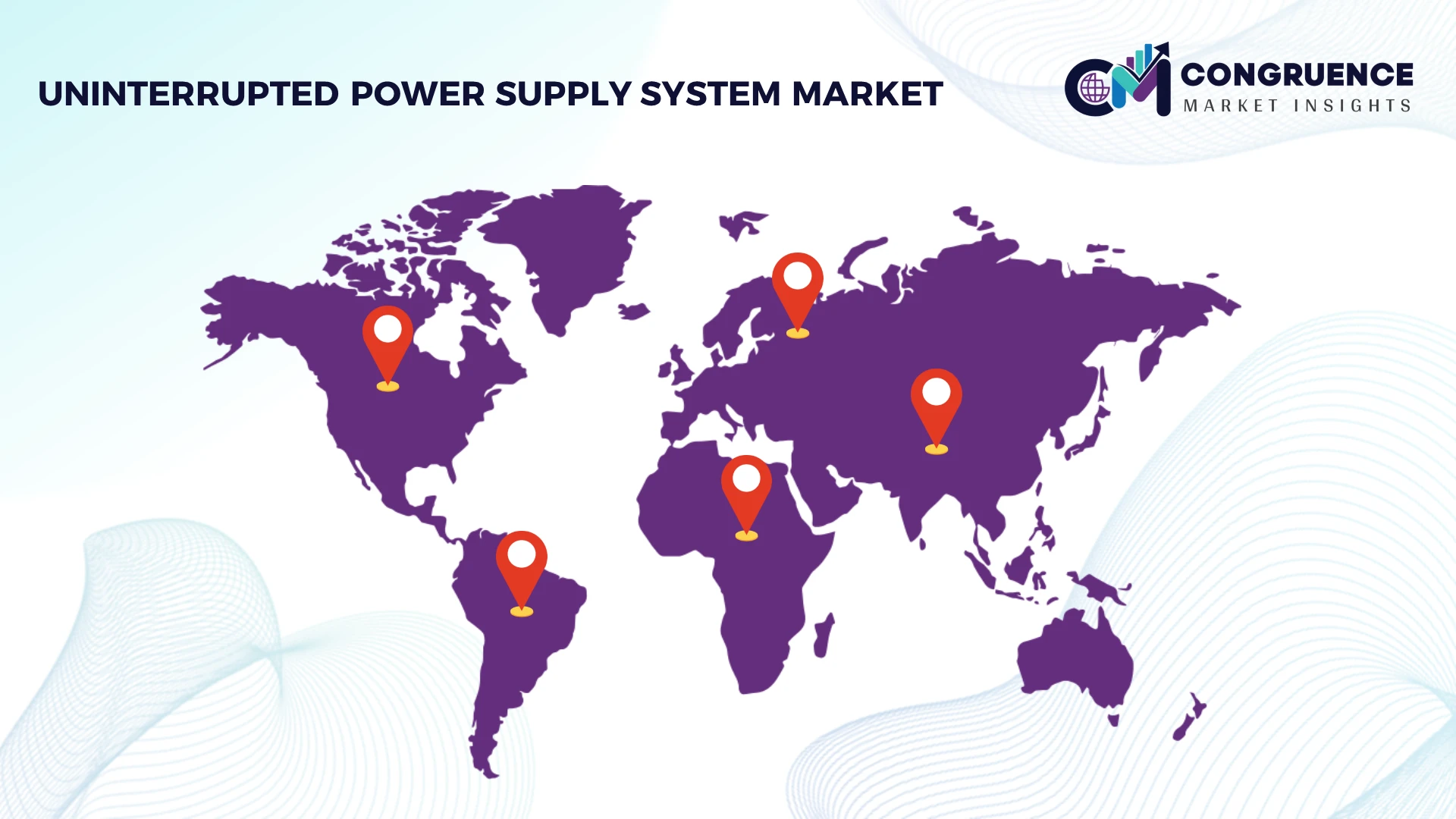
North America maintains the leading position through extensive hyperscale data center deployment, advanced industrial automation, and high enterprise investment in resilient electrical infrastructure. The region contributes approximately 36.4% of global demand, supported by continuous expansion of cloud computing, AI workloads, and mission-critical healthcare facilities. More than 62% of newly commissioned hyperscale facilities deploy modular or intelligent UPS architectures integrated with remote monitoring platforms. Utilities, financial institutions, and semiconductor manufacturers continue modernizing backup power systems to improve operational continuity and energy efficiency. Equipment suppliers are strengthening regional manufacturing, expanding service capabilities, and investing in software-enabled maintenance solutions to support growing demand for scalable, digitally connected power protection across enterprise environments.
United States Market Outlook: The United States represents the largest national market owing to its concentration of hyperscale data centers, semiconductor investments, and advanced digital infrastructure. More than 55% of North America's large-scale cloud facilities are located in the country, driving sustained deployment of intelligent UPS systems. Federal manufacturing incentives, expanding AI infrastructure, and continuous healthcare modernization encourage suppliers to increase localized production, strengthen battery integration capabilities, and establish long-term partnerships supporting resilient enterprise power infrastructure.
Europe continues expanding UPS deployment through industrial modernization, sustainability initiatives, and digital transformation across manufacturing, healthcare, and financial services. The region accounts for approximately 25.8% of global market activity, supported by strong adoption of energy-efficient backup power technologies and modernization of industrial production facilities. Nearly 48% of new industrial installations prioritize intelligent power monitoring and high-efficiency UPS systems that improve operational reliability while reducing electricity losses. Growing investments in edge computing and automation further strengthen deployment across commercial and public infrastructure. Manufacturers are introducing compact modular solutions, expanding regional engineering capabilities, and enhancing predictive maintenance services to improve lifecycle performance and operational resilience.
Germany Market Outlook: Germany remains Europe's most influential market because of its advanced manufacturing ecosystem, automation leadership, and extensive industrial digitalization initiatives. Approximately 40% of newly upgraded smart manufacturing facilities incorporate intelligent UPS platforms supporting robotics and precision production equipment. Domestic engineering expertise, strong industrial standards, and sustained investment in factory modernization continue encouraging suppliers to develop highly efficient, digitally integrated power continuity solutions tailored for industrial applications.
Asia-Pacific is emerging as the fastest-expanding market through rapid industrialization, electronics manufacturing, cloud infrastructure investment, and telecommunications expansion. The region represents approximately 30.6% of global demand while serving as the largest production base for UPS equipment and critical electronic components. More than 60% of global battery manufacturing capacity supports regional supply chains, strengthening production efficiency and export competitiveness. Rising deployment across smart factories, hospitals, and hyperscale data centers is increasing demand for intelligent and modular UPS platforms. Companies are expanding manufacturing facilities, strengthening battery partnerships, and increasing localized engineering capabilities to meet rapidly evolving enterprise infrastructure requirements.
China Market Outlook: China leads the regional market through its large electronics manufacturing ecosystem, extensive data center expansion, and integrated battery supply chain. Nearly one-third of global UPS production is concentrated within the country, supported by continuous investment in industrial automation and cloud infrastructure. Domestic manufacturers continue expanding intelligent product portfolios, improving manufacturing automation, and strengthening export competitiveness through advanced production technologies and vertically integrated supply networks.
South America is experiencing steady UPS deployment as governments and enterprises modernize telecommunications, healthcare infrastructure, and commercial facilities requiring reliable electrical continuity. The region contributes approximately 4.6% of global market demand, with growing investment in digital infrastructure and industrial automation improving long-term adoption. Enterprise facilities are increasingly implementing intelligent monitoring systems, while backup power deployment across hospitals and financial institutions continues expanding. Infrastructure constraints and uneven grid reliability remain operational challenges; however, manufacturers are strengthening local distribution partnerships, expanding technical service capabilities, and improving equipment availability to support regional deployment requirements.
Brazil Market Outlook: Brazil dominates the regional market through its large industrial economy, expanding financial sector, and accelerating cloud infrastructure investments. More than 45% of South America's commercial data center capacity is concentrated in Brazil, increasing demand for advanced UPS technologies across enterprise environments. Suppliers continue investing in regional service centers, channel partnerships, and localized technical support to improve deployment efficiency and strengthen long-term customer relationships.
The Middle East & Africa market is expanding through sustained investment in digital infrastructure, smart cities, healthcare modernization, and critical industrial facilities. The region accounts for approximately 2.6% of global market activity, with increasing deployment across government projects, oil and gas operations, and telecommunications infrastructure. Large infrastructure programs are encouraging wider adoption of modular UPS systems capable of supporting mission-critical operations in demanding environments. Equipment providers are expanding regional distribution networks, establishing technical partnerships, and enhancing after-sales service capabilities to improve deployment reliability while supporting modernization initiatives across strategic sectors.
Saudi Arabia Market Outlook: Saudi Arabia represents the leading market within the region due to extensive investment in digital transformation, smart infrastructure, and industrial diversification projects. More than 35% of new government-backed digital infrastructure developments incorporate resilient backup power solutions supporting continuous operations. Ongoing expansion of hyperscale data centers, healthcare facilities, and industrial projects encourages manufacturers to strengthen regional partnerships, develop localized support capabilities, and deploy intelligent UPS systems aligned with national infrastructure modernization priorities.
Competition is led by Schneider Electric, Eaton, Vertiv, ABB, and Huawei Digital Power, while regional manufacturers and value-focused OEMs compete aggressively across commercial and industrial segments. The top five players collectively control approximately 58% of the global market, competing primarily through technology leadership, supply-chain resilience, and lifecycle service capabilities rather than price alone. Premium vendors deliver intelligent UPS platforms with up to 99% operating efficiency, whereas regional suppliers typically offer solutions priced 15–20% lower for cost-sensitive projects. Modular architectures reduce deployment time by nearly 30%, giving technology-focused companies an execution advantage. Leading manufacturers continue expanding production capacity, integrating battery technologies, forming software partnerships, and strengthening vertical integration to secure critical components. Competition is increasingly shifting toward AI-enabled monitoring, cybersecurity, and predictive maintenance instead of conventional hardware differentiation. High certification requirements, service infrastructure, and application engineering expertise remain major entry barriers. Success depends on delivering scalable digital power ecosystems with reliable lifecycle support and localized execution.
Eaton Corporation plc
Vertiv Holdings Co.
ABB Ltd.
Huawei Digital Power Technologies Co., Ltd.
Mitsubishi Electric Corporation
Delta Electronics, Inc.
Socomec Group
Toshiba Corporation
Riello UPS
Legrand SA
Fuji Electric Co., Ltd.
AEG Power Solutions
Modern UPS technology is rapidly transitioning from standalone backup systems to intelligent digital power platforms. AI-enabled predictive diagnostics, cloud-based asset management, and lithium-ion battery integration are becoming standard across enterprise deployments. More than 58% of newly installed mission-critical UPS systems incorporate remote monitoring, while predictive analytics reduce unexpected maintenance events by approximately 25%. Organizations benefit from improved equipment availability, centralized control, and optimized battery utilization across distributed infrastructure.
Compared with conventional valve-regulated lead-acid systems, lithium-ion UPS platforms provide nearly 30% longer operational life, reduce maintenance requirements by approximately 35%, and occupy up to 40% less installation space. Modular UPS architectures further shorten deployment time by nearly 30%, enabling scalable expansion without major operational disruption. Global technology leaders, hyperscale data center operators, and advanced manufacturing enterprises gain the greatest competitive advantage through these integrated digital power solutions.
Between 2026 and 2028, software-defined power management, digital twins, cybersecurity-enabled monitoring, and AI-assisted energy optimization will reshape enterprise power infrastructure. Intelligent automation is expected to support more than 65% of newly deployed large-scale UPS installations. Companies investing early in interoperable platforms, advanced battery management, and predictive service ecosystems will improve operational resilience, reduce lifecycle costs, and strengthen long-term competitive positioning in increasingly digital industrial environments.
December 2024 – Vertiv introduced the PowerUPS 9000 for large data centers, delivering double-conversion efficiency of up to 97.5% with a footprint 32% smaller than previous generations, improving deployment flexibility for AI-ready facilities. Source: www.vertiv.com
February 2025 – Eaton showcased the new 9395 XR UPS during Elecrama 2025, strengthening its smart power portfolio for data centers and industrial facilities with enhanced efficiency and reliability supporting mission-critical operations. Source: www.eaton.com
April 2025 – Schneider Electric launched the Galaxy VXL UPS supporting 500–1250 kW power capacity with operating efficiency reaching 99%, targeting AI data centers and large industrial workloads through compact modular architecture. Source: www.se.com
May 2025 – Vertiv expanded its critical power portfolio by launching the PowerSwitch 7000 static transfer switch for EMEA markets, enabling seamless automatic source transfers and strengthening high-availability power architectures supporting enterprise data centers and industrial facilities.
This report delivers comprehensive analysis of the global Uninterrupted Power Supply System Market across Offline/Standby UPS, Line-Interactive UPS, Online/Double-Conversion UPS, Modular UPS, and other technologies. It evaluates demand across data centers, telecommunications, healthcare, industrial manufacturing, commercial buildings, government & defense, and additional applications while assessing purchasing behavior among IT & Telecom, BFSI, healthcare, manufacturing, government, energy & utilities, commercial, and other end-users. Regional assessment covers North America, Europe, Asia-Pacific, South America, and the Middle East & Africa with country-level strategic insights.
The study examines technology adoption, deployment patterns, competitive positioning, supply-chain developments, and digital power innovations influencing market evolution between 2026 and 2033. More than 60% of enterprise deployments emphasize intelligent monitoring and scalable architectures, while modular platforms continue expanding across critical infrastructure. The report supports investment evaluation, market entry, product development, expansion planning, partnership strategies, and competitive benchmarking through detailed segmentation, operational analysis, technology assessment, and company profiling relevant to evolving enterprise power continuity requirements.
| Report Attribute / Metric | Details |
|---|---|
| Market Revenue (2025) | USD 1,291.0 Million |
| Market Revenue (2033) | USD 2,168.9 Million |
| CAGR (2026–2033) | 6.7% |
| Base Year | 2025 |
| Forecast Period | 2026–2033 |
| Historic Period | 2021–2025 |
| Segments Covered |
By Type
By Application
By End-User
|
| Key Deliverables | Revenue Forecast; Market Trends; Growth Drivers & Restraints; Technology Insights; Segmentation Analysis; Regional Insights; Competitive Landscape; Regulatory & ESG Overview; Recent Developments |
| Regions Covered | North America; Europe; Asia-Pacific; South America; Middle East & Africa |
| Companies Profiled | Schneider Electric; Eaton Corporation plc; Vertiv Holdings Co.; ABB Ltd.; Huawei Digital Power Technologies Co., Ltd.; Mitsubishi Electric Corporation; Delta Electronics, Inc.; Socomec Group; Toshiba Corporation; Riello UPS; Legrand SA; Fuji Electric Co., Ltd.; AEG Power Solutions |
| Customization & Pricing | Available on Request (10% Customization Free) |




