
Reports
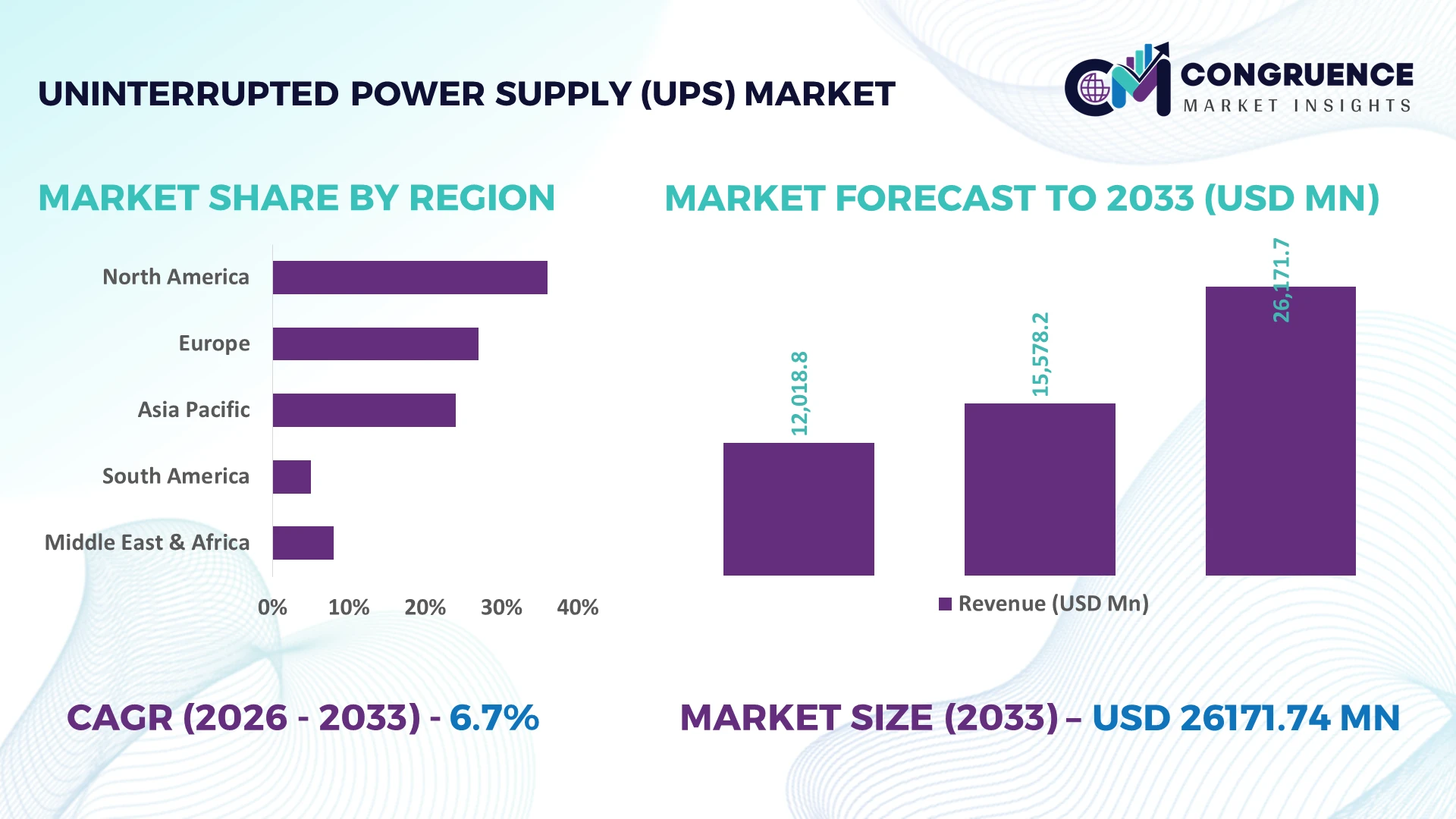
The Global Uninterrupted Power Supply (UPS) Market was valued at USD 15578.2 Million in 2025 and is anticipated to reach a value of USD 26171.74 Million by 2033 expanding at a CAGR of 6.7% between 2026 and 2033. Growth is driven by expanding AI data centers, high-density server infrastructure, semiconductor manufacturing, and mission-critical power protection across healthcare, telecom, and industrial automation facilities.
China accounts for approximately 31% of global UPS manufacturing capacity, supported by large-scale electronics production and battery supply chains, while the United States operates more than 40% of the world's hyperscale data center capacity, driving premium UPS deployment. India continues recording over 20% annual growth in digital infrastructure investments, while supply-chain diversification following 2026 Red Sea logistics disruptions accelerates regional manufacturing expansion and localized sourcing.
Organizations that prioritize intelligent, energy-efficient UPS platforms and diversified manufacturing footprints will strengthen operational resilience and long-term competitiveness.
Market Size & Growth: USD 15,578.2 million in 2025 is projected to reach USD 26,171.74 million by 2033 at a CAGR of 6.7%, driven by AI infrastructure expansion and resilient power requirements.
Top Growth Drivers: Data center deployment (+24%), industrial automation (+18%), and healthcare critical-power installations (+15%) remain the primary growth accelerators.
Short-Term Forecast: By 2028, AI-enabled UPS monitoring lowers maintenance costs by nearly 20% while improving system uptime by approximately 18%.
Emerging Technologies: AI-based predictive maintenance, lithium-ion battery systems, and cloud-enabled remote monitoring improve efficiency by over 25% across enterprise deployments.
Regional Leaders: Asia-Pacific exceeds USD 10.8 billion through manufacturing expansion, North America approaches USD 7.4 billion with hyperscale investments, while Europe reaches USD 5.6 billion through energy-efficient modernization.
Consumer/End-User Trends: More than 72% of hyperscale facilities prioritize modular UPS architecture for scalability, higher efficiency, and simplified maintenance.
Pilot/Case Example: In 2026, an AI-enabled industrial power management project improved power availability by 30% while reducing unplanned downtime by 25%.
Competitive Landscape: Leading manufacturers collectively account for nearly 45% of global shipments, with Eaton, Schneider Electric, Vertiv, ABB, and Huawei maintaining strong market positions.
Regulatory & ESG Impact: High-efficiency power standards increase adoption of advanced UPS systems by approximately 22%, reducing electricity consumption and operational emissions.
Investment & Funding: More than USD 3 billion has been directed toward manufacturing expansion, strategic partnerships, and regional supply-chain diversification since 2025.
Innovation & Future Outlook: Next-generation digital UPS platforms combine AI analytics, battery intelligence, and predictive asset management to improve reliability and support distributed power infrastructure.
The Uninterrupted Power Supply (UPS) Market continues to evolve through increasing deployment across hyperscale data centers, healthcare facilities, semiconductor manufacturing, and smart factories requiring uninterrupted power continuity. Lithium-ion battery systems now represent more than 35% of new enterprise UPS installations, while intelligent diagnostics and remote asset management improve lifecycle performance. Regional manufacturing localization and stricter energy-efficiency requirements continue shaping procurement strategies, providing a strong foundation for the strategic market assessment.
The Uninterrupted Power Supply (UPS) Market has become strategically important as enterprises prioritize power resilience to protect AI infrastructure, semiconductor fabrication, digital banking, and automated manufacturing. Infrastructure modernization and supply-chain restructuring are reshaping procurement strategies, with organizations increasingly selecting localized production and modular UPS platforms to reduce deployment lead times. This shift strengthens competitive positioning while improving business continuity across critical operations.
Modern lithium-ion UPS systems deliver up to 30% lower maintenance requirements and occupy nearly 40% less floor space than conventional valve-regulated lead-acid solutions, enabling higher rack density in data centers. The United States leads hyperscale UPS deployment through advanced cloud infrastructure, while China dominates manufacturing scale and component integration. India is emerging as a high-priority installation market as digital infrastructure expansion exceeds 20% annually. During the next two to three years, intelligent UPS monitoring platforms are expected to surpass 50% adoption among new enterprise deployments, improving predictive maintenance and reducing service interruptions.
A practical example is the deployment of modular UPS systems in AI-ready data centers, where scalable power architecture minimizes downtime during capacity expansion without interrupting operations. Manufacturers are accelerating investments in localized battery production, software partnerships, and intelligent energy management platforms to strengthen operational flexibility. Companies capable of combining digital power intelligence with resilient manufacturing networks will establish stronger competitive differentiation and long-term market leadership.
Rapid expansion of AI computing, hyperscale data centers, and advanced manufacturing is accelerating demand for intelligent UPS solutions capable of delivering continuous power availability. More than 70% of newly commissioned enterprise data centers now prioritize modular UPS architecture, while lithium-ion installations have exceeded 35% of new enterprise deployments due to longer operating life and reduced maintenance. India's digital infrastructure investments continue expanding above 20% annually, increasing demand for reliable backup power. In response, manufacturers are expanding domestic assembly facilities, strengthening battery partnerships, and integrating AI-based predictive diagnostics. The strategic outcome is faster deployment, lower lifecycle operating costs, and stronger resilience for mission-critical industrial and digital infrastructure.
UPS manufacturers continue facing pressure from battery material price fluctuations, semiconductor availability, and power electronics sourcing. Batteries account for approximately 35%–45% of total UPS system costs, while electronic component lead times remain 20% higher than pre-disruption levels for selected industrial-grade devices. Dependence on imported battery cells in several countries increases procurement uncertainty and inventory costs. Companies are responding through supplier diversification, localized assembly, and long-term procurement agreements to stabilize production schedules. Businesses that successfully regionalize component sourcing improve delivery reliability, reduce operational disruptions, and strengthen competitiveness in large enterprise and infrastructure projects.
The convergence of AI-enabled power management, digital monitoring, and smart-grid integration creates significant opportunities beyond traditional backup power applications. Intelligent UPS platforms can reduce energy losses by nearly 15% through optimized battery charging and load balancing, while predictive analytics lower unplanned maintenance events by approximately 20%. Japan and India are expanding investments in smart infrastructure, creating demand for digitally connected power protection systems. Manufacturers are increasing R&D spending, partnering with energy management software providers, and developing cloud-connected UPS ecosystems. The strongest competitive advantage will come from integrating power continuity with energy optimization and real-time operational intelligence.
Deploying UPS systems across hybrid energy environments presents increasing execution complexity as organizations combine renewable energy, battery storage, and conventional grid infrastructure. More than 60% of enterprise facilities operate mixed power architectures requiring advanced interoperability, while cybersecurity incidents targeting industrial control environments have increased by over 30% in recent years. Legacy facilities often lack standardized communication protocols, extending commissioning timelines and increasing engineering costs. Companies are investing in open-platform software, cybersecurity capabilities, digital twins, and specialized engineering partnerships to simplify deployment. Long-term competitive success depends on delivering secure, interoperable, and scalable power management solutions across increasingly complex operational environments.
AI-Optimized Power Intelligence: Enterprise UPS platforms increasingly integrate AI-driven predictive diagnostics, reducing unplanned maintenance by nearly 22% while improving battery utilization by approximately 18%. Large data center operators in the United States are standardizing intelligent monitoring to support high-density AI workloads. Vendors are expanding software partnerships and embedding cloud analytics to shorten service cycles, improve asset visibility, and lower operating costs.
Modular Deployment Accelerates: Modular UPS installations now represent over 40% of new hyperscale deployments because expandable architectures reduce commissioning time by nearly 30% and simplify future capacity additions. Supply-chain diversification following 2026 logistics disruptions has encouraged localized assembly across India and Southeast Asia. Manufacturers are restructuring production networks and increasing regional inventories to improve delivery reliability and deployment flexibility.
Lithium-Ion Adoption Expands: Lithium-ion battery systems account for more than 35% of new enterprise UPS installations, offering approximately 40% lower maintenance requirements and service life exceeding conventional lead-acid technologies. Enterprises prioritize smaller installation footprints and improved energy efficiency. Equipment suppliers are strengthening battery partnerships, expanding localized manufacturing, and introducing advanced battery management software to improve lifecycle performance.
Energy Efficiency Becomes Standard: Energy-efficiency regulations and corporate sustainability targets are accelerating deployment of high-efficiency UPS platforms exceeding 97% operating efficiency. Intelligent load management reduces energy losses by approximately 15%, while remote monitoring decreases routine service visits by nearly 20%. Companies are redesigning product portfolios around digital energy management, automated diagnostics, and integrated power optimization to strengthen long-term operational resilience.
Online UPS remains the dominant segment because it provides continuous power conditioning, zero transfer time, and superior protection for data centers, healthcare facilities, and industrial automation. Nearly 60% of mission-critical installations specify online UPS architecture due to higher reliability and compatibility with sensitive digital infrastructure. Offline UPS maintains relevance in residential and small commercial environments where cost efficiency remains the primary purchasing criterion. Line-Interactive UPS continues serving medium-sized enterprises by balancing voltage regulation with moderate acquisition costs.
Modular UPS represents the fastest-growing segment as enterprises prioritize scalable infrastructure capable of supporting phased capacity expansion. Deployment time can be reduced by nearly 30%, while maintenance efficiency improves by approximately 20% through hot-swappable modules. Industrial UPS systems continue expanding across semiconductor manufacturing, energy, and process industries where uninterrupted operations remain essential. Manufacturers are increasing investments in modular product development, intelligent battery management, and localized production, shifting competitive priorities toward flexible, software-enabled power protection platforms.
Data Centers remain the leading application because AI computing, cloud services, and edge infrastructure require uninterrupted power availability and continuous operational resilience. More than 70% of newly developed hyperscale facilities deploy advanced online or modular UPS systems to protect high-density server environments. IT & Telecom continues expanding through 5G deployment and network modernization, while Healthcare maintains strong demand for uninterrupted power supporting diagnostic imaging, operating theatres, and life-support equipment.
Industrial Facilities represent the fastest-growing application as automation, robotics, and digital manufacturing increase dependence on stable power quality. Commercial Buildings continue adopting intelligent UPS systems for integrated building management and critical security infrastructure. Companies are expanding application-specific product portfolios, integrating predictive monitoring, and strengthening service capabilities to improve deployment efficiency. Investment priorities increasingly favor scalable digital power systems capable of supporting expanding enterprise workloads without disrupting operations.
IT & Telecom represents the largest end-user segment because cloud computing, hyperscale facilities, network infrastructure, and edge computing require uninterrupted electrical continuity. More than 72% of enterprise network expansion projects now include intelligent UPS monitoring to strengthen operational reliability and reduce service interruptions. Healthcare continues expanding UPS deployment as hospitals modernize digital diagnostics and critical patient care infrastructure, where continuous electrical availability is operationally essential.
Manufacturing is the fastest-growing end-user as smart factories increasingly integrate robotics, AI-enabled production lines, and automated quality systems. Banking continues upgrading UPS systems to protect digital transactions and financial infrastructure, while Government organizations prioritize resilient power for emergency operations and digital public services. Manufacturers are responding through customized industry solutions, long-term maintenance agreements, and integrated energy management platforms, strengthening customer retention while addressing increasingly specialized operational requirements.
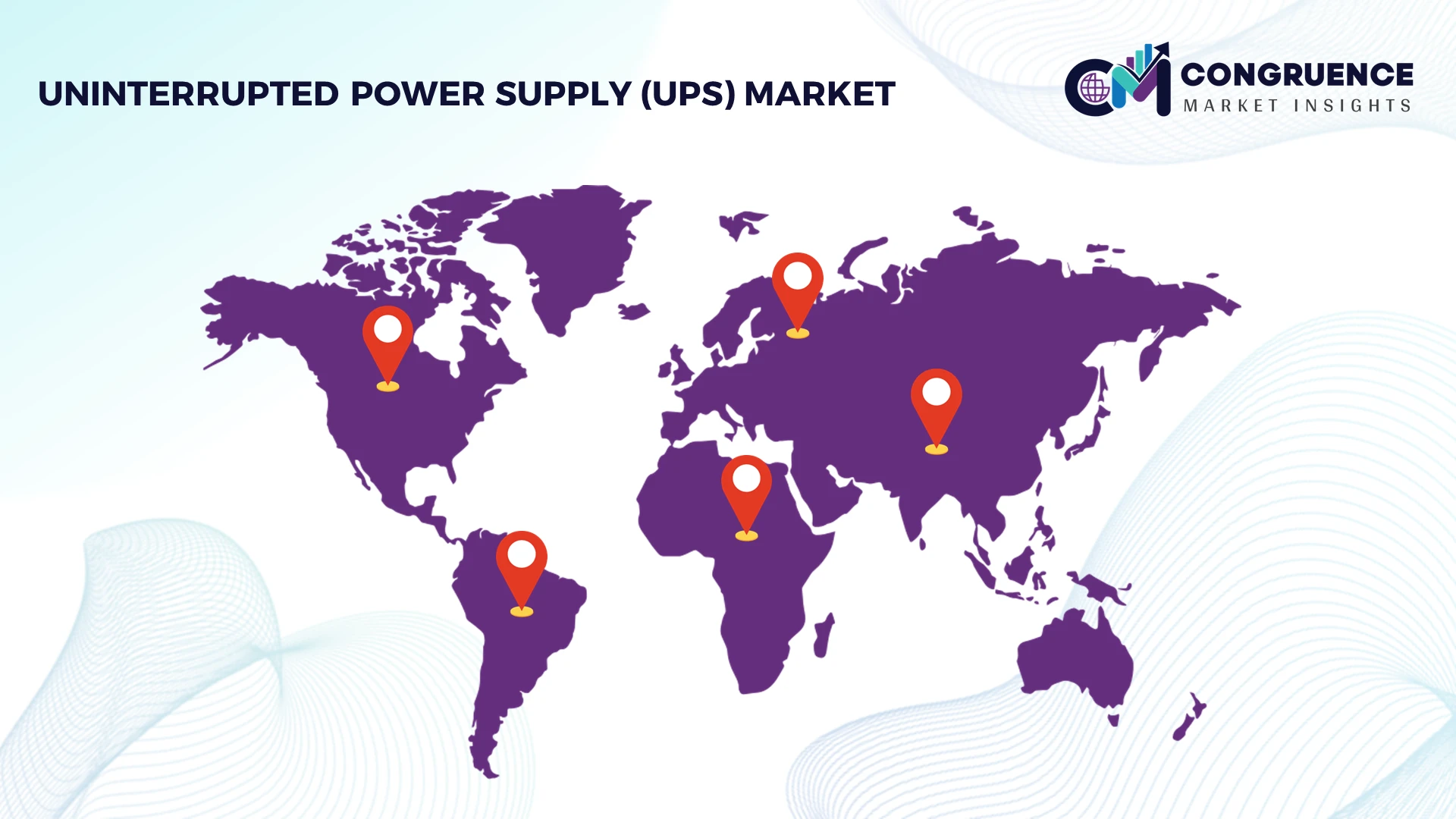
Asia-Pacific accounted for the largest market share at 42.8% in 2025 however, Middle East & Africa is expected to register the fastest growth, expanding at a 7.8% between 2026 and 2033.
Strategic Focus on AI Infrastructure and Grid Resilience
North America remains a mature UPS market supported by hyperscale data centers, cloud computing, healthcare infrastructure, and advanced manufacturing. The region contributes approximately 28% of global demand, with enterprise customers prioritizing modular UPS systems for scalable AI workloads and mission-critical facilities. More than 70% of new hyperscale projects incorporate intelligent power management platforms to improve uptime and predictive maintenance. Grid modernization initiatives, increasing edge computing deployments, and rising electrification continue accelerating replacement of legacy systems. Manufacturers are expanding software-enabled service portfolios and strengthening long-term infrastructure partnerships to improve operational reliability and lifecycle performance.
United States Market Outlook: The United States leads regional deployment through its concentration of hyperscale data centers, semiconductor fabrication, and digital infrastructure. More than 40% of global hyperscale facilities operate within the country, creating sustained demand for high-capacity UPS installations. Federal investment in semiconductor manufacturing and AI infrastructure encourages suppliers to expand localized production, battery integration, and predictive monitoring capabilities while strengthening long-term service networks.
Energy Efficiency Drives Infrastructure Modernization
Europe maintains a strong position through industrial automation, advanced manufacturing, and strict energy-efficiency requirements encouraging modernization of power protection infrastructure. The region accounts for nearly 24% of global UPS deployment, with enterprises increasingly replacing aging systems with high-efficiency digital platforms exceeding 97% operating efficiency. Data center expansion, healthcare modernization, and industrial electrification continue strengthening enterprise demand. Manufacturers are increasing investments in sustainable battery technologies, localized assembly, and intelligent energy management software to comply with evolving operational standards while reducing lifecycle operating costs.
Germany Market Outlook: Germany remains the region's most influential UPS market because of its industrial automation leadership, advanced manufacturing ecosystem, and expanding colocation infrastructure. Industrial facilities increasingly integrate intelligent UPS systems into automated production environments, while digital manufacturing projects continue expanding. More than 35% of large industrial modernization projects now include advanced power continuity systems supporting production reliability and operational efficiency.
Manufacturing Scale and Digital Expansion Lead Growth
Asia-Pacific represents the largest UPS market through its unmatched electronics manufacturing base, expanding digital infrastructure, and rapid industrial automation. The region contributes approximately 43% of global demand while accounting for over 50% of global battery manufacturing capacity supporting UPS production. Large-scale cloud infrastructure, semiconductor investments, and smart manufacturing projects continue increasing enterprise deployments. Manufacturers are expanding regional production facilities, strengthening battery supply chains, and accelerating product localization to improve delivery speed and operational flexibility across high-volume markets.
China Market Outlook: China dominates regional production through its integrated electronics ecosystem, battery manufacturing capabilities, and large domestic enterprise market. The country accounts for roughly 31% of global UPS manufacturing capacity while continuing significant investments in AI computing facilities and industrial automation. Domestic manufacturers are strengthening vertical integration, expanding intelligent UPS portfolios, and improving export competitiveness through localized component production and digital power technologies.
Critical Infrastructure Expands Enterprise Demand
South America continues strengthening UPS deployment through investments in telecommunications, healthcare, financial services, and industrial facilities requiring reliable power continuity. The region contributes approximately 6% of global installations, while enterprise demand is increasingly concentrated around digital infrastructure and modernization projects. More than 20% of new enterprise facilities now specify modular UPS systems to improve scalability and maintenance efficiency. Companies continue expanding regional service networks and distribution partnerships despite infrastructure limitations and logistics challenges affecting deployment timelines.
Brazil Market Outlook: Brazil remains the region's largest UPS market because of its expanding financial sector, telecommunications infrastructure, and growing network of enterprise data centers. Increasing investment in cloud computing and industrial modernization supports consistent deployment of advanced UPS systems. National operators continue upgrading mission-critical infrastructure with intelligent monitoring platforms that improve operational visibility and reduce maintenance requirements across large commercial installations.
Digital Infrastructure Investment Reshapes Demand
The Middle East & Africa market is transforming through rapid investment in smart cities, hyperscale data centers, healthcare expansion, and digital government infrastructure. The region represents approximately 5% of global UPS demand, while deployment activity continues accelerating alongside large infrastructure programs. Enterprise projects increasingly specify high-efficiency UPS platforms capable of supporting continuous operation under demanding environmental conditions. Manufacturers are expanding regional partnerships, technical support capabilities, and localized service operations to improve implementation quality and long-term customer retention.
Saudi Arabia Market Outlook: Saudi Arabia leads regional investment through large-scale digital transformation initiatives, industrial diversification, and expanding hyperscale data center construction. National infrastructure programs continue increasing deployment of advanced UPS technologies across government, healthcare, and industrial facilities. Enterprise operators increasingly prioritize intelligent energy management platforms and modular power architectures to improve operational resilience while supporting long-term infrastructure modernization objectives.
The market is led by Eaton, Schneider Electric, Vertiv, ABB, and Huawei, competing directly against regional manufacturers and cost-focused suppliers for enterprise, industrial, and hyperscale infrastructure contracts. The top five players collectively control approximately 45% of global shipments, while regional vendors compete through localized manufacturing, shorter delivery cycles, and customized configurations. Technology leadership, energy efficiency, and service capability outweigh price in premium projects, with high-efficiency UPS systems improving operating efficiency by over 97% and predictive maintenance reducing service costs by nearly 20%. Modular architectures shorten deployment time by around 30%, strengthening competitive differentiation. Global leaders continue expanding production, forming battery technology partnerships, and increasing vertical integration to secure critical components amid supply-chain restructuring. Competition is shifting toward software-enabled power management, AI-driven diagnostics, and lifecycle service contracts rather than hardware alone. High certification requirements, established distribution networks, and long-term enterprise relationships remain significant entry barriers. Sustainable success requires digital innovation, resilient manufacturing, responsive service ecosystems, and application-specific solutions.
Eaton
Schneider Electric
Vertiv
ABB
Huawei
Delta Electronics
Socomec
Mitsubishi Electric
Toshiba
Riello UPS
Legrand
Cyber Power Systems
Fuji Electric
Kehua Tech
Traditional valve-regulated lead-acid UPS systems are steadily being replaced by lithium-ion platforms, AI-enabled monitoring, and modular architectures that deliver higher operational flexibility. Lithium-ion technology requires nearly 40% less maintenance while extending service life by more than 50% compared with legacy battery systems. High-efficiency power electronics exceeding 97% operating efficiency are becoming standard across enterprise deployments, with approximately 35% of new installations already utilizing lithium-ion energy storage. Large data center operators and industrial manufacturers gain the greatest operational advantage through lower lifecycle costs and improved system availability.
Cloud-connected UPS platforms equipped with predictive analytics, digital twins, and intelligent battery management are transforming maintenance workflows. AI-driven diagnostics reduce unexpected equipment failures by approximately 22%, while remote asset monitoring decreases field service requirements by nearly 20%. More than half of newly commissioned hyperscale facilities now integrate intelligent monitoring as part of centralized infrastructure management. Equipment suppliers continue expanding software ecosystems, automation capabilities, and battery partnerships to strengthen customer retention and improve long-term service performance.
Between 2026 and 2028, modular UPS architecture, silicon carbide power semiconductors, and advanced cybersecurity integration will redefine competitive positioning. Silicon carbide-based power conversion improves electrical efficiency by approximately 2% while reducing thermal losses and cooling requirements. Vendors investing in intelligent software platforms, interoperable energy management, and localized battery manufacturing will achieve faster deployment, stronger supply resilience, and greater enterprise preference as mission-critical infrastructure becomes increasingly digital and distributed.
March 2025 Schneider Electric launched the Galaxy VXL three-phase UPS with up to 98.5% operating efficiency for AI-ready data centers, improving energy performance while supporting higher power density and reduced operating costs for hyperscale facilities.
July 2025 Eaton announced a USD 180 million expansion of its Pune manufacturing facility, adding 250 MW of annual modular lithium-ion UPS production capacity to strengthen regional supply resilience and accelerate enterprise order fulfillment.
November 2025 ABB partnered with VoltaGrid to supply 27 synchronous condensers and prefabricated eHouse units for U.S. grid projects, strengthening power stability for AI-driven infrastructure while expanding high-capacity critical power solutions.
February 2026 Schneider Electric confirmed the expansion of its Bengaluru modular UPS manufacturing facility, adding 250,000 square feet of automated production space capable of manufacturing 12,000 units annually, improving localized supply capacity for hyperscale data center deployments.
This report provides comprehensive coverage of the Uninterrupted Power Supply (UPS) Market across Offline UPS, Line-Interactive UPS, Online UPS, Modular UPS, and Industrial UPS technologies. It evaluates deployment across Data Centers, IT & Telecom, Healthcare, Industrial Facilities, and Commercial Buildings, together with end-user assessment spanning IT & Telecom, Healthcare, Manufacturing, Banking, and Government. The analysis covers North America, Europe, Asia-Pacific, South America, and the Middle East & Africa while examining technology adoption, deployment patterns, and competitive positioning across more than 40 major industry participants.
The study delivers strategic insights into intelligent power management, lithium-ion battery integration, modular UPS architecture, AI-enabled monitoring, and digital energy management platforms. It assesses operational trends, supply-chain developments, infrastructure modernization, and enterprise procurement priorities expected to influence market direction between 2026 and 2033. The report supports investment evaluation, product portfolio planning, geographic expansion, partnership strategies, competitive benchmarking, and long-term business decision-making through detailed segmentation and region-specific market intelligence.
| Report Attribute/Metric | Report Details |
|---|---|
Market Revenue in 2025 | USD 15578.2 Million |
Market Revenue in 2033 | USD 26171.74 Million |
CAGR (2026 - 2033) | 6.7% |
Base Year | 2025 |
Forecast Period | 2026 - 2033 |
Historic Period | 2021 - 2025 |
Segments Covered | By Type
By Application
By End-User
|
Key Report Deliverable | Revenue Forecast, Growth Trends, Market Dynamics, Segmental Overview, Regional and Country-wise Analysis, Competition Landscape |
Region Covered | North America, Europe, Asia-Pacific, South America, Middle East, Africa |
Key Players Analyzed | Eaton, Schneider Electric, Vertiv, ABB, Huawei, Delta Electronics, Socomec, Mitsubishi Electric, Toshiba, Riello UPS, Legrand, Cyber Power Systems, Fuji Electric, Kehua Tech |
Customization & Pricing | Available on Request (10% Customization is Free) |




