
Reports
The Global Unidirectional Tapes (UD) Market was valued at USD 461.35 Million in 2025 and is anticipated to reach a value of USD 890.01 Million by 2033 expanding at a CAGR of 8.56% between 2026 and 2033. Growth is driven by automated fiber placement, thermoplastic consolidation, and increasing substitution of metal components with high-strength, lightweight composite structures across aerospace, automotive, defense, and advanced mobility applications.
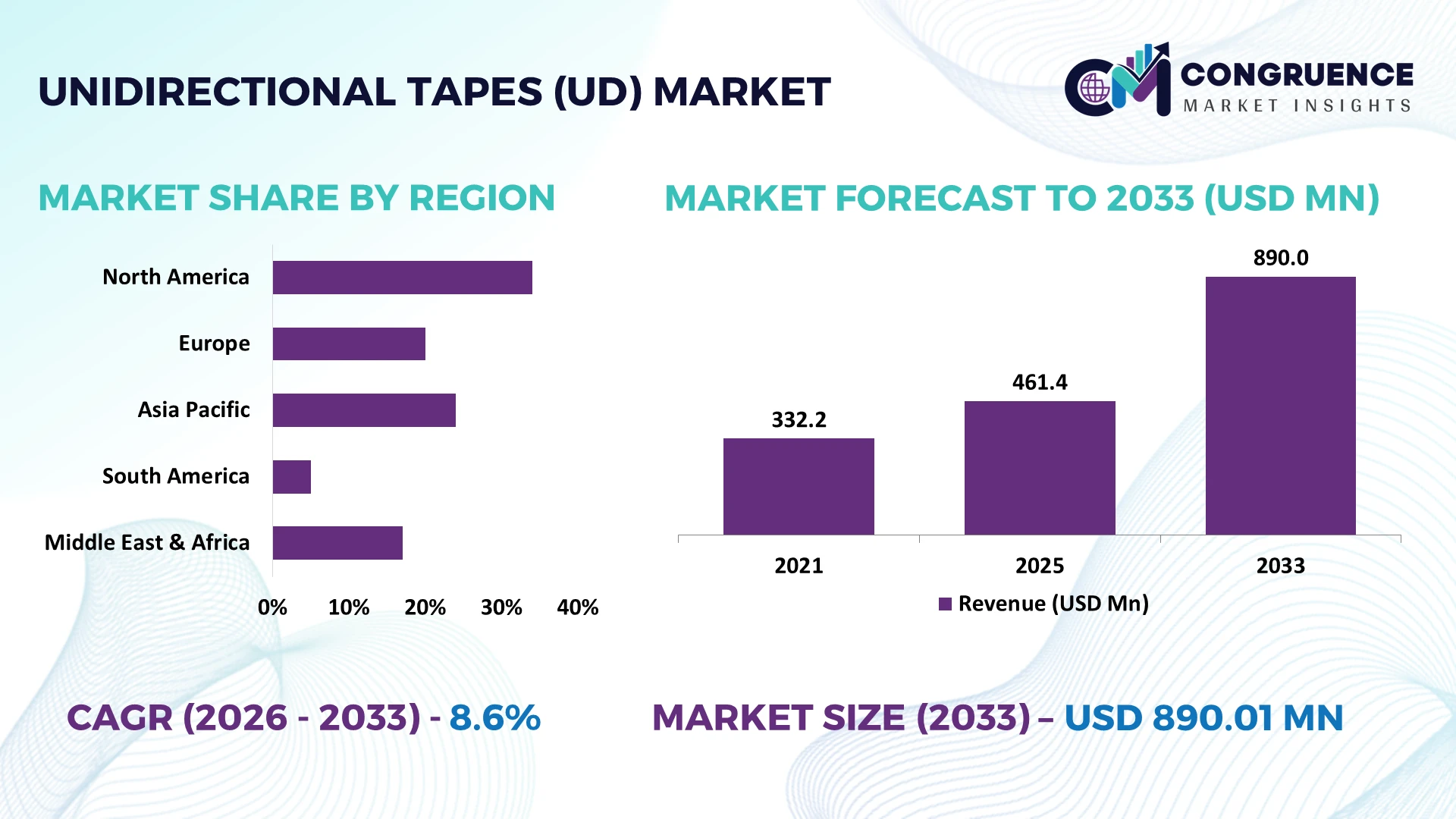
The United States remains a leading country, accounting for approximately 20.5% of global market share, supported by aerospace, defense, automotive, and advanced composite manufacturing. Carbon-fiber UD tapes hold about 55% demand share, while U.S. capacity expansion and supply-chain localization are strengthening domestic adoption. China is rapidly expanding composite-material capacity, intensifying competition in advanced manufacturing and strategic material supply chains.
Strategic implication: manufacturers should prioritize localized capacity, recyclable thermoplastic UD systems, automated processing, and qualification-intensive aerospace and mobility applications to secure high-value growth.
Market Size & Growth: USD 461.35 Million in 2025 to USD 890.01 Million by 2033 at 8.56% CAGR, driven by automated composite processing and lightweight structural design.
Top Growth Drivers: Aerospace & defense 38.5%; carbon-fiber UD tapes 55%; thermoplastic UD tapes 58.8%, demonstrating strong performance-led material substitution.
Short-Term Forecast: By 2030, automated UD-tape processing targets cycle-time reductions of up to 30%, improving throughput across aerospace and automotive composite production.
Emerging Technologies: AI-enabled process monitoring, automated fiber placement, robotic tape laying, and PEEK, PEKK, and PPS thermoplastic systems are advancing consistency, consolidation speed, and recyclability.
Regional Leaders: North America, Europe, and Asia Pacific remain the three leading regions, with projected 2033 values of approximately USD 284.8 Million, USD 249.2 Million, and USD 267.0 Million, respectively; Asia Pacific is accelerating composite manufacturing capacity.
Consumer/End-User Trends: Aerospace and defense account for approximately 38.5% of thermoplastic carbon UD tape demand, while automotive users increasingly adopt UD reinforcement for lightweight structures and EV efficiency.
Pilot/Case Example: The 2018 FORTAPE project demonstrated up to 90.65% raw-material savings for an aeronautical seat-leg application and 51.10% energy savings for an automotive door panel.
Competitive Landscape: Leading suppliers include Toray, Hexcel, Solvay, Teijin, Evonik, SABIC, Celanese, and Victrex, with competition centered on advanced fibers, thermoplastic matrices, automated processing, and aerospace-qualified solutions.
Regulatory & ESG Impact: Sustainability requirements are accelerating recyclable thermoplastic adoption, while advanced composite processing demonstrated potential energy reductions of up to 68.63% in aeronautical manufacturing.
Investment & Funding: The €5.03 Million FORTAPE program and major manufacturer capacity expansions highlight continued investment in automated UD production, localized composite supply, and next-generation thermoplastic technologies.
Innovation & Future Outlook: Low-melt PAEK, PEEK, PPS, inline sensing, automated placement, and recyclable thermoplastic architectures are shifting competition toward high-throughput, digitally controlled, qualification-ready composite systems.
Unidirectional Tapes (UD) are gaining demand across aerospace structures, EV components, pressure vessels, wind systems, sports equipment, and industrial reinforcement, where directional strength improves material efficiency. Carbon fiber remains central, representing about 55% share, while thermoplastic innovations are accelerating automated processing, welding, and recyclability. Supply-chain localization is becoming strategically important amid U.S.-China materials competition, strengthening the shift toward qualified regional sourcing and integrated composite manufacturing.
Thermoplastic Processing Accelerates: Aerospace and automotive manufacturers are shifting toward PEEK, PEKK, and PPS UD tapes as rapid consolidation replaces slower thermoset workflows. Thermoplastic processing can reduce cycle times by up to 30%, while automated forming increasingly integrates heating, consolidation, and trimming into single workflows. Suppliers are scaling compatible tape systems and strengthening OEM partnerships to support high-rate production.
Automated Layup Gains Ground: AFP, ATL, robotic tape placement, and inline inspection are reducing labor-intensive manual handling, with automated placement improving deposition consistency by roughly 15–25% in advanced composite workflows. Aircraft manufacturers are increasing robotic integration as skilled-labor shortages intensify, prompting tape producers to optimize slit widths, tack, impregnation, and placement compatibility for automated cells.
Wind Supply Chains Localize: Larger offshore turbines are increasing demand for glass-fiber UD reinforcement, particularly in spar caps and load-bearing blade sections. Blade lengths above 115 meters are raising material intensity, while 8–12 MW turbine platforms in China and India are accelerating localized sourcing. Manufacturers are responding through regional production partnerships and higher-volume glass-fiber tape capacity to control logistics exposure and lead times.
Recycling Enters Procurement: Sustainability requirements are shifting UD-material selection toward recyclable thermoplastic matrices and recovered-fiber feedstocks. Thermoplastic systems can support material recovery and remanufacturing pathways, while recycled composite content is becoming increasingly relevant in procurement decisions. Companies are investing in closed-loop processing, resin reformulation, and hybrid fiber architectures, creating a less obvious trend: recyclability is increasingly influencing material qualification alongside mechanical performance.
Carbon Fiber Leads, Glass Fiber Accelerates
Carbon Fiber remains the leading type, accounting for approximately 55% market share, supported by its superior stiffness-to-weight ratio, fatigue resistance, and structural performance in aerospace and premium automotive applications. Its performance advantage enables manufacturers to justify higher material costs in load-critical components. Glass Fiber follows with approximately 35% share and is expanding through cost-sensitive automotive, industrial, and wind applications, where processing scalability and balanced mechanical properties improve manufacturing economics.
Aramid Fiber and Basalt Fiber remain specialized segments, collectively representing roughly 10% of demand and serving impact-resistant, ballistic, thermal, and industrial applications. Glass Fiber is gaining faster volume adoption as large wind structures prioritize cost control, while Carbon Fiber remains strategically dominant in high-performance structures. Companies are therefore increasing hybrid reinforcement development, expanding thermoplastic-compatible grades, and directing investment toward automated processing platforms that improve material utilization and production consistency.
Aerospace Leads, Automotive Scales Faster
Aerospace Structures represent the leading application at approximately 40% share, supported by extensive use in wings, fuselage components, spars, brackets, and other load-bearing structures. Automotive Components account for roughly 30%, with adoption strengthening in EV battery enclosures, chassis reinforcement, body structures, and lightweight structural systems. Aerospace maintains higher material-value concentration, while automotive is expanding through automated manufacturing and pressure to reduce vehicle weight without increasing assembly complexity.
Wind Turbine Blades are emerging as the fastest-growing application as increasingly large offshore turbines require stronger, lighter spar-cap structures. Blade lengths exceeding 115 meters are increasing reinforcement requirements, while Sporting Goods remains a smaller but premium application for bicycles, rackets, skis, and other performance equipment. Companies are responding through larger-format glass-fiber tapes for wind, carbon-fiber precision products for sporting goods, and automated placement-compatible materials for automotive and aerospace production.
Aerospace Dominates, Wind Demand Shifts
Aerospace & Defense remains the dominant end-user group at approximately 39% share, reflecting intensive deployment across aircraft structures, defense platforms, and qualification-driven composite programs. Automotive represents another major buyer group, with purchasing increasingly linked to EV lightweighting and structural integration. Aerospace buyers prioritize certification, fatigue resistance, and consistency, whereas automotive purchasers emphasize cost, cycle time, automation compatibility, and scalable production economics.
Wind Energy is the fastest-shifting end-user segment as larger turbines increase demand for glass-fiber UD tapes in spar caps and other structurally critical blade sections. Sports & Recreation remains smaller but supports premium carbon-fiber products where low weight and stiffness command higher prices. Suppliers are responding through application-specific grades, OEM partnerships, localized production, and customized resin systems. Future demand is therefore shifting toward buyers requiring scalable, automated, and application-qualified UD solutions rather than standalone reinforcement materials.
North America accounted for the largest market share at 39.4% in 2025 however, Asia-Pacific is expected to register the fastest growth, expanding at a CAGR of 9.2% between 2026 and 2033.
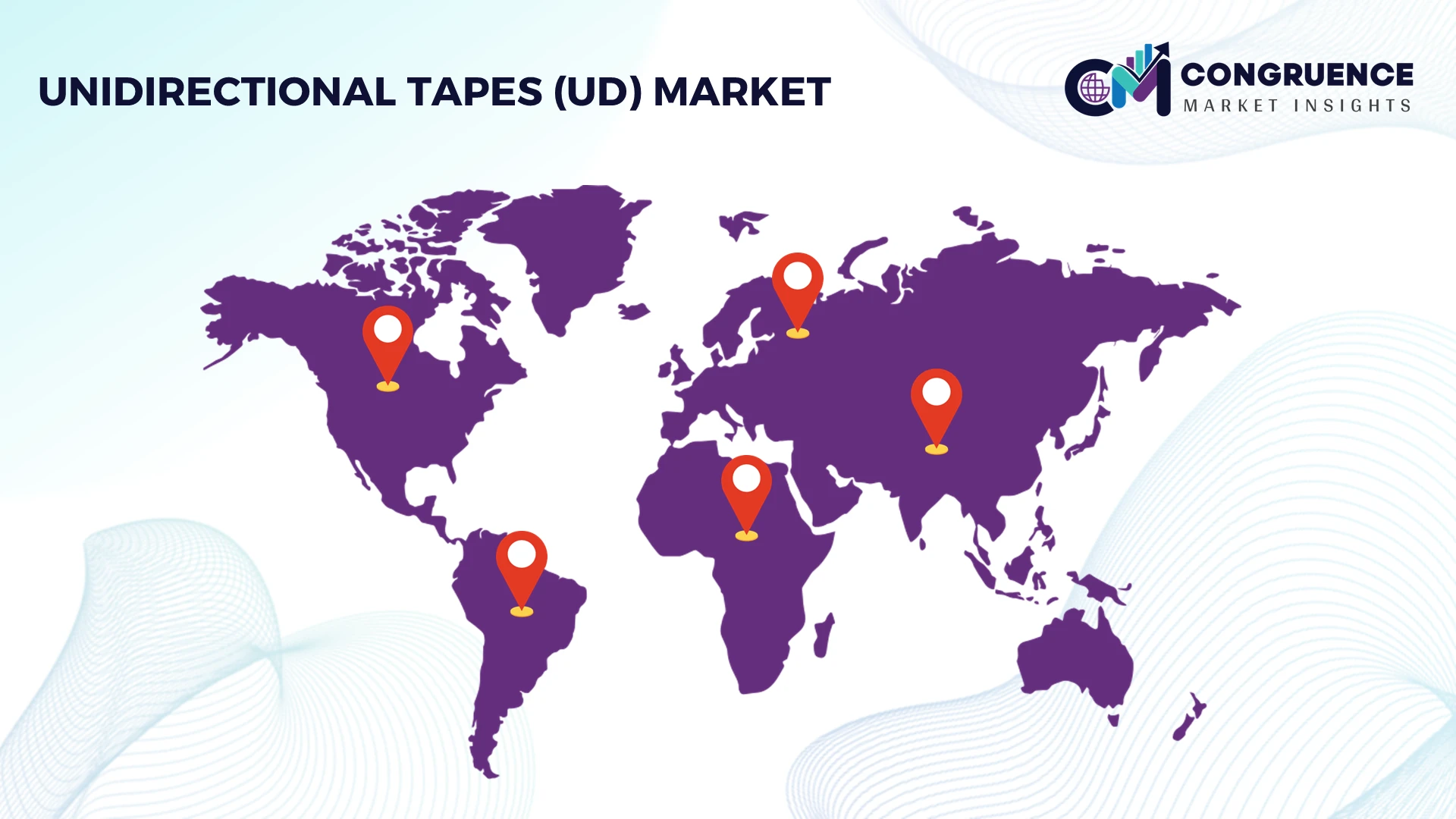
Aerospace qualification drives advanced composite localization
North America maintains the strongest UD-tape position through aerospace, defense, automotive lightweighting, and advanced manufacturing. The region captures approximately 39.4% of market activity, supported by established carbon-fiber supply chains and high-value aerospace programs. U.S. manufacturers are increasing automated fiber placement, thermoplastic consolidation, and digitally monitored tape deposition to reduce labor dependency and improve repeatability. Aerospace remains the largest demand concentration, while automotive suppliers are expanding UD reinforcement into EV structures and battery-related components. Strategic procurement is also shifting toward localized material availability as manufacturers seek greater resilience against international fiber and resin disruptions. Investments in automated composite production and qualification-ready thermoplastic materials are strengthening domestic supplier positioning and shortening development cycles.
United States Market Outlook: The United States represents the region's principal production and technology hub, supported by major aerospace manufacturing clusters and advanced composite research. Its large defense-industrial base and established carbon-fiber ecosystem support high-specification UD adoption. Growing deployment of robotic layup and thermoplastic processing is strengthening domestic manufacturing flexibility and reducing dependence on labor-intensive composite workflows.
Decarbonization accelerates recyclable composite adoption
Europe is strengthening UD-tape adoption through aerospace modernization, automotive lightweighting, wind-energy manufacturing, and stringent sustainability priorities. The region represents approximately 28% of global demand, with Germany, France, Italy, and the United Kingdom forming major industrial centers. European manufacturers are increasingly integrating thermoplastic UD tapes into automated forming and joining workflows to improve recyclability and reduce processing complexity. Automotive producers are prioritizing lightweight structural systems as electrification increases pressure on vehicle mass and range efficiency. Aerospace programs are simultaneously expanding automated composite production and qualification of advanced fiber architectures. EU sustainability requirements are increasing attention toward recyclable matrices, recovered fibers, and lower-waste processing, encouraging suppliers to redesign material portfolios and develop closed-loop manufacturing partnerships.
Germany Market Outlook: Germany provides a strong industrial base through automotive engineering, machinery manufacturing, and advanced materials development. Its large automotive manufacturing ecosystem supports demand for lightweight structural reinforcement and automated composite processing. Increasing integration of robotics and digitally controlled production is positioning German suppliers and OEMs to commercialize UD-based components at higher production volumes while maintaining dimensional and process consistency.
Manufacturing scale reshapes regional supply chains
Asia-Pacific is emerging as the fastest-expanding UD-tape manufacturing and consumption center, driven by China's aerospace programs, automotive production, wind-turbine manufacturing, and expanding composite-material capacity. China dominates regional industrial scale, while Japan, South Korea, and India contribute advanced materials expertise and growing end-use demand. Wind and automotive applications are particularly important because manufacturers require high-volume reinforcement at competitive processing costs. Chinese turbine manufacturers increasingly use glass-fiber UD structures in larger blades, while automotive producers are expanding lightweight composite integration. Regional suppliers are increasing local fiber, resin, and tape-conversion capacity to reduce imported-material dependence. The resulting supply-chain shift is moving competition toward vertically integrated production, localized qualification, and faster delivery.
China Market Outlook: China is the region's most strategically significant market because of its enormous automotive manufacturing base, expanding aerospace ecosystem, and leadership in wind-turbine deployment. The country installed more than 80 GW of new wind capacity in 2023, creating substantial structural-composite demand. Domestic material expansion is also improving supply security and supporting competitively priced UD-tape production.
Wind and industrial applications broaden demand
South America's UD-tape market remains concentrated in Brazil, where aerospace, automotive, wind energy, sporting goods, and industrial composites provide the strongest application base. Brazil's established aircraft manufacturing ecosystem creates higher-value demand for carbon-fiber reinforcement, while renewable-energy investment supports additional glass-fiber consumption. Regional adoption remains smaller than North American, European, and Asian markets because advanced composite conversion capacity is less extensive and imported fibers and resins can increase production costs. Companies are therefore emphasizing application-specific products rather than broad portfolio expansion. Local partnerships, distributor networks, and proximity to aerospace and renewable-energy customers are becoming important competitive tools. Brazil's combination of aircraft manufacturing and renewable-energy infrastructure gives suppliers opportunities to establish localized technical support and reduce logistics-related delays.
Brazil Market Outlook: Brazil offers the region's strongest UD-tape opportunity through its aerospace manufacturing capabilities and expanding renewable-energy ecosystem. The country's aircraft industry supports sophisticated carbon-fiber applications requiring tight process control and qualification. Wind-power expansion provides an additional volume opportunity, particularly for glass-fiber reinforcement, allowing suppliers to diversify beyond aerospace into larger industrial structures.
Industrial diversification creates new composite demand
Middle East & Africa is developing UD-tape demand through aerospace investment, renewable-energy projects, infrastructure modernization, and industrial diversification. The UAE and Saudi Arabia are leading strategic activity, using large-scale investment programs to build advanced manufacturing capabilities and reduce dependence on imported industrial products. Aerospace MRO, defense manufacturing, wind-energy projects, and lightweight infrastructure components are creating specialized opportunities for composite materials. Adoption remains concentrated in high-value projects rather than broad-based manufacturing, making technical qualification and local partnerships particularly important. Companies are establishing regional distribution, processing, and manufacturing relationships to improve project responsiveness. Increasing renewable-energy deployment is also broadening demand beyond aerospace and defense, creating opportunities for glass-fiber and hybrid UD systems in large structural applications.
United Arab Emirates Market Outlook: The UAE has a strong strategic position through aerospace manufacturing, defense capabilities, and advanced industrial investment. Its established aviation ecosystem and composite-processing expertise support premium UD applications, while major manufacturing-development initiatives encourage localized production. The country's aerospace sector handles more than 1,000 aircraft annually through its broader aviation ecosystem, supporting demand for lightweight and high-performance composite technologies.
Toray, Hexcel, Teijin, Solvay, and SGL Carbon compete with specialized regional tape converters and technology-focused composite suppliers, creating a market centered on aerospace-grade performance versus cost-efficient industrial scale. The top five players collectively command an estimated 35–40% share, leaving meaningful space for specialized suppliers. Competition increasingly rests on technology, qualification, supply security, and processing compatibility: automated-placement-ready products can improve manufacturing productivity by 15–25%, while thermoplastic systems can reduce composite cycle times by up to 30%. Leading companies are expanding production, forming OEM partnerships, developing PEEK and PEKK systems, and integrating fiber, resin, and tape-conversion capabilities to strengthen vertical control. The competitive shift is moving from material availability toward application-qualified systems and localized supply. High qualification costs, process expertise, and customer-specific specifications remain major entry barriers. Winning requires combining consistent fiber architecture, automated-processing compatibility, reliable supply, customization, and rapid technical qualification.
Toray Industries, Inc.
Hexcel Corporation
Teijin Limited
Solvay S.A.
SGL Carbon SE
Mitsubishi Chemical Group Corporation
Celanese Corporation
Victrex plc
Avient Corporation
Gurit Holding AG
Covestro AG
Park Aerospace Corp.
Current automation is centered on AFP/ATL, inline inspection, and digitally controlled consolidation. Automated placement can raise deposition consistency by 15–25% versus manual layup, while dry UD systems reduce handling waste. Adoption is strongest in aerospace, where qualified automated workflows support higher throughput and tighter dimensional control.
Emerging thermoplastic UD technologies using PEEK, PEKK, and PPS integrate heating, consolidation, forming, and welding. Compared with conventional thermoset processing, integrated thermoplastic forming can cut cycle time by up to 30% while reducing assembly steps by 10–20%. Toray, Hexcel, and Teijin benefit through differentiated high-temperature materials and OEM qualification.
Disruptive fiber-steering, AI-enabled defect detection, and real-time process analytics are moving UD production toward closed-loop manufacturing. AI inspection can reduce defect-detection time by roughly 20%, while automated fiber orientation optimization improves structural efficiency by 5–10%. This integration strengthens supply-chain resilience by enabling localized production and faster material qualification. Companies investing early gain development cycles, lower rework exposure, and customization capabilities. By 2028, recyclable matrices, robotic deposition, machine-vision inspection, and digitally optimized layup will become increasingly interconnected across aerospace, EV, wind, and industrial composite programs.
November 2024 Toray Advanced Composites acquired Gordon Plastics’ assets, technology, and IP, adding a 47,000-square-foot Colorado facility for thermoplastic composite UD tapes. The expansion increased development and production capacity, strengthening U.S. supply and higher-temperature polymer capabilities and testing. Source: aerospace-manufacturing-and-design.com
May 2025 Hexcel and Specialty Materials introduced Hy-Bor high-modulus UD prepreg combining carbon and boron fibers. Testing showed more than 2X improvement in compression and flexural strength versus baseline carbon composites, expanding high-performance options for defense, aerospace structures. Source: hexcel.com
July 2025 Technology Innovation Institute developed the MENA region’s first thermoplastic carbon-fiber UD tape specifically designed for automated fiber placement. The water-based formulation expands materials capability and supports lightweight, recyclable aerospace and space components through localized advanced-composite production. Source: tii.ae
June 2025 AGY partnered with A+ Composites to launch thermoplastic UD tapes using S2 Glass roving with LM PAEK and PEI resin systems. The products target aerospace, defense, and industrial applications, strengthening lightweight performance and scalable tape supply.
The Unidirectional Tapes (UD) Market Report covers Carbon Fiber, Glass Fiber, Aramid Fiber, and Basalt Fiber across Automotive Components, Aerospace Structures, Wind Turbine Blades, and Sporting Goods. End-user analysis includes Automotive, Aerospace & Defense, Wind Energy, and Sports & Recreation, capturing mature demand centers alongside emerging composite applications.
The report evaluates North America, Europe, Asia-Pacific, South America, and Middle East & Africa, with country-level operational insights where market concentration and industrial activity are significant. Technology coverage includes thermoplastic matrices, automated fiber placement, automated tape laying, inline inspection, fiber steering, recyclable materials, and digital process control. Competitive analysis covering major global suppliers supports investment planning, regional expansion, technology prioritization, supply-chain positioning, and competitive strategy through 2026–2033.
| Report Attribute/Metric | Report Details |
|---|---|
Market Revenue in 2025 | USD 1760 Million |
Market Revenue in 2033 | USD 5809.92 Million |
CAGR (2026 - 2033) | 16.1% |
Base Year | 2025 |
Forecast Period | 2026 - 2033 |
Historic Period | 2021 - 2025 |
Segments Covered | By Type
By Application
By End-User
|
Key Report Deliverable | Revenue Forecast, Growth Trends, Market Dynamics, Segmental Overview, Regional and Country-wise Analysis, Competition Landscape |
Region Covered | North America, Europe, Asia-Pacific, South America, Middle East, Africa |
Key Players Analyzed | Microsoft Corporation, IBM Corporation, Broadcom Inc., BMC Software, Inc., Flexera Software LLC, VMware, Inc., Apptio, Inc., Hewlett Packard Enterprise, Dell Technologies Inc., Oracle Corporation, Amazon Web Services, Inc., Google Cloud, Turbonomic, CloudBolt Software |
Customization & Pricing | Available on Request (10% Customization is Free) |




