Global Under Sink Water Filter System Market Report Overview
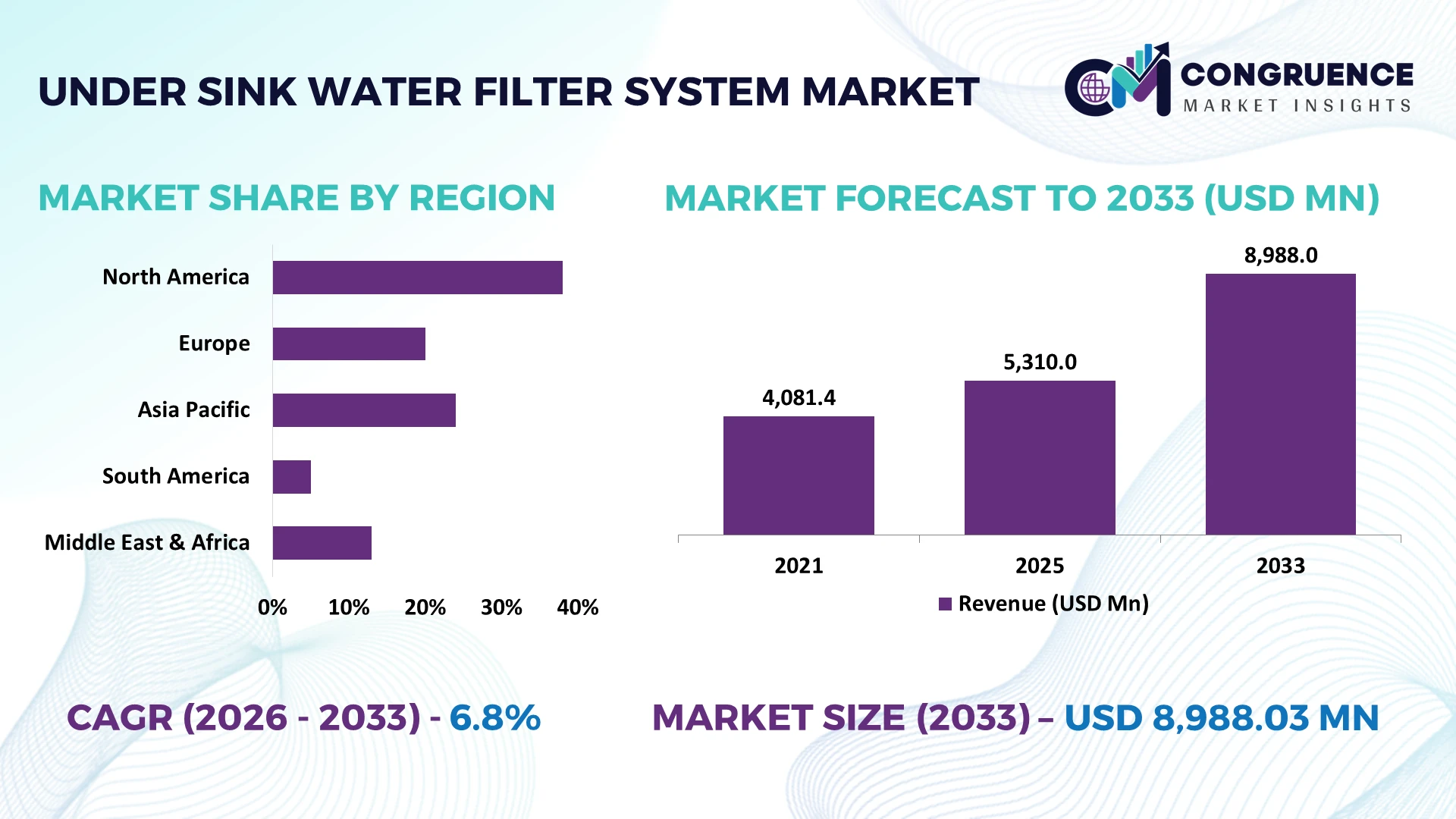
The Global Under Sink Water Filter System Market was valued at USD 5310 Million in 2025 and is anticipated to reach a value of USD 8988.03 Million by 2033 expanding at a CAGR of 6.8% between 2026 and 2033. Growth is driven by stricter PFAS drinking water regulations, adoption of compact reverse osmosis filtration, and replacement of bottled water with certified point-of-use purification systems.
The United States represents a leading country in the global under sink water filter system market, supported by established residential plumbing infrastructure, certified filtration manufacturers, and increasing attention to drinking water contaminants. The Environmental Protection Agency's 2024 drinking water rule established a 4-parts-per-trillion limit for PFOA and PFOS, strengthening demand for advanced activated carbon and reverse osmosis systems. Approximately 90% of Americans receive drinking water from public water systems, creating a substantial potential customer base. Compared with India, where household purification frequently addresses microbial contamination and dissolved solids, American purchasing decisions increasingly emphasize chemical contaminant reduction and independent certification.
Strategic implication: Manufacturers combining verified contaminant removal, compact installation, and affordable cartridge replacement are better positioned to secure residential upgrades and recurring aftermarket demand.
Key Highlights of the Global Under Sink Water Filter System Market
-
Market Size & Growth: USD 5,310 million in 2025, reaching USD 8,988.03 million by 2033 at 6.8% CAGR, supported by compact reverse osmosis adoption.
-
Top Growth Drivers: US consumers identified taste concerns at 47%, contaminants at 45%, and hard water at 23% in a 2025 survey.
-
Short-Term Forecast: By 2028, advanced systems targeting 50% lower wastewater discharge through 2:1 purified-to-drain water recovery configurations strengthen household efficiency.
-
Emerging Technologies: Tankless RO membranes, smart TDS monitoring, and multistage activated carbon filtration enable 3 complementary advances in residential water purification.
-
Regional Leaders: North America emphasizes PFAS-certified filtration, Asia-Pacific expands compact RO adoption, and Europe prioritizes cartridge efficiency; regional USD forecasts require validated geographic allocations.
-
Consumer/End-User Trends: A 2025 US survey found 63% household filter usage, while 9% reported under-sink filtration, indicating considerable conversion potential.
-
Pilot/Case Example: Waterdrop's 2025 customer survey recorded 51% tankless RO ownership among surveyed customers, demonstrating adoption within its existing customer base.
-
Competitive Landscape: Pentair, A. O. Smith, Culligan, 3M, and Aquasana compete across certified filtration and replacement cartridges; independently established global leader shares remain unavailable.
-
Regulatory & ESG Impact: US PFOA and PFOS limits of 4 parts per trillion strengthen demand for certified contaminant reduction and documented filter performance.
-
Investment & Funding: Investment priorities include 3 areas: membrane manufacturing, certified contaminant testing, and automated cartridge production; verified industrywide funding totals remain unavailable.
-
Innovation & Future Outlook: Advanced 2:1 RO recovery designs, connected filter-life indicators, and tool-free cartridge replacement support lower water wastage and simpler maintenance.
The Under Sink Water Filter System Market is increasingly influenced by household concerns about PFAS, lead, chlorine taste, and dissolved contaminants. Manufacturers are introducing tankless reverse osmosis systems, high-capacity carbon block cartridges, and integrated water quality monitoring to improve filtration convenience and performance. A 2026 US consumer survey found that 60% of respondents considered filtered water the most trustworthy drinking water option, reinforcing the importance of independently certified purification. Evolving US contaminant standards and expanding residential plumbing modernization are strengthening demand for compact, serviceable systems. These developments place filtration efficiency, certification, and replacement cartridge economics at the center of strategic market competition.
What Is the Strategic Relevance and Future Pathways of the Under Sink Water Filter System Market?
Under sink water filtration is becoming strategically important as drinking water safety shifts from centralized utility treatment toward household-level contaminant management. The United States Environmental Protection Agency's 2024 PFAS drinking water standards established a 4-parts-per-trillion threshold for PFOA and PFOS, increasing attention to independently certified point-of-use systems. Manufacturers are expanding contaminant-specific filtration portfolios and strengthening NSF/ANSI certification capabilities. This transition favors companies offering measurable removal performance, convenient maintenance, and reliable replacement cartridge availability over basic taste-improvement products.
Technology improvements are reshaping installation economics and household water consumption. Modern tankless reverse osmosis systems achieving a 2:1 purified-to-drain ratio reduce wastewater generation by approximately 75% compared with conventional systems operating at 1:3. American suppliers prioritize chemical contaminant certification, while Indian manufacturers emphasize dissolved solids reduction and compact installation. During 2026–2028, connected filter monitoring, higher-recovery membranes, and simplified cartridge replacement will increasingly influence product differentiation and service efficiency.
Waterdrop's tankless filtration systems demonstrate practical deployment through integrated membrane modules, electronic monitoring, and space-efficient under-counter configurations. Pentair, A. O. Smith, and Culligan are strengthening certified product portfolios, distribution partnerships, and replacement filter ecosystems. Manufacturers integrating filtration performance with predictable maintenance requirements gain stronger customer retention, lower servicing complexity, and more defensible competitive positioning.
Under Sink Water Filter System Market Dynamics
DRIVER:
Rising Contaminant Awareness and Certified Household Filtration
Increasing awareness of drinking water contamination is accelerating adoption of certified under sink filtration systems. A 2025 American consumer survey identified taste concerns among 47% of respondents, contaminant concerns among 45%, and hard water concerns among 23%, demonstrating multiple purchasing motivations. The United States' PFAS regulatory framework has intensified attention to point-of-use technologies capable of reducing persistent chemicals. Manufacturers are responding with NSF/ANSI 53 and 58 certified filtration products, activated carbon cartridges, and advanced reverse osmosis membranes. Pentair and A. O. Smith are strengthening contaminant-specific product positioning through certification and retail distribution. The commercial advantage lies in converting contamination concerns into measurable filtration specifications, allowing premium systems to compete on verified performance rather than promotional claims.
RESTRAINT:
Installation Costs and Replacement Cartridge Dependency
Under sink filtration adoption faces structural limitations from plumbing compatibility, cartridge replacement expenditure, and reverse osmosis wastewater generation. Conventional RO systems operating at a 1:3 purified-to-drain ratio discharge approximately 75% of incoming water, increasing household water consumption. Even modern systems achieving 50% recovery require adequate inlet pressure and suitable drain connections. In India, variable municipal water pressure and compact kitchen plumbing layouts complicate installation, particularly in older residential buildings. Replacement cartridges also introduce recurring ownership costs, while proprietary filter connections restrict supplier interchangeability. Manufacturers are responding through standardized fittings, longer-life filtration media, and higher-recovery membrane designs. Reducing installation complexity and consumable dependency is essential for expanding adoption beyond premium residential households.
OPPORTUNITY:
Smart Filtration Platforms and Water-Efficient Membrane Systems
Connected filtration platforms are creating opportunities to integrate household water purification with predictive maintenance and recurring cartridge services. Advanced reverse osmosis systems operating at a 2:1 purified-to-drain ratio achieve approximately 67% water recovery, compared with 25% for conventional 1:3 configurations. This improvement strengthens suitability for water-constrained households in India and other markets experiencing municipal supply pressure. Smart monitoring systems can track filter usage, membrane performance, and replacement intervals, enabling maintenance based on operating conditions rather than fixed schedules. Manufacturers are developing connected dispensing interfaces, modular cartridges, and compact tankless architectures. Companies combining digital maintenance alerts with direct replacement filter distribution can strengthen customer retention while reducing avoidable service visits and unnecessary cartridge replacement.
CHALLENGE:
Maintaining Certified Performance Across Variable Water Conditions
Maintaining consistent contaminant removal performance across diverse household water conditions represents a critical technical challenge. Reverse osmosis membranes typically achieve 90–99% dissolved solids rejection under specified testing conditions, but actual performance depends on feedwater chemistry, pressure, temperature, and membrane maintenance. Activated carbon filtration performance also varies with contaminant concentration and cartridge saturation. In the United States, certified PFAS reduction requires dependable performance at extremely low contaminant concentrations, increasing testing and quality assurance complexity. Manufacturers must strengthen membrane validation, sensor calibration, and field-service training to maintain product reliability. Integration of electronic monitoring introduces additional requirements for component durability and diagnostic accuracy. Long-term competitiveness depends on delivering repeatable filtration performance throughout the service interval, not merely achieving laboratory certification during product development.
Under Sink Water Filter System Market Latest Trends
-
Tankless Systems Reshape Kitchen Installations: Compact reverse osmosis units are replacing storage-tank configurations in premium residential kitchens. Traditional systems often require 3–4 gallons of reject water per purified gallon, while advanced 2:1 recovery models discharge approximately 0.5 gallons. Removing the storage tank also frees substantial cabinet space and reduces stored-water stagnation concerns. Manufacturers including Waterdrop and A. O. Smith are expanding integrated membrane modules, quick-connect fittings, and high-flow dispensing systems to simplify installation and improve kitchen compatibility.
-
Certification Reshapes Contaminant Removal Claims: American filtration manufacturers are adapting product testing and labeling to increasingly stringent chemical contaminant expectations. NSF/ANSI 42 addresses aesthetic performance, while NSF/ANSI 53 and 58 cover specified health-related contaminant reduction claims. The 2024 federal PFAS framework established 4-parts-per-trillion limits for PFOA and PFOS. Companies are expanding third-party testing, refining activated carbon formulations, and differentiating certified contaminant removal capabilities from general-purpose filtration products.
-
Subscription Cartridges Restructure Aftermarket Services: Filter manufacturers are introducing scheduled replacement programs and simplified cartridge interfaces to strengthen maintenance compliance. Sediment and carbon prefilters commonly require replacement within 6–12 months, depending on feedwater quality and consumption. Membrane replacement intervals frequently extend beyond 24 months under suitable operating conditions. Pentair, Culligan, and other established suppliers are strengthening direct-to-consumer cartridge distribution, creating predictable servicing workflows and reducing the risk of delayed filter maintenance.
-
High-Flow Filtration Supports Commercial Kitchens: Restaurants and cafés are adopting dedicated under-counter filtration to protect beverage equipment and maintain consistent water characteristics. Commercial systems commonly specify service flows of 1–3 gallons per minute, depending on equipment requirements. Activated carbon cartridges reduce chlorine-related taste interference, while specialized treatment protects coffee machines and dispensing equipment. Suppliers are expanding foodservice partnerships and application-specific cartridge configurations, allowing operators to coordinate water treatment with equipment maintenance schedules.
Segmentation Analysis
By Type
Reverse Osmosis Systems Lead Advanced Household Purification
Reverse Osmosis Systems represented an estimated 42.5% of global under sink water filter system demand in 2025, reflecting their broad contaminant reduction capabilities and established adoption in households experiencing elevated dissolved solids. Membrane-based filtration addresses dissolved salts and selected metals while integrating sediment and activated carbon pretreatment. India represents an important deployment center, where variable source-water quality supports household RO installations. Modern membranes commonly achieve 90–99% dissolved solids rejection under specified operating conditions, strengthening their positioning in performance-oriented residential applications. Manufacturers including A. O. Smith and Waterdrop are expanding compact designs and simplified cartridge replacement architectures to improve installation convenience.
Multi-Stage Filtration Systems represent the fastest-growing type as households increasingly seek combined sediment, chemical, and membrane treatment within integrated units. Activated Carbon Filters remain important for chlorine and taste improvement, particularly in municipally supplied homes. Ultrafiltration Systems address particulate and microbial reduction without conventional RO wastewater discharge, while Ceramic Filters serve specialized particulate filtration requirements. Advanced RO configurations achieving approximately 67% water recovery are improving operational efficiency. Suppliers are prioritizing modular cartridges, integrated monitoring, and application-specific filtration combinations.
- The Water Quality Association's 2025 consumer research found that 63% of surveyed American households used water filtration products, demonstrating established familiarity with household treatment technologies and supporting opportunities for higher-performance under sink systems.
By Application
Drinking Water Purification Dominates Household Filtration Applications
Drinking Water Purification accounted for an estimated 48.6% of global under sink water filter system applications in 2025, supported by household preferences for dedicated drinking and cooking water treatment. Under-counter systems provide point-of-use purification without requiring whole-house plumbing modifications, making them suitable for apartments and existing residential buildings. Drinking water applications increasingly combine activated carbon, sediment filtration, and reverse osmosis membranes to address multiple water quality concerns. American households prioritize certified contaminant reduction, while Indian consumers frequently evaluate dissolved solids performance and water taste. Manufacturers are expanding certified product portfolios and offering configurations matched to municipal or groundwater characteristics.
Heavy Metal Reduction represents the fastest-growing application as awareness of lead contamination and other dissolved metals strengthens demand for performance-verified filtration. Chlorine and Chemical Reduction remains important for municipally treated water, while Taste and Odor Improvement supports lower-maintenance carbon filtration. Microbial Contaminant Reduction requires technologies validated for relevant organisms and operating conditions. The EPA's 4-parts-per-trillion PFAS thresholds have increased attention to chemical filtration specifications. Suppliers are integrating contaminant-specific media and clearer performance documentation to strengthen purchasing confidence.
- The US Environmental Protection Agency's 2025 drinking water guidance emphasized selecting independently certified treatment devices for specific contaminants. This reinforces application-based product differentiation, particularly where households require verified lead, PFAS, or other chemical reduction performance.
By End-User
Residential Households Anchor Point-of-Use Filtration Demand
Residential Households accounted for an estimated 72.4% of global under sink water filter system demand in 2025, reflecting widespread installation in kitchens and dedicated drinking water dispensing points. Household purchasing decisions emphasize contaminant removal, cabinet space, cartridge replacement frequency, and installation convenience. The United States benefits from established residential plumbing infrastructure, while India represents a substantial market for compact membrane-based purification. A 2025 American consumer survey found that 63% of respondents used household water filtration products, indicating established familiarity with treatment technologies. Manufacturers are expanding direct-to-consumer distribution, installer partnerships, and maintenance services to improve customer acquisition and recurring cartridge availability.
Restaurants and Cafés represent the fastest-growing end-user segment, supported by increasing requirements for consistent beverage preparation and equipment protection. Hotels and Resorts prioritize reliable guest drinking water, while Offices and Commercial Buildings deploy dedicated filtration at pantry and refreshment points. Healthcare Facilities require carefully specified water treatment appropriate to their intended applications. Commercial systems commonly support dispensing flows of 1–3 gallons per minute. Suppliers are introducing higher-capacity cartridges, service contracts, and equipment-specific filtration configurations to strengthen institutional adoption.
- The Water Quality Association's 2025 consumer findings identified water quality concerns as an important factor in household filtration decisions. The results support residential product positioning based on certified treatment performance, maintenance convenience, and application-specific contaminant reduction.
Region-Wise Market Insights
North America accounted for the largest market share at an estimated 34.5% in 2025 however, Asia-Pacific is expected to register the fastest growth, expanding at a CAGR of 8.4% between 2026 and 2033.
North America Under Sink Water Filter System Market
Certified Contaminant Reduction and Residential Filtration Modernization
North America represented an estimated 34.5% of global under sink water filter system demand in 2025, supported by established residential plumbing infrastructure, advanced filtration distribution networks, and increasing awareness of drinking water contaminants. The United States dominates regional adoption, while Canada contributes through residential renovation and municipal water quality initiatives. Reverse osmosis and activated carbon systems are increasingly specified for reducing lead, PFAS, chlorine, and selected dissolved contaminants. Pentair, A. O. Smith, and Culligan compete through certified filtration portfolios, installer partnerships, and replacement cartridge networks. The US Environmental Protection Agency's 2024 drinking water standards established a 4-parts-per-trillion limit for PFOA and PFOS, intensifying attention to performance-verified household treatment. Manufacturers are strengthening NSF/ANSI certification, expanding compact filtration configurations, and improving cartridge availability. Competitive differentiation increasingly depends on documented contaminant removal, installation compatibility, and predictable maintenance expenditure.
United States Market Outlook: The United States benefits from mature plumbing distribution channels, established certification infrastructure, and extensive residential filtration product availability. Approximately 90% of Americans receive drinking water from public water systems, creating a substantial addressable population for point-of-use treatment. Manufacturers are expanding certified carbon block and reverse osmosis products while strengthening partnerships with home improvement retailers, plumbing contractors, and direct-to-consumer distribution platforms.
Europe Under Sink Water Filter System Market
Drinking Water Compliance and Resource-Efficient Filtration Adoption
Europe accounted for an estimated 24.2% of global under sink water filter system consumption in 2025, supported by established residential renovation activity, stringent drinking water quality requirements, and widespread availability of advanced plumbing products. Germany, the United Kingdom, France, and Italy represent important consumption centers, with manufacturers emphasizing compact filtration, chlorine reduction, and cartridge replacement convenience. The European Union's revised Drinking Water Directive introduces a 0.1 µg/L limit for the sum of 20 specified PFAS substances, strengthening contaminant monitoring requirements. European suppliers increasingly develop activated carbon and membrane filtration systems suited to localized water chemistry and kitchen installation constraints. Manufacturers are also prioritizing water-efficient treatment configurations to reduce unnecessary discharge. Competition increasingly centers on filtration certification, installation simplicity, and durable replacement cartridge distribution, particularly in established residential renovation markets.
Germany Market Outlook: Germany maintains a sophisticated water treatment equipment ecosystem supported by advanced membrane engineering, precision manufacturing, and established plumbing distribution networks. BWT and BRITA contribute to domestic filtration technology development and consumer product distribution. German households frequently prioritize water hardness management, taste improvement, and convenient maintenance. Suppliers are expanding compact filtration configurations and specialized cartridges suitable for kitchen cabinetry and integrated drinking water dispensing systems.
Asia-Pacific Under Sink Water Filter System Market
Manufacturing Localization and Advanced Household Purification Deployment
Asia-Pacific represented approximately 29.8% of global under sink water filter system demand in 2025, supported by concentrated appliance manufacturing, urban housing development, and diverse household water quality requirements. China maintains extensive filtration component production capabilities, while India represents an important market for reverse osmosis purification and compact kitchen installations. Japan and South Korea emphasize advanced membrane performance, electronic monitoring, and space-efficient product engineering. Regional manufacturers increasingly integrate sediment filtration, activated carbon, and reverse osmosis membranes into modular systems tailored to local water characteristics. China's manufacturing infrastructure supports membrane housing, pump, and cartridge production at industrial scale, strengthening export competitiveness. Indian suppliers are expanding domestic assembly, service networks, and replacement filter distribution. Competitive positioning depends on balancing contaminant removal performance, water recovery efficiency, and affordable maintenance across diverse household purchasing requirements.
China Market Outlook: China benefits from established appliance manufacturing clusters in Guangdong and Zhejiang, extensive filtration component supply chains, and advanced electronic appliance integration capabilities. Domestic manufacturers including Midea and Angel develop under sink purification systems incorporating multistage filtration, compact membrane modules, and digital monitoring. China's manufacturing ecosystem supports integrated sourcing of pumps, membranes, and electronic controls, enabling rapid product development and competitive export-oriented production.
South America Under Sink Water Filter System Market
Urban Water Quality Concerns and Localized Filtration Distribution
South America accounted for approximately 6.8% of global under sink water filter system demand in 2025, with Brazil representing the largest regional consumption center. Residential adoption is influenced by drinking water taste concerns, municipal distribution conditions, and increasing availability of compact filtration equipment. Brazil's established water treatment appliance industry supports domestic activated carbon filtration production, while advanced reverse osmosis systems occupy more specialized applications. Manufacturers increasingly target urban households, restaurants, and commercial kitchens through appliance retailers and plumbing distribution networks. Product affordability and replacement cartridge availability remain important purchasing considerations, particularly outside major metropolitan areas. Regional suppliers are strengthening domestic assembly, expanding compatible cartridge portfolios, and developing filtration configurations suited to variable municipal water characteristics. The strategic advantage lies in localized servicing and dependable consumable distribution rather than reliance on imported premium filtration equipment.
Brazil Market Outlook: Brazil maintains an established domestic drinking water purification industry, supported by manufacturers such as Europa and IBBL. São Paulo and other major urban centers provide concentrated distribution opportunities through residential appliance retailers and plumbing suppliers. Brazilian households frequently use point-of-use filtration for chlorine taste reduction and drinking water convenience. Manufacturers are strengthening cartridge availability, compact installation options, and local technical servicing to improve household accessibility.
Middle East & Africa Under Sink Water Filter System Market
Water Security Investment and Premium Residential Filtration
The Middle East & Africa accounted for approximately 4.7% of global under sink water filter system demand in 2025, supported by urban residential development, hospitality infrastructure, and increasing attention to household drinking water quality. Saudi Arabia and the United Arab Emirates represent important premium filtration markets, while South Africa contributes through residential and commercial water treatment requirements. Gulf countries rely extensively on desalinated municipal supplies, creating distinct filtration requirements related to taste, residual disinfectants, and distribution-system conditions. Under sink activated carbon and multistage filtration systems are increasingly integrated into premium residential kitchens and hospitality facilities. Manufacturers are strengthening partnerships with plumbing distributors, property developers, and commercial kitchen equipment suppliers. Market accessibility depends on installation expertise, cartridge availability, and product configurations suited to local water chemistry and operating temperatures.
Saudi Arabia Market Outlook: Saudi Arabia benefits from substantial investment in desalination infrastructure, residential construction, and hospitality development. The country operates one of the world's largest desalination industries, creating opportunities for household polishing filtration and point-of-use drinking water systems. Riyadh and Jeddah represent important urban deployment centers. Suppliers are expanding compact carbon filtration products, premium reverse osmosis configurations, and service partnerships targeting residential developers and hospitality operators.
Market Competition Landscape
The under sink water filter system market features competition between Pentair, A. O. Smith, Culligan, BRITA, and Waterdrop, alongside regional appliance manufacturers. The five leading suppliers collectively represent an estimated 30–35% of global market demand, reflecting fragmented distribution and differentiated filtration requirements. Pentair and Culligan compete through certified treatment technologies and professional installation networks, while Waterdrop emphasizes compact tankless systems and direct consumer distribution. A. O. Smith integrates membrane engineering with established appliance channels, whereas BRITA focuses on cartridge convenience and filtration performance. Advanced reverse osmosis systems achieving 67% water recovery outperform conventional configurations operating near 25%, strengthening efficiency differentiation. Manufacturers are expanding certified contaminant reduction portfolios, proprietary cartridge ecosystems, and connected maintenance capabilities. Certification expenditure, membrane reliability, and replacement filter availability remain significant entry barriers. Competitive success requires verified filtration performance, efficient water recovery, accessible servicing, and dependable consumable distribution across residential and commercial customer segments.
Companies Profiled in the Under Sink Water Filter System Market Report
Technology Insights for the Under Sink Water Filter System Market
Reverse osmosis membranes, activated carbon blocks, and ultrafiltration modules underpin modern under sink purification systems. Advanced thin-film composite membranes typically achieve 90–99% dissolved solids rejection under specified operating conditions, while certified carbon media target chlorine, lead, and selected organic contaminants. Compared with conventional reverse osmosis systems recovering 25% of incoming water, high-efficiency configurations achieving 67% recovery reduce wastewater discharge by approximately 89% per purified gallon. Manufacturers integrate booster pumps, automatic flushing, and compact filtration cartridges to improve installation flexibility and operating consistency.
Emerging technologies include graphene-enhanced membrane research, electroadsorptive filtration, and sensor-enabled cartridge monitoring. Connected systems measure conductivity, water consumption, and filter operating duration, supporting condition-based maintenance rather than fixed replacement schedules. Tankless architectures eliminate bulky storage vessels and integrate multiple treatment stages into compact assemblies. A 2025 American consumer survey reporting 63% household filtration usage demonstrates an established adoption foundation for advanced purification upgrades. Manufacturers benefit from improved maintenance visibility and stronger aftermarket engagement.
Between 2026 and 2028, predictive membrane diagnostics, higher-recovery filtration, and modular cartridge platforms will influence equipment investment priorities. Manufacturers targeting 10–15% fewer unnecessary service visits through connected monitoring can improve operating efficiency. Pentair, A. O. Smith, and Waterdrop compete through certified contaminant removal, compact system engineering, and replacement filter accessibility. Competitive advantage increasingly depends on verified filtration performance, dependable diagnostics, and reduced ownership complexity.
Recent Developments in the Global Under Sink Water Filter System Market
-
October 2026: A. O. Smith launched its Z3 under-sink purifier in India, featuring eight-stage RO and UV treatment with up to 55% water recovery. The product integrates mineralization and compact installation, strengthening water-efficient residential purification options. Source: fonearena.com
-
April 2026: LARQ introduced its under-sink water filtration system for United States customers, opening preorders ahead of April 30 shipments. Its advanced model subsequently received NSF certification for 1,452 gallons of PFAS reduction capacity, strengthening independently verified filtration positioning. Source: nsf.org
-
October 2025: Aquasana introduced upgraded Claryum under-sink filtration systems, including two-stage and three-stage configurations. Its enhanced Max Flow model delivers 44% faster flow, while stricter PFAS certification and expanded faucet options strengthen residential product performance and installation flexibility. Source: prweb.com
-
May 2025: Culligan launched its ZeroWater Technology filtration range, incorporating five-stage treatment and integrated dissolved solids monitoring. The systems claim 99.9% dissolved solids removal, demonstrating transferable filtration innovation and strengthening Culligan's broader household water treatment technology portfolio and differentiation. Source: culliganinternational.com
Scope of the Under Sink Water Filter System Market Report
The Under Sink Water Filter System Market Report evaluates filtration technologies, purchasing patterns, manufacturing capabilities, and competitive positioning between 2026 and 2033. Type segmentation covers Reverse Osmosis Systems, Activated Carbon Filters, Ultrafiltration Systems, Ceramic Filters, and Multi-Stage Filtration Systems. Application analysis examines Drinking Water Purification, Taste and Odor Improvement, Chlorine and Chemical Reduction, Heavy Metal Reduction, and Microbial Contaminant Reduction. End-user assessment includes Residential Households, Restaurants and Cafés, Hotels and Resorts, Offices and Commercial Buildings, and Healthcare Facilities.
Regional coverage encompasses North America, Europe, Asia-Pacific, South America, and Middle East & Africa, supported by country-specific infrastructure and adoption analysis. The report evaluates membrane efficiency, PFAS certification, smart monitoring, tankless integration, and cartridge replacement economics. Competitive assessment profiles 14 manufacturers, examining product differentiation, distribution partnerships, and investment priorities to support geographic expansion, technology selection, and long-term strategic planning.
Under Sink Water Filter System Market Report Summary
| Report Attribute/Metric | Report Details |
|---|
Market Revenue in 2025 | USD 5310 Million |
Market Revenue in 2033 | USD 8988.03 Million |
CAGR (2026 - 2033) | 6.8% |
Base Year | 2025 |
Forecast Period | 2026 - 2033 |
Historic Period | 2021 - 2025 |
Segments Covered | By TypeMulti-Stage Filtration Systems
By ApplicationDrinking Water Purification Taste and Odor Improvement Chlorine and Chemical Reduction Microbial Contaminant Reduction
By End-UserOffices and Commercial Buildings
|
Key Report Deliverable | Revenue Forecast, Growth Trends, Market Dynamics, Segmental Overview, Regional and Country-wise Analysis, Competition Landscape |
Region Covered | North America, Europe, Asia-Pacific, South America, Middle East, Africa |
Key Players Analyzed | Pentair plc, A. O. Smith Corporation, Culligan International, BRITA Group, Waterdrop, BWT Holding GmbH, Midea Group, Angel Drinking Water Industrial Group, Coway Co., Ltd., KENT RO Systems Ltd., Eureka Forbes Ltd., 3M Company, IBBL, Aquaphor International |
Customization & Pricing | Available on Request (10% Customization is Free) |





