
Reports
The Global Ultrasonic Cleaning Market was valued at USD 2162.41 Million in 2025 and is anticipated to reach a value of USD 3407.73 Million by 2033 expanding at a CAGR of 5.85% between 2026 and 2033.
Advanced precision manufacturing across semiconductor, medical device, and electric vehicle battery production increased industrial ultrasonic cleaning system deployment by over 18% between 2024 and 2026 due to higher contamination-control standards and automated cleaning efficiency gains exceeding 25% compared to conventional solvent-based methods. Between 2024 and 2026, tightening industrial wastewater regulations in North America and Europe, combined with supply chain diversification away from single-country sourcing after Red Sea shipping disruptions, accelerated investments in water-efficient and digitally monitored ultrasonic cleaning equipment across critical manufacturing facilities.
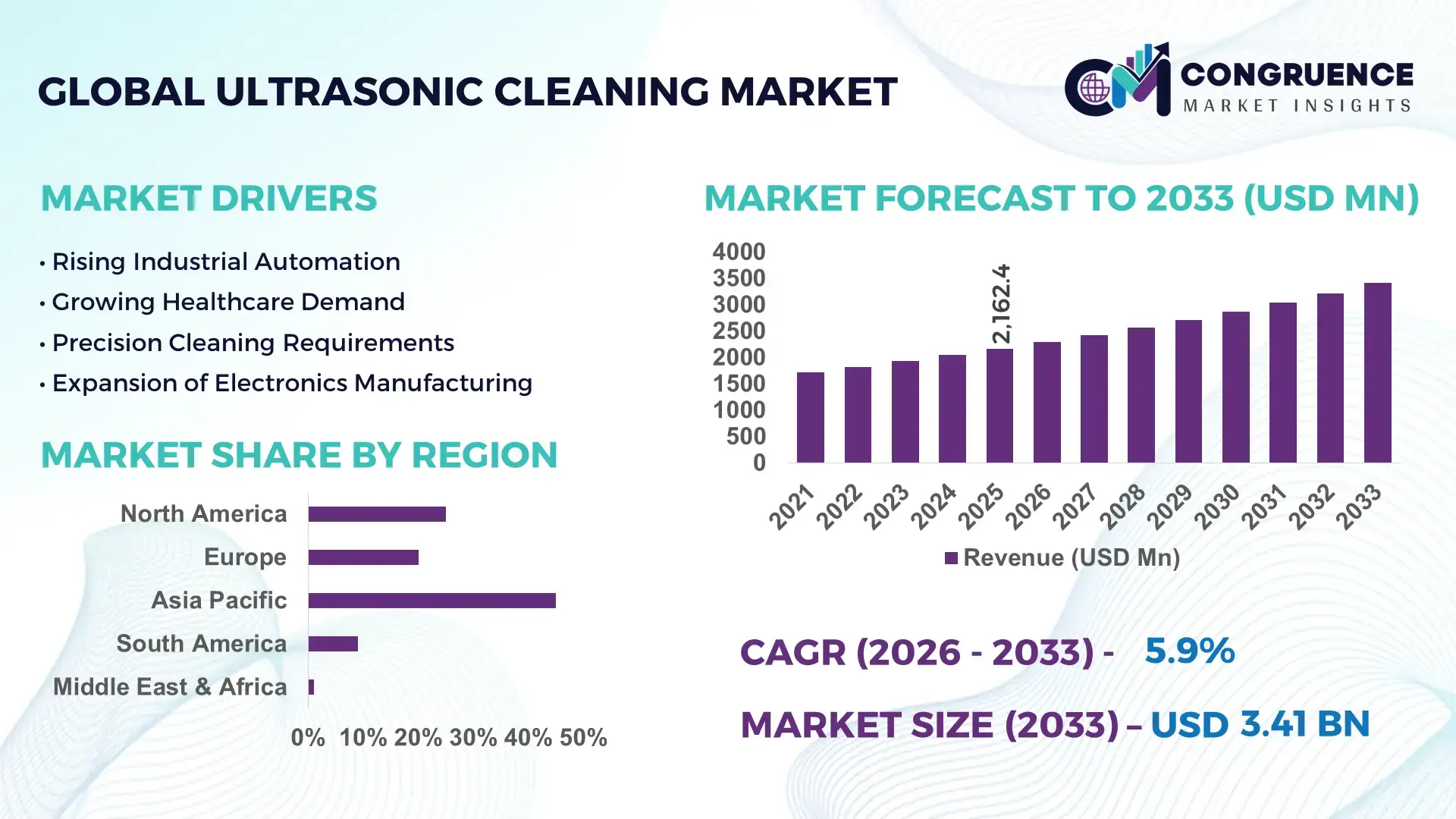
China remains the dominant country in the global ultrasonic cleaning market, accounting for nearly 34% of global manufacturing capacity in 2026, supported by large-scale electronics, automotive, and precision engineering industries. More than USD 420 million in industrial equipment modernization investments were directed toward automated cleaning technologies across eastern industrial provinces. Semiconductor and EV component manufacturers in China reported up to 30% faster contamination removal cycles using multi-frequency ultrasonic systems, while Japan and Germany maintained leadership in high-precision medical and aerospace cleaning technologies with defect reduction rates exceeding 20% in regulated production environments. Compared with traditional immersion cleaning systems, advanced ultrasonic platforms reduce chemical usage by approximately 35%, strengthening operational sustainability and production consistency.
Manufacturers expanding automated, energy-efficient, and compliance-ready ultrasonic cleaning solutions are positioned to secure higher-value contracts across regulated industrial supply chains through 2033.
Market Size & Growth: The global ultrasonic cleaning market reached USD 2162.41 million in 2025 and is projected to hit USD 3407.73 million by 2033, driven by 28% higher adoption of automated precision-cleaning systems in semiconductor and EV manufacturing.
Top Growth Drivers: Semiconductor cleaning demand expanded 24%, medical device sterilization equipment integration rose 19%, and automated industrial maintenance applications increased 21% between 2024 and 2026.
Short-Term Forecast: By 2027, advanced ultrasonic systems are expected to reduce industrial cleaning cycle time by 32% while lowering chemical consumption by nearly 27% across high-volume production facilities.
Emerging Technologies: AI-enabled monitoring, multi-frequency cavitation systems, and robotic ultrasonic platforms improved cleaning precision by 26% and boosted equipment uptime by 18% in advanced manufacturing operations.
Regional Leaders: Asia-Pacific is projected to surpass USD 1.45 billion by 2030 through electronics expansion, Europe exceeds USD 760 million with medical sterilization demand, and North America crosses USD 690 million through aerospace automation adoption.
Consumer/End-User Trends: Nearly 44% of healthcare and electronics manufacturers shifted toward compact automated ultrasonic systems to support contamination-control compliance and labor-cost optimization.
Pilot/Case Example: In 2025, a high-volume EV battery component facility implemented automated ultrasonic cleaning lines and achieved 29% lower rejection rates with 22% faster processing throughput.
Competitive Landscape: The top five companies collectively control approximately 38% of the global market, with leading competition centered on digital monitoring, energy-efficient systems, and customized industrial cleaning platforms.
Regulatory & ESG Impact: Stricter wastewater and solvent-emission regulations reduced chemical-intensive cleaning processes by 31%, accelerating adoption of water-efficient ultrasonic technologies across Europe and North America.
Investment & Funding: More than USD 900 million in industrial automation and precision-cleaning investments flowed into ultrasonic equipment expansion projects during 2024–2026 amid global supply chain restructuring.
Innovation & Future Outlook: Next-generation closed-loop ultrasonic cleaning systems integrated with smart factory infrastructure are improving operational efficiency by over 25% and strengthening predictive maintenance capabilities.
Medical devices, semiconductor fabrication, and automotive component manufacturing collectively contribute more than 61% of total ultrasonic cleaning equipment demand due to strict contamination-control requirements and precision production standards. Multi-frequency cleaning systems and AI-integrated monitoring platforms improved cleaning consistency by nearly 26% in 2026 industrial deployments. Asia-Pacific accounts for over 46% of global demand, while North America continues expanding adoption in aerospace and healthcare applications amid stricter environmental compliance standards. Increasing investment in compact automated systems and closed-loop water recycling technologies reflects the market’s transition toward energy-efficient, regulation-aligned industrial cleaning infrastructure, setting the stage for deeper strategic consolidation and technology-driven competition.
Ultrasonic cleaning systems are becoming strategically critical as precision manufacturing, semiconductor packaging, aerospace engineering, and medical sterilization standards intensify across global industrial supply chains. Manufacturers are accelerating investments in automated contamination-control infrastructure to reduce production defects, improve throughput, and optimize operating efficiency. Between 2024 and 2026, industrial deployment of advanced ultrasonic systems increased by 22% across electronics and healthcare facilities due to stricter particulate-control requirements and rising labor-cost pressure. Simultaneously, supply chain localization strategies in Asia and North America are transforming procurement priorities toward digitally monitored, energy-efficient cleaning platforms with lower operational risk exposure.
AI-enabled multi-frequency ultrasonic technology improves cleaning efficiency by 31% while reducing operating costs by 24% compared to legacy solvent-based immersion systems. Asia-Pacific leads in production volume, while Europe leads in adoption and innovation with 37% higher implementation of closed-loop ultrasonic systems integrated with smart manufacturing environments. By 2028, automated ultrasonic platforms are projected to reduce industrial maintenance downtime by 28% and lower chemical consumption by 33% across regulated manufacturing sectors. ESG-driven water recycling systems are also delivering measurable compliance advantages, helping facilities reduce wastewater discharge costs by nearly 18%.
In 2025, a medical-device manufacturing plant upgraded to robotic ultrasonic cleaning lines and achieved 27% faster sterilization cycles with 21% lower contamination rejection rates. Industrial equipment companies are increasingly shifting capital allocation toward compact modular systems, predictive maintenance software, and regional production expansion to strengthen competitive positioning. Companies capable of integrating automation, compliance efficiency, and precision-cleaning intelligence into scalable ultrasonic platforms are redefining long-term leadership across advanced industrial manufacturing ecosystems.
The rapid expansion of semiconductor fabrication, EV battery production, and medical device manufacturing is accelerating demand for advanced ultrasonic cleaning systems capable of achieving micron-level contamination control. Between 2024 and 2026, automated ultrasonic equipment installations increased by 23% across precision manufacturing facilities, while electronics manufacturers reported 28% lower defect rates after integrating multi-frequency cleaning technologies. Supply chain restructuring following Red Sea shipping disruptions forced manufacturers to localize component production, increasing investment in automated cleaning infrastructure across Asia and North America. Industrial companies are responding through capacity expansion, robotics integration, and strategic partnerships with automation providers to optimize throughput, reduce chemical dependence by 30%, and strengthen production consistency within highly regulated manufacturing environments globally.
High equipment acquisition costs and rising regulatory compliance requirements are constraining ultrasonic cleaning market scalability, particularly among mid-sized industrial manufacturers. Advanced multi-tank automated systems increased capital expenditure requirements by nearly 26% between 2024 and 2026 due to component inflation and higher sensor integration costs. Simultaneously, over 42% of industrial ultrasonic equipment relies on concentrated electronic component sourcing from East Asia, exposing manufacturers to supply disruption risks and procurement delays. Strict wastewater disposal regulations across Europe and North America are also increasing operational compliance expenses by approximately 18%. Companies are mitigating these pressures through supplier diversification strategies, long-term procurement contracts, localized assembly expansion, and adoption of hybrid cleaning technologies designed to reduce infrastructure dependency and operating complexity.
Smart factory integration and rising investment in high-precision manufacturing are redefining growth opportunities across the ultrasonic cleaning market. AI-enabled monitoring systems improved equipment uptime by 24% and reduced maintenance intervention costs by nearly 19% in 2026 industrial deployments. Demand from aerospace electronics, EV battery modules, and reusable medical instrument sterilization is accelerating deployment of compact automated cleaning systems across Southeast Asia and Eastern Europe. A major future signal is the rapid transition toward closed-loop water recycling platforms capable of reducing industrial fluid consumption by over 35%. Companies are positioning for long-term dominance through R&D acceleration, modular product development, and ecosystem partnerships integrating robotics, predictive analytics, and compliance-focused automation into next-generation ultrasonic cleaning infrastructure globally.
Infrastructure limitations, inconsistent process standardization, and rising energy optimization requirements are constraining long-term scalability across industrial ultrasonic cleaning operations. Nearly 34% of manufacturing facilities upgrading to automated ultrasonic systems reported integration delays linked to legacy production infrastructure incompatibility between 2024 and 2026. High-frequency cleaning systems also increased industrial power consumption by approximately 16%, intensifying operational pressure in regions facing electricity cost volatility and grid instability. Regulatory divergence across healthcare, aerospace, and semiconductor sectors continues complicating global equipment standardization and cross-border deployment efficiency. To remain competitive, manufacturers must accelerate investment in energy-efficient transducer technologies, digital calibration systems, workforce training programs, and strategic technology partnerships capable of ensuring scalable, compliant, and operationally resilient cleaning performance across advanced manufacturing environments worldwide.
AI-integrated cleaning systems improved process accuracy by 29% across electronics and medical manufacturing lines in 2026. Manufacturers are deploying sensor-based cavitation monitoring and predictive maintenance software to reduce manual calibration time by 21% and optimize production continuity. Companies are restructuring equipment portfolios toward digitally connected systems to improve contamination traceability and lower servicing interruptions across regulated industrial environments.
Automated multi-tank installations increased by 24% as labor shortages and throughput pressure reshaped factory operations globally. Automotive and semiconductor facilities reduced cleaning cycle times by nearly 31% through synchronized robotic handling and continuous-flow cleaning processes. Companies are accelerating modular equipment deployment to support localized manufacturing expansion following supply chain disruptions affecting component transportation and assembly timelines.
Asia-Pacific accounted for over 46% of new industrial ultrasonic system deployments, while Europe advanced high-efficiency adoption by 34%. China and Southeast Asia are optimizing large-scale electronics production capacity, whereas Germany and France are prioritizing energy-efficient cleaning infrastructure aligned with stricter wastewater compliance frameworks. This regional divergence is forcing suppliers to customize product strategies between volume-driven and compliance-driven industrial markets.
Subscription-based equipment servicing contracts expanded by 18%, redefining how industrial buyers manage ultrasonic cleaning infrastructure. Manufacturers increasingly prefer predictive maintenance agreements and performance-based service models that reduce unplanned downtime by 23%. A non-obvious shift is emerging as mid-sized manufacturers avoid outright equipment ownership to preserve capital flexibility during industrial automation transitions, prompting suppliers to expand lifecycle-support partnerships and recurring-service business models.
The ultrasonic cleaning market is segmented by type, application, and end-user, with industrial and precision-focused demand dominating deployment patterns. Industrial and multi-tank systems collectively account for over 58% of equipment installations due to large-scale manufacturing requirements and automated cleaning integration. Electronics cleaning and medical cleaning represent nearly 49% of application demand as contamination-control standards intensify globally. Healthcare and electronics manufacturers remain the leading end-users, while aerospace and automotive sectors are rapidly increasing adoption of automated ultrasonic platforms to improve defect reduction and operational consistency. Demand is shifting toward digitally monitored, energy-efficient systems as manufacturers prioritize throughput optimization, regulatory compliance, and lower chemical dependency across advanced industrial production environments.
Industrial ultrasonic cleaning systems dominate the market with approximately 41% share due to their scalability, high-capacity cleaning performance, and integration compatibility with automated production environments. Large automotive, semiconductor, and manufacturing facilities increasingly rely on industrial systems to optimize throughput and reduce contamination-related rejection rates by nearly 27%. Multi-tank systems are emerging as the fastest-growing segment, with deployment expansion exceeding 19% between 2024 and 2026 as precision industries prioritize sequential cleaning, rinsing, and drying efficiency within single automated workflows. Compared with benchtop systems, multi-tank platforms improve cleaning consistency by over 24% in regulated manufacturing applications.
Benchtop and portable systems collectively account for nearly 33% of installations, maintaining strong relevance across laboratories, dental clinics, jewelry cleaning, and small-scale industrial servicing operations where flexibility and lower acquisition costs remain critical. Portable systems are gaining traction in field maintenance and aerospace component servicing due to mobility advantages and lower operational complexity. Manufacturers are responding by expanding compact automated product lines, integrating digital monitoring capabilities, and prioritizing energy-efficient ultrasonic platforms optimized for modular industrial deployment. Investment focus is increasingly shifting toward scalable multi-frequency systems capable of supporting high-precision cleaning requirements across advanced manufacturing ecosystems.
Industrial component cleaning leads the ultrasonic cleaning market with approximately 32% share due to extensive deployment across precision engineering, heavy manufacturing, and machinery maintenance operations. Usage concentration remains strongest in facilities requiring continuous contamination removal, corrosion prevention, and automated surface treatment processes. Electronics cleaning is the fastest-growing application segment, expanding by nearly 23% between 2024 and 2026 as semiconductor miniaturization and EV component manufacturing intensify particulate-control requirements. Compared with jewelry cleaning, electronics cleaning systems deliver substantially higher operational utilization rates and stricter precision standards, reshaping equipment configuration priorities across industrial production lines.
Medical cleaning and automotive parts cleaning collectively contribute nearly 44% of application demand, driven by sterilization compliance requirements and high-volume component maintenance needs. Automotive manufacturers increasingly deploy ultrasonic systems to improve fuel injector and battery component cleaning precision, reducing rework rates by approximately 21%. Jewelry cleaning maintains niche relevance through compact benchtop system adoption in retail and specialty service operations. Companies are adapting by scaling automated multi-stage cleaning technologies, redesigning systems for contamination-sensitive applications, and expanding regional production capacity to support precision-focused industrial demand. Strategic investment is increasingly concentrating on electronics and healthcare applications where regulatory intensity and operational precision are redefining purchasing priorities.
Healthcare remains the leading end-user segment, accounting for approximately 29% of ultrasonic cleaning system demand due to strict sterilization standards, high instrument usage intensity, and increasing regulatory oversight across hospitals and diagnostic laboratories. Healthcare providers are prioritizing automated ultrasonic platforms capable of reducing manual cleaning errors by nearly 24% while improving surgical instrument turnaround speed. Electronics is the fastest-growing end-user segment, with adoption increasing by over 25% between 2024 and 2026 as semiconductor and EV battery manufacturers intensify contamination-control investments. Compared with traditional manufacturing facilities, electronics companies deploy higher-frequency precision systems with significantly greater automation integration.
Automotive, manufacturing, and aerospace segments collectively represent nearly 53% of market demand, driven by rising pressure to optimize component reliability, reduce rejection rates, and maintain production consistency. Aerospace manufacturers are increasingly adopting compact multi-frequency systems to support turbine and avionics component cleaning within highly regulated environments. Companies are targeting these end-users through customized pricing models, predictive maintenance partnerships, and application-specific system configurations optimized for throughput and compliance efficiency. Demand is clearly shifting toward digitally monitored, low-chemical-consumption systems as industrial buyers prioritize operational resilience, contamination traceability, and long-term automation scalability across critical manufacturing ecosystems.
Asia-Pacific accounted for the largest market share at 46% in 2025 however, North America is expected to register the fastest growth, expanding at a CAGR of 6.4% between 2026 and 2033.

Asia-Pacific leads global ultrasonic cleaning market demand through large-scale electronics, semiconductor, and automotive manufacturing concentration, with China, Japan, and South Korea driving over 52% of industrial system deployments. North America is accelerating adoption through automated medical sterilization and aerospace precision-cleaning investments, while Europe maintains strong innovation leadership with nearly 34% higher implementation of energy-efficient and closed-loop cleaning technologies. Supply chain diversification and stricter industrial wastewater regulations are reshaping equipment sourcing and operational standards across developed manufacturing economies. South America and the Middle East & Africa are expanding selectively through industrial modernization and infrastructure-linked applications. Global manufacturers are increasingly prioritizing Asia-Pacific for production scale, Europe for compliance-driven innovation, and North America for high-value automation deployment opportunities.
North America represents approximately 27% of global ultrasonic cleaning market demand, driven by strong adoption across healthcare, aerospace, semiconductor, and EV component manufacturing sectors. U.S.-based medical device and aerospace manufacturers increased automated ultrasonic system deployment by nearly 24% between 2024 and 2026 to strengthen contamination-control precision and operational throughput. Stricter FDA sterilization compliance standards and reshoring initiatives are accelerating investment in digitally monitored cleaning technologies and closed-loop fluid management systems. Industrial facilities reported nearly 21% lower maintenance downtime after integrating AI-enabled ultrasonic platforms into automated production workflows. Enterprise buyers increasingly prioritize long-term operating efficiency, predictive maintenance compatibility, and regulatory traceability, positioning North America as a critical region for premium industrial cleaning innovation and high-value manufacturing expansion strategies.
Europe accounts for nearly 24% of the global ultrasonic cleaning market, supported by advanced manufacturing industries in Germany, France, and Italy. Tightening wastewater discharge regulations and industrial sustainability mandates are forcing manufacturers to replace chemical-intensive cleaning methods with energy-efficient ultrasonic systems capable of reducing solvent usage by over 32%. Industrial operators across Europe increased adoption of closed-loop cleaning technologies by approximately 29% between 2024 and 2026 to strengthen ESG compliance and operational efficiency simultaneously. Medical device and aerospace manufacturers are also prioritizing multi-frequency precision cleaning platforms to improve contamination control standards and product reliability. Enterprise purchasing behavior remains strongly compliance-driven and quality-focused, making Europe a strategically important region where regulatory pressure is directly accelerating product innovation, automation investment, and environmentally optimized cleaning infrastructure deployment.
Asia-Pacific dominates the ultrasonic cleaning market with nearly 46% of global demand, led by China, Japan, South Korea, and India through large-scale electronics, automotive, and semiconductor manufacturing concentration. Regional manufacturers increased automated ultrasonic equipment installations by approximately 31% between 2024 and 2026 as localized production expansion and export-oriented industrialization accelerated precision-cleaning requirements. China alone contributes more than one-third of regional system manufacturing capacity due to integrated industrial supply chains and lower production costs. Enterprises across Asia-Pacific prioritize scalability, processing speed, and cost optimization, driving strong demand for modular multi-tank and robotic ultrasonic platforms. Equipment suppliers are expanding regional assembly operations and localized servicing infrastructure, positioning Asia-Pacific as the most critical region for production scale, volume growth, and long-term manufacturing ecosystem expansion.
South America contributes approximately 8% of global ultrasonic cleaning market demand, with Brazil and Argentina leading adoption across automotive servicing, industrial maintenance, and healthcare sterilization applications. Regional industrial operators increased ultrasonic equipment deployment by nearly 17% between 2024 and 2026 to improve maintenance efficiency and reduce chemical-intensive cleaning processes. However, infrastructure limitations, currency volatility, and high import dependency continue constraining large-scale automation investments and advanced system affordability. Mid-sized enterprises increasingly favor compact and portable ultrasonic systems due to lower acquisition costs and flexible operational deployment. Several regional distributors expanded localized servicing and leasing partnerships to improve market accessibility and reduce procurement pressure. South America presents a strong selective-growth opportunity, though operational scalability and economic stability remain key execution risks for long-term expansion strategies.
The Middle East & Africa region accounts for nearly 7% of global ultrasonic cleaning market demand, supported by industrial modernization projects across the UAE, Saudi Arabia, and South Africa. Oil and gas infrastructure maintenance, healthcare expansion, and aviation servicing operations are accelerating adoption of industrial ultrasonic cleaning systems capable of improving equipment lifecycle performance and contamination control efficiency. Regional deployment of automated cleaning technologies increased by approximately 16% between 2024 and 2026 as governments intensified investment in manufacturing diversification and industrial infrastructure modernization programs. Enterprises increasingly prefer durable, low-maintenance systems optimized for high-volume industrial usage and harsh operating conditions. Equipment suppliers are strengthening regional partnerships and technical servicing capabilities, positioning the region as an emerging strategic market linked to infrastructure transformation, industrial diversification, and operational modernization initiatives.
China – 34% market share in the Ultrasonic Cleaning market due to extensive electronics, semiconductor, and automotive manufacturing capacity supported by large-scale industrial automation investments.
United States – 21% market share in the Ultrasonic Cleaning market driven by strong healthcare sterilization demand, aerospace precision-cleaning requirements, and rapid adoption of AI-enabled automated cleaning systems.
The ultrasonic cleaning market is dominated by global industrial equipment leaders competing directly against regional automation-focused manufacturers and low-cost Asian suppliers. Companies such as Branson Ultrasonics, Crest Ultrasonics, Blue Wave Ultrasonics, Elma Schmidbauer, and SharperTek collectively control nearly 39% of global market positioning through precision engineering, automation integration, and application-specific customization. Competition is increasingly centered on cleaning efficiency, digital monitoring, energy optimization, and rapid deployment capability, with advanced multi-frequency systems improving contamination removal performance by over 28% compared to conventional platforms. Premium manufacturers are expanding through strategic healthcare and semiconductor partnerships, while regional suppliers compete aggressively on pricing and localized servicing. Vertical integration and predictive maintenance software adoption increased by approximately 22% across leading suppliers between 2024 and 2026. Rising compliance requirements and high automation integration costs remain major entry barriers. Winning requires scalable precision technologies, regional servicing strength, compliance-focused innovation, and operational reliability.
Branson Ultrasonics
Crest Ultrasonics
Blue Wave Ultrasonics
Elma Schmidbauer GmbH
SharperTek
Ultrawave Ltd.
Morantz Ultrasonics
Omegasonics
GT Sonic
Cleaning Technologies Group
Skymen Cleaning Equipment Shenzhen Co., Ltd.
Emerson Electric Co.
Kaijo Corporation
Mettler Electronics Corp.
Industrial ultrasonic cleaning technology is rapidly shifting toward AI-enabled multi-frequency systems capable of improving contamination removal efficiency by 31% while reducing manual calibration requirements by nearly 22%. More than 44% of semiconductor and medical-device manufacturers integrated digitally monitored ultrasonic platforms by 2026 to improve process consistency and defect traceability. Compared with legacy single-frequency systems, advanced multi-frequency cavitation platforms reduce cleaning cycle time by approximately 28% while lowering chemical dependency by 24%. Manufacturers benefiting most include semiconductor fabs, aerospace component suppliers, and EV battery producers where micron-level cleaning precision directly impacts yield performance and operational reliability.
Emerging technologies are reshaping operational workflows through robotic automation, closed-loop water recycling, and modular cleaning architectures integrated with smart factory infrastructure. Automated multi-tank ultrasonic systems improved throughput efficiency by 27% in high-volume manufacturing environments while reducing wastewater generation by nearly 19%. Adoption of predictive maintenance software increased by 21% across industrial facilities as manufacturers prioritized downtime reduction and production continuity amid labor shortages and stricter environmental regulations. Companies are increasingly deploying connected cleaning platforms capable of real-time cavitation monitoring and remote process optimization.
Disruptive innovation between 2026 and 2028 is centered on sensor-driven cavitation analytics, eco-friendly aqueous chemistries, and fully networked ultrasonic cleaning ecosystems. Over 36% of industrial buyers are prioritizing energy-efficient systems integrated with digital twins and automated quality validation tools. Companies accelerating investment in scalable, compliance-ready ultrasonic technologies are strengthening competitive positioning through lower operating costs, higher contamination-control precision, and faster integration across advanced manufacturing supply chains.
March 2026 – Emerson Electric Co. launched the Branson Polaris ultrasonic welding platform with configurable automation architecture designed for advanced manufacturing applications. The platform improved production flexibility and process integration efficiency by over 20%, strengthening Emerson’s industrial automation positioning in precision ultrasonic technologies. [Flexible Automation Shift] Source: Emerson
October 2025 – Elma Schmidbauer GmbH expanded deployment of its Elmasense Cavicheck measurement technology to improve ultrasonic bath qualification and cavitation monitoring precision. The system enabled real-time process verification and increased cleaning validation accuracy by approximately 25% in regulated industrial environments. [Precision Validation Upgrade] Source: Elma Ultrasonic
August 2025 – Crest Ultrasonics accelerated commercialization of its Digital Modular Series systems featuring expandable modular architecture and automated filtration integration. The upgraded systems reduced production-line maintenance interruptions by nearly 18% while improving large-component cleaning throughput for industrial manufacturing applications. [Modular Throughput Expansion] Source: Crest Ultrasonics
May 2024 – Crest Ultrasonics strengthened industrial deployment of aqueous ultrasonic cleaning systems using reusable bio-friendly cleaning solutions and closed-loop water management integration. Industrial users reported approximately 30% lower chemical waste generation and improved sustainability compliance across precision manufacturing operations. [Sustainable Process Optimization] Source: Crest Ultrasonics
This report delivers comprehensive coverage of the ultrasonic cleaning market across key equipment types including benchtop, industrial, multi-tank, and portable systems, while evaluating core applications such as medical cleaning, electronics cleaning, automotive parts cleaning, jewelry cleaning, and industrial component cleaning. The analysis also examines major end-user sectors including healthcare, electronics, manufacturing, aerospace, and automotive industries across North America, Europe, Asia-Pacific, South America, and the Middle East & Africa. Advanced technologies assessed include AI-enabled cavitation monitoring, robotic automation, multi-frequency ultrasonic systems, closed-loop water recycling, and digitally connected cleaning platforms reshaping industrial process efficiency.
The report analyzes more than 20 strategic market indicators including deployment trends, operational efficiency benchmarks, regional adoption patterns, and equipment integration shifts between 2026 and 2033. Asia-Pacific accounts for over 46% of global industrial deployment activity, while automated multi-tank systems represent nearly 35% of high-precision manufacturing installations. More than 40% of advanced manufacturing facilities are transitioning toward digitally monitored ultrasonic systems to optimize contamination control and reduce operating downtime. The study profiles leading market participants, evaluates competitive positioning strategies, and identifies emerging investment areas supporting expansion, automation modernization, compliance readiness, and long-term industrial productivity optimization.
| Report Attribute/Metric | Report Details |
|---|---|
|
Market Revenue in 2025 |
USD 2162.41 Million |
|
Market Revenue in 2033 |
USD 3407.73 Million |
|
CAGR (2026 - 2033) |
5.85% |
|
Base Year |
2025 |
|
Forecast Period |
2026 - 2033 |
|
Historic Period |
2021 - 2025 |
|
Segments Covered |
By Type
By Application
By End-User
|
|
Key Report Deliverable |
Revenue Forecast, Growth Trends, Market Dynamics, Segmental Overview, Regional and Country-wise Analysis, Competition Landscape |
|
Region Covered |
North America, Europe, Asia-Pacific, South America, Middle East, Africa |
|
Key Players Analyzed |
Branson Ultrasonics, Crest Ultrasonics, Blue Wave Ultrasonics, Elma Schmidbauer GmbH, SharperTek, Ultrawave Ltd., Morantz Ultrasonics, Omegasonics, GT Sonic, Cleaning Technologies Group, Skymen Cleaning Equipment Shenzhen Co., Ltd., Emerson Electric Co., Kaijo Corporation, Mettler Electronics Corp. |
|
Customization & Pricing |
Available on Request (10% Customization is Free) |




