
Reports
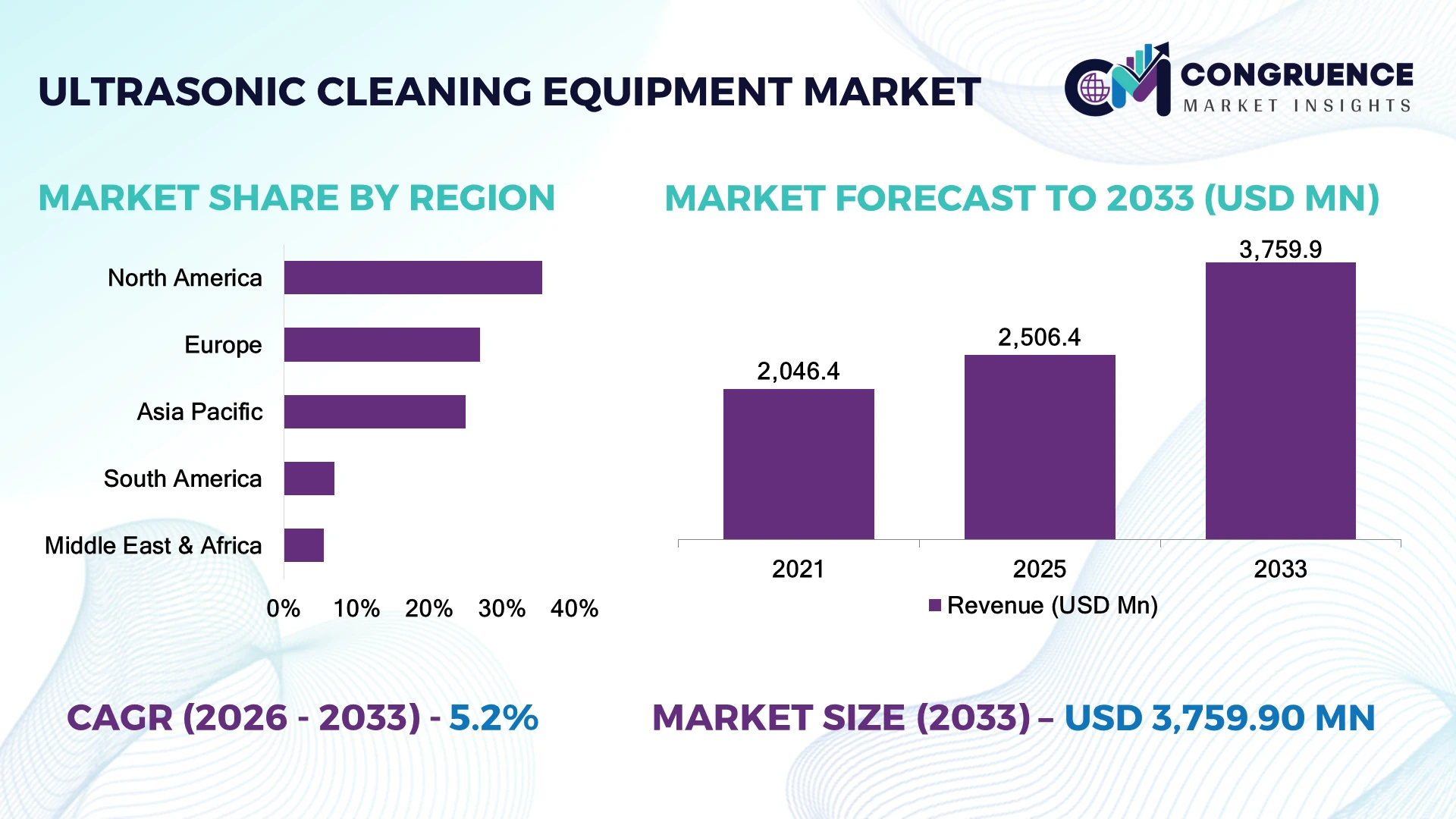
The Global Ultrasonic Cleaning Equipment Market was valued at USD 2,506.4 Million in 2025 and is anticipated to reach a value of USD 3,759.9 Million by 2033 expanding at a CAGR of 5.2% between 2026 and 2033. Growth is driven by precision-cleaning requirements in semiconductor manufacturing, reusable medical-device reprocessing, automotive component production, and industrial maintenance, where manual cleaning struggles to reach complex geometries consistently.
The United States is a strategically important market because semiconductor fabrication, aerospace manufacturing, and medical-device production require tightly controlled contamination removal. The CHIPS and Science Act allocated approximately USD 52.7 billion for semiconductor incentives and related research, reinforcing domestic manufacturing investment. Japan and Germany also maintain important precision-engineering ecosystems. For equipment suppliers, the opportunity lies in matching ultrasonic frequency, tank capacity, filtration, and process monitoring to application-specific cleanliness requirements.
Strategic implication: prioritize validated cleaning performance, application-specific equipment configurations, and integrated process controls to win high-value industrial accounts.
Market Size & Growth: The market reached USD 2,506.4 million in 2025 and is projected to reach USD 3,759.9 million by 2033, supported by precision manufacturing and contamination-control requirements.
Top Growth Drivers: Semiconductor fabrication, reusable medical-device reprocessing, and precision component manufacturing are strengthening demand for repeatable cleaning of complex surfaces and narrow passages.
Short-Term Forecast: By 2028, buyers will increasingly prioritize automated loading, programmable cycles, filtration, and traceable process parameters; plant-level productivity gains depend on part geometry and process validation.
Emerging Technologies: Multi-frequency transducers, automated basket handling, digital cycle monitoring, and integrated rinsing and drying are improving control over contamination removal and process repeatability.
Regional Leaders: North America benefits from semiconductor and medical-device investment, Europe from automotive and precision engineering, and Asia-Pacific from electronics manufacturing and industrial production capacity.
Consumer/End-User Trends: Industrial buyers increasingly evaluate cleaning validation, throughput, chemical compatibility, and total operating cost instead of comparing tank capacity and purchase price alone.
Pilot/Case Example: In semiconductor and medical-device facilities, automated ultrasonic cleaning cells can standardize cycle parameters and reduce operator-dependent variation; measurable gains require application-specific trials and validated baselines.
Competitive Landscape: Elma Schmidbauer, Emerson, Blue Wave Ultrasonics, Crest Ultrasonics, and Kemet International compete through frequency control, equipment configuration, process expertise, and service coverage.
Regulatory & ESG Impact: Medical-device cleaning instructions require validation, while industrial users are evaluating filtration, bath-life extension, and reduced solvent dependence to improve process control and resource use.
Investment & Funding: Semiconductor manufacturing incentives, medical-device production upgrades, and factory automation programs support equipment investment; a comparable global investment total for ultrasonic cleaning alone is not consistently disclosed.
Innovation & Future Outlook: The market is shifting toward integrated cleaning cells with programmable recipes, automated material handling, and process documentation, raising the importance of application engineering and after-sales support.
Ultrasonic cleaning equipment serves applications where contaminants must be removed from intricate components without relying entirely on manual scrubbing or aggressive mechanical action. Operating frequencies commonly range from 20 kHz to 400 kHz, with selection determined by contaminant type, component geometry, material sensitivity, and required finish. In 2026, precision manufacturers are placing greater emphasis on repeatable process parameters, bath management, and documented cleaning outcomes. These requirements favor suppliers that deliver complete process solutions rather than standalone tanks.
Ultrasonic cleaning equipment is becoming strategically important as manufacturers face tighter contamination tolerances, more complex component geometries, and increasing pressure to standardize production quality. Semiconductor parts, precision-machined components, optical assemblies, and reusable medical devices can contain residues in locations that are difficult to reach with conventional wiping or spray cleaning. In medical-device reprocessing, validated instructions and documented cleaning performance are essential; ultrasonic treatment is one process step, not a substitute for the complete required reprocessing cycle.
Conventional manual cleaning depends heavily on operator technique, while automated ultrasonic systems control parameters such as frequency, temperature, exposure time, and solution condition. This can improve repeatability, although productivity and cleaning gains depend on the part, soil, and validated process. North American investment in semiconductor manufacturing strengthens demand for precision cleaning, while Japan, South Korea, China, and Germany serve important electronics and industrial engineering ecosystems. Buyers increasingly assess complete workflows, including rinsing, drying, filtration, and handling.
Over the next two to three years, suppliers will focus on automated loading, programmable cleaning recipes, multi-frequency systems, and traceable cycle data. A practical deployment begins with representative parts, defined contamination targets, and comparative trials against the existing process. Manufacturers are responding through application laboratories, customized equipment, and integration partnerships. Competitive advantage will come from demonstrating reliable cleaning outcomes and lower process variability while meeting throughput, material-compatibility, and operating-cost requirements.
Semiconductor fabrication, aerospace production, medical devices, and precision machining require reliable removal of particles, oils, polishing compounds, and other residues from complex surfaces. Ultrasonic systems commonly operate between 20 kHz and 400 kHz, allowing manufacturers to select cleaning conditions for different contaminants and component sensitivities. Higher-frequency configurations can support delicate parts, while lower-frequency systems are often selected for robust components and heavier contamination. The driver is not frequency alone: repeatable results depend on chemistry, temperature, loading, and rinsing. Manufacturers are investing in programmable systems, filtration, and application testing to qualify cleaning recipes. Suppliers that prove performance on customer-specific parts can secure higher-value projects and longer-term equipment relationships.
Ultrasonic cleaning performance depends on bath chemistry, dissolved gases, temperature, transducer condition, basket loading, and component geometry. A poorly selected process can leave residues, damage sensitive finishes, or produce inconsistent results, increasing qualification and rework costs. Medical-device manufacturers face additional requirements to validate cleaning instructions and demonstrate that residues are removed under defined conditions. Complex components with narrow channels and inaccessible surfaces create particular challenges. Buyers therefore require application trials before committing to large-scale deployment, extending sales cycles and raising engineering costs. Equipment suppliers are reducing this friction through test laboratories, documented process recipes, operator training, and modular systems that allow controlled adjustments without replacing the entire cleaning line.
Automated cleaning cells offer opportunities to combine ultrasonic tanks with filtration, rinsing, drying, robotic handling, and digital process records. This configuration reduces manual transfers and helps standardize cycle execution across production shifts. In semiconductor and medical-device applications, the ability to document process parameters supports quality assurance and repeatable manufacturing. Manufacturers are developing modular equipment that can be configured for specific part sizes, throughput requirements, and cleaning chemistries. Suppliers can strengthen their position through partnerships with automation integrators and process-chemical providers. The most attractive opportunity lies in retrofitting existing production lines with targeted automation, enabling plants to improve traceability and handling consistency without replacing every cleaning station at once.
Scaling ultrasonic cleaning from a laboratory trial to continuous production is difficult because tank geometry, acoustic distribution, basket loading, and contamination levels affect performance. A recipe validated for one component cannot automatically be transferred to another part or facility. Medical-device reprocessing also requires alignment with manufacturer instructions, while semiconductor and aerospace customers impose application-specific cleanliness requirements. Multi-site manufacturers need consistent equipment settings, maintenance procedures, and operator training to avoid process drift. Suppliers must invest in application engineering, calibration, service infrastructure, and data capture to support repeatable deployment. The strategic challenge is to standardize equipment architecture without assuming that one cleaning recipe will deliver equivalent results across different materials and production conditions.
Multi-Frequency Systems Improve Process Control — Equipment increasingly supports multiple frequencies to accommodate different part geometries and contamination profiles. Lower-frequency operation can provide more aggressive cleaning, while higher frequencies are used for delicate components and finer features. Suppliers are emphasizing configurable transducers and validated recipes, helping manufacturers reduce the need for separate dedicated tanks across every cleaning task.
Automation Reduces Handling Variability — Automated baskets, programmed cycle sequences, and integrated rinsing and drying are reducing manual transfers between cleaning stages. Plants are evaluating throughput, operator intervention, and repeatability together rather than measuring cleaning time in isolation. Equipment makers are partnering with automation integrators to deliver production-ready cells for precision manufacturing and medical-device workflows.
Digital Monitoring Strengthens Traceability — Programmable controllers increasingly record cycle time, temperature, operating status, and selected process parameters. This supports troubleshooting and quality documentation in regulated or high-precision environments. Suppliers are adding data interfaces and service diagnostics, while users are prioritizing systems that connect cleaning records with existing quality-management procedures. Recorded parameters support traceability but do not independently prove cleanliness.
Resource Management Shapes Equipment Selection — Filtration, bath monitoring, and controlled solution replacement help users manage cleaning-fluid life and reduce avoidable disposal. Chemical compatibility and rinsing requirements remain critical, particularly for sensitive medical and electronic components. Suppliers are focusing on integrated fluid management and application testing, enabling customers to evaluate operating costs alongside cleanliness, throughput, and process reliability.
Benchtop ultrasonic cleaners represent the leading product type, with an indicative estimated share of 42–45% in 2025. Their compact footprint, relatively low acquisition cost, and straightforward installation support use in dental clinics, laboratories, jewelry workshops, repair facilities, and smaller production environments. Standalone units serve larger cleaning loads and industrial maintenance requirements, while multi-stage systems combine washing, rinsing, and drying to improve process consistency. Fully automated cleaning systems address higher-throughput production environments where repeatable cycle execution and reduced manual handling are priorities.
Fully automated and multi-stage systems are emerging as strategically important configurations as manufacturers seek tighter process control and integration with production lines. Automated loading, filtration, programmable recipes, and traceable operating parameters can reduce handling variation, although realized productivity improvements depend on the application and baseline process. Suppliers are expanding modular equipment portfolios to serve both smaller laboratories and high-volume factories. Investment is shifting toward integrated cleaning cells where labor availability, repeatability, and documentation justify higher initial costs; benchtop products remain relevant where flexibility and affordability outweigh automation requirements.
Precision cleaning is a leading application, with an indicative estimated share of approximately 30–35% in 2025. It covers the removal of fine particles, oils, polishing residues, and other contaminants from intricate components used in electronics, optics, medical devices, and precision engineering. Degreasing is another established application, particularly for machined metal parts, bearings, tools, and automotive components. Surface preparation supports subsequent coating, bonding, and finishing processes, while rust removal, decarbonization, deflashing, and deburring serve more specialized maintenance and manufacturing requirements.
Precision cleaning for electronics and semiconductor components is gaining strategic importance as device architectures become more complex and contamination tolerances tighten. SEMI forecast semiconductor manufacturing equipment sales to reach USD 138.1 billion in 2026, reflecting investment in leading-edge logic, memory, and advanced packaging. This is an industry investment indicator rather than a direct measure of ultrasonic-cleaning demand. Equipment suppliers are responding with configurable frequencies, controlled bath conditions, filtration, and automated handling. Buyers increasingly assess cleaning validation and process repeatability alongside throughput, making application-specific engineering a stronger differentiator than generic tank capacity.
Healthcare and medical-device manufacturers represent a major end-user group, with an indicative estimated share of approximately 24–27% in 2025. Hospitals, dental practices, laboratories, and device producers use ultrasonic equipment to remove residues from complex instruments before subsequent disinfection or sterilization steps. Electronics and semiconductor manufacturers require precision cleaning to control contamination on sensitive components, while automotive and transportation users clean injectors, bearings, machined parts, and assemblies. Aerospace and defense customers prioritize process consistency and material compatibility; industrial manufacturing, laboratories, jewelry businesses, and food-processing operations serve additional specialized requirements.
Electronics and semiconductor manufacturers are becoming strategically important buyers as investment in advanced logic, memory, and packaging expands. Healthcare procurement, by contrast, emphasizes validated cleaning procedures, documented operating parameters, and compatibility with instrument manufacturers’ instructions. Automotive and industrial buyers focus more heavily on throughput, bath life, uptime, and cost per processed component. Suppliers are tailoring equipment through application testing, customized baskets, multi-stage configurations, and service agreements. This divergence in purchasing criteria favors manufacturers with application engineering capabilities and a broad product portfolio rather than suppliers competing solely on equipment price.
North America accounted for the largest market share at an estimated 35.5% in 2025; however, Asia-Pacific is expected to register the fastest growth, expanding at an estimated CAGR of 5.6% between 2026 and 2033.
Precision-Cleaning Requirements Drive Equipment Modernization
North America maintains a leading position in ultrasonic cleaning equipment, supported by medical-device production, aerospace maintenance, semiconductor manufacturing, and precision engineering. Demand is concentrated in the United States, where manufacturers require repeatable removal of microscopic contaminants from complex components while maintaining process consistency. Buyers increasingly evaluate equipment based on automation compatibility, temperature and cavitation control, traceability, and reduced reliance on solvent-intensive cleaning. The expansion and modernization of domestic semiconductor capacity also support demand for specialized cleaning systems, although ultrasonic equipment represents only one part of a broader manufacturing investment cycle. As of July 2025, the United States had awarded approximately USD 30.9 billion across 40 semiconductor projects to construct, expand, or modernize facilities. This investment pipeline supports a wider precision-manufacturing ecosystem in which cleaning-system suppliers can compete through validated processes, service coverage, and application-specific engineering.
United States Market Outlook: The United States benefits from an established medical-device sector, aerospace maintenance networks, advanced electronics production, and a strong base of industrial equipment integrators. These industries require cleaning systems suited to different component geometries, contamination profiles, and quality-control protocols. Semiconductor incentives and domestic supply-chain initiatives are encouraging investment in manufacturing infrastructure, creating opportunities for suppliers of precision-cleaning equipment and automated process lines. Vendors that provide application testing, equipment qualification, maintenance support, and integration with production workflows are better positioned than suppliers competing primarily on initial purchase price.
Quality Compliance and Industrial Modernization Shape Demand
Europe represents an established market for ultrasonic cleaning equipment, underpinned by automotive engineering, medical technology, aerospace components, optics, and precision machinery. Germany, Italy, France, and the United Kingdom provide important industrial demand centres, with equipment selection shaped by process reliability, worker safety, and the need to manage cleaning chemistry and wastewater. Manufacturers are upgrading cleaning operations to support complex components, tighter contamination tolerances, and more consistent production quality. Germany is particularly significant because of its manufacturing depth and semiconductor ecosystem. Its semiconductor industry generated more than EUR 17 billion in revenue in 2025, while public and private spending of up to EUR 40 billion is expected in the sector by 2030. These investments strengthen the region's advanced-manufacturing base, although demand for ultrasonic systems remains dependent on specific process requirements and facility-level procurement.
Germany Market Outlook: Germany's automotive suppliers, industrial machinery manufacturers, medical-technology producers, and semiconductor ecosystem create a diversified customer base for ultrasonic cleaning equipment. More than one-third of European chips are produced in Germany, reinforcing its role in advanced electronics manufacturing. Suppliers can address demand through modular cleaning lines, automated handling, process monitoring, and solutions designed for repeatable component quality. The country's established engineering and industrial-service networks also support equipment commissioning and lifecycle maintenance. However, purchasing decisions remain closely tied to productivity gains, process validation, and the ability to integrate new equipment into existing production facilities.
Manufacturing Scale Expands Demand for Integrated Cleaning Systems
Asia-Pacific is a major production and consumption centre for ultrasonic cleaning equipment, supported by electronics assembly, semiconductor fabrication, automotive manufacturing, medical-device production, and extensive industrial supply chains. China, Japan, South Korea, Taiwan, and India contribute through different combinations of equipment manufacturing, component production, and end-user investment. High-volume factories create demand for cleaning systems that can maintain throughput while managing contamination across intricate parts and sensitive surfaces. China's industrial base remains particularly influential: in 2024, value added in its manufacturing sector increased by 6.1%, while high-tech manufacturing grew by 8.9%. These conditions support demand for production-line cleaning and precision equipment, but supplier competition can be intense on price, delivery, customization, and service. Local manufacturing capabilities and regional technical support are important advantages for equipment vendors serving diverse industrial clusters.
China Market Outlook: China combines a large electronics and machinery manufacturing base with domestic equipment suppliers and extensive industrial procurement networks. Its high-tech manufacturing activity creates opportunities for ultrasonic cleaning systems used in electronic components, precision parts, tooling, and medical-related production. Buyers may prioritize throughput, equipment availability, and integration with automated production lines, while export-oriented manufacturers also require consistent cleaning quality for international customers. Suppliers with local engineering teams, adaptable tank configurations, and responsive maintenance capabilities can address a broad range of factory requirements. Competition from domestic manufacturers makes application performance and dependable after-sales service important differentiators.
Automotive and Industrial Maintenance Anchor Regional Demand
South America's ultrasonic cleaning equipment market is supported by automotive manufacturing, machinery maintenance, mining-related services, medical facilities, and repair operations. Brazil is the region's most significant industrial market, while Argentina and other countries contribute through vehicle production, component servicing, and smaller industrial applications. Demand is often focused on cleaning injectors, precision components, tools, instruments, and parts that benefit from repeatable contaminant removal without aggressive mechanical treatment. Brazil produced approximately 2.644 million motor vehicles in 2025, up 3.5% from the previous year, reinforcing the scale of its automotive production and supplier ecosystem. However, purchasing can be constrained by financing costs, import dependence for specialized equipment, currency volatility, and uneven access to technical service. Suppliers that offer durable systems, locally available support, and clear operating-cost benefits are better positioned to convert industrial demand into equipment sales.
Brazil Market Outlook: Brazil offers the strongest addressable industrial base in South America through automotive assembly, component manufacturing, medical services, agricultural machinery, and industrial repair. Its vehicle production volume supports recurring requirements for cleaning engine parts, transmission components, tools, and production equipment. Ultrasonic systems can also serve laboratories and healthcare facilities where consistent instrument cleaning is important. Suppliers should account for price sensitivity, import lead times, and regional differences in service availability. Distributors that provide application demonstrations, operator training, spare parts, and maintenance support can reduce adoption barriers and build stronger relationships with manufacturers and service workshops.
Industrial Diversification Creates Targeted Equipment Opportunities
The Middle East and Africa market is shaped by industrial diversification, healthcare infrastructure, aviation maintenance, oil-and-gas services, and investment in manufacturing capabilities. Demand remains more concentrated in selected industrial and service hubs than broadly distributed across the region. Gulf economies provide opportunities for cleaning equipment used in maintenance workshops, medical facilities, precision engineering, and industrial component servicing, while South Africa contributes through automotive, mining, and engineering applications. Adoption depends on the scale of local manufacturing, availability of trained operators, equipment servicing, and the economics of importing specialized systems. National industrial-development programmes can create opportunities, but they do not translate directly into ultrasonic cleaner purchases without specific project requirements. Suppliers can strengthen market access through regional distributors, application support, and equipment configurations designed for local operating conditions and maintenance capabilities.
Saudi Arabia Market Outlook: Saudi Arabia is a strategically important market because of its efforts to broaden industrial activity beyond hydrocarbons, alongside investments in healthcare, aviation services, manufacturing, and technical infrastructure. Ultrasonic cleaning equipment can support maintenance operations and precision cleaning of industrial parts, instruments, and components where manual methods are inconsistent or labour-intensive. The opportunity is likely to be project-led, with demand linked to facility commissioning, workshop modernization, and procurement specifications rather than widespread standardized deployment. Suppliers with regional service partners, operator training, and clear maintenance plans can improve adoption prospects as industrial capabilities develop.
The market pits established precision-cleaning specialists such as Crest Ultrasonics, Elma Schmidbauer, and Blue Wave Ultrasonics against cost-focused Asian manufacturers including GT Sonic, while FinnSonic and Kaijo target engineered industrial applications. For industrial ultrasonic cleaning systems, the top five players are estimated to hold approximately 40% combined share; this is an indicative estimate because public figures vary by market definition. Competition centres on cleaning consistency, tank capacity, transducer performance, automation, service responsiveness, and customization. Buyers increasingly assess total operating cost, with energy optimization and process repeatability potentially influencing lifecycle costs by 5–10% in suitable applications. Global specialists differentiate through multi-stage systems, application engineering, and technical support; regional suppliers compete through shorter lead times, flexible designs, and lower acquisition costs. FinnSonic’s US distribution partnership illustrates channel-led expansion, while Kaijo’s large-capacity product launch reflects specialization. Entry barriers include application validation, engineering expertise, and service coverage. Winning requires proven cleaning outcomes, reliable lifecycle support, and competitive total cost.
Modern systems increasingly combine frequency control, sweep and pulse modes, programmable cycles, and temperature regulation to improve cleaning consistency across complex geometries. Conventional fixed-frequency equipment remains suitable for routine workloads, while adjustable-frequency platforms offer greater flexibility across delicate and heavily contaminated parts. Product-specific designs can support frequency adjustments around a nominal 37 kHz, with programmable operating modes that tailor cavitation to the cleaning task. In suitable applications, process optimization may target a 5–10% reduction in cycle time, but results depend on contamination, chemistry, load geometry, and validation.
Automation is the next competitive differentiator: multi-tank washing, rinsing, and drying lines can reduce manual transfers and improve repeatability when integrated with conveyors, recipes, and production controls. Digital controls and stored programs simplify changeovers; manufacturers should validate any productivity or energy benefit against a manual or fixed-cycle baseline rather than assume a universal improvement. Eco modes and optimized transducer operation can reduce energy demand; savings are equipment- and process-specific, so procurement teams should request measured consumption data per cleaning cycle. Adoption is strongest where high-throughput production and consistent cleanliness justify system integration.
From 2026 to 2028, buyers are likely to favour modular equipment, programmable process recipes, improved monitoring, and application-specific automation over basic capacity expansion alone. Dual-frequency systems can combine aggressive degreasing with gentler precision cleaning, while traceable cycle settings support quality assurance in medical, electronics, and aerospace workflows. These technologies benefit established engineering specialists able to validate processes and provide lifecycle service, while cost-focused suppliers face pressure to demonstrate equivalent results. The immediate priority is application testing: compare cleaning effectiveness, cycle time, energy use, and rework rates before committing to a technology upgrade.
The report evaluates the ultrasonic cleaning equipment market across product types, including benchtop, standalone, multi-stage, and automated systems; applications such as precision cleaning, degreasing, surface preparation, rust removal, and deburring; and end-users spanning healthcare, electronics, semiconductor, automotive, aerospace, and industrial manufacturing. It examines major demand centres across North America, Europe, Asia-Pacific, South America, and the Middle East and Africa, with country-level analysis of industrial capacity, equipment adoption, and procurement conditions.
Technology coverage includes piezoelectric and magnetostrictive transducers, frequency control, sweep and pulse modes, programmable cycles, multi-tank automation, and integration with production workflows. Competitive assessment profiles key global and regional manufacturers, comparing specialization, product breadth, distribution reach, customization, and service capabilities. The report also addresses niche requirements in optics, laboratories, medical instruments, and precision components. These insights support investment planning, market-entry assessment, expansion priorities, supplier evaluation, and competitive positioning, helping decision-makers identify relevant technologies and customer segments through 2026–2033.
| Report Attribute/Metric | Report Details |
|---|---|
|
Market Revenue in 2025 |
USD 2,506.4 Million |
|
Market Revenue in 2033 |
USD 3,759.9 Million |
|
CAGR (2026 - 2033) |
5.2% |
|
Base Year |
2025 |
|
Forecast Period |
2026 - 2033 |
|
Historic Period |
2021 - 2025 |
|
Segments Covered |
By Type
By Application
By End-User
|
|
Key Report Deliverable |
Revenue Forecast, Growth Trends, Market Dynamics, Segmental Overview, Regional and Country-wise Analysis, Competition Landscape |
|
Region Covered |
North America, Europe, Asia-Pacific, South America, Middle East, Africa |
|
Key Players Analyzed |
Crest Ultrasonics Corporation, Elma Schmidbauer GmbH, Blue Wave Ultrasonics, SharperTek, L&R Manufacturing, Kemet International Limited, GuangDong GT Ultrasonic Co., Ltd., FinnSonic Oy, Kaijo Corporation, Omegasonics, Cleaning Technologies Group, Sonicor Inc., Ultrasonic Power Corporation, Steelco S.p.A. |
|
Customization & Pricing |
Available on Request (10% Customization is Free) |




