
Reports
The Global Ultra High Temperature Milk Market was valued at USD 82,860.0 Million in 2025 and is anticipated to reach a value of USD 1,25,058.1 Million by 2033 expanding at a CAGR of 5.28% between 2026 and 2033. Growth is anchored in cold-chain avoidance economics, with UHT lines cutting distribution energy needs by up to 19.6% versus refrigerated alternatives across a 20,000-liter shipment.
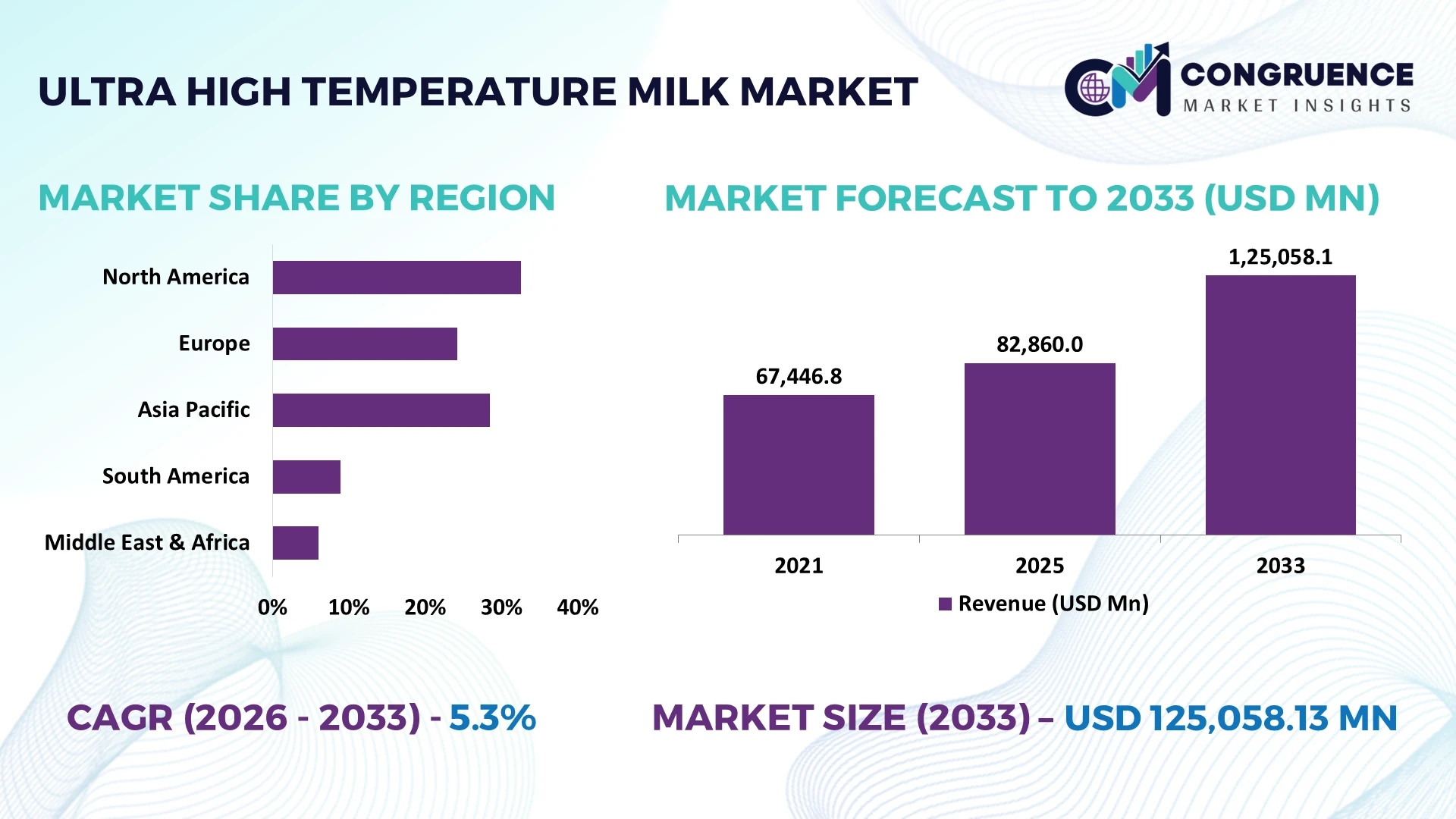
North America commands 37.21% of global revenue, underpinned by a USD 100 million Suntado UHT facility in Idaho processing 800,000 to 1 million pounds of milk daily. Germany and France illustrate the European contrast: Germany's UHT market reached USD 4.14 billion on mature ambient dairy habits, while France channels premiumization through recyclable carton formats and organic UHT lines.
The strategic implication is clear, capital allocation should favor aseptic capacity near export corridors and cold-chain-deficient demand centers, not legacy chilled infrastructure.
Market Size & Growth: Valued at USD 82,860.0 Million in 2025, forecast to USD 125,058.1 Million by 2033 at 5.28% CAGR, driven by ambient logistics economics replacing refrigerated distribution in high-growth markets.
Top Growth Drivers: Cold-chain gap closure in Asia-Pacific (8.66% regional CAGR), lactose-free dominance at 69.92% share, and fortified/functional UHT expansion at 10.05% CAGR.
Short-Term Forecast: By 2027, aseptic filling automation cuts per-liter water use by up to 95% through integrated recovery systems, reducing utility costs across European and Asian lines.
Emerging Technologies: Tetra Pak UHT 2.0 heating portfolios, SIG flexible aseptic filling for high-protein ambient milk, and enzymatic lactose-removal technologies preserving native taste.
Regional Leaders: North America at 37.21% revenue share; Asia-Pacific projected USD 29.02 Billion in 2025 scaling to USD 48.18 Billion; Europe at USD 22.91 Billion with Southern European UHT intake exceeding 80% of fluid milk.
Consumer/End-User Trends: Ready-to-drink dairy nutritionals and protein shakes surged 74% over four years in the U.S., pulling aseptic processing into mainstream retail.
Pilot/Case Example: 2025 Beyti Egypt USD 20.4 million expansion launched Egypt's first PET-bottle UHT line, supporting 650,000 tons annual output across 45 export markets.
Competitive Landscape: Lactalis, Nestlé, Danone, FrieslandCampina, and Arla lead a moderately consolidated field; Lactalis anchors European scale while Yili and Mengniu drive Chinese capacity.
Regulatory & ESG Impact: FDA endorsement of UHT sterilization as legitimate processing removes U.S. entry friction; EU recyclable packaging mandates push carton redesign across Arla and Lactalis supply chains.
Investment & Funding: China's Mengniu and Yili collectively deployed USD 2.3 billion in 2024–2025 for aseptic processing facilities, targeting import substitution in domestic UHT supply.
Innovation & Future Outlook: High-protein ambient formats, coffee-infused UHT lines (Nestlé cold-brew launch 2025 at 120mg caffeine per 330ml), and ultra-filtration integration signal a strategic pivot from commodity white milk to value-added shelf-stable nutrition.
The Ultra High Temperature Milk market's operational center of gravity is shifting toward fortified and high-protein ambient formats, with lactose-free variants holding 69.92% of segment share and ready-to-drink dairy nutritionals posting 74% U.S. sales growth over four years. Capacity investment follows demand: China's Mengniu and Yili committed USD 2.3 billion to aseptic facilities, while New Zealand's Goodman Fielder directed over USD 100 million toward high-protein UHT export lines for Asian markets. A subtle but material supply-chain signal is the 2025 PET-bottle UHT launch in Egypt, indicating packaging diversification beyond cartons in price-sensitive regions. These shifts set the terms for the strategic discussion that follows.
UHT milk has moved from a shelf-stable commodity to a strategic lever for dairy companies navigating volatile cold-chain costs, geopolitical trade disruptions, and shifting consumer expectations around nutrition and convenience. The 2025–2026 period marks an inflection: aseptic processing is being repositioned as infrastructure-grade capacity rather than a backup format, particularly as supply-chain restructuring pushes manufacturers toward ambient-stable products that withstand port delays and energy interruptions. A 20,000-liter shipment comparison demonstrates the operational gap: refrigerated HTST milk recorded 15% spoilage under transport delay versus 0% for UHT, while total energy consumption fell from 12,283 kWh to 9,878.2 kWh.
Technology divergence is sharpening. Legacy pasteurization depends on continuous refrigeration from filling to consumer, whereas modern aseptic UHT lines integrate sterile filling, ambient warehousing, and export-ready packaging, reducing downstream cold-chain exposure to near zero. Regionally, North America's 37.21% revenue share reflects mature infrastructure and emergency-preparedness demand, while Asia-Pacific's 8.66% growth trajectory is driven by structural cold-chain gaps in India, Indonesia, and rural China. India's Hatsun Agro acquisition of Milk Mantra and Rajasthan's new Bhilwara cooperative UHT plant illustrate local consolidation and public-private capacity building.
Operationally, companies are reallocating capital toward aseptic lines with export corridors in mind. Goodman Fielder's USD 100 million Christchurch expansion explicitly targets high-protein UHT exports to China and Southeast Asia through a supply agreement with Yihai Kerry Arawana, adding 25 technical roles and integrating ultra-filtration for protein concentration. Over the next 2–3 years, adoption indicators will center on aseptic filling automation rates and ambient distribution share gains in import-dependent markets. Competitive positioning will favor processors that pair sterility assurance with packaging flexibility and regional sourcing diversification, converting cold-chain avoidance into durable margin advantage.
Cold-chain avoidance has become the decisive cost variable in dairy distribution, pushing processors toward aseptic UHT capacity at scale. UHT milk eliminates refrigerated transport and storage requirements, with energy consumption for a 20,000-liter shipment falling to 9,878.2 kWh versus 12,283 kWh for HTST, while spoilage drops from 15% to zero under delayed transit. China's Mengniu and Yili responded with USD 2.3 billion in combined aseptic facility investment during 2024–2025, targeting domestic supply without imported milk powder dependence. India's cooperative sector is following: Rajasthan's Bhilwara plant inaugurated in 2025 adds regional UHT processing where cold-chain penetration remains uneven. The strategic insight is that UHT capacity is no longer a defensive hedge but an export-enabling asset, particularly for suppliers positioning against Southeast Asian demand growth where ambient distribution reaches retail tiers that chilled logistics cannot serve economically.
Aseptic UHT lines carry 50–100% higher unit capital costs than HTST pasteurization equivalents, creating a structural barrier for mid-tier processors and cooperative entrants. Packaging material supply and cost volatility compounds this: carton stock and aseptic closure components face periodic tightness, while energy intensity for sterilization and sterile filling adds operating overhead that smaller dairies cannot absorb at commodity margins. In India, cooperative plants must balance UHT line investments against raw milk procurement price cycles, delaying capacity upgrades in states outside the organized dairy belt. Companies are mitigating through dual-sourcing of packaging and phased line commissioning, but the operational reality is that UHT expansion remains a scale game. Processors without multi-year offtake visibility—particularly those serving fragmented domestic retail—face prolonged payback periods that favor continued reliance on chilled pasteurized formats despite their distribution fragility.
Functional and fortified UHT represents the clearest value-migration path, with the fortified segment expanding at 10.05% and skimmed variants at 8.32% as health-conscious consumers seek convenient nutrition without refrigeration. New Zealand's Goodman Fielder operationalized this by integrating ultra-filtration into its Christchurch UHT lines, concentrating native dairy proteins for export-grade beverages aimed at Chinese and Southeast Asian retail and foodservice channels. Thailand's Lactasoy launched high-protein UHT using flexible aseptic filling technology in 2025, moving protein milk from chilled formats into nationwide convenience distribution. The non-obvious opportunity lies in institutional channels: school feeding programs backed by Tetra Pak already reach 64 million children across 49 nations, creating baseline volume stability that de-risks private-label and fortified product launches. Companies that pair protein enrichment with ambient packaging can capture margin premiums unavailable in commodity white milk, particularly where cold-chain costs erode chilled dairy competitiveness.
UHT processing demands validated sterility across filler, packaging, and environment, with even minor process faults requiring full line re-sterilization and production loss. In a controlled study, personnel training and GMP checklists achieved 95% compliance, yet the margin for error remains narrow: fungal sterility in aseptic filling exposures reached only 71.4% under validation conditions, exposing persistent contamination risk vectors. The challenge intensifies as capacity expands into geographies with limited technical workforce depth—India's cooperative UHT plants, for instance, face competition for trained aseptic operators against established private dairies. Energy intensity also draws ESG scrutiny: UHT production consumes 6,746 kWh per 20,000-liter batch versus 5,952.8 kWh for HTST, requiring processors to pair expansion with renewable energy procurement or face sustainability-linked cost pressure. Long-term competitiveness depends on building regional training pipelines and embedding quality culture before throughput scales, not after.
High-Protein Ambient Formats Accelerate Protein-enriched UHT is moving from niche fitness positioning into mainstream retail. Thailand's Lactasoy launched Benefitt in January 2026, delivering 31 grams of protein per 350ml serving through SIG flexible aseptic filling—the country's first high-protein ambient milk and a direct shift away from refrigerated pasteurized formats. The move enables nationwide 7-Eleven distribution where chilled logistics cannot reach economically. Processors are responding by integrating ultra-filtration into existing UHT lines, concentrating native protein without heat degradation.
PET Bottles Break Carton Monopoly Egypt's Beyti commissioned a USD 20.4 million expansion in November 2025, launching the country's first PET-bottle UHT line and supporting 650,000 tons annual output across 45 export markets. The format shift matters operationally: PET offers resealability and shatter resistance for mobile consumption occasions that cartons serve poorly. Beyti's parent Almarai is replicating this packaging diversification across Middle East distribution networks where ambient resilience and portability drive repeat purchase.
Aseptic Capacity Localizes in South Asia India's cooperative sector is building regional UHT infrastructure rather than relying on distant processing hubs. Rajasthan's Bhilwara Milk Producers' Cooperative inaugurated the state's first UHT processing and aseptic packaging plant in October 2025, virtual-inaugurated by Prime Minister Modi. The deployment targets cold-chain-deficient districts where packaged ambient milk reaches retail tiers that chilled supply cannot. Cooperative federations are pairing plant commissioning with procurement network expansion, converting raw milk surplus into shelf-stable branded output.
Flavored and Fortified Lines Reshape Portfolio Economics Value-added UHT is outpacing commodity white milk at the formulation level. Fortified variants are expanding at 7.87%, while flavored formats leverage ready-to-drink coffee culture—Nestlé's 2025 cold-brew UHT launch carries 120mg caffeine per 330ml serving. The non-obvious insight: flavored UHT functions as a functional delivery vehicle for probiotics and omega-3s, not merely a taste variant. Brands are reformulating around health claims to command premium shelf positioning against private-label white milk.
White UHT milk remains the operational backbone, holding USD 66.09 billion in 2025 and commanding the dominant share of global volume. Its leadership rests on household staple status, universal foodservice applicability, and manufacturing simplicity—neutral flavor profiles integrate seamlessly into tea, coffee, baking, and institutional catering without reformulation costs. The segment benefits from established procurement contracts and predictable demand cycles that de-risk capacity utilization for processors.
Fortified UHT milk represents the fastest-moving value segment at 7.87% growth, driven by micronutrient enrichment strategies targeting health-conscious consumers and institutional nutrition programs. Flavored variants follow closely, leveraging ready-to-drink coffee and protein beverage culture. Companies are responding by adding fortification modules to existing aseptic lines rather than building dedicated facilities, preserving capital efficiency while capturing premium pricing. Investment priority is shifting toward formulation capability and health-claim validation over raw volume expansion.
B2C distribution commands the dominant application position, valued at USD 74.13 billion in 2025, anchored by supermarket, convenience, and e-commerce channels where shelf-stable milk serves everyday household consumption. The segment's scale reflects entrenched purchasing routines and the format's versatility across breakfast, cooking, and direct drinking occasions. Retailers favor UHT for ambient merchandising efficiency and reduced waste exposure compared to chilled dairy.
B2B applications are accelerating at 6.10%, driven by hotel, restaurant, café, and food manufacturer adoption where consistent supply without refrigeration infrastructure reduces operational complexity. Coffee chains and bakery operations value the neutral flavor profile and extended open-shelf stability that UHT delivers in high-turnover environments. Companies are adapting through bulk packaging formats and dedicated foodservice distribution partnerships, separating B2B supply chains from retail-branded lines to protect margin structures. Demand is strengthening where labor availability constrains chilled handling capacity.
B2C end-users dominate demand concentration, reflecting the format's integration into routine household grocery baskets across both mature and emerging markets. Supermarket and hypermarket channels account for the largest volume share, with online grocery accelerating adoption among urban consumers who prioritize pantry stability and reduced shopping frequency. The segment's operational intensity is low—purchase cycles are predictable and storage requirements minimal—making UHT a reliable anchor category for retailers managing ambient shelf space.
B2B end-users represent the faster-expanding buying group, with hotels, restaurants, and food manufacturers increasingly standardizing on UHT for supply chain simplification. Cafés in Southeast Asia and the Middle East are shifting from chilled milk procurement to ambient formats, reducing spoilage write-offs and storage footprint. Companies are targeting this segment through bulk packaging, dedicated account management, and formulation support for applications requiring specific fat or protein profiles. The strategic shift favors processors that can serve both retail brands and foodservice operators without channel conflict.
North America accounted for the largest market share at 32.5% in 2025 however, Asia-Pacific is expected to register the fastest growth, expanding at a CAGR of 6.13% between 2026 and 2033.
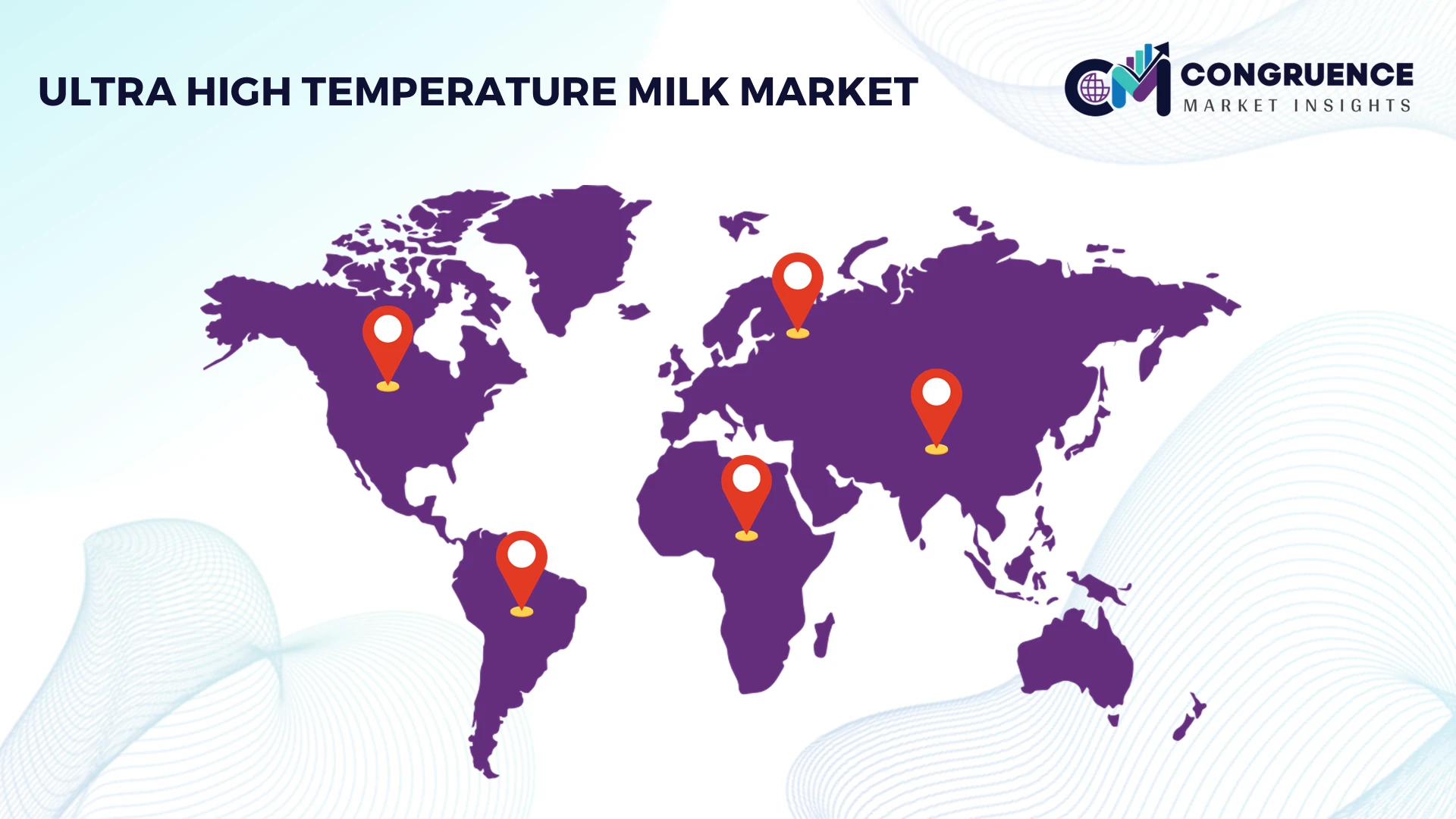
North America contributed 32.5% of global UHT milk value in 2025, with the United States accounting for 89.50% of regional demand . Deployment is concentrated in large-format retail and emergency-preparedness channels, where shelf-stable dairy functions as a pantry staple rather than a chilled substitute. Regional processors are prioritizing carton and bottle filling flexibility to serve both retail private-label programs and foodservice bulk accounts. The U.S. organic dairy segment, representing 13% of total organic food sales, provides a premiumization pathway for aseptic lines targeting health-conscious households .
United States Market Outlook: The U.S. anchors North American UHT economics through scale retail access and food-safety positioning. Organic and lactose-free UHT variants are expanding shelf presence, with dairy and eggs accounting for 13% of total organic food sales. Emergency-preparedness demand, reinforced by recent global disruptions, sustains baseline household adoption beyond convenience-driven purchase cycles .
Europe held 24.2% of global UHT milk value in 2025, with Germany alone valued at USD 4.14 billion. The region's structural advantage lies in mature ambient dairy familiarity and harmonized cross-border trade, but the operative shift is capital deployment toward low-carbon aseptic capacity. Spain stands as the largest per-capita consumer market, with over 90% of its liquid milk sold in UHT form, while Germany's raw milk surplus feeds export-oriented UHT production rather than domestic consumption . The European Investment Bank approved EUR 50 million in December 2025 for Lactalis subsidiary Lactinov to modernize UHT lines for specialized nutrition markets, signaling a pivot from commodity white milk toward medical and infant nutrition applications.
France Market Outlook: France channels UHT capacity into higher-value specialized nutrition through cooperative-led modernization. The Lactinov project enables production of UHT dairy-based products for infant, sports, and medical nutrition markets, strengthening a mid-cap cooperative's position against larger European processors while reducing greenhouse gas emissions across upgraded lines. French UHT holds approximately 40–50% of domestic liquid milk sales, leaving room for premium format expansion .
Asia-Pacific commanded 28.4% of global UHT milk value in 2025, valued at USD 29.02 billion, with 53.6% of the region's population living in urban areas where refrigeration access remains uneven . China dominates regional volume at USD 13.85 billion, while India represents the fastest-scaling production base at USD 5.16 billion . The operational dynamic is capacity localization: cooperative and private processors are commissioning regional aseptic plants to serve districts where chilled distribution cannot reach profitably. Indonesia imports 35–45% of its UHT milk, creating import-substitution opportunities for domestic aseptic capacity .
China Market Outlook: China's UHT position rests on domestic processor scale and nationwide ambient retail reach. Mengniu and Yili have built aseptic capacity that serves both mass-market white milk and premium fortified lines, reducing dependence on imported milk powder. Fortified and functional UHT could reach 15–18% of regional volume by 2035, up from approximately 6% in 2026, creating a clear premiumization runway for domestic brands .
South America contributed 8.9% of global UHT milk value in 2025, with Brazil valued at approximately USD 5.85 billion and dominating regional demand . The region's adoption pattern is driven by necessity rather than premiumization: vast distribution distances, limited refrigeration penetration beyond major urban centers, and high ambient temperatures make shelf-stable milk the practical dairy format for nationwide retail. Brazil's domestic processing base supports large-scale aseptic production, and UHT milk functions as a pantry essential across income groups. E-commerce grocery growth, with Brazil expanding at 14.3%, further favors durable ambient formats .
Brazil Market Outlook: Brazil's UHT leadership is structural, not cyclical. Limited cold-chain penetration across interior states, strong household reliance on shelf-stable staples, and school feeding program demand create baseline volume stability that de-risks aseptic capacity investment. Domestic processors benefit from established aseptic packaging infrastructure and raw milk procurement networks, positioning Brazil as the region's export-capable UHT producer .
Middle East & Africa represented 6.0% of global UHT milk value in 2025, valued at USD 6.13 billion . The region's growth trajectory is shaped by modern trade penetration, with UAE modern trade reaching approximately 70% and hypermarkets serving as primary UHT distribution points . Whole and full-cream milk dominated the fat content segment at 51.72% share in 2025, while skimmed milk is expanding at 6.82% and flavored UHT at 8.34%, driven by health campaigns targeting obesity and diabetes across Gulf populations . Almarai operates the world's largest vertically integrated dairy business, anchoring GCC shelf presence.
Saudi Arabia Market Outlook: Saudi Arabia anchors regional UHT economics through vertically integrated processor scale and full-cream product dominance. The country's domestic processing infrastructure serves both retail and institutional channels, while government health initiatives promoting low-fat dairy create parallel demand for fortified skimmed variants. Saudi Arabia's position as the region's production and branding hub supports export reach across GCC and Levant markets.
Competition in UHT milk pits global dairy majors Lactalis, Nestlé, Danone, FrieslandCampina, and Arla against regional champions Almarai, Yili, and Mengniu, with packaging technology suppliers Tetra Pak and SIG shaping capability asymmetries. The top five players hold roughly 38% combined share, leaving a fragmented long tail of cooperatives and private labels. Price competition dominates commodity white milk, but fortified and high-protein lines shift the battleground to formulation capability—fortified UHT is expanding at 10.05%, nearly double skimmed variants at 8.32%. Almarai leverages vertical integration across 85,000 dairy cows and 50% Saudi market share, while Goodman Fielder’s USD 100 million Christchurch expansion targets Chinese high-protein demand through a Yihai Kerry partnership. Entry barriers are capital intensity and sterility validation, not brand alone. Winning requires aseptic capacity near export corridors, packaging flexibility, and formulation IP that commands premium shelf positioning.
Lactalis Group
Nestlé S.A.
Danone S.A.
FrieslandCampina N.V.
Arla Foods amba
Almarai Company
Inner Mongolia Yili Industrial Group
China Mengniu Dairy Company
Goodman Fielder
Saputo Inc.
Meiji Holdings Co., Ltd.
Amul (Gujarat Cooperative Milk Marketing Federation)
Beyti Food Industries
SIG Combibloc Group AG
Aseptic filling automation and ultra-filtration integration now define operational competitiveness. Modern UHT 2.0 heating portfolios reduce product losses by 57% and water consumption by 45% versus 2019 baselines, while electric heat-pump steam generation reaches 200°C using recovered waste heat, cutting fossil fuel dependence in sterilization and cleaning-in-place processes . These upgrades deliver measurable cost advantages for processors running high-volume lines.
Disruptive potential sits in enzymatic lactose removal and high-protein ultra-filtration, enabling lactose-free UHT at 69.92% segment share without sacrificing taste. SIG’s flexible aseptic platform allowed Thailand’s Lactasoy to launch 31-gram protein UHT in 350ml formats without new filling lines, compressing time-to-market and expanding distribution into 7-Eleven networks where chilled logistics cannot reach . Adoption signals are strongest in Asia-Pacific, where capacity localization pairs with packaging flexibility.
Between 2026 and 2028, competitive advantage will favor processors integrating heat recovery, water reuse, and modular filling into brownfield expansions. Tetra Pak’s exclusive HighLift distribution deal positions it as the efficiency gatekeeper for European and Asian dairies modernizing UHT lines . Companies that lock in energy-efficient aseptic capacity now will convert utility savings into margin resilience before sustainability-linked cost pressures tighten.
June 2025 – Goodman Fielder Expanded Christchurch UHT facility with high-protein processing and 25 new roles, supporting a Yihai Kerry supply partnership for Sam’s Club China; UHT cream capacity at Rolleston rose 20% for Chinese demand. Source: goodmanfielder.com
November 2025 – Beyti (Almarai) Launched Egypt’s first UHT milk in PET bottles via EGP 1 billion expansion, adding five lines to reach 32 total and 650,000 tonnes annual output across 45 export markets. Source: dailynewsegypt.com
December 2025 – Benefitt (Lactasoy) with SIG Launched Thailand’s first high-protein UHT milk at 31g protein per 350ml box, using SIG Small 12 Aseptic filling to extend from 300ml without new line investment, distributed via 7-Eleven nationwide. Source: thaipublica.org
July 2025 – Tetra Pak with Olvondo Technology Secured exclusive global distribution rights for HighLift electric heat pump producing up to 200°C steam from recovered waste heat, targeting UHT sterilization and CIP processes across dairy factories. Source: zuivelzicht.nl
This report delivers a structured assessment of the global UHT milk market across type, application, end-user, and regional dimensions, covering white, fortified, flavored, and lactose-free segments alongside B2C retail and B2B foodservice channels. Regional analysis spans North America, Europe, Asia-Pacific, South America, and Middle East & Africa, with country-level breakdowns for the United States, Germany, France, China, India, Brazil, and Saudi Arabia.
Quantitative coverage includes segment share distribution, adoption rates for fortified and high-protein formats, deployment patterns across aseptic capacity investments, and company participation levels across the value chain. The report maps technology transitions—aseptic filling automation, ultra-filtration integration, and energy recovery systems—against operational efficiency benchmarks. Strategic insights support investment planning, capacity expansion decisions, and competitive positioning through 2033, with emphasis on high-growth niches including lactose-free ambient dairy, high-protein ready-to-drink formats, and institutional nutrition channels where cold-chain limitations create durable demand.
| Report Attribute / Metric | Details |
|---|---|
| Market Revenue (2025) | USD 82,860.0 Million |
| Market Revenue (2033) | USD 1,25,058.1 Million |
| CAGR (2026–2033) | 5.28% |
| Base Year | 2025 |
| Forecast Period | 2026–2033 |
| Historic Period | 2021–2025 |
| Segments Covered |
By Type
By Application
By End-User
|
| Key Deliverables | Revenue Forecast; Market Trends; Growth Drivers & Restraints; Technology Insights; Segmentation Analysis; Regional Insights; Competitive Landscape; Regulatory & ESG Overview; Recent Developments |
| Regions Covered | North America; Europe; Asia-Pacific; South America; Middle East & Africa |
| Companies Profiled | Lactalis Group; Nestlé S.A.; Danone S.A.; FrieslandCampina N.V.; Arla Foods amba; Almarai Company; Inner Mongolia Yili Industrial Group; China Mengniu Dairy Company; Goodman Fielder; Saputo Inc.; Meiji Holdings Co., Ltd.; Amul (Gujarat Cooperative Milk Marketing Federation); Beyti Food Industries; SIG Combibloc Group AG |
| Customization & Pricing | Available on Request (10% Customization Free) |




