
Reports
The Global UD Carbon Fiber Prepreg Market was valued at USD 4,107.8 Million in 2025 and is anticipated to reach a value of USD 9,603.9 Million by 2033 expanding at a CAGR of 11.2% between 2026 and 2033. Growth is driven by accelerating aerospace production, next-generation electric mobility platforms, and rising deployment of automated composite manufacturing for lightweight structural components.
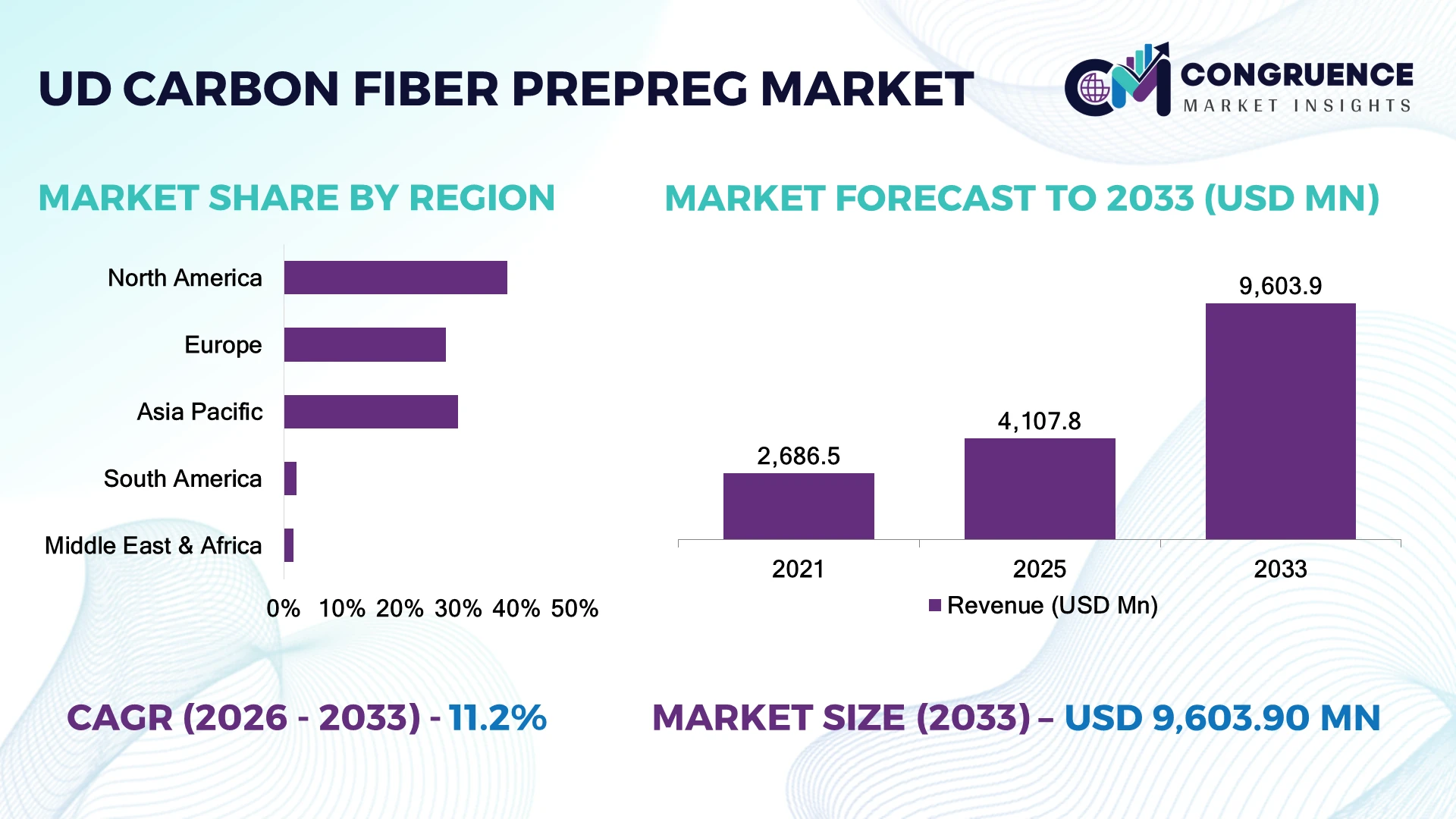
The United States dominates the market with approximately 34% global demand, supported by advanced aerospace manufacturing, defense modernization programs, and expanding automated fiber placement capacity, where over 65% of commercial aerospace composite structures utilize prepreg-based materials. Japan maintains leadership in high-performance carbon fiber production with nearly 30% of global carbon fiber capacity, while the ongoing geopolitical focus on resilient aerospace supply chains has accelerated domestic composite investments across North America. Strategic investments in qualified prepreg production and integrated carbon fiber supply networks are becoming decisive competitive advantages.
Market Size & Growth: USD 4,107.8 million (2025) to USD 9,603.9 million (2033) at 11.2% CAGR, driven by aerospace composite expansion.
Top Growth Drivers: Aerospace 42%, electric mobility 28%, defense modernization 19% accelerate demand.
Short-Term Forecast: By 2028, automated prepreg processing improves production efficiency by 24%.
Emerging Technologies: AI-assisted quality inspection, automated fiber placement, rapid-cure epoxy systems enhance manufacturing precision.
Regional Leaders: North America, Europe, and Asia-Pacific collectively contribute over 88% demand with expanding composite manufacturing capacity.
Consumer/End-User Trends: Aerospace applications account for nearly 56% of advanced prepreg consumption.
Pilot/Case Example: 2026 automated layup implementation reduced composite scrap by approximately 18%.
Competitive Landscape: Top five manufacturers control nearly 63% market share through technology leadership.
Regulatory & ESG Impact: Low-emission manufacturing initiatives reduce composite processing energy consumption by 17%.
Investment & Funding: More than USD 1.5 billion supports prepreg capacity expansion and carbon fiber integration.
Innovation & Future Outlook: Digital manufacturing and recyclable prepreg technologies strengthen next-generation composite competitiveness.
The UD Carbon Fiber Prepreg Market is expanding through stronger demand from aerospace, defense, wind energy, and premium automotive manufacturers requiring lightweight structural composites. Automated fiber placement and rapid-cure resin systems improve manufacturing productivity by nearly 25%, while regional supply-chain localization is strengthening material security. These operational advancements create the foundation for the strategic market evolution discussed below.
The UD Carbon Fiber Prepreg Market has become strategically important because advanced composites now determine competitive performance across aerospace, defense, electric mobility, and renewable energy industries. Governments and manufacturers are restructuring composite supply chains to strengthen domestic production capabilities, while aerospace qualification programs increasingly prioritize certified prepreg systems with predictable mechanical performance and production consistency.
Modern automated fiber placement systems improve material utilization by nearly 20% compared with conventional manual layup while reducing production cycle times by approximately 30%. North America continues leading aerospace-grade prepreg deployment through established aircraft manufacturing ecosystems, whereas Asia-Pacific is rapidly expanding production capacity through integrated carbon fiber manufacturing and industrial automation. By 2028, automated composite manufacturing is expected to exceed 60% adoption across newly commissioned large-scale aerospace prepreg facilities.
Manufacturers are expanding resin formulation capabilities, integrating digital quality monitoring, and forming long-term partnerships with aerospace OEMs to secure qualification programs. For example, integrated fiber-to-prepreg production enables tighter process control and shorter lead times for certified structural materials. Companies combining manufacturing automation, resilient raw-material sourcing, and advanced prepreg technologies will secure stronger competitive positioning and long-term operational leadership in high-performance composite markets.
Commercial aircraft production recovery and defense modernization programs are accelerating demand for UD carbon fiber prepreg. Aerospace applications account for nearly 56% of prepreg consumption, while automated fiber placement improves material utilization by approximately 20% and reduces production time by almost 30%. The United States continues expanding composite-intensive aircraft manufacturing, supported by reshoring initiatives and resilient supply-chain strategies following recent geopolitical disruptions. This combination of higher production rates and qualification-driven procurement is increasing long-term material demand. In response, manufacturers are expanding prepreg capacity, investing in advanced resin systems, and establishing strategic partnerships with aerospace OEMs to secure multi-year supply agreements. A key competitive advantage increasingly lies in integrating carbon fiber production with prepreg manufacturing to improve quality consistency and shorten qualification cycles.
The market remains constrained by concentrated carbon fiber production and volatile precursor material costs. Nearly 70% of aerospace-grade carbon fiber capacity is concentrated in a limited number of producing countries, exposing manufacturers to supply disruptions and extended procurement timelines. Aerospace qualification requirements typically increase production costs by 15–20% compared with industrial-grade materials, limiting broader adoption in cost-sensitive sectors. Japan's strategic importance in premium carbon fiber manufacturing further highlights supply dependency for global converters. Companies are mitigating these pressures through long-term procurement contracts, regional manufacturing expansion, localized resin compounding, and multi-source qualification strategies. Strengthening upstream integration has become an operational priority to stabilize production costs while maintaining certified product performance across demanding aerospace applications.
Digital manufacturing, rapid-cure resin systems, and recyclable composite technologies are creating high-value opportunities beyond conventional aerospace programs. Advanced out-of-autoclave prepregs reduce processing energy by nearly 25%, while automated production increases manufacturing throughput by approximately 22%. South Korea and the United States are expanding automated composite facilities to support electric aircraft, hydrogen mobility, and advanced defense platforms requiring lightweight structural components. Companies are accelerating R&D in thermoplastic-compatible prepregs, AI-enabled production monitoring, and hybrid carbon fiber architectures through collaborative innovation programs. A significant strategic opportunity lies in supplying standardized prepreg materials optimized for robotic manufacturing, allowing customers to reduce production variability while expanding automated composite production across emerging industrial applications.
Maintaining aerospace-grade consistency while expanding production remains the industry's most demanding execution challenge. Qualification standards require exceptionally tight mechanical tolerances, while production deviations exceeding 2–3% can delay customer approvals and increase certification costs. Germany and the United States continue tightening digital traceability expectations across aerospace composite supply chains, requiring manufacturers to modernize inspection infrastructure alongside production expansion. The shortage of experienced composite process engineers further complicates large-scale deployment of automated manufacturing systems. Companies must strengthen inline quality monitoring, digital manufacturing platforms, workforce development, and predictive process analytics to achieve scalable production. Long-term competitiveness depends on consistently delivering certified prepreg materials without compromising throughput, repeatability, or supply-chain reliability.
Automated Fiber Placement Expansion Automated fiber placement adoption has exceeded 60% across newly commissioned aerospace composite facilities, improving material utilization by nearly 20% while reducing manufacturing cycles by approximately 30%. Aircraft production increases and labor shortages are driving automation investments, prompting manufacturers to expand robotic layup systems and digital production control for greater manufacturing consistency.
Rapid-Cure Resin Adoption New rapid-cure epoxy formulations shorten curing times by nearly 35% while lowering processing energy requirements by approximately 18%. Composite manufacturers are integrating these systems into high-volume production to increase throughput and reduce operational costs. Equipment suppliers are responding with automated curing technologies optimized for next-generation aerospace and mobility applications.
Digital Quality Monitoring Growth Machine vision inspection and AI-enabled process analytics now support nearly 45% of new prepreg manufacturing lines, reducing defect rates by around 18% and strengthening production traceability. Increasing certification requirements are accelerating digital transformation, encouraging manufacturers to integrate predictive quality systems with automated production workflows and enterprise manufacturing platforms.
Sustainable Composite Processing Low-emission manufacturing processes and recyclable prepreg technologies are reducing production waste by approximately 15% while improving raw-material utilization by nearly 12%. Environmental compliance requirements and customer sustainability targets are reshaping procurement priorities, leading manufacturers to invest in bio-based resin development, closed-loop material recovery, and energy-efficient composite processing facilities.
Aerospace-grade UD carbon fiber prepreg holds the largest market share at approximately 61% because certified structural components require exceptional strength-to-weight ratios, consistent resin distribution, and strict qualification compliance. Demand remains concentrated in commercial aviation, defense platforms, and advanced space programs where manufacturing precision outweighs material cost. Industrial-grade prepreg represents the fastest-growing segment, supported by expanding use in wind energy, electric mobility, and automated manufacturing, where production volumes are increasing by nearly 16% annually. Specialty-grade prepregs continue gaining traction in high-performance sporting equipment and niche industrial applications requiring customized resin systems and enhanced mechanical characteristics.
Manufacturers are expanding aerospace-qualified production while simultaneously developing rapid-cure industrial formulations and hybrid resin technologies to address broader composite applications. Aerospace-grade materials continue commanding premium investments, whereas industrial-grade solutions are attracting new customers seeking scalable, automated composite manufacturing. This diversification is reshaping production priorities and strengthening long-term market resilience.
According to findings published by the European Association of the Aerospace Industries (ASD) during 2025, automated composite manufacturing continues expanding across aircraft production programs, with qualified aerospace prepregs remaining the preferred material for primary structural components.
Aerospace remains the dominant application, accounting for approximately 56% of market demand because UD carbon fiber prepreg delivers outstanding fatigue resistance, lightweight performance, and certification-ready structural integrity. Commercial aircraft production, military modernization, and satellite programs continue driving procurement. Wind energy represents the fastest-growing application as manufacturers deploy larger turbine blades requiring lightweight composite reinforcement to improve efficiency and structural durability. Automotive applications are expanding steadily through premium electric vehicles, while sporting goods and industrial engineering continue benefiting from customized prepreg architectures.
Manufacturers are increasing dedicated production lines for aerospace while investing in automated fiber placement technologies to support wind energy and mobility customers. Hybrid composite designs, rapid-cure resin systems, and digital manufacturing integration are enabling broader industrial adoption without compromising mechanical performance. Investment priorities increasingly favor scalable production platforms capable of serving multiple high-value applications.
Industry assessments released by the Global Wind Energy Council during 2026 indicate that larger offshore turbine platforms continue increasing demand for advanced unidirectional composite materials to improve blade stiffness and operational efficiency.
Aerospace OEMs account for approximately 49% of global demand because certified aircraft manufacturing requires continuous supplies of aerospace-qualified UD carbon fiber prepreg with tightly controlled mechanical properties. Defense organizations represent the fastest-growing end-user group as advanced military aircraft, unmanned systems, and missile modernization programs accelerate lightweight composite adoption. Automotive manufacturers continue expanding purchases for premium electric platforms, while wind turbine manufacturers and industrial composite fabricators are strengthening procurement to support larger structural applications and automated production environments.
Suppliers are responding through customized material qualification programs, long-term supply agreements, collaborative product development, and regional manufacturing expansion. Digital quality assurance, application-specific resin formulations, and integrated technical support have become important competitive differentiators as procurement shifts toward strategic partnerships instead of transactional sourcing.
A 2025 enterprise survey published by the Aerospace Industries Association reported that qualified composite materials remain among the highest investment priorities for next-generation aircraft manufacturing, with automation and supply-chain resilience shaping procurement decisions across major OEM programs.
North America accounted for the largest market share at 38.4% in 2025 however, Asia-Pacific is expected to register the fastest growth, expanding at a CAGR of 12.5% between 2026 and 2033.
Advanced Aerospace Manufacturing Drives Premium Composite Demand
North America leads the UD carbon fiber prepreg market through its highly integrated aerospace, defense, and advanced manufacturing ecosystem. The region benefits from extensive deployment of automated fiber placement technologies, mature aircraft production programs, and increasing investments in next-generation military platforms. Nearly 60% of regional demand originates from aerospace applications, while large composite manufacturing facilities continue expanding automated production capacity. Recent investments in domestic carbon fiber and prepreg manufacturing have strengthened supply-chain resilience and reduced qualification lead times for certified materials. Companies are expanding vertically integrated operations and collaborating with aircraft OEMs to improve production flexibility, material traceability, and long-term procurement stability across commercial and defense sectors.
United States Market Outlook: The United States remains the regional innovation center because of its concentration of aerospace OEMs, defense contractors, and composite material manufacturers. More than 65% of domestic aerospace composite structures utilize prepreg-based materials, supported by advanced automated fiber placement infrastructure and sustained defense modernization programs. Continuous investments in digital manufacturing, qualified production facilities, and domestic carbon fiber capacity strengthen operational resilience while positioning the country as the primary global supplier of aerospace-grade UD carbon fiber prepreg.
Sustainability and Aerospace Modernization Accelerate Composite Adoption
Europe maintains a strong position through advanced aerospace engineering, lightweight mobility programs, and stringent environmental regulations encouraging high-performance composite materials. The region accounts for nearly 28% of global market demand, supported by commercial aircraft manufacturing, premium automotive production, and expanding renewable energy installations. Manufacturers continue investing in automated composite production and recyclable resin technologies to improve operational efficiency and reduce environmental impact. Collaborative research programs between aerospace manufacturers and material developers are accelerating qualification of next-generation prepreg systems while strengthening Europe's high-value composite manufacturing ecosystem.
Germany Market Outlook: Germany serves as Europe's industrial anchor through its advanced automotive engineering, composite research infrastructure, and precision manufacturing capabilities. Strong collaboration between industrial manufacturers and research institutions has accelerated deployment of automated composite production technologies. Increasing adoption of lightweight structural materials across premium mobility and industrial engineering sectors continues strengthening demand for high-performance UD carbon fiber prepreg with consistent manufacturing quality.
Manufacturing Scale and Capacity Expansion Transform Regional Leadership
Asia-Pacific represents the fastest-expanding regional market due to rapid industrialization, large-scale carbon fiber production, and growing aerospace manufacturing capabilities. The region contributes approximately 30% of global demand while continuing to expand integrated carbon fiber and prepreg production facilities. Significant investments in automated composite manufacturing, electric mobility, and wind energy are strengthening regional consumption. Export-oriented manufacturing ecosystems and government-backed advanced materials programs continue improving production efficiency and international competitiveness, positioning Asia-Pacific as a critical global composite manufacturing hub.
Japan Market Outlook: Japan remains the world's most influential carbon fiber manufacturing center, producing nearly 30% of global carbon fiber capacity through advanced material technologies and highly integrated supply chains. Strong expertise in aerospace-grade fibers, precision resin formulation, and composite processing enables manufacturers to supply premium prepreg materials worldwide. Continuous investment in sustainable production methods and next-generation composite technologies reinforces Japan's long-term technological leadership.
Industrial Diversification Expands Composite Material Demand
South America is gradually strengthening its position through increasing aerospace activity, renewable energy investments, and industrial modernization initiatives. Brazil accounts for the majority of regional composite consumption, supported by aircraft manufacturing, wind energy expansion, and growing industrial engineering applications. Composite adoption continues rising as manufacturers seek lightweight materials for improved operational efficiency. Infrastructure limitations and dependence on imported advanced materials remain challenges, yet strategic industrial partnerships and localized processing investments are improving long-term market accessibility and manufacturing capability.
Brazil Market Outlook: Brazil dominates regional demand through its established aerospace manufacturing sector and expanding renewable energy infrastructure. Aircraft production, industrial composites, and wind turbine manufacturing continue driving prepreg consumption, while investments in advanced manufacturing technologies improve processing capability. Growing collaboration between composite suppliers and domestic manufacturers is strengthening technical expertise and supporting broader adoption of lightweight structural materials.
Strategic Industrial Investment Supports Composite Manufacturing Growth
The Middle East & Africa market is advancing through aerospace diversification, industrial modernization, and government-backed manufacturing initiatives. The region represents a smaller but strategically significant market where investments in aviation, defense, and renewable energy projects are increasing composite material adoption. Industrial free zones and advanced manufacturing strategies are encouraging technology transfer and regional production capabilities. Companies are entering collaborative partnerships to strengthen composite processing infrastructure and improve access to certified high-performance materials for specialized industrial applications.
United Arab Emirates Market Outlook: The United Arab Emirates leads regional development through sustained investment in aerospace manufacturing, advanced industrial infrastructure, and technology-driven economic diversification. Specialized manufacturing zones and aviation-focused industrial programs continue attracting international composite manufacturers. Increasing deployment of advanced composite materials across aerospace maintenance, defense, and precision engineering applications is strengthening long-term demand while improving the country's position as a regional advanced manufacturing hub.
Global leaders including Toray Industries, Hexcel, Teijin, Mitsubishi Chemical Group, and Solvay compete directly with regional prepreg manufacturers and specialized composite formulators for aerospace, defense, wind energy, and mobility programs. The top five companies collectively command approximately 64% of global market share through integrated carbon fiber production, certified prepreg technologies, and long-term OEM contracts. Competition centers on material performance, qualification speed, and supply resilience, with automated production improving throughput by 22% and rapid-cure prepregs reducing manufacturing cycles by nearly 30%. Premium suppliers expand through capacity investments, strategic partnerships, and vertical integration from fiber manufacturing to finished prepreg, while regional producers compete with customized formulations and faster delivery. The competitive landscape is shifting toward sustainable resin systems, digital manufacturing, and out-of-autoclave processing, increasing technical barriers for new entrants. Success depends on certified quality, scalable automated production, resilient raw-material integration, and deep collaboration with aerospace OEMs and defense manufacturers.
Toray Industries, Inc.
Hexcel Corporation
Teijin Limited
Mitsubishi Chemical Group
Solvay SA
Gurit Holding AG
Park Aerospace Corp.
SGL Carbon SE
Axiom Materials, Inc.
PRF Composite Materials
Porcher Industries
SHD Composite Materials Ltd.
UD carbon fiber prepreg manufacturing is advancing through automated fiber placement, AI-enabled process control, and precision resin impregnation. Automated production improves material utilization by nearly 20%, while inline quality monitoring lowers manufacturing defects by approximately 18%. Around 60% of newly commissioned aerospace composite lines now integrate digital inspection and predictive process analytics, enabling tighter qualification standards and improved production consistency. These technologies reduce waste while increasing throughput for high-volume aerospace and defense programs.
Out-of-autoclave prepreg systems, rapid-cure epoxy chemistries, and automated layup technologies are replacing conventional autoclave-dependent manufacturing. Compared with traditional processing, advanced rapid-cure prepregs shorten production cycles by almost 30% while reducing curing energy by approximately 25%. Aerospace manufacturers and advanced mobility suppliers benefit through lower operating costs, faster qualification, and higher production flexibility. Digital manufacturing platforms further improve first-pass quality and reduce process variability across certified structural components.
Between 2026 and 2028, recyclable resin systems, bio-based epoxy matrices, and hybrid composite architectures will gain commercial traction. Automated fiber placement adoption is projected to exceed 65% across new aerospace manufacturing programs, strengthening high-rate production. Companies investing early in intelligent manufacturing, sustainable prepreg technologies, and integrated fiber-to-prepreg operations will achieve stronger qualification capability, supply resilience, and competitive differentiation as global composite demand shifts toward higher-performance, lower-emission production methods.
March 2024 Mitsubishi Chemical Group expanded its BiOpreg portfolio by introducing plant-derived resin carbon fiber prepregs containing up to 25% biomass content, strengthening sustainable composite manufacturing while maintaining equivalent processing performance. Source: Mitsubishi Chemical Group (MCGC)
May 2025 Hexcel and Specialty Materials introduced a new high-modulus unidirectional prepreg combining carbon and boron fibers, delivering significantly improved compression strength for aerospace and defense structures while enabling lighter next-generation platforms. Source: Airframer (Airframer)
February 2025 Mitsubishi Chemical Group began sample production of ISCC PLUS-certified BiOpreg #500 prepregs using a mass-balance approach, expanding sustainable composite offerings and accelerating commercial adoption across mobility and industrial applications. Source: Mitsubishi Chemical Group (MCGC)
January 2026 Gurit secured a five-year supply agreement for core material kits supporting a leading wind turbine OEM, reinforcing long-term composite supply stability and strengthening its strategic position in renewable energy manufacturing.
This report provides comprehensive analysis of the global UD carbon fiber prepreg market across product grades, applications, end-users, manufacturing technologies, and regional demand dynamics. It evaluates aerospace-grade, industrial-grade, and specialty prepregs while assessing adoption across aerospace, defense, wind energy, automotive, sporting goods, and industrial engineering sectors. The study covers more than 12 leading manufacturers, production deployment trends, qualification requirements, and technology adoption patterns influencing competitive positioning and procurement strategies.
The report delivers strategic assessment across North America, Europe, Asia-Pacific, South America, and the Middle East & Africa, highlighting manufacturing concentration, automation deployment, and composite supply-chain evolution between 2026 and 2033. It evaluates digital manufacturing, rapid-cure resin technologies, out-of-autoclave processing, and sustainable prepreg innovations while identifying high-value investment opportunities. Detailed segmentation, competitive benchmarking, technology analysis, and regional demand assessment support expansion planning, supplier evaluation, operational optimization, and long-term strategic decision-making.
| Report Attribute/Metric | Report Details |
|---|---|
|
Market Revenue in 2025 |
USD 4,107.8 Million |
|
Market Revenue in 2033 |
USD 9,603.9 Million |
|
CAGR (2026 - 2033) |
11.2% |
|
Base Year |
2025 |
|
Forecast Period |
2026 - 2033 |
|
Historic Period |
2021 - 2025 |
|
Segments Covered |
By Type
By Application
By End-User
|
|
Key Report Deliverable |
Revenue Forecast, Growth Trends, Market Dynamics, Segmental Overview, Regional and Country-wise Analysis, Competition Landscape |
|
Region Covered |
North America, Europe, Asia-Pacific, South America, Middle East, Africa |
|
Key Players Analyzed |
Toray Industries, Inc., Hexcel Corporation, Teijin Limited, Mitsubishi Chemical Group, Solvay SA, Gurit Holding AG, Park Aerospace Corp., SGL Carbon SE, Axiom Materials, Inc., PRF Composite Materials, Porcher Industries, SHD Composite Materials Ltd. |
|
Customization & Pricing |
Available on Request (10% Customization is Free) |




