
Reports
The Global Uav Payload And Subsystems Market was valued at USD 8047.61 Million in 2025 and is anticipated to reach a value of USD 16633.36 Million by 2033 expanding at a CAGR of 9.5% between 2026 and 2033. Growth is driven by EO/IR sensor upgrades, synthetic-aperture radar, electronic warfare payloads, AI-enabled onboard processing, secure datalinks, and modular mission-system integration across defense and dual-use UAV fleets.
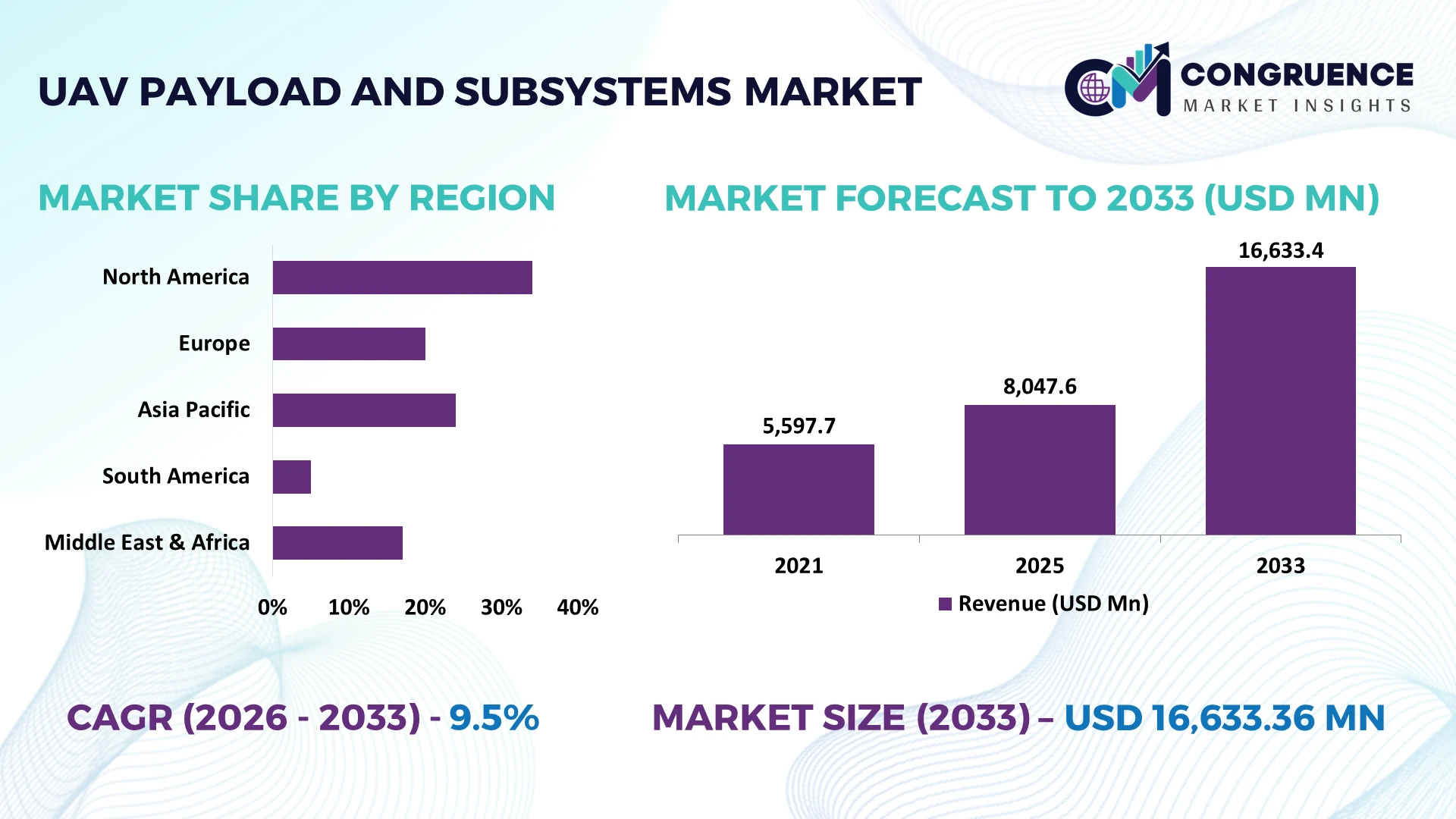
The United States commands an estimated 35–40% of advanced UAV payload demand, supported by MQ-series fleets, autonomous-system procurement, and mature EO/IR, radar, SIGINT, and communications industries. China maintains substantial domestic UAV manufacturing scale, while Israel leads export-oriented mission-system integration. Ukraine’s battlefield has accelerated small-UAV sensor and electronic-warfare deployment, with FPV and reconnaissance systems increasingly operating under contested-spectrum conditions.
Strategically, suppliers should prioritize modular payload architectures, resilient navigation, edge processing, and multi-sensor integration as battlefield survivability and rapid mission reconfiguration become decisive procurement criteria.
Market Size & Growth: USD 8,047.61 million in 2025 reaches USD 16,633.36 million by 2033 at 9.5%, driven by sensor fusion and autonomous mission systems.
Top Growth Drivers: Defense modernization contributes approximately 40%, ISR payload upgrades 30%, and autonomous mission adoption 20% to structural demand momentum.
Short-Term Forecast: By 2028, edge-AI processing can reduce UAV sensor-to-decision latency by approximately 20–30% in optimized mission architectures.
Emerging Technologies: AI accelerators, multispectral EO/IR, AESA radar, electronic-warfare payloads, and resilient navigation are moving rapidly into advanced UAV architectures.
Regional Leaders: By 2033, North America approaches USD 6.5 billion, Asia-Pacific USD 4.8 billion, and Europe USD 3.6 billion as autonomous-defense deployment accelerates.
Consumer/End-User Trends: Defense agencies represent approximately 70–75% of advanced payload demand, reflecting sustained ISR, targeting, communications, and electronic-warfare requirements.
Pilot/Case Example: Ukraine’s 2025 drone operations demonstrated mission cycles measured in minutes, accelerating field-driven upgrades to sensors, datalinks, navigation, and electronic protection.
Competitive Landscape: RTX holds an estimated 8–10% position, competing with L3Harris, Northrop Grumman, Teledyne FLIR, and Leonardo across sensor and mission-system programs.
Regulatory & ESG Impact: U.S. NDAA procurement restrictions are accelerating trusted-component sourcing, with compliant supply chains targeting near-100% exclusion of prohibited Chinese-origin systems.
Investment & Funding: More than USD 1 billion in autonomous-system, sensor, counter-EW, and defense-drone initiatives is strengthening production capacity and technology partnerships.
Innovation & Future Outlook: Modular payload bays and software-defined sensors target 15–25% faster mission reconfiguration, shifting competition from standalone hardware toward integrated mission architectures.
UAV payload and subsystem demand is concentrating around EO/IR surveillance, SAR, SIGINT, electronic warfare, communications relays, navigation, and onboard AI processing. Edge computing can reduce sensor-to-decision latency by approximately 20–30%, while modular interfaces accelerate payload replacement between missions. Ukraine-driven electronic-warfare lessons and trusted-component procurement are pushing suppliers toward resilient, interoperable architectures, establishing the strategic priorities for competitive positioning.
UAV payloads and subsystems are becoming strategically important because procurement is shifting from airframe-centric programs toward modular mission capability, resilient sensing, and rapid software-defined upgrades. Ukraine’s battlefield has accelerated demand for EO/IR, electronic warfare, GNSS-denied navigation, and secure datalinks, while U.S. trusted-supply-chain rules are restructuring sourcing away from restricted components. This favors suppliers controlling sensors, processors, communications, and integration interfaces.
Edge-AI processing can cut sensor-to-decision latency by roughly 20–30% versus architectures dependent on continuous offboard processing, while modular payload interfaces can shorten mission reconfiguration by 15–25%. The United States leads in high-end ISR and mission systems, Israel remains strong in integrated export platforms, and Europe is increasing autonomous-defense investment. A practical deployment is onboard target classification that filters imagery before transmission, reducing bandwidth load and accelerating operator response.
Through 2026–2028, investment will concentrate on AI accelerators, multi-sensor fusion, resilient PNT, electronic protection, and open-architecture payload bays. Companies are expanding defense partnerships and domestic component sourcing. Competitive advantage will depend on interoperable subsystems that survive contested environments and can be upgraded faster than complete UAV platforms.
Persistent battlefield demand for faster intelligence, surveillance, reconnaissance, and targeting is accelerating payload modernization. Defense customers account for roughly 70–75% of advanced UAV payload demand, while onboard AI can reduce sensor-to-decision latency by approximately 20–30% and modular payload integration can cut mission-changeover time by 15–25%. Ukraine has demonstrated the operational value of frequent sensor, datalink, and electronic-protection upgrades under contested-spectrum conditions. This shifts procurement toward EO/IR, SAR, SIGINT, and electronic-warfare payloads rather than static mission configurations. Suppliers are expanding open-architecture interfaces, edge-processing capability, and rapid integration partnerships. The strategic insight is that payload refresh cycles are becoming shorter than airframe replacement cycles, increasing recurring subsystem demand and favoring vendors with upgradeable architectures.
Supply-chain restrictions on Chinese-origin electronics, optics, communications modules, and flight-system components are increasing qualification complexity across U.S. and allied procurement. Replacing restricted components can raise subsystem costs by approximately 10–20%, while requalification and integration testing can extend development cycles by 15–25%. Specialized infrared detectors, RF components, and high-performance processors remain concentrated among relatively limited qualified suppliers, constraining rapid scaling. U.S. procurement rules are forcing contractors to document component provenance and establish compliant domestic or allied alternatives. Companies are responding through supplier diversification, long-term semiconductor agreements, localized assembly, and redesign around interchangeable modules. The non-obvious pressure is certification duplication: changing one restricted component can trigger broader thermal, electromagnetic, software, and flight-validation work, magnifying cost beyond the replacement part itself.
Onboard AI accelerators, sensor fusion, and software-defined payloads create a major opportunity to move intelligence processing closer to the aircraft. Edge inference can reduce communications bandwidth demand by approximately 20–40% in image-heavy missions and shorten operator response times by 20–30%. Israel and the United States are advancing autonomous ISR and target-recognition systems, while India is increasing domestic development under defense-localization programs. Future payload architectures will combine EO/IR, radar, RF sensing, and resilient navigation through shared processing modules. Suppliers are investing in AI chips, open mission systems, digital engineering, and software partnerships. A unique opportunity lies in software-enabled payload upgrades: vendors can extend capability without replacing hardware, improving lifecycle economics and creating recurring upgrade contracts after initial platform deployment.
Long-term competitiveness is constrained by the speed at which jamming, spoofing, cyber intrusion, and counter-UAV technologies invalidate existing subsystems. GNSS disruption can degrade navigation accuracy dramatically, while contested datalinks can reduce effective communications performance by more than 20% without adaptive waveforms or redundancy. Ukraine has shown that electronic-warfare countermeasures can force rapid redesign of antennas, navigation modules, firmware, and operating procedures within months rather than years. This creates continuous validation and software-maintenance burdens across deployed fleets. Companies must invest in resilient PNT, frequency-agile communications, cybersecurity hardening, hardware-in-the-loop testing, and rapid field-update infrastructure. The strategic challenge is maintaining interoperability while changing components quickly; suppliers that cannot update software, RF systems, and sensor-processing stacks at operational tempo will lose deployment relevance despite strong baseline hardware performance.
Payload Miniaturization Expands Mission Density: EO/IR, RF, and navigation modules are becoming smaller as manufacturers integrate processors, sensors, and stabilization electronics into compact assemblies. Payload weight reductions of 15–25% and power savings near 10–15% allow smaller UAVs to carry multi-sensor packages. Suppliers are redesigning gimbals, thermal management, and electronics packaging, increasing mission capability without requiring larger airframes or substantially reducing endurance.
Open Interfaces Accelerate Payload Swaps: Standardized mechanical, electrical, and software interfaces are replacing platform-specific integration workflows. Modular payload bays can shorten reconfiguration by 15–25%, while digital interface standardization reduces integration testing by roughly 10–20%. U.S. and allied programs increasingly emphasize open architectures, prompting subsystem suppliers to develop plug-compatible sensors and processors that shorten qualification cycles and increase addressable platform opportunities.
Resilient Datalinks Reshape Communications: Battlefield jamming is driving adoption of frequency-agile radios, directional antennas, mesh networking, and encrypted communications. Adaptive links can preserve 20–30% more usable connectivity under contested-spectrum conditions than fixed-channel architectures. Ukraine-driven operational pressure is accelerating firmware updates and antenna redesigns. Communications suppliers are partnering with UAV integrators to combine networking, electronic protection, and onboard processing into mission-resilient communications packages.
Trusted Components Restructure Procurement: Restrictions covering selected foreign-manufactured UAV components are changing sourcing and certification workflows. Domestic-content substitution can increase component costs by 10–20% and qualification workloads by 15–25%, but reduces procurement exclusion risk. U.S. suppliers are localizing electronics, optics, and communications assembly, while prime contractors increasingly audit component provenance before platform integration, making traceability a competitive qualification capability.
Electro-Optical Payloads lead type-level demand with an estimated 38–42% share because stabilized visible and infrared imaging supports surveillance, reconnaissance, targeting, inspection, and navigation across both defense and civil UAV platforms. Their mature integration interfaces, declining sensor size, and broad mission applicability sustain scale advantages over more specialized payloads. Communication Payloads account for approximately 18–20%, supporting relay, command, and network-extension missions, while Synthetic Aperture Radar contributes roughly 16–18% where all-weather, long-range imaging is operationally essential.
Electronic Warfare Payloads are the fastest-growing type as contested-spectrum operations increase requirements for RF detection, jamming, geolocation, and electronic support. LiDAR Payloads remain smaller but strategically important for precision terrain modeling and infrastructure measurement. Suppliers are investing in multi-sensor gimbals, lighter AESA architectures, software-defined RF systems, and common processing modules. Investment priorities are shifting from standalone sensors toward interoperable payload suites capable of combining optical, radar, communications, and electromagnetic intelligence within one mission architecture.
Intelligence & Surveillance accounts for approximately 46–50% of application demand because military forces and security agencies require persistent EO/IR, radar, and RF coverage for situational awareness and target identification. Border Monitoring represents approximately 16–18%, using long-endurance sensors and communications links to reduce dependence on fixed observation infrastructure. Communications applications are expanding where UAVs provide temporary network extension during military operations, emergencies, and remote-area deployments.
Precision Agriculture is the fastest-growing application as multispectral imaging, automated route planning, and payload miniaturization make crop monitoring and targeted field operations more operationally accessible. Mapping & Surveying remains established across construction, mining, utilities, and geospatial services, with LiDAR and photogrammetry cutting selected survey-field time by 30–50% compared with labor-intensive terrestrial workflows. Payload suppliers are integrating georeferencing, edge processing, and automated analytics directly into mission packages. Companies increasingly target application-specific bundles rather than selling sensors independently, strengthening recurring software, processing, and support opportunities.
Defense Organizations account for approximately 65–70% of end-user demand because persistent ISR, targeting, electronic warfare, communications, and navigation missions require high-value payloads with stringent qualification standards. Government Agencies contribute approximately 12–15%, deploying UAV systems for border security, emergency response, environmental monitoring, and public safety. Infrastructure Providers increasingly procure LiDAR, imaging, and thermal payloads for power-line, pipeline, transport, and asset inspection, where UAV operations reduce exposure to difficult terrain.
Commercial Operators are the fastest-growing end-user group as regulatory frameworks progress toward broader beyond-visual-line-of-sight operations. Agriculture Companies remain important users of multispectral and imaging payloads, particularly where crop scouting and variable-rate workflows justify recurring deployment. Suppliers are separating military-grade and commercial payload architectures, offering lighter configurations, subscription analytics, and application-specific integration support. Future demand increasingly rewards vendors capable of pairing compliant hardware with flight software, data processing, maintenance, and regulatory-operating support rather than supplying payload hardware alone.
North America accounted for the largest market share at approximately 39% in 2025 however, Asia-Pacific is expected to register the fastest growth, expanding at a CAGR of approximately 11.2% between 2026 and 2033.

Open Architectures Reshape Defense Procurement
North America represents approximately 39% of global UAV payload and subsystem demand, anchored by U.S. investment in EO/IR, SAR, SIGINT, electronic warfare, resilient PNT, and secure communications. Defense procurement increasingly emphasizes modular open-system architectures that permit sensors and processors to be upgraded without replacing complete aircraft. U.S. restrictions on selected Chinese-origin UAV components are simultaneously shifting electronics, optics, and communications sourcing toward domestic and allied suppliers. Defense organizations account for more than 70% of advanced regional payload deployment, while edge processing can shorten sensor-to-decision workflows by approximately 20–30%. Major contractors are integrating AI accelerators, frequency-agile datalinks, multisensor gimbals, and alternative-navigation systems. This procurement model favors subsystem vendors capable of meeting cybersecurity, component-provenance, interoperability, and rapid qualification requirements simultaneously.
United States Market Outlook: The United States combines the world's deepest military UAV ecosystem with specialized sensor, semiconductor, radar, communications, and mission-computing capabilities. Department of Defense programs increasingly prioritize attritable autonomous platforms and modular payload integration. Suppliers able to support open interfaces, domestic component traceability, and rapid software updates gain an advantage as payload refresh cycles compress from traditional multi-year programs toward operationally driven upgrades.
Battlefield Lessons Accelerate Sensor Modernization
Europe accounts for approximately 20% of global UAV payload and subsystem demand, with the United Kingdom, France, Germany, Italy, and Poland increasing investment in ISR, electronic warfare, border monitoring, and tactical autonomy. Ukraine has fundamentally altered requirements: inexpensive UAVs operating under intensive jamming have demonstrated the importance of resilient navigation, frequency-agile communications, thermal imaging, and rapidly replaceable mission electronics. European procurement is therefore shifting from isolated sensor acquisition toward integrated reconnaissance and electronic-protection packages. NATO interoperability requirements reinforce standardized interfaces, while domestic defense initiatives are expanding production capacity for drones and critical subsystems. Multi-sensor fusion can reduce operator interpretation workloads by roughly 15–25% when automated detection supports imagery processing. Suppliers are establishing local engineering partnerships and shortening qualification cycles to respond faster to operational feedback.
Germany Market Outlook: Germany is strengthening autonomous-system capability through defense modernization, domestic electronics expertise, and collaborative European programs. Its industrial base supports radar, optronics, communications, semiconductors, and mission computing. Procurement emphasis increasingly favors NATO-compatible architectures and domestically controlled technology, creating opportunities for suppliers offering AESA radar, EO/IR systems, secure datalinks, resilient navigation, and software-defined payload integration.
Localization Builds Independent Mission Capability
Asia-Pacific contributes approximately 26% of global UAV payload and subsystem demand, supported by China's integrated drone manufacturing base, India's defense localization, South Korea's electronics capability, Japan's autonomous-system investment, and Australia's surveillance requirements. China combines high-volume UAV production with domestic EO/IR, communications, radar, and navigation supply chains, while India is prioritizing indigenous ISR payloads and electronically scanned radar under defense modernization programs. Persistent maritime-security requirements across the Indo-Pacific are increasing demand for long-range surveillance and communications payloads. Local-content policies are shifting subsystem procurement toward domestic engineering and joint development rather than complete imports. Automated sensor fusion can reduce imagery-analysis workloads by approximately 15–25%. Suppliers are establishing local partnerships, technology-transfer arrangements, and regional production capabilities to secure procurement eligibility and lifecycle support.
India Market Outlook: India is emerging as a strategic UAV subsystem production hub through domestic defense procurement, electronics manufacturing, and private-sector drone development. National capability priorities include EO/IR, ELINT, electronically scanned radar, communications, and autonomous navigation. Local-content requirements favor Indian integration and manufacturing partnerships, giving suppliers with transferable technology and modular subsystem architectures stronger access to defense programs and export-oriented production opportunities.
Agriculture Broadens Commercial Payload Deployment
South America represents approximately 5% of global UAV payload and subsystem demand, with Brazil providing the strongest combination of aerospace engineering, agriculture, infrastructure inspection, and border-surveillance applications. Multispectral and imaging payloads are increasingly deployed across soybean, sugarcane, maize, and forestry operations, while government users require EO/IR systems for environmental monitoring and extensive land borders. UAV-based mapping can reduce selected terrestrial survey fieldwork by 30–50%, strengthening adoption among mining, utilities, and infrastructure operators. Brazil's established aerospace and electronics capabilities support local integration, although advanced thermal detectors, LiDAR modules, and specialized RF components remain substantially import-dependent. Companies are expanding distributor networks, localized maintenance, agricultural analytics, and payload integration services. Currency volatility and certification requirements make lifecycle support and locally stocked components important purchasing criteria.
Brazil Market Outlook: Brazil combines a globally significant agricultural sector with aerospace manufacturing capability and extensive infrastructure requiring remote inspection. Large farms create operational scale for multispectral imaging, while mining, electricity, and environmental agencies provide demand for LiDAR and EO payloads. Local integration and maintenance capabilities increasingly differentiate suppliers because imported subsystem downtime can materially disrupt seasonal agricultural and industrial operations.
Security Investment Expands Local Integration
Middle East & Africa accounts for approximately 10% of global UAV payload and subsystem demand, led by Israel, Türkiye, Saudi Arabia, the UAE, and selected African defense operators. Israel maintains advanced capabilities in EO/IR, radar, communications, electronic warfare, and mission integration, while Türkiye has rapidly expanded indigenous UAV production and export deployment. Gulf governments are increasing local defense manufacturing through partnerships and technology transfer, shifting procurement from imported platforms toward domestic assembly and subsystem integration. Border surveillance, maritime monitoring, critical-infrastructure protection, and persistent ISR dominate payload requirements. Modern edge processors can reduce data-transmission requirements by approximately 20–40% by filtering imagery onboard. Suppliers are consequently pairing sensors with analytics, secure communications, and local maintenance capabilities rather than competing through standalone hardware.
Israel Market Outlook: Israel provides the region's strongest UAV payload technology ecosystem through established expertise in optronics, AESA radar, electronic warfare, communications, and autonomous mission systems. Domestic suppliers integrate sensors directly with UAV platforms and battlefield networks, supporting rapid operational feedback. This vertically connected model strengthens export competitiveness and enables faster adaptation of payloads for surveillance, targeting, communications, and contested-spectrum missions.
L3Harris, RTX, Northrop Grumman, Teledyne FLIR and Leonardo compete for high-value EO/IR, radar, communications and electronic-warfare programs, while specialized sensor suppliers challenge primes through lighter modular payloads. The top five players hold approximately 35–40% of organized subsystem demand. Competition centers on detection performance, SWaP efficiency, interoperability, cybersecurity and qualification speed. Edge processing can reduce transmission requirements by 20–40%, modular interfaces shorten payload changeovers by 15–25%, and sensor miniaturization cuts weight by 15–25%. Large contractors compete through vertical integration, defense partnerships and lifecycle support; specialists emphasize rapid innovation and platform-neutral architectures. Procurement is shifting toward open mission systems, resilient PNT and software-defined payloads, reducing dependence on proprietary hardware. Security certification, component provenance, integration testing and export controls remain significant entry barriers. Winning requires trusted supply chains, combat-relevant performance, rapid software upgrades, low-SWaP engineering and interoperability across multiple UAV platforms, command networks and allied procurement frameworks without sacrificing mission reliability.
L3Harris Technologies
RTX Corporation
Northrop Grumman Corporation
Teledyne Technologies
Leonardo S.p.A.
Thales
Elbit Systems
Israel Aerospace Industries
HENSOLDT
Saab AB
BAE Systems
Honeywell International
Garmin Ltd.
Safran
Current UAV payload technology centers on stabilized EO/IR gimbals, synthetic-aperture radar, secure datalinks, electronic-warfare modules, and edge processors. Sensor miniaturization reduces payload weight by approximately 15–25%, while onboard processing can cut transmitted data volumes by 20–40%. Adoption is strongest across defense ISR fleets and increasingly small tactical UAVs, improving endurance, bandwidth efficiency, targeting speed, and survivability in contested electromagnetic environments.
Emerging architectures combine multisensor fusion, AESA radar, software-defined RF, resilient PNT, and AI accelerators through open mission interfaces. Compared with legacy offboard-processing systems, edge AI can shorten sensor-to-decision workflows by 20–30%; modular interfaces can reduce payload reconfiguration time by 15–25%. Suppliers integrating common processors, standardized connectors, and software-defined functionality benefit through faster qualification, broader platform compatibility, and recurring upgrade opportunities.
Disruptive development centers on cognitive electronic warfare, collaborative sensing, autonomous target recognition, and distributed payload networking. Between 2026 and 2028, AI-enabled processing should reduce operator analysis workloads by 15–25%, while software-defined architectures can accelerate capability updates by 20–30%. Large integrators benefit from vertical integration; specialist suppliers gain through low-SWaP innovation. Investment matters now because jamming, GNSS disruption, and shortened battlefield technology cycles reward cyber-secure, interoperable payloads that can be reconfigured without replacing complete aircraft during rapidly evolving multi-domain combat operations.
October 2024 Teledyne FLIR introduced the Vue TV128+ dual-sensor SIRAS payload, combining 128× visible zoom, 16MP imaging and 640×512 Boson+ thermal resolution with ≤20 mK sensitivity, strengthening inspection and public-safety performance through sharper thermal discrimination across field operations. Source: flir.com
June 2025 Thales unveiled a mini COMINT UAV payload covering 200 MHz–6 GHz while weighing 4.5 kg and consuming 40 W. Its low-SWaP design expands passive communications intelligence deployment on smaller unmanned aircraft and improves electronic-surveillance mission flexibility. Source: janes.com
March 2025 Leonardo and Baykar signed an MoU to establish an Italy-based UAS joint venture combining Baykar platforms with Leonardo mission systems, payloads and certification capabilities, targeting a European unmanned market estimated at $100 billion and industrial integration. Source: leonardo.com
May 2026 Teledyne FLIR launched Rogue 1 Block 2, doubling operating range beyond 20 km and increasing endurance 20% through advanced battery cells. The upgrade adds an anti-armor payload and strengthens contested-environment mission flexibility for frontline tactical units. Source: flir.com
The Uav Payload And Subsystems Market report covers Electro-Optical Payloads, Synthetic Aperture Radar, Communication Payloads, Electronic Warfare Payloads, and LiDAR Payloads across Intelligence & Surveillance, Mapping & Surveying, Communications, Border Monitoring, and Precision Agriculture. End-user analysis includes Defense Organizations, Government Agencies, Commercial Operators, Agriculture Companies, and Infrastructure Providers. Electro-optical payloads represent an estimated 38–42% of type-level demand, while defense organizations account for approximately 65–70% of deployment.
Regional coverage spans North America, Europe, Asia-Pacific, South America, and Middle East & Africa, assessing procurement localization, manufacturing capability, deployment intensity, and technology sovereignty. Technology analysis covers edge AI, AESA radar, multisensor fusion, resilient PNT, software-defined RF, electronic warfare, secure datalinks, and open architectures. The report supports 2026–2033 investment planning, supplier selection, localization, partnership development, competitive positioning, and identification of emerging autonomous, low-SWaP, and contested-spectrum payload opportunities.
| Report Attribute/Metric | Report Details |
|---|---|
Market Revenue in 2025 | USD 8047.61 Million |
Market Revenue in 2033 | USD 16633.36 Million |
CAGR (2026 - 2033) | 9.5% |
Base Year | 2025 |
Forecast Period | 2026 - 2033 |
Historic Period | 2021 - 2025 |
Segments Covered | By Type
By Application
By End-User
|
Key Report Deliverable | Revenue Forecast, Growth Trends, Market Dynamics, Segmental Overview, Regional and Country-wise Analysis, Competition Landscape |
Region Covered | North America, Europe, Asia-Pacific, South America, Middle East, Africa |
Key Players Analyzed | L3Harris Technologies, RTX Corporation, Northrop Grumman Corporation, Teledyne Technologies, Leonardo S.p.A., Thales, Elbit Systems, Israel Aerospace Industries, HENSOLDT, Saab AB, BAE Systems, Honeywell International, Garmin Ltd., Safran |
Customization & Pricing | Available on Request (10% Customization is Free) |




