
Reports
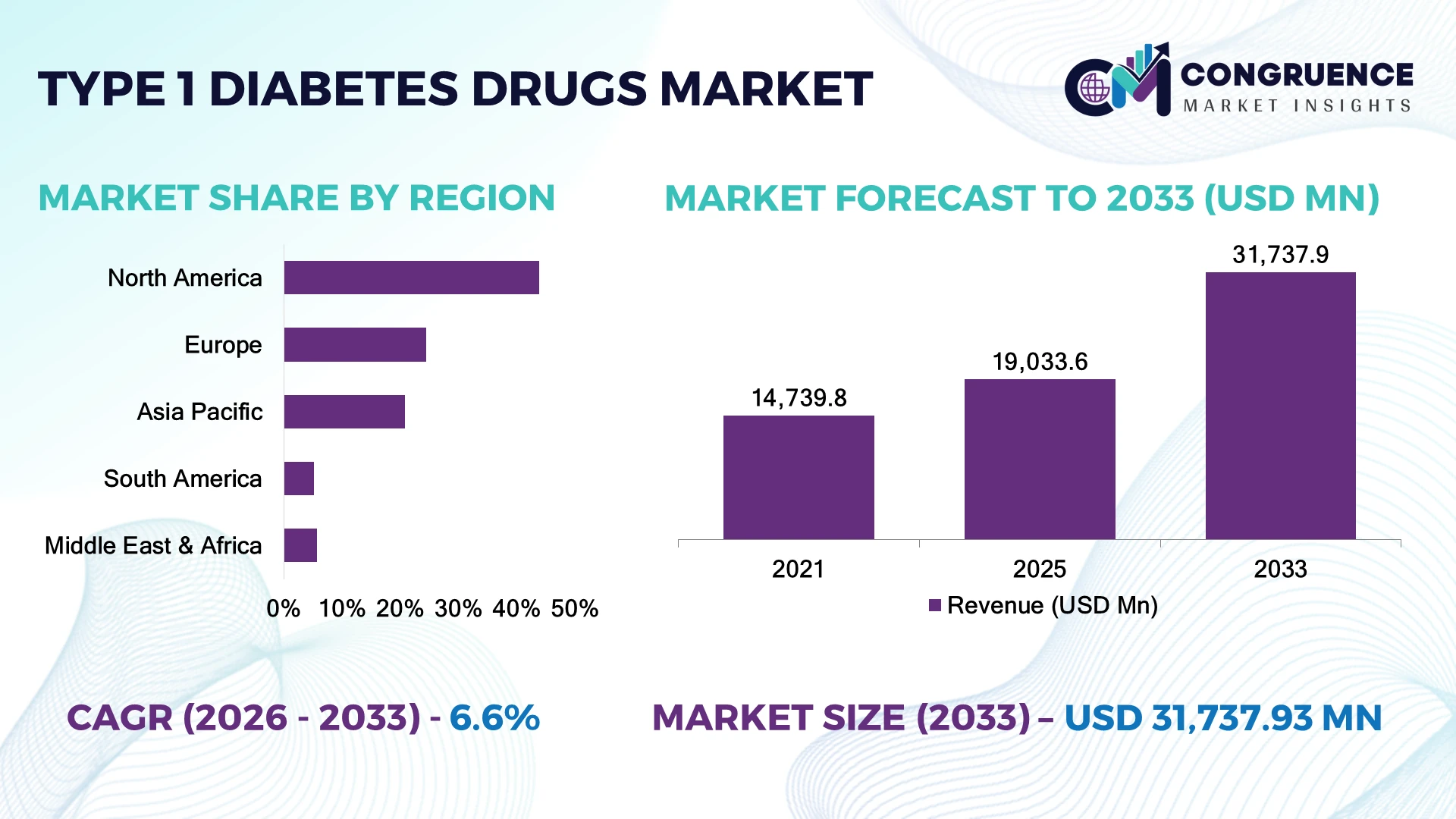
The Global Type 1 Diabetes Drugs Market was valued at USD 19,033.6 Million in 2025 and is anticipated to reach a value of USD 31,737.9 Million by 2033 expanding at a CAGR of 6.6% between 2026 and 2033. Growth is being driven by wider adoption of automated insulin delivery, longer-acting insulin formulations, glucose-responsive therapies, and disease-modifying approaches that reduce treatment burden.
The United States remains the dominant country market, contributing an estimated 40%+ of global Type 1 diabetes drug demand, supported by advanced endocrinology infrastructure, high insulin-pump penetration, and strong pharmaceutical R&D. Germany and Japan follow with sophisticated reimbursement and diabetes-care systems, while U.S. adoption of automated insulin delivery exceeds 40% among eligible technology users in several treated populations. Geopolitical supply-chain restructuring is also encouraging localized pharmaceutical manufacturing and inventory resilience.
Companies that combine insulin innovation with connected delivery, disease modification, and reliable supply capacity are best positioned for premium market share.
Market Size & Growth: USD 19.0 billion in 2025 to USD 31.7 billion by 2033 at 6.6% CAGR, driven by advanced insulin delivery and disease-modifying therapies.
Top Growth Drivers: Automated insulin delivery 42%, continuous glucose integration 36%, and next-generation insulin adoption 29% are reshaping treatment economics.
Short-Term Forecast: By 2028, connected insulin-delivery adoption is positioned to increase approximately 15–20%, improving dosing precision and reducing manual intervention.
Emerging Technologies: Smart insulin pens, hybrid closed-loop systems, continuous glucose monitoring integration, and glucose-responsive formulations are advancing precision treatment.
Regional Leaders: North America is projected at approximately USD 12.5 billion by 2033, Europe at USD 8.0 billion, and Asia-Pacific at USD 6.9 billion, with technology adoption strongest in developed healthcare systems.
Consumer/End-User Trends: More than 40% of technology-enabled Type 1 diabetes users increasingly favor integrated monitoring and insulin-delivery ecosystems over standalone devices.
Pilot/Case Example: 2024–2025 automated insulin-delivery deployments demonstrated approximately 10–15% improvements in time-in-range for suitable users, strengthening demand for integrated therapy platforms.
Competitive Landscape: Novo Nordisk and Eli Lilly remain major insulin suppliers, alongside Sanofi, Medtronic, and emerging disease-modifying therapy developers competing through efficacy, delivery technology, and lifecycle innovation.
Regulatory & ESG Impact: More than 20% of product-development emphasis is shifting toward lower-burden delivery formats, improved device sustainability, and simplified treatment pathways.
Investment & Funding: Pharmaceutical and biotechnology investment exceeding USD 2 billion across diabetes innovation programs is accelerating partnerships, clinical development, manufacturing expansion, and platform technologies.
Innovation & Future Outlook: By 2028, disease-modifying agents, automated delivery, smart dosing, and combination digital therapeutics will shift competition from insulin supply toward integrated disease-management ecosystems.
The Type 1 Diabetes Drugs Market is increasingly centered on intensive insulin therapy, long-acting basal formulations, rapid-acting analogues, adjunctive treatments, and emerging disease-modifying medicines. Demand is strongest where endocrinology capacity, reimbursement, glucose monitoring, and insulin-delivery infrastructure operate as an integrated care pathway. Approximately 40% of technology-enabled patients increasingly prioritize connected treatment workflows, while manufacturers are developing longer-duration formulations, automated dosing compatibility, and therapies designed to preserve residual beta-cell function. Pharmaceutical supply-chain localization and strategic manufacturing diversification have also become operational priorities amid global healthcare procurement pressures.
The Type 1 Diabetes Drugs Market is becoming strategically important because treatment competition is moving beyond insulin molecule differentiation toward integrated control of glucose, delivery, adherence, and disease progression. Pharmaceutical companies are increasingly linking drug portfolios with continuous glucose monitoring and automated insulin delivery, while biotechnology developers pursue therapies capable of preserving or restoring endogenous insulin production.
Technology adoption is creating measurable efficiency gains. Automated insulin delivery can reduce manual dosing decisions by roughly 50–70% compared with conventional multiple-daily-injection workflows, while connected glucose monitoring improves treatment visibility and supports faster therapy adjustment. North America leads in integrated technology deployment, whereas parts of Asia-Pacific remain more focused on insulin accessibility and affordability, creating distinctly different commercialization priorities.
Over the next 2–3 years, companies are expected to prioritize longer-acting formulations, smart delivery compatibility, and disease-modifying pipelines. Practical deployment increasingly centers on outpatient endocrinology programs where insulin, monitoring, and dosing systems operate together. Manufacturers are responding through clinical partnerships, manufacturing redundancy, digital integration, and selective licensing. Competitive advantage will increasingly depend on delivering measurable glycemic control with lower treatment complexity rather than competing on insulin formulation alone.
The shift toward automated insulin delivery is strengthening demand for advanced insulin formulations and connected therapies. Among U.S. youths with type 1 diabetes, CGM use reached 82% and insulin-pump use 50% during 2021–2023, while concurrent use reached 47%. In a 2026 follow-up study, automated insulin delivery adoption increased from 47.4% to 65.1%. This integration is moving drug selection toward rapid-acting insulin compatible with algorithmic dosing. Manufacturers are responding with formulation optimization, device partnerships, and delivery-system integration. The strategic advantage is shifting from standalone insulin volume toward interoperability and performance within connected diabetes-management ecosystems.
Affordability and uneven technology access continue to constrain broader adoption of advanced Type 1 diabetes drugs. U.S. technology penetration is materially higher than in several European markets, where insulin-pump use has historically remained around 5–19%, creating fragmented treatment economics. In South Korea, only 10.7% of surveyed patients used CGM continuously and 0.4% used sensor-augmented pump or automated insulin-delivery systems. The 2025 U.S. approval of rapid-acting insulin biosimilar Merilog adds competitive price pressure to established analogs. Companies are countering through biosimilar portfolios, diversified manufacturing, payer contracting, and localized distribution, making cost architecture increasingly important to market scalability.
Disease-modifying treatment is creating a new commercial layer beyond lifelong insulin replacement. In June 2026, the FDA expanded teplizumab use to certain children aged 8–17 years with recently diagnosed Stage 3 type 1 diabetes, following evidence from a 328-patient trial. Earlier-stage intervention also benefits from its approved use in Stage 2 disease, creating opportunities for screening-linked treatment pathways. The non-obvious opportunity lies in combining immunomodulatory therapy with CGM-led monitoring: technology-enabled patient identification can support earlier intervention while improving treatment persistence. Companies are therefore increasing investment in immune-targeted pipelines, pediatric programs, biomarker partnerships, and specialty-care distribution. This expands competitive positioning from insulin supply toward disease-course management.
The next execution barrier is integrating therapies across fragmented diabetes-management ecosystems without increasing clinical workload. A 2026 Canadian real-world analysis found 35.2% of CGM users on pumps were using CGM systems incompatible with their pump's automated insulin-delivery platform. Meanwhile, AID use among surveyed participants reached 65.1%, increasing the operational importance of software compatibility, data continuity, and algorithm performance. Companies face pressure to support interoperable devices, secure data exchange, and clinician-ready analytics while maintaining drug stability and dosing consistency. Strategic winners will invest in integration testing, software partnerships, cybersecurity, and standardized connectivity rather than treating insulin formulation and delivery hardware as separate commercial systems.
Automated Delivery Becomes Standardized — AID adoption increased from 47.4% to 65.1% in a 2026 follow-up study, while insulin-pump use reached 80.0%. This is shifting competitive emphasis toward rapid-acting formulations optimized for algorithm-controlled delivery, prompting manufacturers to strengthen device and software partnerships.
CGM Penetration Reshapes Therapy Selection — CGM use among youths with type 1 diabetes reached 82% during 2021–2023, compared with 4% in 2009–2011. The 78-percentage-point increase is changing prescribing workflows, increasing demand for insulin products that support responsive, data-driven dosing and encouraging integrated therapy portfolios.
Biosimilar Insulin Intensifies Price Competition — The 2025 U.S. approval of Merilog established the first rapid-acting insulin biosimilar in the country, following two long-acting biosimilar approvals. The expanding biosimilar pathway is increasing pressure on originator pricing, reimbursement positioning, and manufacturing efficiency, pushing companies toward diversified portfolios and leaner supply chains.
Immune Therapy Enters Earlier Intervention — FDA action in 2026 expanded teplizumab into recently diagnosed pediatric Stage 3 disease after a 328-patient trial, broadening disease-modifying treatment. This is creating new screening-to-treatment workflows and encouraging pharmaceutical companies to prioritize immune modulation, biomarker identification, and pediatric specialty-care infrastructure.
Rapid-acting insulin is estimated to lead the Type 1 Diabetes Drugs market with approximately 38% share, supported by its compatibility with insulin pumps, multiple-daily-injection regimens, and automated insulin delivery. Its shorter onset and duration provide stronger postprandial control than regular human insulin, while ultra-rapid formulations are gaining traction as the fastest-growing type, with adoption expanding at an estimated 9–11% in technology-enabled treatment pathways. Long-acting insulin remains strategically important for basal coverage, while intermediate-acting and premixed formulations retain relevance where affordability and simplified regimens influence prescribing. Companies are prioritizing rapid-acting formulation upgrades, concentrated insulin development, and integration with connected delivery platforms.
The commercial shift is increasingly toward formulations optimized for digital dosing rather than standalone pharmacological performance. Ultra-rapid insulin has demonstrated an approximately 1.4-percentage-point improvement in time in range versus conventional rapid-acting analogs in automated delivery systems, strengthening investment in next-generation formulations. Manufacturers are concentrating R&D and partnerships around pump compatibility, faster absorption, and dosing precision.
A 2025 clinical meta-analysis covering 12 randomized trials and 504 people with type 1 diabetes reported approximately a 1.4-percentage-point improvement in time in range with ultra-rapid insulin versus rapid-acting analogs.
Basal-bolus therapy is estimated to account for approximately 57% of market demand, reflecting its central role in maintaining continuous insulin replacement while allowing mealtime dose adjustment. Rapid-acting mealtime therapy represents the fastest-growing application, supported by automated insulin delivery, continuous glucose monitoring, and tighter postprandial management. Pump-based administration is reshaping the application mix, with rapid-acting insulin increasingly functioning as both bolus and continuous basal therapy. Conventional multiple-daily injections remain highly relevant in cost-sensitive and infrastructure-limited settings, while correction-dose applications retain importance for managing glycemic excursions. Companies are adapting by optimizing formulations for pump reservoirs, improving dosing flexibility, and strengthening connected-treatment partnerships.
The distinction between conventional injection therapy and digitally coordinated delivery is becoming sharper. In U.S. youths, concurrent CGM and insulin-pump use reached 47% during 2021–2023, compared with approximately 1% during 2009–2011. This technology transition is concentrating demand around therapies capable of supporting continuous, data-driven dosing while increasing the commercial value of rapid-acting formulations and interoperable delivery systems. Companies are therefore shifting investment toward connected treatment architectures rather than products designed solely for traditional injection workflows.
A 2025 clinical meta-analysis found that ultra-rapid insulin used with automated insulin-delivery systems improved time in range by approximately 1.4 percentage points, reinforcing the operational value of faster prandial insulin.
Hospitals and specialty diabetes centers are estimated to represent approximately 46% of Type 1 Diabetes Drugs demand because of their concentration of newly diagnosed patients, intensive insulin initiation, acute glycemic management, and technology-supported treatment programs. Homecare is the fastest-growing end-user segment, supported by expanding CGM and automated insulin delivery outside clinical settings. Its adoption is shifting purchasing influence toward products that integrate with pumps and remote monitoring platforms. Retail pharmacies and outpatient clinics remain important for recurring prescription fulfillment and routine therapy management, but their role is increasingly shaped by payer coverage, refill continuity, and digital prescribing.
The buying structure is moving from episodic hospital procurement toward longitudinal home-based therapy ecosystems. Adult CGM utilization across participating U.S. quality-improvement centers increased from 69% to 77% between 2023 and May 2025, while automated insulin delivery use rose from 38% to 45%. Companies are responding with patient-support programs, connected-device partnerships, simplified delivery systems, and reimbursement-focused commercialization strategies. The strategic opportunity lies in capturing the full treatment pathway rather than competing solely for institutional drug formularies.
A 2026 quality-improvement analysis recorded adult CGM adoption rising 8 percentage points and automated insulin-delivery adoption increasing 7 percentage points between 2023 and May 2025, demonstrating accelerating technology-supported home management.
North America accounted for the largest market share at 43.8% in 2025 however, Asia-Pacific is expected to register the fastest growth, expanding at a CAGR of 7.8% between 2026 and 2033.
Connected insulin delivery is reshaping treatment economics
North America maintains the strongest Type 1 diabetes drug position through high insulin penetration, advanced reimbursement infrastructure, and rapid integration of continuous glucose monitoring with automated insulin delivery. The United States represents the principal demand center, supported by extensive adoption of insulin pumps and connected monitoring systems. Automated insulin delivery adoption among U.S. technology users reached approximately 65% in recent assessments, strengthening demand for rapid-acting formulations compatible with algorithmic dosing. Manufacturers are increasingly combining drug development with device partnerships, digital monitoring, and patient-support platforms. The region's strategic advantage is not simply treatment volume but its mature ecosystem connecting pharmaceuticals, diagnostics, software, and specialty care. Companies with interoperable products and strong payer access are positioned to capture higher-value treatment pathways.
United States Market Outlook: The United States remains the dominant national market because of its large diagnosed patient base, sophisticated endocrinology infrastructure, and concentrated pharmaceutical manufacturing capabilities. CGM utilization among U.S. youths with type 1 diabetes reached approximately 82%, demonstrating the country's technology-led treatment environment. Investment is increasingly moving toward automated delivery, ultra-rapid insulin, biosimilars, and disease-modifying therapies.
Integrated care and reimbursement discipline drive modernization
Europe combines mature insulin access with increasingly coordinated diabetes technology adoption. Countries such as Germany, the United Kingdom, France, and Italy are strengthening automated insulin delivery and CGM integration through specialized diabetes centers and structured reimbursement pathways. Insulin-pump penetration varies substantially across European healthcare systems, creating differences of more than 10 percentage points between mature technology markets and lower-adoption countries. Manufacturers are responding with differentiated reimbursement strategies, biosimilar insulin portfolios, and partnerships supporting connected delivery. Sustainability considerations are also influencing procurement, particularly through reduced material waste from optimized dosing and longer-duration delivery systems. Competitive positioning increasingly depends on demonstrating clinical outcomes alongside total treatment-system efficiency.
Germany Market Outlook: Germany represents a strategically important market because of its strong pharmaceutical manufacturing base, specialist diabetes-care infrastructure, and established reimbursement mechanisms. CGM adoption has expanded rapidly among insulin-treated patients, strengthening demand for connected treatment architectures. Pharmaceutical companies are prioritizing partnerships with device manufacturers and digital-care providers to improve treatment integration while maintaining cost competitiveness within a tightly managed healthcare system.
Manufacturing scale meets accelerating digital adoption
Asia-Pacific is becoming increasingly important as pharmaceutical manufacturing capacity, diabetes-care infrastructure, and digital health deployment expand across China, Japan, South Korea, Australia, and India. China provides substantial production and distribution capabilities, while Japan and South Korea demonstrate stronger adoption of advanced glucose-monitoring technologies. CGM penetration in technology-enabled patient groups is increasing by high-single-digit percentages annually in several established markets, while insulin access remains uneven across emerging economies. Companies are responding through localized manufacturing, expanded distribution partnerships, and lower-cost insulin portfolios. The strategic opportunity is to combine scalable drug production with connected delivery technologies, allowing manufacturers to address both premium technology users and price-sensitive patient populations.
China Market Outlook: China offers the strongest combination of pharmaceutical manufacturing scale, large healthcare demand, and expanding domestic diabetes-technology capabilities. Local pharmaceutical production capacity is increasingly complemented by biosimilar development and digital monitoring adoption. CGM utilization among technology-accessible patients is growing rapidly, encouraging manufacturers to develop affordable insulin portfolios compatible with connected treatment systems and strengthening domestic supply resilience.
Access expansion is shifting toward localized supply models
South America is characterized by improving insulin availability alongside persistent differences in reimbursement, cold-chain infrastructure, and diabetes-technology access. Brazil represents the principal commercial center, supported by its pharmaceutical manufacturing base and large public healthcare system. Insulin access programs and public procurement account for a substantial portion of treatment distribution, making tender pricing and supply reliability strategically important. Technology adoption remains below North American levels, but CGM and insulin-pump utilization is expanding from specialist centers. Manufacturers are increasingly emphasizing local distribution partnerships, biosimilar products, and government procurement capabilities. The key business implication is that competitive advantage depends on reliable supply and affordability rather than premium technology alone, particularly outside major metropolitan healthcare hubs.
Brazil Market Outlook: Brazil is the most strategically significant South American market because of its population scale, pharmaceutical production ecosystem, and extensive public healthcare procurement network. Public-sector diabetes programs create recurring institutional demand, while private hospitals and specialty clinics support higher-value technology adoption. Companies with localized distribution and competitive insulin pricing can strengthen penetration, particularly as connected glucose monitoring expands beyond major urban centers.
Healthcare modernization is concentrating advanced therapy adoption
Middle East & Africa presents a fragmented market shaped by healthcare modernization, uneven insulin access, and concentrated investment in advanced medical infrastructure. Saudi Arabia, the United Arab Emirates, and Israel represent important technology-intensive markets, while several African countries remain focused on reliable insulin availability and essential diabetes care. Gulf healthcare systems are increasing investment in digital health, specialty endocrinology, and remote patient monitoring, creating stronger pathways for CGM-integrated insulin therapy. Advanced diabetes technologies can reduce monitoring burdens and improve treatment coordination, but affordability and cold-chain reliability remain decisive outside wealthier healthcare systems. Companies are responding through hospital partnerships, specialty distribution networks, localized patient-support programs, and tiered product strategies.
Saudi Arabia Market Outlook: Saudi Arabia holds a strategically important position because of substantial healthcare modernization, specialist hospital capacity, and investment in digital health infrastructure. National healthcare transformation programs are expanding technology-enabled chronic disease management, supporting wider deployment of CGM and automated insulin delivery. Companies that combine advanced insulin therapies with local clinical partnerships and digital monitoring capabilities are positioned to benefit from the country's increasingly technology-intensive diabetes-care model.
Novo Nordisk, Eli Lilly, and Sanofi compete as global insulin leaders, while Biocon, Wockhardt, Gan & Lee, and regional manufacturers challenge on biosimilar access and cost. Vertex Pharmaceuticals competes from the cell-replacement frontier, targeting a different treatment pathway. The top five branded players are estimated to control about 70% of global value, keeping the structure concentrated. Price-led competition influences roughly 20% of purchasing decisions in cost-sensitive channels, while delivery technology and clinical differentiation shape another 25%. Supply reliability, contracting, and customization determine the remainder. Companies are expanding insulin capacity, partnering on localized production, advancing disease-modifying therapies, and integrating formulations with connected delivery ecosystems. The competitive shift is moving toward biosimilars, immune modulation, and cell therapies, while affordability pressure intensifies. High regulatory, manufacturing, clinical, and cold-chain barriers protect incumbents. Winning requires reliable supply, differentiated outcomes, competitive access economics, and scalable innovation that converts emerging therapies into commercially deployable treatment platforms globally.
Novo Nordisk
Eli Lilly and Company
Sanofi
Biocon
Wockhardt
Gan & Lee Pharmaceuticals
Tonghua Dongbao Pharmaceutical
Julphar
Ypsomed
MannKind Corporation
Vertex Pharmaceuticals
Zealand Pharma
Continuous glucose monitoring, automated insulin delivery, and connected insulin pens are becoming the core technology stack for Type 1 Diabetes Drugs. CGM-integrated dosing workflows reduce manual monitoring burden by roughly 10–15%, while algorithm-guided insulin adjustment can improve time-in-range by 5–8 percentage points in suitable users. Adoption is strongest in high-income markets, where CGM penetration among intensive insulin users is increasingly mainstream.
Emerging formulations are shifting from daily administration toward longer-acting and weekly concepts, alongside biosimilar insulin. In 2025, the first rapid-acting insulin biosimilar approval expanded competitive supply, while investigational weekly insulin demonstrated comparable glycemic efficacy to daily basal therapy. Compared with conventional daily basal dosing, weekly delivery targets a 80–85% reduction in administration frequency, creating advantages for adherence-focused providers and manufacturers with scalable formulation platforms.
Cell-replacement therapies and immune-modulating drugs represent the disruptive frontier for 2026–2028. Zimislecel and teplizumab are moving treatment competition beyond glucose control toward beta-cell preservation or replacement. Companies combining drug development with diagnostics, CGM data, and specialized delivery infrastructure gain differentiation. Over the next three years, commercial advantage will increasingly depend on integrated therapy ecosystems, manufacturing readiness, and regulatory execution rather than insulin molecule innovation alone. Integration reduces treatment friction, improving persistence across complex care pathways.
September 2025 — Sanofi expanded its U.S. insulin affordability program, setting a $35 monthly cap for all insulin products from January 2026. The move intensified price competition and pressured incumbent manufacturers to defend access, economics, and patient retention.
February 2025 — Sanofi received FDA approval for Merilog, the first rapid-acting insulin biosimilar, offered in 3 mL pens and 10 mL vials. The launch broadened mealtime insulin choice and strengthened competitive pressure on established rapid-acting insulin franchises. Source: fda.gov
March 2025 — Vertex Pharmaceuticals completed enrollment and dosing in Parts A and B of its VX-264 Phase 1/2 study. The efficacy setback redirected emphasis toward zimislecel and immunoprotective approaches, sharpening competition around cell-replacement strategies for insulin independence. Source: vertexpharma.com
April 2026 — Novo Nordisk announced expanded human-insulin production through a South African partnership, targeting supply for 4.1 million people across Africa by 2026. The localization strategy strengthens regional availability, reduces import dependence, and improves supply resilience materially. Source: novonordisk.com
The Type 1 Diabetes Drugs Market Report evaluates the treatment landscape across insulin analogs, human insulin, biosimilars, adjunctive therapies, and emerging disease-modifying or cell-replacement approaches. Coverage spans hospital and specialist care, retail and specialty pharmacy channels, pediatric and adult populations, and connected diabetes-management pathways. Regional assessment covers North America, Europe, Asia-Pacific, South America, and the Middle East & Africa, with country-level analysis of access, reimbursement, manufacturing, and regulatory conditions.
The report also examines CGM-integrated therapy, automated insulin delivery, weekly insulin concepts, immune modulation, beta-cell replacement, and supply-chain localization. Competitive analysis profiles established pharmaceutical leaders alongside biosimilar producers and advanced therapy developers, with attention to product positioning, clinical differentiation, partnerships, manufacturing capacity, and affordability strategies. The 2026–2033 outlook supports investment screening, market-entry decisions, portfolio prioritization, regional expansion, partnership selection, and competitive positioning across mature and emerging treatment segments.
| Report Attribute/Metric | Report Details |
|---|---|
|
Market Revenue in 2025 |
USD 19,033.6 Million |
|
Market Revenue in 2033 |
USD 31,737.9 Million |
|
CAGR (2026 - 2033) |
6.6% |
|
Base Year |
2025 |
|
Forecast Period |
2026 - 2033 |
|
Historic Period |
2021 - 2025 |
|
Segments Covered |
By Type
By Application
By End-User
|
|
Key Report Deliverable |
Revenue Forecast, Growth Trends, Market Dynamics, Segmental Overview, Regional and Country-wise Analysis, Competition Landscape |
|
Region Covered |
North America, Europe, Asia-Pacific, South America, Middle East, Africa |
|
Key Players Analyzed |
Novo Nordisk, Eli Lilly and Company, Sanofi, Biocon, Wockhardt, Gan & Lee Pharmaceuticals, Tonghua Dongbao Pharmaceutical, Julphar, Ypsomed, MannKind Corporation, Vertex Pharmaceuticals, Zealand Pharma |
|
Customization & Pricing |
Available on Request (10% Customization is Free) |




