
Reports
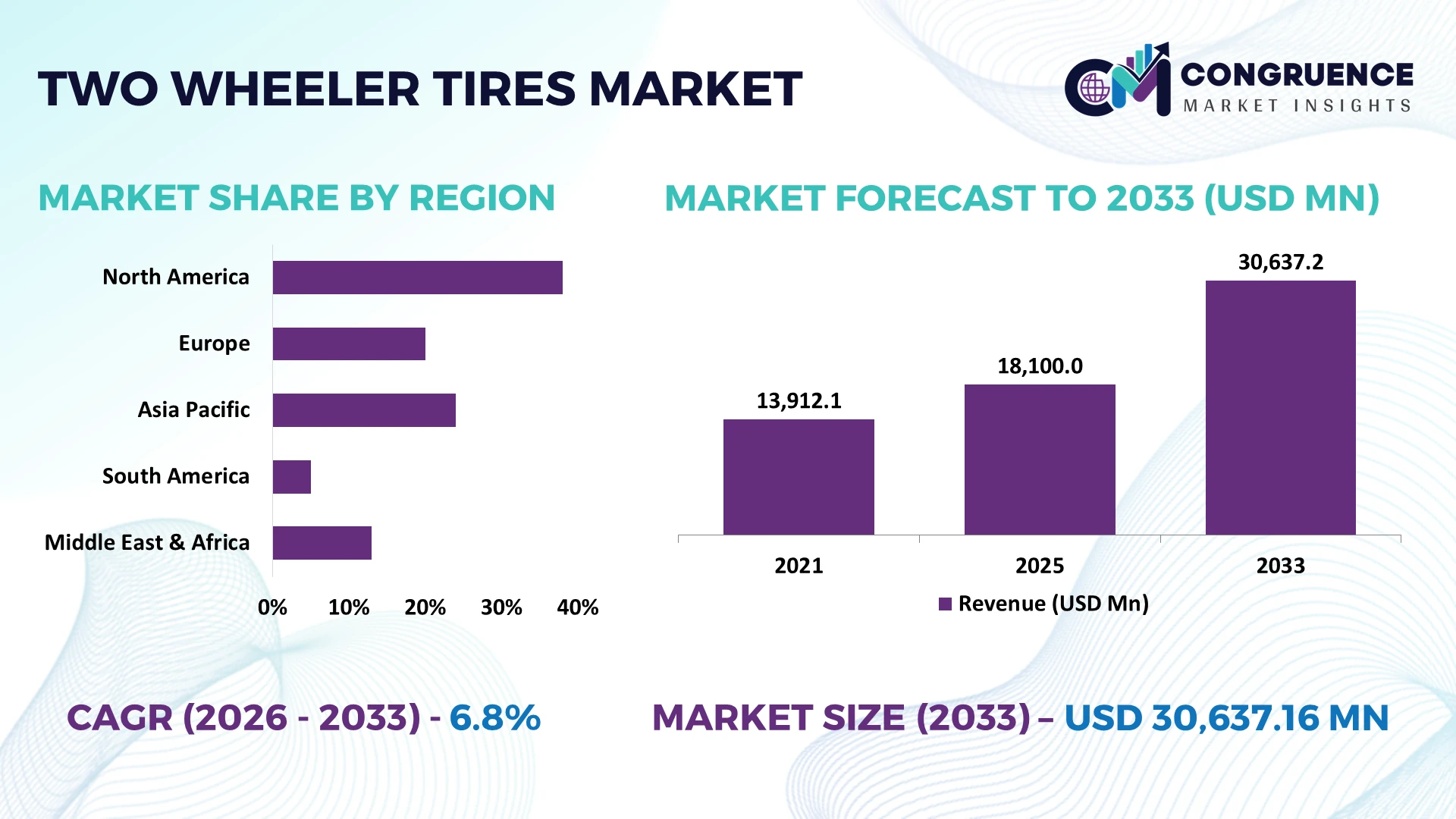
The Global Two Wheeler Tires Market was valued at USD 18100 Million in 2025 and is anticipated to reach a value of USD 30637.16 Million by 2033 expanding at a CAGR of 6.8% between 2026 and 2033. Growth is driven by high motorcycle replacement tire consumption, expanding electric two-wheeler production, and increasing adoption of tubeless radial tires across urban mobility and delivery fleets.
India represents a dominant two-wheeler tire manufacturing and consumption hub, supported by approximately 19.6 million domestic two-wheeler sales during FY2024–25, compared with China's substantially larger electric two-wheeler ecosystem. Electric models accounted for approximately 6% of Indian two-wheeler registrations, accelerating specialized tire development. Manufacturers including MRF, CEAT, and TVS Srichakra are investing in radial construction, silica compounds, and automated production. India's automotive manufacturing policies and localization initiatives strengthen domestic sourcing and export competitiveness.
Strategically, manufacturers should prioritize India's high-volume replacement ecosystem and electric mobility applications, balancing approximately 19.6 million annual vehicle sales with growing demand for specialized tire performance.
Market Size & Growth: USD 18,100 million in 2025, reaching USD 30,637.16 million by 2033 at 6.8% CAGR, supported by motorcycle replacement demand and electric mobility.
Top Growth Drivers: India's two-wheeler sales increased 9.1%, exports rose 21.4%, and electric two-wheeler sales expanded 21% during FY2024–25.
Short-Term Forecast: By 2028, automated tire production programs target an indicative 10–15% reduction in manufacturing cycle time through process optimization.
Emerging Technologies: Three innovations include AI inspection, silica-reinforced compounds, and low rolling resistance radial tires for electric motorcycles and scooters.
Regional Leaders: Indicative 2033 allocations place Asia-Pacific at USD 18,382.3 million, Europe at USD 5,208.3 million, and North America at USD 3,676.5 million, reflecting replacement demand, premium radials, and performance motorcycles.
Consumer/End-User Trends: Electric models exceeded 6% of India's two-wheeler sales, encouraging specialized tire designs for higher torque and urban commuting.
Pilot/Case Example: India's FY2024–25 electric mobility expansion delivered 1.15 million electric two-wheeler sales, representing 21% annual growth and expanding EV tire demand.
Competitive Landscape: Michelin, Bridgestone, MRF, CEAT, and TVS Srichakra compete across premium radial, original equipment, and replacement tire segments.
Regulatory & ESG Impact: India's PM E-DRIVE policy supports electrification; electric two-wheeler registrations represented 6.1% of the category in FY2024–25.
Investment & Funding: CEAT's USD 225 million Camso acquisition expanded its broader tire manufacturing portfolio and international industrial footprint.
Innovation & Future Outlook: Advanced tubeless constructions and automated compound development target 10–15% lower rolling resistance in next-generation tire engineering programs.
The global two-wheeler tires market is increasingly influenced by motorcycle replacement cycles, electric scooter adoption, and demand for durable urban mobility products. India recorded 4.2 million two-wheeler exports during FY2024–25, representing 21.4% annual growth and strengthening international tire supply opportunities. Manufacturers are developing silica-based tread compounds, puncture-resistant tubeless constructions, and reinforced tire structures for electric vehicles. Rising natural rubber procurement pressures are also encouraging compound optimization and regional sourcing diversification. These developments strengthen the importance of manufacturing efficiency, OEM partnerships, and aftermarket distribution in future competitive strategies.
The two wheeler tires market is becoming strategically important as electric mobility, replacement demand, and manufacturing localization reshape competitive priorities. India recorded approximately 19.6 million domestic two wheeler sales during FY2024–25, while exports exceeded 4 million units, strengthening tire production and aftermarket distribution requirements. Natural rubber supply concentration in Southeast Asia is encouraging manufacturers to diversify procurement and strengthen compound development capabilities. Companies including MRF, CEAT, and TVS Srichakra are investing in automated manufacturing, premium radial constructions, and specialized electric scooter tires.
Technology differentiation increasingly determines operating efficiency. Modern radial tire designs can deliver approximately 10–15% lower rolling resistance than comparable conventional constructions under optimized testing conditions, supporting vehicle energy efficiency. India leads high volume commuter tire manufacturing, while Germany and Italy emphasize premium motorcycle performance, advanced compounds, and specialized radial applications. Manufacturers are adjusting production portfolios to accommodate contrasting regional purchasing requirements.
During 2026–2028, investment priorities will emphasize electric two wheeler compatibility, automated inspection, and regional aftermarket expansion. CEAT's development of electric scooter tire products illustrates targeted innovation around instant torque and load distribution. Competitive positioning will depend on combining cost efficient production, consistent quality, and application specific performance across established and electrified mobility platforms.
India's expanding two wheeler ecosystem is strengthening demand for original equipment and replacement tires. Domestic two wheeler sales increased approximately 9.1% during FY2024–25, while exports expanded 21.4%, creating additional requirements for manufacturing capacity and international distribution. Electric two wheelers represented approximately 6% of domestic sales, introducing distinct tire performance requirements involving instant torque, higher vehicle weight, and rolling resistance optimization. Government initiatives including PM E-DRIVE are supporting electric mobility adoption and localized component sourcing. MRF, CEAT, and TVS Srichakra are responding through product development, manufacturing modernization, and OEM partnerships. Replacement tire demand provides recurring sales opportunities, while electric vehicle specifications strengthen opportunities for premium product differentiation.
Natural rubber procurement volatility constrains two wheeler tire manufacturing economics, particularly in India, where domestic production does not fully satisfy industrial consumption. India consumed approximately 1.4 million tonnes of natural rubber during FY2023–24, while domestic output remained near 0.86 million tonnes, creating substantial import dependence. Natural rubber can represent approximately 40–50% of the rubber content in selected motorcycle tire compounds, increasing sensitivity to raw material prices. Southeast Asian supply disruptions and international freight volatility complicate purchasing and inventory planning. Manufacturers are responding through diversified sourcing, longer term procurement agreements, and compound optimization using synthetic elastomers and reinforcing fillers. Maintaining consistent material specifications while controlling input costs remains critical for protecting margins in price sensitive replacement tire segments.
Electric two wheeler adoption is creating opportunities for specialized tire construction, advanced compounds, and differentiated replacement products. India recorded approximately 1.15 million electric two wheeler sales during FY2024–25, representing around 21% annual expansion and approximately 6% of total two wheeler sales. Electric drivetrains require tires optimized for immediate torque delivery, braking performance, and rolling resistance. Manufacturers are developing silica reinforced tread compounds, reinforced carcass structures, and application specific tubeless designs. CEAT and TVS Srichakra are strengthening electric mobility product portfolios and OEM relationships. The strategic opportunity extends beyond factory fitted tires: dedicated electric scooter replacement ranges allow manufacturers to establish differentiated distribution channels and capture recurring demand from high utilization urban mobility fleets.
Scaling specialized two wheeler tire production requires consistent performance validation across diverse vehicle platforms and operating conditions. India's electric two wheeler market exceeded 1 million annual registrations, while electric models represented approximately 6% of total category sales, creating a growing but fragmented specification landscape. Tire engineers must balance wet grip, rolling resistance, durability, and load carrying capacity without compromising safety. India's automotive regulatory framework and evolving electric mobility requirements increase pressure on product testing and traceability systems. Manufacturers must invest in automated inspection, compound characterization, and vehicle specific validation programs. Maintaining consistent performance across commuter motorcycles, premium sports bikes, and electric scooters is essential for reducing warranty exposure, securing OEM approvals, and sustaining long term competitive differentiation.
Tubeless Fitment Reshapes Urban Tire Retail: Tubeless motorcycle and scooter tires are gaining prominence through puncture-sealing convenience and simplified roadside servicing. India's FY2024–25 two-wheeler sales reached approximately 19.6 million units, with scooters representing nearly 35% of domestic volumes. MRF and CEAT are expanding tubeless replacement assortments, while distributors prioritize high-turnover sizes and faster installation services.
Automated Inspection Strengthens Production Quality: Tire manufacturers are deploying machine vision, automated uniformity testing, and digital process monitoring to reduce manufacturing variability. Modern inspection systems evaluate 100% of selected production batches, while automated curing controls target 5–10% lower process variation under optimized operating conditions. Indian manufacturers are upgrading production lines to improve defect detection, reduce rework, and strengthen OEM qualification performance.
Premium Motorcycle Tires Gain Specialization: European manufacturers are refining high-performance radial products for motorcycles requiring improved cornering stability and wet traction. Premium motorcycle tires commonly use 17-inch wheel fitments, while selected sport-touring products target 10–15% improved wet grip performance against predecessor designs. Michelin and Pirelli are expanding differentiated compound portfolios, supporting premium pricing and specialized dealer distribution.
Digital Distribution Improves Replacement Availability: Tire retailers are integrating online ordering, inventory visibility, and dealer fulfillment to improve replacement availability. India's two-wheeler exports exceeded 4 million units during FY2024–25, while domestic sales increased approximately 9%. Manufacturers and distributors are expanding digital catalogues and regional warehouses, improving size availability, reducing inventory duplication, and supporting faster replenishment across fragmented aftermarket networks.
Tubeless Tires Lead Modern Two-Wheeler Fitment
Tubeless Tires represent the leading product category, with an indicative 45% share of global two-wheeler tire demand, supported by widespread scooter adoption, improved puncture management, and compatibility with modern alloy wheels. Tubeless construction eliminates the separate inner tube and enables simpler puncture repairs, strengthening convenience for urban commuters and commercial riders. Tubed Tires remain important in cost-sensitive motorcycle markets, particularly where spoke-wheel configurations and established repair infrastructure support conventional tire systems. Bias-Ply Tires maintain substantial utilization in commuter motorcycles because of their durable construction and relatively economical manufacturing requirements.
Radial Tires represent the fastest-expanding construction category, supported by premium motorcycle demand and increasing emphasis on handling stability, heat management, and high-speed performance. Radial designs can deliver approximately 10–15% lower rolling resistance than selected conventional constructions under comparable testing conditions. Michelin, Pirelli, MRF, and CEAT are expanding radial product portfolios and advanced compound development. Manufacturers are balancing high-volume tubeless production with premium radial investment, strengthening differentiation across replacement and original equipment applications.
Commuter Motorcycles Anchor Replacement Tire Consumption
Commuter Motorcycles represent the leading application segment, with an indicative 50% share of global two-wheeler tire demand, reflecting their extensive installed vehicle base and frequent replacement requirements. India recorded approximately 19.6 million domestic two-wheeler sales during FY2024–25, with motorcycles accounting for the largest vehicle category. High utilization in urban and rural transportation creates consistent demand for durable tread compounds, puncture resistance, and affordable replacement products. Manufacturers including MRF, CEAT, and TVS Srichakra prioritize high-volume commuter fitments, standardized tire sizes, and extensive dealer coverage to strengthen market penetration.
Scooters represent the fastest-expanding application category in several electrifying urban markets, supported by last-mile transportation and increasing electric mobility adoption. Sports Motorcycles generate demand for premium radial tires, advanced silica compounds, and improved cornering performance, while Off-Road Motorcycles require reinforced carcasses and specialized tread geometries. Electric two-wheeler sales exceeded 1 million units in India during FY2024–25, strengthening scooter tire development priorities. Manufacturers are adjusting product portfolios to balance replacement volume, premium performance, and specialized operating requirements.
Individual Owners Dominate Replacement Tire Purchasing
Individual Two-Wheeler Owners represent the leading end-user category, with an indicative 55% share of global tire purchasing demand, supported by the extensive installed motorcycle and scooter population. Replacement purchases are influenced by tread wear, road conditions, vehicle utilization, and tire affordability. India's domestic two-wheeler market exceeded 19 million annual vehicle sales during FY2024–25, reinforcing the long-term replacement ecosystem. Manufacturers prioritize dealer availability, competitive pricing, and durable commuter tire designs to capture recurring individual purchases. Two-Wheeler Dealers and Distributors remain essential commercial intermediaries, particularly in markets with fragmented independent retail networks.
Fleet Operators represent the fastest-expanding end-user segment as delivery platforms, shared mobility services, and commercial electric scooter fleets increase vehicle utilization. Motorcycle Manufacturers continue to drive original equipment tire specifications, emphasizing quality consistency, production scheduling, and vehicle-specific performance. Tire suppliers are developing fleet procurement agreements, digital inventory systems, and specialized OEM partnerships. Competitive differentiation increasingly depends on balancing individual replacement accessibility with institutional purchasing efficiency and predictable product availability.
Asia-Pacific accounted for the largest market share at an estimated 60% in 2025 however, Asia-Pacific is expected to register the fastest growth, expanding at a CAGR of an estimated 7.8% between 2026 and 2033.
Premium Motorcycle Tires and Specialized Replacement Distribution
North America represents an indicative 12% of the global two-wheeler tires market, supported by premium motorcycle ownership, recreational riding, and established aftermarket distribution. The United States dominates regional demand for touring, cruiser, sports, and off-road motorcycle tires, where load capacity, tread durability, and high-speed stability influence purchasing decisions. Michelin, Bridgestone, and Pirelli compete through specialized radial constructions and differentiated rubber compounds. Motorcycle tire retailers increasingly emphasize fitment accuracy, online ordering, and professional installation services. The United States recorded approximately 550,000 new motorcycle and scooter sales in 2024, reinforcing the importance of replacement demand alongside original equipment supply. Manufacturers are expanding premium tire assortments and strengthening distributor relationships to improve product availability. Competitive advantage depends on reliable inventory, application-specific performance, and established relationships with motorcycle dealerships and independent service providers.
United States Market Outlook: The United States maintains an extensive motorcycle aftermarket supported by Harley-Davidson, Indian Motorcycle, and established independent dealership networks. Premium touring motorcycles frequently require 16-inch, 17-inch, or 18-inch tire fitments, creating specialized replacement requirements. Tire manufacturers prioritize high-load constructions, wet-weather traction, and extended tread life, while digital retail platforms improve product selection and regional fulfillment efficiency.
Performance Radial Innovation and Regulatory Compliance
Europe accounts for an indicative 17% of global two-wheeler tire demand, characterized by premium motorcycle manufacturing, advanced tire engineering, and established safety regulations. Germany, Italy, France, and Spain maintain substantial motorcycle ownership and specialist replacement networks. European manufacturers emphasize silica-based tread compounds, multi-compound radial construction, and improved wet-weather performance. Motorcycle and moped registrations across major European markets exceeded 1 million units during 2024, supporting continued aftermarket demand. European tire labeling requirements primarily target passenger and commercial vehicle categories, while motorcycle tires follow applicable UNECE technical approval standards. Michelin, Pirelli, and Continental are investing in compound optimization, performance testing, and specialized dealer partnerships. Competitive differentiation increasingly centers on handling consistency, durability, and product homologation, with manufacturers adapting tire portfolios to diverse motorcycle applications and demanding European riding conditions.
Italy Market Outlook: Italy combines premium motorcycle manufacturing, specialist tire development, and a strong domestic replacement market. Ducati, Aprilia, and Piaggio maintain established vehicle manufacturing operations, supporting close collaboration between tire suppliers and original equipment producers. Italian motorcycle registrations exceeded 350,000 units in 2024, strengthening demand for performance radial tires, urban scooter fitments, and specialized aftermarket services.
High-Volume Manufacturing and Integrated Supply Chains
Asia-Pacific dominates the global two-wheeler tires market with an estimated 60% share, supported by extensive motorcycle production, replacement consumption, and concentrated tire manufacturing infrastructure. India, China, Indonesia, Vietnam, and Thailand maintain substantial two-wheeler populations and established automotive supply chains. India recorded approximately 19.6 million domestic two-wheeler sales during FY2024–25, while exports exceeded 4 million units, strengthening tire manufacturing requirements. China contributes large-scale electric scooter production and component manufacturing, while Indonesia and Vietnam maintain high motorcycle dependence for daily transportation. Regional tire producers are expanding automated manufacturing, compound development, and original equipment partnerships. MRF, CEAT, TVS Srichakra, and Cheng Shin Rubber compete through manufacturing efficiency, distribution coverage, and application-specific product development. Localized production reduces logistics exposure and strengthens responsiveness to high-volume replacement demand.
India Market Outlook: India represents a strategically important manufacturing and consumption hub, supported by extensive motorcycle production and a nationwide replacement tire distribution network. The country's two-wheeler exports increased approximately 21.4% during FY2024–25, expanding international original equipment and aftermarket opportunities. Domestic manufacturers are investing in automated tire production, advanced tread compounds, and radial technology while strengthening relationships with Hero MotoCorp, Honda Motorcycle & Scooter India, and Bajaj Auto.
Motorcycle Mobility Expansion and Localized Tire Production
South America represents an indicative 7% of global two-wheeler tire demand, with Brazil, Colombia, and Argentina supporting motorcycle manufacturing and replacement consumption. Motorcycles remain important for urban commuting, commercial deliveries, and transportation in areas with limited public transit coverage. Brazil's motorcycle production exceeded 1.7 million units in 2024, strengthening demand for original equipment tires and replacement products. Local manufacturing concentration around Manaus supports integrated motorcycle assembly and component sourcing. Tire manufacturers emphasize durable bias-ply constructions, affordable tubeless products, and tread designs suited to variable road conditions. Imported raw materials and exchange-rate fluctuations influence production costs, encouraging localized procurement and inventory planning. Manufacturers and distributors are expanding regional dealer networks and replacement product availability, while fleet-oriented demand strengthens opportunities for durable, high-utilization tire designs.
Brazil Market Outlook: Brazil maintains the region's largest motorcycle manufacturing ecosystem, supported by Honda and Yamaha production facilities in Manaus. Motorcycle manufacturing exceeded 1.7 million units during 2024, reinforcing original equipment tire procurement requirements. Localized assembly, established supplier networks, and growing delivery motorcycle utilization strengthen demand for cost-efficient tire manufacturing, regional warehousing, and dependable replacement distribution.
Affordable Mobility and Replacement Distribution Expansion
The Middle East & Africa represents an indicative 4% of global two-wheeler tire demand, with motorcycle utilization concentrated in Nigeria, Kenya, Egypt, Morocco, and South Africa. Commercial motorcycle transport, urban commuting, and delivery services support replacement tire consumption, particularly in markets where affordability influences vehicle ownership. African motorcycle fleets frequently operate under demanding road conditions, increasing requirements for reinforced sidewalls, puncture resistance, and durable tread compounds. Regional distributors depend substantially on imported tires from Asian manufacturing centers, creating exposure to shipping costs and currency movements. Manufacturers are strengthening distributor agreements, regional warehousing, and product portfolios suited to commercial motorcycle applications. Investment priorities emphasize reliable replacement availability and affordable tire specifications rather than extensive premium radial manufacturing infrastructure.
Nigeria Market Outlook: Nigeria maintains substantial motorcycle transportation activity, particularly across secondary cities and commercial delivery networks. Lagos restrictions on commercial motorcycles across designated routes have influenced operating patterns and fleet deployment. Tire suppliers prioritize durable commuter fitments, affordable replacement products, and distribution partnerships serving high-utilization vehicles. Import dependence creates opportunities for improved inventory management, localized warehousing, and stronger relationships with independent motorcycle service providers.
The two-wheeler tires market features competition between Michelin, Bridgestone, Pirelli, MRF, and CEAT across premium radial, commuter, and replacement categories. An indicative combined 45% share for these manufacturers represents a modeled concentration assumption rather than audited global market data. Michelin and Pirelli emphasize performance compounds, while MRF and CEAT compete through manufacturing scale, affordable fitments, and distribution coverage. India's two-wheeler sales increased approximately 9.1% during FY2024–25, while exports expanded 21.4%, strengthening production and aftermarket competition. Electric models represented approximately 6% of domestic sales, encouraging differentiated tire engineering. Manufacturers are expanding automated production, strengthening OEM partnerships, and localizing raw material procurement. Natural rubber volatility, product validation requirements, and extensive dealer networks create entry barriers. Competitive leadership depends on consistent quality, efficient manufacturing, reliable supply, and application-specific performance across commuter, premium, and electric mobility segments in established and emerging international markets.
Michelin Group
Bridgestone Corporation
Pirelli & C. S.p.A.
MRF Limited
CEAT Limited
TVS Srichakra Limited
Continental AG
Cheng Shin Rubber Industry Co., Ltd.
Kenda Rubber Industrial Co., Ltd.
Sumitomo Rubber Industries, Ltd.
The Goodyear Tire & Rubber Company
Apollo Tyres Limited
JK Tyre & Industries Limited
Shinko Tire USA
Current tire technologies combine tubeless construction, automated curing, and silica-reinforced compounds to improve durability and manufacturing consistency. Modern radial designs can achieve 10–15% lower rolling resistance than selected conventional bias constructions under comparable testing conditions. Automated visual inspection supports complete production line screening, reducing dependence on manual defect identification. Michelin, Bridgestone, and MRF benefit from established compound development capabilities, while high-volume manufacturers prioritize consistent tread geometry, dimensional accuracy, and reliable original equipment qualification.
Emerging technologies emphasize multi-compound treads, digital tire development, and application-specific electric scooter engineering. Finite element simulation evaluates carcass deformation, contact pressure, and heat generation before physical prototyping. Optimized development workflows target 10–20% fewer prototype iterations, although results depend on validation requirements. India's electric two-wheelers represented approximately 6% of domestic category sales during FY2024–25, creating an identifiable deployment base for specialized tire designs. Manufacturers are integrating simulation, automated mixing, and vehicle testing to accelerate product qualification.
Disruptive advances include intelligent tire sensing, renewable reinforcing materials, and automated compound optimization. During 2026–2028, manufacturers will prioritize predictive quality monitoring and recyclable material integration. Suppliers combining verified performance improvements with scalable production will strengthen OEM relationships, reduce warranty exposure, and protect competitive positioning.
October 2026: Bridgestone announced its BATTLAX ADVENTURE A42 motorcycle tire, scheduled for global introduction in January 2027. Internal testing demonstrated 25% longer rear tire life versus its predecessor, strengthening premium touring differentiation and reducing replacement frequency for long-distance riders. Source: bridgestone.com
April 2026: MRF introduced Steel Brace SP-01 superbike tires, certified for Suzuki motorcycles including the Hayabusa. Company testing indicated up to 15% longer tire life than Bridgestone S23, strengthening domestic premium manufacturing capabilities and expanding competition in specialized motorcycle replacement products. Source: autocarindia.com
June 2025: TVS Srichakra partnered with Honda Taiwan to distribute Eurogrip motorcycle tires through authorized Honda service centers. The agreement covers three product families, Protorq, Protorq Extreme, and Roadhound, expanding aftermarket access and strengthening the manufacturer's international premium tire distribution network. Source: tyrepress.com
September 2025: CEAT announced plans to pass India's tire tax reductions to customers following a government policy change. The standard rate declined from 28% to 18%, improving replacement tire affordability and strengthening demand prospects for entry-level commuter motorcycles. Source: reuters.com
The Two Wheeler Tires Market Report examines industry structure, manufacturing capabilities, distribution channels, and competitive developments between 2026 and 2033. Product segmentation covers Tubed Tires, Tubeless Tires, Bias-Ply Tires, and Radial Tires. Applications include Commuter Motorcycles, Sports Motorcycles, Scooters, and Off-Road Motorcycles, while end-user analysis evaluates Individual Two-Wheeler Owners, Fleet Operators, Motorcycle Manufacturers, and Two-Wheeler Dealers and Distributors. Geographic coverage spans North America, Europe, Asia-Pacific, South America, and the Middle East & Africa.
Technology coverage includes automated inspection, silica-reinforced compounds, radial construction, and specialized electric scooter tires. India's approximately 19.6 million annual two-wheeler sales provide a manufacturing and replacement demand benchmark. The report evaluates OEM partnerships, aftermarket expansion, premium product positioning, supply-chain localization, and investment priorities, supporting competitive planning and manufacturing decisions through 2033.
| Report Attribute/Metric | Report Details |
|---|---|
Market Revenue in 2025 | USD 18100 Million |
Market Revenue in 2033 | USD 30637.16 Million |
CAGR (2026 - 2033) | 6.8% |
Base Year | 2025 |
Forecast Period | 2026 - 2033 |
Historic Period | 2021 - 2025 |
Segments Covered | By Type
By Application
By End-User
|
Key Report Deliverable | Revenue Forecast, Growth Trends, Market Dynamics, Segmental Overview, Regional and Country-wise Analysis, Competition Landscape |
Region Covered | North America, Europe, Asia-Pacific, South America, Middle East, Africa |
Key Players Analyzed | Michelin Group, Bridgestone Corporation, Pirelli & C. S.p.A., MRF Limited, CEAT Limited, TVS Srichakra Limited, Continental AG, Cheng Shin Rubber Industry Co., Ltd., Kenda Rubber Industrial Co., Ltd., Sumitomo Rubber Industries, Ltd., The Goodyear Tire & Rubber Company, Apollo Tyres Limited, JK Tyre & Industries Limited, Shinko Tire USA |
Customization & Pricing | Available on Request (10% Customization is Free) |




