
Reports
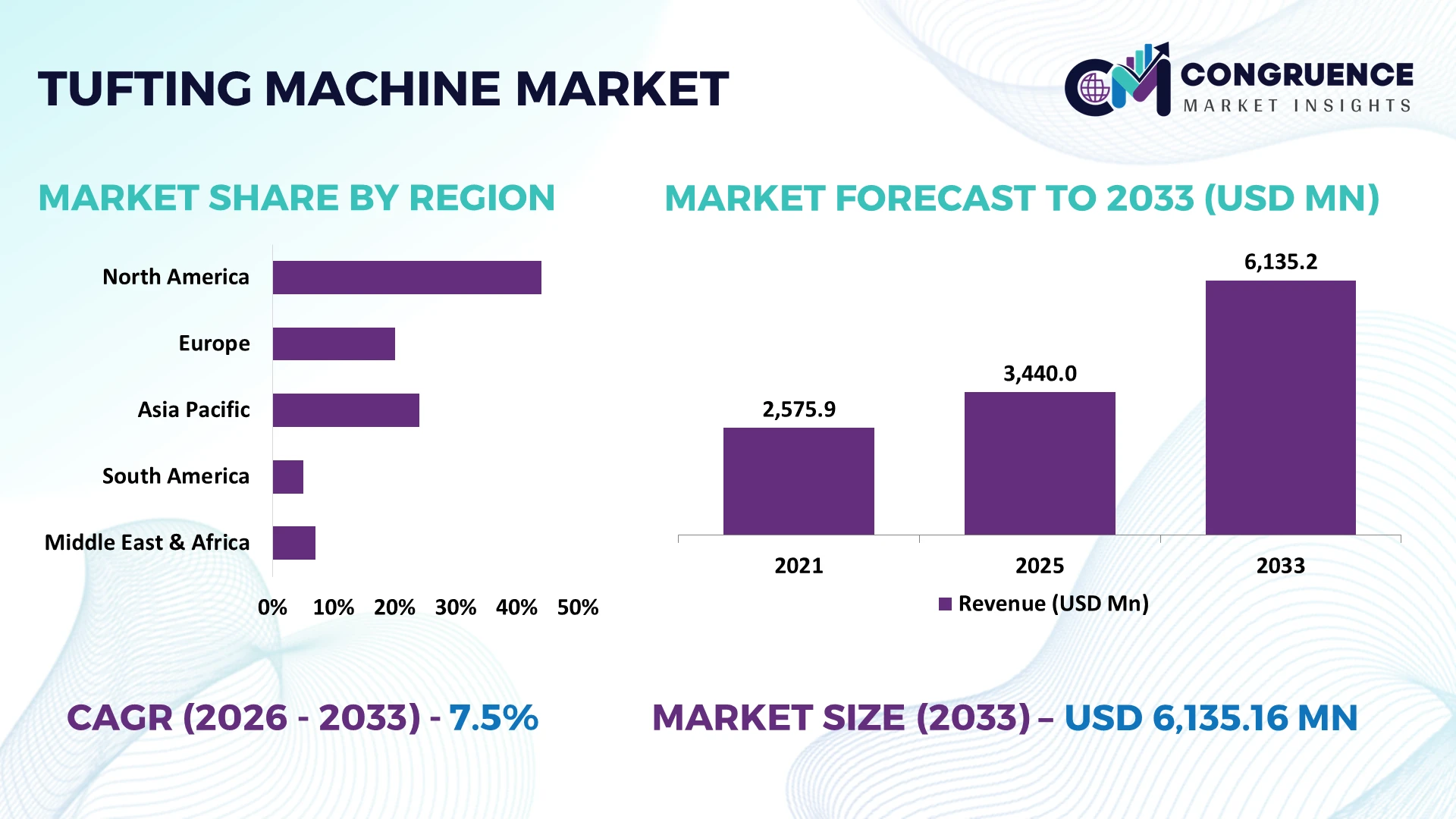
The Global Tufting Machine Market was valued at USD 3440 Million in 2025 and is anticipated to reach a value of USD 6135.16 Million by 2033 expanding at a CAGR of 7.5% between 2026 and 2033. Growth is driven by automated multi-needle tufting, rising artificial-turf production, and demand for faster customized carpet manufacturing with digitally controlled pile patterns.
China dominates the manufacturing ecosystem, supported by USD 1.50 billion in 2024 tufted-floorcovering exports covering 319.1 million square meters. Its carpet sector is strongly B2B-led at 77.4%, while automated, multi-needle systems increasingly serve carpets, artificial turf, automotive interiors, and hospitality projects. China also outpaces the United States in production scale, strengthening Asia-Pacific's equipment advantage.
Geopolitical Red Sea disruptions have increased Asia-Europe logistics uncertainty, reinforcing regional equipment sourcing and localized production strategies.
Strategically, manufacturers should prioritize China- and Asia-focused capacity, automation upgrades, and digitally programmable machines to capture high-volume and customized production demand.
Market Size & Growth: USD 3.44 billion in 2025 to USD 6.14 billion by 2033, with 7.5% CAGR driven by automated carpet production.
Top Growth Drivers: Automation 35%, artificial-turf demand 30%, customized carpets 25%.
Short-Term Forecast: By 2028, automation can reduce operating costs 8% and improve production efficiency 12%.
Emerging Technologies: AI pattern control, robotic tufting, servo drives and digital design integration are reshaping high-speed production.
Regional Leaders: Asia-Pacific leads at 38.5%, North America at 32.7%, and Europe at 27.8%, with automation adoption accelerating across all three.
Consumer/End-User Trends: Carpets and rugs represented 50.7% of application demand in 2025, supported by residential and hospitality customization.
Pilot/Case Example: 2026 robotic tufting deployments demonstrate 1–6.5 sq. m/hour throughput, supporting flexible small-batch and mass production.
Competitive Landscape: Van De Wiele leads with over 16% share, followed by CMC, Tuftco, Michishita Iron Works and Changzhou Wuding.
Regulatory & ESG Impact: Energy-efficient automation and integrated wastewater controls are targeting 10% lower resource intensity across modern carpet lines.
Investment & Funding: Asia-Pacific attracts the strongest machinery expansion activity, while partnerships increasingly combine robotic equipment, digital printing and automated finishing.
Innovation & Future Outlook: Next-generation machines will combine AI-assisted pattern recognition, variable pile heights and closed-loop controls, shifting competition toward intelligent, flexible production.
The Tufting Machine Market is increasingly concentrated around high-volume carpets, artificial turf, automotive interiors, and premium hospitality flooring, where automated equipment improves consistency and customization. Robotic tufting and digitally controlled patterning are expanding adoption, while advanced systems can support up to 2,000 stitches per minute. Red Sea shipping disruptions are also encouraging manufacturers to diversify sourcing and strengthen regional production resilience, shaping the next strategic investment cycle.
The Tufting Machine Market is becoming strategically important as carpet, artificial turf, automotive-interior, and hospitality manufacturers shift from labor-intensive production toward programmable, high-speed manufacturing. Digital design integration is compressing sample-to-production cycles, while supply-chain restructuring is encouraging manufacturers to localize equipment servicing and diversify machinery sourcing. Over the next 2–3 years, automated installations are positioned to gain priority in capacity-expansion budgets.
Technology is also redefining productivity economics. Modern robotic systems operate at up to 2,000 stitches per minute and deliver approximately 1–6.5 square meters per hour, compared with slower manual workflows that require greater operator intervention. Servo-driven positioning improves repeatability to around ±0.1 mm/m. China maintains a scale advantage through dense machinery manufacturing clusters, while India is emerging as a customization and robotic-tufting deployment market.
A practical example is a 2025 Indian installation using dual-Y robotic tufting, where two guns produced about 3.6 square meters per hour combined while maintaining ±0.1 mm/m positioning precision. Manufacturers are responding through software partnerships, dual-gun configurations, automation retrofits, and localized technical support. Competitive advantage will increasingly depend on integrating tufting hardware, digital controls, design software, and flexible production rather than simply increasing machine speed.
Automation is the strongest structural driver as manufacturers replace labor-intensive tufting with programmable systems. Robotic machines reaching 2,000 stitches per minute and production throughput of up to 6.5 square meters per hour are strengthening productivity economics. Digital controls can improve positioning precision to approximately ±0.1 mm/m, supporting complex patterns and repeat orders. China’s machinery clusters are accelerating adoption across carpet and artificial-turf production, while Indian manufacturers are increasingly commissioning customized robotic systems. The shift is reinforced by labor-efficiency pressures and rising demand for short production runs. Companies are responding with servo-driven heads, integrated CAD software, and multi-axis robots. The non-obvious advantage is greater production flexibility: manufacturers can switch between sampling and commercial batches without rebuilding conventional production setups.
High-specification tufting equipment remains capital-intensive, particularly when manufacturers add robotic handling, digital controls, software integration, and finishing systems. Production complexity can reduce effective throughput to roughly 0.8–1.5 square meters per hour for intricate, multicolor designs versus around 3 square meters per hour for simpler patterns. Compressed-air requirements of up to 600 liters per minute and 2 kW electrical demand can also constrain installations where factory utilities are outdated. Smaller producers in price-sensitive markets face longer equipment-utilization cycles, limiting rapid modernization. Supply-chain disruptions affecting specialized components further complicate maintenance planning. Companies are reducing exposure through standardized components, local service partnerships, spare-parts inventories, and modular automation. The sharp operational issue is not machine speed but sustaining utilization across varied product mixes.
The strongest opportunity lies in intelligent tufting systems that combine robotics, machine vision, CAD integration, and variable pile control. Modern systems support pile heights ranging from approximately 4–75 mm, enabling premium rugs, artificial grass, hospitality flooring, and automotive applications from a flexible equipment platform. Dual-gun configurations can reach about 3.6 square meters per hour on simple designs, creating a compelling productivity pathway for customized manufacturing. India, particularly textile and flooring manufacturing hubs, offers room for localized robotic deployment as producers move toward shorter production runs. Companies are investing in software-linked machines, automated pattern control, and multi-axis platforms. A non-obvious opportunity is distributed production: compact robotic tufting cells allow manufacturers to place customized manufacturing closer to customers, reducing inventory and transportation exposure.
The next challenge is integrating high-speed tufting equipment into production environments that still depend on fragmented legacy machinery and manual finishing. Complex designs can reduce robotic throughput to approximately 0.8–1.5 square meters per hour, while multi-process lines require consistent synchronization across tufting, backing, shearing, and inspection. Workforce capability is another constraint because operators must increasingly manage CAD interfaces, servo controls, yarn sensors, and automated diagnostics rather than only mechanical adjustments. European manufacturers face tighter expectations for energy efficiency and process transparency, while emerging-market facilities often require infrastructure upgrades before advanced equipment can run consistently. Companies must therefore invest in technician training, interoperable controls, predictive maintenance, and integrated production software. Long-term competitiveness will depend on stable end-to-end execution, not isolated machine automation.
Computerized Pattern Control: Digital patterning is moving from premium installations into mainstream production, with computerized systems improving design-change efficiency by roughly 10–15% and reducing manual setup requirements by 8–12%. Chinese manufacturers are pairing CAD interfaces with automated yarn control to shorten sampling cycles and support smaller customized batches.
Robotic Production Flexibility: Robotic tufting is expanding beyond specialist rugs, with systems delivering 1–6.5 sq. m/hour and gun speeds reaching 2,000 stitches/minute. Indian installations increasingly combine variable pile heights with software control, allowing companies to shift between samples and mass production without dedicated mechanical changeovers.
Automotive Demand Rebalancing: Automotive textiles are gaining operational importance as vehicle production shifts toward Asia. Global vehicle output increased 3.9% to 96.4 million units in 2025, while China produced 34.53 million and India 6.49 million. Suppliers are consequently expanding precision tufting capacity near vehicle-production clusters.
Efficiency-Driven Machine Upgrades: Manufacturers are prioritizing servo drives, smart HMIs and predictive maintenance as energy and labor pressures reshape plant economics. Modern systems can reduce manual intervention by approximately 15% and improve production consistency by 10%. Supply-chain volatility is also encouraging localized service partnerships and larger critical-spares inventories.
Cut Pile remains the leading type, accounting for approximately 36% of demand, supported by broad use in residential carpets, premium rugs, and applications requiring dense, uniform surfaces. Its mature installed base gives manufacturers predictable operating economics, while Loop Pile holds nearly 24% share because of durability and suitability for commercial flooring. High-Speed machines represent about 21%, increasingly favored by large-volume producers seeking faster throughput and lower labor intensity. Companies are extending established Cut Pile platforms with servo controls and automated yarn handling rather than replacing complete lines.
Computerized machines are the fastest-growing type, with adoption expanding by roughly 14% annually within new equipment installations as manufacturers prioritize programmable patterns, rapid changeovers, and digital workflow integration. Their ability to reduce setup intervention by approximately 10–15% is shifting investment toward software-enabled production. High-Speed systems remain strategically important for China-based mass producers, while Loop Pile retains strength in commercial applications. The key implication is a shift from standalone mechanical capacity toward integrated, digitally configurable equipment.
Carpets remain the dominant application, representing approximately 41% of tufting machine demand, supported by large-scale residential, commercial, and hospitality flooring production. Rugs account for nearly 21%, benefiting from customization and shorter production runs, while Upholstery contributes about 13% through specialized textile applications. Companies serving mature carpet markets are emphasizing automated pattern control, multi-needle configurations, and faster product changeovers to defend production efficiency as customization increases.
Artificial Turf is the fastest-growing application, with deployment expanding by approximately 12–15% as sports infrastructure, landscaping, and recreational facilities adopt synthetic surfaces. Automotive Textiles represent around 11% and are becoming increasingly technology-intensive as suppliers require tighter dimensional consistency and specialized surface structures. Manufacturers are therefore expanding tufting capacity near construction and automotive production clusters. The strategic shift is significant: equipment demand is moving beyond conventional floorcoverings toward applications where durability, repeatability, and automated quality control command greater importance.
Carpet Manufacturers represent the largest end-user group at approximately 43% share, reflecting their high machine utilization, extensive installed bases, and dependence on continuous production. Flooring Companies account for nearly 24%, particularly where integrated tufting, backing, and finishing operations support commercial projects. Textile Manufacturers hold about 19% and increasingly prioritize computerized machines for customized patterns and diversified product portfolios. Large Chinese producers continue to favor high-throughput systems, while smaller Indian manufacturers increasingly adopt modular equipment to control capital exposure.
Automotive Suppliers are the fastest-growing end-user segment, with equipment deployment increasing approximately 13% as vehicle interiors demand precise, lightweight, and durable textile components. Their procurement increasingly emphasizes repeatability, automated inspection, and integration with supplier quality systems. Companies are responding through customized machine configurations, technical partnerships, and localized servicing. This shifts future purchasing power toward specialized industrial buyers rather than conventional floorcovering producers, making application-specific engineering and long-term service contracts increasingly important competitive differentiators.
Asia-Pacific accounted for the largest market share at 34.9% in 2025 however, Asia-Pacific is expected to register the fastest growth, expanding at a CAGR of 7.9% between 2026 and 2033.

Automation retrofits are redefining North American production economics
North America holds approximately 26.8% of global tufting machine demand, with the United States accounting for most regional deployments. Carpet, artificial turf, hospitality flooring, and automotive-textile producers increasingly prioritize computerized patterning and high-speed machines. Card-Monroe has more than 2,500 tufting machines operating across 38 countries, demonstrating the region's strong installed-base and service-network advantage. U.S. manufacturers are favoring retrofit programs that integrate servo controls, electronic patterning, and automated yarn management into existing production lines. Artificial-turf machinery remains particularly important as sports-field and landscaping applications expand. Higher labor costs are accelerating automation investment, while localized technical support is becoming a procurement differentiator. Companies are increasingly combining machine upgrades with software integration rather than pursuing capacity expansion alone, improving asset utilization and shortening changeover cycles.
United States Market Outlook: The United States remains the region's most strategically significant market because of its advanced carpet machinery base, synthetic-turf manufacturing capabilities, and strong industrial automation ecosystem. More than 2,500 CMC machines operate globally, reinforcing U.S. engineering influence in computerized and specialty tufting equipment.
Precision manufacturing and sustainability are reshaping equipment priorities
Europe represents approximately 24.3% of global demand, led by Germany, Italy, and the United Kingdom, where premium carpet and technical-textile production supports sophisticated machinery deployment. European manufacturers increasingly prioritize energy-efficient drives, computerized pattern control, and lower-waste production workflows. Equipment modernization is closely linked with sustainability requirements and tighter industrial efficiency expectations, encouraging replacement of mechanically intensive systems. Germany emphasizes engineering precision and industrial automation, while Italy maintains strong specialization in premium textile machinery and design-oriented production. Manufacturers are investing in modular controls and predictive maintenance to extend machine life while improving uptime. The region's strategic advantage is not volume but high-value engineering and customization, allowing suppliers to defend margins through application-specific configurations. Partnerships between machinery OEMs and textile producers increasingly focus on process integration rather than standalone equipment procurement.
Germany Market Outlook: Germany provides a strong technology base through advanced mechanical engineering, automation expertise, and industrial digitalization. Its carpet and textile machinery ecosystem supports precision manufacturing, while energy-efficiency requirements are encouraging producers to modernize drives, controls, and monitoring systems. The country's engineering capabilities strengthen Europe's premium-equipment positioning.
Manufacturing scale and localized machinery supply dominate deployment
Asia-Pacific commands approximately 34.9% market share and remains the largest production center, with China and India driving machinery deployment. China combines extensive carpet manufacturing capacity with a dense domestic machinery supplier ecosystem, enabling competitive equipment pricing and rapid configuration changes. India is increasing adoption of robotic and computerized tufting as textile manufacturers pursue flexible production and higher pattern complexity. Chinese manufacturers increasingly export mid-range systems, intensifying competition with established Western and Japanese OEMs. Regional equipment suppliers are also shortening delivery cycles through localized component sourcing and domestic service networks. The strategic advantage is manufacturing scale combined with supplier proximity, while the emerging shift is toward digitally controlled systems rather than purely mechanical machines. Companies are prioritizing multi-needle configurations, automated yarn control, and software integration to serve high-volume carpets, rugs, and artificial-turf applications.
China Market Outlook: China is the dominant country within the regional machinery ecosystem, supported by large carpet-production clusters, extensive machinery manufacturing capabilities, and export-oriented supply chains. Its combination of domestic equipment availability and manufacturing scale enables faster machine customization and competitive pricing, strengthening its influence across Asia-Pacific and international mid-market deployments.
Brazil-led flooring modernization is broadening equipment demand
South America represents approximately 6% of global tufting machine demand, with Brazil and Mexico-linked supply chains influencing regional equipment procurement. Brazil's large domestic consumer market supports carpet, rug, upholstery, and commercial flooring production, while infrastructure development is encouraging modernization of manufacturing facilities. Producers increasingly seek computerized machines that reduce setup intervention and accommodate shorter customized production runs. Equipment adoption remains constrained by imported machinery costs, currency exposure, and uneven industrial infrastructure. Companies are mitigating these pressures through distributor partnerships, localized maintenance contracts, and selective automation retrofits instead of full-line replacement. The region's non-obvious opportunity lies in flexible production cells that can support multiple flooring formats without requiring separate machine platforms. Manufacturers targeting Brazil are therefore emphasizing modular configurations, spare-parts availability, and service responsiveness as much as machine speed.
Brazil Market Outlook: Brazil offers the strongest regional manufacturing platform because of its large flooring market, established textile base, and infrastructure-driven commercial demand. Producers increasingly favor automation upgrades that improve equipment utilization without requiring complete factory reconstruction. Local service capability and financing flexibility remain critical factors in accelerating advanced tufting deployment.
Construction-led modernization is creating specialized equipment demand
Middle East & Africa accounts for approximately 6–8% of global demand, with Gulf markets benefiting from hospitality, tourism, sports infrastructure, and large-scale commercial construction. Saudi Arabia and the UAE are particularly important because major development programs require premium carpets, rugs, upholstery textiles, and synthetic turf. Artificial-turf projects are creating demand for specialized high-speed tufting systems, while hospitality projects favor digitally controlled machines capable of producing customized designs. Regional manufacturers remain dependent on imported machinery, making service availability and spare-parts logistics important purchasing criteria. Companies are responding through distributor agreements, regional technical support, and project-specific machine configurations. The strategic shift is toward equipment capable of handling premium, customized orders rather than commodity production. Suppliers that combine installation, operator training, maintenance, and rapid parts availability gain an advantage in markets where local machinery manufacturing remains limited.
Saudi Arabia Market Outlook: Saudi Arabia has the strongest investment momentum in the region, supported by large hospitality, tourism, sports, and urban-development projects. Synthetic turf and premium floorcoverings are creating specialized machinery requirements, while industrial diversification encourages localized textile-processing capabilities and stronger technical-service infrastructure.
The competitive landscape pits premium engineering leaders such as Van De Wiele, Card-Monroe Corporation, and Tuftco against Chinese cost-focused manufacturers including Changzhou Wuding and Guangdong Dayang. The top five players collectively hold about 38.5% share, indicating moderate concentration alongside a broad supplier base. Competition centers on technology, customization, delivery reliability, and service: advanced computerized systems can improve operating efficiency by roughly 10–15%, while automation reduces manual intervention by around 15%. Van De Wiele and CMC emphasize high-speed, customized, digitally controlled equipment, whereas Chinese suppliers compete aggressively on pricing, modular configurations, and shorter delivery cycles. Players are expanding service networks, forming technology partnerships, and integrating software, controls, and machine hardware. The shift is toward intelligent tufting and supply-chain localization, increasing pressure on legacy suppliers. Entry barriers remain high because precision engineering, application know-how, installed-base service, and customer validation require investment. Winning now requires differentiated automation, uptime, customization, and responsive after-sales support.
Van De Wiele
Card-Monroe Corporation (CMC)
Tuftco Corporation
Michishita Iron Works
Changzhou Wuding (WDCM)
Changzhou MTC Industry
Guangdong Dayang
Yamaguchi Sangyo
Weihai Tesite Machinery
Wuxi Matale Industry & Tech
Qingdao Shanzhong
Haochuan Group
KCMCO (Dongguan Kaichuang)
Yueqing Tufting Machine
Current tufting technology is shifting toward digitally controlled, servo-driven platforms that combine electronic patterning, automated yarn feeding, and integrated monitoring. Vandewiele’s HST platform reaches 2,500 RPM for loop pile and 2,000 RPM for cut pile, while integrated yarn-break sensing reduces intervention requirements by approximately 10–15%. Adoption is strongest among high-volume carpet and artificial-turf producers.
Emerging systems increasingly combine robotics, machine vision, CAD/CAM, and programmable pile-height control. Robotic tufting can support production from sampling through continuous orders, while computerized platforms improve changeover efficiency by roughly 12% versus mechanically adjusted legacy machines. CMC’s 2,500-machine installed base across 38 countries signals substantial commercial deployment of digitally enabled equipment, giving established OEMs a competitive advantage through service networks and software integration.
By 2026–2028, disruptive adoption will center on closed-loop quality control, AI-assisted defect detection, and machine-to-software connectivity. CMC’s TuftX partnership enables integrated single-end defect detection on new machines and retrofit availability, moving inspection closer to real-time production. These systems can improve defect-response efficiency by 10–15% and reduce avoidable rework. Manufacturers acting now gain faster customization, higher uptime, and stronger differentiation.
January 2024 Card-Monroe acquired Everworks Automation, adding industrial automation capabilities to tufting expertise and strengthening integrated manufacturing solutions. CMC operates over 2,500 machines across 38 countries. Source: cardmonroe.com
June 2025 Card-Monroe and AEI signed an OEM agreement for TuftX defect detection, securing exclusive integration on new machines worldwide and retrofit availability across North America. Source: cardmonroe.com
September 2025 Vandewiele presented its HST tufting platform at ITMA ASIA Singapore, reaching 2,500 RPM for loop pile and 2,000 RPM for cut pile production. Source: vandewiele.com
January 2026 Tuftco announced participation at CFE 2026, extending its customer-development program across flooring markets and reinforcing international equipment engagement. Its 2026 calendar includes multiple major industry exhibitions. Source: tuftco.com
The Tufting Machine Market Report covers Cut Pile, Loop Pile, High-Speed, and Computerized machines across Carpets, Rugs, Automotive Textiles, Upholstery, and Artificial Turf applications. End-user analysis includes Carpet Manufacturers, Textile Manufacturers, Automotive Suppliers, and Flooring Companies, enabling comparison of equipment intensity, automation adoption, customization requirements, and purchasing priorities.
Regional coverage spans North America, Europe, Asia-Pacific, South America, and Middle East & Africa, with country-level assessment of manufacturing concentration, deployment activity, technology adoption, and infrastructure readiness. The report evaluates servo controls, computerized patterning, robotics, machine vision, digital CAD/CAM integration, defect detection, and automated yarn management. Competitive analysis covering leading OEMs and regional suppliers supports investment planning, capacity expansion, technology selection, partnership strategy, and competitive positioning through 2026–2033.
| Report Attribute/Metric | Report Details |
|---|---|
Market Revenue in 2025 | USD 3440 Million |
Market Revenue in 2033 | USD 6135.16 Million |
CAGR (2026 - 2033) | 7.5% |
Base Year | 2025 |
Forecast Period | 2026 - 2033 |
Historic Period | 2021 - 2025 |
Segments Covered | By Type
By Application
By End-User
|
Key Report Deliverable | Revenue Forecast, Growth Trends, Market Dynamics, Segmental Overview, Regional and Country-wise Analysis, Competition Landscape |
Region Covered | North America, Europe, Asia-Pacific, South America, Middle East, Africa |
Key Players Analyzed | Van De Wiele, Card-Monroe Corporation (CMC), Tuftco Corporation, Michishita Iron Works, Changzhou Wuding (WDCM), Changzhou MTC Industry, Guangdong Dayang, Yamaguchi Sangyo, Weihai Tesite Machinery, Wuxi Matale Industry & Tech, Qingdao Shanzhong, Haochuan Group, KCMCO (Dongguan Kaichuang), Yueqing Tufting Machine |
Customization & Pricing | Available on Request (10% Customization is Free) |




