
Reports
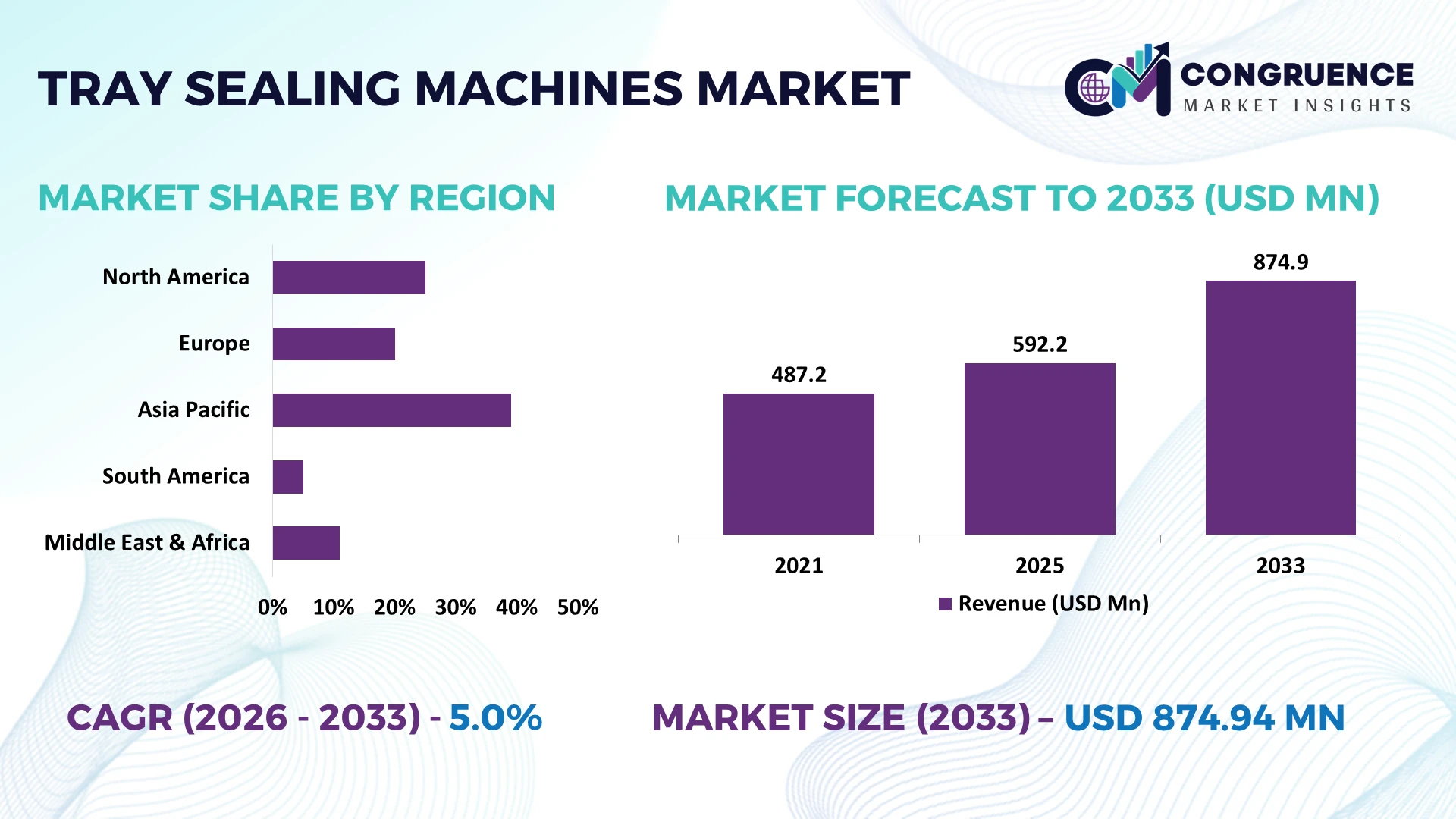
The Global Tray Sealing Machines Market was valued at USD 592.2 Million in 2025 and is anticipated to reach a value of USD 874.94 Million by 2033 expanding at a CAGR of 5% between 2026 and 2033. Modified-atmosphere packaging, ready-meal production, automated food lines, labor substitution, and recyclable mono-material tray adoption are increasing demand for precise high-throughput sealing equipment.
The United States accounts for approximately 24% of global tray sealing machine demand, supported by large meat, poultry, prepared-meal, fresh-produce, and foodservice packaging industries. Advanced automatic lines can process above 100 packs per minute, while MAP systems can extend selected fresh-food shelf life by 50–100% versus conventional air-packed formats. Germany has a smaller installed base but stronger concentration of premium packaging-equipment engineering. U.S. food-processing automation investment is accelerating as persistent manufacturing labor constraints reshape production-line economics and domestic supply-chain resilience.
Strategically, suppliers should prioritize high-speed MAP platforms, recyclable-film compatibility, rapid tooling changeovers, and North American service capacity as food processors increasingly value throughput, labor productivity, and packaging flexibility together.
Market Size & Growth: USD 592.2 million in 2025 reaches USD 874.94 million by 2033 at 5% CAGR, driven by MAP adoption and food-line automation.
Top Growth Drivers: Prepared-food expansion contributes 38%, packaging automation 34%, and shelf-life optimization 28% to incremental machine demand.
Short-Term Forecast: By 2027, automated tray-sealing lines can reduce direct packaging labor requirements by 20–30% in high-throughput food plants.
Emerging Technologies: Vision inspection, robotic loading, and digitally controlled sealing target 15–25% faster changeovers while strengthening seal consistency and traceability.
Regional Leaders: North America approaches USD 255 million, Europe USD 245 million, and Asia-Pacific USD 275 million by 2033 as automatic-line penetration increases.
Consumer/End-User Trends: Food processors represent approximately 65% of machine deployment, with ready meals, proteins, produce, and chilled foods concentrating utilization.
Pilot/Case Example: 2025 automated MAP installations achieved packaging speeds exceeding 100 trays per minute, supporting higher throughput with fewer manual handling stages.
Competitive Landscape: MULTIVAC holds an estimated 15% share, competing with Proseal, ULMA Packaging, SEALPAC, and ILPRA across automated food-packaging lines.
Regulatory & ESG Impact: Recyclable mono-material tray-film systems can reduce packaging material use by approximately 10–20% through downgauging and optimized sealing structures.
Investment & Funding: More than USD 500 million in broader packaging-equipment and food-automation investments supports robotics, digitalization, localized production, and service expansion.
Innovation & Future Outlook: Intelligent sealing controls and automated inspection target 20%+ productivity gains, shifting competition toward integrated, data-enabled packaging cells.
Tray sealing machines are increasingly deployed across meat, poultry, seafood, ready meals, dairy, fresh produce, bakery, and foodservice packaging where seal integrity, throughput, and shelf-life control directly influence operating economics. Automatic systems exceeding 100 trays per minute are replacing labor-intensive packaging steps, while MAP, skin packaging, robotic loading, and vision-based inspection strengthen product protection and line consistency. Recyclable mono-material structures are also changing tooling and sealing-temperature requirements as European packaging regulation tightens. This convergence of food automation, flexible packaging formats, and sustainability-driven material conversion establishes the market’s next strategic competitive phase.
Tray sealing is becoming strategically important as food processors redesign packaging lines around automation, shelf-life control, labor productivity, and recyclable materials. Europe’s packaging regulation is accelerating conversion toward recyclable structures, forcing equipment buyers to evaluate sealing-window flexibility alongside throughput. Simultaneously, prepared-food manufacturers are replacing isolated machines with integrated cells combining tray denesting, filling, gas flushing, sealing, inspection, labeling, and robotics.
Modern automatic sealers can exceed 100 trays per minute, while manual and basic semi-automatic workflows commonly remain below 20 trays per minute. This fivefold throughput difference materially changes labor economics at high-volume plants. The United States leads large-scale meat and prepared-food automation, while Germany and Italy retain strong packaging-machinery engineering. Through 2028, vision inspection, recipe-controlled changeovers, MAP, and digitally monitored seal parameters will penetrate further into industrial lines.
A ready-meal producer can integrate robotic loading with inline MAP sealing and inspection, eliminating multiple manual transfer stages while maintaining product-specific recipes. Equipment manufacturers are expanding recyclable-film trials, automation partnerships, remote diagnostics, and application laboratories. Competitive advantage will increasingly depend on validated material compatibility, rapid changeovers, hygienic design, and complete-line integration rather than sealing speed alone.
Labor-intensive food packaging is shifting toward automated tray handling, sealing, inspection, and secondary packaging as processors pursue higher output with fewer repetitive manual operations. Automatic tray sealers can exceed 100 packs per minute, while integrated lines can reduce direct packaging labor requirements by approximately 20–30% and improve throughput by 25–40% versus disconnected workflows. U.S. meat, poultry, prepared-food, and fresh-produce processors are accelerating automation as persistent manufacturing labor constraints increase the cost of line stoppages and staffing gaps. Machine suppliers are responding with robotic loading, automatic denesting, centralized recipe management, and integrated inspection. The non-obvious advantage is synchronization: processors gain more from eliminating bottlenecks between filling and sealing than from maximizing sealer speed independently, shifting purchasing toward complete-line engineering.
Rapid packaging-material transition is creating a structural restraint because tray sealers must accommodate changing combinations of PET, PP, fiber-based trays, mono-material films, barrier layers, and recyclable structures. Switching formats can require tooling, sealing-temperature validation, dwell-time adjustments, and new film specifications, increasing conversion costs by approximately 10–20%. Poorly optimized sealing parameters can also increase film consumption or reject rates by 2–5%, directly affecting food-plant margins. European processors face particular pressure as packaging rules accelerate recyclable-format adoption while maintaining food-contact and shelf-life requirements. Equipment manufacturers are reducing exposure through interchangeable tooling, broader sealing windows, material-testing centers, and partnerships with film and tray suppliers. The strategic constraint is compatibility uncertainty: processors hesitate to lock capital into machines unable to accommodate the next packaging structure.
Machine vision, seal inspection, connected controls, and automated recipe management are creating a higher-value equipment layer beyond basic sealing. Vision systems can inspect nearly 100% of trays inline, while automated parameter control can reduce changeover time by approximately 15–25% and lower avoidable sealing rejects by 10–20% in optimized operations. Germany’s highly automated food-processing base provides an early deployment environment, while India offers substantial whitespace as organized ready-meal, dairy, and protein processing expands. Through 2028, AI-assisted defect classification and predictive maintenance will increasingly connect sealers with plant manufacturing systems. Suppliers are investing in cameras, analytics, remote diagnostics, and software partnerships. The strategic opportunity extends beyond machine sales: validated production data enables processors to document seal integrity, trace quality deviations, and reduce product giveaway or recall exposure.
High-speed tray sealing increasingly depends on synchronized upstream filling and downstream inspection, labeling, coding, robotics, and case packing, making system integration a long-term execution challenge. A sealer operating above 100 trays per minute delivers little benefit when filling or transfer equipment runs 10–15% slower. Product changeovers can consume 15–30 minutes on poorly standardized lines, while sensor, software, and communications faults create additional downtime. U.S. processors increasingly require interoperability across equipment from multiple OEMs, raising controls-engineering and technician requirements. Suppliers must invest in standardized interfaces, digital commissioning, operator training, remote support, and complete-line testing. The critical insight is that overall equipment effectiveness increasingly determines purchasing decisions: machine builders unable to guarantee coordinated line performance risk losing projects despite superior standalone sealing specifications.
Skin Packaging Moves Premium: Meat, seafood, and premium ready-food processors are increasing vacuum-skin packaging deployment because tight product presentation and reduced purge improve merchandising. Optimized skin packs can extend selected chilled-product shelf life by 50% or more and reduce package headspace substantially. European processors are adding skin-capable tooling to existing automatic platforms, while suppliers expand dual-format machines handling MAP and skin packs without requiring separate packaging lines.
Tooling Changeovers Become Faster: High-mix food plants are prioritizing rapid format conversion as retailers increase SKU proliferation and smaller production batches. Tool-free and automated changeover systems can reduce conversion time by 20–40%, while recipe storage eliminates repeated manual parameter entry. German and Italian equipment manufacturers are redesigning tooling carts, lifting systems, and digital recipes. Faster switching increases productive machine hours and allows processors to run promotional or seasonal products economically.
Seal Inspection Moves Inline: Producers are replacing sample-based quality checks with continuous vision and sensor inspection. Advanced systems can examine nearly 100% of sealed trays and identify contamination, wrinkles, misalignment, or incomplete seals before downstream packing. Automated rejection can cut manual inspection requirements by 20–30%. U.S. protein processors are integrating cameras directly after sealing, while machine builders increasingly offer inspection modules as part of standardized line architectures.
Fiber Trays Force Process Retuning: Paperboard and fiber-based tray adoption is changing heat-transfer, flange, and sealing-window requirements compared with conventional rigid plastics. Material transitions can require sealing-temperature adjustments exceeding 10% and new tooling geometries to maintain consistent closure. European packaging rules are accelerating trials, prompting equipment manufacturers to establish material-testing partnerships with tray and film suppliers. Non-obviously, application laboratories are becoming sales assets because validated material-machine combinations reduce customers’ commercialization risk.
Automatic Tray Sealers lead the type segment with an estimated 46% share, reflecting their ability to combine high throughput, repeatable seal parameters, MAP capability, and downstream automation. Industrial platforms can exceed 100 trays per minute, making them economically attractive for meat, prepared-food, and fresh-product plants. Semi-Automatic Sealers remain important among medium-volume processors requiring flexibility without complete line integration, while Manual Tray Sealers serve low-volume production, catering, and specialized operations where capital intensity outweighs throughput requirements.
Inline Tray Sealers are the fastest-growing type as processors integrate denesting, filling, sealing, inspection, coding, and robotic handling into continuous workflows. Integrated configurations can reduce direct packaging labor by 20–30%. Rotary Tray Sealers retain relevance where indexing accuracy and multiple processing stations support specific high-volume formats. Manufacturers are investing in servo drives, rapid tooling, digital recipes, hygienic construction, and modular automation interfaces. Purchasing priorities are consequently shifting from machine-level speed toward total line efficiency, changeover flexibility, and packaging-material compatibility.
Meat and Seafood represent the leading application with an estimated 32% share because processors require strong seal integrity, leak control, chilled shelf-life protection, and high-volume MAP or vacuum-skin capability. Automatic sealing is concentrated across portioned meat, poultry, fish, and seafood where packaging failures directly create spoilage and retailer rejection. Fresh Food Packaging remains substantial across produce and chilled prepared ingredients, while Dairy Products use tray formats selectively for cheese, cultured products, and portioned foods. Bakery Products prioritize flexible tooling across variable product dimensions.
Ready Meals are the fastest-growing application as convenience-food producers adopt multi-compartment trays, MAP, robotic loading, and recipe-controlled changeovers. Automatic lines can exceed 100 trays per minute, while optimized MAP can extend shelf life by 50% or more for selected chilled foods. Suppliers are expanding multi-format tooling, skin packaging, gas-mixing integration, and inspection systems. Demand is becoming operationally critical where processors must simultaneously manage short production runs, retailer-specific formats, food safety, and labor availability.
Food Processing Companies lead end-user demand with an estimated 38% share because diversified processors operate multiple product categories, packaging formats, and production shifts that justify automatic equipment utilization. Their purchasing decisions emphasize throughput, hygiene, changeover speed, seal validation, and integration with filling and inspection systems. Meat Processors represent a particularly equipment-intensive group because MAP and vacuum-skin formats require reliable sealing under chilled, high-throughput conditions. Dairy Manufacturers and Bakery Manufacturers maintain more selective adoption depending on tray-format penetration within their product portfolios.
Ready Meal Producers are the fastest-growing end-user group as SKU proliferation and multi-component meals increase packaging complexity. Automated lines can reduce direct packaging labor by 20–30%, while rapid tooling can shorten format changes by 20–40%. Suppliers are targeting these processors with modular machines, recipe management, robotic loading, multi-compartment tooling, and service agreements. Competitive demand is therefore moving toward OEMs capable of supporting frequent product transitions without sacrificing line utilization or seal integrity.
Europe accounted for the largest market share at 32% in 2025 however, Asia-Pacific is expected to register the fastest growth, expanding at a CAGR of 6.3% between 2026 and 2033.

Protein Processing Accelerates Line Automation
North America accounted for approximately 29% of global tray sealing machine demand in 2025, anchored by U.S. meat, poultry, seafood, ready-meal, fresh-produce, and institutional food processing. Large processors increasingly specify automatic MAP and vacuum-skin platforms exceeding 100 trays per minute, replacing labor-intensive sealing and inspection stages. Persistent food-manufacturing labor constraints strengthen the economics of robotic loading, automatic denesting, and inline inspection, which can reduce direct packaging labor requirements by 20–30% on optimized lines. Retail demand for case-ready proteins further concentrates investment in high-integrity sealing and extended shelf-life formats. Equipment manufacturers are expanding North American application centers, technician networks, and integration partnerships. Machine availability alone no longer determines procurement; processors increasingly require validated films, tooling, automation, and service under one production-performance framework.
United States Market Outlook: The United States combines extensive protein-processing capacity with a large chilled prepared-food and supermarket distribution system, making high-speed sealing operationally critical. Major processors increasingly use MAP and vacuum-skin formats to centralize case-ready production. Automated inspection approaching 100% of sealed trays strengthens quality control, while domestic technical support reduces downtime across facilities running multiple production shifts.
Packaging Regulation Accelerates Material Conversion
Europe held approximately 32% of global demand in 2025, supported by advanced food-processing and packaging-machinery clusters in Germany, Italy, the United Kingdom, France, Spain, and the Netherlands. The region combines high automation penetration with rapid conversion toward recyclable mono-material and fiber-based packaging structures. EU packaging rules are pushing processors to validate alternative trays and lidding films without sacrificing barrier performance or seal integrity. Rapid-change tooling can shorten format conversion by 20–40%, increasingly important as retailers expand private-label and portion-size variations. German and Italian OEMs are strengthening material-testing centers, servo-controlled sealing, vision inspection, and complete-line integration. The strategic shift is changing supplier selection: processors increasingly favor machine builders that validate tray-film-machine combinations before commercialization, reducing launch risk as packaging specifications evolve under regulatory pressure.
Germany Market Outlook: Germany remains strategically important through its advanced machinery sector, automated food plants, and strong engineering base for packaging systems. Processors prioritize energy management, hygienic construction, traceability, and recyclable-material compatibility. Servo-controlled equipment and digitally stored recipes support frequent SKU changes, allowing plants to standardize production parameters while reducing dependence on operator-adjusted sealing settings.
Processed Food Scale Drives Automation
Asia-Pacific represented approximately 25% of global tray sealing machine demand in 2025, with China, Japan, Australia, South Korea, and India providing distinct deployment profiles. China combines large food-processing capacity with domestic packaging-machinery production, while Japan emphasizes high automation and portioned convenience foods. India is moving from manual and semi-automatic equipment toward automatic platforms as organized dairy, meat, ready-meal, airline-catering, and quick-service food supply chains expand. Automatic machines delivering more than 100 trays per minute provide substantial throughput advantages for centralized processors. Suppliers are widening Asian manufacturing, distributor coverage, local tooling, and application support to reduce imported-equipment lead times. Regional competition increasingly separates standardized cost-efficient machines from premium platforms offering MAP, skin packaging, robotics, and digital inspection, creating distinct investment pathways for processors at different automation stages.
China Market Outlook: China offers the region’s strongest combination of food-processing scale, equipment manufacturing, component supply, and domestic automation capability. Large meat, seafood, prepared-food, and fresh-product processors increasingly deploy integrated sealing cells rather than isolated machines. Local production of frames, controls, tooling, and automation components also enables shorter customization cycles and stronger price competition against imported European platforms.
Protein Exports Reinforce Packaging Modernization
South America accounted for approximately 6% of global demand in 2025, with Brazil and Argentina concentrating industrial meat, poultry, dairy, bakery, and prepared-food processing. Brazil’s major protein-export industry creates a strong operational requirement for reliable high-throughput packaging, particularly MAP and vacuum-skin systems supporting chilled retail presentation and export logistics. Automatic sealing can reduce direct packaging labor by approximately 20–30%, but imported equipment costs, currency volatility, and specialized maintenance availability continue to affect investment decisions. Large processors therefore adopt advanced inline systems faster than smaller domestic producers, which retain semi-automatic machines. OEMs are strengthening Brazilian distributors, spare-parts inventories, remote diagnostics, and locally manufactured tooling. Equipment lifecycle support is particularly important because extended downtime can disrupt tightly scheduled cold-chain production and export commitments.
Brazil Market Outlook: Brazil’s position among the world’s largest meat and poultry producers creates concentrated demand for automated tray packaging around major processing clusters. Export-oriented plants prioritize hygienic design, high seal integrity, and rapid servicing. Domestic technical teams and stocked wear components increasingly influence machine selection because high-utilization protein lines place significant operational cost on prolonged imported-parts lead times.
Food Security Investment Expands Processing Capacity
Middle East & Africa accounted for approximately 8% of global tray sealing machine demand in 2025, led by the UAE, Saudi Arabia, South Africa, and established food-processing centers across selected North African markets. Gulf states are investing in domestic food production, cold-chain capacity, central kitchens, airline catering, and modern retail as food-security strategies reduce dependence on finished-food imports. Automatic tray sealing supports centralized meat, dairy, ready-meal, and fresh-food production while MAP extends distribution windows across high-temperature logistics environments. Optimized automation can reduce direct packaging labor requirements by 20–30%, particularly in large commissaries. Equipment suppliers are building distributor partnerships, operator training, remote service, and flexible semi-automatic-to-inline portfolios. South Africa maintains broader food-manufacturing depth, although capital availability and maintenance infrastructure create uneven automation adoption elsewhere.
Saudi Arabia Market Outlook: Saudi Arabia provides a strong deployment environment through domestic food-security programs, expanding poultry and dairy production, hospitality development, and centralized foodservice. Large processors increasingly require MAP capability, hygienic stainless-steel construction, and automated handling. Local service coverage is strategically valuable because high ambient temperatures and intensive production schedules increase the cost of packaging-line interruptions.
MULTIVAC, Proseal, ULMA Packaging, SEALPAC, and ILPRA compete with specialized regional machine builders across automatic, inline, rotary, and semi-automatic tray sealing. The top five suppliers collectively control approximately 48% of organized global demand, reflecting strong engineering and service advantages. Premium European OEMs compete through automation, hygienic design, MAP capability, and integration, while lower-cost Asian suppliers can price comparable basic equipment 15–25% below imported platforms. High-speed systems exceed 100 trays per minute, while rapid tooling can reduce changeovers by 20–40%. Companies are expanding application centers, partnering with robotics and packaging-material suppliers, integrating inspection, and strengthening regional service networks. Competition is shifting from standalone sealers toward validated packaging ecosystems combining machinery, tooling, films, automation, and digital controls. Food-contact compliance, application engineering, installed service capacity, and material-validation expertise create substantial entry barriers. Winning requires reliable throughput, rapid format flexibility, recyclable-material compatibility, automation integration, and lifecycle support that protects processor uptime globally.
MULTIVAC Group
Proseal
ULMA Packaging
SEALPAC International
ILPRA S.p.A.
G. Mondini S.p.A.
Ishida Co., Ltd.
Webomatic Maschinenfabrik GmbH
Tramper Technology
Henkelman
Ross Industries, Inc.
Platinum Package Group
Reepack S.r.l.
Tecnovac S.r.l.
Current tray sealing technology combines servo-driven motion, modified-atmosphere packaging, vacuum skin sealing, recipe controls, and integrated inspection. High-speed automatic platforms reach 120–240 trays per minute, while electric actuators improve seal-force consistency and airless operation reduces utility dependence. Connected machines increasingly capture temperature, pressure, film, and downtime data, giving high-volume food processors throughput control and lower labor exposure.
Emerging systems integrate RFID tooling identification, machine vision, predictive maintenance, robotic loading, and digitally coordinated line controls. RFID-enabled mould tracking supports preventive maintenance and reduces format-change errors, while vision inspection can examine virtually 100% of packs. Compared with legacy semi-automatic sealing, modern inline platforms can deliver over 300% higher throughput in suitable applications. Medium-sized processors benefit as modular automation reduces the historical scale threshold for advanced MAP deployment.
Disruptive technology is shifting toward AI-supported product identification, intelligent labeling, adaptive controls, and material-saving die systems. MULTIVAC’s CloseCut concept demonstrates up to 30% lower film trim, showing how software and tooling jointly improve economics. During 2026–2028, AI inspection, multi-stream processing, and predictive service will move deeper into industrial lines. Suppliers combining machinery, software, robotics, and sustainable-material validation gain competitive advantage; processors should act now to secure flexible capacity before SKU complexity and recyclable-packaging requirements intensify.
December 2024 – ULMA Packaging introduced the TSA 400 automatic traysealer for low-to-medium production, supporting MAP, vacuum, and skin formats with IP65 protection. Its integration-focused design expands automated sealing access for processors requiring hygienic, flexible, high-efficiency modern packaging operations. Source: PackagingEurope.
May 2025 – Proseal unveiled the XTP Automatic Tray Sealer at IFFA, delivering up to 40 atmospheric packs and 30 MAP packs per minute. Airless operation and electric actuators extend advanced automated sealing to medium-sized food processing facilities worldwide. Source: Proseal.
January 2025 – JBT completed its acquisition of Marel, securing 97.5% initially and combining Proseal tray-sealing technology with broader food-processing systems. The integration expands end-to-end line capability, digital services, customer support, and cross-selling opportunities across major global protein customers. Source: SEC.
May 2026 – MULTIVAC demonstrated its AI-supported TX traysealer line at interpack, combining product identification, intelligent labeling, and CloseCut tooling that cuts film trim up to 30%. Mixed-product processing improves production capacity utilization while lowering packaging-material waste and costs. Source: PackagingInsights.
The Tray Sealing Machines Market Report evaluates Manual Tray Sealers, Semi-Automatic Sealers, Automatic Tray Sealers, Rotary Tray Sealers, and Inline Tray Sealers across Fresh Food Packaging, Meat and Seafood, Dairy Products, Ready Meals, and Bakery Products. End-user coverage includes Food Processing Companies, Meat Processors, Dairy Manufacturers, Ready Meal Producers, and Bakery Manufacturers. Automatic systems represent approximately 46% of type-level demand, reflecting industrial migration toward higher-throughput packaging.
Regional assessment covers North America, Europe, Asia-Pacific, South America, and Middle East & Africa, alongside country-level automation and food-processing ecosystems. Technology coverage includes MAP, vacuum skin packaging, servo motion, RFID tooling, robotic loading, vision inspection, AI identification, predictive maintenance, and material-saving dies. The 2026–2033 framework supports automation investment, capacity expansion, packaging-format selection, service-network planning, competitive positioning, and identification of high-value opportunities in ready meals, recyclable packaging, and digitally integrated production lines.
| Report Attribute/Metric | Report Details |
|---|---|
Market Revenue in 2025 | USD 592.2 Million |
Market Revenue in 2033 | USD 874.94 Million |
CAGR (2026 - 2033) | 5% |
Base Year | 2025 |
Forecast Period | 2026 - 2033 |
Historic Period | 2021 - 2025 |
Segments Covered | By Type
By Application
By End-User
|
Key Report Deliverable | Revenue Forecast, Growth Trends, Market Dynamics, Segmental Overview, Regional and Country-wise Analysis, Competition Landscape |
Region Covered | North America, Europe, Asia-Pacific, South America, Middle East, Africa |
Key Players Analyzed | MULTIVAC Group, Proseal, ULMA Packaging, SEALPAC International, ILPRA S.p.A., G. Mondini S.p.A., Ishida Co., Ltd., Webomatic Maschinenfabrik GmbH, Tramper Technology, Henkelman, Ross Industries, Inc., Platinum Package Group, Reepack S.r.l., Tecnovac S.r.l. |
Customization & Pricing | Available on Request (10% Customization is Free) |




