
Reports
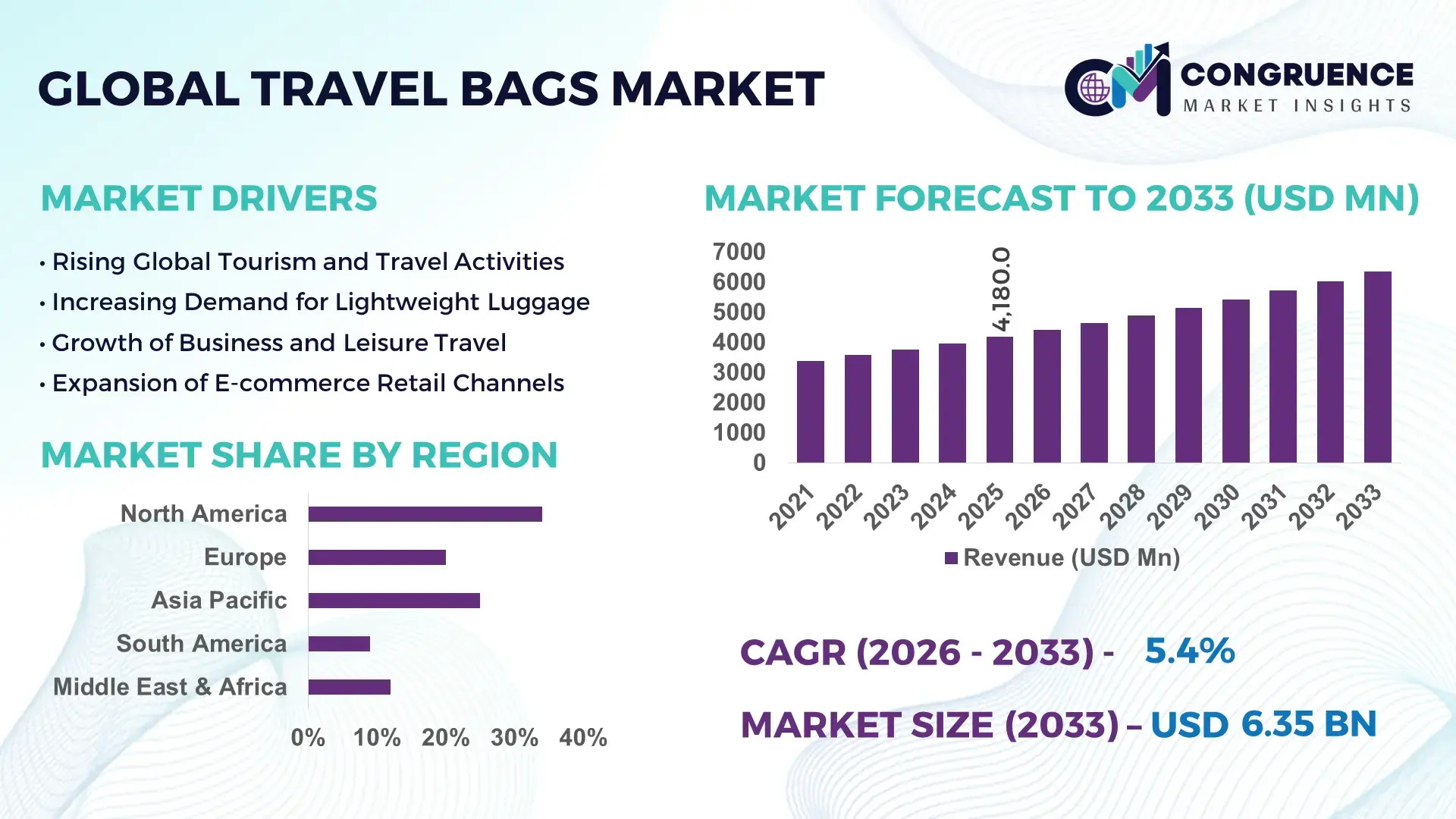
The Global Travel Bags Market was valued at USD 4180 Million in 2025 and is anticipated to reach a value of USD 6352.02 Million by 2033 expanding at a CAGR of 5.37% between 2026 and 2033. Rising global tourism, expanding airline passenger traffic, and increasing demand for durable and smart luggage solutions are accelerating the market’s growth trajectory.
The United States represents one of the most advanced and high-capacity hubs within the global travel bags industry. The country hosts over 40 large-scale luggage manufacturing and design facilities that collectively produce more than 120 million travel bags annually, including suitcases, duffel bags, and smart luggage products. Investments in advanced materials such as polycarbonate shells and ballistic nylon have exceeded USD 500 million in the past decade. Approximately 62% of American leisure and business travelers use multi-functional travel bags with integrated security features such as TSA-approved locks and RFID protection. The e-commerce segment accounts for nearly 48% of travel bag sales in the country, supported by rapid logistics infrastructure and direct-to-consumer brand strategies.
• Market Size & Growth: The global travel bags market reached USD 4180 Million in 2025 and is projected to reach USD 6352.02 Million by 2033, expanding at a CAGR of 5.37%, driven primarily by expanding tourism activity, airline passenger traffic exceeding 4.5 billion annually, and increased demand for lightweight, durable luggage solutions.
• Top Growth Drivers: International tourism growth (28%), rising e-commerce luggage purchases (34%), and demand for lightweight polycarbonate luggage designs improving durability by 22%.
• Short-Term Forecast: By 2028, smart luggage technologies with GPS tracking and biometric locks are expected to improve baggage security efficiency by 30% while reducing baggage misplacement incidents by nearly 18%.
• Emerging Technologies: Integration of GPS-enabled smart luggage systems, anti-theft RFID blocking pockets, and lightweight polycarbonate composite shells enhancing impact resistance and product durability.
• Regional Leaders: Asia-Pacific projected to exceed USD 2400 Million by 2033 with rapid tourism growth, North America approaching USD 1900 Million driven by premium luggage demand, and Europe surpassing USD 1500 Million due to strong luxury travel accessories adoption.
• Consumer/End-User Trends: Frequent travelers and digital nomads increasingly prefer modular travel bags, while business travelers account for nearly 41% of premium luggage purchases globally.
• Pilot or Case Example: In 2024, a smart luggage pilot initiative in Japan reduced baggage misplacement incidents by 16% using IoT tracking sensors integrated into airline-compatible suitcases.
• Competitive Landscape: The market leader holds approximately 21% share, followed by major competitors including Samsonite, VIP Industries, Tumi, American Tourister, and Delsey.
• Regulatory & ESG Impact: Sustainable manufacturing initiatives are encouraging manufacturers to adopt recycled polyester fabrics and biodegradable packaging, targeting 30% material recycling adoption by 2030.
• Investment & Funding Patterns: Over USD 1.2 billion has been invested globally in luggage innovation, including smart travel accessories, lightweight materials, and direct-to-consumer retail channels.
• Innovation & Future Outlook: Emerging innovations such as modular packing systems, IoT-enabled luggage tracking, and sustainable eco-fiber materials are reshaping product development strategies and enhancing consumer convenience.
Travel bags remain essential travel accessories across tourism, aviation, and hospitality industries. Leisure tourism contributes nearly 46% of global travel bag usage, while business travel accounts for approximately 29% of premium luggage purchases. Recent product innovations include anti-microbial interior linings, expandable compression systems, and aluminum-frame hard-shell suitcases designed for improved durability. Environmental regulations are encouraging the adoption of recycled PET fabrics, which now represent nearly 18% of luggage materials used by leading manufacturers. Asia-Pacific continues to lead consumption due to expanding middle-class travel demand, while Europe emphasizes sustainable and luxury luggage design. Future growth is increasingly linked to smart luggage ecosystems, digital retail platforms, and sustainable material engineering.
The Travel Bags Market holds strong strategic importance within the global tourism, aviation, and consumer goods industries as rising international mobility and urban lifestyles drive demand for efficient luggage solutions. Advanced materials such as polycarbonate composite shells deliver 35% higher impact resistance compared to traditional ABS plastic luggage, improving durability and product lifespan. Asia-Pacific dominates in production volume, while North America leads in premium luggage adoption with nearly 58% of travelers preferring high-end or technologically enhanced travel bags.
By 2027, AI-enabled luggage tracking and smart travel accessories are expected to reduce baggage loss incidents by nearly 22% across major international airports. Sustainability commitments are also reshaping industry strategies, with manufacturers targeting 40% recycled material integration in luggage production by 2030 to align with environmental compliance goals.
In 2024, a Japanese luggage manufacturer introduced IoT-enabled suitcases equipped with GPS sensors and digital locking systems, achieving a 25% improvement in luggage tracking accuracy during pilot airport trials. As innovation accelerates, the Travel Bags Market is positioned as a critical pillar supporting resilient tourism infrastructure, regulatory compliance, and sustainable consumer product development worldwide.
The rapid expansion of global tourism is a major driver of the Travel Bags Market. International tourist arrivals exceeded 1.3 billion travelers annually in recent years, while airline passenger numbers surpassed 4.5 billion globally. This surge in travel activity has increased the demand for durable suitcases, backpacks, and duffel bags designed for long-distance travel and frequent mobility. In emerging economies across Asia-Pacific, middle-class travel spending has grown significantly, with nearly 65% of urban travelers purchasing new luggage every three to four years. The rising popularity of adventure tourism and short-duration travel has also boosted demand for lightweight carry-on travel bags that comply with airline cabin baggage regulations.
Volatility in raw material prices is a key constraint affecting the Travel Bags Market. Materials such as polycarbonate, aluminum frames, nylon fabrics, and polyester textiles account for nearly 60% of luggage manufacturing costs. Global polymer price fluctuations have increased production costs by approximately 18% in recent years, impacting profit margins for manufacturers. In addition, supply chain disruptions in textile manufacturing hubs across Asia have extended procurement lead times by up to 20%. These cost pressures make it difficult for companies to maintain competitive pricing while continuing to invest in innovative features such as smart luggage technologies and advanced lightweight materials.
The integration of smart technologies into luggage products presents a significant opportunity for the Travel Bags Market. Smart travel bags equipped with GPS tracking, biometric locks, and USB charging ports are gaining popularity among frequent travelers and business professionals. Surveys indicate that nearly 32% of international travelers prefer luggage with built-in tracking features to reduce baggage loss risks. Airlines and airport authorities are also exploring IoT-enabled baggage tracking systems that could improve luggage monitoring efficiency by nearly 28%. Additionally, advances in lightweight battery technology and Bluetooth connectivity are enabling manufacturers to introduce technologically enhanced luggage products that combine security, connectivity, and traveler convenience.
Changing airline baggage regulations present a complex challenge for the Travel Bags Market. Many international airlines have introduced stricter cabin baggage size and weight restrictions to optimize aircraft storage capacity. Carry-on luggage size limits typically range between 55–56 cm in height, forcing manufacturers to redesign travel bags to comply with global aviation standards. Non-compliant luggage models can lead to additional baggage fees for travelers, reducing consumer demand for larger suitcase designs. Furthermore, smart luggage containing lithium batteries has faced regulatory scrutiny, requiring removable battery modules to meet airline safety guidelines, which increases product development complexity and manufacturing costs.
• Surge in Smart Luggage Adoption: Smart travel bags equipped with GPS tracking, biometric locks, and integrated USB charging ports are rapidly gaining traction among frequent travelers. Industry surveys indicate that nearly 32% of international travelers prefer luggage with integrated tracking systems, reducing baggage misplacement concerns. Smart luggage models now incorporate Bluetooth-enabled tracking modules with accuracy levels above 95%, allowing real-time monitoring via mobile apps. Additionally, airline-compatible removable lithium batteries are now integrated in over 18% of newly launched premium luggage products, reflecting rising demand for technologically enhanced travel accessories. This trend is particularly visible across North America and East Asia, where digital travel ecosystems and connected devices drive higher adoption of smart travel gear.
• Rising Demand for Lightweight and Durable Materials: Manufacturers are increasingly focusing on advanced materials such as polycarbonate, polypropylene composites, and aluminum frames to reduce luggage weight while improving durability. Modern hard-shell suitcases using polycarbonate structures are up to 40% lighter than traditional ABS-based luggage while offering 35% higher impact resistance. In premium travel segments, aluminum-frame luggage designs now account for approximately 14% of high-end suitcase purchases globally. Additionally, ballistic nylon and reinforced polyester fabrics are used in nearly 52% of soft-shell travel bags, enhancing tear resistance and long-term durability. The adoption of lightweight luggage has become particularly significant among airline travelers, where carry-on weight restrictions typically range between 7–10 kilograms.
• Growth in Sustainable and Recycled Material Travel Bags: Sustainability is becoming a defining trend across the travel bags market as manufacturers respond to environmental regulations and eco-conscious consumer demand. Nearly 27% of new luggage products launched in 2024 incorporated recycled polyester or recycled PET fabrics derived from plastic bottles. Leading brands have reported reducing packaging waste by over 35% through biodegradable and recyclable packaging materials. Eco-friendly travel bags manufactured using recycled ocean plastics are gaining attention, particularly in Europe, where more than 41% of consumers consider sustainability a key purchasing factor for travel accessories. This shift is also influencing production practices, with manufacturers targeting 30–40% recycled material integration across product lines by the end of the decade.
• Expansion of E-Commerce and Direct-to-Consumer Luggage Sales: Online retail platforms are transforming the distribution dynamics of the travel bags market. Digital commerce channels now account for nearly 45% of global luggage sales, driven by improved logistics infrastructure and competitive pricing strategies. Consumer surveys reveal that over 58% of millennial and Gen Z travelers purchase travel bags through online platforms, attracted by wider product variety and competitive discounts. Mobile commerce transactions represent nearly 37% of digital luggage purchases, reflecting the growing role of smartphone-based retail platforms. Additionally, direct-to-consumer luggage brands have expanded global shipments by approximately 22% annually through cross-border e-commerce fulfillment networks.
The Travel Bags Market segmentation is primarily categorized by product type, application, and end-user demand patterns. Hard-shell suitcases, soft luggage, backpacks, and duffel bags represent the core product categories, each catering to different travel requirements. Leisure tourism contributes nearly 46% of global travel bag usage, followed by business travel with approximately 29% adoption. Online retail platforms influence over 45% of purchase decisions, highlighting the growing importance of digital distribution channels. Meanwhile, individual travelers represent the dominant end-user group due to rising international tourism and urban mobility. Commercial sectors including airlines, hospitality providers, and travel agencies also contribute significantly to market demand by purchasing branded or customized luggage solutions for corporate travel programs and promotional travel services.
Hard-shell luggage currently dominates the product type segment in the travel bags market, accounting for approximately 44% of global adoption due to its superior durability, impact resistance, and secure locking mechanisms. Polycarbonate and polypropylene hard-shell suitcases have gained popularity among international travelers because they offer up to 35% higher structural strength compared to traditional ABS luggage materials. Soft luggage products, including fabric suitcases and expandable travel bags, hold around 31% of adoption due to their lightweight construction and flexible storage capacity. However, travel backpacks represent the fastest-growing type with an estimated 6.8% growth rate driven by rising adventure tourism and the global digital nomad workforce. Duffel bags, garment bags, and hybrid luggage products collectively contribute nearly 25% of the market, serving niche travel segments such as sports tourism, short trips, and luxury travel accessories.
Leisure travel remains the leading application segment in the travel bags market, accounting for approximately 46% of total luggage usage globally. The expansion of international tourism, which exceeded 1.3 billion annual travelers in recent years, continues to drive strong demand for suitcases, backpacks, and multi-purpose travel bags. Business travel represents nearly 29% of travel bag applications, with corporate professionals preferring lightweight carry-on luggage and compact travel backpacks for short-duration trips. However, adventure and outdoor travel is the fastest-growing application segment with an estimated growth rate of 7.1%, fueled by increasing participation in trekking, camping, and international exploration activities. Specialized travel bags designed for outdoor equipment, waterproof protection, and ergonomic carrying systems are gaining popularity among younger travelers. Other applications including educational travel, sports tourism, and luxury travel accessories collectively account for approximately 25% of travel bag usage.
Individual consumers represent the dominant end-user segment in the travel bags market, accounting for approximately 68% of global demand due to the expanding base of leisure and business travelers. Personal luggage purchases are closely tied to tourism growth, urban mobility, and increasing participation in international travel. Corporate travelers and business professionals represent nearly 17% of end-user demand, as organizations frequently invest in premium luggage products for employee travel programs and executive mobility. However, the fastest-growing end-user segment is the digital nomad and remote workforce category, expanding at an estimated 7.4% growth rate as remote work policies enable professionals to travel while maintaining work responsibilities. These users prefer modular travel backpacks and compact luggage solutions designed for mobility and electronics storage. Other end-users including travel agencies, hospitality groups, airlines, and sports organizations collectively contribute around 15% of the market, often purchasing customized or branded travel bags for promotional or operational purposes.
North America accounted for the largest market share at 34% in 2025 however, Asia-Pacific is expected to register the fastest growth, expanding at a CAGR of 6.9% between 2026 and 2033.

Europe followed with approximately 27% market share, supported by strong tourism infrastructure and premium luggage demand. Asia-Pacific held nearly 24% of global consumption, driven by increasing airline passengers exceeding 1.7 billion annually across China, India, and Southeast Asia. South America represented about 8% of the global travel bags demand, influenced by rising domestic tourism and expanding retail networks. The Middle East & Africa accounted for nearly 7% of global usage, supported by international transit hubs handling more than 150 million airline passengers annually and increasing tourism-related retail expansion across major airports.
How are premium travel trends and aviation expansion reshaping luggage demand?
North America represents approximately 34% of the global travel bags market, supported by strong travel and tourism activity with more than 900 million annual airline passenger movements. Demand is largely driven by the tourism, aviation, and corporate travel industries. Sustainability regulations encouraging recycled polyester materials in consumer products have accelerated the adoption of eco-friendly luggage designs. Technological advancements include smart luggage equipped with GPS tracking and biometric locks, now appearing in nearly 21% of newly launched premium models. A leading regional luggage manufacturer has introduced lightweight polycarbonate suitcases that reduce weight by 30% while improving impact resistance by 35%. Consumer behavior shows high demand for premium luggage, with nearly 58% of travelers preferring branded travel bags with advanced security and durability features.
How are sustainability regulations shaping the next generation of travel accessories?
Europe holds around 27% of the global travel bags market, with Germany, the United Kingdom, and France representing the largest consumer bases. Tourism activity exceeding 600 million international travelers annually drives steady demand for durable luggage products. Strict sustainability policies across the European Union are accelerating the shift toward recycled materials and environmentally responsible manufacturing processes. Nearly 38% of newly introduced travel bags in the region incorporate recycled polyester fabrics. Manufacturers are increasingly adopting lightweight polycarbonate shells and anti-theft technology for premium luggage products. A well-established European luggage brand recently launched eco-friendly suitcases manufactured using up to 60% recycled materials, targeting environmentally conscious travelers. Consumer purchasing behavior strongly favors durable, sustainable travel bags designed for long-distance travel.
What factors are accelerating the rapid expansion of modern travel accessories?
Asia-Pacific ranks among the fastest-growing regions in the travel bags market with rising tourism activity and expanding middle-class travel spending. China, India, and Japan collectively account for more than 1.7 billion annual airline passengers, significantly increasing demand for luggage products. The region hosts over 65% of global luggage manufacturing facilities, particularly in China and Southeast Asia, where advanced production technologies support large-scale manufacturing. Rapid e-commerce growth has driven online luggage sales to nearly 52% of regional purchases. A major Asian luggage manufacturer recently introduced AI-enabled smart suitcases with integrated GPS tracking and digital locks, improving baggage tracking efficiency by 25% during pilot airport trials. Consumer behavior reflects strong demand for affordable, lightweight travel bags purchased through digital retail platforms.
How is tourism expansion influencing demand for modern luggage products?
South America accounts for roughly 8% of the global travel bags market, with Brazil and Argentina representing the largest regional consumers. Tourism growth exceeding 90 million regional travelers annually continues to support luggage demand across airports and travel retail outlets. Government initiatives promoting tourism and expanding airport infrastructure are increasing passenger mobility across the continent. Retail distribution networks have expanded significantly, with luggage product availability increasing by nearly 18% across major urban retail centers. A regional luggage manufacturer recently introduced multi-functional backpacks designed for adventure tourism, improving durability by 28% using reinforced polyester materials. Consumer behavior in this region reflects strong demand for affordable, multifunctional travel bags suitable for short-distance travel and outdoor tourism activities.
What role do international transit hubs play in luggage market expansion?
The Middle East & Africa represents approximately 7% of the global travel bags market, supported by major international aviation hubs and growing tourism infrastructure. Countries such as the United Arab Emirates and South Africa are central to regional travel activity, with major airports handling more than 150 million passengers annually. Infrastructure development, tourism expansion, and airport retail growth continue to drive luggage sales across the region. Technology adoption includes lightweight travel bags with integrated security features and durable polycarbonate shells. A regional luggage brand recently introduced impact-resistant suitcases designed for long-haul international travelers, improving durability by 32% compared with standard models. Consumer demand is strongly linked to international travel and airport-based retail purchases.
• United States – 28% market share: The Travel Bags Market in the United States is driven by high airline passenger traffic exceeding 900 million annual trips, combined with strong demand for premium luggage and smart travel accessories.
• China – 21% market share: The Travel Bags Market in China benefits from extensive manufacturing capacity and large-scale domestic travel activity exceeding 4 billion passenger journeys annually across rail and aviation networks.
The Travel Bags Market is characterized by a moderately fragmented competitive structure with more than 120 active manufacturers and global brands competing across premium, mid-range, and budget product segments. The top five companies collectively control nearly 46% of the global market, reflecting strong brand recognition and established distribution networks. Competition is driven by innovation in lightweight materials, smart luggage technologies, and sustainable manufacturing practices.
Manufacturers are investing heavily in advanced materials such as polycarbonate composites and aluminum frames, which improve durability by 30–40% compared to traditional luggage materials. Product innovation strategies include GPS-enabled smart luggage, biometric locking systems, and anti-theft travel bags designed for international travelers. Strategic partnerships between luggage manufacturers and airline retailers have expanded airport retail presence by nearly 22% globally, improving brand visibility among frequent travelers.
Digital transformation is another key competitive factor, with nearly 45% of global travel bag purchases occurring through e-commerce platforms. Companies are also expanding direct-to-consumer sales channels and launching customized travel accessories to meet evolving consumer preferences. Sustainability initiatives, including recycled polyester fabrics and biodegradable packaging, are increasingly influencing product differentiation strategies and competitive positioning within the global travel bags industry.
Samsonite International
VIP Industries Ltd.
Delsey Paris
Tumi Holdings
Briggs & Riley Travelware
Travelpro International
Antler Ltd.
Eagle Creek
American Tourister
Victorinox AG
Rimowa GmbH
IT Luggage
Osprey Packs Inc.
Deuter Sport GmbH
Herschel Supply Co.
Technological innovation is significantly reshaping the Travel Bags Market through the integration of smart connectivity, advanced materials, and automated manufacturing processes. Smart luggage equipped with GPS tracking modules, Bluetooth connectivity, and mobile app integration has gained traction, with approximately 18–22% of premium luggage models now incorporating tracking technologies to reduce baggage loss risks during international travel. Biometric locking systems and RFID-blocking compartments are increasingly adopted to enhance travel security, particularly among business travelers and frequent flyers.
Material innovation is another critical technological shift. Polycarbonate composite shells now provide 35–40% higher impact resistance compared with traditional ABS plastic luggage while reducing weight by nearly 30%, improving portability for airline travelers. Ballistic nylon and reinforced polyester fabrics are also widely used, appearing in over 50% of soft-shell luggage designs due to superior tear resistance and durability.
Manufacturing technologies are evolving through the adoption of automated cutting, robotic stitching systems, and precision molding equipment, which can increase production efficiency by 25–30% while minimizing material waste. Additionally, modular interior compartments, anti-microbial interior linings, and compression packing systems are being integrated into next-generation luggage designs to improve packing efficiency by nearly 20%. These technological advancements are enabling manufacturers to enhance durability, security, and user convenience while meeting modern traveler expectations.
• In February 2025, Samsonite International launched the ESSENS Circular Collection, a hard-shell suitcase manufactured using at least 70% recycled polypropylene materials. The product line focuses on circular design principles and removable components that allow easier recycling and refurbishment after product life. Source: www.samsonite.com
• In September 2024, Rimowa introduced its Re-Crafted program expansion, refurbishing and reselling pre-owned aluminum suitcases through official brand channels. The initiative extends product life cycles and supports sustainability goals by reconditioning used luggage for resale in global retail markets. Source: www.rimowa.com
• In April 2024, VIP Industries Ltd. expanded its manufacturing operations by upgrading production lines with automated molding and cutting technologies at its India facilities, increasing manufacturing capacity and improving production efficiency for polycarbonate and polypropylene luggage collections. Source: www.vipindustries.co.in
• In October 2024, Delsey Paris launched the Shadow 5.0 luggage series, featuring upgraded anti-theft zippers, TSA-approved locking systems, and lightweight polycarbonate shells designed to improve durability and security for international travelers. Source: www.delsey.com
The Travel Bags Market Report provides a comprehensive analysis of global demand across multiple product categories including hard-shell suitcases, soft luggage, travel backpacks, duffel bags, and specialty travel bags designed for leisure, business, and adventure travel. The report evaluates market dynamics across five major regions—North America, Europe, Asia-Pacific, South America, and the Middle East & Africa—covering more than 40 key countries involved in production, distribution, and consumption of travel bags.
Industry segmentation includes detailed analysis of product types, application areas, and end-user segments, capturing demand patterns from leisure travelers, corporate professionals, tourism operators, and digital nomads. The study also evaluates emerging technological trends such as smart luggage with GPS tracking, RFID-protected compartments, and lightweight polycarbonate composite materials that improve durability and travel convenience.
Additionally, the report examines distribution channels including retail stores, airport travel retail outlets, and e-commerce platforms, which collectively account for a large portion of global luggage sales. Special focus is placed on sustainability initiatives, recycled material adoption, and modular luggage designs that are shaping next-generation product development strategies. The report further highlights competitive positioning, product innovation trends, and strategic developments among leading luggage manufacturers operating in the global travel bags industry.
| Report Attribute/Metric | Report Details |
|---|---|
|
Market Revenue in 2025 |
USD V2025 Million |
|
Market Revenue in 2033 |
USD V2033 Million |
|
CAGR (2026 - 2033) |
5.37% |
|
Base Year |
2025 |
|
Forecast Period |
2026 - 2033 |
|
Historic Period |
2021 - 2025 |
|
Segments Covered |
By Types
By Application
By End-User
|
|
Key Report Deliverable |
Revenue Forecast, Growth Trends, Market Dynamics, Segmental Overview, Regional and Country-wise Analysis, Competition Landscape |
|
Region Covered |
North America, Europe, Asia-Pacific, South America, Middle East, Africa |
|
Key Players Analyzed |
Samsonite International, VIP Industries Ltd., Delsey Paris, Tumi Holdings, Briggs & Riley Travelware, Travelpro International, Antler Ltd., Eagle Creek, American Tourister, Victorinox AG, Rimowa GmbH, IT Luggage, Osprey Packs Inc., Deuter Sport GmbH, Herschel Supply Co. |
|
Customization & Pricing |
Available on Request (10% Customization is Free) |




