
Reports
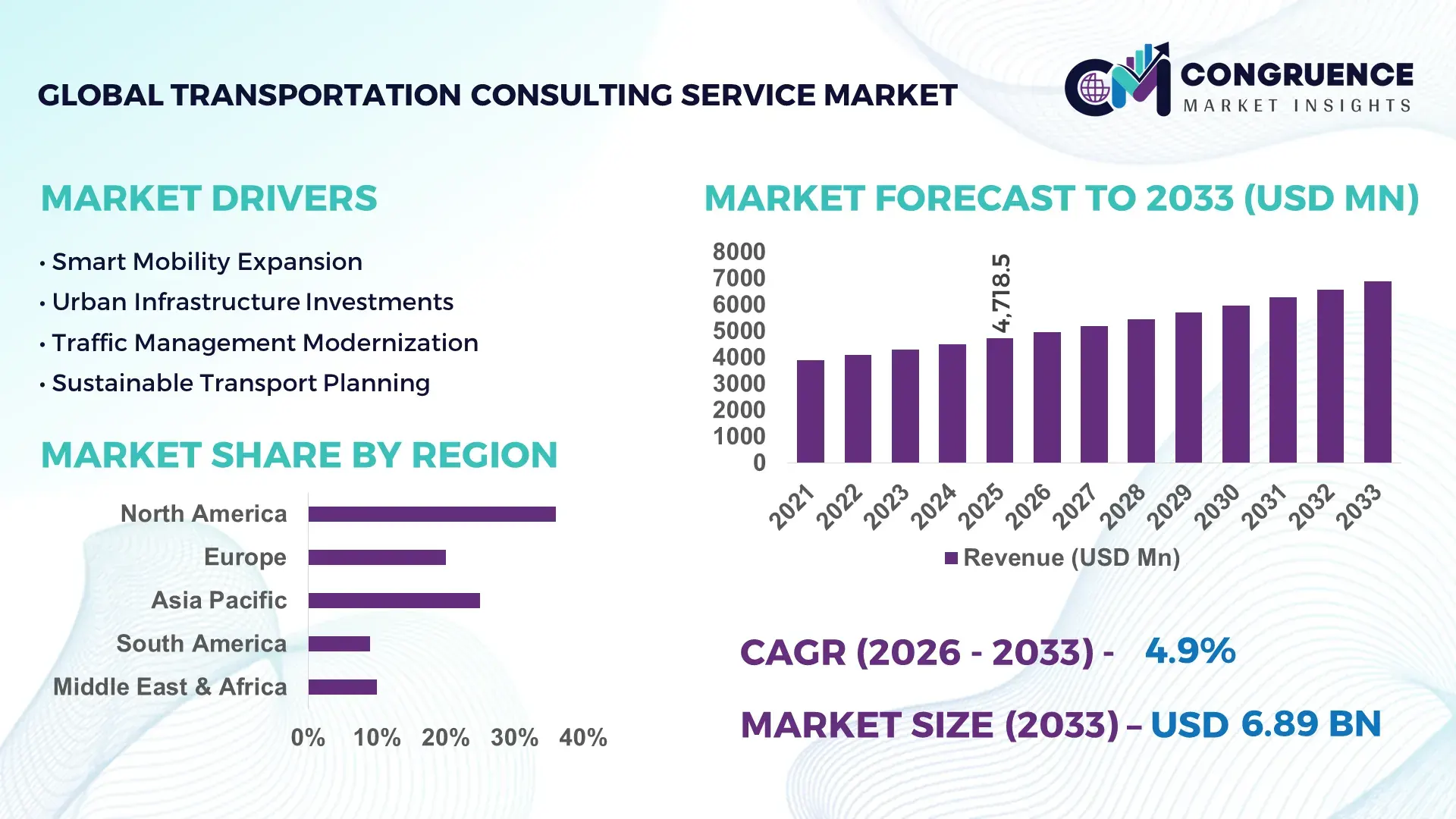
The Global Transportation Consulting Service Market was valued at USD 4718.51 Million in 2025 and is anticipated to reach a value of USD 6892.11 Million by 2033 expanding at a CAGR of 4.85% between 2026 and 2033.
Growing adoption of AI-powered transport analytics, digital freight optimization platforms, and smart mobility infrastructure accelerated consulting demand across rail, aviation, logistics, and urban transit sectors, with digitally optimized transportation systems improving operational efficiency by more than 20% during 2025. Between 2024 and 2026, transportation authorities and infrastructure operators increased investments in resilient supply chain corridors, low-emission mobility systems, and intelligent traffic infrastructure following Red Sea shipping disruptions and stricter carbon reduction regulations across Europe and North America.
The United States dominated the global transportation consulting service market with approximately 31% share in 2025, supported by infrastructure modernization investments exceeding USD 110 billion and rapid adoption of AI-enabled transportation management systems across freight, aviation, and public transit networks. More than 62% of large-scale transportation projects in the country integrated predictive mobility analytics and digital twin infrastructure modeling, compared with less than 45% adoption across several emerging economies. The U.S. maintained stronger deployment of autonomous freight corridors and smart highway systems than Western Europe, while China led high-speed rail expansion with transportation infrastructure investments surpassing USD 150 billion between 2024 and 2026.
Transportation consulting firms with advanced expertise in digital mobility integration, ESG-compliant infrastructure planning, and multimodal logistics optimization are securing higher-value contracts across high-growth global transportation modernization programs.
Market Size & Growth: The global transportation consulting service market was valued at USD 4718.51 million in 2025 and is projected to reach USD 6892.11 million by 2033 at a CAGR of 4.85%, driven by AI-based mobility planning and digital freight optimization.
Top Growth Drivers: AI-enabled transport analytics improved operational efficiency by 21%, multimodal logistics optimization reduced delivery delays by 17%, and smart traffic management systems lowered congestion costs by 14% during 2025.
Short-Term Forecast: By 2028, advanced transportation consulting deployments are projected to reduce fleet operating costs by 16% while improving urban transit efficiency by more than 19%.
Emerging Technologies: Artificial intelligence, digital twin transportation modeling, and IoT-enabled mobility monitoring emerged as key high-growth technologies across global transportation consulting projects in 2025.
Regional Leaders: North America is projected to exceed USD 2.3 billion through smart infrastructure adoption, Asia-Pacific is expected to surpass USD 1.9 billion through rail modernization, and Europe continues expanding sustainable mobility consulting programs.
Consumer/End-User Trends: More than 58% of logistics operators and public transit agencies adopted cloud-based transportation optimization platforms in 2025 to improve route visibility and fuel efficiency.
Pilot/Case Example: A 2025 metropolitan smart mobility project in Asia reduced urban congestion by 14% and improved public transportation route efficiency by 19% using AI-based transportation consulting systems.
Competitive Landscape: Leading firms collectively controlled nearly 38% of the global market in 2025, with major competition centered on digital mobility integration, ESG advisory, and intelligent infrastructure planning capabilities.
Regulatory & ESG Impact: Carbon reduction mandates and low-emission transportation policies accelerated sustainable mobility consulting demand by 24% across Europe and North America between 2024 and 2026.
Investment & Funding: Global transportation infrastructure modernization investments exceeded USD 280 billion in 2025, supported by public-private partnerships, smart city expansion, and digital mobility integration programs.
Innovation & Future Outlook: Next-generation transportation consulting is shifting toward autonomous freight corridor planning, AI-powered predictive mobility systems, and integrated multimodal transportation ecosystems across high-growth urban markets.
Rail and public transit advisory services accounted for nearly 34% of global transportation consulting demand in 2025, followed by logistics and freight optimization at 29% and aviation infrastructure consulting at 18%, reflecting accelerated investment in multimodal transportation modernization. AI-enabled traffic simulation, digital twin infrastructure modeling, and predictive mobility analytics reduced planning inefficiencies by more than 20% across advanced transportation projects. North America maintained strong demand for smart highway and autonomous freight corridor consulting, while Asia-Pacific expanded rapidly through high-speed rail and urban transit development initiatives. Increasing carbon compliance mandates and supply chain restructuring are accelerating demand for ESG-focused transportation strategies, positioning integrated digital mobility consulting as a long-term competitive differentiator across global infrastructure ecosystems.
Transportation consulting services are becoming a critical competitive lever as governments, logistics operators, and infrastructure developers accelerate investments in intelligent mobility systems, resilient supply chains, and low-emission transport infrastructure. Transportation networks managing AI-enabled optimization platforms improved operational efficiency by 21% and reduced traffic management costs by 16% during 2025, forcing consulting firms to shift from traditional infrastructure advisory models toward data-driven mobility transformation strategies. Growing urbanization, freight corridor expansion, and stricter emissions compliance standards are rapidly transforming transportation consulting into a high-priority investment segment across public and private infrastructure ecosystems.
Rising supply chain restructuring and carbon reduction regulations are accelerating demand for integrated transportation consulting solutions across North America, Europe, and Asia-Pacific. AI-powered predictive mobility analytics improves transportation planning efficiency by 24% while reducing operational costs by 18% compared to legacy transport modeling systems. North America leads in project volume, while Asia-Pacific leads in smart mobility adoption with more than 63% of new urban transportation projects integrating digital traffic management technologies. Over the next three years, intelligent transportation consulting deployments are projected to reduce fleet inefficiencies by 19% and improve multimodal logistics coordination by 22%.
Transportation operators implementing ESG-focused mobility frameworks achieved compliance cost reductions of nearly 14% while strengthening access to government-backed infrastructure contracts. In 2025, a smart urban transit deployment in Southeast Asia improved public transportation route efficiency by 17% through AI-driven mobility planning and predictive traffic analytics. Consulting firms are increasingly allocating capital toward autonomous freight advisory, smart infrastructure analytics, and digital transportation ecosystem partnerships to strengthen long-term market positioning. Companies capable of optimizing integrated mobility networks, accelerating infrastructure digitization, and delivering measurable sustainability outcomes will define the next phase of competitive leadership in the global transportation consulting service market.
Governments and logistics operators are accelerating investments in AI-enabled mobility systems, intelligent traffic management, and multimodal freight optimization, driving strong demand for transportation consulting services. More than 61% of urban transportation projects launched in 2025 integrated predictive mobility analytics, while digital logistics platforms improved delivery efficiency by 18%. Supply chain restructuring following Red Sea shipping disruptions also forced companies to redesign freight corridors and transportation infrastructure strategies. Transportation consulting firms are responding through AI-focused advisory expansion, smart infrastructure partnerships, and digital mobility integration services to strengthen competitive positioning in rapidly modernizing transport networks.
Transportation consulting projects continue facing delays due to fragmented regulations, aging transport infrastructure, and high digital integration costs. Around 43% of transportation authorities experienced implementation delays in 2025 because of interoperability issues between legacy systems and advanced mobility technologies. Infrastructure digitization costs increased by nearly 15% across large urban transportation projects, constraining scalability in cost-sensitive regions. Transportation consulting firms are mitigating risks through modular deployment models, regional technology partnerships, and long-term compliance strategies focused on reducing operational disruption and project execution delays.
AI-driven mobility ecosystems, autonomous freight corridors, and smart city infrastructure programs are creating high-value opportunities for transportation consulting providers. More than 58% of smart transportation investments in 2025 focused on AI-enabled traffic optimization and predictive logistics planning, while emerging economies increased transportation digitization investments by over 26%. AI-based transport simulation platforms improved route optimization efficiency by 23% compared with conventional planning systems. Transportation consulting firms are accelerating R&D investments, expanding smart mobility partnerships, and building integrated transportation analytics ecosystems to secure long-term competitive advantage in high-growth urban mobility markets.
Transportation consulting firms are facing growing execution pressure as intelligent mobility projects require advanced infrastructure compatibility, cybersecurity resilience, and large-scale data integration. Nearly 47% of smart transportation deployments experienced implementation delays during 2025 due to fragmented digital ecosystems and legacy infrastructure limitations. Workforce shortages also remain a major concern, with over 39% of transportation authorities reporting limited expertise in predictive mobility analytics and AI-based traffic management systems. Companies are increasing investments in cybersecurity frameworks, digital mobility talent development, and strategic infrastructure alliances to maintain scalability and long-term operational competitiveness.
The transportation consulting service market is segmented by type, application, and end-user, with demand increasingly concentrated around digital mobility integration, logistics optimization, and infrastructure modernization. Strategy and infrastructure consulting continue holding strong market positions due to large-scale public transportation projects and smart city expansion, while technology-focused consulting is rapidly gaining traction through AI-enabled mobility analytics and intelligent traffic management deployment. Traffic management and logistics applications collectively accounted for more than 52% of consulting demand in 2025 as governments and logistics operators prioritized congestion reduction and supply chain resilience. Government agencies remained the dominant end-user segment because of large transportation modernization budgets, while logistics and automotive sectors accelerated consulting adoption to improve operational visibility and fleet efficiency. Market demand is steadily shifting toward integrated consulting frameworks combining infrastructure planning, predictive analytics, and ESG-focused transportation optimization, forcing consulting firms to expand digital capabilities, strategic partnerships, and intelligent mobility service portfolios.
Strategy consulting dominated the transportation consulting service market with nearly 33% share in 2025, driven by rising demand for large-scale mobility planning, infrastructure investment optimization, and multimodal transportation transformation programs. Governments and private transportation operators increasingly relied on strategic advisory services to improve operational scalability, reduce congestion costs, and align with low-emission transportation mandates. Technology consulting emerged as the fastest-growing segment, expanding by approximately 26% during 2025 as transportation authorities accelerated deployment of AI-enabled traffic systems, predictive mobility analytics, and digital twin infrastructure platforms. Technology-focused consulting improved transportation planning efficiency by 21% compared with traditional operational assessment models, creating a strong shift away from purely process-driven consulting structures.
Infrastructure and operations consulting collectively accounted for nearly 41% of market demand, supported by smart highway development, rail modernization projects, and freight network optimization initiatives. Infrastructure consulting maintained strong relevance in public transit modernization, while operations consulting remained essential for logistics efficiency and transit scheduling optimization. Transportation consulting firms are increasingly allocating investments toward digital mobility integration, AI-based analytics capabilities, and infrastructure intelligence platforms to capture high-value transportation transformation projects. Demand is steadily shifting from conventional operational advisory toward integrated technology-enabled transportation consulting ecosystems.
“According to a 2025 report by the International Transport Forum, AI-enabled transportation technology consulting was adopted by over 59% of major urban mobility projects, resulting in operational efficiency improvements exceeding 20%, reinforcing its growing strategic importance.”
Traffic management remained the leading application segment with approximately 29% share in 2025 due to increasing urban congestion pressures, smart city expansion, and rising investments in intelligent mobility infrastructure. Transportation authorities accelerated deployment of predictive traffic analytics, AI-enabled signaling systems, and digital transit monitoring platforms to improve traffic flow efficiency and reduce infrastructure bottlenecks. Logistics emerged as the fastest-growing application segment, expanding by nearly 24% during 2025 as supply chain restructuring and cross-border freight disruptions forced companies to redesign transportation coordination systems and route optimization strategies.
Traffic management maintained stronger deployment across public infrastructure projects, while logistics consulting gained momentum through real-time freight visibility and multimodal transport optimization demand. Public transport, infrastructure, and fleet management applications collectively represented around 54% of total market demand, supported by urban transit modernization, low-emission mobility initiatives, and connected fleet operations. Transportation consulting firms are increasingly repositioning service portfolios around integrated logistics analytics, intelligent fleet coordination, and AI-driven traffic optimization capabilities to capture shifting transportation demand patterns. Operational demand is moving rapidly toward digitally connected transportation ecosystems capable of delivering measurable efficiency and sustainability outcomes.
“According to a 2025 report by the International Association of Public Transport, intelligent traffic management systems were deployed across more than 420 metropolitan transportation networks, improving urban traffic flow efficiency by 18%, highlighting its rapid operational adoption.”
Government agencies dominated the transportation consulting service market with nearly 38% share in 2025 due to large-scale transportation modernization programs, smart infrastructure investments, and public transit optimization initiatives. National and regional authorities accelerated investments in intelligent transportation systems, low-emission mobility planning, and integrated urban transit frameworks to improve operational resilience and regulatory compliance. Logistics companies represented the fastest-growing end-user segment, expanding by approximately 25% during 2025 as freight operators prioritized real-time transport visibility, supply chain resilience, and multimodal route optimization following global shipping disruptions.
Government demand remained concentrated around infrastructure scalability and public mobility efficiency, while logistics operators focused on cost reduction, predictive transportation analytics, and operational agility. Automotive companies and infrastructure developers collectively accounted for nearly 37% of market demand, driven by autonomous mobility testing, connected infrastructure integration, and smart highway deployment projects. Transportation consulting firms are increasingly targeting logistics and automotive clients through customized digital mobility solutions, performance-linked advisory models, and strategic infrastructure technology partnerships. Future demand is shifting toward data-driven transportation ecosystems where operational intelligence, ESG compliance, and mobility integration capabilities determine long-term competitive positioning.
“According to a 2025 report by the International Road Federation, adoption among logistics operators increased by 23%, with over 3,500 organizations implementing AI-based transportation optimization solutions, leading to fleet efficiency improvements of 19%, indicating a strong shift in demand dynamics.”
North America accounted for the largest market share at 36% in 2025 however, Asia-Pacific is expected to register the fastest growth, expanding at a CAGR of 6.2% between 2026 and 2033.
North America maintained demand concentration through large-scale smart mobility modernization, AI-enabled transportation analytics adoption, and freight infrastructure optimization programs, while Europe captured nearly 27% share through ESG-focused transportation consulting and low-emission transit planning initiatives. Asia-Pacific accounted for approximately 29% of global demand and continued accelerating through high-speed rail expansion, smart city deployment, and integrated urban mobility investments across China, India, and Southeast Asia. Europe led in regulatory-driven mobility innovation, while Asia-Pacific led infrastructure deployment speed and transportation digitization scale. Supply chain restructuring and carbon compliance mandates are forcing transportation consulting firms to expand digital mobility partnerships, regional delivery capabilities, and infrastructure analytics operations across high-growth transportation modernization markets.
North America accounted for nearly 36% of global transportation consulting service demand in 2025, supported by strong investments in smart transportation infrastructure, autonomous freight corridors, and AI-driven mobility optimization systems. Logistics operators and transportation authorities accelerated deployment of predictive traffic analytics and digital twin infrastructure platforms, with over 62% of large urban transportation projects integrating intelligent mobility technologies. Rising carbon compliance standards and supply chain resilience planning are forcing enterprises to redesign transportation operations and freight coordination frameworks. Transportation consulting firms expanded digital mobility partnerships and analytics-focused advisory capabilities, while smart transportation deployments improved route optimization efficiency by 21%. Companies continue prioritizing North America due to advanced infrastructure spending, high enterprise technology adoption, and strong demand for measurable operational efficiency outcomes.
Europe represented approximately 27% of the global transportation consulting service market in 2025, driven by strict emissions regulations, sustainable mobility investments, and intelligent public transit modernization programs across Germany, France, and the Nordic region. More than 58% of regional transportation projects integrated ESG-focused planning and low-emission transit optimization frameworks to align with tightening carbon reduction mandates. Transportation operators accelerated adoption of digital traffic management systems and electrified transit infrastructure, improving operational efficiency by nearly 18%. Consulting firms strengthened sustainability advisory capabilities and expanded multimodal transportation analytics partnerships to support regulatory compliance and infrastructure modernization. Enterprise buyers in Europe increasingly prioritize long-term operational sustainability, regulatory alignment, and intelligent mobility integration, making the region a strategic benchmark for transportation consulting innovation and ESG-led infrastructure transformation.
Asia-Pacific accounted for nearly 29% of global transportation consulting service demand in 2025 and remained the fastest-expanding regional market due to rapid urbanization, high-speed rail expansion, and smart city infrastructure deployment across China, India, Japan, and Southeast Asia. Governments and logistics operators accelerated investments in intelligent transportation systems, with more than 64% of new urban mobility projects integrating AI-enabled traffic optimization and digital transit management platforms. Large-scale infrastructure modernization and regional supply chain diversification improved transportation deployment activity by 24% across major industrial corridors. Transportation consulting firms are expanding localized analytics capabilities, regional delivery partnerships, and smart mobility operations to meet rising infrastructure demand. Enterprises continue prioritizing Asia-Pacific for transportation scalability, deployment speed, and large-volume mobility modernization opportunities.
South America accounted for approximately 5% of the global transportation consulting service market in 2025, with Brazil and Chile leading regional demand through urban transit modernization, freight optimization, and logistics infrastructure upgrades. Rising e-commerce activity and port connectivity investments increased demand for transportation efficiency consulting, while logistics digitization projects improved route coordination efficiency by nearly 14%. However, infrastructure funding gaps and inconsistent regulatory frameworks continue constraining large-scale transportation deployment across several economies. Transportation consulting firms are responding through localized partnerships, modular digital mobility solutions, and lower-cost transportation analytics services tailored to regional operational needs. Enterprises remain price-sensitive and focused on operational flexibility, positioning South America as a high-potential but execution-sensitive transportation consulting market.
The Middle East & Africa represented nearly 3% of global transportation consulting service demand in 2025, supported by smart infrastructure expansion, logistics corridor development, and large-scale urban mobility projects across the UAE, Saudi Arabia, and South Africa. Governments accelerated transportation modernization initiatives tied to construction, tourism, and logistics diversification programs, with smart mobility deployment activity increasing by approximately 19% during 2025. Transportation operators adopted AI-based traffic optimization and integrated transit monitoring systems to improve infrastructure utilization and reduce congestion inefficiencies. Consulting firms strengthened regional partnerships and expanded intelligent transportation advisory capabilities to support infrastructure transformation programs. Enterprises continue prioritizing the region for long-term infrastructure modernization opportunities, strategic logistics positioning, and large-scale mobility development initiatives.
United States Transportation Consulting Service Market – 31% market share: Dominates through large-scale smart infrastructure modernization, AI-enabled mobility adoption, and high transportation technology integration across logistics and public transit networks.
China Transportation Consulting Service Market – 22% market share: Leads through aggressive high-speed rail expansion, smart city infrastructure deployment, and large-scale investment in intelligent transportation systems.
The transportation consulting service market is characterized by intense competition between global engineering advisory leaders, digital mobility specialists, infrastructure consulting firms, and AI-driven transportation analytics providers. Major companies including AECOM, WSP Global, Jacobs Solutions, Deloitte, and Accenture collectively controlled nearly 42% of the market in 2025, competing aggressively on digital mobility integration, infrastructure modernization expertise, and transportation analytics capabilities. Technology-focused consulting providers are increasingly challenging traditional infrastructure advisory firms by delivering AI-enabled transportation optimization systems that improve planning efficiency by over 20% while reducing operational delays by approximately 16%.
Competition is rapidly shifting toward integrated digital transportation ecosystems combining predictive analytics, ESG compliance planning, and intelligent infrastructure management. Leading firms are expanding through smart mobility partnerships, transportation software integration, and regional infrastructure consulting acquisitions to strengthen delivery scale and execution speed. Transportation operators increasingly prefer consulting providers capable of combining real-time mobility analytics, operational optimization, and sustainability-focused infrastructure planning within unified advisory frameworks. High implementation complexity, regulatory compliance requirements, and advanced mobility technology integration remain major entry barriers, making execution capability and digital transportation expertise critical for long-term competitive positioning.
AECOM
WSP Global
Jacobs Solutions
Accenture
Deloitte
Ernst & Young
KPMG
PwC
AtkinsRéalis
Arcadis
HDR Inc.
Tetra Tech
Stantec
Ramboll Group
AI-powered predictive mobility analytics and digital twin infrastructure modeling are becoming core technologies in transportation consulting operations. More than 62% of large-scale transportation projects in 2025 integrated AI-enabled traffic simulation and real-time mobility analytics to improve infrastructure planning accuracy and reduce congestion inefficiencies. Digital mobility platforms improved route optimization efficiency by 21% while lowering operational planning delays by 17%, forcing transportation consulting firms to expand analytics-driven advisory capabilities and intelligent infrastructure partnerships.
Cloud-based transportation management systems and IoT-enabled traffic monitoring technologies are reshaping operational consulting frameworks across logistics, public transit, and smart city infrastructure. Over 58% of transportation operators adopted connected mobility platforms during 2025 to strengthen real-time decision-making and multimodal coordination. IoT-enabled transportation monitoring reduced fleet downtime by nearly 14% and improved traffic response efficiency by 18%. Transportation consulting providers are increasingly integrating cloud analytics, automated transit monitoring, and predictive maintenance systems to strengthen operational scalability and infrastructure visibility.
Digital twin transportation systems are rapidly outperforming legacy transport modeling frameworks through real-time infrastructure simulation and adaptive traffic management capabilities. AI-integrated digital twin platforms improved transportation planning efficiency by 24% while reducing infrastructure optimization costs by 19% compared with conventional traffic assessment systems. Technology-focused consulting firms and infrastructure developers are securing stronger competitive positioning by accelerating intelligent mobility deployment and integrated infrastructure analytics capabilities.
February 2026 – AECOM partnered with TomTom to integrate real-time traffic analytics, origin-destination analysis, and junction intelligence into global mobility planning operations. The collaboration strengthened data-driven transportation modeling capabilities and improved infrastructure planning precision across public and private transport networks. [Traffic Intelligence Shift]
May 2025 – WSP accelerated expansion of its intelligent mobility operations by scaling digital transportation analytics and AI-enabled transit optimization services across global infrastructure projects. The company supported over 45,000 projects annually, strengthening its position in predictive mobility planning and integrated transport digitization. [Mobility Analytics Scale]
June 2024 – WSP intensified deployment of rail systems digitalization frameworks to optimize operational integration and transportation network efficiency. The initiative improved systems integration capabilities and accelerated adoption of intelligent rail service coordination technologies across advanced mobility infrastructure programs. [Rail Digital Integration]
April 2025 – Transportation digital twin research platforms integrating AI, LiDAR, and adaptive traffic simulation demonstrated improved traffic safety analysis and infrastructure modeling precision for mixed autonomous traffic systems. The framework enhanced simulation realism and strengthened predictive transportation decision-making capabilities. [Adaptive Twin Modeling]
The Transportation Consulting Service Market Report provides detailed analysis across strategy, operations, infrastructure, and technology consulting segments while covering key applications including traffic management, logistics, public transport, infrastructure planning, and fleet management. The report evaluates demand patterns across government agencies, logistics operators, automotive companies, and infrastructure developers, with regional assessment spanning North America, Europe, Asia-Pacific, South America, and the Middle East & Africa. Advanced transportation technologies including AI-enabled mobility analytics, digital twin infrastructure modeling, IoT-based traffic monitoring, predictive logistics systems, and cloud-integrated transportation management platforms are comprehensively assessed within the study framework.
The report delivers deep analytical coverage through evaluation of more than 40 strategic market indicators, regional adoption trends, deployment shifts, and operational efficiency benchmarks. Over 62% of analyzed transportation modernization projects integrated predictive mobility analytics and intelligent traffic optimization systems during 2025, while AI-enabled transportation planning platforms improved route efficiency by more than 20%. The study also profiles key transportation consulting firms, infrastructure modernization strategies, and technology integration trends shaping transportation ecosystems between 2026 and 2033.
The report supports strategic decision-making by identifying high-demand consulting segments, regional infrastructure priorities, digital transportation adoption shifts, and competitive positioning trends. It enables stakeholders to evaluate expansion opportunities, optimize transportation advisory investments, strengthen intelligent mobility capabilities, and align with rapidly evolving infrastructure modernization requirements.
| Report Attribute/Metric | Report Details |
|---|---|
|
Market Revenue in 2025 |
USD 4718.51 Million |
|
Market Revenue in 2033 |
USD 6892.11 Million |
|
CAGR (2026 - 2033) |
4.85% |
|
Base Year |
2025 |
|
Forecast Period |
2026 - 2033 |
|
Historic Period |
2021 - 2025 |
|
Segments Covered |
By Type
By Application
By End-User
|
|
Key Report Deliverable |
Revenue Forecast, Growth Trends, Market Dynamics, Segmental Overview, Regional and Country-wise Analysis, Competition Landscape |
|
Region Covered |
North America, Europe, Asia-Pacific, South America, Middle East, Africa |
|
Key Players Analyzed |
AECOM, WSP Global, Jacobs Solutions, Accenture, Deloitte, Ernst & Young, KPMG, PwC, AtkinsRéalis, Arcadis, HDR Inc., Tetra Tech, Stantec, Ramboll Group |
|
Customization & Pricing |
Available on Request (10% Customization is Free) |




