
Reports
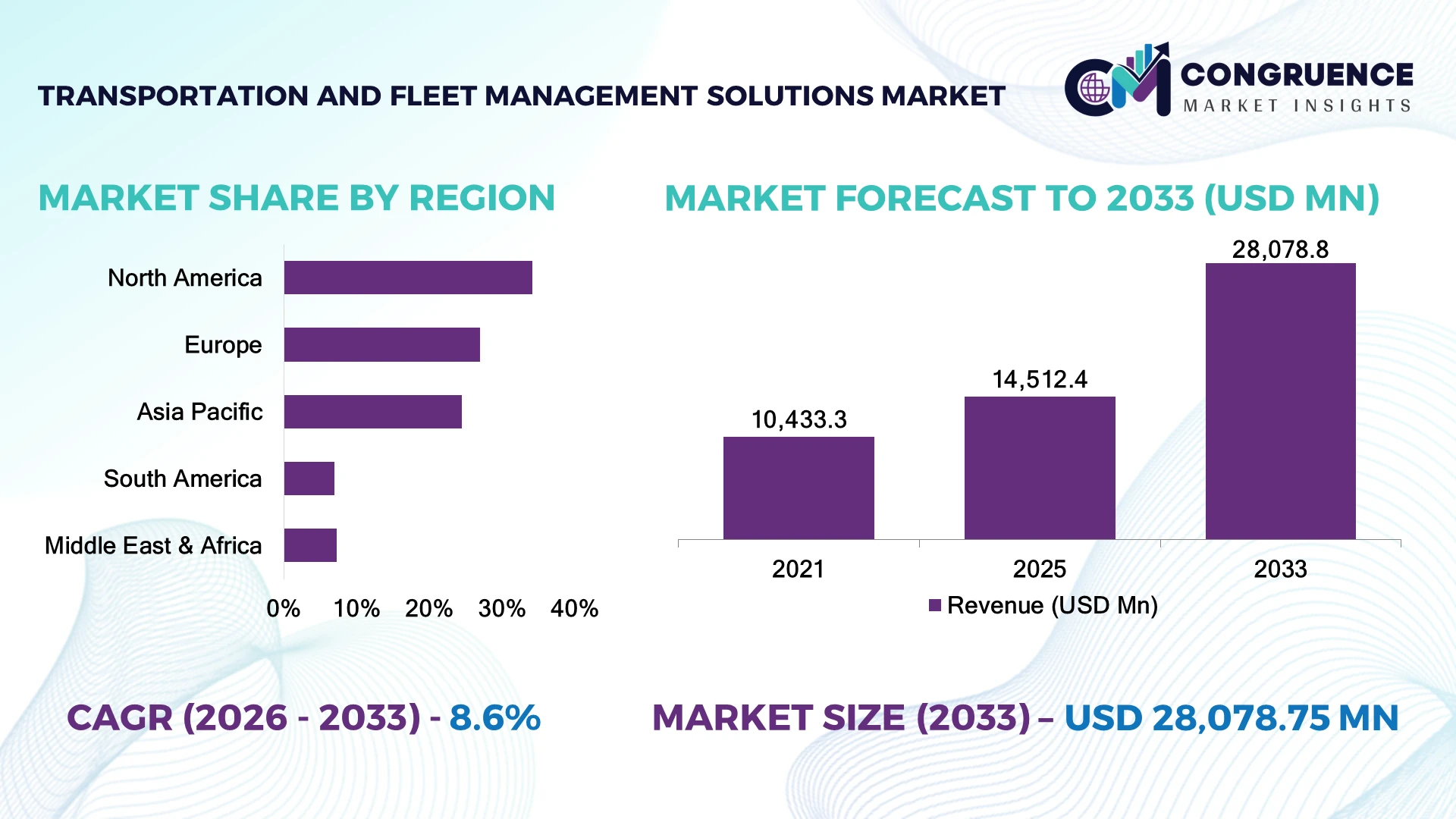
The Global Transportation and Fleet Management Solutions Market was valued at USD 14,512.4 Million in 2025 and is anticipated to reach a value of USD 28,078.8 Million by 2033 expanding at a CAGR of 8.6% between 2026 and 2033. Growth is being driven by the integration of telematics, AI-based route optimization, connected vehicles, electronic logging, and predictive maintenance into commercial transportation operations.
The United States represents the dominant national market, accounting for approximately 30–32% of global fleet-management solution demand, supported by its large trucking, last-mile delivery, rental, and logistics industries. More than 70% of large commercial fleets increasingly use GPS or telematics-based monitoring, while India is expanding connected-fleet adoption from a lower installed base through logistics modernization and electric commercial vehicles. U.S. fleets remain more mature in software penetration, whereas India is recording faster adoption across emerging logistics networks. Geopolitical supply-chain restructuring and nearshoring are also increasing requirements for real-time shipment visibility.
Strategically, providers combining telematics, AI analytics, compliance management, and predictive maintenance will capture greater value from increasingly connected transportation fleets.
Market Size & Growth: USD 14,512.4 million in 2025 is projected to reach USD 28,078.8 million by 2033 at a 8.6% CAGR, driven by connected vehicles, telematics, and AI-enabled fleet optimization.
Top Growth Drivers: Telematics adoption 32%, route optimization 24%, and predictive maintenance 18% represent the leading technology-driven demand catalysts.
Short-Term Forecast: By 2028, AI-based routing and predictive maintenance can reduce fleet operating costs by 8–15% and unplanned vehicle downtime by 15–25%.
Emerging Technologies: AI route optimization, edge telematics, computer vision, connected sensors, digital twins, and automated driver-assistance analytics are reshaping fleet-management platforms.
Regional Leaders: North America is projected at approximately USD 9.0 billion by 2033, Europe at USD 6.5 billion, and Asia-Pacific at USD 7.2 billion, with connected-fleet penetration accelerating across logistics and commercial transportation.
Consumer/End-User Trends: Logistics and transportation companies represent approximately 40–45% of solution demand, increasingly deploying real-time tracking and automated dispatch across multi-vehicle operations.
Pilot/Case Example: 2026 fleet deployments combining AI routing and predictive maintenance are targeting 10–15% lower fuel and maintenance expenditure while improving vehicle utilization by approximately 5–10%.
Competitive Landscape: Geotab, Verizon Connect, Trimble, Samsara, and MiX Telematics compete across connected-fleet management, with leading platforms increasingly differentiating through AI analytics and integrated compliance tools.
Regulatory & ESG Impact: Electronic logging, emissions reporting, and low-emission-zone requirements are increasing digital compliance workloads, while optimized routing can reduce fleet fuel consumption by approximately 5–10%.
Investment & Funding: Fleet operators and technology providers are directing billions of dollars toward connected vehicles, charging infrastructure, telematics, and logistics digitization, with partnerships increasingly linking fleet software to OEM platforms.
Innovation & Future Outlook: Fleet management is shifting toward autonomous decision support, predictive operations, electric-fleet optimization, real-time risk scoring, and integrated transportation-management ecosystems.
The Transportation and Fleet Management Solutions Market is expanding across freight carriers, last-mile delivery, public transportation, construction fleets, rental vehicles, and field-service operations. AI-based routing and predictive maintenance can collectively reduce avoidable operating costs by approximately 8–15%, while connected sensors improve vehicle visibility and utilization. Supply-chain restructuring is also increasing demand for real-time shipment tracking and cross-border fleet coordination, strengthening the strategic value of integrated fleet platforms.
Transportation and fleet management solutions are becoming core operating infrastructure as logistics companies face tighter delivery windows, higher vehicle utilization requirements, driver shortages, and increasingly complex compliance obligations. Fleet data is moving from simple vehicle tracking toward predictive decision-making, allowing operators to coordinate routes, maintenance, fuel consumption, driver behavior, and asset utilization through a single digital environment.
The technology shift is particularly significant for large commercial fleets. AI-enabled route optimization can reduce unnecessary mileage by approximately 5–10% compared with conventional static planning, while predictive maintenance can reduce unplanned downtime by 15–25%. North America has a mature telematics ecosystem, whereas India and Southeast Asia are moving rapidly from basic GPS tracking toward integrated fleet-management platforms as logistics networks modernize.
Over the next 2–3 years, investment will increasingly prioritize electric-fleet management, battery monitoring, automated dispatch, computer vision, and predictive maintenance. A logistics operator managing hundreds of vehicles can use centralized software to identify inefficient routes, schedule maintenance before component failure, and monitor driver performance across locations. Providers are therefore expanding through OEM partnerships, charging-infrastructure integrations, and transportation-management platforms. Competitive advantage will increasingly depend on converting vehicle data into measurable reductions in fuel, downtime, compliance costs, and asset underutilization.
The shift from basic GPS tracking toward integrated telematics, AI routing, and predictive analytics is strengthening fleet-management adoption. Advanced platforms can reduce unnecessary mileage by approximately 5–10%, while predictive maintenance lowers unplanned downtime by 15–25%. In the United States, tighter electronic logging and safety-monitoring requirements are accelerating replacement of fragmented fleet systems with centralized platforms. European operators are similarly integrating emissions monitoring with dispatch and asset management. Technology providers are responding through OEM partnerships, API integrations, and bundled telematics offerings. The sharper strategic shift is that fleet software is increasingly purchased as an operating-control platform rather than a tracking tool, increasing customer retention and expanding software value per vehicle.
Fragmented vehicle architectures and incompatible legacy systems remain a significant constraint for fleet operators managing mixed manufacturers and vehicle ages. Integrating telematics, fuel cards, maintenance systems, cameras, dispatch software, and transportation-management platforms can increase implementation costs by approximately 15–25%, while legacy vehicles can require 10–20% additional hardware or engineering work. India and Southeast Asia face additional complexity from heterogeneous commercial-vehicle fleets and uneven connectivity outside major logistics corridors. Data silos also reduce the effectiveness of predictive analytics when vehicle information is incomplete. Providers are addressing these limitations through standardized APIs, hardware-agnostic platforms, retrofit kits, and multi-year contracts. The operational priority is interoperability because replacing an entire fleet solely for software compatibility is economically impractical.
Electric commercial vehicles are creating a new opportunity for fleet platforms through battery-state monitoring, charging optimization, energy-cost management, and route planning based on remaining range. Integrated EV fleet systems can reduce charging-related idle time by approximately 10–20% and improve vehicle utilization by 5–10% when charging schedules are coordinated with dispatch. India, Germany, and the United States are expanding commercial EV deployment, creating demand for software that connects vehicles, depots, chargers, and electricity tariffs. Fleet-management companies are partnering with vehicle OEMs and charging providers to build integrated energy-management ecosystems. A non-obvious opportunity lies in using fleet data to optimize depot capacity, enabling operators to defer unnecessary charging-infrastructure expansion while maintaining vehicle availability.
Fleet platforms are becoming increasingly exposed to cybersecurity and data-governance risks as vehicles connect with cloud systems, cameras, mobile applications, payment platforms, and external APIs. Large fleets can generate thousands of data points per vehicle daily, increasing storage, processing, and anomaly-detection requirements by approximately 20–30% as connected functionality expands. Europe faces particularly stringent requirements around personal and operational data, while North American fleets increasingly connect telematics with insurance and safety systems. Cyber incidents affecting vehicle-connected infrastructure can disrupt dispatch and operational continuity rather than simply compromise information. Providers must therefore strengthen encryption, identity management, over-the-air security, and anomaly detection while investing in standardized data architectures that preserve interoperability across rapidly expanding connected-fleet ecosystems.
AI Moves Into Dispatch Decisions: Fleet operators are increasingly using AI for dynamic routing, driver allocation, and congestion avoidance rather than relying solely on historical route plans. Automated routing can reduce unnecessary mileage by approximately 5–10% and improve vehicle utilization by 5–8%. Providers are embedding machine-learning engines directly into fleet platforms, allowing dispatchers to respond faster to traffic, delivery-window, and vehicle-availability changes.
Video Telematics Becomes Operational: Camera-based driver monitoring is moving beyond incident recording toward real-time risk detection, distraction alerts, and coaching. Adoption across larger commercial fleets is increasingly paired with telematics, while automated event detection can reduce manual video-review workload by approximately 30–50%. U.S. operators are expanding integrated camera deployments as insurance, safety, and compliance requirements become more data-driven.
EV Fleet Software Gets Specialized: Fleet platforms are adding battery-health monitoring, charging schedules, range prediction, and depot-energy management as commercial electrification expands. Coordinated charging can reduce avoidable charging downtime by approximately 10–20%, while route planning based on battery state improves vehicle availability. Providers are partnering with charging companies and OEMs to connect vehicle, charger, and dispatch data within unified fleet-management environments.
Maintenance Shifts Toward Condition Monitoring: Fleets are increasingly using sensor data, fault codes, engine diagnostics, and component histories to identify maintenance requirements before failures occur. Predictive systems can reduce unplanned downtime by approximately 15–25% and improve maintenance scheduling efficiency by 10–20%. Supply-chain volatility for replacement parts is reinforcing the trend, prompting operators to integrate parts forecasting with maintenance platforms and prioritize high-failure components.
Telematics and fleet-tracking solutions represent approximately 38–42% of the global Transportation and Fleet Management Solutions market, making them the leading type because GPS visibility, vehicle diagnostics, driver monitoring, and route data form the foundation for broader fleet digitization. Fleet management software accounts for approximately 25–30%, while video telematics and safety systems contribute around 12–16%. The mature telematics segment benefits from established hardware, recurring software subscriptions, and broad OEM compatibility.
Video telematics and AI-enabled solutions represent the fastest-shifting category, supported by automated risk detection, driver coaching, and computer vision. AI-integrated systems can reduce manual event-review workloads by approximately 30–50%, encouraging operators to replace standalone cameras with connected safety platforms. Providers are responding through OEM integrations, cloud analytics, edge processing, and bundled hardware-software offerings. Investment is consequently shifting from basic tracking toward integrated platforms capable of combining vehicle, driver, safety, maintenance, and compliance data.
The 2026 Fleet Technology Trends Report found that three out of four fleet professionals use at least one major fleet technology, including GPS tracking, video telematics, or asset tracking, demonstrating broad technology penetration across commercial operations.
Freight and logistics fleets represent approximately 34–38% of solution demand, making them the leading application because vehicle utilization, delivery windows, fuel consumption, and shipment visibility directly affect operating margins. Last-mile delivery accounts for approximately 20–24%, while field-service and utility fleets represent around 15–19%. Freight operators typically prioritize route optimization, electronic compliance, asset tracking, and predictive maintenance, whereas last-mile operators place greater emphasis on dispatch automation, proof of delivery, and real-time customer visibility.
Last-mile delivery is the fastest-shifting application as e-commerce fulfillment becomes more time-sensitive and urban delivery networks become increasingly complex. Automated routing can reduce unnecessary mileage by approximately 5–10%, while dynamic dispatch improves vehicle utilization by roughly 5–8%. Public transportation, construction, rental, and municipal fleets remain important specialized applications. Providers are adapting through vertical-specific workflows, API integration, automated dispatch, and flexible SaaS models, allowing operators to deploy functionality according to vehicle density and operational complexity.
Verizon Connect's 2025 fleet technology research found that GPS tracking users reported improvements across routing, productivity, maintenance, and fuel management, reinforcing the operational value of connected fleet applications across commercial transportation.
Third-party logistics providers, freight carriers, and large transportation operators account for approximately 40–45% of demand, reflecting their large vehicle populations, complex routes, and high sensitivity to fuel, maintenance, and utilization costs. Field-service companies represent approximately 20–24%, while public-sector and municipal fleets contribute around 12–16%. Large logistics operators typically prioritize centralized fleet visibility and automated dispatch, whereas smaller field fleets increasingly prioritize quick deployment, mobile workflows, and predictable subscription costs.
Field-service and utility fleets represent the fastest-shifting buyer group as service organizations seek to coordinate vehicles, technicians, equipment, and customer appointments through unified platforms. Asset tracking and mobile workforce integration can improve productivity by approximately 10–15% in structured deployments. Public transportation and government fleets continue adopting telematics for safety, compliance, and asset utilization. Providers are responding with modular pricing, open APIs, industry-specific dashboards, and partnerships with vehicle manufacturers and mobility platforms. The competitive opportunity is moving toward integrated fleet ecosystems rather than standalone tracking subscriptions.
A 2026 Australian fleet survey of 517 professionals found that more than half of fleets were already using in-cab video, with users reporting 65% improvement in driver safety and 49% reduction in safety-incident costs.
North America accounted for the largest market share at 34.2% in 2025 however, Asia-Pacific is expected to register the fastest growth, expanding at a CAGR of 10.1% between 2026 and 2033.

Mature telematics infrastructure shifts competition toward AI-driven fleet intelligence
North America accounts for approximately 34.2% of the global Transportation and Fleet Management Solutions Market, supported by extensive trucking, parcel delivery, field-service, rental, and commercial-vehicle operations. The United States represents more than 85% of regional demand, with large fleets increasingly combining GPS tracking, electronic logging, video telematics, predictive maintenance, and fuel analytics. Approximately 70–75% of large commercial fleets use telematics-based monitoring, creating a mature installed base for software upgrades rather than first-time hardware deployment. Regulatory requirements around driver hours, electronic records, and vehicle safety further reinforce connected-fleet adoption. Providers are therefore shifting investment toward AI analytics, cybersecurity, OEM integrations, and subscription-based fleet intelligence rather than competing primarily on tracking hardware.
United States Market Outlook: The United States is the region's dominant market because of its extensive trucking network, large commercial-vehicle population, sophisticated logistics infrastructure, and established telematics ecosystem. Large carriers increasingly connect fleet software with dispatch, compliance, maintenance, insurance, and safety systems. More than 70% of large fleets use some form of telematics, creating significant upgrade potential toward AI-enabled platforms. The country's mature transportation technology ecosystem also supports partnerships between fleet-software providers, vehicle manufacturers, insurers, and logistics operators.
Regulatory digitization and fleet decarbonization reshape technology procurement
Europe represents approximately 27.0% of global market demand, with Germany, the United Kingdom, France, Italy, and the Netherlands forming major deployment centers. Fleet operators are integrating telematics with emissions reporting, driver compliance, route optimization, and electric-vehicle management as transportation regulations become more data intensive. Approximately 60–65% of larger commercial fleets use connected fleet-management technologies, while EV-specific monitoring is becoming increasingly important for urban delivery operations. The region's dense cross-border freight network creates additional demand for real-time asset visibility and compliance automation. Providers are responding with multilingual platforms, regulatory modules, API interoperability, and partnerships with charging and vehicle manufacturers.
Germany Market Outlook: Germany represents Europe's largest industrial fleet-management opportunity, supported by automotive manufacturing, freight transportation, logistics hubs, and extensive commercial-vehicle activity. Fleet operators increasingly combine telematics with route optimization, maintenance scheduling, emissions monitoring, and driver-safety analytics. Connected-fleet penetration among large commercial operators is estimated above 60%, providing a strong installed base for advanced software upgrades. Germany's expanding electric commercial-vehicle ecosystem is also creating demand for battery monitoring, charging optimization, and energy-aware route planning.
Rapid logistics digitization combines expanding fleets with connected-vehicle adoption
Asia-Pacific represents approximately 24.5% of global demand but has the strongest expansion potential as China, India, Japan, South Korea, and Southeast Asian economies modernize logistics networks. China accounts for roughly 40% of regional demand, supported by large freight fleets, e-commerce logistics, connected commercial vehicles, and smart transportation infrastructure. India is transitioning rapidly from basic GPS tracking toward integrated fleet platforms as organized logistics and electric commercial vehicles expand. Regional fleet operators increasingly deploy mobile dispatch, driver monitoring, route optimization, and real-time asset tracking. Technology providers are localizing hardware, developing regional partnerships, and offering scalable SaaS platforms to address fragmented fleet structures and varied connectivity conditions.
China Market Outlook: China is the region's largest market, supported by extensive freight transportation, e-commerce fulfillment, commercial-vehicle production, and smart-road infrastructure. Large logistics operators increasingly require integrated tracking, automated dispatch, driver monitoring, and predictive maintenance across geographically dispersed fleets. More than 40% of Asia-Pacific demand originates from China, creating substantial scale for software providers. Domestic vehicle and electronics manufacturing also enables closer integration between fleet platforms and OEM telematics systems, strengthening localized ecosystem development.
Brazilian logistics modernization strengthens demand for connected fleet control
South America represents approximately 7.0% of global market demand, with Brazil accounting for more than 55% of regional consumption. Freight transportation, agricultural logistics, last-mile delivery, rental fleets, and field-service operations represent the principal deployment areas. Brazil's geographically dispersed logistics network increases the value of GPS visibility, route optimization, fuel monitoring, and theft prevention, while connectivity limitations outside major corridors continue to influence platform architecture. Approximately 45–50% of regional demand is associated with freight and logistics fleets. Providers are responding through mobile-first platforms, localized support, hardware retrofit programs, and partnerships with transportation operators. The commercial opportunity increasingly centers on improving utilization and fuel control rather than simply tracking vehicle location.
Brazil Market Outlook: Brazil dominates regional demand because of its large road-freight network, agricultural supply chains, commercial-vehicle population, and extensive last-mile delivery activity. Logistics operators increasingly use telematics for route control, driver behavior, fuel monitoring, and asset security. Freight and logistics applications represent approximately 50% of Brazilian demand, creating a substantial installed base for advanced fleet software. São Paulo, Paraná, and Minas Gerais provide major logistics and industrial clusters where connected fleet deployment is concentrated.
Smart logistics infrastructure and commercial modernization accelerate connected-fleet deployment
Middle East & Africa accounts for approximately 8.0% of global demand, with Saudi Arabia, the UAE, South Africa, and Turkey serving as major adoption centers. Fleet-management deployment is concentrated in freight logistics, construction, oil and gas services, public transportation, rental vehicles, and last-mile delivery. Gulf economies are investing heavily in logistics corridors, smart-city infrastructure, and digital transportation systems, increasing demand for centralized vehicle visibility and predictive maintenance. Approximately 35–40% of regional demand is associated with commercial freight and industrial fleets. Providers are expanding through systems-integrator partnerships, localized technical support, and rugged telematics hardware designed for high-temperature operating environments.
Saudi Arabia Market Outlook: Saudi Arabia is emerging as the region's most strategically significant market through logistics infrastructure investment, industrial diversification, smart-city development, and expanding commercial transportation networks. Fleet operators increasingly require vehicle tracking, driver monitoring, route optimization, and maintenance analytics across large geographically distributed operations. Logistics and industrial fleets represent more than 40% of local demand. Suppliers are positioning through partnerships with transportation companies, technology integrators, and vehicle manufacturers while developing localized support capabilities for major logistics and infrastructure projects.
Geotab, Samsara, Verizon Connect, Trimble, and Powerfleet compete directly for enterprise fleets, while Motive and regional telematics providers pressure mid-market accounts on price and deployment speed. The top five are estimated to control roughly 35–40% of global fleet-management solution spending, leaving room for specialists and regional integrators. Competition centers on platform breadth, AI capability, hardware economics, integrations, and service responsiveness: video-telematics adoption has reached 46%, while GPS tracking is used by 80% of fleet professionals, intensifying feature parity and pricing pressure. Geotab is deepening OEM and AI partnerships; Samsara is expanding AI routing, maintenance, and safety; Powerfleet is consolidating through acquisitions; Verizon Connect is adding integrated cameras and compliance workflows. The competitive shift is from basic tracking toward AI-driven operational automation and connected ecosystems. Entry barriers include vehicle-data integrations, cybersecurity, datasets, channel relationships, and deployments globally. Winning requires proprietary data, rapid deployment, open integrations, measurable ROI, and continuous AI innovation.
Geotab
Samsara
Verizon Connect
Trimble
Powerfleet
Motive
Solera
Zonar Systems
Lytx
Netradyne
Azuga
Omnitracs
Teletrac Navman
Michelin Connected Fleet
AI-powered video telematics, predictive maintenance, and automated route optimization are becoming fleet technologies. Video telematics reached 46% adoption, while 80% of fleet professionals use GPS tracking. AI video can improve safety outcomes by 20–30% through automated detection and coaching, while predictive maintenance can reduce unplanned downtime by 15–25%. Cloud-native platforms increasingly integrate vehicle diagnostics, driver behavior, routing, fuel, and compliance data into one operational layer.
Edge processing and OEM-embedded telematics are the next integration step. Compared with hardware-dependent installations, OEM cloud-to-cloud connections can eliminate installation requirements and cut deployment costs by roughly 10–20%. Integrated APIs also reduce manual administration by 15–25%. Geotab, Samsara, Verizon Connect, and Powerfleet benefit as customers consolidate fragmented point solutions, while regional providers compete through lower-cost deployment and customization.
During 2026–2028, agentic AI, digital twins, EV fleet optimization, and autonomous decision support will move toward workflows. Agentic systems can automate alerts, maintenance scheduling, and route interventions, reducing human review workloads by 20–30%. Fleets adopting these capabilities gain faster response, higher utilization, and stronger data lock-in. Suppliers should prioritize open integrations, vehicle data, cybersecurity, and embedded intelligence because switching becomes harder once AI workflows are operationalized.
June 2026 Geotab formed a global alliance with Toyota Connected, combining connectivity platforms with telematics and AI capabilities. The collaboration targets regional fleet challenges and connected-mobility solutions, strengthening OEM integration and expanding Geotab’s data-driven fleet ecosystem globally today. Source: geotab.com
June 2025 Samsara introduced more than a dozen AI-powered solutions spanning safety, routing, navigation, and maintenance. Early routing data indicated a 15% reduction in vehicles required for deliveries, strengthening fleet productivity while shifting competition toward integrated operational automation. Source: samsara.com
February 2026 Verizon Connect reported 80% GPS-tracking adoption among surveyed fleet professionals, up 11 percentage points year-over-year. Video telematics reached 46%, with 74% of users reporting improved driver safety, reinforcing demand for AI-enabled visibility and coaching and compliance. Source: verizon.com
June 2025 Powerfleet reported its MiX and Fleet Complete integrations had expanded subscribers to approximately 2.8 million and customers to 48,000 across 120+ countries. The consolidation strengthened global scale, recurring software reach, and cross-selling opportunities significantly across regions. Source: powerfleet.com
The report evaluates transportation and fleet management solutions across telematics, fleet management software, video telematics, safety systems, route optimization, predictive maintenance, and connected-vehicle platforms. Coverage spans freight and logistics, last-mile delivery, field services, utilities, public transportation, construction, rental fleets, and emerging EV fleet applications. End-user analysis distinguishes large transportation operators, 3PLs, enterprises, public agencies, and commercial fleets.
Regional assessment covers North America, Europe, Asia-Pacific, South America, and Middle East & Africa, with country-level emphasis on deployment markets. The study tracks AI routing, edge telematics, computer vision, OEM integrations, IoT sensors, digital twins, EV charging optimization, and cybersecurity. Adoption indicators such as 80% GPS usage and 46% video-telematics penetration contextualize technology maturity. The report supports investment planning, expansion, vendor selection, competitive positioning, partnership strategy, and direction through 2033.
| Report Attribute/Metric | Report Details |
|---|---|
|
Market Revenue in 2025 |
USD 14,512.4 Million |
|
Market Revenue in 2033 |
USD 28,078.8 Million |
|
CAGR (2026 - 2033) |
8.6% |
|
Base Year |
2025 |
|
Forecast Period |
2026 - 2033 |
|
Historic Period |
2021 - 2025 |
|
Segments Covered |
By Type
By Application
By End-User
|
|
Key Report Deliverable |
Revenue Forecast, Growth Trends, Market Dynamics, Segmental Overview, Regional and Country-wise Analysis, Competition Landscape |
|
Region Covered |
North America, Europe, Asia-Pacific, South America, Middle East, Africa |
|
Key Players Analyzed |
Geotab, Samsara, Verizon Connect, Trimble, Powerfleet, Motive, Solera, Zonar Systems, Lytx, Netradyne, Azuga, Omnitracs, Teletrac Navman, Michelin Connected Fleet |
|
Customization & Pricing |
Available on Request (10% Customization is Free) |




