
Reports
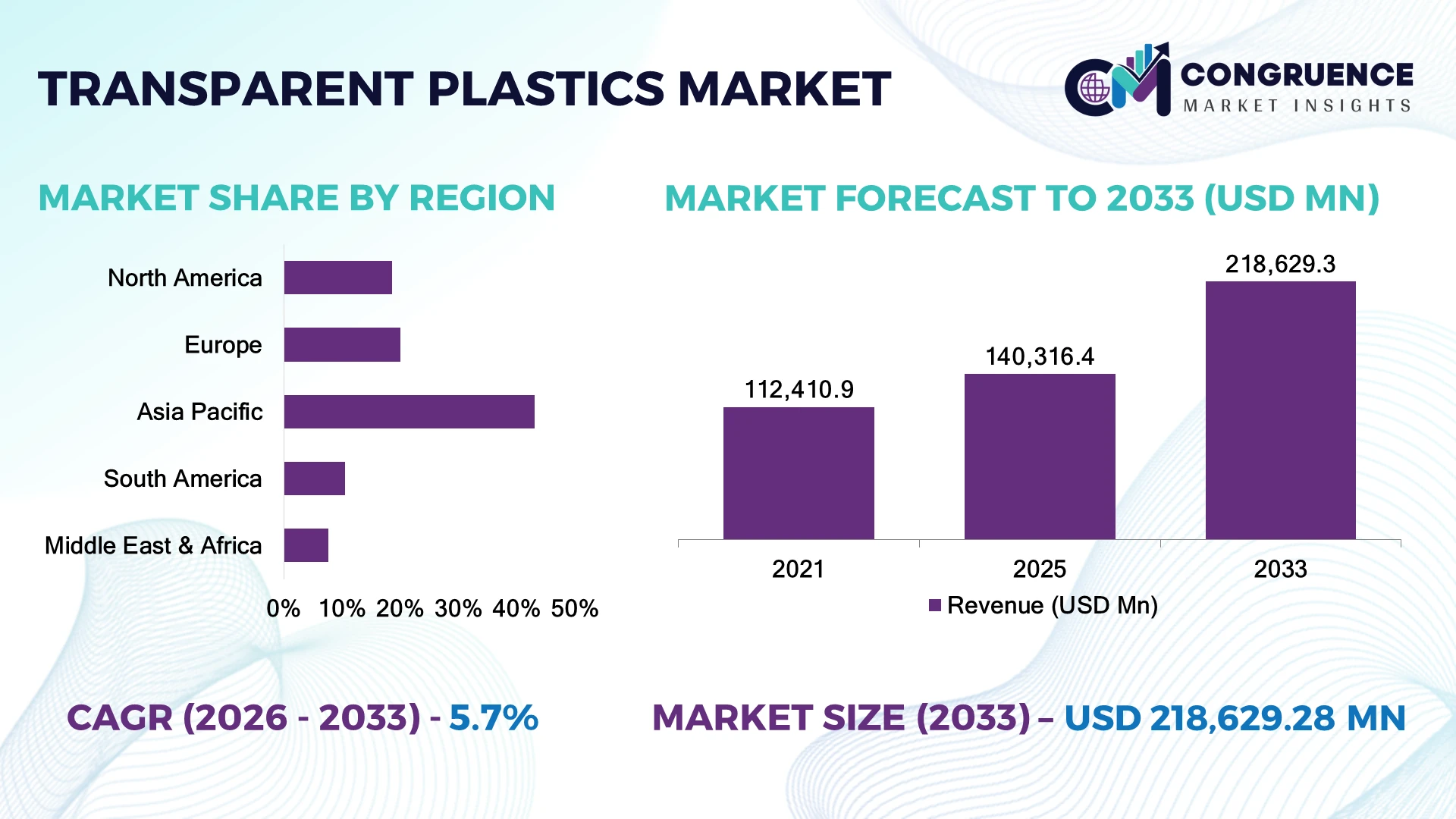
The Global Transparent Plastics Market was valued at USD 140,316.4 Million in 2025 and is anticipated to reach a value of USD 218,629.3 Million by 2033 expanding at a CAGR of 5.7% between 2026 and 2033. Growth is driven by lightweight packaging, optical-grade materials for electronics and automotive components, pharmaceutical packaging requirements, and the replacement of glass with durable transparent polymers.
China anchors global transparent plastics manufacturing through its extensive packaging, electronics, automotive, and construction supply chains. The country accounted for approximately 26.8% of Asia-Pacific transparent plastics demand in 2025, supported by high-volume polymer conversion and domestic resin availability. China's 2025 vehicle market reached approximately 32.9 million units, reinforcing requirements for transparent polycarbonate and acrylic components. Compared with India, China has a more integrated polymer-processing ecosystem, while India's pharmaceutical packaging and infrastructure requirements support additional demand.
For investors and manufacturers, the priority is to combine high-volume production with optical performance, recycled-content readiness, and application-specific material development.
Market Size & Growth: The market reached USD 140,316.4 million in 2025 and is projected to reach USD 218,629.3 million by 2033, supported by packaging conversion and lightweight engineering applications.
Top Growth Drivers: Packaging represented approximately 38% of demand in a 2024 market estimate, while automotive lightweighting and electronics applications strengthen requirements for high-clarity polymers.
Short-Term Forecast: By 2028, converters are expected to prioritize measurable reductions in resin use, production scrap, and cycle time through lightweighting and process optimization.
Emerging Technologies: Optical-grade polycarbonate, advanced acrylic formulations, multilayer barrier structures, and recycled-content PET are expanding material choices across packaging and engineering applications.
Regional Leaders: Asia-Pacific represents an estimated USD 61.0 billion market, followed by Europe at approximately USD 31.4 billion and North America at USD 29.2 billion, based on indicative regional shares.
Consumer and End-User Trends: Packaging remains the largest application, with an estimated 38% share in 2024; demand increasingly combines product visibility with material efficiency and recyclability.
Operational Case Example: In 2026, the EU's packaging rules began applying from 12 August, strengthening requirements for recyclable packaging and accelerating redesign decisions across packaging supply chains.
Competitive Landscape: Covestro, SABIC, BASF, Mitsubishi Chemical Group, and Indorama Ventures compete through polymer performance, supply reliability, processing expertise, and recycled-material integration.
Regulatory and ESG Impact: EU packaging rules require all packaging to be recyclable under the applicable framework, with recycled-content requirements for plastic packaging scheduled to apply from 2030.
Investment Priorities: Capital allocation is shifting toward advanced recycling, optical-grade polymer development, and production upgrades; comparable market-wide investment totals are not consistently disclosed.
Innovation and Future Outlook: Through 2033, competitive positioning will depend on balancing clarity, strength, weight, processing efficiency, and end-of-life performance across high-volume and specialty applications.
The transparent plastics market serves packaging, automotive, healthcare, construction, and electronics manufacturers that require visibility, low weight, and application-specific performance. PET remains important in clear packaging, while polycarbonate and PMMA support demanding optical and engineering uses. Regulatory changes taking effect in the European Union during 2026 are pushing packaging suppliers to assess recyclability and material composition earlier in product design. This shift makes material selection a strategic purchasing and engineering decision.
Transparent plastics are becoming strategically important because manufacturers must balance product visibility, component weight, mechanical performance, and regulatory compliance without compromising production throughput. PET, polycarbonate, PMMA, PVC, and transparent polypropylene serve different combinations of cost, optical clarity, impact resistance, and chemical compatibility. As the EU Packaging and Packaging Waste Regulation began applying in August 2026, packaging developers faced greater pressure to incorporate recyclability and material composition into product specifications rather than address these issues after launch.
Technology choices increasingly depend on application economics. PET offers established processing and collection pathways for clear packaging, while polycarbonate and PMMA provide higher-performance options for demanding optical, automotive, and electronics applications. Lightweighting and precision molding can reduce material consumption, but achievable savings depend on part geometry, safety requirements, and processing conditions. Asia-Pacific benefits from manufacturing scale and integrated conversion networks, whereas Europe places greater emphasis on circularity and documented environmental performance.
During 2026–2028, suppliers are expected to expand recycled-content grades, improve sorting compatibility, and develop optical materials that retain performance after processing. Packaging converters are reviewing structures, pigments, labels, and adhesives together because these components affect recycling outcomes. Automotive and electronics manufacturers continue to prioritize durability and dimensional stability. Companies that qualify materials against both technical specifications and end-of-life requirements will strengthen customer relationships and reduce redesign risk.
Packaging remains the primary demand driver, accounting for an estimated 42.5% of transparent plastics applications in 2025. PET held approximately 31.2% of the market by polymer type, supported by clarity, established processing lines, and beverage-container infrastructure. As brands seek lightweight packaging with strong shelf visibility, transparent polymers offer alternatives to heavier materials while supporting high-speed molding and filling. The EU Packaging and Packaging Waste Regulation, applicable from August 2026, is pushing converters to assess recyclability during design. Manufacturers are responding by expanding clear PET grades, improving lightweight preforms, and developing compatible labels and closures. The strategic advantage lies in optimizing the complete package rather than resin performance alone.
Transparent plastics producers face exposure to petrochemical feedstock volatility and limited supplies of high-quality recycled resin. PET's estimated 31.2% polymer share reflects its established processing ecosystem, but food-contact and optical specifications restrict the usable recycled-material pool. Globally, only 9% of plastic waste was ultimately recycled in 2019, illustrating the structural gap between plastic consumption and recovered material supply. Variations in recycled-resin clarity, color, contamination, and intrinsic viscosity can increase rejection rates and require additional processing. Manufacturers are reducing exposure through multi-supplier procurement, long-term resin contracts, recycled-content qualification, and virgin-recycled blending strategies. The immediate challenge is securing consistent material quality without pricing clear packaging beyond customers' cost targets.
Polycarbonate and PMMA create opportunities beyond commodity packaging in automotive lighting, protective glazing, medical equipment, and electronic displays. Polycarbonate is projected to grow faster than mature transparent-polymer categories as manufacturers prioritize impact resistance and reduced component weight. Automotive and electronics designers are integrating optical components with structural functions, creating opportunities for precision-molded parts and specialty grades. Even a 2–3% reduction in component weight can support vehicle-efficiency objectives when achieved without compromising safety or durability; actual benefits depend on the component and design. Suppliers are investing in optical-grade formulations, surface coatings, and application testing. The strongest opportunity is replacing multi-material assemblies with transparent engineered components that reduce part count and simplify manufacturing.
Transparent plastics face a technical challenge: recycled content must meet demanding clarity, color, strength, and safety specifications. The OECD found that secondary plastics accounted for only 6% of total plastics use in 2019, indicating limited circular-material penetration at the time. The EU packaging framework now requires recyclable packaging, while recycled-content obligations for plastic packaging apply from 2030 under specified provisions. Multilayer structures, incompatible additives, pigments, and labels can complicate sorting and material recovery. Producers must redesign packaging without reducing barrier performance or production efficiency. Investment in optical sorting, decontamination, compatibilizers, and design-for-recycling validation is essential. Companies that qualify recycled grades across multiple production runs will be better positioned to meet customer specifications consistently.
Recyclability Enters Packaging Design: From August 2026, EU packaging rules apply across the market, with recyclability requirements and 2030 recycled-content obligations shaping material specifications. Packaging teams are reviewing labels, closures, and additives alongside resin choice. This integrated approach reduces redesign risk and helps converters prepare for compliance without disrupting filling-line performance.
Rigid Formats Retain Processing Advantages: Rigid transparent plastics represented an estimated 60.1% of the market in 2025. Established molding equipment and dimensional stability support bottles, containers, and protective components. Converters are improving wall-thickness control and preform design to reduce material use while maintaining clarity, impact resistance, and handling performance.
Recycled Resin Quality Becomes Differentiator: Secondary plastics represented only 6% of total plastics use in 2019, highlighting the supply gap for reliable recycled feedstock. Producers are expanding sorting, decontamination, and material-traceability capabilities. For transparent applications, consistent color and optical quality matter as much as recycled content because visual defects can trigger rejection.
Optical Grades Target Engineering Uses: Polycarbonate and PMMA are gaining attention in lighting, electronics, medical devices, and protective components. Polycarbonate held a smaller share than PET but benefits from impact resistance and design flexibility. Suppliers are refining coatings, molding precision, and optical specifications to help manufacturers replace heavier or multi-part assemblies without sacrificing reliability.
PET Leads Through Packaging Scale While Polycarbonate Gains Engineering Applications
Polyethylene terephthalate (PET) is the leading transparent plastic type, accounting for an estimated 31.3% of global market share in 2025. Its dominance reflects high-volume beverage and food packaging, strong optical clarity, established processing infrastructure, and comparatively mature recycling systems. Polycarbonate (PC) is an important growth segment because impact resistance, dimensional stability, and optical performance support automotive components, electronic housings, protective glazing, and medical equipment. PMMA remains valuable in lighting, signage, displays, and architectural applications requiring high light transmission and surface quality. PVC, polypropylene (PP), polystyrene (PS), and other transparent polymers serve more specialized needs based on chemical resistance, flexibility, cost, and processing characteristics.
Polycarbonate is positioned for faster expansion than mature PET applications as manufacturers seek lightweight engineering components and durable transparent assemblies. An indicative 2–3% improvement in component weight can create meaningful design benefits when strength and safety specifications remain satisfied. PET producers are emphasizing lightweight packaging and recycled-content compatibility, while PC and PMMA suppliers are investing in specialty grades, coatings, and precision molding. For buyers, material selection increasingly depends on lifecycle cost and application performance rather than clarity alone; suppliers that combine consistent optical quality with application-specific engineering are better positioned to capture premium demand.
Packaging Leads While Automotive Components Expand Material Requirements
Packaging is the leading application, accounting for an estimated 42.6% of the transparent plastics market in 2025. Clear PET bottles, food containers, trays, personal-care packaging, and pharmaceutical formats benefit from product visibility, low weight, and established high-speed conversion systems. Building and construction applications use transparent polymers in glazing, skylights, partitions, and protective panels, while electrical and electronics manufacturers require optical clarity and dimensional stability in displays, lenses, and protective housings. Healthcare applications depend on transparent materials for medical packaging, fluid-handling products, and diagnostic components, where compatibility and product integrity influence material qualification.
Automotive applications are positioned for faster growth as vehicle manufacturers integrate transparent polymers into lighting systems, sensor covers, interior components, and selected glazing applications. Replacing glass or multiple conventional components with engineered polymers can reduce weight and simplify part integration, although safety, scratch resistance, weathering, and repairability must be validated. A 2–3% reduction in component mass can support lightweighting objectives when achieved without compromising performance. Packaging converters are adapting to recyclability requirements through material and package redesign, while automotive suppliers focus on specialty grades, coatings, and precision molding. Investment is shifting toward applications where transparent plastics deliver measurable functional advantages rather than simple material substitution.
Packaging and Consumer-Goods Manufacturers Anchor Demand
Food and beverage and fast-moving consumer-goods manufacturers are estimated to represent approximately 38% of transparent plastics demand by end-user industry in 2025. Their purchasing scale reflects recurring requirements for clear bottles, containers, protective packaging, and personal-care formats. These buyers prioritize optical consistency, food-contact compliance, high-speed processability, and dependable resin supply. Automotive and transportation manufacturers represent another important group, using transparent plastics in lighting, instrument panels, sensor covers, and selected glazing components. Electrical and electronics companies require precise optical properties and dimensional stability, while healthcare and pharmaceutical manufacturers apply strict qualification requirements to transparent packaging and medical components. Construction and other industrial users add demand for panels, covers, and protective structures.
Automotive and electronics manufacturers are positioned for faster adoption of specialized transparent engineering polymers as product designs integrate lightweight structures, optical functions, and electronic sensing. Even a 2–3% reduction in component weight can support system-level efficiency targets when mechanical and safety requirements remain intact. Packaging buyers, by contrast, generally emphasize unit economics, line compatibility, and recyclability at scale. Suppliers are tailoring commercial strategies accordingly: high-volume customers receive standardized grades and supply agreements, while engineering buyers require technical co-development, testing, and customized formulations. Future competitive positioning will depend on serving both procurement models without compromising resin consistency, qualification speed, or manufacturing reliability.
Asia-Pacific accounted for the largest market share at approximately 43.1% in 2025; however, Asia-Pacific is also expected to register the fastest growth, supported by expanding packaging conversion, electronics manufacturing, automotive production, and infrastructure development. Regional shares are indicative estimates based on market research benchmarks and may vary with segmentation and geographic definitions.
Advanced Packaging and Engineering Applications Sustain Premium Demand
North America represented an estimated 18.6% of the global transparent plastics market in 2025, supported by established packaging, healthcare, automotive, and electronics industries. The United States drives regional demand through high-volume PET packaging and specialized polycarbonate and PMMA applications in lighting, protective equipment, and electronic components. Mexico adds manufacturing demand through automotive assembly and export-oriented packaging conversion, while Canada contributes through construction and industrial applications. Suppliers are emphasizing high-clarity grades, lightweight designs, and recycled-material qualification to meet customer specifications. In packaging, the challenge is balancing optical quality with recycling compatibility and cost. Manufacturers are strengthening resin supply agreements and investing in processing improvements that reduce scrap and material use. Competitive advantage increasingly comes from reliable technical support and application-specific grades rather than resin availability alone.
United States Market Outlook: The United States benefits from a large consumer-packaging industry, advanced medical-device manufacturing, and established automotive and electronics supply chains. These sectors support demand for PET, polycarbonate, and specialty acrylic materials with tightly controlled optical and mechanical properties. U.S. manufacturers are also evaluating recycled-resin integration and improved sorting technologies to strengthen material availability. Suppliers that combine consistent resin quality with food-contact qualification, precision processing, and dependable delivery are positioned to serve high-volume buyers and technically demanding applications.
Packaging Regulation Accelerates Material and Design Reassessment
Europe accounted for an estimated 20.1% of the transparent plastics market in 2025, supported by packaging, automotive, healthcare, and electrical-equipment manufacturing. Germany, France, Italy, and the United Kingdom are important demand centers, with Germany particularly influential in automotive engineering and industrial plastics. The EU Packaging and Packaging Waste Regulation began applying on 12 August 2026, strengthening the focus on packaging composition, recyclability, and waste reduction. These requirements are prompting converters to reassess labels, closures, additives, and multilayer structures alongside resin selection. PET suppliers are emphasizing recyclable packaging formats, while engineering-polymer producers target precision automotive and electronics components. Companies that incorporate regulatory screening early in product development can reduce redesign costs and improve readiness for evolving packaging requirements.
Germany Market Outlook: Germany's automotive, machinery, medical technology, and chemical industries support demand for transparent engineering polymers and high-quality packaging materials. Manufacturers require dimensional stability, impact resistance, and consistent optical performance for vehicle lighting, equipment covers, and technical components. The country's established polymer-processing ecosystem enables close collaboration between resin suppliers, molders, and original equipment manufacturers. Suppliers that support material testing, component redesign, and compliance documentation can gain an advantage as German customers balance durability, production efficiency, and recyclability.
Manufacturing Scale Reinforces Regional Material Leadership
Asia-Pacific held an estimated 43.1% of the transparent plastics market in 2025, supported by packaging conversion, electronics manufacturing, construction, and automotive production. China anchors regional supply through its integrated polymer and processing industries, while India contributes through expanding consumer packaging, pharmaceutical manufacturing, and infrastructure activity. Japan and South Korea support demand for specialty optical materials and precision-engineered components. China accounted for approximately 34.5% of global plastics production in 2024, highlighting the scale of the regional manufacturing ecosystem, although this figure covers plastics overall rather than transparent grades specifically. Suppliers are expanding local technical support and tailoring grades to packaging, electronics, and automotive specifications. The region's advantage lies in combining large production volumes with dense downstream manufacturing networks.
China Market Outlook: China combines extensive resin production, large-scale packaging conversion, and strong automotive and electronics manufacturing. Its domestic supply chain supports transparent PET packaging as well as polycarbonate and PMMA components used in lighting, displays, and vehicle interiors. The country's automotive market reached approximately 32.9 million vehicle sales in 2025, reinforcing demand for lightweight and functional polymer components. Suppliers must compete on consistent optical performance, processing efficiency, and cost while developing grades suited to electric vehicles and increasingly integrated electronic systems.
Packaging Conversion Supports Demand Amid Uneven Industrial Investment
South America represented an estimated 10.5% of the global transparent plastics market in 2025, with Brazil serving as the principal manufacturing and consumption center. Demand is concentrated in food and beverage packaging, personal-care products, agriculture, construction, and automotive components. Brazil's established plastics-conversion industry provides a base for flexible films, clear containers, and rigid packaging, while Argentina and Chile contribute demand through consumer goods and industrial applications. However, currency volatility, financing costs, and uneven access to high-quality recycled resin can constrain capital investment. Brazil's flexible plastic packaging industry produced approximately 2.32 million tonnes in 2025, illustrating the scale of downstream conversion, although the figure is not specific to transparent materials. Suppliers are focusing on efficient production, domestic distribution, and cost-sensitive product portfolios.
Brazil Market Outlook: Brazil benefits from a substantial food-processing sector, established packaging converters, and a large consumer market that supports transparent films, bottles, trays, and containers. The country's flexible-plastics industry operated at approximately 70.4% of installed capacity in 2025, indicating meaningful existing infrastructure alongside room for utilization improvements. Manufacturers can strengthen competitiveness through process optimization, resin procurement diversification, and recycled-material qualification. For suppliers, reliable local distribution and packaging formats tailored to food, agriculture, and personal-care applications remain important routes to market.
Petrochemical Integration and Packaging Modernization Shape Demand
The Middle East & Africa region accounted for an estimated 7.7% of the transparent plastics market in 2025. Demand is supported by food and beverage packaging, healthcare products, construction, and consumer goods, particularly in Saudi Arabia, the United Arab Emirates, South Africa, and Egypt. Gulf producers benefit from petrochemical feedstock access and established polymer infrastructure, while African converters rely more heavily on dependable resin imports and local processing capacity. Investment in packaging production and logistics supports demand for transparent PET, PVC, polycarbonate, and acrylic materials. Nevertheless, inconsistent recycling infrastructure and import exposure can affect material quality and operating costs. Suppliers are strengthening regional distribution, developing customer-specific formulations, and targeting applications where reliable supply and processing performance justify investment.
Saudi Arabia Market Outlook: Saudi Arabia combines a large petrochemical industry, established polymer production, and growing packaging and consumer-goods manufacturing. Access to upstream feedstocks and industrial infrastructure supports competitive resin supply, while downstream converters serve beverage, food, healthcare, and household-product markets. The country's industrial diversification agenda creates opportunities for higher-value polymer processing and engineered plastic components. Suppliers that develop local customer relationships, technical support, and dependable material availability can capture demand while helping converters improve production consistency and meet evolving packaging specifications.
The market pits diversified polymer producers Covestro, SABIC, and BASF against specialty-material leaders Eastman, Arkema, and Evonik. Global suppliers compete through scale, resin consistency, and integrated customer support, while specialty producers differentiate through optical performance, recycled-content formulations, and customized grades. The top five players are estimated to account for approximately 25–35% of the global market, reflecting a fragmented structure spanning PET, polycarbonate, PMMA, and other transparent polymers. Competition centers on price, clarity, impact resistance, processing efficiency, and reliable supply. Even a 1–3% reduction in material consumption can improve converter economics when product performance remains unchanged. Producers are expanding regional compounding, qualifying circular feedstocks, and developing application-specific formulations for packaging, automotive, electronics, and healthcare. The competitive shift favors documented recyclability and specialty performance over undifferentiated resin volume. Entry barriers include capital-intensive production, technical qualification, and customer approvals. Winning requires dependable supply, competitive processing economics, and proven material performance.
Conventional extrusion, injection molding, and thermoforming remain the production backbone because they deliver established throughput and repeatable optical quality. Advanced process control, inline inspection, and precision mold design help reduce haze, surface defects, and scrap. A 1–2% reduction in material waste is a practical improvement target for optimized production lines, not a verified industry-wide result. Polycarbonate and PMMA also support lightweight, impact-resistant components where glass creates weight or breakage disadvantages.
Recycled-content polymers and molecular recycling are gaining attention where mechanical recycling struggles to maintain clarity, color, or purity. Eastman's molecular recycling platform targets difficult-to-recycle waste, while specialty recycled polyamides are entering premium eyewear applications. Recyclability qualification is becoming commercially important: six Eastman specialty PET resins received approval as fully compatible with European PET-bottle recycling processes. Adoption remains application-specific, with packaging and premium consumer products offering different qualification requirements.
During 2026–2028, competitive advantage will depend on integrating optical performance with verified circularity. Covestro's planned Ohio expansion targets customized polycarbonate compounds, while Arkema's Singapore investment is designed to triple global capacity for its transparent polyamide grades. Suppliers should prioritize resin traceability, automated optical inspection, and design-for-recycling validation. A 1–2% improvement in cycle time can support throughput economics, but only when validated against production-line conditions. Producers that combine dependable quality, local technical support, and qualified recycled feedstocks will be better positioned to win demanding customer programmes.
January 2025 Covestro committed a low triple-digit million-euro investment to expand Ohio compounding with multiple production lines. Operations were planned by late 2026, strengthening regional supply of customized polycarbonate for automotive, electronics, and healthcare customers. Source: covestro.com
July 2025 Arkema announced an approximately USD 20 million Singapore investment for Rilsan Clear transparent polyamides. The project is designed to triple global capacity, supporting eyewear, electronics, healthcare devices, and home appliances while strengthening Asian supply availability. Source: arkema.com
September 2025 Eastman and Doloop presented a beverage bottle made from 100% recycled PET at Drinktec. Using Eastar Renew resin, the collaboration demonstrated clear packaging with recycled content and virgin-like performance, giving beverage brands a practical circular-material option. Source: eastman.com
January 2026 Evonik launched TROGAMID R, a transparent polyamide made from eyewear-manufacturing scrap, with Poliplastic SRL processing recovered material into granules. Nylo Zero became the first designer eyewear brand offering models using the recycled polymer, establishing a premium circular application. Source: evonik.com
The report examines transparent plastics by polymer type, including PET, polycarbonate, PMMA, PVC, polypropylene, polystyrene, and specialty polymers, alongside rigid and flexible forms. Application coverage includes packaging, automotive, construction, healthcare, electrical and electronics, and consumer goods. End-user analysis distinguishes packaging converters, automotive manufacturers, electronics producers, healthcare companies, and industrial buyers. Regional coverage spans North America, Europe, Asia-Pacific, South America, and the Middle East and Africa, with country-level assessment of manufacturing capabilities, conversion infrastructure, and material adoption.
Technology analysis covers optical-grade formulations, precision molding, advanced coatings, recycled-content polymers, molecular recycling, and design-for-recycling practices. Competitive assessment compares major resin producers and specialty-material suppliers across product performance, supply reliability, customization, and circularity readiness. Segment estimates and application trends help identify opportunities in high-volume packaging and premium engineering uses. The findings support investment screening, supplier selection, capacity planning, regional expansion, and competitive positioning through 2033 without treating specialty-grade adoption as representative of the entire plastics industry.
| Report Attribute/Metric | Report Details |
|---|---|
|
Market Revenue in 2025 |
USD 140,316.4 Million |
|
Market Revenue in 2033 |
USD 218,629.3 Million |
|
CAGR (2026 - 2033) |
5.7% |
|
Base Year |
2025 |
|
Forecast Period |
2026 - 2033 |
|
Historic Period |
2021 - 2025 |
|
Segments Covered |
By Type
By Application
By End-User
|
|
Key Report Deliverable |
Revenue Forecast, Growth Trends, Market Dynamics, Segmental Overview, Regional and Country-wise Analysis, Competition Landscape |
|
Region Covered |
North America, Europe, Asia-Pacific, South America, Middle East, Africa |
|
Key Players Analyzed |
Covestro AG, SABIC, BASF SE, Eastman Chemical Company, Arkema S.A., Evonik Industries AG, Mitsubishi Chemical Group Corporation, LG Chem Ltd., Toray Industries, Inc., Indorama Ventures Public Company Limited, Röhm GmbH, Chimei Corporation |
|
Customization & Pricing |
Available on Request (10% Customization is Free) |




