
Reports
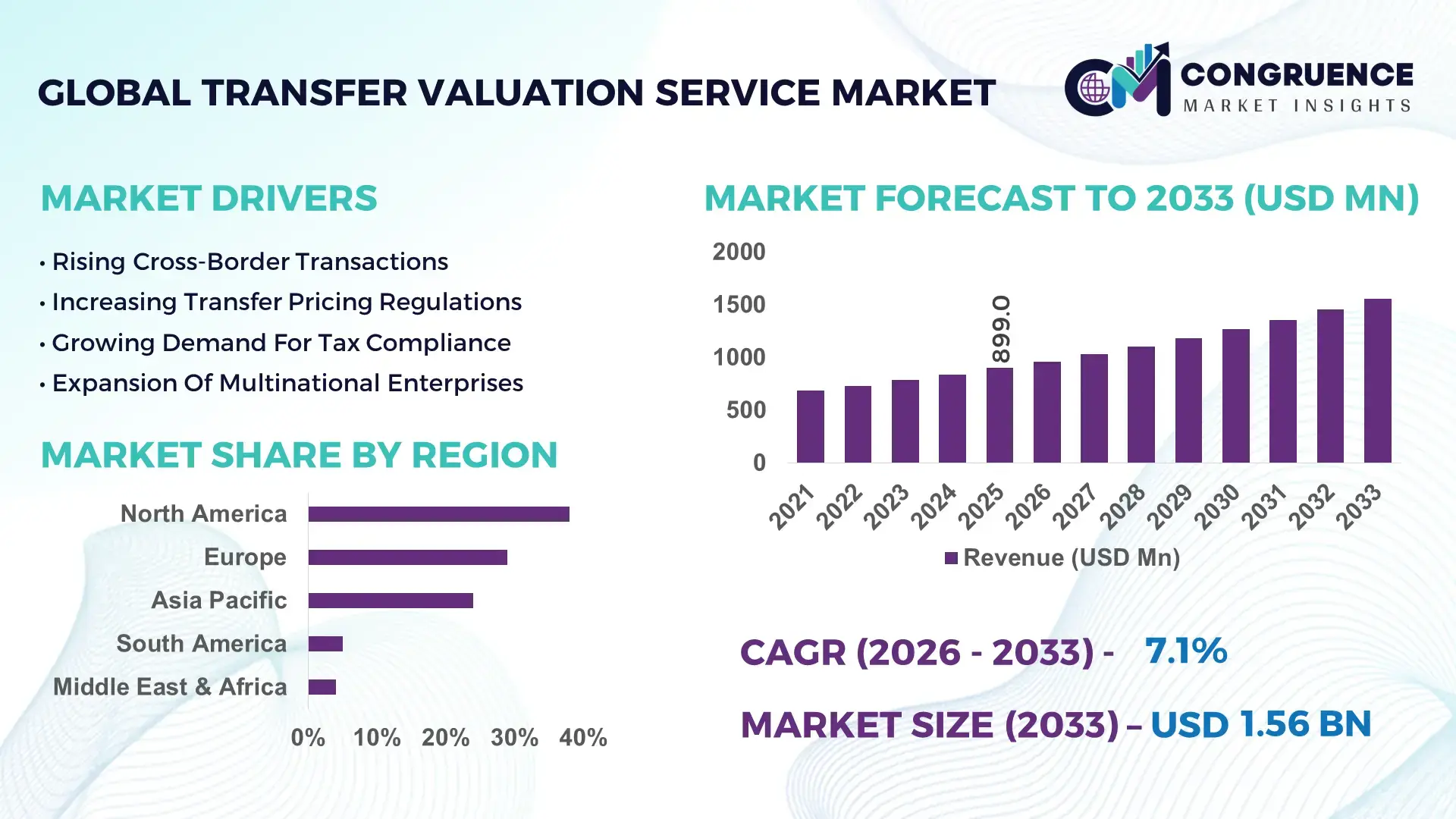
The Global Transfer Valuation Service Market was valued at USD 899.0 Million in 2025 and is anticipated to reach a value of USD 1,556.2 Million by 2033 expanding at a CAGR of 7.1% between 2026 and 2033. Rising cross-border mergers, intangible asset transfers, and stricter OECD-aligned transfer pricing enforcement are accelerating demand for advanced transfer valuation services, particularly across pharmaceuticals, digital services, semiconductors, and intellectual property-intensive industries. Multinational enterprises are increasingly adopting AI-assisted valuation analytics and automated benchmarking platforms, reducing documentation turnaround time by nearly 35% while improving audit defensibility. Between 2024 and 2026, global tax transparency mandates, BEPS 2.0 implementation, and geopolitical supply chain diversification across Asia and Eastern Europe are reshaping intercompany pricing structures, forcing enterprises to re-evaluate valuation models and operational footprints. Regulatory scrutiny linked to digital taxation and intangible asset migration has intensified across major economies, particularly after the expansion of Pillar Two compliance frameworks.
The United States dominates the global Transfer Valuation Service Market with approximately 34% market share, supported by over 15,000 multinational groups operating complex intercompany structures across technology, life sciences, and financial services. More than 62% of Fortune 500 companies increased transfer pricing documentation investments during the last two years, while enterprise demand for intangible asset valuation services expanded by nearly 28%. Compared to emerging Asian markets, the U.S. market demonstrates significantly higher adoption of AI-based valuation platforms and litigation-ready compliance frameworks, particularly among digital economy enterprises and global manufacturing groups managing multi-jurisdictional tax exposure.
As enterprises continue optimizing global tax efficiency while navigating aggressive compliance regimes, transfer valuation capabilities are becoming a strategic board-level function directly influencing expansion decisions, risk exposure, and long-term capital allocation.
Market Size & Growth: USD 899.0 Million in 2025 is projected to reach USD 1,556.2 Million by 2033, driven by OECD tax enforcement and AI-enabled valuation automation.
Top Growth Drivers: Cross-border restructuring (+31%), intangible asset transfers (+27%), and digital tax compliance adoption (+24%) are accelerating market expansion.
Short-Term Forecast: By 2028, automated valuation workflows are expected to reduce documentation processing time by 38% and audit preparation costs by 26%.
Emerging Technologies: AI-based benchmarking, cloud valuation engines, and predictive risk analytics improved valuation accuracy by over 33% across global enterprises.
Regional Leaders: North America holds 38% share, Europe 29%, and Asia-Pacific 24%, supported by compliance modernization and multinational expansion activity.
Consumer/End-User Trends: Nearly 61% of multinational enterprises now prioritize real-time transfer pricing analytics for audit readiness and operational optimization.
Pilot/Case Example: In 2025, a global pharmaceutical restructuring program improved intercompany valuation efficiency by 41% through AI-assisted compliance automation.
Competitive Landscape: Big Four firms collectively control nearly 48% market share alongside Deloitte, PwC, EY, KPMG, and Alvarez & Marsal.
Regulatory & ESG Impact: ESG-linked tax reporting frameworks improved compliance transparency by 22% amid rising global regulatory alignment initiatives.
Investment & Funding: More than USD 1.2 billion was allocated toward tax automation partnerships, valuation platforms, and regional compliance expansion programs.
Innovation & Future Outlook: Advanced digital twins, blockchain-backed audit trails, and integrated valuation ecosystems are redefining global transfer valuation execution models.
Transfer valuation services are increasingly concentrated across technology, pharmaceutical, manufacturing, and financial service sectors, which collectively account for nearly 68% of global engagement demand due to high intangible asset movement and complex cross-border structures. AI-enabled valuation engines improved benchmarking efficiency by approximately 32%, while cloud-based compliance platforms reduced manual documentation dependency by 29%. North America continues leading in enterprise-scale deployment, whereas Asia-Pacific is experiencing rapid adoption due to manufacturing diversification and regional tax modernization initiatives. Simultaneously, evolving global minimum tax frameworks and supply chain realignment strategies are forcing multinational corporations to redesign transfer pricing governance structures. These operational shifts are positioning advanced transfer valuation capabilities as a decisive competitive and regulatory differentiator for global enterprises.
Transfer valuation services are rapidly transforming from a compliance-oriented function into a core strategic capability influencing global capital allocation, tax optimization, supply chain positioning, and cross-border competitiveness. As multinational corporations accelerate restructuring initiatives and intangible asset transfers, enterprises are prioritizing valuation precision to protect margins, minimize litigation exposure, and maintain operational agility across highly regulated jurisdictions. Increasing regulatory convergence under OECD Pillar Two frameworks, combined with heightened scrutiny of intellectual property migration, is accelerating enterprise demand for integrated transfer valuation ecosystems capable of supporting real-time financial and tax decision-making.
Global supply chain diversification and regional manufacturing shifts are intensifying valuation complexity, particularly across semiconductors, pharmaceuticals, software, and advanced manufacturing sectors. AI-enabled valuation automation improves documentation efficiency by 42% while reducing compliance preparation costs by 31% compared to legacy spreadsheet-driven systems. North America leads in enterprise transaction volume, while Asia-Pacific leads in operational expansion and digital valuation adoption with nearly 36% growth in AI-integrated transfer pricing deployments across multinational manufacturing groups.
Over the next three years, enterprises are expected to reduce manual transfer pricing workflows by more than 45%, significantly improving audit readiness, cross-border reporting speed, and dispute resolution efficiency. ESG-aligned tax transparency programs are also becoming a competitive advantage, with multinational enterprises reporting nearly 21% lower regulatory response costs after implementing centralized digital valuation governance systems.
A major pharmaceutical company recently optimized its global intangible asset transfer framework, reducing valuation review timelines by 39% while improving jurisdictional compliance accuracy through machine-learning-based benchmarking tools. Simultaneously, consulting firms and enterprise software providers are accelerating capital allocation toward cloud-based valuation intelligence platforms, regional compliance centers, and AI-driven tax analytics partnerships. The market is no longer competing solely on advisory expertise; it is shifting toward technology-enabled execution, predictive compliance intelligence, and scalable global governance models. Companies investing aggressively in automated valuation infrastructure, regulatory interoperability, and data-driven transfer pricing ecosystems are positioning themselves to capture long-term competitive advantage in an increasingly complex international tax environment.
The Transfer Valuation Service Market is undergoing significant transformation as multinational enterprises face intensifying regulatory scrutiny, increasing cross-border asset transfers, and growing pressure to optimize global tax structures. Demand is shifting from traditional documentation-focused advisory services toward technology-enabled valuation platforms capable of supporting real-time compliance, audit defense, and operational transparency. Industries with high intellectual property concentration, including pharmaceuticals, software, advanced manufacturing, and financial services, are driving substantial valuation complexity due to expanding intangible asset migration and intercompany restructuring activity. The implementation of OECD BEPS 2.0 initiatives and global minimum tax frameworks is redefining transfer pricing governance standards across more than 140 jurisdictions. At the same time, enterprises are accelerating AI-driven valuation automation, improving documentation efficiency by over 35% while reducing compliance turnaround cycles. North America remains dominant in transaction volume and advisory spending, whereas Asia-Pacific is rapidly emerging as a strategic execution hub due to manufacturing diversification and regional tax modernization. Companies are increasingly prioritizing centralized valuation management systems, predictive analytics, and integrated compliance workflows to reduce litigation exposure and improve cross-border operational agility.
The rapid expansion of global tax transparency mandates and cross-border restructuring activity is forcing enterprises to strengthen transfer valuation capabilities across increasingly complex international operating environments. More than 64% of multinational corporations expanded transfer pricing compliance budgets between 2024 and 2026 due to intensified OECD-aligned audit scrutiny and Pillar Two implementation requirements. Simultaneously, intangible asset transfers increased by nearly 29%, particularly across pharmaceutical, semiconductor, and digital services industries where intellectual property valuation directly impacts profitability and tax exposure. Geopolitical supply chain restructuring following U.S.-China trade tensions and European manufacturing diversification initiatives has further accelerated demand for defensible valuation frameworks. Companies operating across multiple jurisdictions are experiencing up to 34% higher documentation complexity, forcing enterprises to adopt AI-driven benchmarking and automated compliance systems. In response, leading advisory firms and enterprise software providers are aggressively expanding cloud-based valuation platforms, strategic compliance partnerships, and regional execution centers. This shift is redefining transfer valuation from a periodic reporting exercise into a continuous operational governance function embedded directly within multinational financial planning and risk management strategies.
Despite strong enterprise demand, regulatory inconsistency across jurisdictions continues constraining scalability and operational efficiency within the Transfer Valuation Service Market. More than 47% of multinational enterprises report significant delays caused by varying local documentation standards, inconsistent valuation methodologies, and country-specific audit expectations. Fragmented regulatory interpretation across North America, Europe, and emerging Asian economies has increased compliance processing costs by nearly 26%, particularly for companies managing high-volume intercompany intellectual property transactions. The lack of standardized financial data integration and inconsistent enterprise resource planning systems further complicates valuation execution. Approximately 39% of organizations continue relying on partially manual workflows, increasing the probability of reporting inconsistencies and audit exposure. In addition, talent shortages in advanced transfer pricing analytics and cross-border tax technology implementation are constraining execution speed for large enterprises and mid-sized advisory providers alike. To mitigate these risks, companies are diversifying regional compliance operations, investing in centralized digital valuation frameworks, and establishing long-term partnerships with AI-enabled tax technology vendors. However, ongoing geopolitical fragmentation and evolving digital tax rules continue creating uncertainty around long-term operational harmonization, limiting global scalability despite rising demand intensity.
The accelerating shift toward AI-enabled transfer valuation ecosystems is creating substantial opportunities for advisory firms, enterprise software providers, and multinational corporations seeking operational efficiency and real-time compliance intelligence. AI-based benchmarking systems have improved valuation processing speed by approximately 43% while reducing manual review dependency by 37%, enabling enterprises to manage increasingly complex cross-border transactions with greater precision and scalability. Global manufacturing diversification into Southeast Asia, Eastern Europe, and Mexico is expanding demand for localized transfer pricing frameworks capable of supporting multi-jurisdictional operations. Nearly 33% of multinational enterprises are currently restructuring supply chains to optimize tax exposure, tariff efficiency, and production resilience. This shift is generating strong demand for integrated valuation services tied directly to procurement, logistics, and intangible asset allocation strategies. An emerging opportunity is the rapid adoption of predictive compliance analytics, where machine-learning models identify valuation anomalies and audit exposure before regulatory intervention occurs. Companies are responding through aggressive R&D investment, cloud infrastructure expansion, and ecosystem partnerships combining tax advisory, financial analytics, and automation technologies. Enterprises capable of integrating valuation intelligence into broader operational decision-making frameworks are gaining measurable advantages in speed, transparency, and cross-border execution efficiency.
The Transfer Valuation Service Market faces mounting execution challenges linked to regulatory volatility, data governance complexity, and scaling limitations across multinational operating environments. More than 41% of enterprises report difficulty maintaining consistent valuation methodologies across rapidly changing international tax regulations, particularly within digital economy transactions and intellectual property migration structures. Regulatory audits involving transfer pricing disputes increased by approximately 24% over the last two years, significantly increasing enterprise litigation exposure and compliance risk. Infrastructure limitations also remain a major operational concern. Many organizations continue operating fragmented financial reporting systems that lack interoperability with advanced valuation analytics platforms, creating processing inefficiencies and documentation inconsistencies. In high-volume multinational environments, manual reconciliation processes increase review cycles by nearly 28%, directly impacting audit readiness and financial planning agility. Global talent shortages in advanced tax technology implementation, combined with rising cybersecurity risks surrounding cross-border financial data, are further constraining market execution capacity. Companies seeking long-term competitiveness must accelerate investment in AI-enabled governance systems, interoperable digital infrastructure, and cross-functional compliance partnerships. Firms unable to modernize valuation execution frameworks risk escalating operational costs, prolonged regulatory disputes, and declining competitiveness in increasingly digitized international tax ecosystems.
AI-based valuation automation adoption surged 38% across multinational enterprises during 2025, reshaping compliance execution speed and operational accuracy. Organizations are replacing spreadsheet-driven workflows with cloud-integrated benchmarking engines capable of reducing documentation preparation time by nearly 34%. Large advisory firms are expanding machine-learning-based anomaly detection systems to improve audit defensibility and reduce manual review dependency. This transition accelerated following tighter OECD-aligned reporting enforcement and rising cross-border restructuring activity.
Real-time transfer pricing analytics deployment increased 31% as enterprises shifted toward centralized global governance models. Multinational corporations are integrating valuation systems directly into ERP and financial planning infrastructure, improving intercompany transaction visibility and reducing reconciliation delays by approximately 27%. Companies managing complex intellectual property structures are prioritizing continuous monitoring frameworks over periodic compliance reporting, particularly amid global supply chain restructuring and regional tax policy shifts.
Asia-Pacific shared service expansion grew 29%, redefining operational delivery models for transfer valuation execution. Enterprises are relocating documentation support, benchmarking analysis, and valuation processing functions into India, Singapore, and Malaysia to optimize scalability and cost efficiency. Outsourced valuation operations reduced administrative processing costs by nearly 24% while improving turnaround consistency. This operational shift is forcing consulting firms to expand regional digital delivery hubs and multilingual compliance teams.
Integrated ESG-linked tax transparency programs expanded 26%, forcing companies to align valuation governance with sustainability reporting standards. Enterprises are embedding carbon allocation, supply chain sourcing visibility, and ESG disclosure metrics into intercompany valuation frameworks to improve regulatory positioning and investor confidence. Advanced reporting platforms improved compliance traceability by approximately 22%, while companies strengthened partnerships between tax, legal, sustainability, and financial reporting divisions to support increasingly interconnected global disclosure requirements.
The Transfer Valuation Service Market is segmented across service types, applications, and end-user industries, reflecting the growing complexity of cross-border financial structures and regulatory compliance requirements. Demand remains highly concentrated in valuation services linked to intellectual property transfers, intercompany transactions, and tax documentation management, particularly among multinational enterprises operating in technology, pharmaceutical, and manufacturing sectors. Large enterprises account for nearly 58% of overall service adoption due to higher transaction volumes and multi-jurisdictional compliance exposure. Demand is increasingly shifting toward AI-enabled valuation platforms and integrated compliance services capable of improving audit readiness and operational efficiency. Applications involving intangible asset valuation and digital economy transactions are expanding rapidly as enterprises restructure global supply chains and regional operating models. At the same time, mid-sized firms are accelerating outsourcing partnerships to access advanced valuation expertise without large internal compliance infrastructure investments. These segmentation trends demonstrate how transfer valuation services are evolving beyond traditional tax advisory functions into strategic operational intelligence systems supporting enterprise scalability, regulatory resilience, and cross-border risk optimization.
Transfer pricing documentation services continue dominating the Transfer Valuation Service Market with approximately 42% share due to mandatory compliance requirements across multinational enterprises managing intercompany transactions in multiple jurisdictions. Their structural dominance is driven by recurring regulatory filing obligations, litigation defense requirements, and enterprise dependency on standardized audit-ready reporting frameworks. Large multinational groups increasingly prioritize automated documentation systems capable of reducing compliance cycle times by nearly 33% while improving reporting consistency across global subsidiaries. Intangible asset valuation services represent the fastest-growing segment, expanding at nearly 30% adoption growth as digital business models, software licensing, and intellectual property transfers accelerate worldwide. Compared to traditional benchmarking services, intangible valuation solutions deliver higher strategic importance because they directly influence tax exposure, cross-border restructuring efficiency, and enterprise profitability optimization. Benchmarking and economic analysis services collectively account for approximately 36% share, maintaining strong relevance for dispute resolution, operational pricing validation, and regional compliance management. Demand is steadily shifting toward integrated technology-enabled valuation ecosystems combining documentation automation, predictive analytics, and real-time compliance monitoring. Companies are responding through AI-driven platform investments, cross-border advisory expansion, and cloud-based workflow integration. The strategic investment focus is increasingly centered on scalable intangible valuation capabilities and automated compliance infrastructure rather than standalone manual advisory execution.
• According to a 2025 report by the OECD Tax Administration Forum, AI-enabled transfer pricing documentation platforms were adopted by over 58% of multinational enterprises, resulting in nearly 34% faster compliance processing and improved audit consistency across cross-border reporting operations, reinforcing their growing strategic importance.
Intellectual property and intangible asset transfer applications lead the Transfer Valuation Service Market with nearly 39% share, driven by rising global software licensing, pharmaceutical patent migration, and digital platform expansion. Multinational corporations increasingly concentrate valuation spending within high-value intangible transactions because these structures directly affect tax optimization, profit allocation, and regulatory exposure. Technology and pharmaceutical companies remain the largest users due to continuous cross-border intellectual property commercialization and restructuring activity. Intercompany financial transaction valuation is emerging as the fastest-growing application segment with approximately 28% growth, fueled by tighter regulatory oversight on financing structures, treasury operations, and intra-group lending arrangements. Compared to mature documentation-centric applications, financial transaction valuation requires deeper analytical modeling and real-time risk assessment capabilities. Supply chain restructuring and manufacturing diversification are further accelerating demand for operational transfer valuation services linked to procurement, logistics, and regional sourcing optimization. Remaining applications, including dispute resolution support and merger-related valuation services, collectively contribute around 33% share and maintain strategic importance for litigation management and restructuring execution. Companies are increasingly deploying integrated valuation platforms capable of supporting simultaneous documentation, benchmarking, and operational pricing analysis. This evolution reflects how application demand is shifting from isolated compliance tasks toward enterprise-wide valuation intelligence frameworks supporting faster decision-making and global operational agility.
• According to a 2025 report by the International Fiscal Association, intercompany financial transaction valuation solutions were deployed across more than 11,000 multinational organizations, improving documentation accuracy and audit-response efficiency by 31%, highlighting their rapid operational adoption.
Large multinational enterprises dominate the Transfer Valuation Service Market with approximately 61% demand share due to extensive cross-border transaction networks, complex subsidiary structures, and high regulatory exposure across multiple jurisdictions. These organizations require continuous valuation monitoring, advanced benchmarking, and centralized compliance governance to manage operational scale and litigation risk. Pharmaceutical, technology, automotive, and financial services corporations remain the most intensive service consumers because of high intangible asset mobility and recurring restructuring activity. Mid-sized multinational firms represent the fastest-growing end-user segment, expanding by nearly 27% as global expansion strategies and regional manufacturing diversification increase cross-border compliance complexity. Compared to established enterprise users with large internal tax teams, mid-sized firms are more aggressively outsourcing valuation operations to specialized advisory and AI-enabled platform providers to improve scalability and reduce operational costs. Financial service institutions and digital platform companies are also increasing adoption due to growing scrutiny surrounding intercompany financing and intellectual property allocation structures. Remaining end-users, including regional manufacturers and private investment groups, collectively contribute approximately 24% share while increasingly adopting modular valuation services tailored to acquisition activity and supply chain restructuring. Companies are responding through flexible pricing models, industry-specific compliance frameworks, and integrated digital reporting systems. Future demand concentration is clearly shifting toward scalable, technology-enabled valuation partnerships capable of supporting dynamic global operating environments and real-time regulatory adaptation.
• According to a 2025 report by the International Chamber of Commerce, adoption among mid-sized multinational enterprises increased by 29%, with over 7,500 organizations implementing AI-assisted transfer valuation systems, leading to nearly 26% compliance cost optimization and stronger audit preparedness, indicating a strong shift in demand dynamics.
North America accounted for the largest market share at 38% in 2025 however, Asia-Pacific is expected to register the fastest growth, expanding at a CAGR of 8.4% between 2026 and 2033.
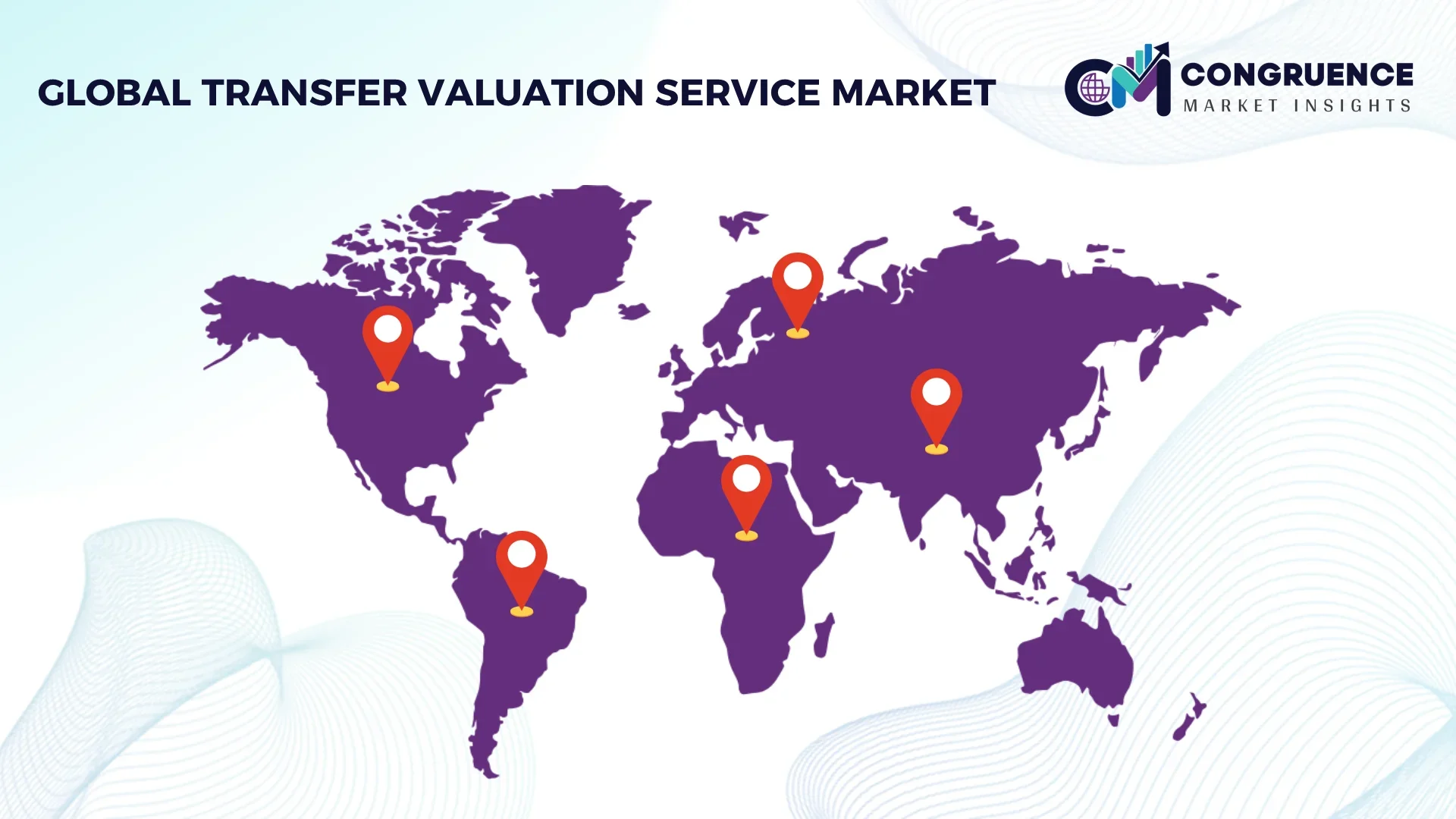
North America continues leading due to high multinational enterprise concentration, advanced transfer pricing governance systems, and aggressive adoption of AI-enabled valuation automation platforms. Europe holds approximately 29% share, supported by stringent OECD-aligned compliance enforcement and strong demand from pharmaceutical, manufacturing, and financial services sectors. Asia-Pacific contributes nearly 24% share and is rapidly accelerating because of manufacturing diversification, expanding digital economies, and regional tax modernization initiatives across India, China, and Southeast Asia. South America and the Middle East & Africa collectively account for 9% share, driven by growing cross-border investment activity and infrastructure expansion. Increasing global supply chain restructuring and international tax harmonization efforts are forcing enterprises to expand regional compliance operations, with companies strategically prioritizing Asia-Pacific execution hubs and North American digital valuation infrastructure investments.
North America commands approximately 38% of global Transfer Valuation Service Market demand due to the region’s high concentration of multinational corporations operating across technology, pharmaceutical, financial services, and advanced manufacturing industries. The United States alone accounts for nearly 81% of regional activity, driven by aggressive regulatory scrutiny surrounding intellectual property transfers and digital economy taxation. More than 63% of enterprises implemented AI-assisted valuation automation tools during the last two years to improve audit readiness and reduce compliance cycle times by approximately 32%. Increasing OECD Pillar Two alignment and cross-border restructuring activity are forcing companies to centralize valuation governance systems and expand cloud-based compliance infrastructure. Enterprises increasingly prioritize predictive analytics, integrated benchmarking engines, and litigation-ready reporting capabilities, making North America the leading region for advanced valuation technology deployment and long-term strategic investment.
Europe represents nearly 29% of the global Transfer Valuation Service Market, supported by strong multinational manufacturing, pharmaceutical, automotive, and financial services activity across Germany, France, the United Kingdom, and the Netherlands. The region’s demand structure is heavily compliance-driven due to expanding OECD reporting enforcement, BEPS implementation, and ESG-linked tax transparency frameworks. Approximately 57% of multinational enterprises operating in Europe upgraded digital valuation systems to improve audit traceability and cross-border reporting consistency. Advanced automation platforms reduced documentation preparation delays by nearly 28%, particularly among companies managing high-value intellectual property transfers. European enterprises increasingly prioritize centralized governance, sustainability-linked financial transparency, and standardized reporting workflows. This regulatory intensity is forcing companies to accelerate digital transformation investments, making Europe a critical market for valuation innovation, operational harmonization, and advanced compliance infrastructure deployment.
Asia-Pacific holds approximately 24% share of the global Transfer Valuation Service Market and is rapidly emerging as the fastest-expanding regional hub due to manufacturing diversification, export growth, and expanding multinational operations across China, India, Singapore, and Southeast Asia. Nearly 41% of new regional valuation demand is linked to supply chain restructuring and localized production expansion following global trade realignments. Enterprises are aggressively adopting cloud-based valuation systems and AI-enabled benchmarking platforms, improving documentation efficiency by approximately 35%. India and Singapore have become strategic shared-service centers supporting large-scale transfer pricing analytics and compliance execution for multinational corporations. Cost efficiency, operational scalability, and faster regulatory adaptation remain the primary enterprise priorities across the region. Companies continue investing in regional digital delivery infrastructure and localized compliance ecosystems, positioning Asia-Pacific as a critical execution market for global valuation scalability and operational expansion.
South America contributes approximately 5% to the global Transfer Valuation Service Market, with Brazil, Chile, and Colombia leading regional demand due to increasing foreign direct investment, mining expansion, and multinational manufacturing activity. Nearly 36% of enterprise valuation demand originates from commodity-linked sectors and cross-border infrastructure projects requiring enhanced transfer pricing governance. However, fragmented regulatory systems and inconsistent tax administration standards continue constraining scalability and operational efficiency across the region. Companies implementing localized digital compliance platforms reduced reporting delays by approximately 22%, improving audit coordination and documentation consistency. Regional enterprises remain highly price-sensitive and increasingly favor outsourced valuation partnerships over large internal compliance teams. Despite structural limitations, rising international investment activity and gradual tax modernization efforts are positioning South America as a strategic growth opportunity for firms capable of balancing cost efficiency, regulatory adaptation, and localized execution support.
The Middle East & Africa accounts for approximately 4% of the global Transfer Valuation Service Market, supported by expanding infrastructure investment, energy diversification programs, and multinational project financing activity across the UAE, Saudi Arabia, and South Africa. Oil & gas, construction, logistics, and sovereign investment sectors collectively contribute nearly 61% of regional valuation demand due to increasing cross-border partnership structures and international capital flows. Governments are aggressively modernizing tax frameworks and digital reporting infrastructure, accelerating enterprise adoption of cloud-based valuation systems and automated compliance tools. Approximately 27% of regional multinational enterprises upgraded transfer pricing governance frameworks during the last two years to improve transparency and operational control. Companies increasingly prioritize scalable advisory partnerships and localized compliance support, positioning the region as an emerging strategic market tied directly to infrastructure modernization, economic transformation, and long-term investment expansion.
United States – 34% Market share: Dominates due to high multinational enterprise concentration, advanced digital valuation adoption, and aggressive regulatory enforcement surrounding intellectual property and cross-border taxation.
Germany – 11% Market share: Leads through strong manufacturing exports, pharmaceutical activity, and stringent compliance requirements driving enterprise investment in centralized transfer valuation systems.
The Transfer Valuation Service Market is dominated by global advisory leaders including Deloitte, PwC, EY, KPMG, Alvarez & Marsal, and BDO, with competition intensifying between AI-enabled global consulting firms and specialized regional tax advisory providers. The top five players collectively control approximately 48% of global market activity, driven by multinational enterprise relationships, integrated compliance ecosystems, and technology-led execution capabilities.
Competition is increasingly centered on AI-driven automation, cross-border compliance speed, and valuation accuracy rather than traditional manual advisory models. AI-enabled benchmarking platforms reduced documentation turnaround times by nearly 35%, while automated analytics improved audit response efficiency by approximately 31%. Large firms are aggressively competing through cloud-based valuation infrastructure, strategic technology alliances, and regional delivery center expansion across India, Singapore, and Eastern Europe.
The competitive landscape is rapidly shifting toward integrated digital valuation ecosystems as enterprises demand predictive compliance intelligence and real-time governance capabilities. Strategic partnerships with Google Cloud, Snowflake, Anthropic, and enterprise ERP providers are reshaping competitive positioning. However, regulatory expertise, proprietary data access, and advanced AI integration remain major entry barriers. Winning in this market increasingly requires scalable automation, jurisdictional depth, and the ability to combine technology-driven execution with high-value strategic advisory capabilities.
PwC
EY
KPMG
Alvarez & Marsal
BDO International
Grant Thornton
RSM International
Baker Tilly International
Crowe Global
Duff & Phelps
Andersen Global
Artificial intelligence and predictive analytics are rapidly redefining the operational foundation of the Transfer Valuation Service Market. AI-powered benchmarking engines and machine-learning-driven anomaly detection platforms improved valuation processing efficiency by nearly 42% while reducing manual review dependency by approximately 36%. More than 58% of multinational enterprises have already integrated automated transfer pricing workflows into enterprise tax and financial reporting systems, accelerating audit readiness and reducing cross-border compliance delays. Firms leveraging AI-integrated valuation ecosystems are gaining measurable advantages in execution speed, documentation consistency, and litigation defense capabilities.
Cloud-native compliance platforms are replacing fragmented spreadsheet-based systems across global enterprises. Compared to legacy manual frameworks, integrated cloud valuation systems reduce reporting cycle times by nearly 33% and improve intercompany transaction traceability by approximately 29%. Large advisory firms and multinational corporations are increasingly embedding valuation analytics directly into ERP and treasury management infrastructure to support real-time pricing governance and multi-jurisdictional reporting alignment.
Emerging technologies including blockchain-backed audit trails, generative AI tax assistants, and digital twin modeling are reshaping enterprise valuation governance. Big Four firms and enterprise software providers are aggressively investing in interoperable AI ecosystems and automated regulatory intelligence platforms to strengthen competitive positioning. Between 2026 and 2028, real-time compliance orchestration and autonomous transfer pricing monitoring systems are expected to become mainstream operational standards, particularly among multinational pharmaceutical, semiconductor, and digital platform enterprises seeking scalable global tax governance and predictive risk management capabilities.
February 2026 – EY India launched AI-enabled enterprise tax and transfer pricing automation solutions under its India Tax Platform, supporting over 4,000 enterprise clients and processing more than USD 750 billion in annual tax transactions. The launch significantly strengthened real-time compliance execution and automated documentation workflows across multinational operations. [AI Tax Expansion] Source: www.ey.com
April 2025 – Deloitte expanded its strategic AI alliances with Google Cloud and ServiceNow, introducing over 100 agentic AI capabilities designed to automate enterprise tax, valuation, and compliance operations. The initiative accelerated intelligent workflow deployment and strengthened Deloitte’s position in AI-driven transfer pricing modernization. [Agentic AI Scaling]
March 2026 – KPMG highlighted major transfer pricing reforms under India’s finalized Income-tax Rules 2026, including accelerated APA processing and enhanced safe harbor standards effective April 2026. The regulatory shift increased enterprise demand for advanced valuation governance and automated compliance management across multinational organizations. [Regulatory Alignment Push]
December 2025 – Deloitte India introduced Tax Pragya™, an AI-led tax research and transfer pricing intelligence platform trained on over 1.2 million tax cases and 5,000 technical papers. The platform substantially improved tax research speed, multi-domain benchmarking accuracy, and enterprise-scale compliance efficiency for complex valuation environments. [AI Knowledge Engine]
The Transfer Valuation Service Market Report delivers comprehensive coverage across service types, applications, end-user industries, regional markets, and emerging valuation technologies shaping multinational compliance and operational governance. The report evaluates critical segments including transfer pricing documentation, intangible asset valuation, benchmarking analysis, intercompany transaction assessment, and AI-enabled compliance platforms. It further analyzes demand patterns across multinational enterprises, financial institutions, pharmaceutical companies, digital platforms, manufacturing groups, and regional advisory ecosystems operating within increasingly complex cross-border tax environments.
The study covers five major geographic regions and evaluates more than 20 country-level operational markets, highlighting adoption trends, enterprise restructuring activity, and regulatory transformation influencing valuation demand. The report profiles key global advisory firms, technology providers, and integrated compliance platform operators responsible for approximately 48% of global market concentration. It includes measurable operational indicators such as AI adoption levels exceeding 58%, automation-driven documentation efficiency improvements of 35%, and rising enterprise deployment of cloud-based valuation systems across high-volume multinational environments.
The report also delivers forward-looking strategic analysis covering 2026–2033 transformation pathways, including predictive compliance analytics, blockchain-backed audit infrastructure, ESG-linked tax governance, and autonomous transfer pricing monitoring systems. This intelligence framework supports investment prioritization, market entry strategy, digital transformation planning, competitive benchmarking, and long-term operational positioning for enterprises navigating evolving global tax and valuation ecosystems.
| Report Attribute / Metric | Details |
|---|---|
| Market Revenue (2025) | USD 899.0 Million |
| Market Revenue (2033) | USD 1,556.2 Million |
| CAGR (2026–2033) | 7.1% |
| Base Year | 2025 |
| Forecast Period | 2026–2033 |
| Historic Period | 2021–2025 |
| Segments Covered |
By Type
By Application
By End-User Insights
|
| Key Report Deliverables | Revenue Forecast; Market Trends; Growth Drivers & Restraints; Technology Insights; Segmentation Analysis; Regional Insights; Competitive Landscape; Regulatory & ESG Overview; Recent Developments |
| Regions Covered | North America; Europe; Asia-Pacific; South America; Middle East & Africa |
| Key Players Analyzed | Deloitte; PwC; EY; KPMG; Alvarez & Marsal; BDO International; Grant Thornton; RSM International; Baker Tilly International; Crowe Global; Duff & Phelps; Andersen Global |
| Customization & Pricing | Available on Request (10% Customization Free) |




