
Reports
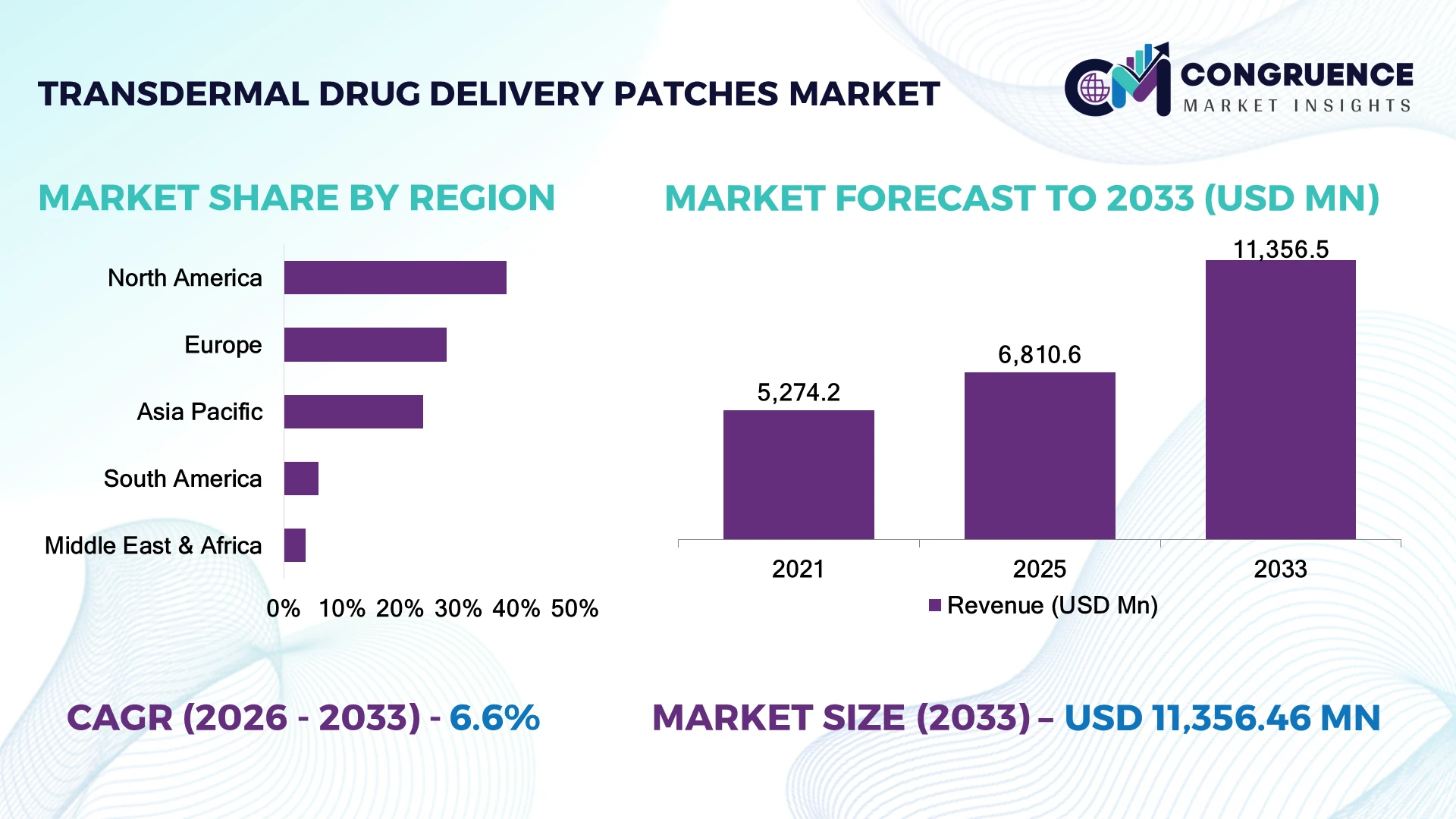
The Global Transdermal Drug Delivery Patches Market was valued at USD 6,810.6 Million in 2025 and is anticipated to reach a value of USD 11,356.5 Million by 2033 expanding at a CAGR of 6.6% between 2026 and 2033. Growth is driven by rising preference for controlled drug release, improved adherence, microneedle-enabled delivery, and replacement of selected oral therapies with sustained transdermal administration.
The United States remains the dominant national market, representing approximately 35% of global transdermal patch demand, supported by established chronic-care infrastructure, pharmaceutical R&D, and adoption of nicotine, pain-management, hormone, and neurological patches. Japan contributes roughly 10–12%, with strong pharmaceutical formulation expertise and advanced patch technologies. U.S. pharmaceutical companies are increasingly investing in long-acting and patient-friendly delivery systems as healthcare systems emphasize adherence and home-based treatment.
Strategically, manufacturers that combine drug-device expertise, scalable adhesive technologies, and regulatory-ready delivery platforms will capture the strongest commercial opportunities.
Market Size & Growth: USD 6,810.6 million in 2025 to USD 11,356.5 million by 2033 at 6.6% CAGR, supported by controlled-release formulations and patient adherence.
Top Growth Drivers: 32% chronic-disease treatment demand, 25% adherence-related preference, and 18% growth in advanced transdermal formulations.
Short-Term Forecast: By 2028, optimized patch manufacturing can reduce material waste by 8–12% and improve production efficiency by 10–15%.
Emerging Technologies: Microneedle arrays, drug-in-adhesive systems, nanocarriers, and smart patches are increasing delivery precision and formulation flexibility.
Regional Leaders: North America is projected at approximately USD 4.0 billion by 2033, Europe at USD 2.8 billion, and Asia-Pacific at USD 3.0 billion, with advanced-patch adoption accelerating.
Consumer/End-User Trends: Approximately 55–60% of transdermal demand is linked to chronic or recurring treatment, strengthening preference for convenient dosing formats.
Pilot/Case Example: By 2026, microneedle development programs are targeting administration periods of minutes rather than conventional multi-hour patch wear, potentially improving patient convenience and drug-delivery precision.
Competitive Landscape: Leading transdermal specialists and pharmaceutical companies compete across adhesive performance, formulation expertise, manufacturing scale, and regulatory capability, with established players collectively controlling a substantial share of branded patch supply.
Regulatory & ESG Impact: Advanced solvent-free adhesive systems can reduce manufacturing emissions and processing requirements by approximately 10–20% while supporting cleaner production.
Investment & Funding: Pharmaceutical and drug-delivery companies are directing multimillion-dollar R&D budgets toward microneedles, long-acting systems, and combination drug-device platforms.
Innovation & Future Outlook: 2026–2028 innovation is shifting from conventional reservoir patches toward multifunctional systems integrating microneedles, sensors, controlled release, and personalized dosing.
The Transdermal Drug Delivery Patches Market is moving toward higher-value systems capable of sustained, programmable, and increasingly precise drug administration. Nicotine replacement, pain management, hormone therapy, cardiovascular treatment, and neurological applications remain important demand areas, while microneedle platforms are expanding the addressable drug range. Advanced drug-in-adhesive formulations already represent more than 50% of many commercial patch configurations, while pharmaceutical manufacturers are strengthening domestic and dual-source supply chains amid continuing global pharmaceutical manufacturing realignment.
Transdermal drug delivery patches are becoming strategically important because pharmaceutical companies can differentiate therapies through improved adherence, controlled exposure, and simplified dosing rather than relying solely on active-ingredient innovation. This creates an attractive drug-device development pathway for chronic therapies where dosing convenience directly influences treatment persistence.
Technology is widening the addressable formulation base. Conventional passive patches generally support molecules with suitable molecular weight and skin permeability, whereas microneedle systems physically bypass the outer skin barrier and can improve delivery efficiency by approximately 20–40% for suitable compounds. North America retains stronger commercial penetration, while Japan and South Korea demonstrate advanced formulation and patch-engineering capabilities. Over the next 2–3 years, manufacturers are expected to prioritize higher-loading adhesives, microneedle arrays, and longer-duration delivery platforms.
A practical deployment pathway involves combining pharmaceutical formulation with specialized adhesive and device engineering rather than developing the patch independently. Companies are therefore increasing partnerships between drug developers, delivery-technology specialists, and contract manufacturers. Manufacturing investment is also shifting toward automated coating, precision lamination, and inline inspection. The strategic advantage will belong to companies that can demonstrate consistent drug release, skin compatibility, scalable manufacturing, and regulatory readiness across multiple therapeutic applications.
Controlled and sustained drug release is strengthening transdermal patch adoption as pharmaceutical companies seek alternatives to frequent oral dosing. Chronic therapies account for approximately 55–60% of commercial patch utilization, while adherence-focused formulations represent roughly 20–25% of development activity. Drug-in-adhesive architectures now dominate many commercial products because they simplify manufacturing and support consistent dosing. In the United States, pharmaceutical developers are also prioritizing home-based treatment formats that reduce administration burden. The strategic shift is toward higher-loading adhesives and longer-wear systems rather than simply expanding conventional patches. Manufacturers are responding through formulation R&D, specialized adhesive partnerships, and automated coating capacity, with platform technologies allowing one delivery architecture to support multiple drug candidates.
Limited skin permeability restricts the number of molecules suitable for conventional passive transdermal delivery, with only a relatively small proportion of drug candidates meeting the required molecular-weight, lipophilicity, and potency criteria. Formulation constraints can eliminate approximately 60–70% of conventional small-molecule candidates during early feasibility screening. Adhesive performance adds another 10–15% development complexity through irritation, residue, and wear-time requirements. Manufacturers also face dependence on specialized polymers, permeation enhancers, and medical-grade adhesives, creating procurement sensitivity when chemical supply chains tighten. Companies are mitigating these constraints through microneedles, permeation-enhancing formulations, diversified excipient sourcing, and longer-term supplier agreements. The key operational insight is that molecule selection increasingly determines patch economics before commercial manufacturing begins.
Microneedle-enabled transdermal systems are expanding the addressable drug universe by bypassing the stratum corneum, creating opportunities for molecules poorly suited to conventional passive patches. Advanced platforms can improve delivery efficiency by approximately 20–40% for suitable compounds, while minimally invasive arrays can reduce administration time substantially compared with conventional wear-based systems. Japan, South Korea, and the United States are important development centers for microneedle technologies, supported by pharmaceutical R&D and drug-device partnerships. The non-obvious opportunity is combination therapy: one platform can potentially integrate controlled release with sensing or sequential dosing. Companies are increasing investment in dissolving and coated microneedles, partnering with formulation specialists, and developing scalable roll-to-roll manufacturing to reduce unit costs.
Commercial transdermal manufacturing requires tight control over drug loading, coating thickness, adhesive uniformity, lamination, and release characteristics. Production tolerances for critical coating parameters can be below 5%, while automated inspection systems increasingly target defect-detection rates above 95%. Scaling from laboratory prototypes to high-throughput coating lines therefore creates significant process-validation requirements. Microneedle systems add further complexity because array geometry and insertion performance must remain consistent across large production batches. Regulatory expectations also increasingly require integrated drug-device characterization. Companies must invest in inline spectroscopy, machine vision, automated coating controls, and specialized contract-manufacturing partnerships. The long-term competitive pressure is not simply formulation innovation; it is the ability to reproduce precise delivery performance across millions of patches without increasing scrap or quality deviations.
Microneedle Platforms Move Forward: Commercial development is shifting toward dissolving and coated microneedles that bypass the skin barrier rather than relying entirely on passive diffusion. Advanced systems can improve delivery efficiency by approximately 20–40% for suitable molecules and shorten administration procedures. U.S. and Japanese developers are increasingly partnering with specialized drug-device manufacturers, making scalable array fabrication a critical technology priority.
Adhesive Engineering Gets Smarter: Patch manufacturers are refining medical-grade adhesives to extend wear time while reducing irritation and residue. New formulations are targeting approximately 10–15% longer usable wear periods and 5–10% lower material consumption through thinner multilayer constructions. The operational shift is significant because adhesive performance increasingly determines patient retention, manufacturing yield, and product differentiation alongside the active pharmaceutical ingredient.
Digital Quality Control Expands: Automated vision inspection, inline spectroscopy, and process analytics are moving deeper into patch production. Advanced inspection can identify more than 95% of visible manufacturing defects, while real-time process monitoring reduces manual quality checks by approximately 20–30%. Manufacturers are installing connected coating and inspection systems to improve batch consistency and reduce scrap as pharmaceutical quality requirements become increasingly stringent.
Supply Chains Become More Localized: Pharmaceutical manufacturers are reducing dependence on single-source adhesive, polymer, and specialty-film suppliers following recent global logistics disruptions. Approximately 15–25% of procurement programs for critical patch components are being evaluated for dual sourcing or regional alternatives. Companies are responding through supplier qualification, longer-term contracts, and regional manufacturing partnerships, improving continuity while reducing exposure to freight volatility and component shortages.
Drug-in-adhesive patches represent the leading type, accounting for approximately 41–46% of the global market, supported by simpler construction, lower manufacturing complexity, thin profiles, and compatibility with high-volume therapies such as nicotine replacement, hormones, and pain management. Matrix patches contribute roughly 25–30%, benefiting from established controlled-release performance, while reservoir systems retain approximately 15–18% share in applications requiring defined membrane-controlled release. Drug-in-adhesive designs therefore remain the commercial workhorse, particularly for mature pharmaceutical portfolios.
Microneedle patches represent the fastest-growing technology segment as developers seek to overcome the stratum-corneum barrier and expand delivery beyond conventional small molecules. Their share remains around 10–12%, but pharmaceutical investment is increasingly moving toward coated, dissolving, and polymeric microneedle platforms. Companies are responding through drug-device partnerships, formulation licensing, and specialized manufacturing investments. The strategic implication is a two-speed market: mature patch architectures prioritize manufacturing economics, while microneedle platforms attract higher R&D investment because they can unlock previously unsuitable molecules.
A 2025 peer-reviewed review identified microneedles, permeation enhancers, vesicular systems, and responsive delivery technologies as key innovation pathways for improving drug flux and controlling transdermal release.
Pain management represents the leading application at approximately 35–38% of global transdermal patch demand, supported by established use of analgesic therapies and the ability to provide sustained exposure without repeated oral dosing. Hormone replacement therapy contributes around 18–22%, while smoking cessation accounts for approximately 15–18%. These mature applications benefit from extensive physician familiarity and established regulatory pathways, creating predictable prescription demand and manufacturing volumes. Cardiovascular and neurological applications remain smaller but strategically important because controlled delivery can address adherence requirements in chronic treatment.
Neurological and hormone-related applications represent faster-moving opportunities as manufacturers develop longer-wear formulations and improved permeation technologies. Approximately 55–60% of commercial utilization is associated with chronic or recurring treatment, reinforcing the operational value of simplified dosing. Companies are expanding specialized formulation pipelines, partnering with pharmaceutical developers, and improving adhesive performance to extend wear time. The business priority is shifting toward applications where transdermal delivery provides a clear pharmacokinetic or adherence advantage rather than simply replicating oral therapy in patch form.
A 2025 systematic review from researchers at AIIMS evaluated transdermal nicotine patches in perioperative pain management, illustrating continued investigation of established patch technology beyond conventional smoking-cessation use.
Homecare settings account for approximately 55–65% of end-user demand, reflecting the suitability of transdermal patches for self-administration, chronic therapy, and recurring treatment without continuous clinical supervision. Hospitals and clinics contribute approximately 30–40%, particularly for patients receiving neurological, cardiovascular, postoperative, or complex pain-management therapy. Specialty clinics represent a smaller share, generally below 10%, but remain relevant for hormone therapy, pain programs, and treatment initiation. The established homecare segment therefore benefits from convenience, reduced administration frequency, and lower dependence on facility-based dosing.
Hospitals and clinics remain the faster-evolving institutional segment as healthcare systems emphasize medication adherence, discharge continuity, and outpatient treatment. Approximately 20–30% of clinical workflows involving recurring transdermal therapies increasingly connect prescribing with pharmacy fulfillment and patient education. Manufacturers are responding with clearer application instructions, improved skin adhesion, unit-dose packaging, and pharmacy partnerships. The commercial opportunity is shifting toward products designed for reliable self-administration while maintaining clinical-grade performance. Companies with strong patient-support ecosystems can differentiate beyond formulation and improve treatment continuity across home and institutional settings.
A 2025 peer-reviewed review found that real-world transdermal performance remains affected by patient misuse and adhesion variability, emphasizing the importance of patient education and standardized adhesion testing for home-use products.
North America accounted for the largest market share at 38.2% in 2025 however, Asia-Pacific is expected to register the fastest growth, expanding at a CAGR of 7.4% between 2026 and 2033.

Advanced drug-device development strengthens controlled-release leadership
North America represents approximately 38.2% of the global Transdermal Drug Delivery Patches Market, supported by established pharmaceutical manufacturing, high prescription volumes, sophisticated drug-delivery R&D, and strong adoption of home-based chronic-care therapies. The United States accounts for more than 85% of regional demand, with nicotine, pain-management, hormone, and neurological patches forming major commercial categories. Approximately 55–60% of regional patch utilization is associated with recurring or chronic treatment, reinforcing the value of sustained-release formats. Pharmaceutical companies are increasing investment in microneedle platforms, high-performance adhesives, and combination drug-device systems. Contract manufacturing partnerships and automated coating capacity are also expanding as developers seek faster scale-up from clinical batches to commercial production.
United States Market Outlook: The United States remains the world's principal commercial and innovation center for transdermal delivery, supported by extensive pharmaceutical R&D and established regulatory pathways. Approximately 35% of global patch demand originates from U.S. healthcare and consumer-treatment channels. Domestic developers are prioritizing microneedle delivery, improved adhesion, and longer-duration formulations to extend transdermal use into additional therapeutic categories.
Specialized formulation expertise supports advanced patch development
Europe accounts for approximately 27–29% of global transdermal patch demand, supported by mature pharmaceutical manufacturing, strong generic-drug production, and established chronic-care systems. Germany, France, the United Kingdom, Switzerland, and Italy represent important formulation and commercialization centers. European manufacturers increasingly emphasize solvent-efficient coating, medical-grade adhesives, and lower-material constructions as manufacturing sustainability requirements strengthen. Approximately 50–55% of regional demand is concentrated in established chronic-treatment applications, while advanced drug-in-adhesive and microneedle technologies receive increasing R&D attention. Pharmaceutical companies are using contract development and manufacturing partnerships to reduce scale-up timelines and improve access to specialized coating and lamination infrastructure.
Germany Market Outlook: Germany combines a large pharmaceutical manufacturing base with advanced formulation and medical-device engineering capabilities. Approximately 20% of Europe's pharmaceutical manufacturing capacity is concentrated in Germany, creating a strong ecosystem for formulation development, clinical supply, and commercial patch production. Manufacturers are increasingly emphasizing automated coating, precision lamination, and quality-control systems.
Pharmaceutical manufacturing scale accelerates next-generation delivery
Asia-Pacific represents approximately 23–25% of global transdermal patch demand and combines expanding pharmaceutical consumption with strong formulation and manufacturing capabilities. Japan remains particularly important for sophisticated transdermal formulations, while China and South Korea provide growing pharmaceutical production and drug-delivery technology capacity. Japan accounts for approximately 35–40% of regional advanced transdermal technology activity, supported by established patch-development expertise. India is gaining relevance through expanding pharmaceutical manufacturing and lower-cost formulation capabilities. Companies are increasing investment in microneedle R&D, automated coating, and localized production, while partnerships between pharmaceutical developers and specialized drug-delivery firms are accelerating commercialization.
Japan Market Outlook: Japan is the region's most established transdermal technology market, supported by extensive pharmaceutical formulation expertise and long-standing commercial use of medicated patches. More than 40% of Japan's transdermal demand is concentrated in pain-management and chronic-treatment applications. Manufacturers continue investing in thin-film matrices, advanced adhesives, and controlled-release architectures that improve patient comfort and dosing consistency.
Brazilian pharmaceutical capacity supports broader patch accessibility
South America contributes approximately 6–7% of global transdermal patch demand, with Brazil representing the region's principal pharmaceutical and healthcare market. Demand is concentrated in pain management, hormone therapy, smoking cessation, and other recurring treatments where simplified dosing improves patient convenience. Brazil's domestic pharmaceutical manufacturing base supports local formulation, packaging, and distribution, although advanced patch components and specialized materials remain dependent on international supply chains. Approximately 60% of regional demand is concentrated in Brazil, creating a clear commercial priority for manufacturers entering the market. Companies are expanding through local pharmaceutical partnerships, distributor agreements, and localized packaging while maintaining centralized sourcing of specialized adhesives and delivery components.
Brazil Market Outlook: Brazil represents approximately 60% of South America's transdermal patch demand and benefits from the region's strongest pharmaceutical manufacturing and distribution infrastructure. Domestic drug manufacturers provide established formulation and packaging capabilities, while large urban healthcare networks support prescription-based adoption. Local partnerships are increasingly important for navigating procurement, reimbursement, and distribution requirements.
Healthcare modernization increases access to convenient drug delivery
Middle East & Africa accounts for approximately 5–6% of global transdermal patch demand, with Saudi Arabia, the UAE, South Africa, and Israel serving as principal commercial centers. Gulf healthcare modernization is strengthening demand for convenient chronic-care formats, while private hospitals and specialty pharmacies provide important channels for prescription patches. Approximately 45–50% of regional demand is concentrated in Saudi Arabia and the UAE, reflecting higher pharmaceutical spending and advanced healthcare infrastructure. Companies are increasingly working with local distributors, hospital groups, and pharmaceutical importers to improve market access. The strategic opportunity centers on chronic pain, hormone therapy, and other recurring treatments where reduced dosing frequency supports outpatient care.
Saudi Arabia Market Outlook: Saudi Arabia is the region's most strategically significant market because of healthcare modernization, rising pharmaceutical investment, and expanding private-sector capacity. The country accounts for approximately 30% of regional transdermal patch demand. Manufacturers are strengthening distributor partnerships and hospital relationships while positioning convenient drug-delivery formats for chronic-care and outpatient treatment pathways.
Hisamitsu Pharmaceutical, Viatris, Bayer, Teva, and established generic manufacturers compete across branded patches, OTC analgesics, hormone therapies, and low-cost formulations, while specialists such as Medherant challenge incumbents through adhesive and microneedle innovation. The top five are estimated to represent 20–25% combined global share, reflecting fragmentation. Competition centers on formulation performance, adhesion, manufacturing scale, regulatory speed, and price: advanced patches command 15–30% premiums, while automated coating can reduce unit-processing costs 10–15%. Hisamitsu leverages patch specialization and global brands; Viatris expands differentiated prescription products; Bayer partners with delivery specialists; generic producers compete through cost and manufacturing capacity. The competitive shift is toward drug-device partnerships, microneedles, solvent-free adhesives, and supply-chain localization. Entry barriers include clinical validation, specialized coating infrastructure, adhesive know-how, regulatory compliance, and pharmaceutical relationships. Winning requires reliable drug release, superior adhesion, scalable manufacturing, regulatory execution, and partnerships that convert delivery technology into commercially differentiated therapies across multiple therapeutic categories and geographies.
Hisamitsu Pharmaceutical Co., Inc.
Viatris Inc.
Bayer AG
Teva Pharmaceutical Industries Ltd.
Novartis AG
AbbVie Inc.
Luye Pharma Group
Endo International plc
Mylan Pharmaceuticals
Teikoku Seiyaku Co., Ltd.
Sandoz Group AG
Medherant Limited
Aveva Drug Delivery Systems, Inc.
Drug-in-adhesive systems, precision coating, inline vision inspection, and automated lamination remain core commercial technologies. Automated inspection can reduce manual quality checks by 20–30%, while precision coating improves dose uniformity by roughly 5–10%. Adoption is highest in mature pharmaceutical manufacturing, where continuous process monitoring protects batch consistency and reduces scrap.
Microneedles, dissolving arrays, permeation enhancers, and solvent-free adhesives represent the disruptive layer. Microneedles can improve delivery efficiency by approximately 20–40% for suitable molecules, while advanced adhesive systems can extend wear performance by 10–15%. Compared with conventional passive patches, microneedle platforms bypass the stratum corneum, expanding formulation possibilities and attracting pharmaceutical partnerships. Hisamitsu and specialist developers benefit through proprietary delivery platforms.
Between 2026 and 2028, integration will become more important than individual technologies. Connected manufacturing execution systems, machine vision, spectroscopy, and automated release testing can improve production throughput by 10–15% while reducing deviation-related rework. Pharmaceutical companies with established coating infrastructure gain a scale advantage, whereas technology specialists benefit through licensing and co-development. Manufacturers are prioritizing modular platforms that support multiple APIs, localized production, and faster technology transfer. The immediate priority is converting laboratory performance into validated, high-volume manufacturing without sacrificing adhesion, dose accuracy, or patient comfort across diversified therapeutic pipelines and markets.
July 2026 Viatris received FDA approval for Gwyn Lo, a once-weekly contraceptive patch. Phase 3 recorded only 1.3% full detachment across 39,790 applications during the year-long trial, strengthening confidence in adhesion performance and expanding differentiated women’s-health transdermal options. Source: viatris.com
October 2025 Medherant reported positive Phase 1 testosterone-patch results, restoring testosterone levels to the normal pre-menopausal range with strong tolerability. The milestone advances a potential first-in-class women’s testosterone patch and supports broader commercialization of specialized adhesive delivery platforms. Source: medherant.co.uk
September 2026 FDA reported estradiol transdermal-patch supply pressure and said approved supply had nearly doubled over the previous year. Manufacturers added shifts, equipment, capacity, and larger batches, demonstrating how demand shocks are driving rapid manufacturing expansion, protecting access. Source: fda.gov
March 2025 Aveva Drug Delivery Systems received FDA approval for generic lidocaine 1.8% patch, targeting post-herpetic neuralgia. Annual reference-market sales were approximately $116 million, creating a commercially relevant generic opportunity and intensifying price competition in localized pain treatment. Source: prnewswire.com
The Transdermal Drug Delivery Patches Market Report evaluates drug-in-adhesive, matrix, reservoir, and emerging microneedle patches across pain management, hormone replacement, smoking cessation, cardiovascular, neurological, and other therapeutic applications. End-user coverage includes hospitals and clinics, homecare settings, specialty practices, pharmacies, and pharmaceutical procurement channels. Regional analysis spans North America, Europe, Asia-Pacific, South America, and Middle East & Africa, with country-level assessment of major pharmaceutical and manufacturing centers.
The report examines adhesive engineering, permeation enhancers, precision coating, automated inspection, microneedle arrays, solvent-free formulations, and controlled-release architectures. It assesses mature applications representing approximately 55–60% of recurring-treatment utilization alongside emerging drug-device platforms, partnerships, licensing activity, and manufacturing localization. Strategic analysis supports investment planning, product development, geographic expansion, technology partnerships, competitive positioning, manufacturing capacity decisions, and identification of emerging therapeutic opportunities shaping the market through 2033.
| Report Attribute/Metric | Report Details |
|---|---|
|
Market Revenue in 2025 |
USD 6,810.6 Million |
|
Market Revenue in 2033 |
USD 113,56.5 Million |
|
CAGR (2026 - 2033) |
6.6% |
|
Base Year |
2025 |
|
Forecast Period |
2026 - 2033 |
|
Historic Period |
2021 - 2025 |
|
Segments Covered |
By Type
By Application
By End-User
|
|
Key Report Deliverable |
Revenue Forecast, Growth Trends, Market Dynamics, Segmental Overview, Regional and Country-wise Analysis, Competition Landscape |
|
Region Covered |
North America, Europe, Asia-Pacific, South America, Middle East, Africa |
|
Key Players Analyzed |
Hisamitsu Pharmaceutical Co., Inc., Viatris Inc., Bayer AG, Teva Pharmaceutical Industries Ltd., Novartis AG, AbbVie Inc., Luye Pharma Group, Endo International plc, Mylan Pharmaceuticals, Teikoku Seiyaku Co., Ltd., Sandoz Group AG, Medherant Limited, Aveva Drug Delivery Systems, Inc. |
|
Customization & Pricing |
Available on Request (10% Customization is Free) |




