
Reports
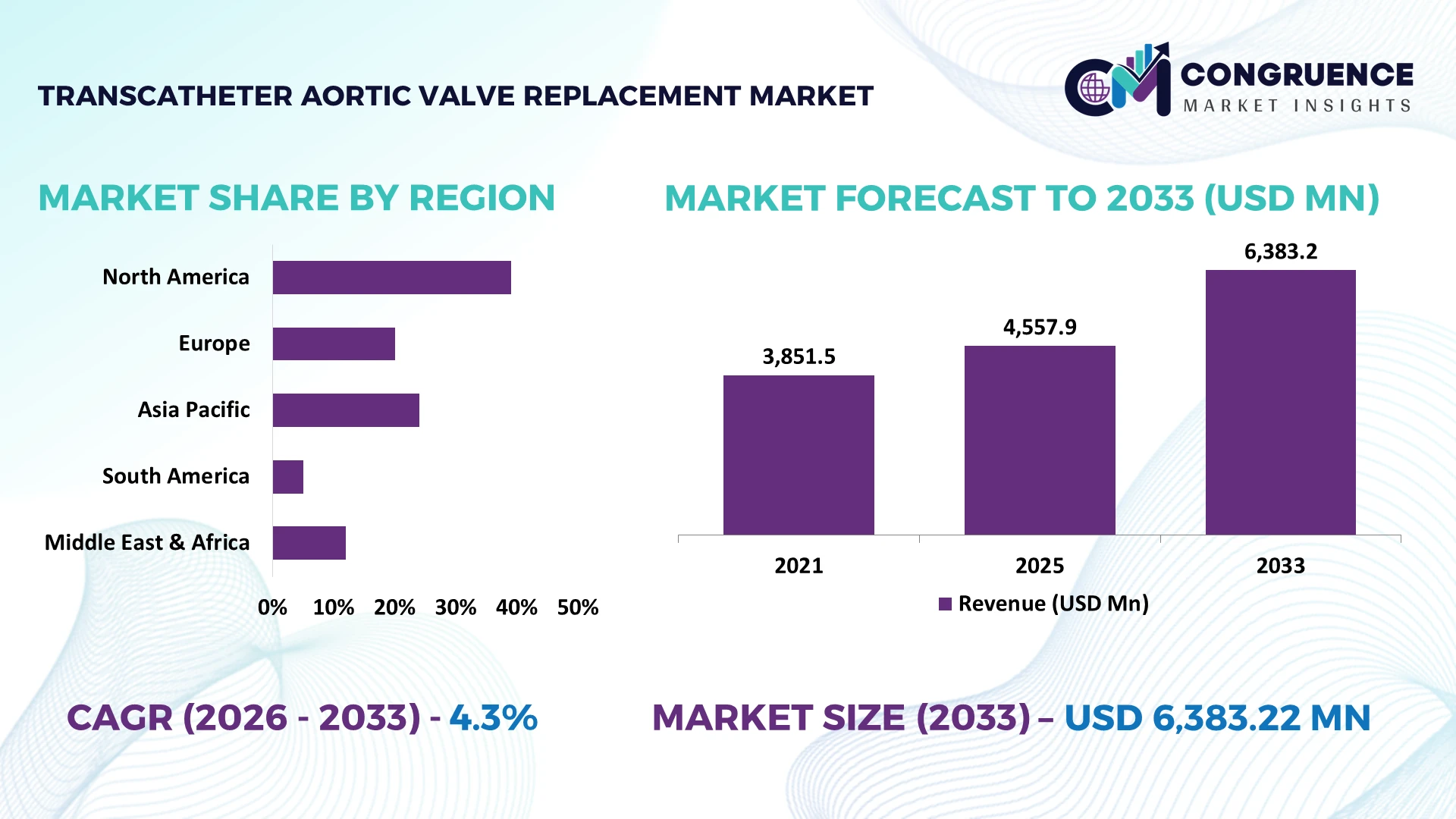
The Global Transcatheter Aortic Valve Replacement Market was valued at USD 4557.91 Million in 2025 and is anticipated to reach a value of USD 6383.22 Million by 2033 expanding at a CAGR of 4.3% between 2026 and 2033. Growth is driven by TAVR expansion into low-risk and asymptomatic severe aortic stenosis patients, increasing transfemoral procedures, shorter hospitalization, and next-generation valve systems engineered for improved coronary access and lifetime valve management.
The United States dominates the advanced TAVR landscape, with 383,030 procedures captured by the STS/ACC TVT Registry from January 2020 through March 2024; 108,407 patients, or 28.3%, were classified as low surgical risk. Transfemoral access has exceeded 95% in U.S. practice, while Germany maintains one of Europe's highest TAVI procedure densities. Continued U.S. FDA indication expansion reinforces adoption beyond historically high-risk surgical populations.
Strategically, manufacturers and structural-heart centers combining earlier intervention, high-throughput transfemoral pathways, durable valve platforms, and lifetime coronary-access planning hold the strongest competitive position.
Market Size & Growth: USD 4,557.91 million in 2025 is projected to reach USD 6,383.22 million by 2033 at 4.3%, supported by widening eligibility for minimally invasive aortic valve replacement.
Top Growth Drivers: Low-risk expansion is established, with 28.3% of 383,030 U.S. TAVR patients classified as low surgical risk; transfemoral access exceeding 95% further supports procedural scalability.
Short-Term Forecast: By 2028, streamlined TAVR pathways will emphasize shorter recovery and higher structural-heart throughput; established U.S. registry experience has demonstrated approximately 2-day median hospitalization and home-discharge rates above 90%.
Emerging Technologies: AI-assisted imaging, advanced CT-based valve sizing, commissural alignment, improved sealing skirts, and coronary-access-focused frames are shifting TAVR innovation toward precision implantation and lifetime valve management.
Regional Leaders: North America leads clinical commercialization, Europe maintains mature high-volume TAVI infrastructure, and Asia-Pacific is expanding structural-heart capacity as next-generation systems enter additional tertiary-care hospitals.
Consumer/End-User Trends: Lower-risk treatment is becoming increasingly established; among 108,407 U.S. low-risk TAVR patients, one-year mortality was 4.6%, stroke was 2.6%, and approximately 90% were classified alive and well.
Pilot/Case Example: In 2024, EARLY TAVR evaluated 901 asymptomatic patients across 75 centers; primary events occurred in 26.8% receiving early TAVR versus 45.3% managed with clinical surveillance.
Competitive Landscape: Edwards Lifesciences and Medtronic anchor global TAVR competition, with Abbott and Boston Scientific active across structural-heart technologies; competition centers on durability, hemodynamics, deliverability, sealing performance, and coronary access.
Regulatory & Clinical Impact: Earlier intervention gained stronger clinical support after cardiovascular hospitalization reached 20.9% with early TAVR versus 41.7% under surveillance, strengthening the case for treatment before symptomatic deterioration.
Investment & Expansion: Manufacturers are directing substantial capital toward valve R&D, clinical trials, manufacturing capacity, physician training, and localized structural-heart expansion, particularly as Asian healthcare systems increase advanced catheter-based cardiac capabilities.
Innovation & Future Outlook: Lifetime valve management defines the next technology cycle; 87% of surveillance patients in EARLY TAVR eventually underwent aortic-valve replacement, reinforcing the strategic transition toward earlier treatment and durable next-generation platforms.
The Transcatheter Aortic Valve Replacement Market is increasingly shaped by low-risk treatment, transfemoral access, advanced imaging, improved valve durability, and earlier intervention. Low-risk patients represented 28.3% of a large U.S. real-world TAVR cohort. Regulatory expansion and high-volume structural-heart programs are moving treatment beyond high-risk intervention, positioning lifetime valve management as the next major strategic priority.
Transcatheter aortic valve replacement is becoming strategically important as structural-heart competition shifts from treating inoperable patients toward earlier intervention and lifetime valve management. In the United States, 108,407 of 383,030 TAVR patients recorded from 2020 through March 2024 were low surgical risk, representing 28.3%. Regulatory expansion into asymptomatic severe aortic stenosis further changes hospital referral pathways and manufacturers’ addressable patient strategies.
Operationally, transfemoral TAVR provides a substantial efficiency advantage over surgical aortic valve replacement. Contemporary programs achieve hospital stays near 2 days, compared with approximately 5–9 days reported across surgical pathways, while transfemoral access exceeds 95% in established U.S. practice. The United States leads clinical scale and new-indication development, whereas Germany combines mature reimbursement infrastructure with exceptionally high per-capita TAVI deployment.
Over the next 2–3 years, CT-guided planning, commissural alignment and coronary-access preservation will become stronger purchasing criteria. EARLY TAVR demonstrated primary events of 26.8% with early intervention versus 45.3% under surveillance. Manufacturers are consequently investing in next-generation platforms, physician training and structural-heart partnerships. Competitive advantage will increasingly depend on controlling the entire patient pathway—from diagnosis and procedural planning to repeat intervention and lifetime valve management.
Expansion beyond high-risk patients is the strongest structural driver of TAVR utilization. Among 383,030 U.S. procedures assessed from 2020 through March 2024, 28.3% involved low-risk patients, while approximately 90% of this cohort was alive and well at one year. Transfemoral access now exceeds 95% in established U.S. practice, supporting predictable recovery and greater procedural throughput. The regulatory shift toward treating asymptomatic severe aortic stenosis further moves intervention upstream rather than waiting for clinical deterioration. This transition expands referral opportunities for cardiology networks and structural-heart centers. Edwards Lifesciences, Medtronic and competing cardiovascular-device developers are responding through indication-expansion studies, improved delivery systems, physician education and valve designs optimized for younger patients requiring longer-term coronary access and potential repeat intervention.
Clinical complexity remains a structural limitation despite increasingly standardized TAVR workflows. Real-world low-risk U.S. data indicate approximately 8.8% permanent pacemaker implantation at one year, while stroke occurred in about 2.6% and moderate-or-greater paravalvular regurgitation remained near 3%. These outcomes matter as treatment expands toward younger patients with longer life expectancy and lower tolerance for device-related complications. Challenging coronary anatomy, bicuspid valves, calcified access vessels and small annuli can also restrict device selection or require additional procedural resources. Hospitals consequently cannot scale TAVR purely through catheterization-laboratory capacity. Manufacturers are mitigating these limitations through repositionable systems, improved sealing technologies, lower-profile delivery catheters and enhanced CT-based patient selection. The strategic constraint is therefore increasingly anatomical precision rather than simple treatment availability.
Treating severe aortic stenosis before symptoms emerge creates a major pathway beyond conventional symptom-triggered intervention. The EARLY TAVR study enrolled 901 asymptomatic patients across 75 centers and recorded primary endpoint events in 26.8% of early-TAVR patients compared with 45.3% receiving clinical surveillance. Importantly, 87% of surveillance patients ultimately underwent aortic-valve replacement, revealing substantial latent procedural demand rather than permanently avoidable intervention. This evidence supports closer integration between echocardiography, CT assessment and structural-heart referral programs. In the United States, manufacturers can position advanced valve platforms around proactive disease management, while hospital systems can identify eligible patients earlier through surveillance databases. Companies investing in AI-assisted imaging, predictive planning, commissural alignment and durable leaflet technology gain an opportunity to compete across the patient lifecycle rather than only at implantation.
Moving TAVR into younger and lower-risk populations creates a long-term execution challenge centered on durability, coronary re-access and repeat procedures. Low-risk patients already represent 28.3% of a major U.S. real-world cohort, while one-year pacemaker implantation approaches 8.8%, making downstream device consequences increasingly important. In EARLY TAVR, 87% of initially monitored patients ultimately received valve replacement, reinforcing the need for decades-long treatment planning rather than isolated procedures. Hospitals must therefore coordinate imaging specialists, interventional cardiologists, surgeons and electrophysiology teams while maintaining consistent procedural quality. Manufacturers must solve commissural alignment, leaflet durability, valve-in-valve compatibility and coronary-access preservation through platform redesign and clinical evidence. Competitive leadership will depend less on first-procedure penetration and more on demonstrating predictable performance across the complete lifetime structural-heart pathway.
Minimalist TAVR Workflows Scale: Transfemoral access exceeds 95% across mature U.S. programs, while selected minimalist pathways achieve discharge within 24 hours and increasingly use conscious sedation rather than general anesthesia. Hospitals are reorganizing structural-heart workflows around percutaneous closure, rapid imaging and standardized recovery protocols, reducing bed utilization and increasing procedural throughput. Manufacturers are responding with lower-profile delivery systems, simplified deployment mechanisms and expanded physician-training programs.
Anatomy-Specific Valve Selection Expands: Balloon-expandable and self-expanding systems increasingly compete on patient-specific performance rather than broad platform preference. Contemporary comparative evidence shows permanent pacemaker implantation can differ by approximately 10 percentage points between valve platforms, while paravalvular regurgitation remains below 5% in well-selected populations. Structural-heart teams are integrating CT-based sizing and anatomical assessment into procurement decisions, pushing manufacturers toward improved sealing, repositionability and coronary-access preservation.
TAVR Portfolios Are Consolidating: Regulatory evidence requirements are reshaping competitive portfolios. Boston Scientific discontinued worldwide ACURATE valve sales in 2025 after additional clinical requirements changed the platform's investment economics. Meanwhile, Edwards Lifesciences and Medtronic continue concentrating development around established scalable platforms. This consolidation reduces marginal device proliferation and raises the strategic value of clinical evidence, manufacturing scale and physician familiarity when hospitals standardize valve inventories and procedural workflows.
Outcome-Based Programs Gain Influence: U.S. structural-heart programs increasingly benchmark performance through the STS/ACC TVT Registry, which captured 383,030 TAVR patients between 2020 and March 2024. Low-risk patients represented 28.3%, while approximately 90% were alive and well at one year. Hospitals are strengthening registry-driven quality management, multidisciplinary case review and standardized discharge pathways. Manufacturers increasingly support clinical education and procedural optimization alongside devices, shifting competition toward reproducible outcomes across expanding treatment populations.
Balloon-Expandable valves represent the leading type, with an estimated 50–55% share of global TAVR utilization, supported by extensive clinical evidence, predictable deployment and strong penetration of Edwards Lifesciences' SAPIEN platform. Precise positioning and established transfemoral workflows make the technology particularly attractive for high-volume structural-heart centers. Transfemoral access exceeding 95% in mature U.S. practice further reinforces demand for compact, catheter-compatible delivery platforms.
Self-Expanding valves represent the fastest-developing competitive category, supported by supra-annular hemodynamics, repositionability and suitability across challenging annular anatomies. Their estimated 40–45% deployment position creates a substantial competitive counterweight to balloon-expandable systems. Mechanically Expandable valves remain a niche segment, constrained by limited active commercial platforms and physician familiarity. Manufacturers are therefore directing investment toward improved sealing skirts, lower-profile delivery systems, commissural alignment and coronary-access preservation rather than expanding mechanically expandable portfolios.
Aortic Stenosis represents the dominant application, accounting for well above 80% of TAVR procedures because severe symptomatic aortic stenosis remains the core approved and established treatment indication. Native Valve Replacement consequently represents the principal procedural pathway within this disease population, supported by increasingly standardized transfemoral intervention. U.S. real-world evidence covering 383,030 patients shows that 28.3% were already classified as low surgical risk, demonstrating how utilization has moved beyond historically high-risk candidates.
Valve-in-Valve Procedures represent the fastest-expanding application within the provided categories as aging surgical bioprostheses create repeat-intervention demand. These procedures avoid repeat sternotomy for appropriately selected patients and increase the importance of coronary-access planning, CT imaging and valve compatibility. High-Risk Patients remain an established application but represent a progressively smaller proportion of overall TAVR activity as eligibility broadens. Manufacturers are adapting through indication expansion, valve-in-valve clinical programs, improved frame geometry and lifetime-management technologies designed for sequential interventions.
Hospitals remain the dominant end-user, representing an estimated 75–80% of TAVR procedure infrastructure because implantation requires advanced catheterization laboratories, cardiac imaging, anesthesia support, surgical backup and multidisciplinary heart teams. Large U.S. hospital systems benefit from concentrated referral networks and established structural-heart programs, while transfemoral access above 95% enables increasingly standardized procedural pathways. Cardiac Centers form the strongest specialist alternative, particularly where dedicated valve programs consolidate imaging, intervention and postoperative monitoring.
Specialty Clinics primarily support diagnosis, echocardiographic surveillance and referrals rather than implantation, making them strategically important patient-acquisition nodes. Ambulatory Surgical Centers represent the smallest segment and the fastest-developing potential care setting, although complex reimbursement, emergency-support requirements and patient-selection standards currently constrain broad TAVR migration. Device companies are therefore prioritizing hospital and Cardiac Center partnerships while supporting shorter-stay pathways, physician education and streamlined delivery technologies that progressively reduce infrastructure intensity.
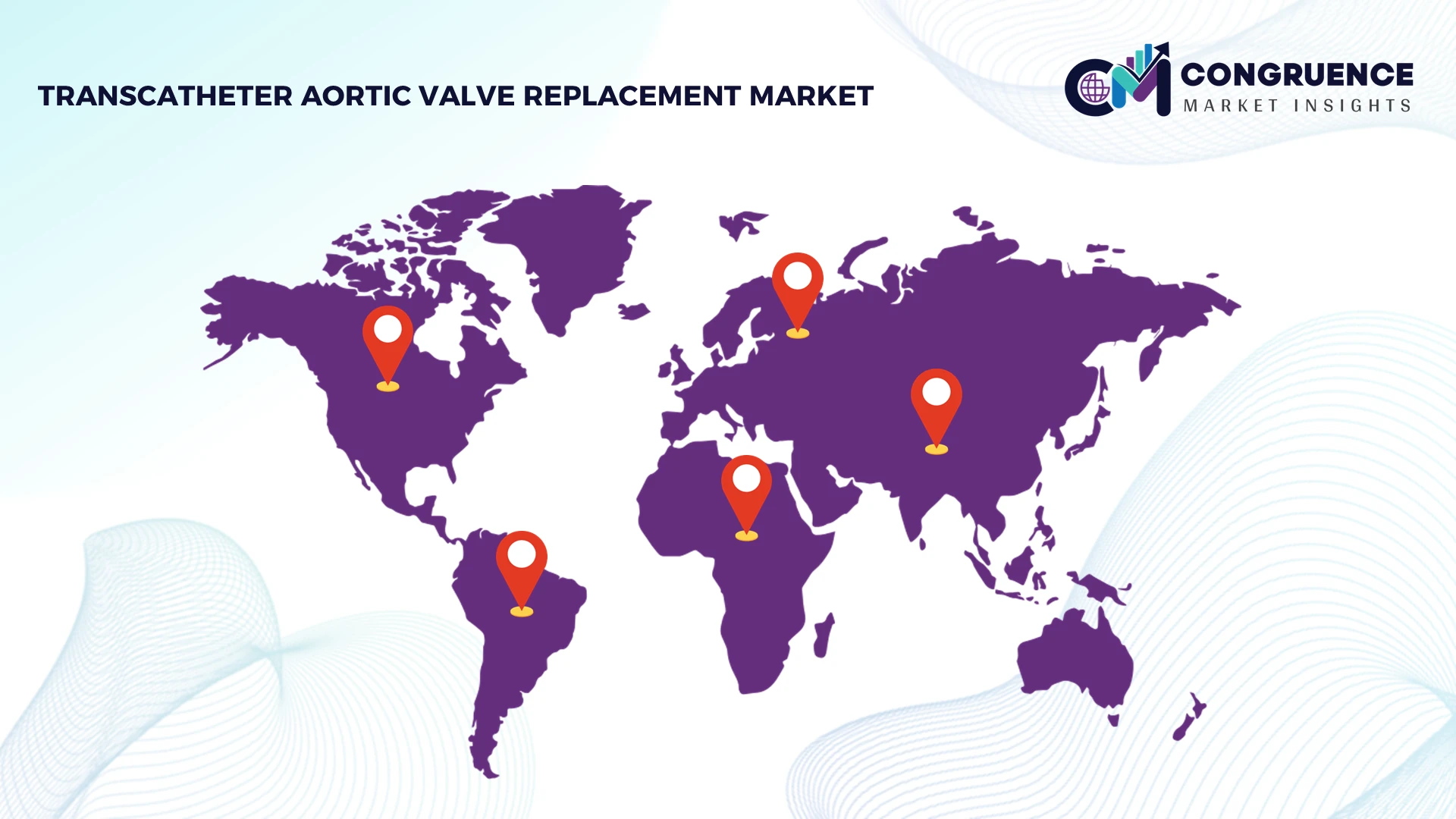
North America accounted for the largest market share at approximately 48% in 2025 however, Asia-Pacific is expected to register the fastest growth, expanding at a CAGR of approximately 7% between 2026 and 2033.
Earlier Intervention Strengthens Structural-Heart Scale
North America maintains the strongest TAVR position through extensive catheterization-laboratory infrastructure, mature reimbursement, large structural-heart networks and rapid incorporation of expanded clinical indications. The region accounts for an estimated 48% of global market activity, led overwhelmingly by the United States. The STS/ACC TVT Registry captured 383,030 U.S. TAVR patients between 2020 and March 2024, including 108,407 classified as low surgical risk. Transfemoral access exceeding 95% in mature programs has enabled standardized pathways, shorter hospitalization and greater procedural throughput. U.S. regulatory expansion into asymptomatic severe aortic stenosis further moves intervention upstream. Manufacturers are concentrating clinical programs around durability, coronary re-access, commissural alignment and repeat-intervention planning as younger, lower-risk patients become strategically more important.
United States Market Outlook: The United States combines regulatory leadership, high-volume structural-heart centers and extensive registry infrastructure. In a major real-world low-risk cohort, approximately 90% of patients were alive and well at one year, with mortality of 4.6% and stroke of 2.6%. This evidence base supports increasingly standardized patient selection and strengthens manufacturer investment in next-generation valve platforms.
High Procedure Density Supports Mature Adoption
Europe represents an estimated 29% of global TAVR activity, supported by established public healthcare systems, experienced heart teams and broad acceptance of catheter-based valve replacement. Germany, France, Italy and the United Kingdom anchor procedure volumes, although reimbursement and treatment capacity remain uneven between countries. Germany stands out with TAVI procedure density above 300 interventions per million population, illustrating considerably deeper deployment than many European healthcare systems. European operators increasingly emphasize minimalist transfemoral procedures, conscious sedation and shorter hospital stays as bed and clinical-workforce pressures intensify. At the supplier level, regulatory evidence requirements are becoming more demanding, demonstrated by the 2025 withdrawal of Boston Scientific's ACURATE platform. This environment favors manufacturers capable of supporting extensive clinical evidence, post-market surveillance and consistent outcomes across multiple national reimbursement systems.
Germany Market Outlook: Germany remains Europe's strategically important TAVI market, recording approximately 312 procedures per million population in 2023. Its dense cardiac-center network, mature reimbursement environment and extensive physician experience enable high procedural utilization. Hospitals increasingly use catheter-based intervention across broader surgical-risk categories, making Germany an important proving ground for procedural efficiency and next-generation valve technologies.
Structural-Heart Infrastructure Accelerates Deployment
Asia-Pacific holds an estimated 16% of global TAVR activity but offers the strongest deployment runway as China, Japan, India and South Korea expand structural-heart capabilities. Japan combines universal healthcare coverage with established reimbursement and an aging population, while China is developing a significant domestic transcatheter-valve manufacturing ecosystem. India is moving from concentrated metropolitan adoption toward broader tertiary-care deployment as advanced valve platforms secure regulatory approvals and physician-training networks expand. Unlike mature Western markets, regional competition increasingly includes locally engineered valves positioned around anatomical requirements and procurement economics. Domestic manufacturing in China also reduces dependence on imported systems and creates pricing pressure for established multinational suppliers. Companies are responding through local clinical studies, distributor partnerships, physician education and country-specific product portfolios rather than relying exclusively on globally standardized commercialization strategies.
China Market Outlook: China combines a large untreated structural-heart population with expanding domestic device capabilities. Indigenous manufacturers including Venus Medtech, Peijia Medical and MicroPort compete with multinational platforms, strengthening local supply and technology development. The country's strategic advantage lies in combining hospital expansion, local engineering and lower-cost valve platforms capable of accelerating penetration beyond top-tier metropolitan cardiac centers.
Referral Concentration Shapes TAVR Access
South America represents approximately 4% of global TAVR activity, with deployment concentrated in Brazil, Argentina, Chile and selected private healthcare networks. Brazil dominates procedural capacity because of its large cardiovascular patient population, established interventional cardiology centers and combination of public and private treatment pathways. However, imported device dependence, currency volatility and uneven reimbursement constrain expansion outside major urban hospitals. TAVR therefore remains substantially more concentrated than conventional cardiovascular interventions. Brazil's public health system has progressively incorporated transcatheter valve technologies, while private hospitals typically provide faster access to newer-generation platforms. Suppliers are emphasizing distributor relationships, physician training and selective high-volume institutional partnerships rather than broad hospital coverage. Local clinical expertise creates expansion potential, but procurement economics remain the decisive operational constraint for wider adoption.
Brazil Market Outlook: Brazil provides South America's deepest structural-heart infrastructure and largest addressable treatment population. More than 75% of Brazilians depend primarily on the public SUS healthcare system, making reimbursement decisions critical to TAVR accessibility. Multinational manufacturers consequently require dual strategies spanning premium private cardiac centers and cost-sensitive public procurement pathways to achieve sustainable procedural scale.
Specialist Cardiac Investment Expands Access
Middle East & Africa represents an estimated 3% of global TAVR activity, with procedures concentrated in Saudi Arabia, the United Arab Emirates, Israel, South Africa and advanced tertiary-care institutions. Gulf healthcare modernization is strengthening catheterization laboratories, cardiac imaging and specialist training, while government-backed hospital development supports adoption of minimally invasive cardiovascular technologies. Saudi Arabia's healthcare transformation under Vision 2030 is particularly relevant as authorities expand specialist capacity and reduce dependence on overseas treatment. The UAE similarly uses internationally affiliated hospital networks to accelerate advanced structural-heart deployment. Across Africa, adoption remains concentrated because specialist workforce availability, reimbursement and advanced imaging infrastructure vary substantially. Manufacturers therefore prioritize clinical partnerships, training programs and high-capability referral hospitals rather than broad geographic distribution.
Saudi Arabia Market Outlook: Saudi Arabia offers the strongest Gulf expansion platform through large-scale healthcare modernization and tertiary cardiac investment. Vision 2030 targets substantial private-sector participation in healthcare, while specialized cardiac centers increasingly incorporate catheter-based valve interventions. Centralized procurement and expanding specialist infrastructure make institutional partnerships, physician training and reliable device supply particularly important competitive advantages.
Edwards Lifesciences and Medtronic dominate TAVR competition, while Abbott, Meril Life Sciences, Venus Medtech and other structural-heart innovators challenge through specialized platforms and geographic expansion. The top five commercially relevant suppliers are estimated to control above 90% of global TAVR device activity, reflecting high clinical and regulatory barriers. Edwards' balloon-expandable SAPIEN franchise competes directly with Medtronic's self-expanding Evolut platform, creating the market's central technology rivalry. Transfemoral access exceeding 95% makes delivery profile, positioning precision and procedural simplicity decisive, while permanent pacemaker rates can differ by roughly 5–10 percentage points between platforms and patient populations. Chinese and Indian manufacturers increasingly compete through localization and procurement economics. Leading companies are investing in commissural alignment, sealing technologies, coronary-access preservation, clinical trials and physician training. Regulatory evidence requirements are simultaneously driving portfolio consolidation. Winning requires proven durability, predictable outcomes, scalable manufacturing, extensive clinical evidence and lifetime valve-management capabilities.
Edwards Lifesciences Corporation
Medtronic plc
Abbott Laboratories
Meril Life Sciences Pvt. Ltd.
Venus Medtech (Hangzhou) Inc.
Peijia Medical Limited
MicroPort Scientific Corporation
JenaValve Technology, Inc.
Anteris Technologies Global Corp.
JC Medical, Inc.
NVT AG
Braile Biomédica
Colibri Heart Valve LLC
HighLife SAS
Current TAVR technology is centered on balloon-expandable and self-expanding valves, low-profile transfemoral delivery, advanced sealing skirts, and CT-guided sizing. Transfemoral access exceeds 95% in mature U.S. programs, reducing reliance on surgical access. Contemporary platforms have pushed moderate-or-greater paravalvular leakage toward roughly 2–3% in selected populations, improving procedural predictability, recovery speed, and hospital throughput while strengthening standardized structural-heart workflows.
Emerging technology emphasizes coronary re-access, commissural alignment, supra-annular hemodynamics, and durable leaflet materials. Medtronic’s Evolut FX+ uses coronary windows four times larger than earlier Evolut designs, while advanced imaging supports anatomy-specific valve selection. Compared with legacy open surgery, modern transfemoral TAVR can reduce typical hospitalization from roughly 5–9 days toward 1–3 days, representing more than 40% improvement in bed utilization for suitable patients and enabling higher procedural capacity.
Disruptive development is moving toward AI-enabled case identification, digital procedural planning, redo-TAVR, and lifetime valve management. SMART three-year evidence showed bioprosthetic valve dysfunction of 16.3% with Evolut versus 54.4% with SAPIEN in small-annulus patients. Between 2026 and 2028, manufacturers combining predictive imaging, durable tissue, coronary-access preservation, and repeat-intervention compatibility will gain competitive advantage as hospitals increasingly select platforms around lifetime performance rather than implantation success alone.
March 2024 – Medtronic received FDA approval for Evolut FX+, featuring coronary-access windows four times larger than earlier Evolut designs. The modification improves catheter maneuverability after implantation, strengthening lifetime coronary-management capabilities for younger TAVR patients. Source: fda.gov
May 2025 – Edwards Lifesciences secured FDA approval for SAPIEN 3 TAVR in asymptomatic severe aortic stenosis after EARLY TAVR showed primary events of 26.8% versus 45.3% under surveillance, materially expanding earlier-intervention eligibility. Source: edwards.com
May 2025 – Boston Scientific discontinued worldwide ACURATE neo2 and ACURATE Prime sales after increased regulatory requirements made additional investment prohibitive; shares fell 1.5% premarket, accelerating TAVR portfolio consolidation and strengthening established competitors. Source: pharmalive.com
May 2026 – SMART three-year results showed Medtronic Evolut bioprosthetic valve dysfunction at 16.3% versus 54.4% for Edwards SAPIEN in small-annulus patients, strengthening anatomy-specific platform differentiation and long-term hemodynamic competition. Source: cardiovascularbusiness.com
The Transcatheter Aortic Valve Replacement Market Report evaluates Balloon-Expandable, Self-Expanding, and Mechanically Expandable technologies across Aortic Stenosis, Native Valve Replacement, Valve-in-Valve Procedures, and High-Risk Patients. End-user coverage includes Hospitals, Cardiac Centers, Specialty Clinics, and Ambulatory Surgical Centers. Regional assessment spans North America, Europe, Asia-Pacific, South America, and Middle East & Africa, with country-level analysis of structural-heart infrastructure, regulatory pathways, procedural deployment, and competitive positioning.
The report tracks advanced CT planning, AI-enabled patient identification, commissural alignment, coronary-access preservation, durable leaflet technologies, and redo-TAVR strategies. Transfemoral access exceeding 95% in mature U.S. practice and low-risk patients representing 28.3% of a large registry cohort illustrate changing deployment patterns. Through 2026–2033, the analysis supports investment planning, geographic expansion, product-development priorities, hospital partnerships, competitive benchmarking, and positioning around earlier intervention and lifetime valve management.
| Report Attribute/Metric | Report Details |
|---|---|
Market Revenue in 2025 | USD 4557.91 Million |
Market Revenue in 2033 | USD 6383.22 Million |
CAGR (2026 - 2033) | 4.3% |
Base Year | 2025 |
Forecast Period | 2026 - 2033 |
Historic Period | 2021 - 2025 |
Segments Covered | By Type
By Application
By End-User
|
Key Report Deliverable | Revenue Forecast, Growth Trends, Market Dynamics, Segmental Overview, Regional and Country-wise Analysis, Competition Landscape |
Region Covered | North America, Europe, Asia-Pacific, South America, Middle East, Africa |
Key Players Analyzed | Edwards Lifesciences Corporation, Medtronic plc, Abbott Laboratories, Meril Life Sciences Pvt. Ltd., Venus Medtech (Hangzhou) Inc., Peijia Medical Limited, MicroPort Scientific Corporation, JenaValve Technology, Inc., Anteris Technologies Global Corp., JC Medical, Inc., NVT AG, Braile Biomédica, Colibri Heart Valve LLC, HighLife SAS |
Customization & Pricing | Available on Request (10% Customization is Free) |




