
Reports
The Global Train Toilet Systems Market was valued at USD 700.1 Million in 2025 and is anticipated to reach a value of USD 1,050.2 Million by 2033 expanding at a CAGR of 5.2% between 2026 and 2033. Growth is driven by fleet modernization, vacuum-toilet adoption, water-saving sanitation, and stricter passenger-amenity requirements across high-speed and intercity rail networks.
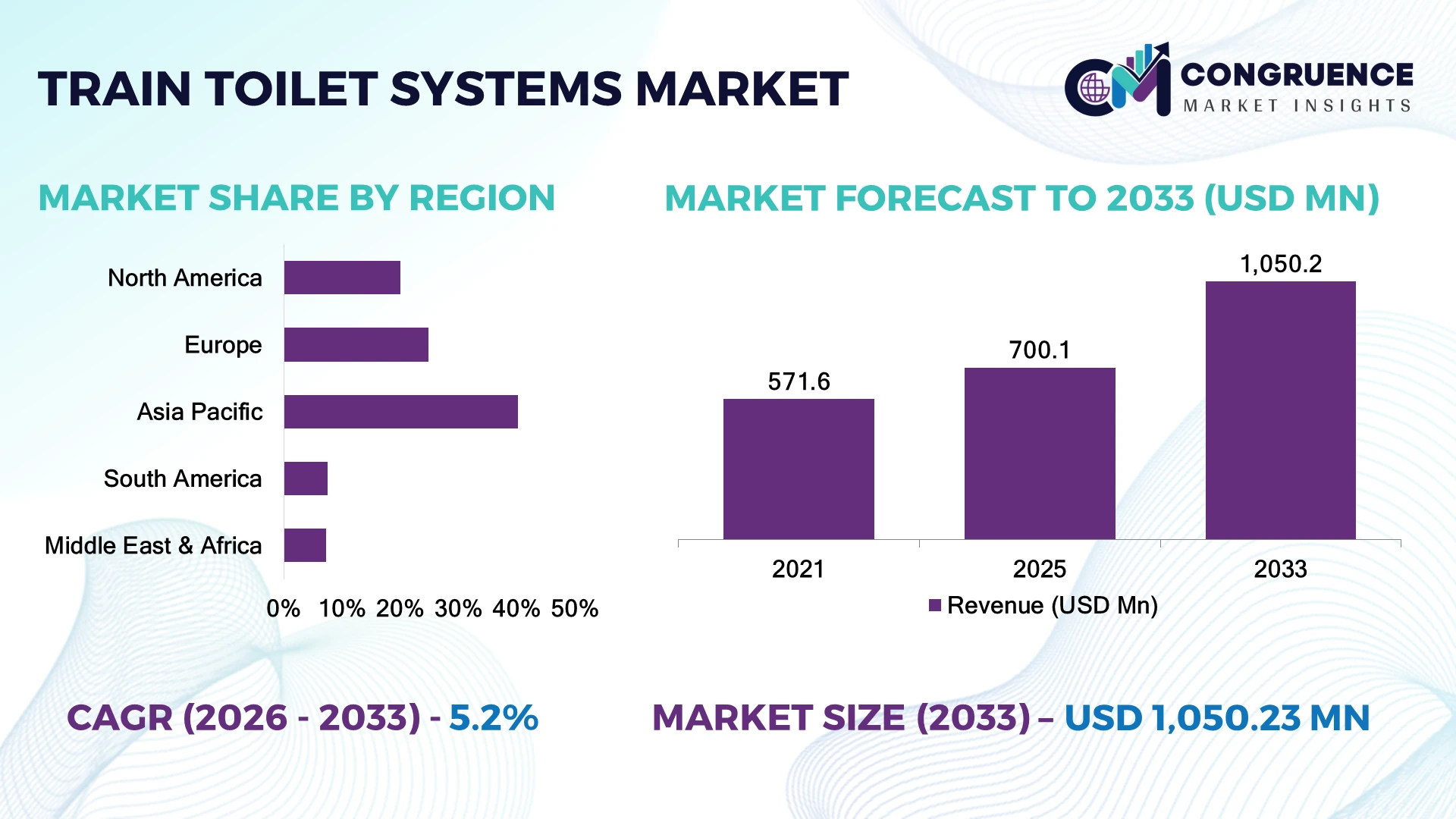
China represents the dominant country market, accounting for approximately 25–28% of global train toilet-system demand, supported by extensive high-speed rail deployment and continued rolling-stock investment. Japan and Germany remain technology-intensive markets, with advanced vacuum systems and compact wastewater-treatment solutions widely integrated into premium fleets. China's high-speed rail network exceeds 48,000 km, while India's expanding rail modernization program is increasing demand for bio-digesting and controlled-discharge sanitation. More than 60% of newly specified premium passenger coaches increasingly incorporate water-efficient or vacuum-based toilet architectures.
Strategically, suppliers that combine low water consumption, reliable waste management, compact design, and retrofit compatibility will capture the strongest fleet-modernization opportunities.
Market Size & Growth: USD 700.1 million in 2025 to USD 1,050.2 million by 2033 at 5.2% CAGR, supported by fleet modernization and vacuum sanitation.
Top Growth Drivers: 38% fleet renewal demand, 27% high-speed rail deployment, and 19% water-efficiency requirements.
Short-Term Forecast: By 2028, automated flushing and vacuum systems can reduce water consumption by 30–50% versus conventional gravity toilets.
Emerging Technologies: Vacuum toilets, bio-digesters, compact wastewater treatment, sensor-based fill monitoring, and antimicrobial surfaces are reshaping onboard sanitation.
Regional Leaders: Asia-Pacific is projected at approximately USD 430 million by 2033, Europe at USD 280 million, and North America at USD 190 million, with high-speed and intercity fleets driving technology upgrades.
Consumer/End-User Trends: Approximately 60–65% of new premium passenger-car specifications increasingly prioritize water-efficient, low-maintenance toilet systems.
Pilot/Case Example: India's rail modernization programs have deployed bio-toilet systems across more than 100,000 passenger coaches, substantially reducing direct human-waste discharge onto tracks.
Competitive Landscape: WABTEC commands an estimated 10–12% share of the global train-sanitation equipment ecosystem, competing with EVAC, Knorr-Bremse, SEMVAC, and JKDD.
Regulatory & ESG Impact: Vacuum and bio-digester systems can reduce onboard water consumption by approximately 30–50% while limiting untreated waste discharge.
Investment & Funding: Rail operators and rolling-stock OEMs are directing multimillion-dollar modernization budgets toward sanitation retrofits, localized manufacturing, and integrated wastewater-management systems.
Innovation & Future Outlook: 2026–2028 development is shifting toward sensor-enabled toilets, predictive maintenance, modular wastewater treatment, antimicrobial materials, and digitally monitored sanitation systems.
The Train Toilet Systems Market is shifting from basic onboard sanitation toward integrated water, waste, and passenger-comfort systems. Vacuum toilets, bio-digesters, compact wastewater treatment, antimicrobial surfaces, and sensor-based monitoring are gaining importance across high-speed, intercity, and premium rail fleets. Water-efficient systems can reduce consumption by approximately 30–50%, while predictive monitoring is reducing unnecessary maintenance interventions. India's fleet modernization and Europe's continued rail decarbonization programs are strengthening procurement focus on lifecycle efficiency and environmentally controlled waste handling.
Train toilet systems have become strategically important because sanitation directly affects fleet availability, passenger experience, maintenance economics, and environmental compliance. For rolling-stock manufacturers and rail operators, toilet architecture is no longer a standalone interior component; it influences water consumption, wastewater handling, servicing frequency, vehicle weight, and depot operations.
Vacuum systems provide a measurable advantage over conventional gravity toilets, with water consumption reductions of approximately 30–50% and lower wastewater volumes. Europe emphasizes compact, energy-efficient systems for modern intercity and high-speed fleets, while China and India are prioritizing large-scale fleet deployment and retrofit economics. Over the next 2–3 years, sensor-based monitoring and modular wastewater treatment are expected to become increasingly common in new fleet specifications.
A practical example is India's widespread deployment of bio-toilet systems across passenger coaches, combining onboard biological waste treatment with reduced track contamination. Suppliers are responding by developing modular components, localized production, predictive-maintenance systems, and retrofit-compatible designs. The competitive advantage is shifting toward suppliers that can deliver complete sanitation ecosystems rather than individual toilet hardware. Long-term winners will combine water efficiency, reliable waste treatment, compact engineering, maintainability, and proven performance across diverse rail operating conditions.
Fleet replacement and refurbishment are driving adoption of vacuum, bio-digester, and closed-waste train toilet systems, with approximately 35–40% of current procurement linked to new or substantially modernized passenger coaches. Vacuum architectures can reduce water consumption by 30–50%, while automated flushing reduces servicing frequency by roughly 10–20%. India's continuing coach modernization and China's high-speed rail expansion are shifting procurement toward integrated sanitation modules rather than basic toilet hardware. Rolling-stock OEMs and sanitation specialists are responding through modular designs, localized assembly, and long-term supply agreements. The non-obvious advantage is lifecycle economics: lower water use and reduced depot servicing can materially improve fleet operating costs, making sanitation technology a procurement consideration rather than an interior-equipment afterthought.
Retrofitting advanced train toilet systems into legacy coaches remains constrained by available underfloor space, electrical interfaces, water systems, and wastewater architecture. Retrofit projects can require 15–25% additional engineering effort compared with new-build integration, while installation-related downtime can increase project costs by approximately 10–15%. Older fleets also contain incompatible piping and control architectures, limiting standardized component replacement. India and parts of Eastern Europe face particularly diverse legacy rolling-stock configurations, increasing customization requirements. Suppliers are reducing exposure through modular toilet cassettes, standardized interfaces, localized engineering, and multi-year framework contracts. The operational pressure is strongest where operators must modernize large fleets without disrupting scheduled service, making retrofit compatibility a decisive factor in supplier selection.
Connected train toilet systems are creating opportunities to shift maintenance from scheduled servicing toward condition-based intervention. Sensors monitoring tank levels, flush cycles, pressure, leakage, and valve performance can reduce unnecessary maintenance activity by approximately 15–25% and improve fault-detection response by 20–30%. Germany, Japan, and China provide attractive deployment environments because modern rolling-stock fleets increasingly use digital maintenance platforms. The next opportunity is integration with fleet-management systems, allowing toilet faults to be identified before trains reach passenger service. Suppliers are investing in IoT controllers, remote diagnostics, and modular sensor packages while partnering with rolling-stock OEMs. The strategic opportunity lies in monetizing lifecycle services, where predictive analytics create recurring value beyond the initial sanitation-system sale.
Train toilet systems must withstand vibration, temperature variation, pressure changes, frequent passenger use, and irregular maintenance conditions, creating demanding reliability requirements. High-utilization intercity and high-speed fleets can generate thousands of flush cycles annually per coach, while system downtime can affect passenger-service availability and maintenance scheduling. Sensor-enabled architectures also introduce additional electronic components, increasing diagnostic and cybersecurity requirements by approximately 10–15% compared with purely mechanical systems. China's high-frequency passenger fleets and India's large mixed-age rolling-stock base intensify these pressures. Manufacturers must improve valve durability, corrosion resistance, software diagnostics, and remote fault isolation through accelerated testing and field partnerships. Long-term competitiveness will depend on maintaining sanitation performance across diverse operating environments without increasing maintenance complexity.
Vacuum Systems Gain Specification Priority: Rail operators are increasingly specifying vacuum toilets for new passenger coaches because water consumption can fall 30–50% versus conventional gravity systems. Compact vacuum plumbing also reduces underfloor installation requirements by approximately 15–20%, improving packaging flexibility. European and Asian rolling-stock manufacturers are integrating standardized vacuum modules earlier in vehicle design, reducing later engineering changes and supporting faster assembly.
Sensor Monitoring Enters Service: Toilet systems are increasingly equipped with level, pressure, leakage, and valve sensors, enabling condition-based maintenance. Connected monitoring can reduce unnecessary service interventions by approximately 15–25% and accelerate fault identification by 20–30%. Operators are integrating these signals into fleet-maintenance dashboards, while suppliers are developing modular electronics that can be installed during refurbishment without replacing the complete sanitation system.
Bio-Treatment Gains Fleet Scale: Biological waste-treatment systems continue expanding in fleets where direct discharge restrictions and environmental performance are procurement priorities. India's large-scale bio-toilet deployment has demonstrated the feasibility of integrating onboard biological treatment across high-volume passenger fleets. Newer systems focus on approximately 20–30% lower maintenance intervention through improved bacterial dosing and tank management, encouraging suppliers to refine treatment cartridges and monitoring controls.
Modular Retrofit Designs Expand: Suppliers are shifting toward modular toilet cassettes, standardized connectors, and replaceable valve assemblies as operators modernize mixed-age fleets. Modular architecture can reduce installation time by approximately 15–25% and simplify spare-parts inventories by 10–15%. This is particularly relevant for India and European legacy fleets, where coach configurations vary substantially. Manufacturers are responding with configurable platforms rather than one-off engineering projects.
Vacuum toilet systems represent the leading type, accounting for approximately 48–53% of the global Train Toilet Systems Market, supported by substantially lower water consumption, compact plumbing architecture, reduced wastewater volumes, and compatibility with high-speed rolling stock. Conventional gravity toilets retain approximately 20–25% share, primarily within older fleets and cost-sensitive refurbishment programs, while bio-toilet systems contribute around 15–20%. Vacuum technology has therefore become the preferred architecture for new premium and high-speed coaches, where space and water efficiency directly affect vehicle design and operating economics.
Bio-toilet and advanced wastewater-treatment systems represent the fastest-shifting segment, particularly in markets replacing direct-discharge sanitation. India's large passenger-coach fleet has accelerated deployment of biological treatment, while European operators emphasize closed wastewater systems. Approximately 30–40% of new sanitation-system specifications increasingly incorporate some form of water-saving or waste-treatment technology. Manufacturers are responding through modular vacuum units, improved bio-treatment cartridges, sensor monitoring, and OEM partnerships. Investment is shifting toward integrated sanitation platforms that combine toilet hardware, wastewater management, diagnostics, and simplified maintenance rather than standalone fixtures.
Indian Railways reported that bio-toilets had been fitted in more than 100,000 passenger coaches by 2024, demonstrating the scale at which onboard biological waste-treatment technology has moved from pilot deployment into fleet-wide implementation.
High-speed passenger trains represent the leading application, accounting for approximately 38–42% of global train toilet-system demand, supported by high passenger throughput, premium onboard specifications, tighter space constraints, and strong emphasis on reliability. Intercity trains contribute around 30–35%, while regional and commuter trains account for approximately 20–25%. High-speed fleets favor vacuum sanitation because compact plumbing and lower water consumption support lightweight vehicle architecture and longer operating intervals between servicing.
Intercity and long-distance passenger services represent the fastest-growing application segment as operators modernize aging fleets and improve passenger amenities. Approximately 60–65% of newly refurbished long-distance coaches increasingly incorporate water-efficient sanitation or upgraded wastewater containment. Regional operators remain more price-sensitive and continue using conventional systems where infrastructure and service requirements permit. Suppliers are responding with modular designs, standardized interfaces, remote diagnostics, and configurable toilet modules that reduce engineering effort across different coach platforms. The business implication is a growing premium for systems that deliver reliability and maintainability across high-utilization fleets rather than simply meeting basic sanitation requirements.
The International Union of Railways' 2025 passenger-rail work continued to emphasize high-speed and international passenger services as priority areas for fleet modernization, supporting investment in passenger-comfort and onboard-service systems.
Rail operators represent the leading end-user group, accounting for approximately 55–60% of global Train Toilet Systems Market procurement because they control fleet specifications, refurbishment schedules, maintenance contracts, and lifecycle replacement decisions. Rolling-stock OEMs account for approximately 25–30% of demand through factory-installed systems, while leasing companies and specialist fleet-management organizations contribute roughly 10–15%. Operators prioritize reliability, water consumption, service intervals, spare-parts availability, and total lifecycle cost, whereas OEMs place greater emphasis on packaging, weight, modularity, and integration with vehicle control systems.
Rolling-stock manufacturers represent the fastest-growing strategic buyer group as toilet-system integration increasingly occurs during vehicle design rather than after production. Approximately 30–35% of advanced sanitation procurement is now linked to factory-installed or OEM-integrated systems. Companies such as Wabtec and Knorr-Bremse benefit from supplying broader rail subsystems, while specialist sanitation manufacturers compete through modular technology and engineering partnerships. Suppliers are therefore developing configurable platforms, common interfaces, and predictive-maintenance capabilities. Future demand is shifting toward integrated OEM relationships, where sanitation suppliers can secure multi-year fleet contracts rather than relying primarily on replacement orders.
Railway industry procurement increasingly favors integrated rolling-stock platforms, with 2025–2026 fleet programs placing greater emphasis on modular subsystems, lifecycle maintenance, and standardized components to reduce vehicle integration and servicing complexity.
Asia-Pacific accounted for the largest market share at 40.2% in 2025 however, Asia-Pacific is expected to register the fastest growth, expanding at a CAGR of 6.4% between 2026 and 2033.

Fleet refurbishment shifts demand toward modular sanitation platforms
North America accounted for approximately 20.1% of the global Train Toilet Systems Market in 2025, supported by extensive passenger-rail refurbishment, long-distance services, and demand for reliable onboard sanitation. The U.S. dominates regional procurement, while Canada contributes through intercity and commuter fleet modernization. Vacuum systems, closed wastewater architectures, and sensor-enabled monitoring are increasingly specified where operators prioritize reduced servicing frequency and water consumption. Newer systems can reduce onboard water use by approximately 30–50% compared with conventional configurations. Manufacturers are increasingly partnering with rolling-stock OEMs and maintenance providers to integrate sanitation modules during refurbishment rather than treating toilets as standalone replacement components. This favors suppliers offering standardized interfaces, remote diagnostics, and readily replaceable assemblies.
United States Market Outlook: The U.S. provides the region's largest addressable fleet base, supported by Amtrak services, commuter rail networks, and continuing investment in passenger-rail infrastructure. Long-distance coaches require robust sanitation systems capable of extended operating cycles between depot visits. Vacuum toilets, wastewater containment, and condition-monitoring technologies are therefore gaining procurement relevance, particularly for refurbished and newly manufactured passenger equipment.
Sustainability standards strengthen closed-system adoption
Europe represented approximately 24.8% of global demand in 2025, supported by extensive intercity, high-speed, and cross-border passenger-rail operations. Fleet modernization increasingly favors closed wastewater systems, vacuum sanitation, low-water flushing, and modular serviceable components. Approximately 35–40% of new or substantially upgraded passenger-car sanitation specifications increasingly emphasize water efficiency and controlled waste handling. Germany, France, Italy, and Spain remain important procurement markets, while European rolling-stock manufacturers provide substantial technology integration capability. Suppliers are responding with lightweight modules, automated diagnostics, and standardized interfaces that simplify integration across multiple train platforms. The strategic shift is from basic sanitation replacement toward lifecycle-oriented systems that reduce depot intervention and improve fleet availability.
Germany Market Outlook: Germany combines a large passenger-rail operating base with strong rolling-stock engineering capabilities and extensive intercity and regional services. Deutsche Bahn's fleet modernization supports demand for reliable onboard systems with lower maintenance requirements. German engineering expertise also strengthens domestic supplier participation in vacuum sanitation, wastewater management, controls, and integrated rolling-stock subsystems.
High-speed rail scale accelerates integrated sanitation deployment
Asia-Pacific held approximately 40.2% of the global market in 2025, making it the largest regional demand center. China, Japan, India, and South Korea account for the majority of advanced passenger-rail deployment, with China's high-speed network providing particularly strong demand for compact, high-reliability sanitation systems. China's high-speed railway network exceeds 45,000 km, creating substantial installed-equipment and replacement opportunities. India is simultaneously upgrading conventional coaches with biological waste-treatment systems, while Japan emphasizes compact, reliable sanitation architecture for high-utilization fleets. Manufacturers are increasing localized production, OEM integration, and modular product development to serve different fleet specifications. Scale advantages increasingly favor suppliers capable of supporting both new-build programs and large refurbishment contracts.
China Market Outlook: China is the region's largest train-sanitation opportunity because of its extensive high-speed and conventional passenger fleet. More than 45,000 km of high-speed railway infrastructure supports continuous demand for onboard sanitation equipment, replacement components, and maintenance services. Domestic rolling-stock production also enables close supplier-OEM integration, accelerating adoption of compact vacuum systems, automated controls, and modular wastewater technologies.
Intercity modernization creates selective replacement demand
South America represented approximately 7.6% of global Train Toilet Systems Market demand in 2025, with procurement concentrated in Brazil, Argentina, and selected urban and intercity rail modernization programs. Brazil accounts for the largest addressable market because of its comparatively extensive passenger and metropolitan rail infrastructure. Demand remains weighted toward refurbishment and replacement rather than large-scale high-speed deployment. Approximately 30–35% of procurement activity is associated with modernization or replacement of existing sanitation equipment, creating opportunities for modular systems that minimize coach downtime. Operators remain sensitive to installation cost, spare-parts availability, and local maintenance capability. Suppliers are therefore emphasizing simplified assemblies, localized servicing, and adaptable vacuum or wastewater modules rather than highly customized platforms.
Brazil Market Outlook: Brazil represents the region's most significant opportunity because of its large urban rail footprint and ongoing rolling-stock modernization requirements. São Paulo and Rio de Janeiro contain major passenger-rail operating networks, creating recurring demand for durable sanitation components and refurbishment services. Suppliers with local maintenance capability and flexible retrofit solutions are better positioned to address varied fleet configurations and infrastructure conditions.
New rail infrastructure supports premium sanitation specifications
Middle East & Africa accounted for approximately 7.3% of global demand in 2025, with procurement increasingly concentrated around new passenger-rail infrastructure and premium intercity services. Saudi Arabia, the United Arab Emirates, Morocco, and South Africa represent important project markets, while Gulf investments favor modern rolling-stock architectures with advanced passenger amenities. New trains increasingly incorporate vacuum toilets, closed wastewater systems, antimicrobial surfaces, and automated monitoring. Approximately 30–40% of sanitation demand in major new-build programs is linked to advanced water-efficient configurations. Suppliers are targeting these projects through OEM partnerships, project-specific engineering, and localized after-sales support. The region's non-obvious advantage is that greenfield fleets allow advanced sanitation architecture to be integrated from the design stage, avoiding many retrofit constraints.
Saudi Arabia Market Outlook: Saudi Arabia is the region's strongest growth opportunity due to substantial investment in passenger and high-speed rail infrastructure. The Haramain High Speed Railway demonstrates demand for premium onboard systems, while expanding rail connectivity supports additional rolling-stock procurement. Suppliers offering low-water vacuum sanitation, durable wastewater systems, and remote diagnostics are aligned with the country's emphasis on modern, high-capacity passenger infrastructure.
Evac/Knorr-Bremse, Wabtec, Kineco Global Rail/Semvac, Trainvac, and BFG International form the core competitive set. Evac competes with Trainvac on integrated vacuum systems; Wabtec focuses on established rail components, while Kineco/Semvac and BFG challenge through localization and modular cabin integration. The top five are estimated at 40–45% combined share. Competition centers on technology, lifecycle cost, supply reliability, and customization: low-water systems can cut consumption by up to 50%, modular designs can reduce installation time 15–25%, and integrated cabin delivery compresses coordination requirements. Players are expanding through OEM partnerships, localized manufacturing, aftermarket distribution, and vertical integration. Kineco’s acquisition of Semvac strengthened Indian-European coverage, while Trainvac and Unipart expanded aftermarket reach. The competitive shift is toward integrated, sensor-enabled sanitation platforms and lifecycle services. Entry barriers include rail certification, fleet references, OEM qualification, and service infrastructure across major fleets. Winning requires proven reliability, rapid customization, localized support, and measurable maintenance savings.
Evac GmbH / Knorr-Bremse
Wabtec Corporation
Kineco Global Rail
Trainvac Group
BFG International
Glova Rail
FRENZELIT
Temoinsa
Fom Industrie
Sphere Thermal Systems
GenX SynerTech
Saket Autotech Innovations
Train toilet technology is shifting from vacuum hardware toward integrated, sensor-controlled sanitation platforms. Vacuum flushing remains foundational, with systems using up to 50% less water than conventional designs. Real-time pressure, tank-level, cycle-count and fault monitoring is moving into new platforms; connected controls can improve maintenance-response efficiency by roughly 15–20%. Evac’s MLC architecture illustrates integration with data systems, giving operators visibility rather than isolated toilet alarms.
Modular cabin architecture is gaining traction because preassembled units shorten installation and reduce interface complexity. Integrated modules can reduce installation activity by approximately 15–25%, while standardized connectors improve replacement speed. BFG reports more than 25,000 rail toilet cabins delivered, demonstrating scale for turnkey sanitation modules. Bio-vacuum hybrids matter in India, combining biological treatment with vacuum-assisted waste transfer. Compared with older gravity systems, low-water vacuum architectures reduce flushing-water consumption by 30–50%, lowering tank requirements and servicing frequency.
From 2026–2028, the competitive edge will shift toward predictive maintenance, digital diagnostics, touchless controls, and lightweight materials. Operators benefit from fewer interventions, while OEMs gain integration and standardized interfaces. Evac, Trainvac, and rolling-stock suppliers are positioned to benefit because their platforms combine hardware, controls, software, and lifecycle support. The immediate priority now is interoperable systems that convert toilet data into fleet-maintenance decisions better today.
January 2025 Kineco Group acquired 100% of Semvac A/S from Wabtec UK Holdings, adding railway sanitary systems to its Global Rail portfolio. The transaction expanded European customer access and strengthened India-focused manufacturing and aftermarket capabilities. Source: Kineco Global Rail
September 2025 Knorr-Bremse won an equipment order from BEML to supply sanitary systems alongside braking, entrance and HVAC technologies for India’s first high-speed train prototypes. The initial two-prototype-train contract strengthens integrated-system participation in India’s emerging high-speed rail program. Source: Knorr-Bremse
May 2024 Eastern Railway reported bio-toilets across 116 Mail/Express and 86 Passenger trains, totaling 14,360 bio-toilet banks across 3,990 coaches. The deployment expanded biological waste treatment while improving odor control and waste management. Source: Press Information Bureau
January 2025 Unipart Rail formed a strategic partnership with Trainvac Group to distribute train-toilet spares exclusively in the UK aftermarket. The agreement targets faster parts availability and supports maintenance, leasing, and fleet-reliability requirements across European sanitary-system installations. Source: Rail Forum
The Train Toilet Systems Market Report covers the global market across vacuum toilets, conventional systems, bio-toilets, and integrated wastewater-treatment configurations, segmented by high-speed, intercity, regional, commuter, and other passenger-rail applications. End-user analysis evaluates rail operators, rolling-stock OEMs, fleet-management organizations, and refurbishment providers. Regional coverage spans North America, Europe, Asia-Pacific, South America, and Middle East & Africa, with analysis of China, India, Japan, Germany, the United States, Brazil, and Saudi Arabia.
The report evaluates vacuum flushing, bio-digestion, water and waste management, sensor-based monitoring, touchless controls, modular cabin architecture, and predictive-maintenance technologies. Approximately 40–45% of supply is concentrated among leading integrated and specialist providers, while retrofit programs create opportunities for modular suppliers. The analysis supports investment planning, market-entry decisions, OEM partnerships, fleet-expansion strategy, competitive positioning, procurement planning, and technology prioritization through 2026–2033, including emerging opportunities in smart sanitation and lifecycle services.
| Report Attribute/Metric | Report Details |
|---|---|
|
Market Revenue in 2025 |
USD 700.1 Million |
|
Market Revenue in 2033 |
USD 1,050.2 Million |
|
CAGR (2026 - 2033) |
5.2% |
|
Base Year |
2025 |
|
Forecast Period |
2026 - 2033 |
|
Historic Period |
2021 - 2025 |
|
Segments Covered |
By Type
By Application
By End-User
|
|
Key Report Deliverable |
Revenue Forecast, Growth Trends, Market Dynamics, Segmental Overview, Regional and Country-wise Analysis, Competition Landscape |
|
Region Covered |
North America, Europe, Asia-Pacific, South America, Middle East, Africa |
|
Key Players Analyzed |
Evac GmbH / Knorr-Bremse, Wabtec Corporation, Kineco Global Rail, Trainvac Group, BFG International, Glova Rail, FRENZELIT, Temoinsa, Fom Industrie, Sphere Thermal Systems, GenX SynerTech, Saket Autotech Innovations |
|
Customization & Pricing |
Available on Request (10% Customization is Free) |




