
Reports
The Global Trail Running Shoes Market was valued at USD 890.0 Million in 2025 and is anticipated to reach a value of USD 1,218.0 Million by 2033 expanding at a CAGR of 4.0% between 2026 and 2033. Growth is being driven by rising participation in trail running events, rapid adoption of high-performance lightweight footwear, and increasing investment in outdoor recreation infrastructure across major economies.
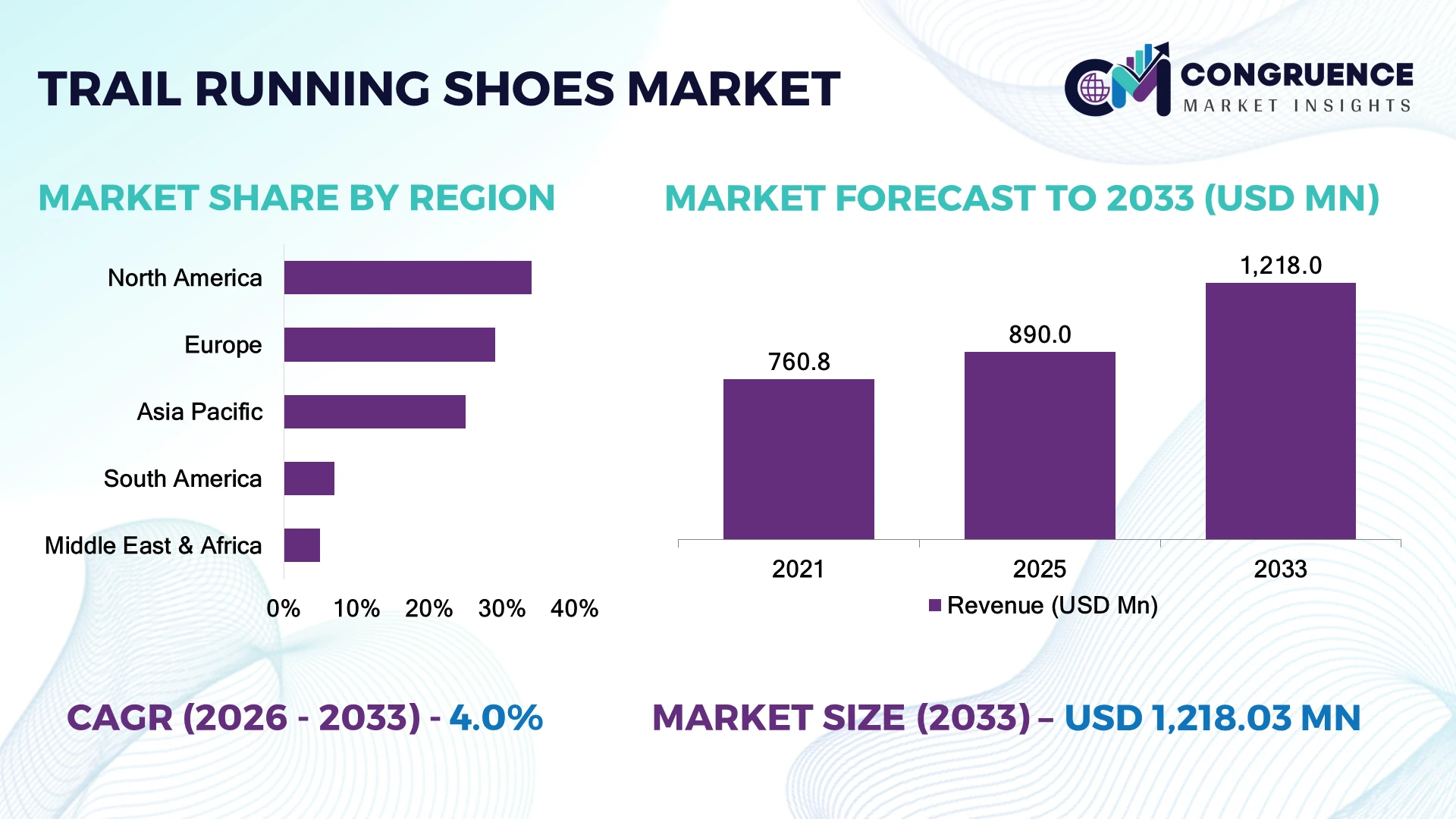
The United States dominates the global trail running shoes landscape with approximately 31% market share, supported by over 60 million annual trail users, strong outdoor recreation spending exceeding USD 1 trillion, and extensive adoption of advanced cushioning and carbon-infused footwear technologies. Compared with Germany, where organized trail race participation remains significantly smaller, the U.S. benefits from larger recreational ecosystems and higher premium footwear penetration. Continued investment in national trail networks and outdoor tourism programs strengthens long-term product adoption and brand expansion opportunities.
Strategically, companies that align innovation pipelines with performance-driven outdoor consumers and regional trail infrastructure development are positioned to secure stronger competitive advantages.
Market Size & Growth: USD 890.0 Million in 2025 reaching USD 1,218.0 Million by 2033 at 4.0% CAGR, supported by advanced cushioning systems and premium outdoor footwear adoption.
Top Growth Drivers: Trail running participation up 18%, premium performance footwear sales up 14%, and outdoor recreation spending growth exceeding 12% across key markets.
Short-Term Forecast: By 2028, lightweight material integration is projected to reduce shoe weight by 10–15%, improving athlete endurance and comfort.
Emerging Technologies: AI-assisted footwear design, carbon-plated midsoles, and advanced energy-return foams are accelerating product performance optimization.
Regional Leaders: North America projected near USD 390 Million, Europe above USD 320 Million, and Asia-Pacific exceeding USD 280 Million, driven by outdoor sports expansion and specialty retail penetration.
Consumer/End-User Trends: Nearly 45% of trail runners now prefer premium technical footwear with enhanced grip, durability, and terrain-specific performance.
Pilot/Case Example: In 2024, several major brands introduced high-rebound foam platforms delivering up to 8% better energy return during endurance runs.
Competitive Landscape: Top five players control approximately 48% of the market, led by Salomon, Nike, HOKA, Adidas, and ASICS through innovation-led competition.
Regulatory & ESG Impact: Recycled-content footwear programs increased by over 25%, supported by sustainability commitments and material traceability initiatives.
Investment & Funding: More than USD 500 Million has been directed toward outdoor footwear innovation, manufacturing upgrades, and strategic partnerships since 2023.
Innovation & Future Outlook: Smart biomechanical analytics, sustainable materials, and localized production networks are reshaping next-generation competitive strategies.
Trail running shoes are increasingly used across endurance racing, recreational outdoor fitness, mountain tourism, and adventure sports segments. Recent innovations include carbon-enhanced propulsion systems, adaptive traction technologies, and bio-based foam materials that improve energy return and durability. More than 35% of new premium launches now incorporate sustainable material content, while ongoing supply-chain diversification outside traditional manufacturing hubs is strengthening operational resilience. These developments are creating a more performance-focused and technologically differentiated competitive environment, setting the stage for deeper strategic evolution.
The trail running shoes market is becoming strategically important as outdoor recreation transitions from a niche activity into a mainstream performance and wellness category. Brands are competing through material innovation, athlete-focused product ecosystems, and direct-to-consumer engagement models. At the same time, supply-chain restructuring initiatives following global logistics disruptions are encouraging manufacturers to diversify sourcing and improve production flexibility.
Advanced energy-return foam platforms now deliver approximately 6–8% higher running efficiency compared with conventional EVA-based designs, enabling measurable performance gains for endurance athletes. The United States remains the largest deployment market due to its extensive trail infrastructure, while China is accelerating innovation through expanding outdoor sports participation and domestic performance footwear manufacturing. This contrast is creating distinct opportunities for premium and value-oriented product strategies.
A practical example is the expansion of localized manufacturing partnerships that shorten lead times and improve inventory responsiveness. Over the next two to three years, premium trail footwear penetration is expected to rise as brands increase investments in sustainable materials, digital gait analysis, and athlete community platforms. Companies that combine product innovation, resilient sourcing networks, and strong outdoor brand positioning will secure lasting competitive advantages and stronger long-term market relevance.
Trail running participation has expanded significantly as outdoor fitness gains momentum across developed and emerging economies. Organized trail race registrations increased by more than 15% in several leading markets between 2022 and 2025, while premium performance footwear adoption rose by approximately 14%. Growing investment in recreational trail infrastructure, particularly in the United States and France, is increasing accessibility and frequency of participation. This shift directly boosts demand for terrain-specific footwear featuring enhanced grip, stability, and energy-return technologies. In response, leading brands are expanding technical product portfolios, investing in athlete partnerships, and accelerating innovation cycles. A notable strategic insight is that community-driven outdoor events are increasingly influencing footwear purchasing decisions, strengthening brand loyalty and premium product conversion rates.
Volatility in synthetic rubber, specialized foam compounds, and performance textile costs continues to pressure manufacturers. Material procurement expenses have fluctuated by 10–18% across several footwear supply chains, while freight-related costs remain above pre-disruption benchmarks in some sourcing corridors. Dependence on concentrated manufacturing hubs creates additional operational exposure when labor availability or logistics networks tighten. These pressures affect pricing flexibility, margin stability, and inventory planning. Companies are responding through supplier diversification, localized sourcing initiatives, and longer-term procurement agreements to reduce volatility. A critical operational insight is that brands with diversified manufacturing footprints are better positioned to maintain product availability and premium positioning during periods of supply-chain stress.
The integration of bio-based foams, carbon-infused propulsion systems, and AI-supported footwear engineering is creating new avenues for differentiation. More than 35% of premium trail footwear launches now feature sustainability-oriented material components, while demand from women-specific and youth outdoor sports segments continues to expand. In China, outdoor recreation participation has increased by over 20% in recent years, creating substantial untapped demand for technical footwear. Companies are increasing R&D investments, forming material innovation partnerships, and developing terrain-specific product ecosystems. A particularly valuable opportunity lies in combining sustainability credentials with performance enhancements, enabling brands to command premium pricing while meeting evolving consumer expectations.
As innovation cycles accelerate, sustaining meaningful product differentiation becomes increasingly complex. Premium trail footwear development costs have risen by approximately 12%, while consumer expectations for durability, sustainability, and performance continue to intensify. Product testing requirements across diverse terrains and climatic conditions add further operational complexity. Additionally, rapid expansion of direct-to-consumer channels requires stronger digital capabilities and inventory synchronization. Companies must invest in advanced material science, athlete testing programs, and integrated product development platforms to maintain competitiveness. A key strategic challenge is balancing innovation speed with manufacturing consistency, ensuring that performance claims remain reliable across global production networks and increasingly diverse consumer segments.
Advanced Foam Platform Expansion Premium trail footwear manufacturers are rapidly deploying high-rebound foam compounds and hybrid midsole architectures. More than 40% of new performance launches now feature enhanced energy-return systems, while product weight reductions of 8–12% are becoming standard. The transition toward lighter technical constructions improves endurance performance and reduces fatigue over long-distance terrain. Companies are accelerating material partnerships and expanding specialized R&D programs to strengthen competitive differentiation.
Localized Supply Network Strategies Ongoing supply-chain diversification has prompted major brands to reduce dependence on single-country sourcing models. Production allocation outside traditional manufacturing hubs has increased by nearly 20%, while lead-time variability has improved by approximately 15%. This operational restructuring helps mitigate geopolitical disruptions and logistics volatility. Companies are responding through regional manufacturing partnerships, supplier diversification programs, and inventory optimization initiatives to improve resilience and fulfillment speed.
Sustainability-Led Product Engineering Recycled textiles, bio-based foams, and lower-impact manufacturing processes are moving into mainstream product portfolios. More than 35% of premium trail running models now incorporate recycled material content, while sustainable component utilization has expanded by over 25% since 2023. Regulatory pressure on environmental reporting and consumer preference shifts are accelerating adoption. Brands are scaling material innovation programs and restructuring procurement strategies around traceable supply chains.
Digital Athlete Ecosystem Integration Connected training platforms, gait-analysis applications, and performance data ecosystems are influencing footwear development. Nearly 30% of performance-focused runners actively use digital training tools, while personalized product recommendation programs have improved conversion rates by more than 12%. A non-obvious shift is the growing use of athlete-generated terrain data to refine outsole design and traction patterns. Companies are investing in analytics platforms, sports technology partnerships, and consumer engagement ecosystems to strengthen retention and product precision.
The market is commonly segmented into Light Trail Running Shoes, Rugged Trail Running Shoes, Off-Trail Running Shoes, and Ultra-Trail Running Shoes. Rugged Trail Running Shoes represent the leading segment with an estimated 38% share due to their versatility across mixed terrain conditions, durability advantages, and broad consumer appeal. Their ability to balance protection, traction, and comfort makes them suitable for both recreational and competitive runners. Manufacturers continue to prioritize this category through enhanced outsole compounds, improved cushioning systems, and lightweight structural materials.
Ultra-Trail Running Shoes are emerging as the fastest-growing segment as participation in endurance events and long-distance mountain races expands. Adoption within this category has increased by approximately 16%, supported by demand for superior energy return and fatigue reduction capabilities. Light Trail Running Shoes remain important for speed-focused applications, while Off-Trail Running Shoes address specialized terrain requirements and niche adventure segments. Leading brands are increasing investment in terrain-specific product development, athlete testing programs, and premium performance technologies to capture higher-value consumers and strengthen category differentiation.
The market is segmented into Recreational Trail Running, Competitive Trail Running, Adventure Sports, Fitness Training, and Hiking & Trekking. Recreational Trail Running accounts for approximately 42% of total demand, supported by growing outdoor wellness participation, accessible trail networks, and increased consumer preference for versatile performance footwear. Demand concentration remains strongest among casual athletes seeking durability, comfort, and multi-purpose outdoor functionality. Companies are expanding direct-to-consumer channels and launching broader product portfolios targeting everyday trail users.
Competitive Trail Running is the fastest-growing application segment, with participation growth exceeding 15% across several organized race markets. The adoption of advanced cushioning technologies, carbon-enhanced propulsion systems, and athlete-specific designs is accelerating premium product uptake. Adventure Sports and Hiking & Trekking continue to generate stable demand due to increasing outdoor tourism activity, while Fitness Training applications are benefiting from cross-functional footwear preferences. Manufacturers are responding through event sponsorships, athlete partnerships, and specialized product ecosystems designed around performance-driven use cases.
The market is segmented into Individual Consumers, Professional Athletes, Sports Clubs & Teams, Outdoor Adventure Organizations, and Specialty Retail & Rental Operators. Individual Consumers hold the largest share at approximately 58%, reflecting the broad adoption of trail running as a recreational and fitness activity. Demand concentration is supported by increasing outdoor participation rates, premium footwear purchasing behavior, and expanding e-commerce accessibility. Brands continue to target this segment through personalization tools, loyalty programs, and terrain-specific product positioning.
Professional Athletes represent the fastest-growing end-user category, with technical footwear adoption increasing by nearly 14% as competitive performance standards continue to rise. Sports Clubs & Teams remain important for organized training environments, while Outdoor Adventure Organizations support demand through guided events and endurance programs. Specialty Retail & Rental Operators contribute to product trial opportunities and brand visibility. Companies are strengthening competitive positioning through athlete endorsements, community partnerships, and customized product offerings tailored to specific user requirements and performance expectations.
Research discussed within World Athletics and trail-running community surveys during 2025–2026 indicated increasing investment in specialized footwear among competitive runners, reflecting the growing importance of technical performance characteristics in purchasing decisions.
North America accounted for the largest market share at 34% in 2025 however, Asia-Pacific is expected to register the fastest growth, expanding at a CAGR of 5.3% between 2026 and 2033.

Premium Performance Innovation Driving Market Leadership
North America contributes approximately 34% of global demand and remains the primary center for premium trail running shoe adoption. Strong participation in endurance sports, established outdoor recreation infrastructure, and high consumer spending on technical footwear continue to reinforce market leadership. Major brands increasingly utilize athlete testing programs and digital gait-analysis platforms to refine product performance and accelerate innovation cycles. More than 40% of advanced trail footwear launches in 2025 incorporated next-generation cushioning or propulsion technologies. Retail transformation is also reshaping distribution, with direct-to-consumer channels gaining importance for premium product sales. Companies are investing in localized inventory management and consumer analytics to improve responsiveness and product personalization.
United States Market Outlook: The United States benefits from one of the world's largest trail-running communities, supported by over 60 million annual trail users and extensive outdoor recreation infrastructure. Strong brand concentration, advanced footwear R&D capabilities, and widespread premium product adoption create favorable conditions for innovation-led competition. Enterprise investments in athlete partnerships, event sponsorships, and consumer engagement platforms continue strengthening the country's influence on global product development strategies.
Europe accounts for approximately 29% of global market activity and remains a major center for technical trail running footwear development. Strong participation in mountain sports, established endurance racing culture, and increasing sustainability requirements are shaping product strategies across the region. Manufacturers are integrating recycled textiles, bio-based materials, and lower-impact production processes into premium footwear portfolios. More than 35% of newly introduced technical trail models now include sustainable material components. Demand remains particularly concentrated in countries with strong outdoor sports traditions and developed specialty retail networks. Companies continue expanding regional partnerships, athlete programs, and sustainable sourcing initiatives to align with evolving consumer preferences and regulatory expectations.
France Market Outlook: France represents one of Europe's most strategically important trail running markets due to its established mountain sports culture and concentration of internationally recognized endurance events. The country supports strong demand for high-performance footwear, particularly among long-distance and technical terrain runners. Extensive trail networks, active outdoor communities, and premium product adoption continue to attract investment from leading footwear manufacturers seeking visibility and brand engagement opportunities.
Asia-Pacific holds approximately 25% of the global market and represents the fastest-evolving regional landscape. Rapid growth in outdoor recreation participation, expanding middle-class consumer spending, and extensive footwear manufacturing capabilities are strengthening the region’s strategic importance. Production ecosystems across key countries support efficient scaling, shorter development cycles, and cost-effective manufacturing operations. Outdoor sports participation has increased by more than 20% in several major markets over recent years, driving stronger demand for specialized trail footwear. Companies are expanding regional product portfolios, investing in localized marketing initiatives, and strengthening retail distribution networks to capture emerging demand. The region also benefits from increasing digital commerce penetration and growing interest in premium performance footwear categories.
China Market Outlook: China combines manufacturing scale with rapidly expanding consumer demand, creating a uniquely advantageous position within the trail running shoes market. The country remains a major global footwear production hub while simultaneously developing a large domestic outdoor sports consumer base. Increasing participation in trail races, outdoor fitness activities, and adventure tourism continues to strengthen premium footwear adoption. Investments in sports infrastructure and digital retail ecosystems further support market expansion and product accessibility.
South America accounts for approximately 7% of global demand and continues to benefit from growing interest in outdoor fitness and adventure sports. Expanding participation in mountain races, endurance events, and recreational trail activities is strengthening demand for technical footwear products. Countries with established outdoor tourism sectors are experiencing increasing adoption of specialized running gear and performance footwear. Organized trail event participation has increased by more than 12% across several key markets, encouraging brands to expand regional visibility and distribution capabilities. While infrastructure and premium product accessibility remain uneven, improving digital commerce channels are helping broaden consumer access. Companies are increasingly leveraging partnerships with sporting events and outdoor communities to build brand recognition and market presence.
Brazil Market Outlook: Brazil serves as the region’s largest market due to its population scale, expanding sports culture, and growing outdoor recreation participation. Strong engagement in fitness activities and endurance sports is supporting demand for specialized footwear categories. Local distributors are strengthening premium product availability through e-commerce expansion and specialty retail partnerships. The country’s diverse terrain and increasing trail event activity provide favorable conditions for long-term category development.
The Middle East & Africa region represents approximately 5% of global demand and is gradually strengthening its position through outdoor recreation investments and sports tourism initiatives. Government-backed wellness programs, adventure tourism projects, and infrastructure modernization efforts are increasing participation in outdoor activities. Several countries are expanding recreational trail networks and hosting endurance sporting events to attract both local and international participants. Demand remains concentrated in urban centers with higher disposable income and access to specialized sporting goods. Companies are responding through targeted distribution partnerships, digital retail expansion, and localized brand engagement strategies. Although market penetration remains comparatively lower than mature regions, improving infrastructure is creating a stronger foundation for long-term adoption.
United Arab Emirates Market Outlook: The United Arab Emirates stands out due to its strong investment environment, sports tourism initiatives, and expanding outdoor recreation ecosystem. Government support for wellness and fitness participation continues to stimulate demand for performance-oriented sporting products. The country’s growing portfolio of endurance events and recreational trail developments has increased awareness of specialized footwear categories. Advanced retail infrastructure and high consumer spending capacity further enhance its strategic importance within the regional market landscape.
The competitive landscape is led by Salomon, HOKA, ASICS, Adidas TERREX, Nike, and Brooks, with global performance specialists competing directly against diversified athletic footwear brands. The top five players collectively account for approximately 48% of market activity, creating a moderately concentrated structure where technology leadership increasingly outweighs scale alone. Competition centers on cushioning performance, traction systems, material innovation, and supply-chain responsiveness. Premium technical models generate selling prices 25–40% above standard outdoor footwear, while lightweight foam technologies can reduce product weight by 8–12%. Companies are expanding through athlete partnerships, trail-race sponsorships, direct-to-consumer channels, and localized manufacturing strategies. Vertical integration of design, testing, and material development is becoming more common as brands seek faster innovation cycles. The current competitive shift favors proprietary foam platforms, sustainability-focused materials, and data-driven product development. High R&D requirements and brand credibility remain key entry barriers. Winning requires differentiated performance technology, strong outdoor community engagement, resilient sourcing networks, and rapid product commercialization.
HOKA
ASICS
Adidas TERREX
Nike
Brooks Running
New Balance
Saucony
Altra Running
La Sportiva
Merrell
Inov-8
Arc'teryx
Scarpa
Trail running footwear technology is increasingly centered on advanced foam compounds, carbon-infused propulsion systems, and terrain-specific traction engineering. Next-generation superfoams deliver 6–10% higher energy return compared with conventional EVA-based midsoles, improving endurance efficiency and reducing fatigue during long-distance trail events. Adoption of premium cushioning platforms now exceeds 40% across newly launched performance models. Companies with proprietary foam technologies benefit from stronger product differentiation, premium pricing, and improved athlete retention.
Emerging technologies include carbon plate integration, AI-assisted footwear design, and digital biomechanical testing. Carbon-enhanced trail shoes improve propulsion efficiency by approximately 4–8% compared with traditional trail models while maintaining terrain stability. AI-supported development platforms are shortening product design cycles by nearly 15% through simulation-driven testing and material optimization. Leading manufacturers increasingly combine athlete telemetry, terrain analytics, and laboratory testing to accelerate innovation and improve product accuracy.
Disruptive developments between 2026 and 2028 are expected to focus on adaptive cushioning systems, bio-based performance materials, and digital customization capabilities. Sustainable foam technologies are already reducing petroleum-derived material usage by more than 20% in selected premium models. Brands investing early in advanced materials, digital product engineering, and integrated testing ecosystems will secure stronger competitive positioning, faster innovation deployment, and greater long-term consumer loyalty.
February 2025 ASICS launched the GEL-TRABUCO 13 trail shoe featuring FF BLAST PLUS ECO cushioning, ASICSGRIP technology, and enhanced terrain protection. The platform incorporates a higher share of sustainable materials while improving traction performance for technical trails. Business impact: strengthens premium trail portfolio expansion. Source: ASICS
May 2025 HOKA introduced the Mafate X, evolving its flagship trail franchise for ultra-distance competition. The launch marked the brand’s 15-year Mafate lineage and focused on enhanced propulsion, durability, and comfort for endurance athletes. Business impact: reinforces leadership in high-performance ultra-trail footwear.
August 2025 Salomon released the redesigned S/LAB PULSAR 4, a full model refresh of its elite trail-running platform. The launch strengthened the company’s premium racing portfolio and expanded athlete-focused product positioning. Business impact: supports innovation-led brand differentiation in competitive trail segments. Source: PR Times
July 2026 ASICS unveiled the new BLAZEBLAST trail-running franchise featuring FF BLAST MAX cushioning and a 2.5 mm lug outsole configuration. The platform targets broader trail participation through accessible performance design. Business impact: expands customer reach and strengthens category penetration. Source: ASICS Global Press Release
This report provides comprehensive analysis of the global trail running shoes market across product categories, applications, end-user groups, and major geographic regions. Coverage includes Light Trail Running Shoes, Rugged Trail Running Shoes, Off-Trail Running Shoes, and Ultra-Trail Running Shoes, alongside applications spanning recreational running, competitive racing, adventure sports, fitness training, and hiking activities. The study evaluates demand distribution patterns, technology adoption trends, product positioning strategies, and evolving consumer purchasing behavior across established and emerging markets.
The report further examines competitive positioning, innovation pipelines, advanced cushioning technologies, carbon-enhanced footwear platforms, sustainable material integration, and digital product development trends. Regional assessment covers North America, Europe, Asia-Pacific, South America, and the Middle East & Africa, with country-level strategic insights for key markets. More than 45% of current premium product activity is concentrated within performance-focused categories, highlighting the importance of innovation and brand differentiation. The analysis supports investment planning, market entry evaluation, portfolio expansion decisions, competitive benchmarking, and long-term strategic positioning between 2026 and 2033.
| Report Attribute / Metric | Details |
|---|---|
| Market Revenue (2025) | USD 890.0 Million |
| Market Revenue (2033) | USD 1,218.0 Million |
| CAGR (2026–2033) | 4.0% |
| Base Year | 2025 |
| Forecast Period | 2026–2033 |
| Historic Period | 2021–2025 |
| Segments Covered |
By Type
By Application
By End-User
|
| Key Deliverables | Revenue Forecast; Market Trends; Growth Drivers & Restraints; Technology Insights; Segmentation Analysis; Regional Insights; Competitive Landscape; Regulatory & ESG Overview; Recent Developments |
| Regions Covered | North America; Europe; Asia-Pacific; South America; Middle East & Africa |
| Companies Profiled | Salomon; HOKA; ASICS; Adidas TERREX; Nike; Brooks Running; New Balance; Saucony; Altra Running; La Sportiva; Merrell; Inov-8; Arc'teryx; Scarpa |
| Customization & Pricing | Available on Request (10% Customization Free) |




