
Reports
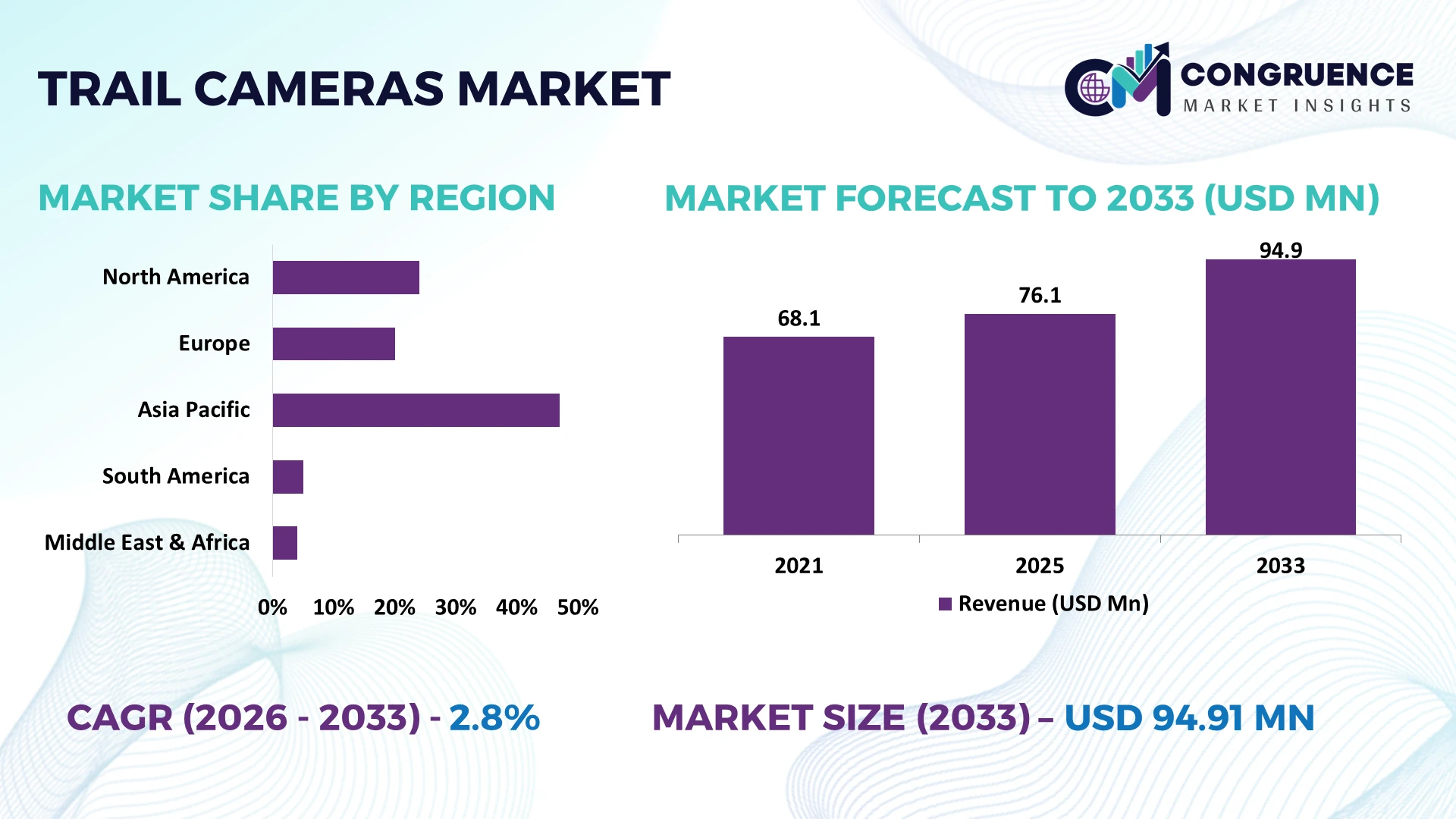
The Global Trail Cameras Market was valued at USD 76.1 Million in 2025 and is anticipated to reach a value of USD 94.91 Million by 2033 expanding at a CAGR of 2.8% between 2026 and 2033. Growth is driven by 4G/LTE cellular scouting, AI-based species recognition, remote property surveillance, solar-powered deployments, and expanding hunting and wildlife-monitoring access.
The United States accounts for approximately 36% of global trail camera demand, supported by 14.4 million hunters and more than 92 million acres of National Wildlife Refuge System land open to hunting. Cellular models increasingly combine sub-0.4-second triggers, GPS protection, live streaming, and dual-carrier connectivity, giving the U.S. a stronger premium technology mix than Canada’s smaller recreation-led installed base. The 2026 expansion of 1,488 hunting and fishing opportunities across 32 U.S. states strengthens field-camera deployment potential, while U.S.–China electronics supply-chain realignment increases pressure to diversify sensors, wireless modules, and battery sourcing.
Manufacturers should prioritize connected-camera ecosystems, subscription services, AI filtering, and resilient electronics procurement because recurring digital services and field reliability increasingly determine competitive positioning.
Market Size & Growth: USD 76.1 million in 2025 reaches USD 94.91 million by 2033 at 2.8% CAGR, supported by cellular scouting and AI-enabled wildlife identification.
Top Growth Drivers: 95%+ refuge-land hunting access, approximately 80% potential blank-image incidence, and 88% AI blank-frame detection strengthen connected monitoring economics.
Short-Term Forecast: By 2028, AI filtering and remote image transmission can reduce manual image-review workload by more than 50% in high-volume monitoring deployments.
Emerging Technologies: 4G/LTE, satellite backup, AI species recognition, GPS anti-theft tracking, and live streaming are moving trail cameras toward autonomous remote-monitoring platforms.
Regional Leaders: By 2033, North America approaches USD 32 million, Asia-Pacific USD 29 million, and Europe USD 22 million, led respectively by cellular, conservation, and recreational adoption.
Consumer/End-User Trends: More than 14.4 million U.S. hunters support recurring scouting demand, while app-controlled cellular cameras increasingly replace physical SD-card retrieval.
Pilot/Case Example: In 2025, Panthera deployed 300+ cameras in Tanzania and captured 150,000+ images, demonstrating scalable remote biodiversity-monitoring workflows.
Competitive Landscape: Tactacam leads connected-camera momentum, competing with SPYPOINT, Browning, Bushnell, and Moultrie through sub-0.5-second triggers, cloud services, and cellular ecosystems.
Regulatory & ESG Impact: Remote monitoring can eliminate repeated field visits, while solar accessories extend deployment duration and reduce disposable-battery dependence across multi-camera installations.
Investment & Funding: Approximately USD 1.6 billion changed hands in the 2024 GSM Outdoors acquisition, reinforcing private-equity interest in hunting, surveillance, and connected outdoor-device platforms.
Innovation & Future Outlook: Satellite failover, edge AI, 46MP imaging, 1080p video, and automated species tagging are shifting competition from hardware sales toward subscription-enabled monitoring ecosystems.
The Trail Cameras Market is shifting toward cellular wildlife monitoring, hunting intelligence, property surveillance, and conservation deployments as 4G/LTE connectivity removes manual SD-card retrieval. Advanced models now combine 46MP imaging, 1080p video, AI species recognition, live streaming, and GPS tracking. With more than 95% of U.S. refuge-system acreage open to hunting, connected scouting demand remains strategically important despite electronics supply-chain diversification pressures, setting the foundation for deeper strategic analysis.
Trail cameras are becoming strategically important as competition shifts from standalone imaging hardware toward connected wildlife-intelligence platforms combining cellular transmission, cloud storage, AI classification, and subscription services. With approximately 14.4 million U.S. hunters and extensive conservation deployments, manufacturers can monetize cameras beyond initial hardware sales. Digital adoption is simultaneously replacing physical SD-card retrieval with remotely managed camera fleets.
Cellular models can eliminate most routine retrieval visits, while AI filtering can cut manual review workloads by more than 50% in image-intensive deployments compared with conventional SD-card workflows. North America leads premium hunting and cellular adoption, whereas Europe emphasizes biodiversity research and regulated wildlife monitoring. Asia is building deployment scale through conservation, forestry, agriculture, and protected-area surveillance, creating different requirements for connectivity and power autonomy.
A 2025 Tanzania conservation deployment using more than 300 cameras generated over 150,000 images, demonstrating why automated classification matters at fleet scale. Through 2028, satellite failover, solar charging, edge AI, and multi-carrier connectivity will expand unattended operating periods. Companies are investing in app ecosystems, AI software, carrier partnerships, and subscription packages. Competitive leadership will depend on converting reliable field imagery into actionable, remotely delivered intelligence.
Cellular connectivity is restructuring trail-camera deployment by transmitting images directly from remote locations instead of requiring repeated SD-card collection. With approximately 14.4 million hunters in the United States and more than 95% of National Wildlife Refuge System acreage available for hunting, the addressable scouting environment is substantial. Modern cameras deliver trigger speeds below 0.5 seconds, while 4G/LTE connectivity can eliminate most scheduled card-retrieval trips where network coverage exists. Expanding U.S. hunting access, including 1,488 additional opportunities announced across 32 states in 2026, reinforces deployment potential. Manufacturers are responding with multi-carrier SIMs, cloud galleries, remote configuration, and subscription plans. Strategically, connectivity transforms cameras from periodically checked equipment into continuously managed scouting infrastructure, increasing customer retention and recurring service engagement.
Cellular trail cameras remain constrained by network availability, recurring data plans, and electronics costs that conventional SD-card models avoid. Around 8% of the U.S. population still lacks access to terrestrial fixed broadband meeting modern benchmark speeds, while remote forests and mountainous hunting zones face materially weaker mobile coverage. Cellular models can also cost 20–50% more than comparable non-connected cameras before recurring subscription charges, limiting large-fleet economics for price-sensitive hunters and landowners. U.S.–China electronics trade friction adds procurement uncertainty because image sensors, wireless modules, circuit boards, and battery components remain heavily linked to Asian manufacturing. Suppliers are mitigating exposure through multi-carrier connectivity, flexible data tiers, bundled subscriptions, alternative component sourcing, and solar accessories. The key constraint is therefore total deployment cost, not simply camera acquisition price.
AI-assisted classification creates an opportunity to monetize the enormous image volumes generated by connected camera fleets. Wildlife projects can accumulate more than 150,000 photographs from several hundred cameras, while blank or irrelevant frames can represent over 50% of datasets under challenging field conditions. Automated recognition systems exceeding 85% accuracy for selected classification tasks can substantially reduce manual sorting and accelerate identification of target species, people, or vehicles. U.S. hunting applications can use automated buck recognition and activity patterns, while conservation programs in India and Africa can apply the same architecture to biodiversity monitoring and anti-poaching workflows. Manufacturers are investing in edge processing, cloud analytics, species databases, and premium app subscriptions. The strategic opportunity is selling decision-ready information rather than storage capacity or megapixels, creating higher-value recurring digital relationships.
Scaling connected trail-camera networks creates challenges around false triggers, battery endurance, firmware management, cybersecurity, and image-classification consistency. A single camera generating 500 images weekly becomes 50,000 images across a 100-camera fleet, making inaccurate alerts operationally expensive. Cold conditions can reduce lithium-ion battery performance by approximately 20% or more, while high-resolution transmission consumes substantially more energy than local SD storage. Remote firmware updates and cloud accounts also create cybersecurity requirements absent from legacy cameras, particularly when devices monitor farms, private property, or critical wildlife locations. Companies must invest in encrypted communications, edge filtering, solar-assisted power, remote diagnostics, and fleet-management software. Long-term competitiveness depends on maintaining consistent detection accuracy and uptime across thousands of unattended endpoints; adding connectivity without robust device management simply transfers field complexity into digital operations.
Satellite Connectivity Extends Remote Coverage: Trail-camera connectivity is moving beyond conventional cellular networks as satellite-enabled communication reaches areas with weak LTE coverage. New systems combine 4G/LTE with satellite fallback, reducing missed transmissions in remote hunting and conservation zones. Fleet operators can cut manual retrieval trips by more than 50%, while manufacturers are partnering with connectivity providers to improve uptime and subscription value.
AI Filtering Reduces Image Overload: Automated species recognition and blank-frame filtering are becoming standard workflow tools as large camera fleets generate tens of thousands of images. AI systems can remove more than 50% of irrelevant frames and exceed 85% classification accuracy in selected deployments. Brands are integrating cloud analytics and edge processing to reduce review time, storage requirements, and user fatigue.
Solar Power Extends Field Uptime: Solar-assisted charging is reducing battery replacement frequency across long-duration hunting, research, and property-monitoring deployments. Efficient panels paired with lithium batteries can sustain cameras for months under favorable sunlight, while low-power standby electronics further reduce energy consumption. Companies are scaling integrated solar kits and external power accessories as labor-intensive servicing becomes a significant fleet-management cost.
Security Features Gain Commercial Relevance: GPS tracking, encrypted cloud accounts, anti-theft mounting, and tamper alerts are expanding as trail cameras move into property surveillance and remote asset monitoring. Premium models increasingly offer 1080p video, sub-0.5-second triggers, and remote configuration. Manufacturers are strengthening firmware security and app controls, recognizing that device theft and unauthorized access now affect enterprise purchasing decisions.
Cellular Trail Cameras account for approximately 38% of market demand, supported by remote image transmission, app-based configuration, cloud storage, and multi-carrier connectivity. Their dominance is strongest among hunters, landowners, and professional wildlife users who value reduced field visits and immediate alerts. Standard Trail Cameras remain important in price-sensitive applications, representing a mature segment where affordability and SD-card storage outweigh connectivity requirements. No-Glow Trail Cameras retain strategic relevance for covert wildlife observation and security applications requiring minimal visible disturbance.
Wireless Trail Cameras are the fastest-growing type as manufacturers combine cellular, Wi-Fi, Bluetooth, and increasingly satellite-enabled connectivity within unified platforms. Wi-Fi Trail Cameras remain more constrained by local network range but fit properties, camps, and facilities with established infrastructure. Connected models can reduce manual retrieval visits by more than 50%, while advanced products now deliver trigger speeds below 0.5 seconds. Companies are shifting investment toward carrier partnerships, subscription plans, solar integration, and remote diagnostics because recurring digital services offer stronger customer retention than hardware-only sales.
Hunting represents the leading application with approximately 36% of total demand, concentrated in the United States where roughly 14.4 million hunters use trail cameras for game scouting, movement tracking, and stand-location decisions. Wildlife Monitoring follows as a major application across private land, forestry, and habitat-management programs, while Property Monitoring is expanding through remote alerts and app-based image access. Security & Surveillance remains smaller but strategically important where low-visibility, battery-powered monitoring is required.
Research & Conservation is the fastest-growing application because large-scale biodiversity projects increasingly use camera networks combined with AI classification. Multi-camera deployments can generate more than 150,000 images, making automated filtering essential for reducing manual review. AI systems exceeding 85% accuracy in selected classification tasks materially improve processing speed. Companies are responding with species-recognition software, cloud dashboards, metadata tagging, and solar-powered camera kits. Demand is becoming operationally critical where continuous wildlife observation must be maintained across large protected areas without permanent power or communications infrastructure.
Hunters account for approximately 40% of trail-camera demand, reflecting the scale of recreational scouting and repeated use across deer, turkey, elk, and other game management. With approximately 14.4 million hunters in the United States, this group drives the largest installed base and frequent replacement cycles. Landowners represent another established buyer group, using cameras for property monitoring, wildlife management, and remote security. Wildlife Researchers and Conservation Organizations purchase smaller volumes individually but often operate larger multi-camera projects with demanding data-management requirements.
Government Agencies represent the fastest-growing end-user group as forestry departments, protected-area authorities, and wildlife services adopt camera networks for population monitoring, anti-poaching, and habitat assessment. Deployments involving hundreds of cameras create demand for standardized batteries, encrypted data transfer, centralized dashboards, and AI classification. Manufacturers are responding with institutional pricing, fleet-management software, solar accessories, and customized data plans. Competitive positioning is therefore shifting from consumer-only product portfolios toward dual-channel strategies serving both recreational users and professionally managed monitoring networks.
North America accounted for the largest market share at approximately 37% in 2025 however, Asia-Pacific is expected to register the fastest growth, expanding at a CAGR of approximately 4.0% between 2026 and 2033.
Cellular Scouting Becomes the Core Platform
North America represents approximately 37% of global Trail Cameras Market demand, supported by extensive hunting participation, private-land management, wildlife research, and increasingly connected property surveillance. The United States anchors adoption through cellular trail cameras using multi-network SIMs, app-based image retrieval, GPS location, and solar-assisted power. Roughly 14.4 million U.S. hunters provide a substantial installed user base, while current premium cameras deliver trigger speeds around 0.25–0.4 seconds and 100-foot detection ranges. Cellular models are also moving into remote security, reducing the need for fixed broadband or wired power. Manufacturers are investing in subscription ecosystems, AI-assisted image organization, live-view capabilities, and battery-life improvements. The operational shift is clear: competitive value increasingly comes from persistent connectivity and software intelligence rather than camera resolution alone.
United States Market Outlook: The United States remains the region’s strategic center because hunting, land management, outdoor recreation, and remote property monitoring converge at commercial scale. New models offer 40MP-plus photography, 1080p video, on-demand capture, GPS, and automatic carrier selection. Suppliers are increasingly bundling hardware with data plans, mapping software, solar power, and image analytics to deepen recurring customer relationships.
Scientific Monitoring Expands Structured Deployment
Europe accounts for approximately 24% of global trail camera demand, with Germany, the United Kingdom, France, Italy, and Nordic countries supporting conservation, forestry, hunting, and ecological research applications. Deployment is becoming more standardized through coordinated biodiversity-monitoring programs rather than isolated camera installations. Snapshot Europe now connects hundreds of scientists, with participating teams typically deploying cameras at 10–50 locations for at least three weeks during annual monitoring cycles. This structured methodology strengthens requirements for standardized metadata, long battery duration, no-glow illumination, and reliable image storage. Strict privacy and data-handling expectations also influence cameras installed near public spaces or privately owned land. Manufacturers are adapting through lower-visibility infrared systems, encrypted connectivity, configurable capture zones, and research-oriented fleet management. Europe therefore rewards precision, compliance, and interoperable data workflows more strongly than recreational feature density alone.
Germany Market Outlook: Germany provides a strategically important market through its combination of structured wildlife science, forestry management, hunting infrastructure, and technology adoption. Researchers increasingly participate in standardized continent-wide camera-trapping protocols, while land managers prioritize low-disturbance no-glow imaging and long-duration deployment. Suppliers with strong privacy controls, metadata quality, and standardized research workflows hold a distinct advantage in institutional purchasing.
Conservation Scale Drives Camera Networks
Asia-Pacific represents approximately 26% of global demand and offers the strongest institutional deployment pathway through tiger conservation, forestry surveillance, biodiversity assessment, agriculture, and protected-area management. India demonstrates exceptional camera-trapping scale: its national tiger assessment deployed cameras at 26,838 locations, covering more than 121,000 square kilometers and generating over 34.8 million wildlife photographs. China, Australia, Japan, and Southeast Asian countries add demand from conservation estates, forest monitoring, invasive-species research, and rural security. Hardware procurement increasingly emphasizes long standby life, infrared sensitivity, rugged enclosures, and AI-assisted classification because multi-thousand-camera programs create significant manual processing burdens. Manufacturers and research organizations are integrating cameras with GIS, mobile patrol applications, and automated species identification. This creates an advantage for suppliers capable of supporting standardized fleet deployments rather than standalone consumer devices.
India Market Outlook: India is the region’s most strategically significant institutional deployment market. National tiger monitoring has demonstrated camera-trap networks at tens of thousands of locations, while annual Phase IV monitoring requires continued camera-based observation across tiger source areas. Integration with M-STrIPES and centralized photograph repositories creates demand for standardized imaging, location metadata, reliable storage, and scalable analytics suitable for government conservation programs.
Biodiversity Monitoring Expands Field Demand
South America accounts for approximately 6% of global demand, with Brazil, Colombia, Peru, Argentina, and Ecuador supporting deployments across rainforest research, protected areas, agricultural boundaries, hunting-management studies, and species conservation. Brazil provides the strongest operational base because extensive Amazon and Atlantic Forest landscapes require unattended monitoring where fixed power and connectivity remain limited. Camera-trap projects increasingly use deployments lasting 21–30 days, strengthening demand for low-power electronics, large storage capacity, weather sealing, and reliable infrared night imaging. Research institutions are also combining camera traps with autonomous acoustic monitoring to build richer biodiversity datasets. Connectivity limitations outside major population centers constrain fully cellular deployments, encouraging hybrid architectures using local storage plus periodic synchronization. Suppliers are responding with solar accessories, extended-life batteries, rugged housings, and configurable sensing modes optimized for tropical field conditions.
Brazil Market Outlook: Brazil combines exceptional biodiversity with large protected and privately managed landscapes, creating sustained research and conservation requirements. Current ecological programs use camera traps alongside autonomous acoustic recorders, allowing visual and sound datasets to be compared across the same habitat. Manufacturers that deliver humidity-resistant enclosures, low-power operation, and flexible offline storage gain stronger positioning in Amazonian and Atlantic Forest deployments.
Conservation Technology Moves Toward Integration
Middle East & Africa represents approximately 7% of global demand, shaped primarily by protected-area management, anti-poaching operations, safari conservation, biodiversity research, and remote asset surveillance. South Africa, Kenya, Tanzania, Namibia, and Botswana provide important deployment concentrations because large protected landscapes require persistent monitoring without fixed infrastructure. Conservation technology is becoming integrated: camera traps increasingly operate alongside drones, thermal imaging, sensors, satellite links, and ranger-management platforms. Technology-enabled conservation systems are now deployed across close to 10 million hectares of African protected areas, demonstrating the scale at which interoperable monitoring tools are being adopted. The key limitation is not camera availability but maintaining devices, communications, and trained personnel across remote terrain. Suppliers are responding through solar power, ruggedized hardware, centralized platforms, technical training, and conservation partnerships that reduce field-maintenance burdens.
South Africa Market Outlook: South Africa offers the strongest operational ecosystem through established private reserves, national parks, conservation technology programs, and advanced anti-poaching operations. Recent training initiatives have brought conservation specialists from 11 African countries into technology-focused field programs using cameras, thermal drones, and monitoring software. This positions South Africa as an important testing and deployment hub for integrated wildlife-surveillance systems.
Tactacam, SPYPOINT, Moultrie, Browning Trail Cameras, and Stealth Cam compete at the premium connected end, while Cuddeback, RECONYX, and value-focused Asian OEMs pressure specialized niches. The top five brands collectively represent an estimated 42% of global demand, leaving meaningful fragmentation across hunting, research, and property-monitoring channels. Cellular leaders compete on transmission reliability, trigger speed, app quality, and subscriptions; premium models achieve sub-0.5-second triggers, while solar accessories can reduce battery-service visits by over 50% in suitable deployments. Companies are expanding multi-carrier connectivity, cloud analytics, AI filtering, and bundled data plans, while hardware groups pursue portfolio consolidation and shared sourcing. Competition is shifting from megapixel claims toward recurring software services, fleet management, and power autonomy. Entry pressure remains high because reliable modem integration, carrier certification, low-power firmware, and distribution relationships require sustained engineering investment. Winning against incumbents requires dependable field uptime, intuitive software, competitive subscription economics, and differentiated imaging intelligence at scale.
Tactacam
SPYPOINT
Moultrie
Browning Trail Cameras
Stealth Cam
Cuddeback
RECONYX
Covert Scouting Cameras
Wildgame Innovations
GardePro
Boly Media Communications
Campark
Ridgetec
Bushnell
Current trail-camera technology centers on 4G/LTE connectivity, low-glow and 940nm no-glow infrared, GPS, cloud storage, and automated carrier selection. Connected models remove routine SD-card retrieval, reducing field visits by over 50% in suitable deployments. Modern cameras achieve 0.3-second trigger speeds, 100-foot detection ranges, and 40–50MP imaging, giving hunters, landowners, and researchers faster intelligence with fewer missed events.
Emerging systems combine edge AI, live streaming, solar power, automatic species filtering, and integrated mapping. AI-assisted detection suppresses false triggers, reducing unnecessary transmissions and extending battery performance by approximately 10–20% under high-activity conditions. Compared with legacy 1-second-trigger cameras, 0.3-second platforms improve capture responsiveness by 70%. Cellular brands integrating cameras, applications, feeders, mapping, and analytics benefit most because ecosystem ownership increases subscription retention and operating visibility.
Through 2026–2028, satellite fallback, embedded AI processors, rechargeable power systems, dual image sensors, and predictive wildlife analytics will disrupt conventional monitoring. Current premium platforms already support 4K imagery, 1080p video, active GPS, and simultaneous photo-video capture, signaling commercial readiness. Conservation agencies will gain scalable remote monitoring, while hunters receive decision-ready activity patterns. Manufacturers must prioritize low-power computing, interoperable connectivity, cybersecurity, and software integration now, because competitive differentiation is shifting decisively from camera specifications toward autonomous field intelligence and reliable fleet management.
February 2024 Browning Trail Cameras introduced the Pro Scout Max Extreme HD cellular model, delivering 22MP images, 1080p video, 120-foot infrared illumination, and 0.25-second triggering. Dual AT&T-Verizon carrier detection improved connectivity and reduced manual network-selection requirements for remote monitoring. Source: Browning
June 2025 Tactacam launched REVEAL Ultra, adding live video streaming, Active GPS theft monitoring, and app-selectable low-glow/no-glow illumination. Active GPS alerts users when cameras move beyond 0.5 mile, strengthening asset protection and expanding cellular cameras beyond traditional wildlife scouting applications. Source: Tactacam
July 2025 Moultrie expanded its EDGE 3 lineup with AI-assisted buck detection and direct onX Hunt integration; EDGE 3 PRO delivers 50MP imagery, 1440p video, and 0.3-second triggering. Integration strengthened connected property intelligence and consolidated mapping with camera management. Source: AmericanHunter
July 2026 Tactacam refreshed its REVEAL cellular lineup with Pro 4.0 and X 4.0 models, introducing 4K imagery, 1080p video and built-in GPS. The Pro 4.0 reached $159.99 positioning, strengthening premium competition around image quality, connectivity, and field intelligence. Source: Tactacam
The Trail Cameras Market Report evaluates Cellular Trail Cameras, Wi-Fi Trail Cameras, Wireless Trail Cameras, Standard Trail Cameras, and No-Glow Trail Cameras across Wildlife Monitoring, Hunting, Security & Surveillance, Research & Conservation, and Property Monitoring. End-user analysis covers hunters, wildlife researchers, conservation organizations, landowners, and government agencies. Cellular models represent approximately 38% of current demand, reflecting the transition toward remotely managed monitoring.
Regional coverage includes North America, Europe, Asia-Pacific, South America, and Middle East & Africa, examining hunting activity, conservation deployments, connectivity infrastructure, regulations, and procurement patterns. Technology assessment covers 4G/LTE, satellite connectivity, AI classification, GPS, solar power, cloud platforms, infrared imaging, and automated carrier selection. The 2026–2033 framework supports investment planning, geographic expansion, product-roadmap decisions, competitive benchmarking, partnership strategy, and evaluation of emerging subscription-based wildlife intelligence, conservation monitoring, and remote-security opportunities.
| Report Attribute/Metric | Report Details |
|---|---|
Market Revenue in 2025 | USD 76.1 Million |
Market Revenue in 2033 | USD 94.91 Million |
CAGR (2026 - 2033) | 2.8% |
Base Year | 2025 |
Forecast Period | 2026 - 2033 |
Historic Period | 2021 - 2025 |
Segments Covered | By Type
By Application
By End-User
|
Key Report Deliverable | Revenue Forecast, Growth Trends, Market Dynamics, Segmental Overview, Regional and Country-wise Analysis, Competition Landscape |
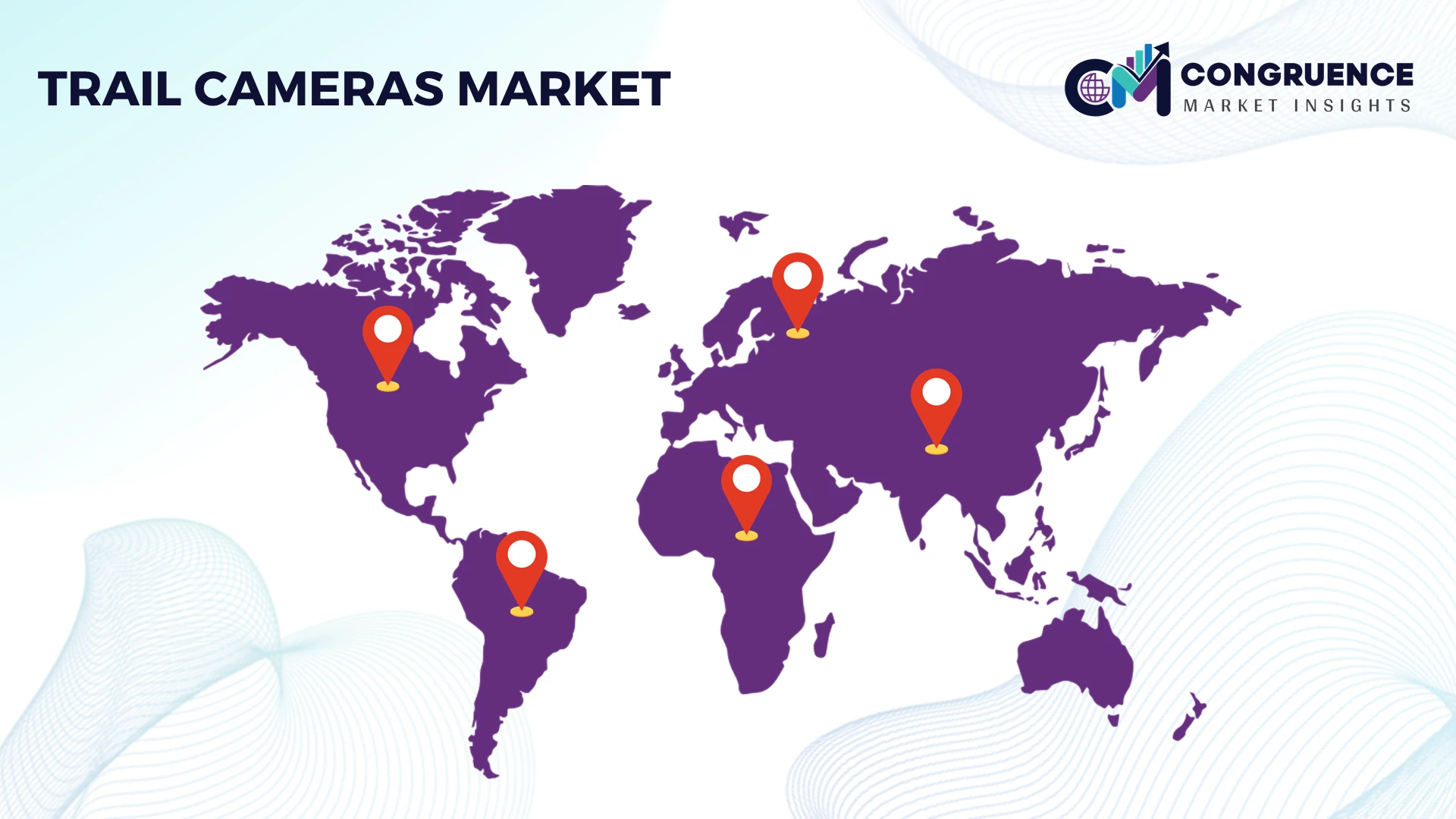
Region Covered | North America, Europe, Asia-Pacific, South America, Middle East, Africa |
Key Players Analyzed | Tactacam, SPYPOINT, Moultrie, Browning Trail Cameras, Stealth Cam, Cuddeback, RECONYX, Covert Scouting Cameras, Wildgame Innovations, GardePro, Boly Media Communications, Campark, Ridgetec, Bushnell |
Customization & Pricing | Available on Request (10% Customization is Free) |




