
Reports
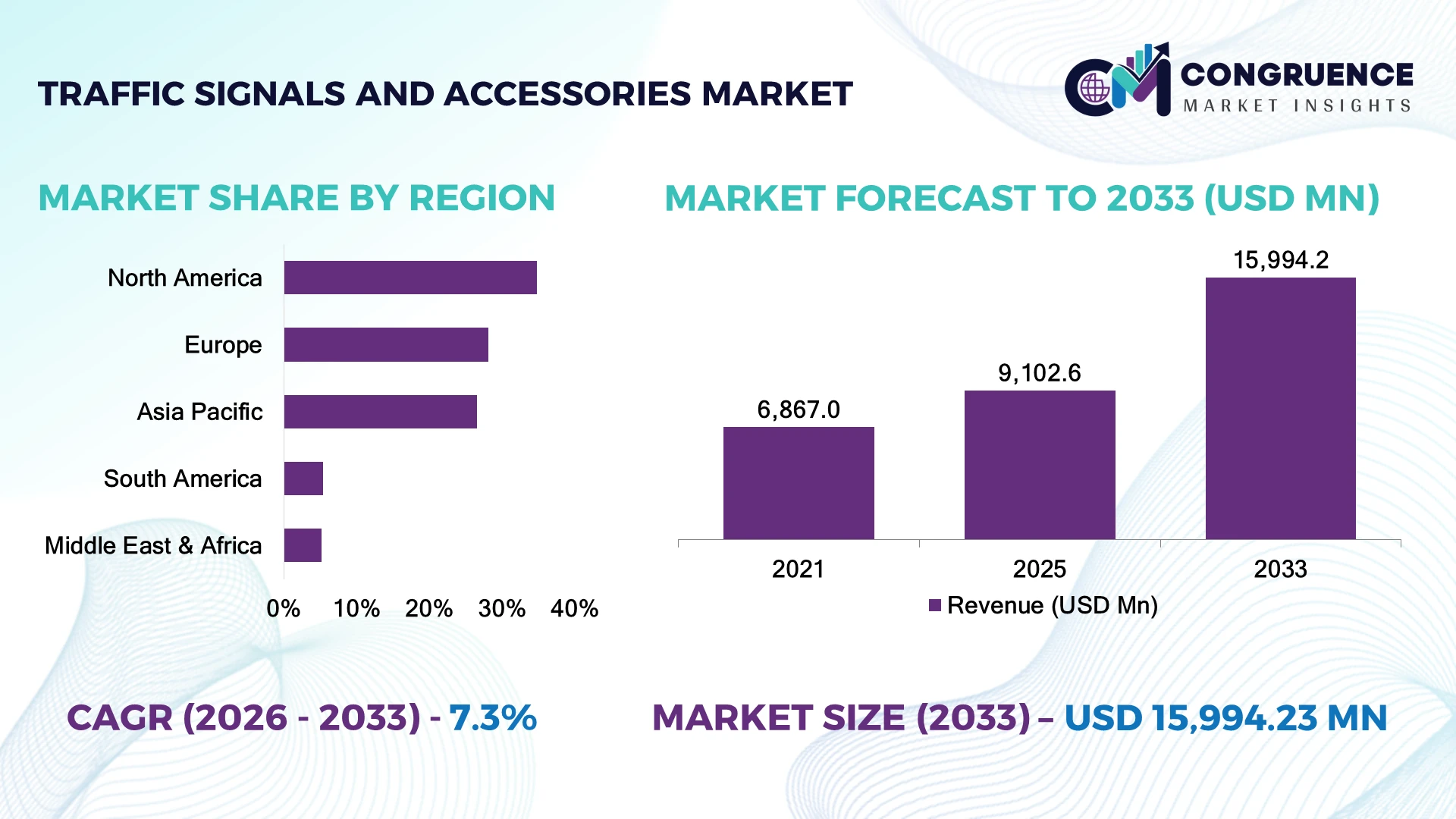
The Global Traffic Signals and Accessories Market was valued at USD 9,102.6 Million in 2025 and is anticipated to reach a value of USD 15,994.2 Million by 2033 expanding at a CAGR of 7.3% between 2026 and 2033. Growth is driven by intelligent transportation system deployments, AI-enabled adaptive traffic control, smart city investments, and mandatory intersection safety upgrades across urban road networks.
The United States leads the market with approximately 29% global deployment share, supported by large-scale intelligent transportation investments, over 335,000 signalized intersections, and rapid adoption of connected traffic management platforms. Compared with Germany, where adaptive signal penetration exceeds 45% in metropolitan corridors, the U.S. maintains broader infrastructure scale following accelerated infrastructure modernization under post-2021 federal transportation funding initiatives and resilient supply-chain localization efforts.
Strategic investment is increasingly concentrated on interoperable, AI-enabled traffic ecosystems capable of improving safety, reducing congestion, and supporting future connected mobility infrastructure.
Market Size & Growth: USD 9,102.6 million in 2025 to USD 15,994.2 million by 2033 at 7.3%, driven by intelligent traffic infrastructure.
Top Growth Drivers: AI traffic control 32%, smart city investment 28%, road safety modernization 24%.
Short-Term Forecast: By 2028, adaptive signal efficiency improves intersection throughput by 18%.
Emerging Technologies: AI analytics, V2X communication, and edge computing accelerate smart intersection deployment.
Regional Leaders: North America, Europe, and Asia-Pacific together exceed USD 11 billion, led by digital mobility programs.
Consumer/End-User Trends: Over 52% of municipalities prioritize adaptive traffic management over fixed-time systems.
Pilot/Case Example: 2026 smart corridor deployment reduced average travel delays by 21%.
Competitive Landscape: Top five suppliers control nearly 46% through integrated hardware and intelligent software.
Regulatory & ESG Impact: LED signal adoption cuts energy consumption by approximately 75%.
Investment & Funding: More than USD 5 billion supports smart transportation modernization and connected infrastructure expansion.
Innovation & Future Outlook: AI-powered predictive traffic optimization and digital twins redefine next-generation urban mobility.
Traffic Signals and Accessories Market demand is accelerating across urban intersections, highways, tunnels, and connected mobility corridors as cities modernize traffic infrastructure. AI-enabled adaptive controllers, vehicle-to-everything communication, and cloud-based monitoring platforms improve traffic flow, while LED-based systems now represent nearly 78% of new installations. Increasing infrastructure digitization and resilient component sourcing are reshaping procurement strategies, leading into the market's strategic evolution.
The Traffic Signals and Accessories Market has become strategically important as governments prioritize intelligent transportation systems to improve urban mobility, road safety, and infrastructure efficiency. Digital traffic management is replacing conventional fixed-cycle control, supported by national smart city programs, connected mobility initiatives, and modernization of aging signal infrastructure. This transition is intensifying competition among traffic technology providers, software developers, and infrastructure integrators.
AI-enabled adaptive signal control systems reduce average intersection delays by approximately 20% while lowering fuel consumption by nearly 12% compared with conventional time-based controllers. North America emphasizes connected corridor deployments and V2X integration, whereas Asia-Pacific leads in large-scale smart intersection implementation across expanding metropolitan areas. Industry estimates indicate that more than 45% of newly upgraded urban intersections over the next two to three years will incorporate AI-enabled traffic optimization and remote monitoring capabilities.
Municipal authorities increasingly deploy centralized traffic management platforms integrating sensors, cameras, and predictive analytics to optimize traffic flow in real time. Technology providers are expanding partnerships with infrastructure contractors, telecommunications companies, and smart city developers to deliver interoperable mobility ecosystems. Companies capable of combining intelligent software, cybersecurity, scalable hardware, and lifecycle services will secure stronger competitive positioning as connected transportation networks become foundational to future urban infrastructure.
Large-scale deployment of intelligent transportation systems is accelerating adoption of advanced traffic signals and accessories across urban corridors. More than 60% of newly modernized intersections now incorporate adaptive signal control, while AI-enabled traffic optimization reduces average congestion by nearly 20% and emergency vehicle response time by approximately 15%. The United States continues expanding connected corridor programs through infrastructure modernization, prompting municipalities to replace legacy controllers with networked platforms. This transition improves traffic efficiency while creating long-term demand for sensors, controllers, communication modules, and LED signaling equipment. Companies are responding through software-driven product portfolios, strategic partnerships with smart city integrators, and investments in cloud-based traffic management platforms. A notable strategic shift is the bundling of hardware, analytics, and maintenance services into unified mobility solutions.
A significant barrier remains the integration of modern traffic control technologies with decades-old signaling infrastructure. Nearly 42% of municipal intersections continue operating on legacy controllers, while interoperability challenges increase implementation costs by 18–25% during upgrade projects. Dependence on imported semiconductor components and communication hardware has also exposed procurement schedules to supply-chain disruptions following geopolitical trade realignments. These constraints delay deployment, compress contractor margins, and complicate multi-vendor interoperability. Technology providers are reducing operational risks by localizing assembly operations, adopting standardized communication protocols, and securing long-term component agreements with electronics suppliers. Organizations capable of delivering backward-compatible systems gain a measurable competitive advantage in large municipal modernization programs.
The convergence of connected vehicles, edge computing, and AI-based traffic orchestration creates significant opportunities beyond traditional signal hardware. Intelligent intersections equipped with vehicle-to-everything communication can improve traffic throughput by approximately 22%, while predictive analytics reduce signal optimization workloads by nearly 30%. Japan and South Korea continue expanding connected mobility infrastructure, encouraging deployment of interoperable roadside equipment and digital traffic platforms. Companies are increasing R&D investment in cloud-native control software, digital twins, and multimodal traffic optimization while partnering with telecommunications providers to support low-latency communication networks. An emerging opportunity lies in integrating traffic signal infrastructure with autonomous vehicle ecosystems, transforming intersections into real-time data hubs instead of standalone control points.
As traffic control systems become increasingly connected, maintaining cybersecurity and operational reliability across thousands of distributed intersections presents a complex execution challenge. More than 55% of advanced traffic management platforms now rely on cloud connectivity, while cyber incidents targeting public infrastructure continue to increase globally. Managing software updates, device authentication, and encrypted communications across mixed hardware environments requires substantial investment and specialized expertise. Operational inconsistencies between municipalities further complicate standardized deployment. Companies must strengthen zero-trust architectures, continuous monitoring, and secure firmware management while expanding cybersecurity partnerships. Organizations that successfully combine resilient digital infrastructure with scalable lifecycle support will sustain long-term competitiveness as intelligent transportation networks continue expanding.
AI-Controlled Signal Optimization AI-driven adaptive traffic management is replacing fixed-cycle operation across major cities, with deployment increasing by nearly 34% over two years. Intelligent controllers improve intersection throughput by approximately 18% while reducing average vehicle idling. Municipal authorities are partnering with software providers to automate real-time signal timing using predictive traffic analytics.
Connected Intersection Deployment Vehicle-to-everything communication infrastructure is expanding rapidly, with connected intersections accounting for nearly 28% of newly upgraded urban traffic projects. Infrastructure modernization and autonomous mobility testing are driving deployments in the United States and China. Companies are integrating roadside sensors, communication modules, and cloud-based control platforms into unified traffic ecosystems.
LED Lifecycle Modernization Energy-efficient LED traffic signals now represent over 78% of new installations, reducing electricity consumption by approximately 75% and maintenance requirements by nearly 45%. Rising sustainability mandates and municipal operating cost reductions are accelerating replacement of incandescent systems. Manufacturers are expanding smart diagnostic capabilities alongside modular signal hardware to simplify maintenance.
Digital Traffic Operations Centers Centralized traffic management platforms equipped with edge computing and AI analytics are improving incident response by nearly 25% while shortening congestion recovery times by approximately 20%. Growing urbanization and infrastructure digitization are encouraging agencies to consolidate traffic monitoring, predictive maintenance, and signal coordination through integrated operational control centers.
Intelligent traffic signal controllers accounted for approximately 36% of the market in 2025, making them the leading segment because they enable adaptive traffic management, remote diagnostics, and seamless integration with intelligent transportation systems. Their scalability, software-driven functionality, and compatibility with AI-based traffic optimization platforms have accelerated adoption across urban mobility projects. LED signal heads represent the fastest-growing segment as municipalities replace conventional lighting to reduce energy consumption by nearly 75% and maintenance costs by approximately 45%. Traffic sensors, pedestrian crossing systems, countdown timers, communication modules, and signal poles continue supporting network modernization by expanding intersection intelligence and improving operational reliability.
As cities shift toward connected mobility infrastructure, suppliers are prioritizing modular product portfolios that combine intelligent controllers, sensors, and cloud-based monitoring platforms. Approximately 58% of new urban traffic modernization projects now specify integrated hardware-software solutions instead of standalone signal equipment, encouraging investments in interoperable architectures and lifecycle service contracts. This transition is reshaping procurement strategies toward scalable digital traffic ecosystems.
According to findings published by the Institute of Transportation Engineers (ITE) during 2025, agencies deploying adaptive traffic signal controllers reported measurable improvements in intersection efficiency and operational reliability, reinforcing investment in intelligent control technologies.
Urban intersections represented approximately 41% of market demand in 2025, reflecting their critical role in congestion management, pedestrian safety, and coordinated traffic control. High traffic density, frequent infrastructure upgrades, and smart city initiatives continue concentrating investments in adaptive traffic signal deployments. Highways and expressways are emerging as the fastest-growing application as governments expand intelligent corridor programs using connected sensors, AI-based monitoring, and incident detection systems. Airports, ports, industrial zones, railway crossings, and institutional campuses continue adopting specialized signaling solutions to improve operational safety and vehicle movement efficiency.
Demand increasingly favors integrated traffic management rather than isolated signal installations. Nearly 49% of newly awarded transportation infrastructure projects now include centralized traffic monitoring, adaptive signal optimization, and remote diagnostics within a unified deployment scope. Companies are responding through intelligent software integration, customized traffic management platforms, and strategic partnerships with infrastructure engineering firms to address increasingly complex mobility requirements.
According to a 2026 enterprise assessment by the International Road Federation (IRF), transportation agencies increasingly prioritize adaptive traffic management at urban intersections to improve travel efficiency and reduce congestion across expanding metropolitan networks.
Municipal governments accounted for approximately 48% of total demand in 2025, making them the largest end-user due to responsibility for urban road infrastructure, intersection modernization, and public safety initiatives. Their large-scale procurement programs, smart city investments, and long-term maintenance contracts continue driving widespread deployment of intelligent traffic management systems. Highway authorities represent the fastest-growing end-user group as national transportation agencies expand connected corridor infrastructure and integrate AI-enabled monitoring across major road networks. Airport operators, industrial facilities, ports, and private infrastructure developers continue increasing investments to improve internal traffic efficiency and operational safety.
Technology providers are responding with customized traffic control platforms, lifecycle maintenance agreements, and interoperable communication architectures designed for large infrastructure operators. Approximately 53% of recent public-sector procurement programs require integrated software, cybersecurity capabilities, and remote asset management, reinforcing the shift toward intelligent transportation ecosystems and long-term operational partnerships.
According to a 2025 survey published by the Institute of Transportation Engineers (ITE), transportation agencies continue prioritizing adaptive signal technologies and centralized traffic management platforms to improve operational efficiency across urban road networks.
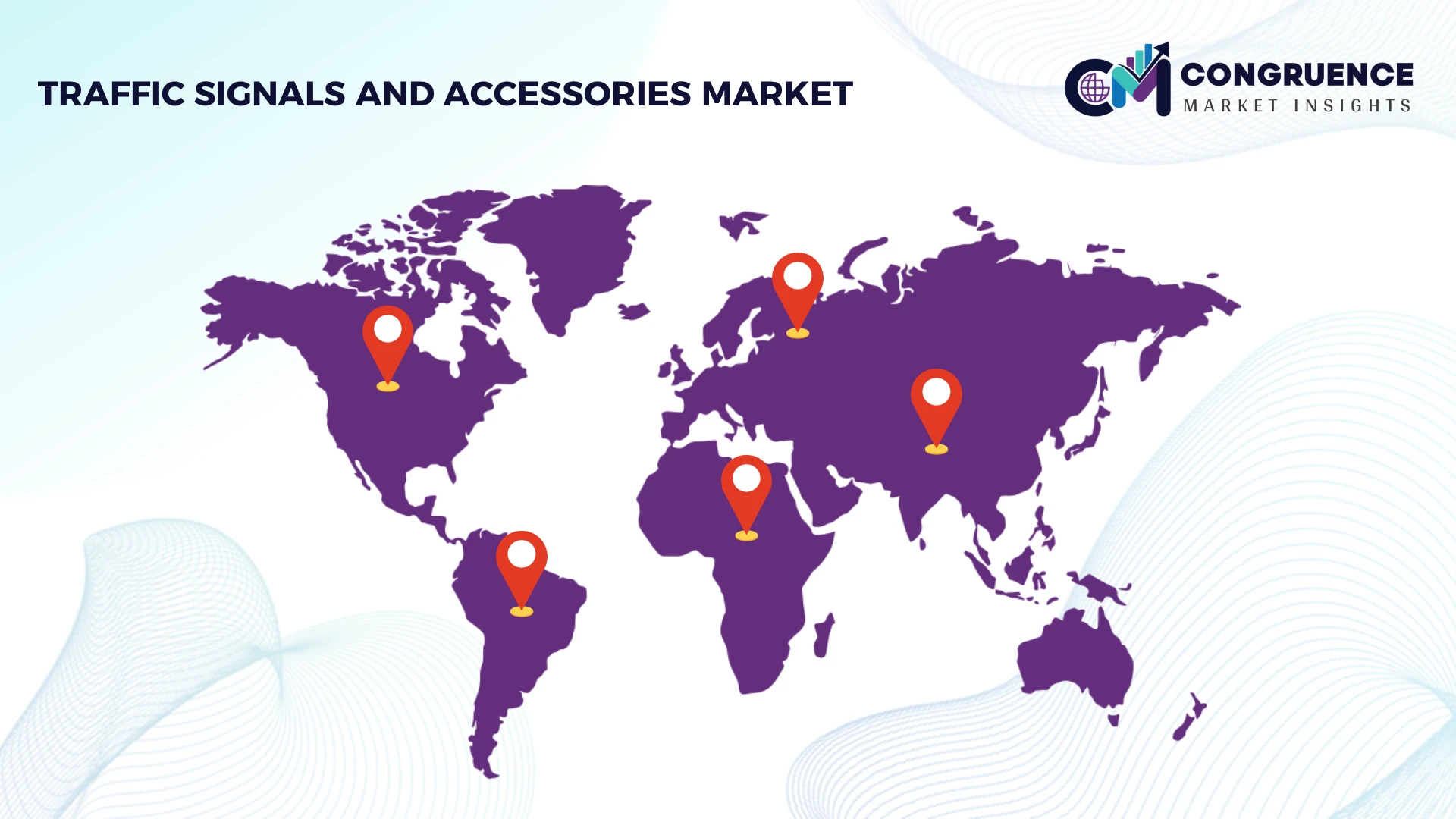
North America accounted for the largest market share at 34.8% in 2025 however, Asia-Pacific is expected to register the fastest growth, expanding at a CAGR of 8.5% between 2026 and 2033.
Intelligent Corridor Modernization Drives Regional Leadership
North America maintains its leadership through widespread deployment of intelligent transportation systems, connected intersections, and AI-enabled traffic management platforms. More than 40% of regional signal modernization projects incorporate adaptive traffic control integrated with centralized traffic management centers. Infrastructure funding continues accelerating replacement of aging controllers with network-connected LED signal systems, while partnerships between technology vendors and municipal authorities support scalable deployment. Increasing adoption of vehicle-to-infrastructure communication further strengthens demand for advanced controllers, sensors, communication modules, and pedestrian safety accessories. Operational priorities have shifted from isolated signal upgrades toward integrated corridor management capable of improving traffic efficiency, incident response, and long-term infrastructure resilience.
United States Market Outlook: The United States remains the region's largest market because of its extensive roadway infrastructure, smart city investments, and advanced intelligent transportation ecosystem. More than 335,000 signalized intersections provide significant modernization opportunities, while federal infrastructure programs continue supporting deployment of adaptive traffic control, AI-powered traffic analytics, and connected mobility platforms. Municipal agencies increasingly prioritize integrated software ecosystems over standalone hardware, strengthening long-term demand for intelligent traffic solutions.
Sustainable Urban Mobility Accelerates Digital Upgrades
Europe continues expanding intelligent traffic infrastructure through sustainable mobility initiatives, digital road management, and pedestrian safety improvements. Approximately 37% of newly upgraded intersections incorporate adaptive traffic management and energy-efficient LED signaling technologies. Regulatory emphasis on emissions reduction and multimodal transportation is encouraging deployment of connected traffic controllers, smart pedestrian crossings, and integrated mobility platforms. Public authorities increasingly adopt centralized monitoring systems that coordinate public transport priority, emergency vehicle movement, and congestion mitigation while improving operational efficiency across dense metropolitan road networks.
Germany Market Outlook: Germany leads the European market through advanced transportation engineering, extensive urban mobility investments, and widespread deployment of adaptive traffic management systems. Metropolitan regions continue integrating intelligent intersections with connected mobility infrastructure and digital traffic control platforms. Strong industrial capabilities and established ITS expertise enable rapid deployment of interoperable traffic technologies supporting safer, more efficient transportation networks.
Massive Urban Expansion Fuels Smart Infrastructure
Asia-Pacific represents the fastest-expanding regional market as rapid urbanization, expanding highway infrastructure, and smart city programs accelerate deployment of intelligent traffic systems. Nearly 48% of new metropolitan road projects incorporate adaptive signaling, AI-enabled monitoring, and integrated communication infrastructure. Large-scale investments in digital transportation networks are increasing demand for controllers, traffic sensors, LED signals, and centralized management software. Manufacturers continue expanding regional production capacity while local governments prioritize intelligent mobility solutions to manage rising vehicle density and improve road safety.
China Market Outlook: China dominates the regional market through extensive smart city implementation, large-scale urban infrastructure development, and domestic manufacturing capacity. Hundreds of intelligent transportation projects integrate AI traffic optimization, edge computing, and connected intersections across rapidly expanding metropolitan areas. Strong government investment and local technology ecosystems continue strengthening deployment of advanced traffic signal infrastructure nationwide.
Urban Mobility Investments Strengthen Demand
South America is gradually modernizing traffic management infrastructure as major cities prioritize congestion reduction, road safety, and intelligent transportation initiatives. Approximately 31% of recent urban mobility investments include traffic signal upgrades, LED modernization, and centralized traffic monitoring systems. Budget limitations remain a consideration, yet public-private partnerships continue supporting deployment of adaptive controllers and smart pedestrian signaling in high-density metropolitan corridors. Cities increasingly favor modular systems that simplify future digital expansion while minimizing installation complexity.
Brazil Market Outlook: Brazil leads the regional market through large urban transportation networks, ongoing smart mobility investments, and modernization of municipal traffic infrastructure. Major metropolitan authorities continue replacing conventional controllers with intelligent traffic management systems capable of remote monitoring and adaptive signal optimization. Expanding public transportation integration further supports long-term deployment of advanced traffic signaling technologies.
Infrastructure Modernization Supports Intelligent Mobility
The Middle East & Africa market is advancing through smart city development, transportation modernization, and investments in digitally connected urban infrastructure. Approximately 35% of newly planned metropolitan road developments include intelligent traffic signaling and centralized traffic management capabilities. Governments increasingly prioritize integrated mobility solutions supporting congestion reduction, emergency response coordination, and pedestrian safety. Technology providers are strengthening regional partnerships while deploying scalable traffic control platforms designed for rapidly expanding urban environments and new infrastructure developments.
United Arab Emirates Market Outlook: The United Arab Emirates remains the region's most advanced market owing to extensive smart city initiatives, digitally connected transportation infrastructure, and continuous investment in intelligent mobility technologies. Large-scale urban developments increasingly integrate AI-enabled traffic management, connected intersections, and centralized operational control centers. Strong government support and rapid deployment capabilities position the country as a regional benchmark for advanced traffic signal modernization.
Global intelligent transportation leaders including SWARCO, Siemens Mobility, Yunex Traffic, Econolite, and Q-Free compete directly with regional signal manufacturers, infrastructure integrators, and software-focused mobility specialists. The top five participants collectively control approximately 48% of the market. Competition centers on adaptive traffic control, AI-enabled analytics, lifecycle support, and deployment speed, with advanced controllers improving traffic flow efficiency by nearly 20% and LED-based systems lowering energy consumption by approximately 75%. Technology innovators differentiate through connected mobility platforms and V2X readiness, while regional suppliers compete with localized engineering, customization, and cost-efficient implementation. Companies increasingly pursue strategic acquisitions, cloud software integration, and partnerships with municipalities to secure long-term intelligent transportation contracts. Cybersecurity compliance, interoperability with legacy infrastructure, and certification requirements remain significant entry barriers. Sustained market leadership depends on delivering scalable intelligent traffic ecosystems that combine reliable hardware, predictive software, seamless integration, and long-term operational support.
SWARCO AG
Siemens Mobility GmbH
Yunex Traffic
Econolite Group, Inc.
Q-Free ASA
Sumitomo Electric Industries, Ltd.
Traffic Technologies Ltd.
Dialight plc
Wanco Inc.
Pelco Products, Inc.
Trafitronics India Pvt. Ltd.
Hisense TransTech
AI-powered adaptive traffic control, edge computing, and vehicle-to-everything (V2X) communication are reshaping traffic signal infrastructure. Around 56% of newly modernized intersections incorporate networked controllers and real-time analytics, while edge processing reduces traffic signal response latency by approximately 30%. Cloud-connected traffic management platforms integrate cameras, radar sensors, pedestrian detection, and emergency vehicle prioritization into centralized operations, enabling continuous optimization across urban road networks.
Compared with conventional fixed-time controllers, AI-enabled adaptive systems improve intersection throughput by nearly 22% while reducing average vehicle delay by approximately 20%. Nearly 48% of ongoing smart intersection deployments include predictive analytics and remote diagnostics. Global technology leaders benefit by combining intelligent software, communication infrastructure, and lifecycle maintenance, whereas regional integrators compete through customized deployments and rapid implementation tailored to municipal infrastructure requirements.
Between 2026 and 2028, digital twins, computer vision, connected roadside units, and autonomous mobility interfaces will become core elements of intelligent traffic ecosystems. Predictive maintenance platforms are expected to lower maintenance interventions by approximately 25%, while cybersecurity-enabled traffic controllers will strengthen operational resilience across connected infrastructure. Organizations investing in interoperable AI-driven traffic management platforms today will gain lasting competitive advantages as smart mobility infrastructure becomes increasingly standardized.
December 2024 Yunex Traffic deployed its Stratos UTMC adaptive traffic management platform across Lancashire, enabling network-wide intelligent signal optimization and improving coordinated urban traffic operations through centralized control.
December 2024 The U.S. Department of Transportation announced USD 130 million in SMART Grants supporting intelligent transportation technologies, including advanced traffic signal modernization across 23 states, accelerating connected mobility infrastructure deployment.
February 2026 Econolite secured a contract to deploy 150 Cobalt ATC controllers replacing legacy systems across 140 intersections in Parker, Colorado, strengthening intelligent transportation system integration and multimodal traffic operations.
January 2026 Siemens Mobility and Yunex Traffic announced expanded collaboration on AI-powered traffic management platforms integrating predictive analytics and autonomous vehicle coordination, strengthening next-generation smart city traffic infrastructure. Source: Industry announcement.
This report provides comprehensive analysis of the Traffic Signals and Accessories Market across intelligent controllers, signal heads, pedestrian systems, sensors, communication modules, and supporting accessories. It evaluates deployment across urban intersections, highways, airports, ports, industrial facilities, and smart city infrastructure while assessing purchasing patterns among municipal authorities, highway agencies, and private infrastructure operators. Regional analysis spans North America, Europe, Asia-Pacific, South America, and the Middle East & Africa, highlighting technology adoption, modernization priorities, and infrastructure deployment trends.
The study further examines AI-enabled traffic management, adaptive signal control, edge computing, V2X communication, cloud-integrated monitoring, and cybersecurity-enabled traffic infrastructure. It evaluates segment leadership, deployment intensity, procurement strategies, and competitive positioning supported by quantitative adoption indicators across major markets. The report enables decision-makers to identify expansion opportunities, prioritize infrastructure investments, benchmark technology strategies, evaluate competitive dynamics, and formulate long-term growth plans for intelligent transportation systems between 2026 and 2033.
| Report Attribute/Metric | Report Details |
|---|---|
|
Market Revenue in 2025 |
USD 9,102.6 Million |
|
Market Revenue in 2033 |
USD 15,994.2 Million |
|
CAGR (2026 - 2033) |
7.3% |
|
Base Year |
2025 |
|
Forecast Period |
2026 - 2033 |
|
Historic Period |
2021 - 2025 |
|
Segments Covered |
By Type
By Application
By End-User
|
|
Key Report Deliverable |
Revenue Forecast, Growth Trends, Market Dynamics, Segmental Overview, Regional and Country-wise Analysis, Competition Landscape |
|
Region Covered |
North America, Europe, Asia-Pacific, South America, Middle East, Africa |
|
Key Players Analyzed |
SWARCO AG, Siemens Mobility GmbH, Yunex Traffic, Econolite Group, Inc., Q-Free ASA, Sumitomo Electric Industries, Ltd., Traffic Technologies Ltd., Dialight plc, Wanco Inc., Pelco Products, Inc., Trafitronics India Pvt. Ltd., Hisense TransTech |
|
Customization & Pricing |
Available on Request (10% Customization is Free) |




