
Reports
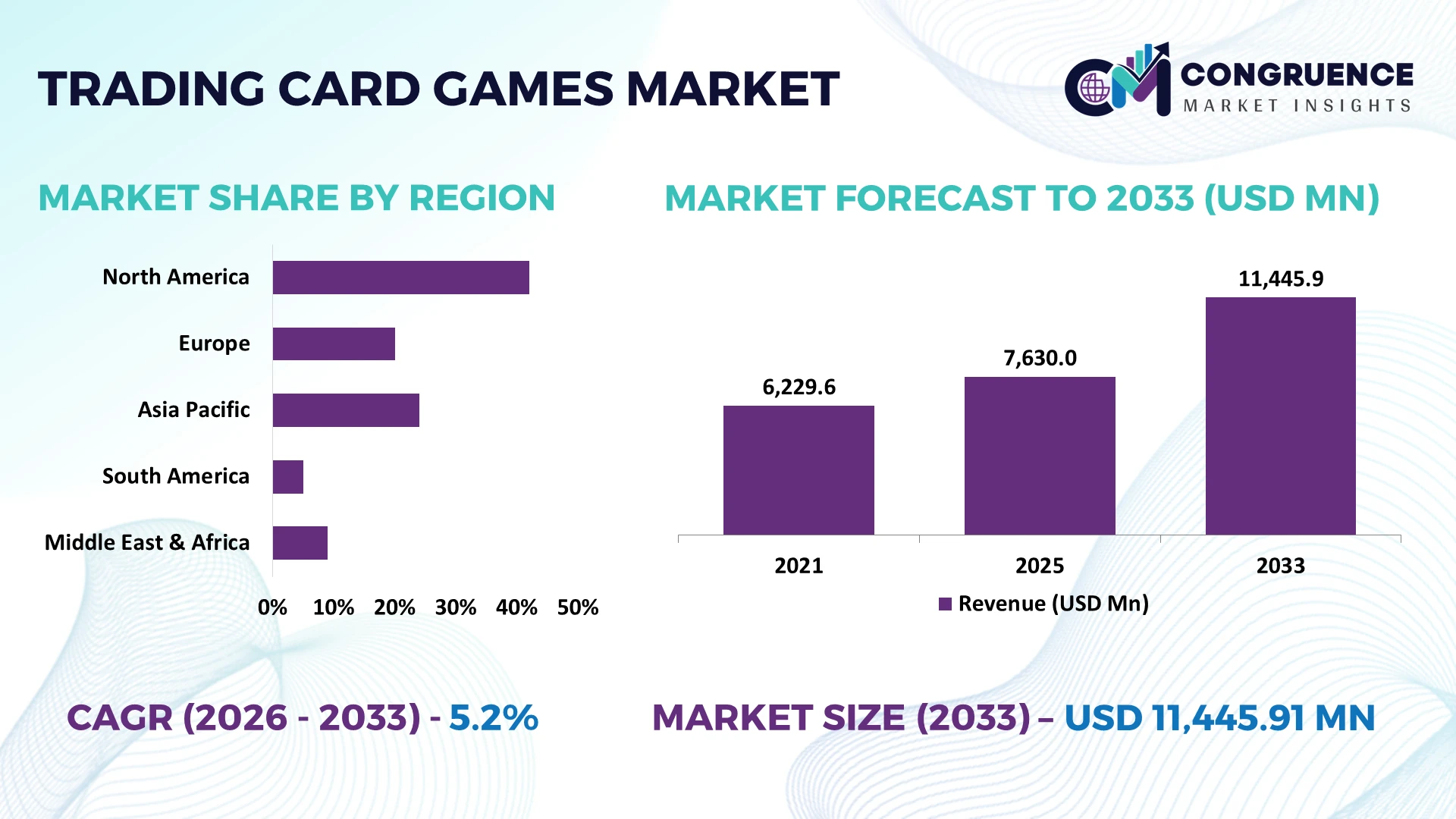
The Global Trading Card Games Market was valued at USD 7630 Million in 2025 and is anticipated to reach a value of USD 11445.91 Million by 2033 expanding at a CAGR of 5.2% between 2026 and 2033. Growth is driven by entertainment franchise licensing, organized competitive tournaments, international product distribution, and increasing integration between physical trading cards and digital gaming ecosystems.
The United States represents the largest geographical trading card games market, supported by established specialty retailers, competitive gaming infrastructure, and major entertainment franchises. Hasbro's tabletop gaming business recorded 62.2% growth in 2025, reflecting strong demand for Magic: The Gathering products and licensed collaborations. Japan represents another major market, with trading cards accounting for approximately 29% of its domestic toy industry in fiscal 2025. Japanese publishers benefit from integrated intellectual property development, specialized printing infrastructure, and international distribution networks.
Publishers should prioritize franchise licensing, production scalability, competitive gaming communities, and localized distribution to strengthen international market positioning.
Market Size & Growth: USD 7,630 million in 2025, reaching USD 11,445.91 million by 2033 at 5.2% CAGR, supported by franchise licensing and organized gaming.
Top Growth Drivers: Japan's card market expanded approximately 11.9% in fiscal 2025, while Hasbro's tabletop gaming business grew 62.2%, demonstrating strong franchise demand.
Short Term Forecast: By 2028, inventory automation and demand forecasting will target a 10% reduction in replenishment delays, supporting faster product distribution.
Emerging Technologies: Three technologies are AI inventory forecasting, automated card authentication, and digital gaming integration, improving inventory visibility, counterfeit detection, and player engagement.
Regional Leaders: Indicative 2033 projections allocate USD 4,578 million to North America, USD 4,006 million to Asia Pacific, and USD 2,289 million to Europe, reflecting different franchise ecosystems.
Consumer and End User Trends: Trading cards represented approximately 29% of Japan's domestic toy market in fiscal 2025, highlighting established collector and player engagement.
Pilot and Case Example: In 2025, Magic: The Gathering's licensed collaborations contributed to Hasbro's reported 62.2% tabletop gaming growth, demonstrating franchise integration effectiveness.
Competitive Landscape: Bandai held approximately 16.3% of Japan's trading card market in fiscal 2025. Major competitors include Pokémon, Wizards of the Coast, Konami, and Ravensburger.
Regulatory and ESG Impact: European packaging regulations establish a 2030 recyclability objective, encouraging publishers to redesign booster packaging and strengthen responsible material sourcing.
Investment and Funding: Hasbro's 2025 tabletop gaming business reached USD 1,686.6 million, demonstrating the commercial scale supporting continued investment in licensed products and distribution.
Innovation and Future Outlook: Three priorities are digital integration, authenticated collectibles, and international tournament expansion, strengthening customer retention and franchise monetization through 2033.
The global trading card games market is shifting toward integrated entertainment franchises, competitive gaming communities, and digitally supported collectible ecosystems. Publishers are expanding licensed collaborations, developing premium card editions, and strengthening relationships with specialized retailers. Japan's trading card category represented approximately 29% of domestic toy sales in fiscal 2025, demonstrating the commercial importance of established collector communities. Automated authentication and digital companion platforms are emerging as important tools for improving transaction security and player engagement. These developments are encouraging publishers to prioritize intellectual property partnerships, production flexibility, and international distribution infrastructure as strategic competitive advantages.
Trading card games are becoming strategically important as entertainment publishers transform established intellectual property into integrated physical gaming, digital engagement, and competitive tournament ecosystems. The Pokémon franchise surpassed 75 billion cards produced cumulatively by March 2025, demonstrating the manufacturing scale supporting international distribution. Publishers are restructuring supply chains around specialized printing capacity, coordinated product launches, and regional inventory management. Organized gaming programs increasingly connect specialty retailers with publishers, strengthening customer retention while creating measurable demand signals for subsequent product releases.
Digital inventory management, automated authentication, and integrated player platforms are changing traditional distribution operations. Automated card identification enables faster cataloging than manual visual inspection, although processing improvements depend on equipment and card condition. Japan maintains substantial franchise development and manufacturing capabilities, while the United States benefits from established specialty retail networks and international licensing partnerships. Digital integration allows publishers to coordinate physical product releases with online gaming communities and competitive events.
Between 2026 and 2028, publishers will prioritize regional manufacturing partnerships, automated distribution, and integrated tournament infrastructure. Magic: The Gathering's licensed collaborations demonstrate how entertainment partnerships extend existing gaming ecosystems. Companies combining established intellectual property with reliable product availability and organized competitive participation will strengthen customer retention, distribution efficiency, and international competitive positioning.
Entertainment franchise licensing and organized competitive gaming are strengthening trading card game distribution and customer engagement. Hasbro reported 62.2% growth in its tabletop gaming business during 2025, reflecting strong performance from Magic: The Gathering and licensed product collaborations. Japan's trading card category represented approximately 29% of domestic toy industry sales, demonstrating established consumer participation. International tournament programs connect product releases with recurring competitive events, strengthening relationships between publishers and specialty retailers. The transition toward coordinated physical and digital gaming ecosystems encourages publishers to expand intellectual property partnerships and regional distribution capabilities. Companies are investing in organized play infrastructure, specialized printing capacity, and coordinated international product launches to improve availability.
Specialized printing requirements and unpredictable collectible demand create structural limitations for trading card game publishers. Premium products require precise color reproduction, specialized finishes, and consistent manufacturing quality, restricting flexibility when production schedules become congested. Pokémon's cumulative production exceeding 75 billion cards demonstrates the scale required by established franchises, creating substantial capacity requirements for manufacturing partners. International distribution introduces additional exposure to shipping costs, customs procedures, and regional inventory imbalances. Limited edition releases intensify forecasting difficulties because collectible demand differs from competitive player purchasing behavior. Publishers are diversifying printing partnerships, improving inventory forecasting, and coordinating product allocation with distributors. Flexible production contracts and regional warehousing strengthen supply continuity during major product launches.
Digital gaming integration creates opportunities to connect physical card ownership with online competitive participation, authenticated collectibles, and personalized player engagement. Pokémon Trading Card Game Pocket demonstrated substantial consumer interest in mobile card collecting following its October 2024 launch. Digital platforms provide publishers with direct information about player activity, preferred card combinations, and engagement patterns. India presents an emerging opportunity through expanding mobile gaming participation and established entertainment franchise recognition. Publishers are developing digital companion applications, automated card identification systems, and partnerships with specialty retailers. Integrating physical product releases with digital engagement creates additional opportunities for customer retention, targeted product development, and international community expansion without relying exclusively on conventional retail distribution.
Managing competitive integrity across expanding international gaming communities presents a significant operational challenge. Publishers must coordinate card legality, tournament regulations, product localization, and digital platform compatibility across multiple countries. Pokémon's international distribution and cumulative production exceeding 75 billion cards illustrate the complexity of maintaining consistent product identification and quality standards. Counterfeit cards, automated purchasing systems, and unauthorized secondary market activity create additional pressures on consumer confidence. Competitive tournament programs require standardized judging procedures, reliable event infrastructure, and synchronized product release schedules. Publishers are strengthening authentication technologies, tournament management platforms, and regional operational partnerships. Long term competitiveness depends on maintaining consistent gameplay standards, reliable product verification, and coordinated international player engagement.
Premium Card Releases Reshape Inventory Planning: Publishers are increasing premium product differentiation through alternative artwork, collectible treatments, and franchise collaborations. Magic: The Gathering scheduled 6 major releases during 2025, while attendance at MagicCon events increased 29% compared with 2024. Publishers are coordinating specialized printing schedules, preorder allocation, and premium product distribution to capture collector demand while maintaining availability for competitive players.
Organized Retail Networks Adopt Performance Metrics: Specialty retailers increasingly use participation data to determine promotional inventory requirements and event scheduling. During 2025, Magic: The Gathering recorded 22% growth in unique organized players, supported by more than 10,000 active Wizards Play Network stores. Publishers are integrating retailer performance monitoring with promotional allocation systems, improving inventory distribution and strengthening relationships with stores demonstrating consistent player engagement.
Manufacturing Capacity Responds to Supply Pressure: Pokémon's cumulative production exceeded 75 billion cards by March 2025, demonstrating the scale of international manufacturing requirements. Persistent product shortages prompted expanded printing and replenishment initiatives during 2026. Publishers are strengthening production planning, coordinating international release schedules, and improving inventory allocation to address concentrated purchasing activity during major collectible launches.
Retail Marketplaces Strengthen Digital Integration: In November 2025, Wizards of the Coast expanded its partnership with TCGplayer, integrating marketplace services with its organized retail network. The initiative connects physical distribution with digital commerce across thousands of participating stores. Publishers are improving retailer identification, digital storefront integration, and exclusive promotional content to strengthen inventory visibility and support specialized retailers competing with larger ecommerce platforms.
Collectible Card Games represent the leading segment of the global trading card games market, supported by recurring product releases, established entertainment franchises, and extensive international distribution. An indicative segment allocation places Collectible Card Games at approximately 45% of market demand, reflecting the commercial importance of Pokémon, Magic: The Gathering, and other established franchises. Battle Card Games maintain significant participation through competitive gameplay and organized tournaments. Publishers prioritize these established formats because recurring expansions support product replenishment and sustained consumer engagement.
Deck-Building Games represent an emerging segment as consumers increasingly explore strategic gameplay and accessible product formats. Living Card Games provide predictable expansion structures, while Expandable Card Games emphasize structured collection development. These alternatives reduce dependence on randomized purchasing and support differentiated consumer acquisition strategies. Publishers are investing in specialized gameplay mechanics, licensed intellectual property, and targeted distribution partnerships. Product development priorities increasingly balance established collectible formats with differentiated gaming experiences that strengthen customer retention and reduce reliance on individual franchise launches.
Trading & Collecting represents the leading application, supported by premium collectible releases, secondary market transactions, and professional authentication services. An indicative market allocation places this application at approximately 35%, reflecting the commercial importance of collectible purchasing alongside traditional gameplay. Casual Play maintains broad participation through accessible product formats, while Competitive Play generates recurring purchases associated with evolving gameplay strategies. Tournament Play creates concentrated purchasing activity around officially sanctioned events and major product releases.
Online Play represents an expanding application as publishers integrate established franchises with digital gaming platforms. Magic: The Gathering has accumulated more than 17 million registered digital players, demonstrating the scale of established digital gaming infrastructure. Organized Events provide additional engagement through specialty retailers and competitive gaming communities. Publishers are strengthening tournament management platforms, coordinating digital and physical releases, and expanding regional event partnerships. These strategies support recurring participation while providing valuable information about consumer preferences, competitive formats, and product purchasing patterns.
Individual Players represent the leading end-user category, supported by recurring card purchases, established gaming communities, and extensive competitive participation. An indicative market allocation places individual players at approximately 40% of demand, reflecting the importance of recurring product purchases and gameplay engagement. Collectors represent another significant consumer category, emphasizing product rarity, card condition, alternative artwork, and premium collectible editions. Publishers differentiate their offerings through accessible starter products, specialized expansions, and limited collectible configurations to address these distinct purchasing behaviors.
Gaming Stores and Hobby Shops provide essential community infrastructure, combining product distribution with recurring gaming events. Specialty Retailers support broader product availability, while Tournament Organizers coordinate competitive participation and major gaming events. During 2025, Wizards Play Network expanded to more than 10,000 active stores, demonstrating the importance of organized retail infrastructure. Publishers are strengthening retailer partnerships, improving promotional allocation systems, and introducing digital event management tools. Investment increasingly targets retail networks that combine product availability with measurable player engagement.
North America accounted for the largest estimated market share at 40% in 2025 however, Asia Pacific is expected to register the fastest growth, expanding at an estimated CAGR of 6.4% between 2026 and 2033.
Established Franchise Ecosystems and Expanding Organized Retail Networks
North America represents approximately 40% of the global trading card games market, supported by established entertainment franchises, extensive specialty retail networks, and competitive gaming infrastructure. The United States dominates regional activity through major publishers, collectible marketplaces, and organized tournament participation. Magic: The Gathering's international retail infrastructure provides an established distribution network connecting product releases with recurring player engagement. Publishers increasingly coordinate licensed entertainment collaborations with physical card launches and digital gaming platforms. Professional grading services and specialized collectible marketplaces strengthen secondary market activity. Canadian specialty retailers contribute additional distribution capacity through organized gaming communities and international franchise availability. Publishers are prioritizing inventory automation, regional product allocation, and coordinated tournament schedules to strengthen retailer relationships. Established intellectual property ownership provides competitive advantages through recurring product development and international licensing opportunities.
United States Market Outlook: The United States benefits from established trading card publishers, extensive collectible marketplaces, and specialized gaming infrastructure. Magic: The Gathering and Pokémon maintain substantial consumer participation through recurring product releases and competitive gaming programs. Professional grading companies strengthen collectible authentication, while specialty retailers connect physical product distribution with organized tournaments. Publishers are investing in licensed collaborations, improved inventory management, and integrated digital engagement platforms.
Specialty Retail Expansion and Localized Competitive Gaming
Europe represents approximately 20% of the global trading card games market, supported by established specialty retailers, international entertainment franchises, and expanding competitive gaming communities. Germany, France, and the United Kingdom represent important markets for collectible products and organized tournament participation. Publishers increasingly coordinate localized card editions with international product launches to improve regional accessibility. European specialty retailers support recurring engagement through competitive tournaments, collectible trading events, and community gaming activities. Digital marketplaces provide additional distribution opportunities by connecting collectors with specialized retailers across national boundaries. European packaging regulations are also encouraging publishers to evaluate recyclable packaging materials and responsible product distribution practices. Manufacturers and distributors are strengthening localization partnerships, expanding tournament support infrastructure, and improving regional inventory allocation to address differences in consumer purchasing patterns and product availability.
Germany Market Outlook: Germany represents an important European trading card games market because of its established specialty retail infrastructure, extensive tabletop gaming culture, and international distribution connections. Competitive gaming communities support recurring product demand through organized tournaments and specialized gaming events. Publishers are expanding localized product availability and strengthening relationships with gaming stores. Digital collectible marketplaces provide additional opportunities for German retailers to reach international customers.
Japanese Franchise Leadership and Expanding International Manufacturing
Asia Pacific accounts for approximately 30% of the global trading card games market, supported by Japanese entertainment franchises, specialized card manufacturing, and extensive collectible gaming communities. Japan represents the principal regional production and intellectual property development center, with Pokémon, Yu Gi Oh!, and Bandai franchises supporting international distribution. Pokémon's cumulative production exceeded 75 billion cards by March 2025, demonstrating substantial manufacturing scale. China, South Korea, and Australia contribute through expanding specialty retail networks and established gaming communities. Regional publishers increasingly coordinate domestic product releases with international localization and distribution schedules. Manufacturing partnerships support specialized printing requirements, premium collectible editions, and consistent production quality. Publishers are expanding international licensing arrangements, strengthening regional distribution infrastructure, and integrating digital gaming platforms with established physical collectible franchises.
Japan Market Outlook: Japan benefits from globally recognized entertainment franchises, specialized printing infrastructure, and extensive domestic collectible gaming participation. Pokémon, Konami, and Bandai maintain established product development and international licensing capabilities. Japanese publishers coordinate recurring card releases with entertainment merchandising and competitive tournaments. Advanced printing technologies, specialized collectible treatments, and established distribution partnerships support international expansion while strengthening Japan's position in trading card intellectual property development.
Localized Distribution and Expanding Competitive Gaming Communities
South America represents approximately 6% of the global trading card games market, with Brazil contributing substantially to regional collectible gaming activity. Established international franchises maintain consumer engagement through specialty retailers, competitive tournaments, and localized product distribution. Brazil benefits from established gaming communities and international entertainment franchise recognition, creating opportunities for expanded organized gaming infrastructure. Argentina and Chile contribute additional demand through specialty retail networks and collectible trading communities. Import duties, currency fluctuations, and international shipping requirements create operational challenges for distributors handling premium collectible products. Publishers are strengthening regional distribution partnerships and coordinating localized releases to improve product availability. Digital marketplaces support collectible trading across national boundaries, while organized gaming events strengthen relationships between publishers, retailers, and competitive players.
Brazil Market Outlook: Brazil represents a strategically important South American market because of its established gaming communities, specialized retailers, and participation in international competitive gaming programs. São Paulo provides an important distribution center for collectible products and organized gaming events. Publishers are strengthening Portuguese language product availability and regional distributor partnerships. Improved inventory allocation and coordinated tournament support are important for reducing supply disruptions and strengthening specialty retail participation.
Gaming Infrastructure Development and International Franchise Distribution
The Middle East and Africa represent approximately 4% of the global trading card games market, supported by expanding gaming communities, international entertainment franchises, and developing specialty retail infrastructure. The United Arab Emirates and Saudi Arabia represent important commercial markets because of their entertainment investments and established international retail connections. South Africa contributes through specialized gaming retailers and organized tabletop gaming communities. International publishers are expanding product availability through regional distributors and ecommerce platforms. Limited specialized retail coverage and imported product dependence create operational challenges outside major metropolitan markets. Publishers are strengthening distribution partnerships, supporting organized gaming events, and expanding localized marketing activities. Growing investment in entertainment infrastructure provides opportunities to integrate collectible gaming events with established consumer entertainment destinations and specialized retail environments.
Saudi Arabia Market Outlook: Saudi Arabia represents an emerging market supported by entertainment infrastructure development and expanding consumer gaming participation. Riyadh and Jeddah provide commercial centers for specialized gaming retailers and international franchise distribution. Vision 2030 initiatives support broader entertainment industry development, creating opportunities for organized gaming communities. Publishers are developing regional distribution relationships and exploring partnerships with entertainment venues and specialty retailers to strengthen product accessibility.
The global trading card games market features competition between established franchise publishers, specialized gaming developers, and regional distributors. The Pokémon Company, Wizards of the Coast, Konami, Bandai, and Ravensburger maintain significant competitive positions through established intellectual property, international distribution, and recurring product development. Their combined global market share is not publicly established through comparable disclosures. Competitive differentiation centers on franchise recognition, product availability, collectible rarity, and organized gaming infrastructure. Pokémon benefits from extensive international franchise recognition, while Magic: The Gathering emphasizes licensed collaborations and competitive gameplay. Konami and Bandai leverage established entertainment properties, while Ravensburger expands through licensed collectible gaming products. Publishers are strengthening specialized printing partnerships, improving international inventory allocation, and expanding tournament support programs. Digital integration and professional collectible authentication are reshaping consumer engagement. Established intellectual property, manufacturing capacity, and specialized distribution networks create substantial entry barriers. Sustainable competition requires differentiated gameplay, reliable product availability, and recurring community participation.
The Pokémon Company
Hasbro
Konami Group Corporation
Bandai Namco Holdings
Ravensburger
Bushiroad
Upper Deck
Legend Story Studios
Cryptozoic Entertainment
Wise Wizard Games
Asmodee
Gamegenic
Digital platforms are changing how trading card publishers acquire players. Pokémon Trading Card Game Pocket exceeded 60 million downloads within six weeks of launching in October 2024. Its 20 card decks contain 67% fewer cards than conventional 60 card competitive decks, simplifying entry rather than reducing manufacturing costs. Digital collections and synchronized expansions provide publishers with engagement signals for promotional planning, benefiting established franchises with substantial international audiences.
Emerging authentication combines high resolution imaging, computer vision, and searchable grading databases. Automated image comparison standardizes preliminary identification, although universal grading cost savings remain unverified. Digital tournament infrastructure provides another adoption signal: Konami's 2025 world championship featured four competition categories spanning physical and digital formats. Compared with manual registration, integrated event platforms centralize eligibility checks and match reporting, improving administrative consistency across participating international locations.
Between 2026 and 2028, publishers will connect digital engagement analytics, product planning, and retailer inventory systems. Automated print inspection identifies artwork defects before packaging, while collectible authentication strengthens secondary market traceability. Smaller publishers benefit from shared tournament platforms and contracted digital services rather than proprietary infrastructure. Investment in localized digital experiences and interoperable retailer reporting supports faster product decisions without assuming downloads translate directly into physical purchases.
December 2024: The Pokémon Company and DeNA announced that Pokémon Trading Card Game Pocket surpassed 60 million downloads following its October launch. The milestone demonstrated rapid digital adoption and supported expansion through additional collectible content and international mobile distribution.
April 2025: Hasbro announced that Magic: The Gathering's Final Fantasy collaboration became its bestselling expansion through preorders alone, exceeding previous release records. The achievement demonstrated the commercial effectiveness of established entertainment partnerships and strengthened demand for licensed collectible products.
May 2025: Ravensburger announced Disney Lorcana's ninth expansion, Fabled, introducing two additional rarity categories and rotating four original sets from competitive play. The restructuring strengthened collectible differentiation while establishing a sustainable framework for tournament formats and recurring product development.
September 2025: Konami announced the completion of its Yu Gi Oh! World Championship in Paris, featuring four competitive categories. The tournament integrated physical and digital gaming formats, strengthening international competitive participation while establishing Tokyo as the subsequent championship destination. .
The Trading Card Games Market Report examines industry structure, product innovation, consumer participation, and competitive developments between 2026 and 2033. Product segmentation covers Collectible Card Games, Living Card Games, Expandable Card Games, Deck Building Games, and Battle Card Games. Application analysis evaluates Casual Play, Competitive Play, Tournament Play, Online Play, Trading & Collecting, and Organized Events. End user coverage includes individual players, collectors, hobby shops, gaming stores, tournament organizers, and specialty retailers.
Geographical coverage encompasses North America, Europe, Asia Pacific, South America, and the Middle East and Africa. Technology analysis examines automated authentication, digital gaming platforms, inventory forecasting, and advanced printing processes. Competitive assessment evaluates franchise licensing, manufacturing partnerships, distribution networks, and tournament infrastructure. The report supports investment planning, international expansion, product differentiation, and strategic positioning across established and emerging gaming markets.
| Report Attribute/Metric | Report Details |
|---|---|
Market Revenue in 2025 | USD 7630 Million |
Market Revenue in 2033 | USD 11445.91 Million |
CAGR (2026 - 2033) | 5.2% |
Base Year | 2025 |
Forecast Period | 2026 - 2033 |
Historic Period | 2021 - 2025 |
Segments Covered | By Type
By Application
By End-User
|
Key Report Deliverable | Revenue Forecast, Growth Trends, Market Dynamics, Segmental Overview, Regional and Country-wise Analysis, Competition Landscape |
Region Covered | North America, Europe, Asia-Pacific, South America, Middle East, Africa |
Key Players Analyzed | The Pokémon Company, Hasbro, Konami Group Corporation, Bandai Namco Holdings, Ravensburger, Bushiroad, Upper Deck, Legend Story Studios, Cryptozoic Entertainment, Wise Wizard Games, Asmodee, Gamegenic |
Customization & Pricing | Available on Request (10% Customization is Free) |




