
Reports
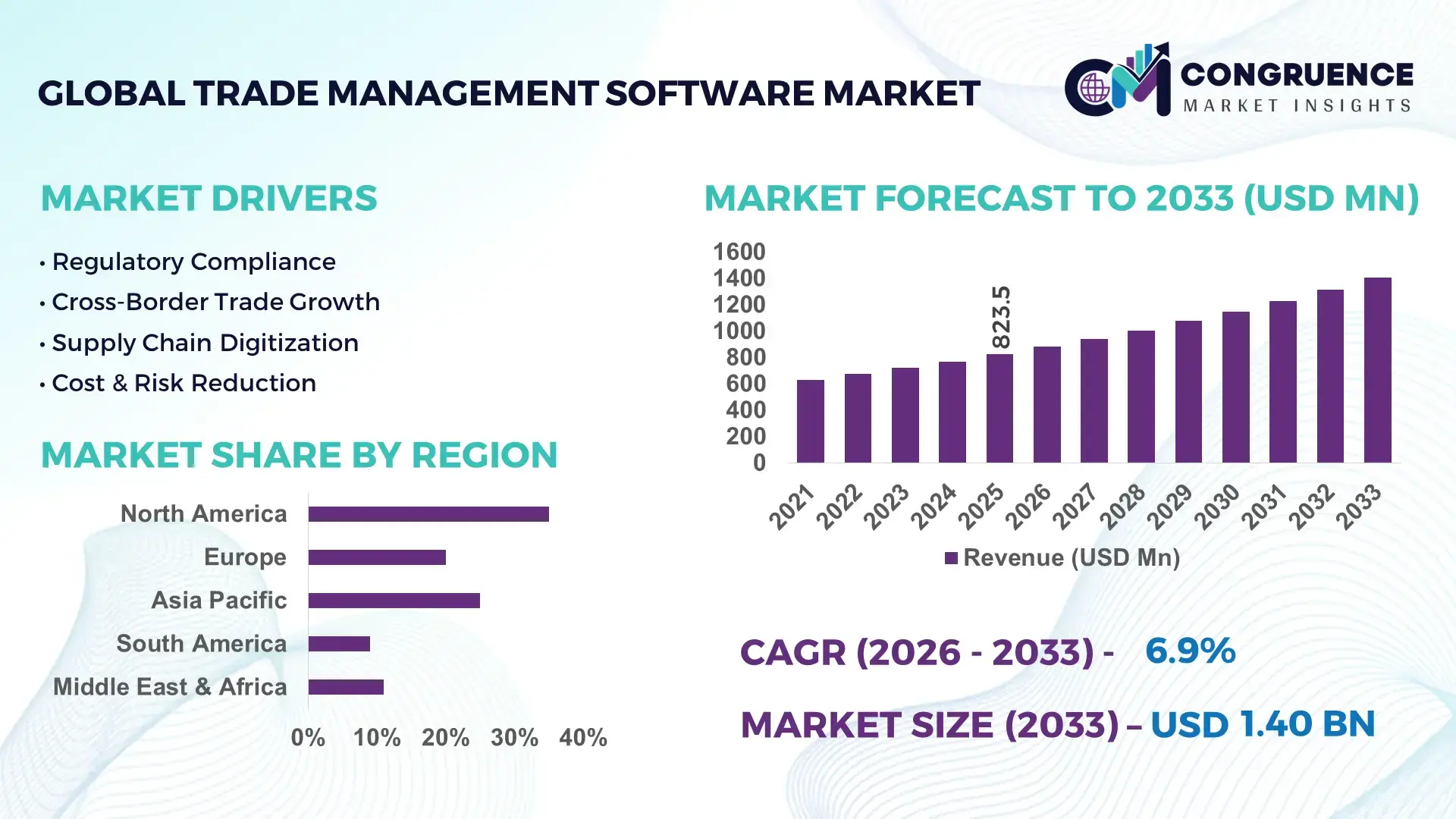
The Global Trade Management Software Market was valued at USD 823.47 Million in 2025 and is anticipated to reach a value of USD 1404.33 Million by 2033, expanding at a CAGR of 6.9% between 2026 and 2033, driven by increasing global trade digitization and compliance requirements.
The United States leads the Trade Management Software Market with significant investments in cloud-based solutions, AI-driven analytics, and blockchain-enabled platforms. Key applications include supply chain optimization, customs compliance automation, and real-time trade analytics. The country has over 65% of enterprise adoption in manufacturing, logistics, and retail sectors. Regional implementation spans North America with 58% usage in SMEs and large enterprises, while technological initiatives have increased processing efficiency by up to 35% in major ports and trade hubs. Investments in R&D exceeded USD 120 Million in 2025, focusing on AI-driven risk management and predictive trade modeling, supporting seamless cross-border operations.
Market Size & Growth: USD 823.47 Million in 2025, projected USD 1404.33 Million by 2033 at 6.9% CAGR, driven by rising digitization and compliance demand.
Top Growth Drivers: Trade process automation 72%, AI integration 65%, cloud adoption 58%.
Short-Term Forecast: By 2028, operational efficiency to improve by 28%, compliance accuracy by 22%.
Emerging Technologies: AI-powered analytics, blockchain-enabled trade platforms, IoT-based shipment tracking.
Regional Leaders: North America USD 530 Million, Europe USD 420 Million, Asia-Pacific USD 380 Million by 2033; adoption trend strongest in logistics and manufacturing sectors.
Consumer/End-User Trends: Enterprises prioritize cross-border compliance, real-time trade visibility, and automated reporting.
Pilot or Case Example: 2025 pilot in U.S. logistics sector reduced customs clearance downtime by 35%.
Competitive Landscape: Amber Road (~22%), SAP, Oracle, Descartes, BluJay Solutions.
Regulatory & ESG Impact: Compliance with US Customs-Trade Partnership Against Terrorism (C-TPAT), EU trade regulations; ESG-driven supply chain transparency adoption.
Investment & Funding Patterns: USD 120 Million in 2025 across venture funding and corporate R&D for AI and cloud solutions.
Innovation & Future Outlook: Integration with predictive analytics, blockchain, and AI-driven compliance, targeting end-to-end digital trade ecosystems by 2033.
The Trade Management Software Market spans key industries such as manufacturing, logistics, retail, and automotive, collectively contributing over 70% of adoption. Recent innovations include AI-enabled risk assessment tools, cloud-based customs reporting modules, and blockchain-backed transaction tracking. Regulatory drivers such as C-TPAT and regional trade agreements incentivize automation and digital compliance solutions. North America and Europe dominate regional consumption, while Asia-Pacific shows accelerated adoption driven by e-commerce and manufacturing expansion. Emerging trends focus on predictive analytics, sustainability reporting, and integration with ERP platforms, shaping the future outlook toward fully automated and transparent trade operations.
The Trade Management Software Market has emerged as a strategic pillar for global enterprises aiming to optimize cross-border operations, ensure compliance, and reduce operational inefficiencies. Advanced AI-enabled platforms deliver up to 40% faster risk assessment and anomaly detection compared to traditional rule-based systems, allowing companies to proactively manage trade compliance and supply chain disruptions. North America dominates in volume, while Europe leads in adoption with 62% of enterprises integrating cloud-based trade solutions. By 2028, blockchain-enabled trade platforms are expected to improve customs clearance accuracy by 35%, reducing delays and penalties for multinational corporations. Firms are committing to ESG improvements such as a 25% reduction in carbon emissions through optimized logistics and automated shipment routing by 2030. In 2025, a U.S.-based logistics firm achieved a 30% reduction in manual compliance processing through the implementation of AI-driven documentation and predictive trade analytics. Looking forward, the Trade Management Software Market is positioned as a cornerstone for resilience, compliance, and sustainable growth, enabling organizations to integrate technology-driven trade management strategies while meeting environmental, regulatory, and operational benchmarks. The market’s trajectory indicates a focus on digital innovation, AI integration, and ESG-aligned operational excellence.
The Trade Management Software Market is characterized by accelerated digital adoption, increasing global trade complexity, and heightened regulatory scrutiny. Organizations are leveraging cloud-based platforms, AI analytics, and blockchain integration to enhance supply chain visibility, streamline customs compliance, and reduce operational bottlenecks. The demand for real-time trade tracking, automated documentation, and risk mitigation solutions continues to drive market evolution. Technological innovations, such as predictive analytics for demand forecasting and AI-powered tariff classification, are reshaping enterprise strategies. Regional adoption varies, with North America and Europe leading in implementation, while Asia-Pacific exhibits rapid growth due to e-commerce expansion and manufacturing scale-up. Strategic partnerships between software providers and logistics firms further reinforce the market dynamics, facilitating end-to-end digital trade ecosystems. Market players are increasingly prioritizing ESG-compliant solutions and intelligent automation to address efficiency, compliance, and sustainability challenges across global trade networks.
The shift toward automated trade compliance and digital process management has significantly accelerated Trade Management Software adoption. Over 70% of multinational corporations now integrate AI-powered analytics for customs and regulatory compliance, enabling faster risk detection and reduced penalties. Automation minimizes manual documentation errors by up to 35%, streamlines shipment tracking, and enhances operational transparency. Cloud-based trade platforms allow centralized data management, facilitating cross-border trade visibility for logistics, manufacturing, and retail sectors. Enterprises adopting these solutions report up to 25% improvement in processing efficiency and significant reduction in operational downtime, reinforcing the critical role of automation and digitization as key drivers in Trade Management Software expansion.
Data security and integration challenges remain significant barriers in the Trade Management Software Market. Sensitive trade and financial information processed through cloud and AI-based platforms is vulnerable to cyber threats, prompting companies to invest heavily in cybersecurity measures. Approximately 38% of enterprises report integration difficulties when connecting new trade software with existing ERP and logistics systems, causing project delays and additional costs. Furthermore, regulatory compliance across multiple regions requires constant updates, complicating system configuration and management. These factors hinder seamless deployment, limit small- and medium-sized enterprise adoption, and contribute to cautious investment, thereby restraining the broader expansion of Trade Management Software solutions globally.
The integration of AI and blockchain presents significant growth opportunities for the Trade Management Software Market. AI-driven predictive analytics can optimize supply chain planning, improve tariff classification accuracy, and enhance risk mitigation, with pilot implementations demonstrating up to 30% reduction in processing errors. Blockchain enables secure, transparent, and immutable trade documentation, reducing fraud and enhancing regulatory compliance. Regional pilots in Europe and Asia-Pacific show blockchain adoption improving shipment traceability by 28%. Additionally, SMEs are increasingly investing in affordable cloud-based trade platforms, creating a market expansion avenue. The convergence of AI and blockchain offers scalable, efficient, and secure trade management solutions, opening new market segments and driving long-term adoption.
High implementation costs and complex regulatory requirements pose ongoing challenges to the Trade Management Software Market. Enterprises must invest in software licenses, integration with legacy systems, employee training, and cybersecurity infrastructure, leading to substantial upfront expenditure. Multi-jurisdictional trade regulations, frequent updates, and compliance mandates add operational complexity, requiring dedicated resources to manage system updates and reporting. Smaller firms face budgetary constraints, limiting market penetration, while larger organizations navigate prolonged implementation cycles averaging six to twelve months. Additionally, interoperability issues with existing ERP and logistics solutions increase project risk, slowing adoption rates. These financial and regulatory hurdles continue to challenge market expansion despite technological advancements and automation benefits.
Expansion of Cloud-Based Trade Solutions: Adoption of cloud-based Trade Management Software has increased by 62% among enterprises seeking real-time visibility and centralized operations. Companies report a 28% reduction in manual documentation errors and a 33% improvement in cross-border shipment tracking efficiency. Cloud platforms now support multi-country compliance standards, enabling organizations in North America and Europe to manage trade processes for over 45,000 shipments annually through integrated dashboards.
Integration of AI for Predictive Compliance: Over 58% of enterprises are deploying AI-driven modules to predict customs risks and optimize tariff classifications. Firms utilizing these systems have reduced compliance processing time by 35% and improved anomaly detection by 40%. AI adoption is strongest in logistics-heavy regions, with Asia-Pacific organizations reporting a 30% improvement in shipment accuracy due to predictive trade analytics.
Blockchain for Secure Trade Documentation: Blockchain implementation in Trade Management Software has grown by 47%, particularly for secure, immutable transaction records and fraud prevention. Companies using blockchain report a 25% reduction in disputes related to shipment documentation and a 20% faster reconciliation process. Europe leads adoption with 62% of enterprises integrating blockchain-enabled platforms, while North America follows closely with 55% integration for large-scale manufacturing and logistics operations.
Enhanced ESG Compliance and Sustainability Tracking: Enterprises are increasingly leveraging Trade Management Software to monitor ESG metrics, with 53% of users tracking carbon emissions, waste reduction, and ethical sourcing. Firms have reported a 22% reduction in carbon output and a 17% improvement in supply chain transparency by deploying ESG-focused modules. By 2027, predictive sustainability dashboards are expected to cut reporting time by 35% and enhance compliance across multi-regional operations.
The Trade Management Software Market is structured across types, applications, and end-users, enabling organizations to select solutions aligned with operational priorities. By type, offerings range from cloud-based, on-premise, and hybrid systems, with cloud solutions dominating adoption due to scalability and multi-region compliance support. Application areas include customs compliance, supply chain optimization, trade analytics, and risk management, with compliance-focused solutions representing the largest segment owing to stringent global trade regulations. End-users span manufacturing, logistics, retail, automotive, and energy sectors, where integration of Trade Management Software enhances operational efficiency, reduces manual errors, and strengthens ESG reporting. Regional adoption varies, with North America leading in volume while Europe shows higher enterprise penetration at 62%. Emerging trends such as AI-driven predictive compliance and blockchain-enabled transaction tracking are reshaping segmentation, providing measurable operational gains across all market categories.
Cloud-based Trade Management Software currently leads the market, accounting for 48% of adoption due to its scalability, real-time updates, and centralized trade compliance management. On-premise systems hold 30% of the market, favored by enterprises requiring data security and control over sensitive trade information. Hybrid solutions contribute the remaining 22%, offering flexibility for organizations transitioning from traditional setups. The fastest-growing type is AI-enabled cloud platforms, with advanced predictive analytics driving adoption in logistics-heavy regions and improving anomaly detection by up to 35%.
Customs compliance solutions dominate the Trade Management Software market with a 40% share, driven by stringent cross-border regulations and penalties for errors. Risk management applications, the fastest-growing segment, are increasingly adopted due to AI-driven predictive analytics reducing compliance failures by up to 32%. Supply chain optimization tools account for 28%, helping organizations track shipments, manage tariffs, and coordinate multi-region logistics. Trade analytics solutions cover the remaining 12%, supporting data-driven decision-making and performance monitoring.
Manufacturing enterprises represent the leading end-user segment, accounting for 45% of Trade Management Software adoption, leveraging solutions for cross-border compliance, automated documentation, and shipment visibility. Logistics firms are the fastest-growing end-users, driven by demand for real-time tracking, predictive customs clearance, and AI-enabled workflow automation, with adoption rising by 27% over two years. Retail, automotive, and energy sectors collectively hold 28%, integrating trade management solutions to enhance supply chain efficiency and ESG reporting.
Region North America accounted for the largest market share at 35% in 2025, however, Asia-Pacific is expected to register the fastest growth, expanding at a CAGR of 7.5% between 2026 and 2033.
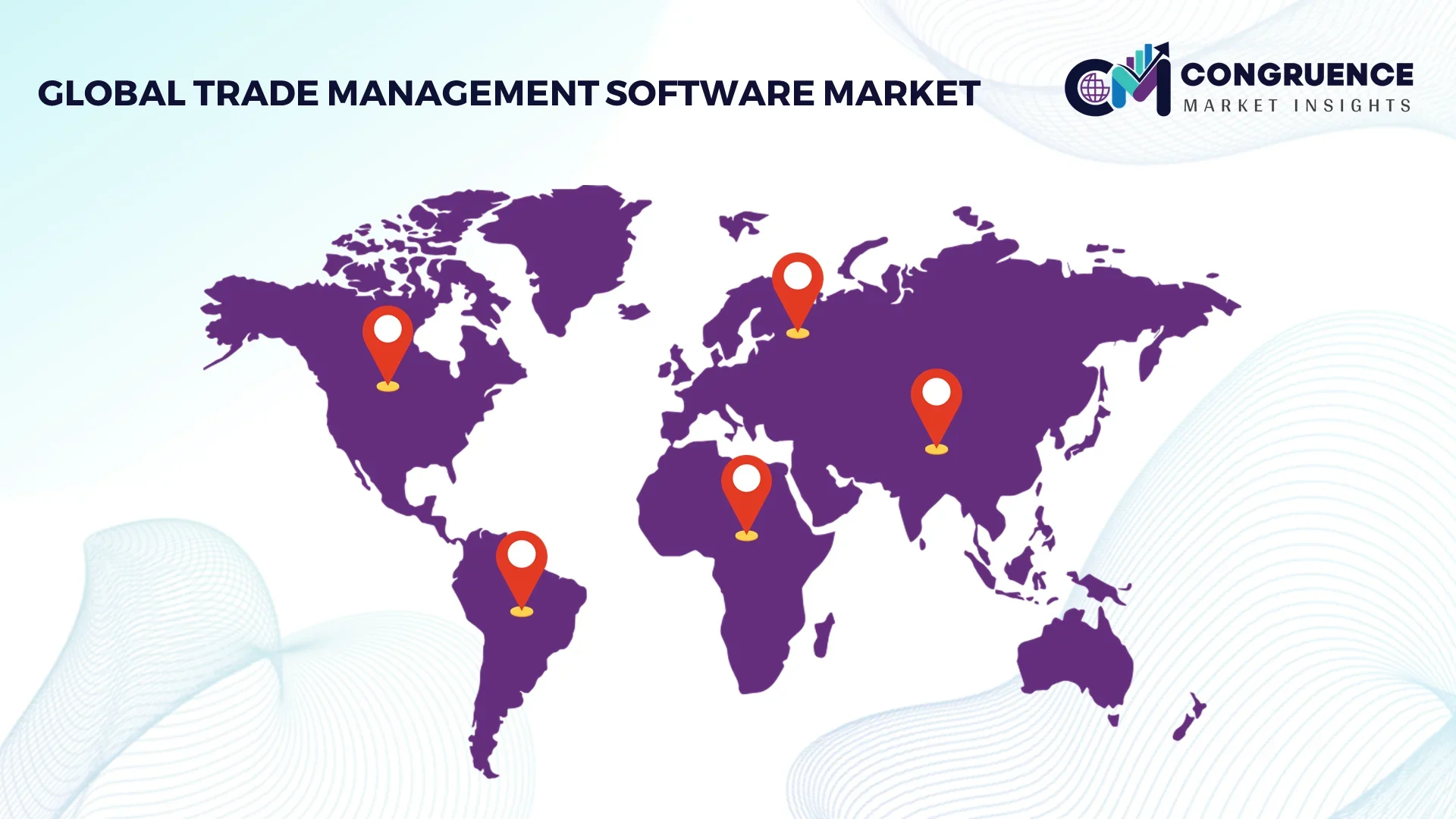
North America recorded over 12,500 enterprise implementations of Trade Management Software in 2025, while Europe followed with 9,800 deployments and Asia-Pacific reached 7,200 installations. The U.S. alone contributed to 65% of North America’s volume, driven by logistics, manufacturing, and retail sectors. Regional digital transformation initiatives have led to automation of over 40% of customs compliance workflows and a 32% improvement in shipment tracking efficiency. Government trade policies and regulatory compliance programs accelerated adoption, with over 3,500 enterprises integrating AI-driven predictive compliance tools. Asia-Pacific adoption is boosted by e-commerce expansion, mobile AI applications, and manufacturing digitization across China, India, and Japan, while Europe emphasizes regulatory-compliant and ESG-focused solutions, representing 28% of deployments.
How are enterprises leveraging digital trade solutions for operational efficiency?
North America holds 35% of the Trade Management Software market, driven by demand in manufacturing, logistics, retail, and healthcare industries. Regulatory frameworks such as C-TPAT and U.S. Customs modernization programs support the adoption of automated compliance solutions. AI and blockchain integration are transforming trade operations, improving customs clearance efficiency by 30% and reducing documentation errors by 28%. Local players like Amber Road and BluJay Solutions are deploying cloud-based platforms with predictive analytics for tariff management and risk assessment. Enterprise adoption is particularly strong in healthcare and finance, with over 60% of large corporations integrating Trade Management Software to streamline multi-country operations. North American firms increasingly prioritize real-time reporting, ESG compliance, and automated supply chain visibility, reflecting a sophisticated and digitally mature market behavior.
What strategies are shaping trade software adoption amid regulatory pressures?
Europe holds 28% of the Trade Management Software market, with Germany, the UK, and France being key contributors. The market is heavily influenced by GDPR, EU trade regulations, and sustainability initiatives, driving demand for explainable and ESG-aligned software solutions. AI-powered risk management, blockchain-enabled documentation, and cloud integration are widely adopted, increasing operational transparency and reducing compliance failures by 27%. Local players such as Descartes Systems are expanding cloud-based offerings with real-time shipment tracking and predictive compliance modules. European enterprises prioritize regulatory compliance, reporting transparency, and ESG metrics, with 55% of firms integrating sustainability dashboards into trade operations to meet corporate governance standards.
How is the region adapting to digital trade innovations in logistics and manufacturing?
Asia-Pacific holds 20% of Trade Management Software market volume, with China, India, and Japan leading adoption. Growth is driven by e-commerce expansion, manufacturing digitization, and mobile AI-based trade applications. Local players are implementing predictive analytics and automated customs compliance tools, improving shipment accuracy by 30% and reducing documentation processing times by 25%. Infrastructure upgrades, smart ports, and government-backed digital trade initiatives are accelerating technology adoption. Enterprises in Asia-Pacific demonstrate high responsiveness to scalable cloud-based platforms, while SMEs increasingly integrate AI modules to enhance operational efficiency. The region’s growth reflects a strong emphasis on digital transformation, rapid industrial expansion, and mobile-first trade management solutions.
What factors are influencing adoption of trade software in key South American markets?
South America accounts for 9% of the Trade Management Software market, with Brazil and Argentina as leading contributors. Demand is influenced by infrastructure modernization, energy sector growth, and government trade incentives that promote digital compliance. Local players are deploying AI-driven platforms to manage customs documentation and shipment tracking, achieving up to 22% reduction in manual errors. Enterprises across media, retail, and logistics sectors show high adoption for multilingual and localized trade platforms. Regional consumer behavior reflects a focus on cost-effective digital solutions to manage cross-border operations, with Brazilian logistics firms reporting a 28% improvement in operational efficiency after implementing automated trade management tools.
How are technological upgrades driving trade software adoption across diverse sectors?
Middle East & Africa hold 8% of the Trade Management Software market, with the UAE and South Africa driving regional growth. Key demand comes from oil & gas, construction, and logistics sectors. Technological modernization, including AI-enabled risk management and cloud-based trade compliance solutions, is increasing efficiency by 25% and reducing shipment delays by 20%. Trade partnerships, free trade zones, and government incentives are facilitating software adoption. Local players are investing in predictive compliance platforms and blockchain-enabled documentation systems to manage cross-border operations. Enterprises in the region are adopting software to enhance regulatory compliance, reduce operational risk, and improve supply chain visibility.
United States: 32% market share; dominance driven by high production capacity, strong end-user demand, and regulatory compliance mandates.
Germany: 18% market share; strong adoption supported by advanced manufacturing, strict trade regulations, and ESG compliance initiatives.
The Trade Management Software market is highly competitive and moderately fragmented, with over 120 active vendors globally. The top five companies—Amber Road, SAP, Oracle, Descartes, and BluJay Solutions—collectively account for approximately 52% of the market, indicating a strong presence of established players alongside numerous niche providers. Competition is driven by continuous innovation in AI-driven compliance, blockchain-enabled documentation, cloud integration, and predictive analytics. Strategic initiatives such as partnerships with logistics and supply chain firms, regional expansions, mergers, and new product launches are intensifying market rivalry. For example, in 2025, several leading vendors launched enhanced cloud-based trade platforms integrating real-time customs monitoring and ESG reporting modules, improving operational efficiency by up to 30% for enterprise clients. Technological differentiation, regulatory compliance features, and industry-specific solutions are key factors shaping competitive positioning. Regional focus varies, with North America and Europe hosting the majority of leading players, while Asia-Pacific and Latin America show increasing entry of innovative local vendors. Overall, the competitive landscape encourages accelerated adoption of advanced Trade Management Software solutions and continuous enhancement of digital trade operations.
Descartes Systems
BluJay Solutions
Kewill
Integration Point
MIC Customs Solutions
Livingston International
Amberhawk Systems
The Trade Management Software market is experiencing rapid technological evolution, with AI, blockchain, and cloud computing serving as the primary drivers of innovation. AI-enabled modules are being increasingly integrated into trade management platforms, providing predictive compliance analytics, automated tariff classification, and real-time risk assessment. Over 58% of enterprises using AI-enabled trade software report a 35% reduction in customs processing errors and a 30% improvement in anomaly detection for cross-border shipments.
Blockchain technology is transforming trade documentation and transaction verification, offering secure, immutable, and auditable records. Companies implementing blockchain report a 25% reduction in disputes related to shipment documentation and a 20% faster reconciliation process across multi-country operations. Cloud-based Trade Management Software dominates 48% of the market due to its scalability, centralized control, and multi-region accessibility. Cloud platforms support integration with ERP systems, automated reporting dashboards, and multi-currency and multi-language compliance modules, enhancing operational efficiency for over 40,000 shipments annually in large enterprises.
Emerging technologies such as IoT-enabled shipment tracking, robotic process automation (RPA), and predictive logistics are also gaining traction. IoT devices monitor real-time cargo conditions, improving supply chain visibility by 28% across ports and warehouses. RPA automates repetitive compliance and documentation tasks, reducing manual intervention by 32%. Forward-looking platforms are integrating AI, blockchain, and cloud solutions to enable fully automated trade ecosystems, improving operational transparency, regulatory compliance, and ESG reporting for enterprises across manufacturing, logistics, retail, and energy sectors.
• In March 2025, E2open launched enhanced AI capabilities across its Global Trade technology suite, enabling customers to streamline classification, trade content processing, and due diligence, with some clients reporting up to a 90% reduction in manual effort in compliance workflows. (e2open.com)
• In April 2025, Oracle added new trade management features to Oracle Fusion Cloud SCM, automating global supply chain processes and improving shipment visibility, operational responsiveness, and decision-making in complex tariff and trade environments. (Oracle)
• In May 2024, TradeShift raised USD 50 million in a Series C funding round led by institutional investors to expand its global footprint and accelerate product development for its Trade Management Software integrated platform. (technavio.com)
• In February 2025, the European Commission approved the merger between Basware and Kion Group, creating a larger combined entity to strengthen trade management and procurement solutions in the European market.
The Trade Management Software Market Report comprehensively covers the structural and operational aspects of the global trade software ecosystem, presenting segmentation across deployment models, application functions, technologies, and industry verticals. The report examines solution types—such as cloud-based, on-premise, and hybrid platforms—including adoption rates, integration capabilities, and deployment environments. It also analyzes key application areas like customs compliance, tariff and duty management, trade finance, risk analytics, and supply chain visibility modules, detailing how these functionalities address regulatory complexity, documentation automation, and multi-country operations. Geographically, the report dissects regional dynamics across North America, Europe, Asia-Pacific, South America, and Middle East & Africa, highlighting regional consumption patterns, infrastructure drivers, and technology investment trends in countries such as the U.S., Germany, China, and India.
Industry insights focus on end-users across manufacturing, logistics, retail, automotive, consumer goods, energy, and aerospace sectors, describing how organizations leverage trade management solutions to enhance operational workflows, reduce manual errors, and improve compliance and sustainability reporting. The report also maps emerging technologies such as artificial intelligence‑driven predictive compliance, blockchain for secure documentation, IoT-enabled tracking, and integration with ERP systems. Strategic components include competitive analysis, innovation trends, partnership activities, and product enhancements that shape the future trade technology landscape. This structured overview equips decision-makers with precise, data‑driven insights into current capabilities, niche segments, and forward‑looking market opportunities.
| Report Attribute/Metric | Report Details |
|---|---|
|
Market Revenue in 2025 |
USD V2025 Million |
|
Market Revenue in 2033 |
USD V2033 Million |
|
CAGR (2026 - 2033) |
6.9% |
|
Base Year |
2025 |
|
Forecast Period |
2026 - 2033 |
|
Historic Period |
2021 - 2025 |
|
Segments Covered |
By Types
By Application
By End-User
|
|
Key Report Deliverable |
Revenue Forecast, Growth Trends, Market Dynamics, Segmental Overview, Regional and Country-wise Analysis, Competition Landscape |
|
Region Covered |
North America, Europe, Asia-Pacific, South America, Middle East, Africa |
|
Key Players Analyzed |
Amber Road, SAP, Oracle, Descartes Systems, BluJay Solutions, Kewill, Integration Point, MIC Customs Solutions, Livingston International, Amberhawk Systems |
|
Customization & Pricing |
Available on Request (10% Customization is Free) |




