
Reports
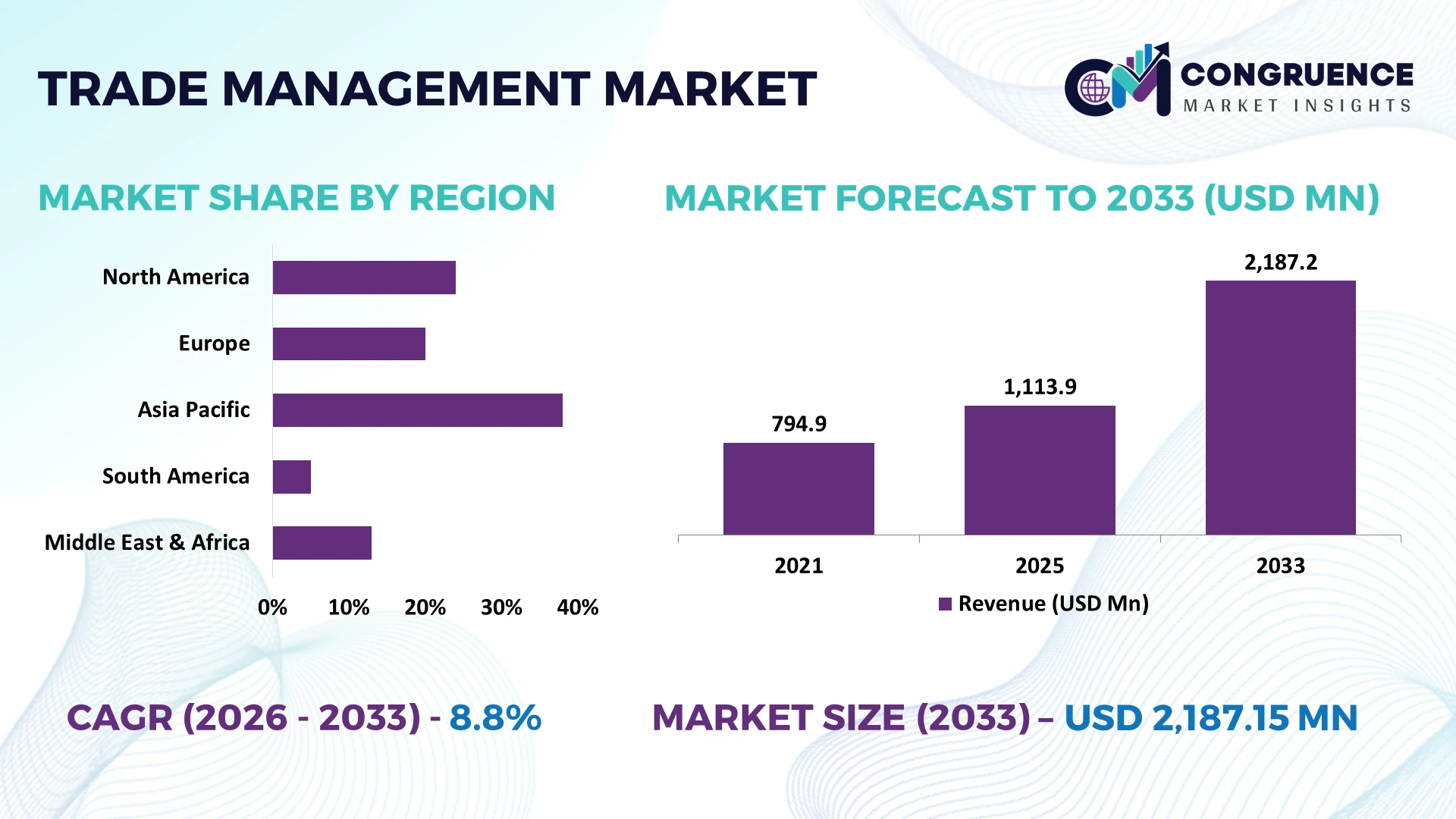
The Global Trade Management Market was valued at USD 1113.9 Million in 2025 and is anticipated to reach a value of USD 2187.15 Million by 2033 expanding at a CAGR of 8.8% between 2026 and 2033. Growth is being accelerated by stricter cross-border trade compliance, AI-driven customs automation, digital documentation platforms, and supply chain diversification across manufacturing, retail, and logistics sectors.
The United States accounts for approximately 31% of global Trade Management Market activity, supported by large-scale enterprise software deployment, customs modernization, and continued investments exceeding USD 2 billion in digital trade infrastructure. Compared with Germany, where advanced export manufacturing drives around 18% higher enterprise compliance software adoption, the U.S. benefits from broader cloud integration across logistics and industrial sectors. Ongoing tariff realignments and evolving global trade regulations continue to accelerate technology upgrades for multinational organizations.
Organizations investing in advanced trade management platforms gain stronger compliance resilience, faster border clearance, and improved global supply chain visibility, strengthening long-term competitive positioning.
Market Size & Growth: USD 1113.9 Million in 2025, projected to reach USD 2187.15 Million by 2033 at 8.8% CAGR, driven by AI-enabled trade compliance and digital customs modernization.
Top Growth Drivers: Automated compliance improves processing efficiency by 28%, cloud deployment adoption exceeds 62%, and cross-border supply chain digitalization increases by 24%.
Short-Term Forecast: By 2028, automated trade workflows reduce customs processing costs by 19% while improving documentation accuracy by 27%.
Emerging Technologies: AI, predictive analytics, and robotic process automation enable over 58% of leading enterprises to automate trade classification and compliance tasks.
Regional Leaders: North America approaches USD 760 Million, Europe exceeds USD 620 Million, and Asia Pacific surpasses USD 540 Million, supported by regional manufacturing expansion and digital trade initiatives.
Consumer/End-User Trends: More than 67% of multinational manufacturers and logistics providers prioritize integrated trade management platforms for real-time compliance visibility.
Pilot/Case Example: In 2026, an enterprise customs automation deployment reduced shipment delays by 22% and improved customs document accuracy by 31%.
Competitive Landscape: Leading vendors collectively control approximately 39% of the market, with SAP, Oracle, Descartes Systems Group, E2open, and Thomson Reuters maintaining strong enterprise presence.
Regulatory & ESG Impact: Digital compliance initiatives lower paper-based documentation by nearly 45% while supporting evolving customs regulations and sustainability reporting requirements.
Investment & Funding: More than USD 1.4 billion supports cloud platform expansion, AI integration, and strategic partnerships amid global supply chain diversification.
Innovation & Future Outlook: Next-generation AI copilots, blockchain-enabled trade records, and intelligent risk analytics accelerate enterprise-wide trade orchestration and strategic global expansion.
Trade Management Market demand continues to strengthen across manufacturing, automotive, pharmaceuticals, retail, and third-party logistics as organizations prioritize automated compliance and end-to-end shipment visibility. AI-powered classification engines and digital customs documentation platforms improve operational accuracy, with automated processing rates increasing by nearly 35%. Ongoing regulatory modernization and supply-chain restructuring are accelerating enterprise platform upgrades, setting the stage for broader strategic transformation across international trade operations.
Trade management platforms have become a strategic business priority as enterprises respond to supply-chain restructuring, stricter customs regulations, and increasing geopolitical trade realignments. Organizations are replacing fragmented compliance workflows with integrated digital trade ecosystems to improve shipment visibility, regulatory accuracy, and cross-border decision-making. More than 64% of large multinational manufacturers are expanding digital trade operations to strengthen resilience against evolving tariff policies and customs documentation requirements, making trade management a competitive differentiator rather than a back-office function.
Modern AI-enabled trade management platforms process customs classifications and compliance validations nearly 35% faster than legacy rule-based systems while reducing manual documentation costs by approximately 24%. The United States leads enterprise-scale cloud deployments across manufacturing and logistics, whereas Germany emphasizes export-focused compliance automation integrated with advanced industrial production. During the next two to three years, enterprise adoption of intelligent trade orchestration platforms is expected to exceed 70%, supported by automated risk monitoring, digital documentation, and predictive supply-chain analytics.
Global manufacturers are expanding partnerships with cloud software providers and logistics technology specialists to unify customs, transportation, and supplier data into centralized platforms. A recent multinational deployment integrated trade compliance with warehouse operations, reducing customs clearance delays by 21% while improving shipment accuracy. Companies prioritizing intelligent trade ecosystems are strengthening operational agility, improving regulatory resilience, and establishing durable competitive advantages across increasingly complex international trade networks.
Enterprise demand for automated trade compliance remains the primary structural driver as customs regulations become more complex and cross-border trade networks expand. Around 68% of multinational organizations are increasing investment in AI-driven compliance platforms, while automated classification reduces processing time by nearly 30% and documentation errors by approximately 26%. Ongoing tariff adjustments and customs modernization initiatives in the United States are accelerating replacement of manual trade processes with integrated digital platforms. In response, software providers are expanding cloud infrastructure, strengthening logistics partnerships, and introducing predictive compliance analytics. Companies combining trade intelligence with transportation and procurement systems achieve faster border clearance, stronger audit readiness, and improved operational control across international supply chains.
Many organizations continue to operate fragmented ERP, logistics, and customs environments, limiting seamless trade management deployment. Nearly 46% of enterprises report interoperability challenges during platform integration, while implementation timelines extend by approximately 20% when legacy infrastructure requires customization. Export-intensive manufacturers in Japan and other mature industrial economies frequently encounter compatibility issues between older operational systems and modern cloud-based trade applications. These limitations increase implementation costs, delay operational standardization, and reduce visibility across international transactions. Companies are addressing these constraints through phased digital transformation, localized implementation partners, standardized APIs, and long-term technology agreements that improve interoperability while minimizing disruption to mission-critical trade operations.
Advanced AI, digital customs platforms, and blockchain-supported trade documentation are creating new operational opportunities beyond regulatory compliance. Intelligent trade analytics improve shipment planning accuracy by approximately 29%, while automated risk identification enhances compliance efficiency by nearly 25%. India is accelerating national digital trade infrastructure initiatives, encouraging enterprises to modernize export documentation and customs connectivity. Technology vendors are increasing investment in AI research, expanding ecosystem partnerships, and developing industry-specific compliance solutions for manufacturing, healthcare, and electronics exporters. The strongest strategic opportunity lies in combining predictive trade intelligence with supplier collaboration platforms, enabling organizations to optimize sourcing decisions while strengthening resilience across diversified global supply networks.
Long-term market expansion depends on overcoming execution challenges associated with cybersecurity, multi-country regulatory updates, and workforce capability gaps. Approximately 41% of enterprises identify evolving compliance requirements as a major operational burden, while nearly 34% report shortages of experienced international trade specialists capable of managing increasingly automated platforms. Germany's advanced exporters must continuously align digital trade systems with changing customs standards across multiple jurisdictions, increasing operational complexity. Companies are investing in cybersecurity frameworks, compliance automation, workforce upskilling, and strategic technology partnerships to maintain consistent deployment quality. Organizations that successfully integrate secure digital infrastructure with skilled trade operations will sustain stronger competitiveness and long-term operational resilience.
AI-Driven Customs Decision Automation Enterprise adoption of AI-powered customs classification has exceeded 61%, reducing document validation time by nearly 33% and lowering manual intervention by 27%. Stricter customs enforcement and increasing product classification complexity are accelerating deployment across the United States and Germany. Software vendors are expanding AI partnerships and embedding predictive compliance engines, enabling faster shipment clearance while improving audit consistency and reducing operational bottlenecks.
Integrated Multi-Carrier Trade Platforms Around 57% of multinational enterprises are consolidating logistics, customs, and procurement into unified trade management platforms, improving cross-functional visibility by approximately 29%. Ongoing supply-chain restructuring is driving synchronized workflow management instead of isolated compliance tools. Companies are scaling cloud integrations with freight forwarders and customs brokers, creating continuous trade execution that shortens response times during cross-border disruptions and improves operational coordination.
Digital Documentation Becomes Standard Electronic certificates, digital invoices, and automated customs documentation now support more than 65% of enterprise cross-border transactions, reducing processing costs by nearly 22%. Regulatory modernization initiatives in Singapore and the United Kingdom continue accelerating paperless trade adoption. Technology providers are strengthening digital document ecosystems through interoperability partnerships, while exporters achieve faster customs acceptance and lower administrative workloads across international shipping operations.
Predictive Risk Intelligence Expansion More than 48% of large enterprises have introduced predictive trade risk monitoring, improving disruption forecasting accuracy by approximately 31% while reducing compliance exceptions by 19%. Instead of reacting after customs delays occur, organizations increasingly prioritize proactive trade intelligence. Companies are expanding investments in scenario modeling, supplier intelligence, and automated alerts to strengthen operational resilience against geopolitical uncertainty and evolving trade regulations.
Cloud-Based solutions lead the Trade Management Market with an estimated 46% market share due to superior scalability, rapid deployment, and seamless integration with ERP, transportation, and customs systems. Organizations increasingly prioritize cloud deployments because they reduce infrastructure complexity while enabling continuous regulatory updates. Hybrid solutions represent the fastest-growing segment as enterprises balance cloud flexibility with sensitive data control, with adoption rising by approximately 24% among large multinational manufacturers. SaaS platforms continue expanding across mid-sized exporters through subscription-based deployment models that reduce implementation time by nearly 28%.
On-Premises platforms remain strategically relevant for highly regulated industries requiring localized infrastructure and extensive customization, although new investments increasingly favor cloud-native architectures. Vendors are expanding multi-cloud capabilities, strengthening cybersecurity partnerships, and developing industry-specific SaaS offerings to improve deployment flexibility. Investment priorities continue shifting toward hybrid ecosystems that combine centralized governance with operational agility, enabling enterprises to modernize global trade operations without disrupting existing business-critical systems.
Trade Compliance remains the leading application, representing approximately 39% of market deployment because multinational enterprises face increasingly complex customs regulations, sanctions screening, and product classification requirements. Automated compliance workflows improve document accuracy by nearly 30% while reducing manual review activities by approximately 25%. Customs Management is the fastest-growing application as governments accelerate digital border modernization, encouraging organizations to automate declarations, inspections, and clearance procedures.
Export Management continues expanding among manufacturing and industrial exporters seeking improved shipment coordination, while Import Management gains importance as companies diversify sourcing across multiple countries. Software providers are integrating compliance, customs, and logistics into unified operational platforms while expanding AI-enabled workflow automation. Organizations increasingly prioritize end-to-end application integration because centralized trade execution reduces compliance delays, strengthens supplier coordination, and enhances operational transparency across international commerce.
Manufacturing accounts for approximately 35% of Trade Management Market demand because global producers manage extensive supplier networks, export documentation, and complex customs compliance requirements. Integrated trade platforms improve shipment visibility by nearly 27% while reducing documentation errors by approximately 24%. Logistics is the fastest-growing end-user segment as freight operators automate cross-border coordination, customs communication, and transportation planning to manage increasingly diversified international trade flows.
Retail organizations continue expanding deployment to improve import visibility and supplier coordination, while healthcare companies strengthen compliance capabilities for regulated medical products. Automotive manufacturers remain major adopters because globally distributed production requires synchronized customs and supplier management. Technology providers are developing industry-specific platforms, expanding strategic partnerships, and introducing flexible pricing models that accelerate adoption across operationally intensive sectors while strengthening long-term customer retention.
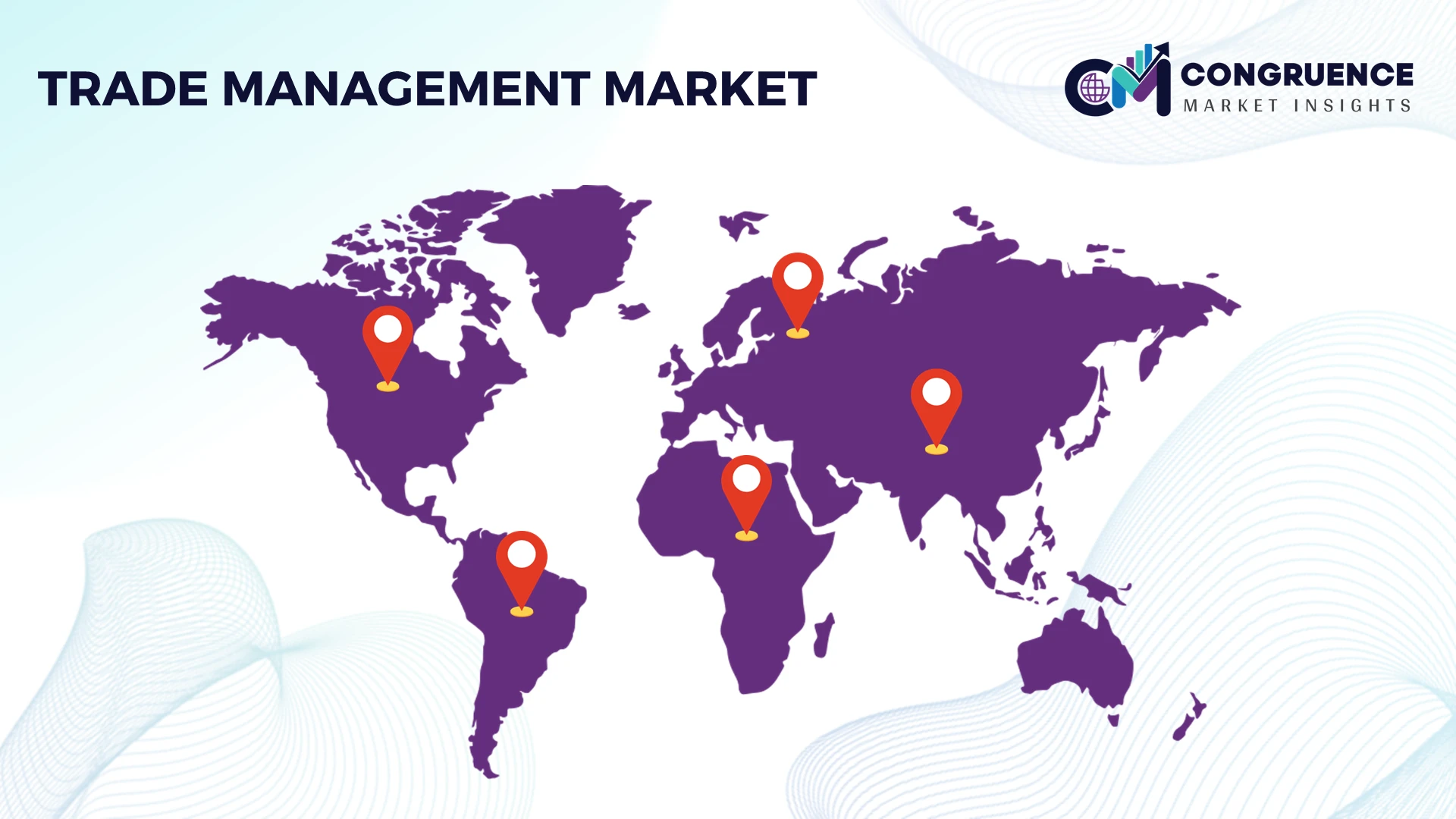
North America accounted for the largest market share at 37.2% in 2025 however, Asia-Pacific is expected to register the fastest growth, expanding at a CAGR of 10.4% between 2026 and 2033.
Digital Compliance Leadership and Enterprise Integration
North America maintains the highest concentration of enterprise trade management deployments due to advanced cloud infrastructure, mature customs modernization programs, and widespread digital transformation across manufacturing, retail, and logistics. The region contributes approximately 37.2% of global market activity, supported by integrated ERP ecosystems and strong adoption of AI-enabled compliance platforms. More than 69% of large enterprises have implemented automated trade workflows to improve customs accuracy and cross-border visibility. Strategic partnerships between software providers, logistics operators, and customs technology specialists continue accelerating deployment. Organizations are increasingly integrating predictive trade analytics with transportation management platforms, reducing customs processing delays while strengthening regulatory compliance across complex international supply chains.
United States Market Outlook: The United States remains the region's operational center because of its extensive multinational enterprise base, advanced cloud adoption, and continuous customs technology modernization. More than 72% of Fortune-level manufacturers utilize integrated digital trade management capabilities for import, export, and compliance operations. Continued investment in AI-enabled customs processing, supplier visibility platforms, and cross-border logistics optimization strengthens enterprise resilience while improving international trade execution efficiency.
Export Compliance Modernization Accelerates Adoption
Europe benefits from its export-oriented industrial economy, harmonized trade procedures, and continuous investment in digital customs modernization. The region represents approximately 28.5% of global market activity, with manufacturers prioritizing automated compliance and integrated export management systems. Around 63% of multinational exporters have expanded digital documentation capabilities to improve regulatory accuracy and border efficiency. Sustainability reporting requirements and evolving customs procedures encourage enterprises to consolidate trade operations into unified digital platforms. Technology providers continue strengthening partnerships with industrial manufacturers and logistics operators to deliver integrated compliance, transportation, and customs management solutions.
Germany Market Outlook: Germany leads the European market through its advanced manufacturing ecosystem, export intensity, and enterprise technology adoption. Nearly 68% of large industrial exporters have integrated automated trade compliance with production and logistics systems, improving shipment coordination and customs readiness. Strong industrial digitalization initiatives and continued investment in intelligent supply-chain technologies reinforce Germany's leadership in enterprise trade management deployment.
Manufacturing Expansion Drives Digital Trade Adoption
Asia-Pacific is emerging as the fastest-expanding regional market due to rapid industrialization, export diversification, and accelerated digital trade infrastructure development. The region accounts for approximately 25.4% of global deployment activity while recording the highest enterprise implementation momentum. More than 60% of export-focused manufacturers are investing in automated customs documentation and cloud-based compliance systems. Governments continue modernizing digital trade infrastructure to improve international competitiveness, encouraging broader enterprise adoption. Software vendors are expanding regional partnerships and localized cloud platforms to support cross-border manufacturing and growing international supply-chain complexity.
China Market Outlook: China remains the region's largest trade management deployment market because of its extensive manufacturing capacity, export scale, and continuous logistics modernization. Over 70% of major export-oriented enterprises have implemented digital trade management solutions supporting customs processing, supplier coordination, and shipment visibility. Continuous smart port development and enterprise digital transformation strengthen China's position as a global leader in technology-enabled international trade operations.
Trade Digitalization Strengthens Export Operations
South America continues expanding trade management adoption through export modernization, customs digitization, and improving logistics connectivity. The region contributes approximately 5.4% of global market activity, with agribusiness, mining, and industrial exporters driving enterprise demand. Around 44% of large exporters have introduced digital compliance workflows to reduce documentation delays and improve customs coordination. Infrastructure modernization and growing investment in cloud-based logistics platforms are improving operational efficiency despite uneven digital readiness across individual markets. Technology providers increasingly partner with logistics operators to strengthen regional deployment capabilities and support expanding international trade volumes.
Brazil Market Outlook: Brazil represents the largest market within South America due to its diversified industrial base, export-oriented economy, and increasing enterprise technology investment. Nearly 52% of major exporters have accelerated implementation of automated trade compliance systems to improve customs documentation and shipment visibility. Continued logistics modernization and cloud platform adoption position Brazil as the region's primary driver of enterprise trade management transformation.
Infrastructure Investment Accelerates Digital Trade Transformation
The Middle East & Africa market is advancing through large-scale logistics infrastructure investment, customs modernization, and expanding international trade corridors. The region contributes approximately 3.5% of global market activity while strengthening enterprise deployment across logistics, energy, and industrial sectors. More than 42% of major trade operators have adopted digital customs documentation platforms to improve cross-border processing efficiency. Governments continue investing in smart ports, digital trade platforms, and logistics corridors, encouraging broader enterprise technology deployment. Software vendors are expanding regional implementation partnerships to support growing demand for integrated compliance and trade visibility solutions.
United Arab Emirates Market Outlook: The United Arab Emirates leads regional adoption through world-class logistics infrastructure, advanced free trade zones, and extensive international trade connectivity. Around 58% of large logistics and trading enterprises utilize integrated digital trade management platforms supporting customs automation and shipment coordination. Continued investment in smart logistics ecosystems and digital customs services reinforces the country's role as the regional hub for technology-enabled trade operations.
Global enterprise software providers including SAP, Oracle, Descartes Systems Group, E2open, and Thomson Reuters compete directly with specialized trade technology vendors such as WiseTech Global and MIC Customs Solutions. The top five players collectively control approximately 42% of the market, competing through platform integration, AI-enabled compliance, customs automation, and global logistics connectivity rather than price alone. AI-assisted trade processing improves operational productivity by nearly 30%, while integrated cloud deployments reduce implementation time by approximately 25% compared with disconnected legacy environments. Vendors continue expanding through strategic acquisitions, logistics partnerships, cloud infrastructure investment, and vertical industry solutions for manufacturing, retail, and healthcare. Competition is shifting toward intelligent trade orchestration, predictive compliance, and unified supply-chain visibility as enterprises replace standalone customs applications. High integration complexity and regulatory expertise create significant entry barriers. Winning requires scalable cloud architecture, continuous regulatory intelligence, strong ecosystem partnerships, and enterprise-grade automation delivering measurable operational efficiency.
SAP SE
Oracle Corporation
Descartes Systems Group
E2open
Thomson Reuters
WiseTech Global
MIC Customs Solutions
Infor
BluJay Solutions
Bamboo Rose
QAD Inc.
Aptean
Integration Point
CargoWise
Artificial intelligence, cloud-native trade management platforms, and API-driven ERP integration define the current technology landscape. More than 66% of multinational enterprises now deploy cloud-based trade compliance solutions, while AI-assisted product classification improves processing efficiency by approximately 31% and reduces manual compliance effort by 24%. Integrated customs screening, denied-party verification, and digital documentation enable real-time regulatory compliance across global supply chains, strengthening operational accuracy and reducing border delays.
Emerging technologies between 2026 and 2028 include generative AI compliance assistants, blockchain-backed trade documentation, predictive tariff analytics, and digital twin-based trade planning. Around 43% of large enterprises are piloting predictive trade intelligence to improve sourcing and customs decisions, while blockchain-enabled documentation reduces document verification time by nearly 27%. Compared with legacy rule-based trade systems, AI-enabled platforms deliver approximately 35% faster compliance processing and 22% lower administrative costs through continuous automation and intelligent workflow orchestration.
Disruptive innovation is shifting competition toward integrated digital trade ecosystems rather than standalone compliance software. Global software leaders and cloud platform providers benefit from unified ERP, logistics, and customs connectivity, while manufacturers and logistics operators gain superior shipment visibility and regulatory resilience. Enterprise adoption of intelligent trade orchestration is projected to exceed 72% by 2028, positioning automation, predictive analytics, and secure digital trade networks as the defining competitive technologies for international commerce.
April 2025 Oracle introduced new Oracle Fusion Cloud Global Trade Management capabilities to help organizations respond to tariff volatility, improving shipment visibility and trade decision-making through enhanced automation across global supply-chain workflows.
November 2025 SAP released SAP Global Trade Services 2025 SP00 with expanded compliance, customs, and cross-border automation capabilities, enabling faster customs clearance and reducing trade penalties through tighter supply-chain integration.
April 2026 Thomson Reuters expanded its collaboration with Oracle by delivering validated global trade content for Oracle Global Trade Management, enabling enterprises to maintain current regulatory content and strengthen compliance accuracy across international trade operations.
April 2026 Thomson Reuters highlighted that 66% of business leaders prefer unified tax, trade, and legal compliance platforms, accelerating AI-enabled compliance integration through strategic ERP partnerships with SAP and Oracle. Source: Thomson Reuters
This report provides a comprehensive assessment of the Trade Management Market across Cloud-Based, On-Premises, Hybrid, and SaaS deployment models, together with detailed evaluation of Trade Compliance, Customs Management, Export Management, and Import Management applications. It examines demand across manufacturing, retail, logistics, healthcare, and automotive sectors while covering North America, Europe, Asia-Pacific, South America, and the Middle East & Africa. More than 65% of enterprise deployments now emphasize integrated digital trade workflows, reflecting the industry's transition toward intelligent compliance ecosystems.
The analysis evaluates technology adoption, enterprise deployment strategies, AI-enabled compliance automation, predictive trade analytics, cloud integration, and digital customs modernization between 2026 and 2033. It also benchmarks competitive positioning, investment priorities, partnership activity, deployment patterns, and operational transformation across leading vendors. The report supports strategic expansion, product development, market entry planning, supply-chain optimization, and long-term investment decisions by identifying high-impact growth segments, emerging technology trends, and evolving enterprise purchasing behavior.
| Report Attribute/Metric | Report Details |
|---|---|
Market Revenue in 2025 | USD 1113.9 Million |
Market Revenue in 2033 | USD 2187.15 Million |
CAGR (2026 - 2033) | 8.8% |
Base Year | 2025 |
Forecast Period | 2026 - 2033 |
Historic Period | 2021 - 2025 |
Segments Covered | By Type
By Application
By End-User
|
Key Report Deliverable | Revenue Forecast, Growth Trends, Market Dynamics, Segmental Overview, Regional and Country-wise Analysis, Competition Landscape |
Region Covered | North America, Europe, Asia-Pacific, South America, Middle East, Africa |
Key Players Analyzed | SAP SE, Oracle Corporation, Descartes Systems Group, E2open, Thomson Reuters, WiseTech Global, MIC Customs Solutions, Infor, BluJay Solutions, Bamboo Rose, QAD Inc., Aptean, Integration Point, CargoWise |
Customization & Pricing | Available on Request (10% Customization is Free) |




