
Reports
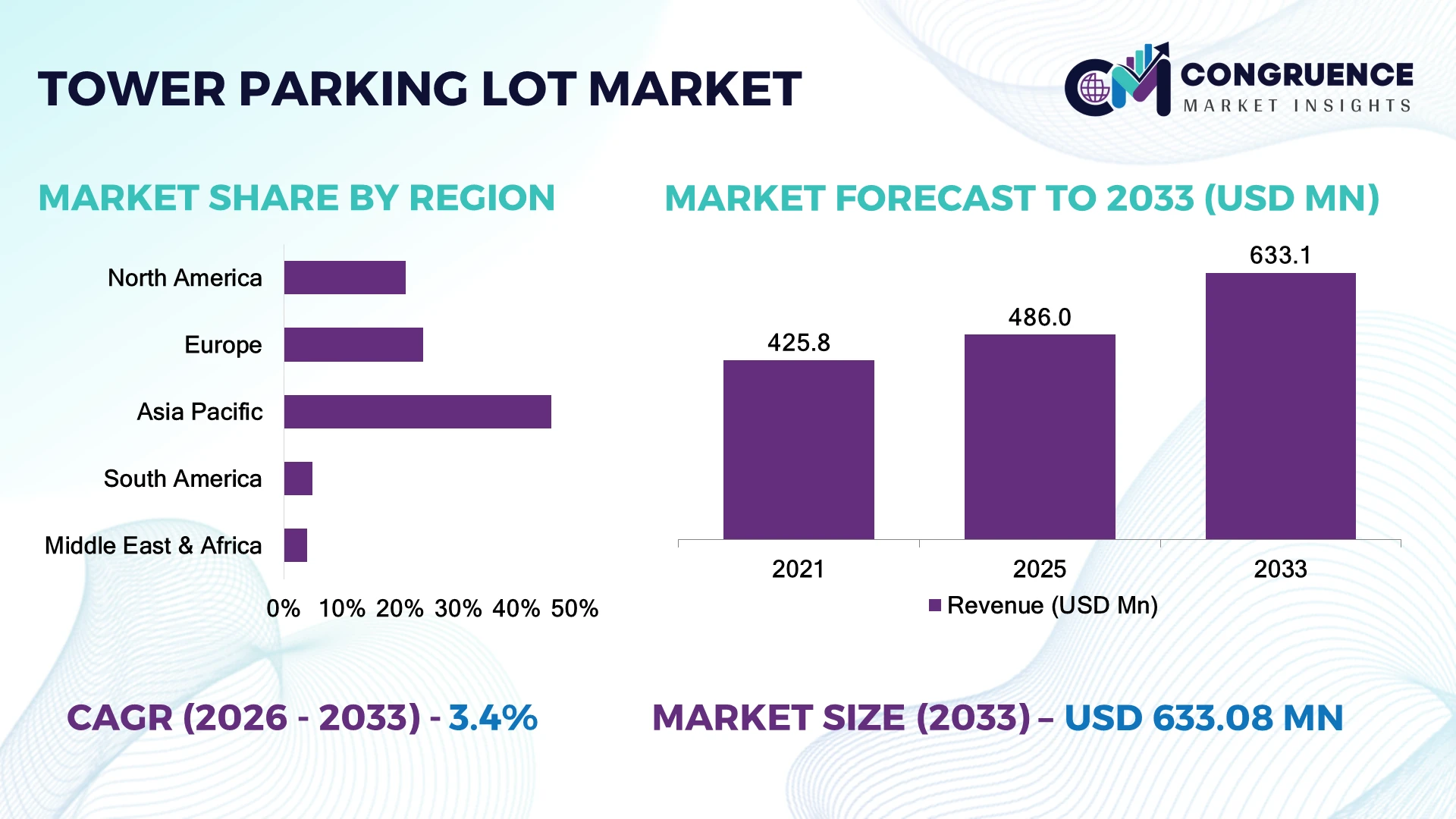
The Global Tower Parking Lot Market was valued at USD 486.0 Million in 2025 and is anticipated to reach a value of USD 633.1 Million by 2033 expanding at a CAGR of 3.36% between 2026 and 2033. Growth is primarily driven by urban land scarcity, smart-city infrastructure programs, and increasing deployment of automated vertical parking systems in high-density commercial districts.
China dominates the market with an estimated 34% share of installed tower parking capacity, supported by investments exceeding USD 1.2 billion in urban mobility and intelligent infrastructure projects across major cities. More than 7,500 automated parking towers operate across metropolitan clusters, compared with Japan’s estimated 4,800 systems, reflecting stronger large-scale deployment. The ongoing modernization of urban transport corridors under regional infrastructure initiatives has accelerated adoption, while automated systems improve land utilization by up to 60% versus conventional parking structures.
This leadership positions automated parking infrastructure as a critical investment priority for developers, municipalities, and mobility operators seeking higher land productivity and operational efficiency.
Market Size & Growth: USD 486.0 Million in 2025, reaching USD 633.1 Million by 2033, supported by automated urban mobility infrastructure deployment.
Top Growth Drivers: Urban land scarcity (+45%), smart-city investments (+38%), automated parking adoption (+32%).
Short-Term Forecast: By 2028, parking footprint requirements decline by 40% while vehicle retrieval efficiency improves by 25%.
Emerging Technologies: AI-based traffic management, IoT monitoring, and robotic vehicle handling improve system uptime by over 20%.
Regional Leaders: Asia Pacific (~USD 245 Million), Europe (~USD 128 Million), North America (~USD 104 Million); deployment tied to urban densification programs.
Consumer/End-User Trends: More than 55% of new mixed-use developments evaluate automated parking integration during planning stages.
Pilot/Case Example: A 2024 smart parking deployment in Seoul reduced vehicle search time by 35% and increased parking turnover by 22%.
Competitive Landscape: Wohr, IHI, ShinMaywa, Skyline Parking, and Unitronics lead; top players collectively account for nearly 40% market presence.
Regulatory & ESG Impact: Automated systems reduce land use by up to 60% and lower vehicle idling emissions by approximately 20%.
Investment & Funding: Over USD 900 Million committed globally toward smart parking infrastructure modernization and urban redevelopment projects.
Innovation & Future Outlook: AI-enabled predictive maintenance and integrated mobility platforms are reshaping next-generation automated parking ecosystems.
Tower Parking Lot systems are increasingly deployed across commercial complexes, transit hubs, hospitals, and mixed-use developments where land optimization is critical. Recent innovations include AI-driven vehicle retrieval algorithms, cloud-connected monitoring platforms, and energy-efficient lift mechanisms. More than 30% of newly planned automated parking projects now incorporate smart-building integration features. Urban redevelopment initiatives and stricter land-use regulations continue to accelerate adoption, creating a strong foundation for broader strategic investments and operational transformation.
Tower parking infrastructure is becoming strategically important as cities confront rising vehicle density, limited developable land, and increasing pressure to improve urban mobility efficiency. Infrastructure modernization programs, transit-oriented development projects, and digital facility management platforms are accelerating deployment across commercial, residential, and public-sector environments. The market is increasingly viewed as a productivity-enhancing urban asset rather than a standalone parking solution.
Modern automated tower systems deliver measurable operational advantages over conventional parking garages. Advanced robotic platforms can reduce land requirements by up to 60% while lowering average vehicle retrieval times by nearly 30%. Japan and South Korea remain leaders in high-density deployment and engineering innovation, while China is scaling installations through large urban redevelopment projects. In contrast, North American adoption is concentrated in premium real-estate developments and mobility-focused infrastructure upgrades.
Over the next two to three years, integration with smart-building platforms, digital access control, and predictive maintenance solutions is expected to expand significantly. Developers are increasingly partnering with automation providers and mobility technology firms to create integrated parking ecosystems. A recent mixed-use urban project demonstrated a 25% increase in parking throughput after implementing automated vertical storage systems. Companies that establish strong technology partnerships and scalable deployment capabilities will secure lasting competitive advantages in urban infrastructure markets.
Rapid urban densification is accelerating demand for space-efficient parking infrastructure. Automated tower systems can reduce land consumption by up to 60%, while increasing parking capacity by nearly 40% within the same footprint. In China, smart-city investment programs have expanded intelligent infrastructure deployment by more than 30% across major metropolitan areas. This shift is directly improving project feasibility for developers facing rising land acquisition costs. As municipalities prioritize compact urban planning and transit-oriented development, parking automation is becoming a core infrastructure component. Companies are responding through expanded manufacturing capacity, technology partnerships, and integrated software platforms that improve throughput and operational monitoring. A key strategic insight is that land-efficiency gains increasingly determine project economics, making automated parking a valuable competitive differentiator for urban development projects.
Deployment costs remain a significant barrier, particularly in mid-sized cities and older urban districts. Automated tower parking projects typically require 25–40% higher upfront investment than conventional parking structures, while retrofitting existing facilities can increase installation expenses by nearly 20%. Steel price fluctuations and elevator component supply constraints have also affected project budgets in several markets. Infrastructure compatibility challenges, including utility upgrades and site-specific engineering requirements, further complicate deployment timelines. Companies are mitigating these issues through localized sourcing strategies, long-term supplier contracts, and modular construction approaches that reduce installation complexity. A critical operational insight is that project viability increasingly depends on lifecycle efficiency rather than initial construction costs, shifting investment evaluations toward long-term performance metrics.
The convergence of automation, AI, and connected infrastructure is creating substantial opportunities beyond traditional parking applications. AI-driven vehicle management systems can improve parking throughput by approximately 25% while reducing maintenance downtime by nearly 15%. India, Indonesia, and Vietnam are witnessing rising demand as urban populations expand and mixed-use developments accelerate. Smart-building integration and digital payment ecosystems are also becoming standard features in new installations. Companies are increasing R&D spending, developing cloud-based monitoring platforms, and forming ecosystem partnerships with property technology providers. A notable strategic opportunity lies in transforming parking facilities into connected mobility hubs capable of supporting electric vehicle services, digital access management, and future autonomous vehicle infrastructure requirements.
Maintaining consistent performance across increasingly digitalized parking environments presents a significant execution challenge. Automated parking systems rely on interconnected software, sensors, robotics, and mechanical infrastructure, increasing integration complexity by more than 30% compared with conventional facilities. Unplanned downtime can reduce operational efficiency by 15–20%, directly affecting customer experience and facility utilization. Cybersecurity requirements are also intensifying as cloud-connected infrastructure becomes more prevalent. In Japan and South Korea, operators are investing heavily in predictive maintenance and digital monitoring to maintain reliability standards. Companies must strengthen software resilience, workforce training, and lifecycle service capabilities to sustain performance at scale. The strongest competitive advantage will belong to providers capable of delivering dependable, secure, and highly integrated parking ecosystems over extended operational lifecycles.
AI-Driven Parking Orchestration Automated tower parking operators are increasingly deploying AI-enabled traffic allocation and retrieval software, reducing vehicle retrieval times by 25–35% and improving facility throughput by nearly 20%. Digital workflow integration now supports over 40% of new installations in Japan and South Korea. The transition from standalone control systems to predictive operations is lowering service interruptions, prompting companies to expand software partnerships and scale intelligent facility management platforms.
Modular Construction Deployment Models Prefabricated steel modules and standardized lift assemblies are shortening installation timelines by 30–45% while reducing on-site labor requirements by approximately 25%. Labor shortages in urban construction markets have accelerated this shift, particularly in China. Companies are restructuring supply chains around modular manufacturing networks, enabling faster project execution, improved quality consistency, and greater scalability across mixed-use developments and transport-oriented infrastructure projects.
Smart Building Integration Expansion More than 50% of newly commissioned tower parking projects are being connected with smart-building management systems, access-control platforms, and digital payment ecosystems. Integrated operations can lower facility management costs by 15–20% while improving user processing speed by nearly 30%. Developers are prioritizing interoperability standards and enterprise software partnerships, reflecting a broader transition toward connected urban infrastructure rather than isolated parking assets.
Energy-Efficient System Modernization Advanced regenerative drives, intelligent lighting controls, and low-energy vertical transport mechanisms are reducing electricity consumption by 18–28% compared with earlier-generation systems. Stricter building efficiency requirements and sustainability targets are accelerating equipment upgrades. A notable emerging insight is that energy performance is increasingly influencing procurement decisions alongside capacity metrics, encouraging suppliers to expand automation portfolios and redesign system architectures around lifecycle efficiency.
Fully Automated Tower Parking Systems account for approximately 58% of total installations, making them the leading type segment. Their dominance stems from superior space optimization, reduced manpower requirements, and high-density vehicle storage capabilities. These systems typically improve parking capacity by 40–60% compared with conventional structures while lowering operational intervention by nearly 70%. Developers increasingly favor fully automated configurations in commercial districts where land efficiency directly influences project economics. Semi-Automated Tower Parking Systems remain relevant for mid-sized developments requiring lower upfront integration complexity and flexible deployment models.
Semi-Automated Systems represent the fastest-growing type category as operators seek balanced automation with controlled investment exposure. Adoption has increased by roughly 18% across emerging urban projects where phased modernization strategies are preferred. Companies are expanding product portfolios, introducing modular architectures, and enhancing software compatibility to support diverse project requirements. Investment priorities increasingly favor scalable automation platforms capable of future upgrades. This shift is encouraging manufacturers to strengthen engineering partnerships and accelerate deployment-focused innovation while maintaining operational flexibility for different urban environments.
Commercial Buildings represent the largest application segment with an estimated 44% share, supported by demand from office complexes, shopping centers, hotels, and mixed-use developments. High vehicle turnover and limited urban land availability continue to concentrate demand within this category. Automated parking integration can improve parking throughput by approximately 25% while reducing vehicle circulation space by over 40%. Residential Buildings maintain strong adoption in premium urban housing projects where developers prioritize land optimization and differentiated property offerings.
Transportation Hubs are emerging as the fastest-growing application segment as cities modernize mobility infrastructure and transit connectivity. Deployment activity has increased by nearly 20% across major railway and metro-linked developments. Healthcare Facilities and Institutional Buildings continue adopting tower parking systems to address land constraints and improve visitor accessibility. Companies are responding through integrated mobility solutions, digital access systems, and customized deployment strategies tailored to specific operational environments. Demand is increasingly shifting toward applications where parking efficiency directly affects customer experience and facility performance.
Real Estate Developers account for approximately 47% of total market demand, making them the dominant end-user group. Large-scale residential, commercial, and mixed-use projects increasingly incorporate tower parking infrastructure to maximize land productivity and enhance asset value. Automated parking integration can increase usable building space by nearly 20% while reducing parking footprints by up to 60%. Their extensive project pipelines and long-term infrastructure planning continue to support sustained procurement activity across major urban centers.
Municipal Authorities are emerging as the fastest-growing end-user category as governments address congestion, parking shortages, and urban mobility modernization initiatives. Adoption rates within public infrastructure projects have expanded by approximately 22% in recent development cycles. Transportation Operators and Facility Management Companies also remain important buyers, focusing on operational efficiency and digital infrastructure integration. Suppliers are responding through customized financing structures, public-private partnerships, and ecosystem-based deployment models. Competitive positioning is increasingly shaped by the ability to deliver scalable solutions aligned with both public infrastructure priorities and private development objectives.
Asia-Pacific accounted for the largest market share at 46.0% in 2025 however, North America is expected to register the fastest growth, expanding at a CAGR of 4.1% between 2026 and 2033.
North America represents approximately 21% of the global market, driven by increasing deployment in mixed-use developments, premium residential towers, healthcare campuses, and transit-oriented infrastructure projects. Major metropolitan areas are prioritizing automated parking systems to address land scarcity, rising construction costs, and parking optimization requirements. Automated tower facilities can reduce parking footprints by up to 55%, improving project economics in dense urban locations. Integration with smart-building platforms, mobile access systems, and predictive maintenance tools is becoming standard across new installations. Recent urban redevelopment initiatives have supported the deployment of automated parking infrastructure in high-density districts, while property developers increasingly incorporate vertical parking solutions into large-scale projects. Strategic partnerships between parking technology providers and commercial real-estate operators continue to strengthen deployment pipelines and accelerate modernization efforts.
United States Market Outlook: The United States remains the largest national market in the region due to strong urban redevelopment activity, advanced building technology adoption, and increasing investment in intelligent infrastructure. Major cities including New York, Miami, Chicago, and Los Angeles continue expanding automated parking deployments in premium residential and commercial developments. More than 60% of recent tower parking installations have been concentrated within mixed-use urban projects. Developers are prioritizing automated parking as a land-efficiency tool, while technology providers are expanding service networks and software capabilities to improve facility utilization and operational reliability.
Europe accounts for approximately 24% of global market activity, supported by stringent urban planning policies, land-use efficiency targets, and sustainable infrastructure initiatives. Automated tower parking systems are increasingly integrated into city-center redevelopment projects where space constraints and environmental objectives intersect. Many municipalities are encouraging compact mobility solutions that reduce surface parking requirements and improve urban land utilization. Advanced energy-management systems have reduced facility power consumption by nearly 20% compared with earlier installations. Digital access control, automated retrieval systems, and integrated mobility platforms are becoming key procurement criteria. Infrastructure modernization programs across major European cities continue supporting deployment activity, while developers increasingly focus on long-term operational efficiency and lifecycle performance when selecting parking technologies.
Germany Market Outlook: Germany leads the European market through its strong engineering ecosystem, advanced automation expertise, and extensive urban redevelopment pipeline. Commercial real-estate projects, transportation hubs, and mixed-use developments are major deployment areas. Automated parking integration has improved land utilization by more than 45% across several dense urban projects. German manufacturers continue investing in intelligent control systems, modular parking architectures, and energy-efficient technologies, strengthening the country’s position as a key innovation and deployment center within the European automated parking landscape.
Asia-Pacific remains the largest regional market, accounting for approximately 46% of global demand. Rapid urbanization, population concentration, and extensive smart-city development programs continue driving large-scale deployment. High-density cities increasingly rely on tower parking infrastructure to maximize land productivity while supporting growing vehicle ownership levels. Automated systems can increase parking capacity by 40–60% within constrained urban footprints, making them highly attractive for commercial and residential developments. Infrastructure investment and large-scale urban modernization projects continue accelerating installation activity. Developers are adopting integrated digital parking ecosystems featuring AI-enabled management, remote monitoring, and automated vehicle handling technologies. Strong domestic manufacturing capabilities also support cost-effective deployment and faster project execution across key metropolitan markets.
China Market Outlook: China represents the most influential national market due to its extensive urban infrastructure investments, large-scale smart-city initiatives, and high deployment concentration. Major metropolitan clusters continue integrating automated parking solutions into commercial districts, transportation hubs, and mixed-use developments. Thousands of automated parking towers operate across leading cities, supporting efficient land utilization in densely populated environments. Domestic manufacturers are expanding production capacity, strengthening software integration capabilities, and developing advanced automation platforms that enhance system reliability and operational throughput across increasingly complex urban infrastructure projects.
South America accounts for roughly 5% of the global market and remains an emerging deployment environment for automated parking infrastructure. Demand is concentrated in major metropolitan areas where parking shortages, traffic congestion, and land constraints are creating pressure for more efficient parking solutions. Commercial developments, premium residential projects, and transportation facilities are the primary adoption segments. Installation activity has increased as developers seek to optimize limited urban land resources while improving parking efficiency. However, infrastructure funding limitations and project financing challenges continue influencing deployment pace. Companies are responding through phased implementation strategies, localized partnerships, and modular system offerings that reduce project complexity and support gradual market expansion.
Brazil Market Outlook: Brazil leads the regional market through its large urban population, extensive commercial real-estate activity, and growing infrastructure modernization efforts. São Paulo and Rio de Janeiro remain the most active deployment centers, where land scarcity and increasing vehicle density support automated parking adoption. Recent high-density development projects have demonstrated parking capacity improvements exceeding 35% through vertical parking integration. Technology providers are strengthening local partnerships and expanding maintenance capabilities to improve operational reliability and support long-term project performance.
The Middle East & Africa region accounts for approximately 4% of global market activity, with demand largely driven by large-scale urban development projects, smart-city programs, and premium real-estate investments. Tower parking infrastructure is increasingly incorporated into mixed-use developments, hospitality complexes, commercial centers, and transportation hubs where space optimization is a strategic priority. Automated systems support improved land utilization and enhanced user experience while aligning with broader infrastructure modernization objectives. Several large urban projects are integrating intelligent mobility platforms and digital facility management systems to improve operational performance. Investment-led development continues to create opportunities for advanced parking technologies across key metropolitan markets.
United Arab Emirates Market Outlook: The United Arab Emirates remains the most strategically important market within the region due to its ambitious smart-city initiatives, premium real-estate developments, and strong infrastructure investment environment. Dubai and Abu Dhabi continue deploying advanced automated parking solutions within commercial, hospitality, and mixed-use projects. Automated parking integration has reduced parking land requirements by more than 50% in several high-density developments. Developers increasingly prioritize intelligent mobility infrastructure, while technology providers expand partnerships focused on automation, digital integration, and long-term operational optimization.
The competitive landscape is led by WÖHR Autoparksysteme, ShinMaywa Industries, IHI Parking Square, Klaus Multiparking, Unitronics, and Skyline Parking, with global automation specialists competing against regional cost-focused manufacturers and project integrators. The top five players collectively control approximately 52% of market activity through established engineering capabilities, service networks, and deployment experience. Competition centers on automation performance, retrieval speed, lifecycle reliability, and customization rather than equipment pricing alone. Advanced systems reduce parking footprints by up to 60%, while intelligent control platforms improve operational throughput by 20–30%, creating a strong technology-driven advantage. Companies are expanding through urban infrastructure partnerships, localized manufacturing, software integration, and long-term maintenance contracts. The market is shifting toward digitalized parking ecosystems featuring AI-enabled management, predictive maintenance, and smart-building connectivity. Vertical integration between software, controls, and mechanical systems is strengthening competitive positioning. High engineering requirements, certification standards, and service obligations remain key entry barriers. Winning requires proven automation reliability, scalable deployment capability, and integrated lifecycle support.
ShinMaywa Industries, Ltd.
IHI Parking Square Co., Ltd.
Klaus Multiparking GmbH
Unitronics Ltd.
Skyline Parking AG
ParkPlus Inc.
Robotic Parking Systems Inc.
Citylift Parking LLC
Dongyang Parking Industry Co., Ltd.
Westfalia Parking Solutions
FATA Automation
Parkmatic
Tada Parking Systems
Tower parking technology is rapidly evolving from mechanical storage infrastructure into intelligent automated mobility systems. AI-driven traffic orchestration, IoT-enabled monitoring, and predictive maintenance platforms are increasingly embedded within new deployments. More than 45% of newly commissioned projects now incorporate remote diagnostics and cloud-connected control architecture. These technologies reduce unscheduled downtime by approximately 20% and improve retrieval efficiency by nearly 25%, delivering measurable operational advantages for facility operators and property developers.
Emerging technologies include digital twins, machine-vision guidance, advanced robotic shuttles, and integrated EV charging management. Compared with conventional PLC-based systems, AI-assisted parking management can improve throughput by nearly 30% while reducing maintenance intervention by 15%. Automated vehicle handling systems are also becoming faster and more precise through sensor fusion and adaptive control algorithms. Technology-focused manufacturers benefit most because performance differentiation increasingly influences procurement decisions in premium urban developments.
Between 2026 and 2028, autonomous parking integration, predictive analytics, and connected smart-building ecosystems are expected to reshape deployment strategies. Adoption of intelligent parking management platforms is projected to exceed 55% of new installations. Companies investing early in software-centric architectures, cybersecurity resilience, and interoperable mobility platforms will gain stronger operational control, higher facility utilization, and a more defensible competitive position in increasingly digitalized urban infrastructure environments.
July 2025 – WÖHR Parking Systems launched its first dedicated service and maintenance van in Pune, strengthening predictive maintenance and 24x7 support capabilities. The initiative expanded field-service responsiveness and improved operational uptime for automated parking installations across western India. Source: wohrparking.in
June 2025 – WÖHR Parking Systems announced expansion milestones including a new manufacturing facility and corporate office while introducing next-generation parking solutions focused on scalability and user efficiency. The development strengthened production readiness and supported growing deployment requirements. Source: woehrparking.in News
January 2025 – ShinMaywa Industries expanded its mechanical parking business in Taiwan through local market entry initiatives, strengthening deployment capabilities in dense urban environments and supporting broader adoption of automated parking infrastructure across high-density developments. Source: ShinMaywa Industries
January 2026 – IHI announced the transition of IHI Transport Machinery to IHI Parking Square, creating a business structure dedicated exclusively to parking systems. The strategic specialization sharpened focus on urban mobility infrastructure, space optimization technologies, and long-term parking innovation. Source: IHI Corporation
This report provides a comprehensive assessment of the global Tower Parking Lot Market, covering automated and semi-automated tower parking technologies across commercial, residential, transportation, institutional, and mixed-use infrastructure environments. The analysis evaluates deployment patterns, technology adoption trends, operational performance indicators, and competitive positioning across major geographic markets. More than 50% of current installations are concentrated in high-density urban developments where land optimization and infrastructure efficiency remain critical investment priorities.
The study examines key market segments by type, application, and end-user while providing detailed regional insights across North America, Europe, Asia-Pacific, South America, and the Middle East & Africa. It also evaluates emerging technologies including AI-enabled parking management, predictive maintenance, digital integration platforms, and intelligent mobility ecosystems. Competitive benchmarking, deployment strategies, partnership activity, and infrastructure modernization trends are assessed to support expansion planning, investment prioritization, operational optimization, and long-term strategic decision-making between 2026 and 2033.
| Report Attribute / Metric | Details |
|---|---|
| Market Revenue (2025) | USD 486.0 Million |
| Market Revenue (2033) | USD 633.1 Million |
| CAGR (2026–2033) | 3.36% |
| Base Year | 2025 |
| Forecast Period | 2026–2033 |
| Historic Period | 2021–2025 |
| Segments Covered |
By Type
By Application
By End-User
|
| Key Deliverables | Revenue Forecast; Market Trends; Growth Drivers & Restraints; Technology Insights; Segmentation Analysis; Regional Insights; Competitive Landscape; Regulatory & ESG Overview; Recent Developments |
| Regions Covered | North America; Europe; Asia-Pacific; South America; Middle East & Africa |
| Companies Profiled | WÖHR Autoparksysteme GmbH; ShinMaywa Industries, Ltd.; IHI Parking Square Co., Ltd.; Klaus Multiparking GmbH; Unitronics Ltd.; Skyline Parking AG; ParkPlus Inc.; Robotic Parking Systems Inc.; Citylift Parking LLC; Dongyang Parking Industry Co., Ltd.; Westfalia Parking Solutions; FATA Automation; Parkmatic; Tada Parking Systems |
| Customization & Pricing | Available on Request (10% Customization Free) |




