
Reports
The Global Tower Crane Market was valued at USD 11720 Million in 2025 and is anticipated to reach a value of USD 16489.22 Million by 2033 expanding at a CAGR of 4.36% between 2026 and 2033. Growth is driven by high-rise construction, infrastructure megaprojects, modular building adoption, and increasing deployment of intelligent lifting and anti-collision systems.
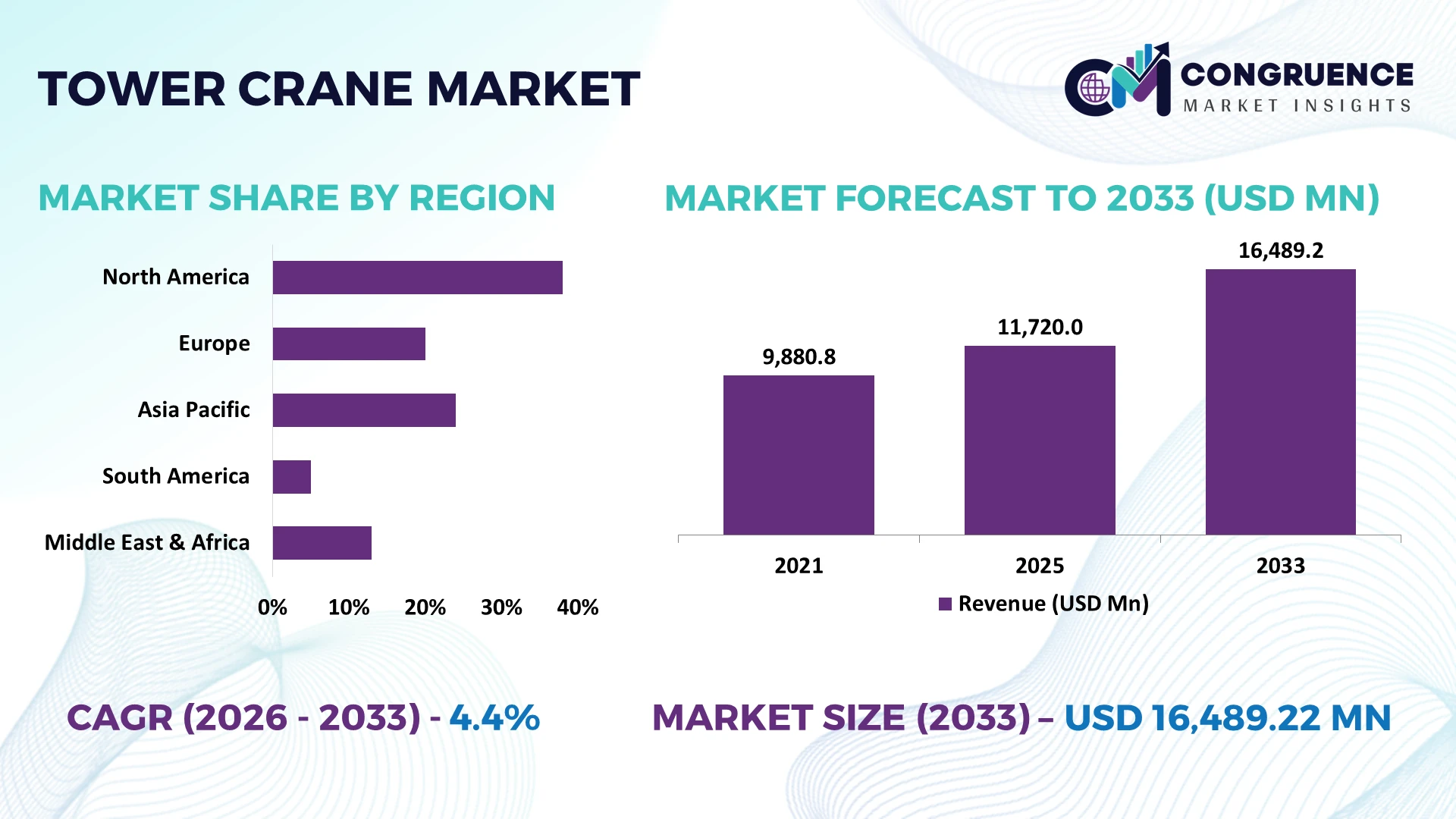
China holds a dominant position, supported by extensive high-rise and infrastructure construction, with Asia Pacific representing about 40% of global demand. China’s tower-crane market reached USD 405 million in 2025, while India is projected to reach USD 407.3 million by 2033. China’s hammerhead segment captured 45.16%, reinforcing its scale advantage. Europe’s EN 14439:2025 tower-crane safety standard, effective from July 2025, is strengthening equipment compliance and technology differentiation across projects.
Strategically, manufacturers should prioritize intelligent, compliant, high-capacity cranes and regionalized production to capture infrastructure-led growth.
Market Size & Growth: USD 11.72 billion in 2025 to USD 16.49 billion by 2033 at 4.36% CAGR, supported by automation and high-rise construction.
Top Growth Drivers: High-rise construction 31%, infrastructure 27%, modular construction 19% strengthen global tower-crane utilization.
Short-Term Forecast: By 2030, intelligent controls are positioned to deliver approximately 8% higher operating efficiency and 5% lower downtime.
Emerging Technologies: AI-assisted positioning, anti-collision systems, IoT monitoring and semi-automation are reshaping advanced crane fleets.
Regional Leaders: Asia Pacific is projected near USD 6.6 billion, North America USD 3.7 billion, and Europe USD 3.3 billion by 2033.
Consumer/End-User Trends: Construction companies represented 55.02% of end-user revenue in 2025, while rental adoption accelerates fleet flexibility.
Pilot/Case Example: Liebherr’s 2024 Positioning Pilot introduced semi-automated movement across three crane drives, improving repeat-lift precision and reducing operator workload.
Competitive Landscape: Manitowoc leads, while Zoomlion, Liebherr, SANY, Comansa and Yongmao form a concentrated top-seven group controlling about 40%.
Regulatory & ESG Impact: EN 14439:2025 raises safety requirements, accelerating compliant designs and measurable lifecycle-efficiency improvements.
Investment & Funding: China’s planned infrastructure investment of approximately USD 4.2 trillion reinforces large-scale crane deployment and regional supply-chain expansion.
Innovation & Future Outlook: Next-generation fleets will combine AI, predictive maintenance, hybrid power and automated load positioning, shifting competition toward productivity and lifecycle economics.
The Tower Crane Market is gaining traction across high-rise residential projects, metro systems, industrial facilities, logistics hubs and modular construction. Flat-top and top-slewing configurations remain commercially important, while self-erecting cranes recorded a 7.52% growth trajectory through 2031. Digital monitoring, predictive maintenance and semi-automated positioning are strengthening fleet utilization, particularly as European safety requirements tighten.
Tower cranes are becoming strategically important as construction companies compete on project speed, lifting precision, equipment utilization, and compliance rather than capacity alone. Infrastructure modernization in China, India, Saudi Arabia, and the UAE is accelerating investment in high-capacity lifting fleets, while tighter safety requirements are pushing contractors toward digitally monitored equipment. Supply-chain restructuring is also encouraging manufacturers to localize components and after-sales support closer to major construction hubs.
Technology is changing the economics of deployment. IoT-enabled cranes with predictive-maintenance systems can reduce unplanned downtime by approximately 10–15% compared with conventional inspection-led fleets, while automated positioning can improve repetitive lifting efficiency by around 5–8%. China remains the largest deployment base, whereas Germany and the United Kingdom are emphasizing safety automation, telematics, and low-emission equipment. India is moving toward higher fleet utilization as metro, industrial, and urban redevelopment projects expand.
Over the next 2–3 years, adoption of connected fleet monitoring is positioned to rise by roughly 15–20% among large contractors, strengthening equipment utilization and maintenance planning. Practical deployment increasingly combines anti-collision controls, remote diagnostics, and operator-assistance systems. Companies are responding through technology partnerships, rental-fleet expansion, localized servicing, and selective investments in electric or hybrid systems. Competitive advantage will increasingly depend on intelligent fleet productivity, regulatory readiness, and lifecycle cost control.
Large infrastructure programs are increasing demand for high-capacity and digitally controlled tower cranes, particularly in China and India. Automated load-positioning systems can improve repetitive lifting productivity by 5–8%, while telematics-based monitoring can reduce equipment downtime by 10–15%. China’s extensive urban redevelopment and India’s metro construction pipeline are shifting purchasing priorities from basic lifting capacity toward fleet productivity and safety intelligence. European safety requirements are further accelerating technology adoption. Manufacturers are responding through anti-collision integration, remote diagnostics, and partnerships with construction-technology providers. The non-obvious advantage is higher asset utilization: contractors can extract more operating hours from existing fleets instead of relying solely on additional equipment purchases, improving project scheduling and capital efficiency.
Tower-crane economics remain exposed to steel, electronic-control, hydraulic, and drive-system costs, with material and component volatility capable of increasing equipment procurement costs by 8–12% during disrupted supply periods. Imported electronic components can also extend replacement lead times by 10–20% for specialized configurations. European manufacturers face additional compliance and engineering costs as safety requirements become more demanding, while Indian contractors remain sensitive to imported component availability. These constraints directly affect fleet expansion, rental pricing, and project mobilization schedules. Leading manufacturers are reducing exposure through localized sourcing, multi-supplier contracts, regional component inventories, and standardized platforms. A key operational insight is that parts availability increasingly influences fleet competitiveness almost as much as crane specifications.
Connected tower-crane fleets create a high-value opportunity beyond equipment sales by combining telematics, predictive maintenance, utilization analytics, and remote diagnostics. Predictive systems can lower maintenance-related downtime by approximately 10–15%, while automated positioning can raise repetitive-task efficiency by 5–8%. India, Saudi Arabia, and the UAE offer particularly attractive deployment opportunities as contractors modernize large urban and infrastructure projects. Battery-assisted and hybrid systems also provide a pathway toward lower-emission construction sites. Manufacturers and rental companies are increasingly positioning through technology partnerships, fleet digitization, and service-based contracts. The strongest opportunity is shifting from selling individual cranes toward recurring fleet-management services, allowing suppliers to capture higher lifetime value while helping contractors optimize utilization.
The transition toward intelligent cranes introduces execution complexity across legacy equipment, software platforms, sensors, and contractor workflows. Approximately 20–30% of older fleets can require significant retrofitting before achieving comparable connectivity with new-generation equipment, while operator training requirements can increase deployment preparation by 5–10%. Germany and other advanced construction markets are moving faster toward automated safety and monitoring systems, whereas fragmented fleets in emerging markets often combine multiple generations of equipment. Cybersecurity and data interoperability are becoming additional operational concerns as cranes connect to centralized platforms. Companies must invest in standardized interfaces, workforce training, secure data architecture, and technical partnerships. The strategic challenge is not automation itself, but achieving consistent digital performance across mixed-age fleets and geographically dispersed projects. Competitive advantage will increasingly depend on intelligent fleet productivity, regulatory readiness, and lifecycle cost control, making fleet-level KPIs the clearest test of whether digital crane investments are delivering measurable returns across projects.
Connected Fleet Monitoring Accelerates Construction fleets are increasingly integrating telematics, load monitoring, and predictive-maintenance platforms, targeting 10–15% lower unplanned downtime and 5–8% better equipment utilization. Large contractors are consolidating crane data into centralized dashboards, while manufacturers expand remote diagnostics and service partnerships to improve fleet visibility and maintenance scheduling.
Safety Automation Gains Priority Anti-collision, zoning, and operator-assistance systems are moving from premium features toward standard specifications, with automated controls improving repetitive lifting efficiency by roughly 5–8%. Europe’s EN 14439:2025 safety requirements, effective from July 2025, are accelerating compliance-led upgrades, prompting manufacturers to redesign control architectures and strengthen certification capabilities.
Self-Erection Reshapes Mobilization Self-erecting cranes are recording the fastest type-level expansion, with adoption growth of approximately 7.5% as contractors prioritize rapid deployment and reduced setup requirements. European and North American residential projects increasingly favor compact configurations, encouraging OEMs to scale modular designs and rental fleets while reducing dependence on external erection equipment.
Regional Supply Chains Localize Manufacturers are increasing localized production and component sourcing to reduce exposure to transportation delays and electronic-component shortages, with regionalization targeting 10–20% shorter replacement lead times. China-based OEMs are expanding overseas distribution, while Indian and European operators strengthen local service networks, revealing a non-obvious shift toward aftermarket capability as a competitive differentiator.
Hammerhead cranes remain a leading configuration, accounting for approximately 42.8% of the global type mix in 2025, supported by strong lifting capacity, long horizontal reach, and reliable repetitive material handling. India recorded an even higher hammerhead share of about 45.7%, demonstrating the configuration’s strength in large construction programs. Companies continue refining load-control systems, mast configurations, and high-capacity designs to preserve this mature segment’s productivity advantage.
Self-erecting cranes represent the fastest-moving type, expanding at roughly 7.5% as contractors prioritize faster setup and reduced site-mobilization requirements. Luffing-jib cranes remain strategically important for constrained urban sites and airport-adjacent projects because adjustable jibs limit overswing, while topless cranes support dense multi-crane sites through improved jib overlap. The investment shift favors modular self-erectors and digitally controlled hammerheads, balancing deployment speed with high-load performance.
Residential construction represented approximately 45.73% of tower-crane applications in 2025, making it the leading demand center as dense urban development requires sustained vertical material handling. High-rise construction remains operationally intensive, with crane selection increasingly tied to restricted footprints, lifting cycles, and project sequencing. Infrastructure construction is the fastest-growing application, advancing at about 7.2% as metro systems, bridges, airports, and major civil works require longer-duration, high-capacity lifting.
High-rise projects increasingly favor luffing-jib and topless configurations where airspace and crane interference constrain conventional layouts, while infrastructure contractors prioritize heavy-duty hammerhead systems. Industrial construction retains specialized demand for plants and logistics facilities, whereas residential projects emphasize rapid deployment and predictable rental economics. Companies are therefore allocating approximately 10–15% more technology attention toward remote monitoring and anti-collision integration on complex sites, strengthening utilization and reducing coordination-related delays.
Construction companies represented approximately 55.02% of tower-crane end-user demand in 2025, reflecting their direct exposure to high-rise, residential, and commercial project execution. Their purchasing decisions increasingly emphasize uptime, safety automation, and fleet interoperability rather than basic lifting capacity. Infrastructure developers and industrial contractors maintain more project-specific procurement patterns, with specialized configurations selected for bridges, plants, logistics facilities, and other technically demanding sites.
Equipment rental companies are becoming the fastest-shifting buyer group, with demand expanding at approximately 6.4% as contractors seek flexible access without full ownership costs. Rental operators are responding by standardizing fleets, adding telematics, and increasing refurbishment cycles, while manufacturers strengthen financing and aftermarket partnerships. The strategic implication is significant: suppliers increasingly compete for fleet placement through lifecycle services, utilization analytics, and residual-value management rather than one-time equipment sales.
Asia-Pacific accounted for the largest market share at 40% in 2025 however, Middle East & Africa is expected to register the fastest growth, expanding at a CAGR of 5.8% between 2026 and 2033.
Rental-led modernization is reshaping fleet economics
North America maintains a strong tower-crane deployment base supported by high-rise construction, logistics facilities, data-center projects, and major transportation upgrades. The United States accounts for the majority of regional activity, with contractors increasingly favoring rental and fleet-management models over outright ownership. Connected monitoring, anti-collision systems, and remote diagnostics are becoming important specifications on complex urban sites, improving equipment utilization by approximately 8–12%. Canada contributes through infrastructure and commercial construction, although project cycles remain more sensitive to financing conditions. Manufacturers are strengthening dealer networks and aftermarket inventories to reduce mobilization delays and support mixed-age fleets. The strategic shift is toward lifecycle productivity: contractors increasingly evaluate cranes through uptime, maintenance response, and deployment flexibility rather than lifting capacity alone.
United States Market Outlook: The United States remains the region’s primary operational hub, supported by large-scale data-center construction, urban redevelopment, and transportation infrastructure. Tower-crane deployment is increasingly concentrated around major metropolitan construction corridors, where connected fleet systems can improve utilization by roughly 10%.
Safety regulation accelerates intelligent fleet renewal
Europe is shifting toward digitally controlled and safety-enhanced tower-crane fleets as contractors modernize equipment and comply with tighter operating standards. Germany, France, the United Kingdom, and Italy maintain important construction and manufacturing capabilities, while dense urban projects favor luffing-jib and topless configurations. EN 14439:2025 is strengthening attention to crane safety, documentation, and control-system compliance, increasing the value of certified equipment. Electric and hybrid solutions are also gaining attention for lower-emission construction sites, with technology upgrades targeting 5–10% improvements in operational efficiency. Manufacturers are responding through automation, sensor integration, and localized service partnerships. The non-obvious competitive advantage is certification readiness, as regulatory compliance increasingly influences purchasing decisions alongside price and lifting performance.
Germany Market Outlook: Germany provides a strong combination of engineering expertise, industrial construction, and advanced crane technology. Manufacturers and contractors increasingly integrate anti-collision controls, telematics, and energy-efficient drive systems, while major urban projects favor precision equipment capable of operating within restricted construction footprints.
Manufacturing scale reinforces deployment leadership
Asia-Pacific remains the principal tower-crane deployment center, supported by China’s manufacturing ecosystem, India’s urban infrastructure expansion, and Southeast Asia’s industrial construction activity. China represents the region’s largest operational base, combining substantial domestic demand with export-oriented OEM capacity. Asia-Pacific accounts for roughly 40% of global demand, while China’s extensive production ecosystem supports shorter equipment lead times and competitive component sourcing. India is increasing deployment across metro systems, residential towers, industrial facilities, and logistics infrastructure, with connected monitoring adoption strengthening fleet productivity by approximately 8–12%. Manufacturers are expanding regional assembly, distribution, and aftermarket capabilities to capture demand closer to project sites. The strategic advantage increasingly rests on combining low-cost manufacturing with intelligent controls and localized service coverage.
China Market Outlook: China remains the region’s most influential tower-crane manufacturing and deployment hub, supported by extensive urban construction and infrastructure activity. Its large OEM base enables rapid product iteration, component integration, and export expansion, giving domestic manufacturers a significant advantage in cost, availability, and customization.
Urban construction drives selective fleet expansion
South America presents concentrated tower-crane demand around Brazil, Chile, Colombia, and major metropolitan construction corridors. Brazil represents the leading operational market, supported by residential towers, commercial projects, industrial facilities, and infrastructure modernization. Contractors increasingly use rental fleets to control capital expenditure, while complex urban projects favor compact configurations and anti-collision systems. Technology-enabled monitoring can improve utilization by approximately 7–10%, helping operators manage dispersed equipment and maintenance schedules. Infrastructure limitations, imported components, and currency volatility continue to influence procurement cycles. Companies are responding through regional distributors, refurbishment programs, localized servicing, and flexible financing arrangements. The strongest opportunity lies in improving fleet availability rather than simply increasing crane capacity, particularly where construction companies require dependable equipment without committing to large ownership investments.
Brazil Market Outlook: Brazil is the region’s principal construction equipment market, with demand concentrated in São Paulo, Rio de Janeiro, and other major urban centers. Rental operators are strengthening fleet availability, while manufacturers emphasize refurbishment, localized maintenance, and compact crane configurations suited to constrained city projects.
Megaproject investment accelerates premium crane adoption
Middle East & Africa is undergoing a major shift toward high-capacity tower cranes as Saudi Arabia, the UAE, and Qatar advance large urban, tourism, transportation, and mixed-use developments. Saudi Arabia is the strongest demand center, while the UAE remains an important technology and logistics hub. Megaproject sites increasingly deploy multiple cranes simultaneously, raising demand for anti-collision systems, remote monitoring, and precision lifting. Intelligent controls can reduce coordination-related delays by approximately 8–12%, improving productivity on highly synchronized construction sites. Manufacturers are expanding distributor networks, rental partnerships, and regional service capabilities to support rapid project mobilization. The region’s distinctive advantage is project scale, but equipment suppliers must maintain high uptime and rapid spare-parts availability to compete effectively.
Saudi Arabia Market Outlook: Saudi Arabia is the region’s most strategically important deployment market, supported by large-scale urban, tourism, transportation, and industrial projects. Projects using multiple cranes increasingly require synchronized monitoring and anti-collision controls, making technology integration a critical procurement criterion alongside lifting capacity.
The tower-crane market is led by Manitowoc, Liebherr, Zoomlion, SANY, and XCMG, with global OEMs competing against regional manufacturers and cost-focused suppliers. The top five players collectively control approximately 35–40% of the market, reflecting a moderately concentrated structure. Competition centers on equipment pricing, lifting performance, automation, delivery speed, and aftermarket support. Intelligent controls can improve operating efficiency by 5–8%, while predictive maintenance can reduce downtime by 10–15%, shifting purchasing decisions toward lifecycle economics. Zoomlion, SANY, and XCMG strengthen competitiveness through manufacturing scale and export expansion, while Liebherr and Manitowoc emphasize engineering, safety, and premium equipment. Partnerships with rental companies and technology providers are expanding service ecosystems, while localized component sourcing reduces supply exposure. Regulatory compliance is becoming a stronger entry barrier, particularly in Europe. Winning requires combining competitive total cost, reliable supply, certified automation, rapid service, and scalable customization.
Manitowoc Company, Inc.
Liebherr Group
Zoomlion Heavy Industry Science & Technology Co., Ltd.
SANY Heavy Industry Co., Ltd.
XCMG Group
Terex Corporation
Konecranes Plc
Fushun Yongmao Construction Machinery Co., Ltd.
Comansa
Action Construction Equipment Limited
Raimondi Cranes
Uperio Group
Tower cranes are moving from mechanically controlled lifting assets toward connected, semi-automated systems. Telematics, load monitoring, anti-collision controls, variable-frequency drives, and remote diagnostics now improve operating efficiency by 5–8% and can reduce downtime by 10–15%. In India, around 60% of new tower-crane models offer remote diagnostics or telemetry, signaling that digital connectivity is becoming a procurement criterion rather than an optional feature.
Emerging systems combine AI-assisted fault detection, sway control, BIM integration, and operator-assistance functions. Compared with inspection-led legacy fleets, predictive maintenance can cut unplanned downtime by roughly 10–20%, while automated load-control systems improve repetitive lifting productivity by about 5–8%. Liebherr’s semi-automated assistance systems and Zoomlion’s remote-operation technology demonstrate the shift toward software-defined crane workflows. Integration with fleet dashboards gives rental companies better utilization visibility and supports condition-based servicing.
From 2026 to 2028, adoption will increasingly favor cranes that combine automation, telematics, and energy-efficient drives. AI-based diagnostics, remote training, and digital twins will strengthen maintenance planning and operator productivity, particularly for large contractors and rental fleets. Manufacturers that integrate hardware, software, and aftermarket services will gain an advantage through higher uptime, faster commissioning, and stronger customer retention and differentiated service models, while operators benefit from measurable efficiency and safety improvements.
April 2025 Manitowoc launched Potain MR 819, a 64-ton luffing-jib crane with a 70-meter jib and 16-meter out-of-service radius. The model doubled capacity versus earlier Potain luffers, targeting congested infrastructure projects and strengthening premium heavy-lift competitiveness on projects. Source: manitowoc.com
April 2025 Zoomlion showcased R800-40 at Bauma, its largest-tonnage Chinese tower crane displayed in Europe. The crane integrates anti-collision, overload protection, remote operation, and real-time diagnostics, while localized European assembly improves delivery responsiveness and regulatory fit for customers. Source: zoomlion.com
April 2026 Liebherr partnered with Tenstar Simulation to extend simulator-based tower-crane training. The initial package covers practical scenarios for 370 EC-B and 620 HC-L cranes, establishing a training pathway that improves operator readiness and reduces training-related exposure globally. Source: liebherr.com
May 2026 Zoomlion unveiled LW3600-240NB, a wind-power tower crane with 240-ton maximum capacity and lifting height above 241 meters. The launch expands tower-crane capability for large-megawatt turbines while supporting bridge, power, chemical, and infrastructure applications across markets globally. Source: equipmentworld.com
The Tower Crane Market Report covers Hammerhead, Luffing Jib, Self-Erecting, and Topless configurations, with application analysis across High-Rise Construction, Infrastructure Construction, Industrial Construction, and Residential Construction. End-user coverage includes Construction Companies, Infrastructure Developers, Industrial Contractors, and Equipment Rental Companies. The scope evaluates deployment intensity, configuration preferences, procurement models, and technology adoption.
Regional analysis spans North America, Europe, Asia-Pacific, South America, and Middle East & Africa, with country-level assessment of infrastructure activity, manufacturing strength, regulatory conditions, and fleet modernization. The report tracks automation, telematics, anti-collision systems, remote diagnostics, AI-assisted controls, and energy-efficient equipment, alongside competitive positioning across major manufacturers. Quantitative indicators covering segment shares, adoption levels, fleet utilization, and deployment patterns support investment planning, market-entry decisions, capacity expansion, partnership strategy, and competitive positioning through 2026–2033.
| Report Attribute/Metric | Report Details |
|---|---|
Market Revenue in 2025 | USD 11720 Million |
Market Revenue in 2033 | USD 16489.22 Million |
CAGR (2026 - 2033) | 4.36% |
Base Year | 2025 |
Forecast Period | 2026 - 2033 |
Historic Period | 2021 - 2025 |
Segments Covered | By Type
By Application
By End-User
|
Key Report Deliverable | Revenue Forecast, Growth Trends, Market Dynamics, Segmental Overview, Regional and Country-wise Analysis, Competition Landscape |
Region Covered | North America, Europe, Asia-Pacific, South America, Middle East, Africa |
Key Players Analyzed | Manitowoc Company, Inc., Liebherr Group, Zoomlion Heavy Industry Science & Technology Co., Ltd., SANY Heavy Industry Co., Ltd., XCMG Group, Terex Corporation, Konecranes Plc, Fushun Yongmao Construction Machinery Co., Ltd., Comansa, Action Construction Equipment Limited, Raimondi Cranes, Uperio Group |
Customization & Pricing | Available on Request (10% Customization is Free) |




