
Reports
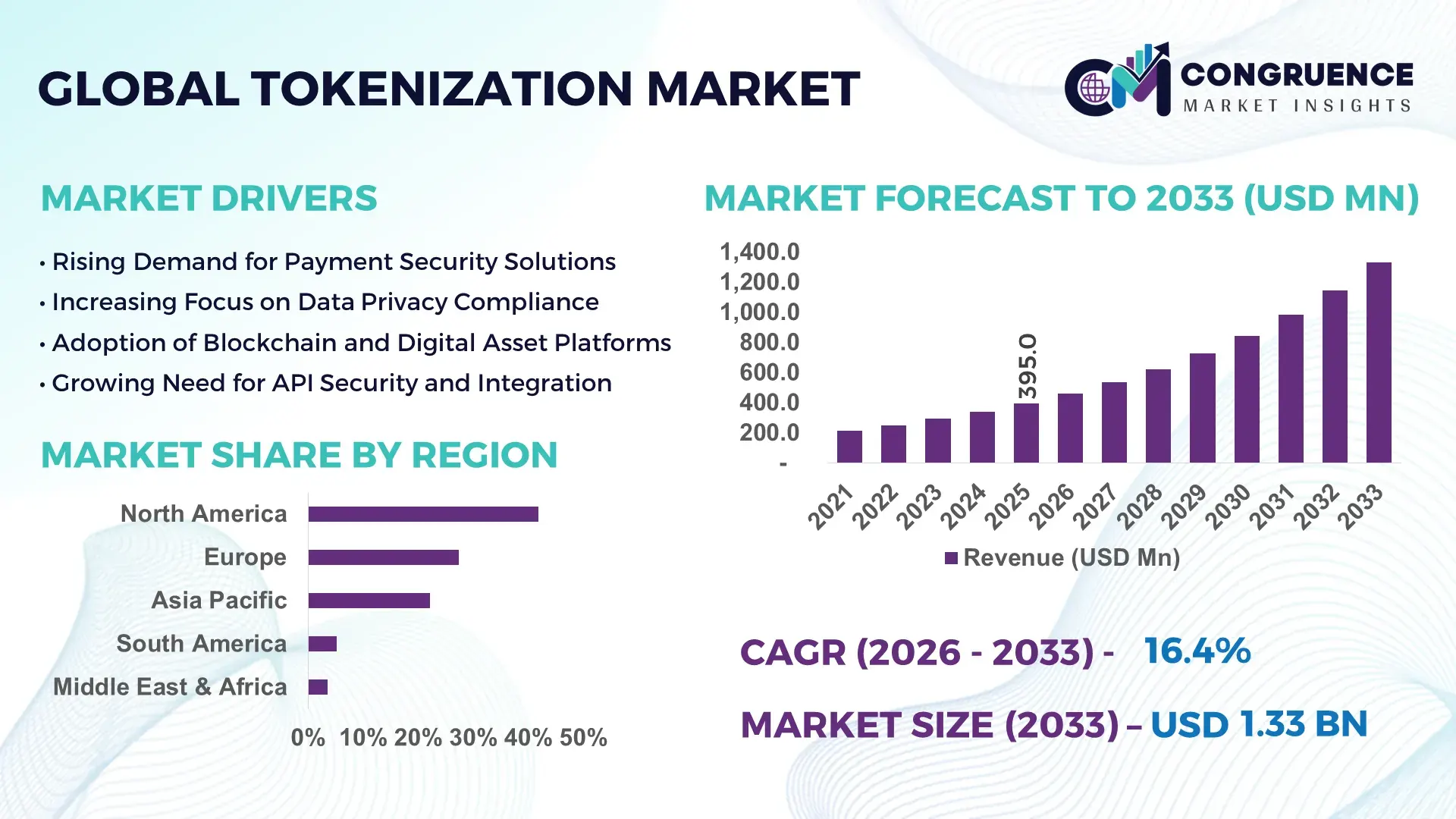
The Global Tokenization Market was valued at USD 395.0 Million in 2025 and is anticipated to reach a value of USD 1,331.1 Million by 2033 expanding at a CAGR of 16.40% between 2026 and 2033, according to an analysis by Congruence Market Insights. This growth is primarily driven by the accelerating adoption of digital payment security, real-world asset tokenization, and enterprise-grade blockchain infrastructure across financial services and regulated industries.
The United States dominates the Tokenization Market through large-scale production of secure tokenization platforms, sustained venture and corporate investment, and advanced deployment across banking, healthcare, and retail sectors. In 2024, over 68% of Tier-1 U.S. banks had implemented network tokenization for card payments, processing more than 95 billion tokenized transactions annually. Annual investment in blockchain and tokenization infrastructure exceeded USD 6.8 billion, with more than 1,200 active enterprise pilots in capital markets, healthcare data security, and digital identity. Cloud-native tokenization systems in the U.S. now support over 72% of Fortune 500 companies’ sensitive data workflows, reflecting deep integration into production-scale enterprise environments.
Market Size & Growth: USD 395.0 Million in 2025, projected to reach USD 1,331.1 Million by 2033 at 16.40% CAGR, driven by rising digital payment security and asset digitization.
Top Growth Drivers: Digital payments adoption 42%, enterprise data protection penetration 37%, blockchain integration rate 31%.
Short-Term Forecast: By 2028, automated token lifecycle management is expected to reduce data breach exposure by 28%.
Emerging Technologies: Network tokenization, smart contract-based asset tokenization, privacy-preserving cryptography.
Regional Leaders: North America USD 520 Million by 2033 (banking-led adoption), Europe USD 410 Million (PSD3-driven compliance), Asia Pacific USD 300 Million (mobile payment integration).
Consumer/End-User Trends: 64% of digital wallet users now transact via tokenized credentials; B2B API usage growing at 34% annually.
Pilot or Case Example: In 2024, a U.S. card network reduced fraud losses by 23% through network tokenization deployment.
Competitive Landscape: Visa ~22%, Mastercard, Thales, Marqeta, Entrust, Giesecke+Devrient.
Regulatory & ESG Impact: PCI DSS 4.0 and GDPR driving 41% of enterprise deployments for compliance.
Investment & Funding Patterns: Over USD 8.2 Billion invested globally in tokenization and blockchain security since 2022.
Innovation & Future Outlook: Convergence of tokenization with AI-driven fraud detection and programmable finance platforms.
Tokenization is increasingly applied across banking, healthcare, retail, and capital markets, with payments contributing nearly 46% of deployments, followed by data security at 29% and asset tokenization at 17%. Recent innovations in network tokenization, dynamic token refresh, and multi-cloud key management are reshaping enterprise security architectures. Regulatory digital identity frameworks and cross-border payment reforms are accelerating adoption in Asia Pacific and Europe, while programmable securities and fractional ownership models are shaping future growth pathways.
Tokenization has become a strategic pillar for digital trust, data protection, and financial infrastructure modernization. Enterprises increasingly view tokenization as a core layer of cyber-resilience, with network tokenization delivering 35% lower fraud rates compared to traditional static encryption. In payments, EMV tokenization delivers 28% improvement in authorization success compared to legacy PAN-based systems, directly improving transaction efficiency and customer experience.
North America dominates in transaction volume, while Asia Pacific leads in adoption with over 61% of mobile payment users transacting via tokenized credentials. By 2028, AI-driven fraud analytics integrated with tokenization platforms is expected to cut false-positive declines by 32% and reduce manual review costs by 25%.
Firms are committing to ESG improvements such as 40% reduction in paper-based financial documentation by 2030 through digital identity and tokenized records. In 2024, a European clearing house achieved a 21% settlement cycle reduction through tokenized bond issuance and smart contract automation.
Looking ahead, the Tokenization Market is positioned as a pillar of resilience, compliance, and sustainable growth, enabling programmable finance, secure data sharing, and scalable digital asset ecosystems across regulated industries.
The Tokenization Market is shaped by the convergence of digital payments, data privacy regulation, and distributed ledger technologies. Rising transaction volumes, increasing cyber risk exposure, and regulatory pressure to protect sensitive information are pushing enterprises toward token-based security architectures. Financial institutions are replacing static identifiers with dynamic tokens across cards, wallets, and APIs, while capital markets are adopting tokenized securities to shorten settlement cycles and reduce counterparty risk. Cloud-native deployment models, API standardization, and interoperability frameworks are accelerating multi-sector adoption. At the same time, integration complexity, governance requirements, and cross-border regulatory alignment continue to influence enterprise deployment strategies.
Global digital payment volumes exceeded 1.3 trillion transactions in 2024, with over 62% of card-not-present transactions now processed via tokenized credentials. Large retailers report 19% lower fraud rates after adopting network tokenization. Mobile wallet penetration above 70% in developed markets is accelerating backend token deployment. Banks implementing end-to-end tokenization have reduced sensitive data storage footprints by 44%, lowering breach exposure and compliance costs. These measurable gains are making tokenization a default architecture in modern payment ecosystems.
Over 48% of mid-tier banks still operate on core systems older than 15 years, limiting seamless token integration. Integration projects average 14–18 months and require 25–30% higher IT budgets compared to greenfield deployments. Interoperability gaps between legacy HSMs, cloud KMS platforms, and blockchain networks delay enterprise rollouts. Governance complexity and fragmented standards across regions further slow large-scale migration, particularly in emerging economies.
Tokenized securities issuance surpassed USD 18 billion in cumulative volume by 2024, with settlement times reduced from T+2 to near real-time. Fractional ownership platforms are expanding retail access to real estate and private equity, increasing investor participation by 27%. Custodians adopting token-based asset servicing report 33% lower reconciliation workloads. These structural shifts create long-term opportunities across capital markets, insurance, and trade finance.
More than 40 national frameworks govern digital assets and data protection, creating compliance fragmentation. Cross-border tokenized transactions face up to 22% higher legal and operational costs due to licensing duplication. Inconsistent treatment of tokenized securities across jurisdictions delays multi-market issuance. Auditability, data residency, and key custody rules add operational overhead, constraining rapid global scale-up.
Network Tokenization Expansion: Card networks processed over 95 billion tokenized transactions in 2024, with authorization success rates improving by 6–9% versus legacy PAN routing.
Tokenized Securities Adoption: More than 320 tokenized bond issuances were recorded globally, cutting settlement cycles by 45% and reducing operational errors by 31%.
Cloud-Native Security Integration: Over 58% of new tokenization deployments are now cloud-native, enabling 40% faster provisioning and 27% lower infrastructure costs.
Digital Identity Convergence: Government-backed digital ID programs now cover 1.2 billion users, with tokenized identity reducing onboarding fraud by 34% in financial services.
The Tokenization Market is segmented by type, application, and end-user, reflecting how security architectures, asset digitization frameworks, and data-protection needs vary across industries. By type, network and vault-based tokenization dominate enterprise deployments due to their scalability and regulatory acceptance, while blockchain-based and format-preserving tokenization are gaining traction in asset digitization and analytics-driven environments. Application-wise, payment security leads adoption as digital transactions and mobile wallets expand globally, followed by data protection, identity management, and capital markets use cases such as tokenized securities and real-time settlement. From an end-user perspective, financial services institutions account for the largest installed base, supported by regulatory mandates and fraud-reduction imperatives, while healthcare, retail, and government sectors are accelerating adoption to secure sensitive records and enable digital identity frameworks. Across all segments, enterprises increasingly prioritize dynamic token refresh, API-based interoperability, and cloud-native deployment to reduce breach exposure, support cross-border transactions, and meet evolving compliance standards.
Network tokenization currently accounts for approximately 46% of total deployments, driven by its widespread integration into card networks, digital wallets, and e-commerce gateways. Its dominance is supported by measurable fraud reduction of 20–30% in card-not-present transactions and improved authorization success rates of 6–9% compared to static identifiers. Vault-based tokenization holds around 28% of adoption, particularly in regulated enterprises requiring centralized control over sensitive datasets and cryptographic keys. However, blockchain-based tokenization is rising fastest, expanding at an estimated 22.8% CAGR, fueled by demand for tokenized securities, real-world asset digitization, and programmable settlement layers in capital markets.
Other types, including format-preserving tokenization and dynamic tokenization for analytics workloads, collectively contribute 26% of the market, serving niche use cases such as legacy system compatibility, data masking for AI training, and privacy-preserving analytics. These formats are increasingly relevant in healthcare and telecom environments where data structure integrity must be preserved.
In 2025, a major U.S. card network expanded network tokenization across 12 million merchants, resulting in a documented 24% reduction in e-commerce fraud incidents within 12 months.
Payment security leads all applications with a 44% share, reflecting the rapid expansion of digital wallets, contactless payments, and cross-border e-commerce. Tokenized credentials now support over 60% of mobile wallet transactions globally, significantly lowering exposure to card data theft. Data protection and privacy compliance applications account for 27%, driven by regulatory mandates requiring encryption or tokenization of personally identifiable information across enterprise systems.
However, asset tokenization is the fastest-growing application segment, advancing at an estimated 24.6% CAGR, supported by rising issuance of tokenized bonds, real estate fractions, and programmable securities. Settlement cycle compression from T+2 to near real time and reconciliation workload reductions of over 30% are accelerating institutional interest. Other applications—including digital identity, loyalty platforms, and secure API data exchange—together represent 29% of deployments.
Consumer and enterprise trends reinforce this segmentation: in 2025, 41% of global enterprises reported piloting tokenized identity or payment systems for customer experience platforms, while 64% of mobile wallet users preferred tokenized credentials over static card storage.
In 2025, a European clearing institution implemented tokenized bond settlement for sovereign debt instruments, reducing settlement failures by 18% and shortening post-trade processing time by 21%.
Financial services institutions represent the largest end-user group, accounting for approximately 49% of total adoption. Banks and payment processors deploy tokenization to reduce fraud exposure, meet PCI DSS 4.0 compliance, and support omnichannel payments. Retail and e-commerce platforms follow with 21%, leveraging tokenization to protect customer payment data and enable one-click checkout experiences.
The healthcare sector is the fastest-growing end-user segment, expanding at an estimated 23.2% CAGR, driven by stricter data privacy mandates, increased digitization of medical records, and the rise of telehealth platforms. Tokenization is being applied to patient identifiers, insurance records, and genomic datasets to reduce breach exposure by over 35% in pilot deployments. Government and public-sector agencies, along with telecom and energy firms, collectively contribute 30%, focusing on digital identity programs, citizen data protection, and secure IoT authentication.
Adoption indicators highlight momentum: in 2025, 38% of enterprises globally reported deploying or piloting tokenization for sensitive data workflows, and 42% of U.S. hospitals were testing tokenized patient record systems to support interoperability and AI analytics.
In 2025, a national health authority deployed tokenization across 180 hospitals, securing over 95 million patient records and reducing unauthorized data access incidents by 29% within one year.
North America accounted for the largest market share at 41.8% in 2025 however, Region Asia-Pacific is expected to register the fastest growth, expanding at a CAGR of 21.6% between 2026 and 2033.
North America processed over 95 billion tokenized payment transactions in 2025, supported by more than 6,500 regulated financial institutions and 72% enterprise penetration of tokenization in Tier-1 banks. Europe followed with 27.4% share, driven by over 4,200 GDPR-compliant deployments and 38 national digital identity programs. Asia-Pacific accounted for 22.1%, supported by 1.4 billion mobile wallet users and more than 320 large-scale fintech platforms integrating tokenization. South America and the Middle East & Africa together represented 8.7%, with more than 180 government-led digital ID and payment modernization projects underway. Regional divergence reflects payment digitization rates, regulatory maturity, cloud infrastructure density, and mobile-first consumer behavior.
North America holds approximately 41.8% of the global Tokenization Market, supported by the world’s largest installed base of card networks, cloud service providers, and regulated financial institutions. Over 68% of Tier-1 banks and 59% of large retailers have deployed network tokenization across e-commerce and mobile channels. Key industries driving demand include banking, healthcare, insurance, and digital commerce, with healthcare alone accounting for 14% of regional deployments. Regulatory developments such as PCI DSS 4.0 enforcement and federal data privacy frameworks have accelerated enterprise migration toward token-based data protection. Technologically, more than 74% of new deployments are cloud-native and API-integrated. A leading local player expanded tokenization services to 12 million merchants, reducing card-not-present fraud by 24% within one year. Consumer behavior shows higher adoption in healthcare and finance, with 61% of U.S. digital wallet users transacting primarily through tokenized credentials.
Europe accounts for around 27.4% of global adoption, with Germany, the United Kingdom, and France collectively contributing over 62% of regional deployments. More than 4,200 enterprises operate GDPR-aligned tokenization systems to protect personal and financial data. Regulatory bodies enforcing PSD2, upcoming PSD3, and national digital identity programs are key demand drivers. Emerging technologies such as tokenized securities platforms and privacy-preserving analytics are expanding across over 35 regulated exchanges and clearing institutions. A regional payments provider deployed network tokenization across 9 countries, supporting 18 billion annual transactions. Consumer behavior reflects strong compliance-led adoption, with 57% of European enterprises prioritizing explainable and auditable token workflows to meet regulatory reporting and data residency requirements.
Asia-Pacific represents approximately 22.1% of global volume and ranks as the fastest-growing region by deployment count. China, India, and Japan together account for over 71% of regional tokenized transactions. The region supports more than 1.4 billion mobile payment users and processes over 420 billion digital transactions annually, creating a large addressable base for tokenization. Infrastructure trends include rapid expansion of cloud data centers, with over 520 new hyperscale facilities added since 2022. Innovation hubs in Singapore, Shenzhen, and Bengaluru lead blockchain and digital identity pilots. A major regional fintech integrated tokenization into 45 million active wallets, reducing credential theft incidents by 31%. Consumer behavior shows growth driven by e-commerce and mobile apps, with 66% of users preferring tokenized in-app payments.
South America holds around 5.2% of global share, led by Brazil and Argentina, which together contribute over 68% of regional deployments. Financial inclusion programs and real-time payment systems support more than 210 million active digital accounts. Infrastructure modernization in banking and telecom is driving token adoption across mobile wallets and government benefit platforms. Government incentives for cashless payments and cross-border trade digitization support regional momentum. A Brazilian payments platform deployed tokenization across 3.8 million SMEs, reducing fraud-related chargebacks by 19%. Consumer behavior is tied to media and localization, with 54% of users preferring tokenized credentials for streaming, gaming, and digital subscription services.
The Middle East & Africa region represents approximately 3.5% of global deployments, with the UAE and South Africa contributing over 61% of activity. Regional demand is driven by oil & gas digitization, construction project payments, and government digital identity programs. More than 95 national e-government platforms now integrate token-based authentication. Technological modernization includes rollout of 5G-backed payment systems and sovereign cloud infrastructure. A Gulf-based bank deployed enterprise tokenization across 420 government and energy-sector clients, reducing unauthorized data access by 27%. Consumer behavior shows rising trust in digital services, with 49% of users preferring tokenized authentication for government and utility platforms.
United States – 34.6% Market Share: High transaction volume, advanced card networks, and deep enterprise adoption across finance and healthcare.
China – 18.9% Market Share: Massive mobile payment base, large-scale fintech platforms, and government-backed digital identity infrastructure.
The competitive environment in the Tokenization Market is increasingly dynamic and fragmented but rapidly consolidating around leading platforms and incumbent financial institutions. As of 2025, more than 260 active competitors operate globally, ranging from core tokenization software vendors and cloud-native orchestration platforms to large-scale payment networks and blockchain infrastructure providers. The top 5 companies collectively account for an estimated 38%–43% combined share, illustrating both competitive clustering and significant room for emerging players. Key strategic initiatives include major partnerships (e.g., bank–blockchain collaborations), platform enhancements, and expanded tokenization service offerings that blend network tokenization, vault-based systems, and distributed ledger technology.
Leading incumbents are investing heavily in cross‑enterprise interoperability standards and multi‑cloud support, with over 64% of tokenization deployments now API‑integrated for seamless integration into enterprise stacks. Innovation trends shaping competition include real‑time tokenized settlement engines, regulatory compliance frameworks embedded in token logic, and secure hardware modules for key management used in over 78% of enterprise solutions. Strategic alliances between payment processors, cloud service providers, and blockchain consortia have increased the market’s emphasis on security, scalability, and compliance, making tokenization platforms integral to digital transformation strategies in finance, healthcare, and retail.
The market is also witnessing mergers and acquisitions as larger players seek to absorb niche innovators—strengthening capabilities in areas such as dynamic token refresh, machine‑learning‑driven fraud detection, and cross‑border token interoperability—thereby reinforcing competitive differentiation among top-tier participants.
Thales
JPMorgan Chase
Intercontinental Exchange (ICE)
BNY Mellon
Goldman Sachs
Securitize
TokenEx
Protegrity
CipherCloud
Elliptic
SolidBlock
The Tokenization Market is underpinned by a suite of emerging and established technologies that collectively enhance security, interoperability, and operational efficiency. Cloud‑native tokenization frameworks dominate new deployments, with over 74% of enterprises implementing API‑driven, multi‑tenant architectures that decouple sensitive data from applications while enabling seamless scaling across hybrid environments. Cryptographic advancements such as format‑preserving tokenization, vaultless token networks, and hardware security modules (HSMs) provide robust data protection layers critical for compliance with stringent data privacy regimes. Blockchain and distributed ledger technologies remain central for real‑world asset (RWA) tokenization, enabling programmable settlement, immutable audit trails, and fractional ownership structures; institutional pilots on public and permissioned ledgers now process billions of tokenized transactions annually across equities, fixed income, and commodities.
Interoperability standards are evolving rapidly to bridge tokenization platforms with enterprise systems, identity providers, and payment networks. APIs supporting ISO 20022 messaging and emerging token lifecycle management protocols are enabling seamless token issuance, refresh, and retirement across diverse ecosystems. Artificial intelligence and machine learning are being integrated to enhance token analytics, anomaly detection, and compliance monitoring, addressing operational risks and regulatory reporting requirements.
Edge computing and secure enclave technologies are emerging to support on‑device tokenization for IoT and mobile use cases, reducing latency and improving privacy guarantees in consumer and industrial applications. Advances in post‑quantum cryptography are also influencing roadmap planning, with forward‑looking organizations exploring quantum‑resilient token schemes to future‑proof digital asset security. Collectively, these technological trends position tokenization as a foundational component of secure digital infrastructure across financial services, healthcare, retail, and government sectors, supporting data protection, liquidity innovation, and new business models.
• In June 2024, Visa announced it has issued its 10 billionth token globally, with these tokens generating over USD 40 billion in incremental e‑commerce value and preventing approximately USD 650 million in fraud over the past year. Visa also noted that roughly 29 % of all its processed transactions now use tokens, marking widespread adoption of its tokenization technology. Source: www.visa.com
• In February 2025, Visa reported that its Visa Token Service reached 1 billion tokens issued across Latin America & the Caribbean, which contributed to an uplift of more than USD 3.5 billion in digital commerce volume in 2024 and aided in reducing fraud by up to 30 % in the region, underlining the growing impact of tokenization on regional payment ecosystems. Source: www.visa.gp
• In October 2024, Visa introduced the Visa Tokenized Asset Platform (VTAP)—a new solution enabling banks to issue and manage fiat‑backed tokens on blockchain networks, with live pilot plans expected in 2025. VTAP is designed to support minting, burning, and transferring of tokens and to extend tokenization beyond payments into broader digital asset operations. Source: www.visa.com
• In February 2024, Mastercard launched MDES Token Connect in India, a platform that enables issuer banks to tokenize payment credentials through mobile and internet banking. This initiative simplifies secure token issuance for debit and credit cards, allowing seamless integration with merchants, digital wallets, and e‑commerce platforms while strengthening digital payment security. Source: www.mastercard.com
The Tokenization Market Report provides a comprehensive review of the technology, application, and industry dimensions of tokenization solutions across global regions. The report covers product type segmentation including network tokenization, vault‑based tokenization, blockchain and distributed ledger token frameworks, and additional formats supporting cloud and edge deployment models. It examines application areas such as payment security, data protection, identity management, real‑world asset tokenization, and secure API ecosystems. The report also offers end‑user insights into financial services, healthcare, retail, government, and emerging digital economy sectors, highlighting adoption rates, use case maturity, and technology integration patterns.
Geographically, the scope includes North America, Europe, Asia‑Pacific, South America, and Middle East & Africa, with detailed regional breakdowns of deployment volumes, regulatory landscapes, consumer behavior patterns, and infrastructure readiness. Coverage extends to enterprise technology stacks, interoperability protocols, encryption standards, and emerging innovations such as AI‑enhanced token analytics, API‑first orchestration platforms, quantum‑resilient token schemes, and mobile token solutions for IoT. Moreover, the report explores competitive dynamics through profiling key players, strategic partnerships, product launches, and industry consolidation patterns.
The report further identifies emerging and niche segments such as tokenized carbon credits, fractional real estate tokens, and decentralized finance (DeFi) integrations, detailing how these areas broaden the market’s relevance beyond traditional payment security. By analyzing deployment case studies, adoption hurdles, and innovation trends, the report equips business leaders and analysts with actionable insights for strategic planning, investment prioritization, and technology selection in a rapidly evolving digital landscape.
| Report Attribute / Metric | Details |
|---|---|
| Market Revenue (2025) | USD 395.0 Million |
| Market Revenue (2033) | USD 1,331.1 Million |
| CAGR (2026–2033) | 16.40% |
| Base Year | 2025 |
| Forecast Period | 2026–2033 |
| Historic Period | 2021–2025 |
| Segments Covered |
By Type
By Application
By End-User Insights
|
| Key Report Deliverables | Revenue Forecast, Market Trends, Growth Drivers & Restraints, Technology Insights, Segmentation Analysis, Regional Insights, Competitive Landscape, Regulatory & ESG Overview, Recent Developments |
| Regions Covered | North America, Europe, Asia-Pacific, South America, Middle East & Africa |
| Key Players Analyzed | Visa, Mastercard, IBM, Thales, JPMorgan Chase, Intercontinental Exchange (ICE), BNY Mellon, Goldman Sachs, Securitize, TokenEx, Protegrity, CipherCloud, Elliptic, SolidBlock |
| Customization & Pricing | Available on Request (10% Customization Free) |




