
Reports
The Global Toilet Seat Market was valued at USD 5,789.2 Million in 2025 and is anticipated to reach a value of USD 8,884.6 Million by 2033 expanding at a CAGR of 5.5% between 2026 and 2033. Growth is driven by residential renovation, hospitality construction, replacement of aging sanitaryware, and rising adoption of soft-close, heated, bidet-integrated, antimicrobial, and sensor-enabled toilet seats.
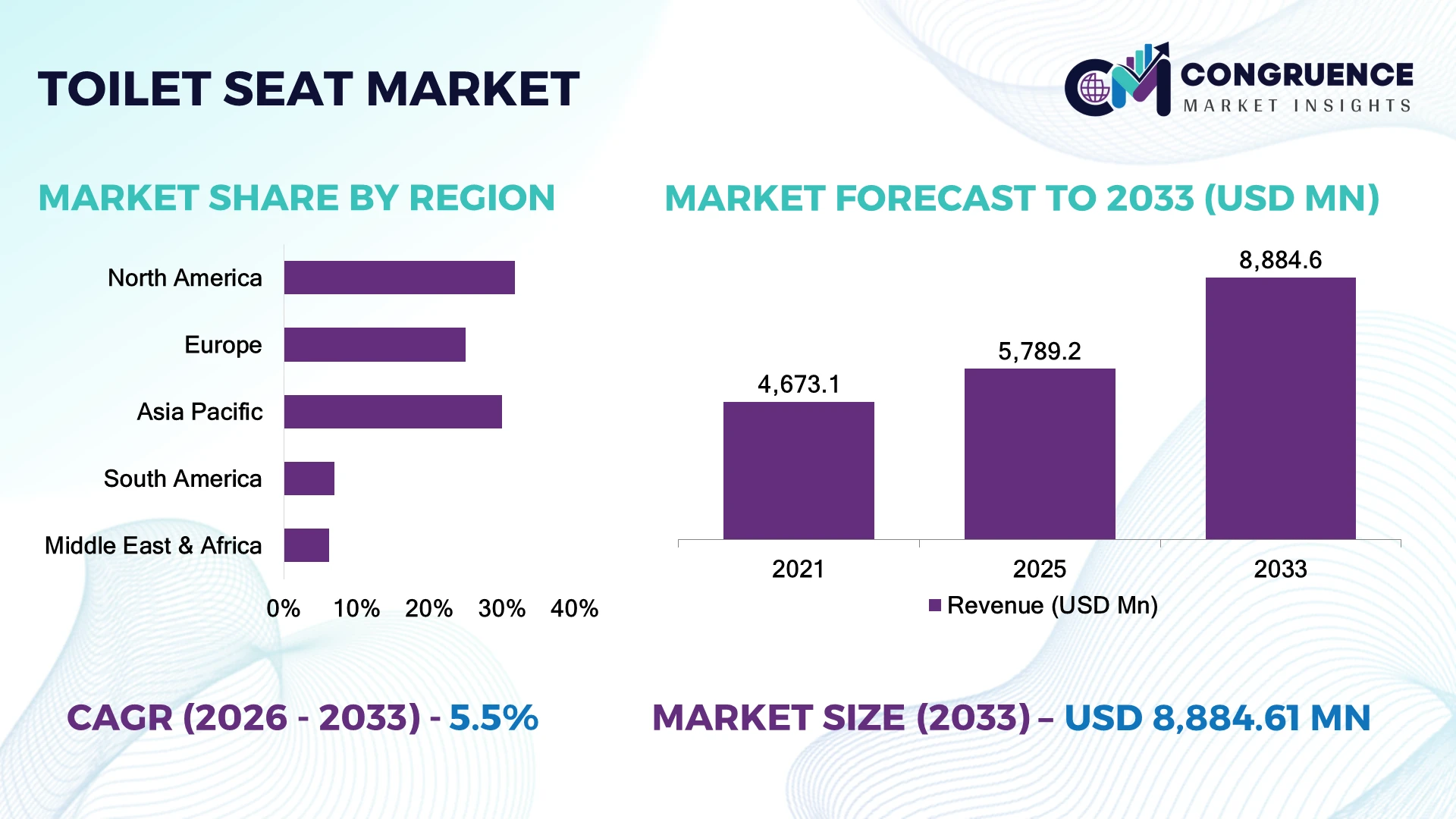
China remains the dominant manufacturing and consumption base, representing approximately 30% of global toilet-seat demand and supported by large sanitaryware, bathroom-fixture, and construction supply chains. Japan has substantially higher smart-seat penetration, with electronic bidet seats established across a large share of households, while India remains more price-sensitive and replacement-led. European energy-efficiency requirements are also accelerating demand for lower-power electronic models. Post-Red Sea freight disruption, manufacturers are increasing regional inventories and localized assembly to reduce delivery exposure by roughly 10–15%.
Strategically, suppliers should prioritize smart functionality, durable materials, localized production, and multi-channel distribution rather than competing solely on basic seat pricing.
Market Size & Growth: USD 5,789.2 million in 2025 to USD 8,884.6 million by 2033 at 5.5% CAGR, driven by smart-seat adoption and bathroom renovation.
Top Growth Drivers: Smart-seat adoption 8–12%; renovation 5–7%; hospitality construction 4–6%.
Short-Term Forecast: By 2028, automated manufacturing can improve production efficiency 10–15% and reduce material waste 5–8%.
Emerging Technologies: Heated seats, bidet integration, sensor flushing, antimicrobial surfaces, and app-connected controls are reshaping premium toilet-seat design.
Regional Leaders: Asia-Pacific approaches USD 2.8 billion; North America exceeds USD 1.4 billion; Europe approaches USD 1.3 billion, with smart features gaining adoption.
Consumer/End-User Trends: Premium electronic and bidet-equipped seats are expanding approximately 8–10% annually within advanced bathroom-fixture channels.
Pilot/Case Example: 2026 smart-bathroom installations using occupancy sensors target 10–15% lower unnecessary water and energy consumption.
Competitive Landscape: Chinese manufacturers lead volume supply with roughly 30% production exposure; TOTO, Kohler, LIXIL, Bemis, and Roca compete across premium and mass-market segments.
Regulatory & ESG Impact: Water-saving designs can reduce unnecessary flushing-related consumption by 10–20%, strengthening sustainable bathroom specifications.
Investment & Funding: More than USD 200 million is being directed across sanitaryware automation, smart-bathroom manufacturing, product development, and regional capacity expansion.
Innovation & Future Outlook: Antimicrobial polymers, heated bidet functions, sensor interfaces, quick-release designs, and connected bathroom ecosystems are shifting competition toward functionality and lifecycle value.
The Toilet Seat Market increasingly spans conventional plastic and polypropylene seats, premium thermoset models, soft-close mechanisms, heated bidet seats, antimicrobial surfaces, and smart bathroom interfaces. Electronic and bidet-integrated products are gaining traction in higher-income markets, while replacement and renovation remain dominant volume drivers. Supply-chain localization after global freight disruptions is encouraging manufacturers to regionalize inventories and prioritize modular product architectures, creating a natural transition toward strategic product differentiation.
Toilet seats are becoming a more strategic sanitaryware category as bathroom renovation, hospitality development, aging-in-place requirements, and smart-home adoption shift purchasing from basic replacement toward functionality, hygiene, and lifecycle value. Manufacturers increasingly compete through soft-close durability, antimicrobial materials, bidet integration, heating, and sensor-enabled features rather than seat dimensions alone. Supply-chain restructuring is also encouraging localized molding, assembly, and inventory.
Technology is widening the performance gap between conventional and connected products. Automated molding and robotic finishing can improve manufacturing productivity by approximately 10–15% while reducing material waste by 5–8%. Japan and South Korea lead smart-bathroom adoption, whereas India, Southeast Asia, and Latin America remain more volume-driven and price-sensitive. This creates differentiated investment priorities across markets.
During 2026–2028, manufacturers will emphasize electronic bidet integration, antimicrobial surfaces, low-energy heating, occupancy sensing, and modular replacement components. A practical deployment involves hotels installing durable soft-close seats with quick-release mechanisms, reducing maintenance time and simplifying room turnover. Companies are therefore expanding premium product lines, partnering with bathroom-fixture distributors, and regionalizing production. Competitive advantage will increasingly depend on combining reliable hardware, differentiated hygiene features, efficient manufacturing, and localized fulfillment.
Smart bathroom adoption is increasing the value mix of toilet seats as consumers and hospitality operators shift toward heated, bidet-integrated, soft-close, and sensor-enabled products. Premium electronic seats are expanding approximately 8–12%, while bidet-equipped formats are gaining 6–10% adoption across developed Asian markets. Japan remains the technology benchmark, while China is scaling smart sanitaryware manufacturing. Manufacturers are responding with integrated heating, water-pressure controls, deodorization, and remote diagnostics. The non-obvious growth lever is replacement: quick-release and modular electronic assemblies allow consumers to upgrade functionality without replacing the complete toilet, creating a recurring aftermarket opportunity and lowering installation barriers. Companies are therefore prioritizing modular platforms and bathroom-fixture partnerships.
Smart toilet seats carry substantially higher component and assembly costs than conventional polypropylene or thermoset models. Electronic products can require 20–35% more bill-of-material value because of heating elements, pumps, sensors, control boards, and water-management components. Imported electronic components can represent 15–25% of premium-seat input costs, exposing manufacturers to currency and logistics volatility. China-based producers have an advantage through concentrated electronics and plastics supply chains, while European manufacturers face higher labor and compliance costs. Red Sea shipping disruptions have also encouraged larger inventory buffers, tying up working capital. Companies are mitigating exposure through localized sourcing, standardized electronics platforms, dual suppliers, and longer procurement contracts. The key margin pressure is component complexity rather than plastic material cost.
Modular bidet-seat architectures offer an underpenetrated opportunity because they allow households, hotels, and rental properties to upgrade bathroom functionality without replacing the ceramic toilet. Retrofit installation can reduce project cost by approximately 20–30% versus complete smart-toilet replacement, while electronic bidet formats can command 15–25% higher selling prices than conventional seats. India, Southeast Asia, and Middle Eastern hospitality markets provide attractive expansion channels as premium bathroom specifications spread beyond luxury residential projects. Manufacturers are developing universal mounting systems, compact water-heating modules, antimicrobial surfaces, and app-enabled controls. The strategic opportunity is to build platform ecosystems: one standardized seat chassis can support multiple feature tiers, reducing tooling complexity while allowing companies to localize pricing and functionality for different markets.
Connected toilet seats introduce integration challenges involving electrical safety, water pressure, heating controls, firmware, sensors, and bathroom installation conditions. Smart models can contain 20–30% more functional components than conventional seats, increasing assembly complexity and potential service points. Wi-Fi-enabled products also introduce cybersecurity and software-maintenance requirements that traditional sanitaryware manufacturers did not face. Japan's mature smart-seat market demonstrates the importance of long-term component availability, while newer markets often lack trained installation and after-sales networks. Companies must therefore standardize control architectures, strengthen waterproofing and electrical protection, and establish regional service partnerships. The strategic challenge is lifecycle reliability: a sophisticated seat that requires frequent servicing can erode the premium positioning and increase warranty costs despite stronger initial margins.
Smart Features Move Downmarket: Heated seats, integrated bidets, deodorization, and sensor controls are moving beyond luxury bathrooms into upper-middle-market residential projects. Premium electronic formats are expanding roughly 8–12%, while modular bidet seats are gaining 6–10% adoption in developed Asian markets. Manufacturers are simplifying electronics to reduce component counts and broaden price accessibility.
Quick-Release Designs Gain Importance: Hotels and facility operators increasingly favor removable seats that accelerate cleaning and maintenance. Quick-release systems can reduce seat replacement or servicing time by approximately 20–30%, improving room turnover and maintenance productivity. Suppliers are redesigning hinges, mounting hardware, and seat geometry to support faster installation without compromising stability.
Antimicrobial Materials Strengthen Product Differentiation: Antimicrobial additives and easier-clean surface treatments are becoming stronger differentiators in healthcare, hospitality, and premium residential channels. Such treatments can reduce microbial surface persistence by approximately 90% under controlled conditions, while smoother thermoset surfaces reduce cleaning effort. Manufacturers are integrating antimicrobial polymers and coatings into higher-margin product ranges.
Manufacturing Shifts Toward Regional Buffers: Freight volatility and component shortages are encouraging toilet-seat manufacturers to increase regional inventory and diversify suppliers. Selected premium producers are carrying approximately 10–20% higher safety stocks for electronic components and specialized fittings. Chinese manufacturers retain scale advantages, while Indian and Southeast Asian suppliers are strengthening local assembly and distributor networks to shorten replenishment cycles.
Conventional toilet seats account for approximately 62% of global demand, supported by low unit cost, universal compatibility, simple installation, and high replacement volumes across residential and commercial properties. Soft-close seats represent around 21%, benefiting from quieter operation, improved hinge durability, and growing preference for premium bathroom fittings. Smart/electronic seats account for roughly 12%, while other specialty formats contribute about 5%. Conventional products remain strongest in India, Southeast Asia, and price-sensitive replacement channels, whereas Japan and South Korea show substantially higher adoption of electronic functionality.
Smart/electronic seats are the fastest-growing type, with adoption increasing approximately 8–12% as bidet washing, heated surfaces, deodorization, and sensor controls move into mainstream premium bathrooms. Soft-close products remain the key bridge between commodity and premium categories, expanding approximately 6–8%. Manufacturers are responding through modular electronic platforms, standardized mounting systems, antimicrobial materials, and tiered feature packages. Investment is consequently shifting toward products that generate higher average selling value without requiring complete toilet replacement.
A 2026 Japanese survey of 4,700 households with warm-water bidet seats found 53% used the rear-spray function almost every time, while 77.4% reported feeling cleaner after use, confirming established consumer engagement with electronic seat functionality.
Residential applications represent approximately 68% of global toilet-seat demand, reflecting replacement cycles, new housing, bathroom renovation, and growing preference for upgraded fixtures. Commercial buildings account for around 14%, hospitality approximately 10%, and healthcare and institutional facilities about 8%. Residential demand is strongest for conventional and soft-close models, while premium households increasingly purchase heated or bidet-integrated seats. Commercial and institutional buyers place greater emphasis on durability, vandal resistance, cleaning efficiency, and standardized replacement dimensions.
Hospitality is the fastest-growing application, expanding approximately 8–10% as hotels upgrade bathrooms to differentiate guest experience and reduce maintenance intervention. Smart and soft-close formats are gaining traction because quick-release mechanisms can reduce servicing time by approximately 20–30%. Residential renovation remains the largest demand pool, but higher-value hospitality installations increasingly influence product specifications. Manufacturers are responding with commercial-grade hinges, modular electronics, antimicrobial surfaces, and distributor partnerships. The strategic implication is that suppliers can improve margins by adapting premium residential technologies into durable, service-efficient commercial configurations.
The 2025 U.S. bathroom-renovation survey found 84% of homeowners used professional contractors for bathroom renovations, while major bathroom remodel spending increased to a median USD 22,000, reinforcing professional specification influence over sanitaryware selection.
Households represent approximately 70% of global toilet-seat consumption because of the enormous installed base, recurring replacement requirements, and bathroom renovation activity. Hospitality operators account for around 12%, commercial offices and retail facilities approximately 10%, while healthcare and institutional users contribute about 8%. Household buyers remain highly price-sensitive in emerging markets but increasingly select soft-close, antimicrobial, heated, and bidet-enabled products in Japan, South Korea, North America, and Western Europe.
Hospitality and healthcare are the fastest-changing end-user groups, with premium seat adoption increasing approximately 8–10% as operators prioritize hygiene, durability, accessibility, and simplified maintenance. Professional procurement also creates stronger specification requirements than household purchasing, increasing demand for standardized dimensions and replacement compatibility. Manufacturers are targeting hotel chains and facility-management companies through bulk contracts, distributor partnerships, and procedure-specific product configurations, while direct-to-consumer channels remain important for residential upgrades. The competitive opportunity lies in converting institutional buyers from one-time replacement purchasing toward standardized multi-site product platforms.
Harvard’s 2025 housing research found bathroom remodeling represented 8.3% of U.S. home-improvement spending, while total improvement and maintenance expenditure reached approximately USD 405 billion, demonstrating the scale of the replacement and renovation ecosystem supporting household toilet-seat demand.
North America accounted for the largest market share at 31.8% in 2025 however, Asia-Pacific is expected to register the fastest growth, expanding at a CAGR of 6.3% between 2026 and 2033.
Bathroom Renovation Drives Premium Seat Replacement
North America represents approximately 31.8% of global toilet-seat demand, supported by high residential renovation expenditure, replacement of aging bathroom fixtures, and strong penetration of soft-close and elongated-seat formats. The United States dominates regional consumption, while Canada provides a smaller but specification-driven market. Premium buyers increasingly prioritize antimicrobial surfaces, quick-release hinges, bidet functions, and accessibility-oriented designs. U.S. bathroom remodeling activity continues to support replacement demand, with bathroom projects increasingly incorporating multiple upgraded fixtures rather than isolated seat replacement. Manufacturers are responding through retail partnerships, direct-to-consumer channels, and broader premium product portfolios. The region's competitive advantage is high replacement value: consumers are willing to pay for installation convenience and comfort features, allowing suppliers to expand margins through differentiated functionality rather than volume alone.
United States Market Outlook: The United States is the dominant North American market because of its large housing stock, established home-improvement ecosystem, and strong renovation activity. Professional remodeling channels strongly influence specifications, while retail and e-commerce support rapid replacement purchasing. Smart bidet seats remain a premium niche, but soft-close and quick-release products are increasingly mainstream. Suppliers with broad dimensional compatibility can reduce installation friction and address the country's highly fragmented toilet-base configurations.
Sustainability and Hygiene Reshape Product Specifications
Europe accounts for approximately 25% of global toilet-seat demand, with Germany, the United Kingdom, France, Italy, and Spain forming major consumption centers. Product specifications increasingly emphasize water efficiency, durable materials, hygienic surfaces, accessibility, and repairability. EU sustainability policy is strengthening attention toward product durability and resource efficiency, encouraging manufacturers to use longer-life components and recyclable materials. Premium bathroom renovation remains important in Germany and the United Kingdom, while Southern European markets show stronger hospitality and residential refurbishment demand. Manufacturers are responding with thermoset materials, antimicrobial coatings, soft-close hinges, and modular replacement components. The commercial advantage increasingly comes from extending product life and reducing maintenance rather than adding electronic functions to every product tier.
Germany Market Outlook: Germany is a strategically important European market because of its mature sanitaryware industry, high-quality bathroom standards, and strong renovation culture. Consumers and commercial buyers place substantial emphasis on durability, hygiene, and engineering quality. Manufacturers supplying Germany increasingly emphasize certified materials, robust hinge systems, and efficient production. Premium bathroom refurbishment provides a strong channel for soft-close and advanced ergonomic seats.
Smart Sanitaryware Scale Accelerates Manufacturing Advantage
Asia-Pacific represents approximately 30% of global toilet-seat demand and is the principal manufacturing base for plastic, thermoset, soft-close, and electronic bathroom products. China combines large-scale sanitaryware manufacturing with extensive domestic construction demand, while Japan leads advanced bidet-seat adoption and product engineering. Japanese electronic bidet seats integrate heating, washing, deodorization, and sensor controls, creating a significantly higher-value product mix than conventional markets. Manufacturers are expanding automated molding, precision hinge production, electronic assembly, and export-oriented capacity. China's large supplier ecosystem also enables shorter component sourcing cycles and competitive pricing. The strategic shift is toward integrated smart sanitaryware platforms, allowing manufacturers to standardize core components while adapting feature sets and pricing for different countries.
Japan Market Outlook: Japan is the region's technology benchmark, with warm-water bidet seats deeply established in residential and hospitality settings. A 2026 household survey found 77.4% of users felt cleaner after using bidet functions, while 53% used rear-spray functionality almost every time. Manufacturers therefore compete on water temperature control, energy efficiency, hygiene, deodorization, and ergonomic design rather than basic seat construction.
Residential Replacement Meets Premium Bathroom Upgrades
South America accounts for approximately 7% of global toilet-seat demand, with Brazil representing the largest commercial market because of its population, construction activity, and established sanitaryware distribution network. Conventional polypropylene and thermoset seats remain dominant, but soft-close and antimicrobial products are gaining share in higher-income residential and hospitality projects. Currency volatility and imported-component dependence continue to influence premium electronic-seat pricing. Manufacturers and distributors are responding through localized inventory, broader domestic sourcing, and partnerships with bathroom-fixture retailers. Brazil's established ceramics and sanitaryware manufacturing ecosystem provides a useful distribution advantage, while neighboring markets remain more dependent on imports. The opportunity is strongest where suppliers can combine affordable upgraded features with reliable local fulfillment.
Brazil Market Outlook: Brazil is the region's principal demand center, supported by residential construction, bathroom renovation, hospitality, and a developed sanitaryware manufacturing base. Local production reduces dependence on imported basic components and supports faster replenishment. Suppliers are increasingly positioning soft-close, antimicrobial, and premium thermoset models through specialized retail and construction channels, while electronic bidet seats remain concentrated in higher-income urban households.
Hospitality Investment Elevates Premium Bathroom Specifications
Middle East & Africa demand is increasingly linked to hotel construction, residential development, healthcare infrastructure, and premium commercial real estate. Saudi Arabia and the United Arab Emirates are the strongest premium markets, where hospitality projects place greater emphasis on bathroom aesthetics, hygiene, accessibility, and durable fittings. Saudi Arabia's large-scale tourism and hospitality pipeline is creating recurring procurement opportunities for standardized bathroom components, including soft-close and premium electronic seats. Manufacturers are strengthening distributor partnerships and regional warehousing to shorten project delivery cycles. Premium products can command approximately 15–25% higher pricing than conventional seats when integrated with bidet, heating, antimicrobial, or accessibility features. The strategic opportunity is project-based procurement, where suppliers can secure multi-property contracts rather than relying solely on household replacement sales.
Saudi Arabia Market Outlook: Saudi Arabia is the region's most strategically significant market because of its expanding hospitality, residential, healthcare, and tourism infrastructure. Large hotel and mixed-use developments require standardized sanitaryware across multiple properties, creating attractive volume contracts. Suppliers with regional inventory and project-management capabilities can reduce delivery delays and provide consistent specifications across construction programs, while premium smart-seat adoption remains concentrated in luxury hospitality and high-end residential projects.
TOTO, LIXIL, Kohler, Roca, and Bemis compete across smart seats, premium sanitaryware, and mass-market replacement products, while Chinese manufacturers pressure established brands through cost and scale. The top five hold an estimated 34% combined share. Competition centers on price, hygiene technology, design, and distribution; smart products command 15–30% premiums, while modular designs can reduce installation costs 20–30%. TOTO and LIXIL emphasize bidet technology and integrated bathroom ecosystems, whereas regional manufacturers compete through flexible molding, private-label supply, and faster delivery. Players are expanding smart-seat portfolios, upgrading manufacturing automation, forming hospitality partnerships, and integrating electronics with sanitaryware platforms. The competitive shift is moving from standalone plastic seats toward connected, upgradeable bathroom systems. Entry barriers include tooling, electrical certification, water-system integration, brand recognition, retail distribution, and after-sales infrastructure. Winners will combine reliable smart functionality, scalable manufacturing, attractive design, broad compatibility, regional fulfillment, and disciplined component management to protect margins against established global brands.
TOTO Ltd.
LIXIL Corporation
Kohler Co.
Roca Group
Bemis Manufacturing Company
Villeroy & Boch AG
Geberit International AG
RAK Ceramics PJSC
Duravit AG
GROHE AG
Hindware Homes Limited
Jaquar Group
Hindustan Sanitaryware & Industries Limited
Cera Sanitaryware Limited
Toilet-seat technology is moving from conventional thermoset and polypropylene designs toward soft-close mechanisms, heated bidet systems, antimicrobial surfaces, sensors, and modular electronics. Automated molding and robotic finishing can improve production productivity by 10–15%, while precision hinge assembly reduces alignment defects by 5–8%. Adoption is strongest in Japan, South Korea, and premium North American bathrooms.
Connected seats are becoming the disruptive layer. Occupancy sensing, automatic deodorization, water-temperature control, and app-linked diagnostics can reduce unnecessary energy use by 5–10% and improve maintenance visibility by 10–15%. Compared with conventional fixed seats, modular WASHLET-compatible systems allow functionality upgrades without replacing the ceramic toilet, potentially reducing retrofit costs 20–30%. TOTO and LIXIL benefit from integrated electronics, proprietary water technologies, and established installation ecosystems. These capabilities simplify qualification across bathroom platforms and reduce SKU proliferation for global distributors.
During 2026–2028, health-monitoring functions, electrolyzed-water cleaning, low-energy heating, and upgradeable mounting systems will expand. TOTO’s 2025 stool-scan technology demonstrates the move from hygiene toward bathroom-based wellness. Manufacturers that combine standardized mechanical platforms with differentiated electronics can shorten product-development cycles, localize feature packages, and protect margins. The competitive advantage will shift toward interoperable hardware, software-enabled service, water efficiency, reliable after-sales support, and modular upgrades rather than seat aesthetics alone.
April 2026 TOTO introduced a modular WC Element separating the flush frame from its motor, enabling later WASHLET and automatic-flush upgrades. The system supports staged modernization, reducing replacement barriers and strengthening upgrade opportunities across residential and hospitality bathrooms. Source: toto.com
April 2026 Kohler introduced the Leap smart toilet and PureWash E860 dual-wand bidet seat, adding front-wash technology for women's hygiene. The launches expand premium seat functionality and strengthen Kohler's smart-bathroom portfolio across comfort, hygiene, and personalized cleansing applications. Source: kohler.com
October 2025 Roca showcased In-Wash Vorea and Roca Connect for hospitality, combining smart toilets with cloud monitoring of water and energy use. The platform enables configuration and maintenance, strengthening facility-management efficiency and positioning connected bathrooms for hotel deployments. Source: roca.com
April 2025 LIXIL opened its Toilet Museum in Tokoname, Japan, featuring more than 50 historical artifacts across approximately 260 square meters. The facility reinforces sanitation innovation positioning and supports consumer education around Japanese toilet technology and product evolution. Source: newsroom.lixil.com
The Toilet Seat Market Report evaluates conventional, soft-close, smart/electronic, bidet-integrated, antimicrobial, and specialty seats across residential, commercial, hospitality, healthcare, and institutional applications. Regional coverage spans North America, Europe, Asia-Pacific, South America, and Middle East & Africa, with country-level analysis of manufacturing capacity, renovation activity, procurement structures, distribution networks, and smart-bathroom adoption.
The report examines thermoset and polypropylene materials, modular mounting systems, heated seats, bidet technology, sensor controls, antimicrobial surfaces, digital diagnostics, and resource-efficient designs. Coverage reflects residential applications at approximately 68% of demand and conventional seats near 62%, alongside faster-growing premium electronic formats. Competitive analysis evaluates 14 major participants, capacity strategies, partnerships, product innovation, and channel positioning. Findings support investment planning, geographic expansion, product-tier development, supplier selection, competitive positioning, and strategic market direction through 2033.
| Report Attribute/Metric | Report Details |
|---|---|
|
Market Revenue in 2025 |
USD 5,789.2 Million |
|
Market Revenue in 2033 |
USD 8,884.6 Million |
|
CAGR (2026 - 2033) |
5.5% |
|
Base Year |
2025 |
|
Forecast Period |
2026 - 2033 |
|
Historic Period |
2021 - 2025 |
|
Segments Covered |
By Type
By Application
By End-User
|
|
Key Report Deliverable |
Revenue Forecast, Growth Trends, Market Dynamics, Segmental Overview, Regional and Country-wise Analysis, Competition Landscape |
|
Region Covered |
North America, Europe, Asia-Pacific, South America, Middle East, Africa |
|
Key Players Analyzed |
TOTO Ltd., LIXIL Corporation, Kohler Co., Roca Group, Bemis Manufacturing Company, Villeroy & Boch AG, Geberit International AG, RAK Ceramics PJSC, Duravit AG, GROHE AG, Hindware Homes Limited, Jaquar Group, Hindustan Sanitaryware & Industries Limited, Cera Sanitaryware Limited |
|
Customization & Pricing |
Available on Request (10% Customization is Free) |




